
 My Inquiry
 My Account


Oil Pressure Sensor: Symptoms, Location, Testing and Replacement Guide
Article Details
An oil pressure sensor monitors pressure in the engine lubrication system and sends a pressure-related signal to the instrument cluster, engine control unit, or warning circuit. It helps detect loss of oil pressure, incorrect oil pressure readings, wiring faults, and pressure-related engine protection conditions.
The search term oil pressure sensor is often used for several related parts, including oil pressure switches, oil pressure senders, and engine oil pressure sensors. Some designs use a simple on/off switch for an oil warning lamp, while others use an analog pressure sensor or variable-resistance sender to provide a changing pressure signal.
This guide explains what an oil pressure sensor does, how it works, where it is commonly located, bad oil pressure sensor symptoms, testing methods, replacement considerations, oil pressure sensor socket use, common failure cases, and the electronics behind the pressure signal.
What Is an Oil Pressure Sensor?
An oil pressure sensor is a pressure-monitoring device installed in an engine oil passage. It detects pressure in the lubrication system and sends a signal to the gauge, warning light, ECU, or body control system. The signal may be an on/off switch state, a variable resistance, or an analog voltage depending on the sensor design.
| Item | Practical Meaning |
|---|---|
| Main function | Monitors engine oil pressure and reports pressure condition to the vehicle electronics |
| Common names | Oil pressure sensor, engine oil pressure sensor, oil pressure switch, oil pressure sender |
| Typical signal type | On/off switch, variable resistance, or analog voltage signal |
| Common vehicle symptoms | Oil warning light, wrong gauge reading, diagnostic trouble code, intermittent pressure warning |
| Important diagnostic rule | Confirm real oil pressure before assuming the sensor is faulty |
Oil Pressure Sensor vs Oil Pressure Switch
The terms oil pressure sensor and oil pressure switch are often used interchangeably, but they do not always describe the same electrical function. A switch usually changes state at a pressure threshold. A sensor or sender may provide a variable signal that changes with oil pressure.
| Item | Oil Pressure Switch | Oil Pressure Sensor / Sender |
|---|---|---|
| Output type | On/off state | Analog voltage, variable resistance, or pressure-related signal |
| Main use | Oil warning lamp or simple low-pressure detection | Gauge reading, ECU monitoring, diagnostics, pressure trend information |
| Typical wiring | One or two terminals depending on circuit design | Often three wires: supply, ground, and signal; some senders use different layouts |
| Failure behavior | Warning light may stay on, stay off, or flicker incorrectly | Gauge may read zero, maximum, unstable, or trigger a fault code |
| Testing method | Continuity, pressure threshold, circuit state | Voltage, resistance, signal sweep, supply and ground verification |
How an Oil Pressure Sensor Works
The sensor is connected to an oil gallery, oil filter housing, engine block passage, or another oil-pressure point. Engine oil pressure acts on an internal diaphragm, sensing element, or pressure switch mechanism. The sensor then converts this pressure condition into an electrical output.
In a simple oil pressure switch, pressure moves a contact mechanism. When pressure is below or above a threshold, the switch changes state and the warning circuit reacts. In a pressure sender or analog sensor, the pressure changes resistance or output voltage, allowing the gauge or ECU to track pressure changes more continuously.
Modern pressure sensors often include sensing elements and signal-conditioning electronics. TE Connectivity describes pressure sensors as devices that sense pressure and convert the applied pressure into an electrical signal for measurement, monitoring, or control. (TE Connectivity, Pressure Sensors)
Oil Pressure Sensor Location
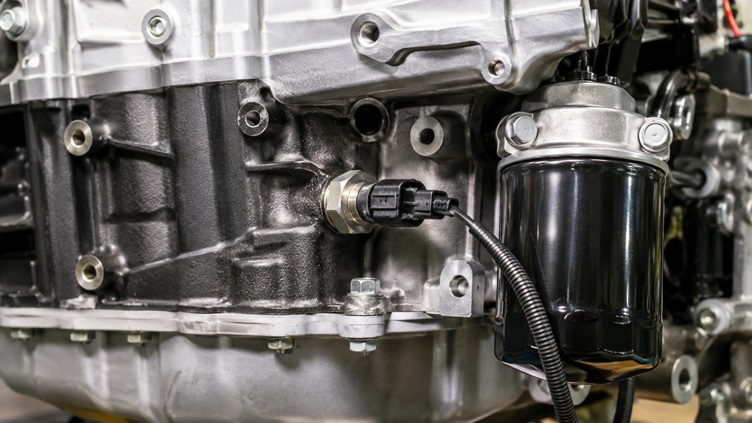
Oil pressure sensor location depends on engine design. Common locations include the engine block, oil filter housing, oil cooler adapter, cylinder head oil passage, rear engine area, or a threaded oil pressure port near the main oil gallery.
Many Chevrolet Silverado and GMC truck engines are commonly searched together with oil pressure sensor location because access can vary by engine family. Ford, Dodge, Jeep, Chevy, GMC, Honda, and other platforms may place the sensor in different locations depending on engine layout, intake manifold clearance, oil filter position, and harness routing.
| Possible Location | Why It Is Used | Access Consideration |
|---|---|---|
| Engine block oil gallery | Reads pressure near the main lubrication passage | May be partly hidden by harnesses, brackets, or intake parts |
| Oil filter housing | Convenient location near pressurized oil flow | May be easier to reach from below or near the filter area |
| Oil cooler adapter | Common on some engines with cooler assemblies | Requires checking for leaks and connector routing |
| Cylinder head oil passage | Used on engines where pressure is monitored near upper oil passages | May require removing covers or intake components |
| Rear engine area | Common on some V-engine layouts | Often more difficult to access and may require a special socket |
Bad Oil Pressure Sensor Symptoms
A faulty oil pressure sensor can create warning lights, incorrect gauge readings, intermittent signals, and fault codes. However, the same symptoms can also be caused by real oil pressure problems, wiring faults, oil level issues, worn engine components, blocked oil passages, or an incorrect oil filter.
| Symptom | Sensor-Related Cause | Must Also Check |
|---|---|---|
| Oil pressure warning light stays on | Switch stuck closed, failed sensor, connector fault, signal out of range | Actual oil pressure, oil level, oil pump operation, filter condition |
| Gauge reads zero after startup | Open circuit, failed sender, missing reference voltage, poor ground | Mechanical pressure with a gauge, harness continuity, ECU input |
| Gauge reads maximum all the time | Shorted signal line, incorrect sender type, internal sensor fault | Signal wire, connector contamination, replacement part compatibility |
| Oil light flickers at idle | Sensor threshold issue, intermittent connector, weak switch contact | Real low pressure at hot idle, oil viscosity, engine wear |
| Intermittent pressure reading | Loose connector, oil contamination in connector, broken wire near sensor | Harness movement, ground path, terminal tension |
| Diagnostic trouble code | Signal voltage outside expected range or pressure plausibility fault | Scan data, supply voltage, ground, actual oil pressure |
How to Test an Oil Pressure Sensor
Oil pressure sensor testing should separate three possibilities: real low oil pressure, a failed sensor, or an electrical circuit problem. Replacing the sensor without testing may not solve the fault if the issue is mechanical pressure, wiring, or ECU input.
1. Basic Visual and Engine Checks
- Check engine oil level and oil condition.
- Inspect for oil leaks near the sensor, oil filter housing, and connector.
- Check whether the correct oil filter and oil viscosity are being used.
- Inspect the wiring harness for heat damage, abrasion, broken insulation, or oil contamination.
- Check connector pins for corrosion, spread terminals, oil intrusion, or loose locking tabs.
2. Electrical Circuit Test
For a three-wire sensor, the circuit commonly includes supply voltage, ground, and signal output. A two-wire or one-wire switch may be tested differently. Always identify the circuit type before applying voltage or measuring resistance.
| Test Item | What to Check | What It May Indicate |
|---|---|---|
| Reference or supply voltage | Voltage between supply and ground at the connector | Missing supply, ECU fault, blown fuse, wiring issue |
| Ground circuit | Voltage drop or continuity to ground | Poor ground, harness resistance, corroded terminal |
| Signal output | Voltage or resistance change with pressure condition | Failed sensor, stuck output, wiring short/open |
| Connector condition | Oil contamination, terminal looseness, corrosion | Intermittent reading or unstable signal |
| Scan tool data | Oil pressure reading, plausibility data, related fault code | Sensor signal fault or real pressure abnormality |
3. Mechanical Oil Pressure Confirmation
If the warning light indicates low pressure or the gauge reads zero, a mechanical oil pressure gauge is often used to confirm actual engine pressure. This step is important because an electrical sensor reading alone cannot prove that the lubrication system is healthy.
Oil Pressure Switch and Sensor Testing
The video below shows a practical bench-style explanation of oil pressure switch operation and multimeter testing. It is useful for understanding the difference between a switching device and a pressure-related electrical output.
Oil Pressure Sensor Replacement
Oil pressure sensor replacement is usually straightforward when the part is accessible, but some engines require a special oil pressure sensor socket, deep socket, swivel extension, or removal of nearby components. Access difficulty is one reason replacement cost varies widely by vehicle.
- Confirm that the fault is not caused by real low oil pressure.
- Disconnect battery power if required by the service procedure.
- Locate the oil pressure sensor or switch on the engine.
- Clean the surrounding area to reduce contamination entering the oil passage.
- Disconnect the electrical connector without damaging the locking tab.
- Use the correct oil pressure sensor socket or suitable deep socket.
- Remove the old sensor while avoiding damage to the threaded port.
- Install the correct replacement part with the required sealing method.
- Reconnect the harness and check for oil leaks after startup.
- Clear diagnostic codes if needed and verify gauge or warning light behavior.
Oil Pressure Sensor Socket and Access
The keyword oil pressure sensor socket appears frequently because many oil pressure sensors are installed in tight spaces where a normal socket may not fit. A dedicated socket is often deep, slotted, or thin-walled to clear the connector body and sensor housing.
| Tool / Access Item | Why It Matters |
|---|---|
| Oil pressure sensor socket | Allows removal without crushing the sensor body or connector area |
| Deep socket | Useful when the sensor body is taller than a standard socket can cover |
| Swivel extension | Helps reach sensors at the rear of the engine or near brackets |
| Torque control | Prevents cracked housings, stripped threads, or leaks |
| Connector pick tool | Helps release locking tabs without breaking the connector |
Oil Pressure Sensor Replacement Cost
Oil pressure sensor replacement cost depends on part price, labor access, engine layout, and whether related parts must be removed. A sensor that is easy to access near the oil filter housing may be quick to replace, while a sensor located behind the intake manifold or at the rear of the engine may require more labor.
Cost estimates should not replace diagnosis. A sensor may be inexpensive compared with engine damage, but replacing it without confirming actual oil pressure can hide a serious lubrication issue.
| Cost Factor | Effect |
|---|---|
| Sensor type | Simple switches are usually less complex than pressure transducers or integrated sensor assemblies |
| Access difficulty | Hidden sensors require more labor time |
| Connector or harness damage | May add repair steps beyond sensor replacement |
| Oil leak at sensor | May require cleaning, seal inspection, and verification after installation |
| Need for mechanical pressure test | May add diagnostic time but prevents unnecessary replacement |
Common Failure Cases and Troubleshooting
Oil pressure sensor faults should be diagnosed by connecting the symptom to electrical checks and mechanical pressure confirmation. The following cases show common patterns.
| Failure Case | Symptom | Likely Cause | Diagnostic Step |
|---|---|---|---|
| Oil light flickers at hot idle | Warning light appears at low rpm or after warm-up | Real low pressure, weak switch threshold, thin oil, worn engine, or connector issue | Confirm hot idle pressure with mechanical gauge and inspect sensor circuit |
| Gauge reads zero after startup | No pressure reading even when engine runs normally | Open signal circuit, failed sender, missing supply, failed gauge input | Check supply, ground, signal voltage, and mechanical pressure |
| Gauge reads high all the time | Gauge stays near maximum or reads unrealistic pressure | Shorted signal, incorrect sender, internal sensor fault | Inspect signal wire and verify correct replacement part type |
| Oil leak around sensor | Oil residue on connector, sensor body, or engine block | Cracked sensor housing, failed seal, loose installation, thread damage | Clean area, inspect leak source, replace damaged sensor or seal as required |
| Fault returns after replacement | New sensor does not fix warning light or code | Wiring issue, wrong sensor type, real pressure problem, ECU input fault | Check circuit continuity, pressure reading, and part compatibility |
Electronics Behind Oil Pressure Sensor Signal
An oil pressure sensor is also an automotive electronics component. The pressure signal must survive heat, vibration, oil contamination, electrical transients, and connector exposure. The ECU or gauge circuit must interpret this signal reliably under engine operating conditions.
Depending on design, the signal path may include a pressure sensing element, bridge circuit, signal-conditioning stage, pull-up resistor, analog-to-digital converter input, protection circuit, filtering, connector sealing, and diagnostic logic.
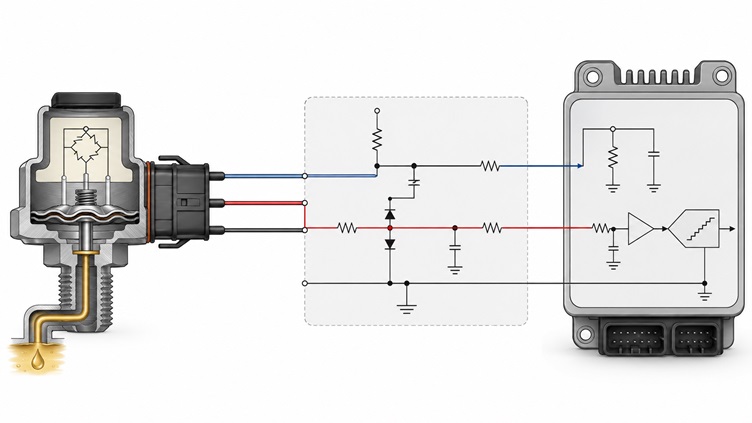
| Electronic Element | Function in Oil Pressure Sensor System |
|---|---|
| Pressure sensing element | Converts pressure force into an electrical change |
| Signal conditioning | Amplifies, filters, or scales the pressure signal |
| Pull-up or pull-down circuit | Creates readable voltage behavior for switch or sender circuits |
| ADC input | Allows ECU or gauge electronics to read analog pressure-related voltage |
| TVS / ESD protection | Protects ECU input from transients on the harness |
| Connector sealing | Prevents oil, water, and contamination from disturbing the signal |
| Diagnostic logic | Detects open circuits, short circuits, implausible readings, or pressure faults |
Sensor Design and Reliability Notes
Automotive oil pressure sensors operate in a harsh environment. They must tolerate thermal cycling, vibration, pressure pulsation, oil exposure, connector movement, and electrical noise from ignition, alternator, injectors, pumps, and switching loads.
| Reliability Factor | Why It Matters |
|---|---|
| Thread and seal design | Prevents oil leakage and maintains pressure connection |
| Connector quality | Maintains signal integrity under vibration and temperature change |
| Pressure range | Must match engine oil pressure behavior and diagnostic thresholds |
| Output type | Must match the ECU, gauge, or warning circuit design |
| Temperature rating | Important near engine block, oil filter housing, and exhaust-adjacent areas |
| Electrical protection | Protects against load dump, ESD, reverse battery, and harness transients depending on system design |
Oil Pressure Sensor and Related Electronic Components
Oil pressure sensor systems involve more than the sensor body. Related components may include pressure sensing elements, automotive connectors, ECU input circuits, voltage references, ADCs, operational amplifiers, resistors, TVS diodes, ESD protection devices, wiring harness terminals, and microcontrollers.
For electronic component sourcing, designers and repair-support teams should match output type, connector pattern, thread size, pressure range, sealing method, temperature rating, and system compatibility before selecting a replacement or designing an interface circuit.
Frequently Asked Questions
What does an oil pressure sensor do?
It monitors pressure in the engine oil system and sends a signal to the gauge, warning lamp, ECU, or diagnostic system.
Where is the oil pressure sensor located?
Common locations include the engine block, oil filter housing, oil cooler adapter, cylinder head oil passage, or rear engine oil gallery. Exact location depends on engine design.
What are bad oil pressure sensor symptoms?
Common symptoms include oil warning light, zero gauge reading, maximum gauge reading, intermittent oil pressure signal, oil leak around the sensor, or related fault codes.
Is an oil pressure sensor the same as an oil pressure switch?
Not always. A switch usually provides an on/off state, while a sensor or sender may provide a variable pressure-related signal.
Can I drive with a bad oil pressure sensor?
Driving should be avoided until actual oil pressure is confirmed. A warning may be caused by a faulty sensor, but it may also indicate real low oil pressure.
How do you test an oil pressure sensor?
Testing usually includes oil level inspection, connector check, supply and ground verification, signal measurement, scan data review, and mechanical oil pressure confirmation.
What socket is used for oil pressure sensor replacement?
Many sensors require a deep or dedicated oil pressure sensor socket. The exact size and shape depend on the sensor body and vehicle access.
Can low oil pressure be caused by something other than the sensor?
Yes. Low oil level, worn bearings, oil pump wear, blocked pickup, incorrect oil viscosity, filter restriction, or internal engine wear can also cause low oil pressure.
Why does an oil pressure sensor leak?
Leaks can come from a cracked sensor body, damaged seal, loose installation, thread damage, or oil contamination around the connector area.
Why did the oil pressure warning return after replacing the sensor?
The fault may be caused by wiring, connector damage, wrong sensor type, real oil pressure problem, ECU input fault, or mechanical engine issue.
Engineering Summary for Diagnosis and Replacement
Oil pressure sensor diagnosis should not begin with part replacement alone. The correct process is to confirm oil level, inspect wiring, test the sensor circuit, verify actual pressure when needed, and then decide whether replacement is justified.
From an electronics perspective, an oil pressure sensor is a pressure-to-signal conversion device operating in a harsh automotive environment. Stable readings depend on the sensing element, signal conditioning, connector quality, wiring path, ECU input circuit, and mechanical oil pressure condition. A useful replacement or diagnostic workflow must consider all of these factors.


