
 My Inquiry
 My Account


Amplifiers Explained: Types, Circuits, Gain, Classes and Applications
Article Details
Amplifiers are electronic circuits or devices that use power from a supply to produce an output signal larger than the input signal. The increase may be voltage gain, current gain, or power gain depending on the circuit type and application.
In practical electronics, amplifiers are used in audio systems, sensor interfaces, RF receivers, optical front ends, automotive electronics, industrial control, instrumentation, communications, and power stages. A useful amplifier design must consider gain, bandwidth, noise, distortion, input impedance, output drive, feedback stability, load conditions, and thermal limits.
What Is an Amplifier?
An amplifier is a circuit that increases the amplitude of a signal. The signal being amplified may be voltage, current, or power. In an audio amplifier, the output drives a speaker. In an op-amp circuit, the output may scale a sensor signal. In an RF amplifier, the circuit increases signal level in a selected frequency band.
Analog Devices defines an electronic amplifier as a circuit that uses an external power supply to generate an output signal that is a larger replica of its input. (Analog Devices, Amplifier)
| Amplifier Role | What Is Increased | Typical Example |
|---|---|---|
| Voltage amplifier | Voltage amplitude | Op-amp gain stage, sensor signal amplifier, audio preamplifier |
| Current amplifier | Output current capability | Buffer, driver stage, transistor current booster |
| Power amplifier | Power delivered to a load | Speaker amplifier, RF power amplifier, motor or actuator driver stage |
| Transimpedance amplifier | Converts current into voltage | Photodiode receiver, optical sensor front end, current-output sensor interface |
Amplifier vs Amplify
"Amplify" describes the action of increasing a signal or effect. "Amplifier" refers to the electronic circuit, component, module, or system that performs the amplification. In engineering use, the important question is not only whether a circuit amplifies, but how much gain it provides, over what frequency range, with how much distortion, noise, heat, and load capability.
| Term | Engineering Meaning |
|---|---|
| Amplify | The action of increasing signal amplitude, current capability, or output power |
| Amplifier | The circuit, IC, module, or system that performs amplification |
| Gain | The ratio between output signal and input signal |
| Feedback | A controlled portion of the output returned to the input network to set gain, bandwidth, and stability |
How Amplifiers Work
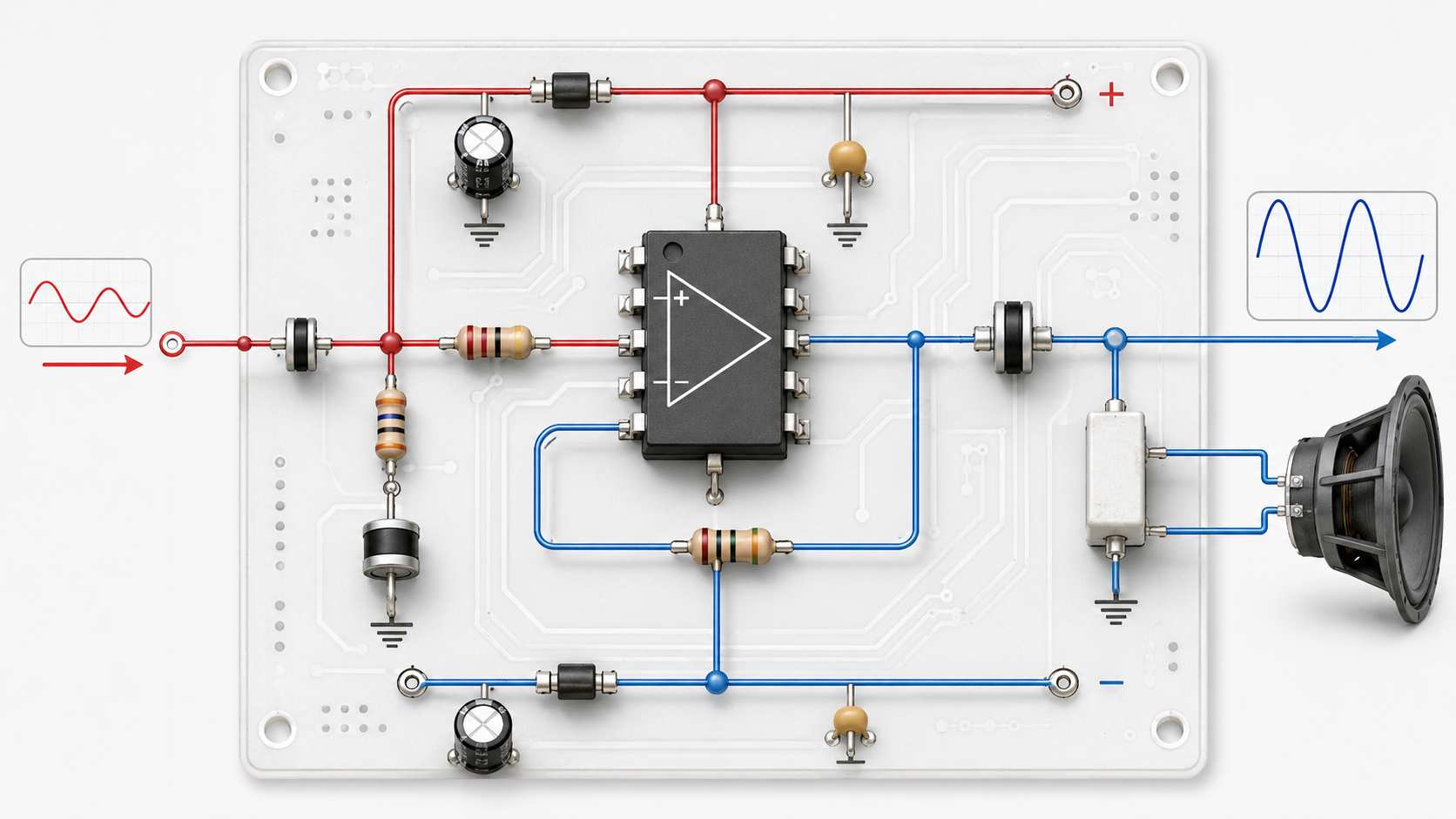
An amplifier uses an active device such as a BJT, MOSFET, operational amplifier, vacuum tube, or integrated power stage. The active device controls output current or voltage using the input signal. The power supply provides the energy needed to produce a larger output.
In many linear amplifiers, negative feedback is used to control closed-loop gain. Feedback can reduce distortion, improve gain accuracy, extend usable bandwidth, and stabilize the operating point. Poor feedback design, however, can cause oscillation, ringing, bandwidth loss, or phase-margin problems.
Key Amplifier Parameters
Amplifier selection depends on electrical performance, load requirements, signal type, environment, and layout constraints. The same nominal gain can behave very differently in low-noise sensor circuits, audio circuits, RF circuits, and high-power output stages.
| Parameter | Meaning | Why It Matters |
|---|---|---|
| Gain | Output-to-input signal ratio | Determines signal level and required feedback network |
| Bandwidth | Frequency range where gain remains usable | Important for audio, RF, sensors, fast pulses, and control loops |
| Input impedance | Load seen by the signal source | Prevents source loading in sensor and audio circuits |
| Output impedance | Effective resistance seen at the output | Affects load drive, damping, and voltage drop under load |
| Noise | Unwanted signal added by the amplifier | Critical for photodiodes, microphones, instrumentation, and RF receivers |
| Distortion | Waveform error caused by nonlinearity or clipping | Important for audio quality and precision signal processing |
| Slew rate | Maximum output voltage change per unit time | Limits large-signal high-frequency response |
| Output power | Power delivered to the load | Important for speakers, RF transmitters, actuators, and drivers |
| Efficiency | Output power compared with supply power | Determines heat generation and thermal design |
| Stability | Ability to avoid oscillation under feedback and load conditions | Critical for op-amp circuits, capacitive loads, RF stages, and power amplifiers |
Main Types of Amplifiers
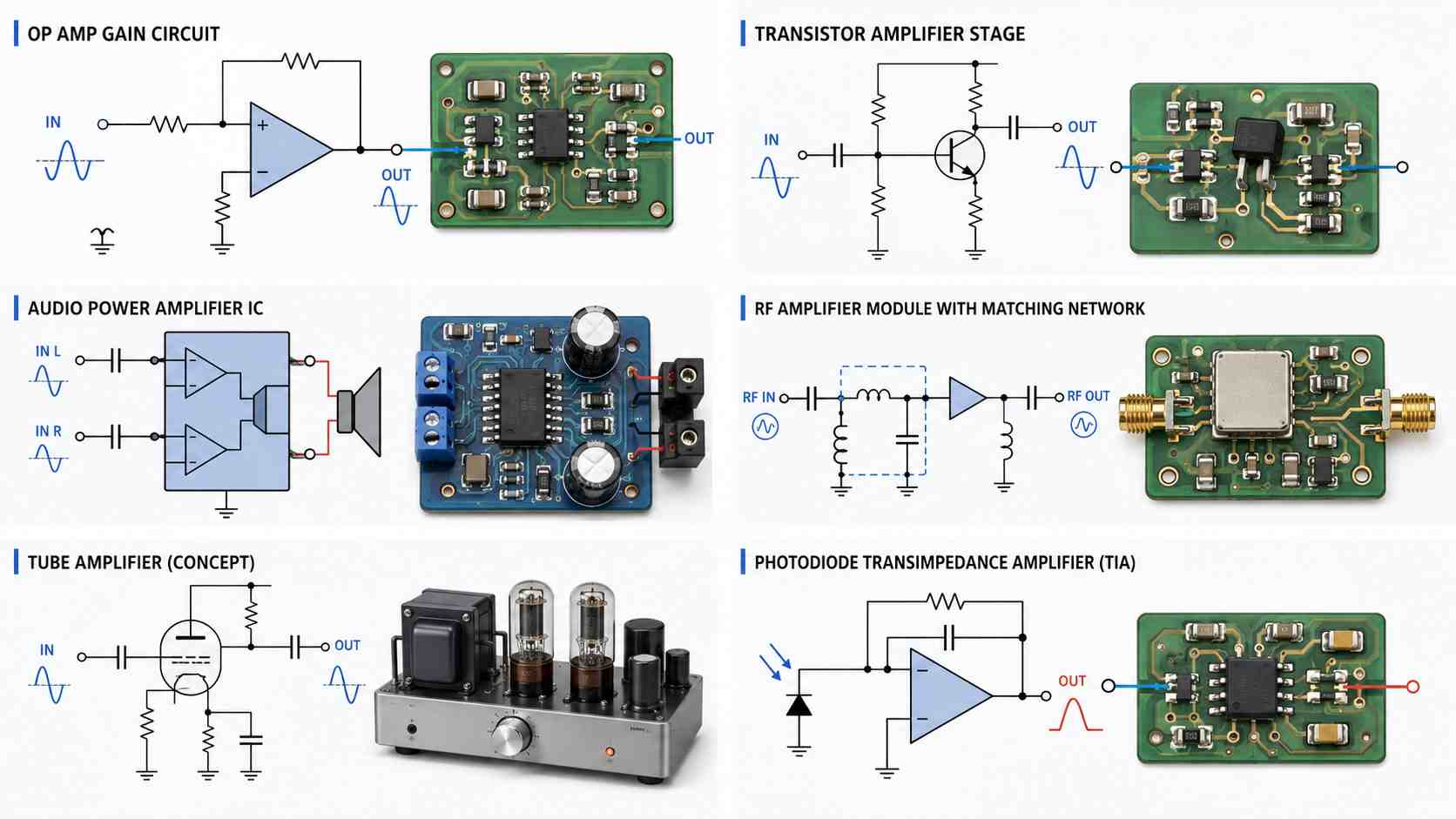
Amplifiers are classified by signal type, circuit topology, application, frequency range, and output stage operation. In practical design, the amplifier type should be selected from the input source, load requirement, gain target, bandwidth, noise limit, and power dissipation.
| Amplifier Type | Main Function | Typical Application |
|---|---|---|
| Voltage amplifier | Increases signal voltage | Audio preamp, sensor scaling, op-amp gain stage |
| Current amplifier | Increases current drive capability | Buffer, transistor driver, load interface |
| Power amplifier | Delivers usable power to a load | Speaker driver, RF output, motor drive, actuator control |
| Operational amplifier | High-gain differential amplifier used with feedback | Filters, buffers, inverting/non-inverting gain, sensor interfaces |
| Instrumentation amplifier | Amplifies small differential signals with high common-mode rejection | Bridge sensors, medical measurement, industrial instrumentation |
| Transimpedance amplifier | Converts input current into output voltage | Photodiode receiver, optical front end, current-output sensor |
| Audio amplifier | Amplifies audio-frequency signals | Stereo amplifier, headphone amplifier, guitar amplifier, car amplifier |
| RF amplifier | Amplifies radio-frequency signals | Antenna preamp, LNA, transmitter driver, RF power stage |
| Tube amplifier | Uses vacuum tubes as active gain devices | Guitar amplifiers, audio equipment, legacy RF systems |
Amplifier Classes
Amplifier class describes how the output device conducts during the signal cycle. It strongly affects efficiency, distortion, heat generation, and application suitability.
| Class | Operating Method | Efficiency / Linearity | Common Use |
|---|---|---|---|
| Class A | Output device conducts for the full signal cycle | High linearity, low efficiency, high heat | Low-distortion small-signal and audio stages |
| Class B | Each output device conducts for half of the signal cycle | Higher efficiency, crossover distortion risk | Push-pull output stages |
| Class AB | Output devices conduct slightly more than half cycle | Balanced efficiency and distortion | Audio power amplifiers, general power stages |
| Class C | Device conducts for less than half cycle, usually with tuned load | High efficiency, nonlinear | RF tuned amplifiers |
| Class D | Switching output stage with filtered or load-averaged output | High efficiency, switching noise management required | Portable speakers, automotive audio, high-efficiency power amplifiers |
Audio, Stereo and Car Amplifiers
Audio amplifiers increase low-frequency signals to drive headphones, speakers, subwoofers, or line-level outputs. A stereo amplifier usually has two channels, while a multi-channel amplifier may drive several speakers independently. A car amplifier must operate from an automotive electrical system, often using an internal power converter to generate higher rails for the output stage.
Watt rating should be read together with load impedance, distortion level, supply voltage, thermal condition, and number of channels driven. A high watt figure without clear test conditions is not enough to judge amplifier performance.
| Audio Term | Engineering Meaning |
|---|---|
| Channel | Independent amplifier output path, such as left and right stereo channels |
| Watt rating | Power delivered to a specified load under specified distortion and supply conditions |
| Speaker impedance | Load condition that affects output current, heat, and protection behavior |
| THD | Total harmonic distortion caused by nonlinear output behavior |
| Signal-to-noise ratio | Difference between desired signal level and noise floor |
| Thermal protection | Protection function that reduces or disables output when the amplifier overheats |
Op-Amp and Small-Signal Amplifier Circuits
Operational amplifiers are widely used in analog and mixed-signal systems. Analog Devices describes an op amp as a high-gain differential amplifier with positive and negative inputs that can be used with feedback to perform many functions, including amplifiers, filters, oscillators, references, comparators, level translation, and mathematical operations. (Analog Devices, Op Amp)
Two common starting circuits are the inverting amplifier and the non-inverting amplifier. The inverting configuration produces an output that is 180 degrees out of phase with the input, while the non-inverting configuration keeps the output in phase with the input and usually provides high input impedance.
For an inverting op-amp stage, feedback and input resistor values set the gain and input impedance. The Op-Amp Inverting Resistor Calculator can be used to estimate feedback and bias resistor values when the target gain, input level, output level, and supply rails are known.
For a non-inverting op-amp stage, the input source sees a high impedance and the gain is set by the feedback resistor network. The Op-Amp Non-Inverting Resistor Calculator can help verify gain resistor values before simulation, PCB design, or bench testing.
| Op-Amp Circuit | Typical Use | Design Check |
|---|---|---|
| Inverting amplifier | Signal inversion, gain scaling, summing amplifier | Input resistor, feedback resistor, source impedance, output swing |
| Non-inverting amplifier | High input impedance signal gain | Feedback ratio, common-mode range, output swing, bandwidth |
| Voltage buffer | Impedance isolation without voltage gain | Output current, capacitive load stability, input range |
| Differential amplifier | Amplifies difference between two input signals | Resistor matching, CMRR, input common-mode voltage |
| Active filter | Frequency shaping and noise reduction | Cutoff frequency, op-amp bandwidth, stability, component tolerance |
Op-Amp Gain and Feedback Circuits
The video below shows how inverting and non-inverting op-amp circuits use feedback resistor networks to set closed-loop gain.
Transimpedance Amplifier
A transimpedance amplifier, or TIA, converts an input current into an output voltage. It is commonly used with photodiodes, optical receivers, light sensors, chemical sensors, radiation detectors, and current-output sensing elements.
In a photodiode front end, photocurrent is usually small. A feedback resistor converts the photocurrent into voltage, while a feedback capacitor may be added to control bandwidth and improve stability. The op amp selection must consider input bias current, voltage noise, current noise, gain-bandwidth product, input capacitance, output swing, leakage, and PCB layout cleanliness.
When photocurrent, dark current, feedback resistor, feedback capacitor, and input capacitance are known, the Photodiode Transimpedance Calculator can estimate output voltage, dark-current offset, feedback-pole bandwidth, total input capacitance, and basic resistor noise indicators.
| TIA Parameter | Why It Matters |
|---|---|
| Photocurrent | Defines the useful sensor signal that must be converted into voltage |
| Feedback resistor | Sets transimpedance gain and output voltage range |
| Feedback capacitor | Limits bandwidth and helps stabilize the feedback loop |
| Photodiode capacitance | Affects bandwidth, noise, and stability |
| Op-amp input bias current | Creates offset error in high-resistance feedback networks |
| PCB leakage | Can create large errors when input current is very small |
RF and Antenna Amplifiers
RF and antenna amplifiers operate at radio frequencies where impedance matching, layout parasitics, noise figure, gain flatness, and linearity are critical. A low-noise amplifier improves weak receiver signals, while an RF power amplifier drives transmission power into a matched antenna or load.
| RF Amplifier Type | Typical Purpose | Key Design Check |
|---|---|---|
| Low-noise amplifier | Boosts weak receiver signals | Noise figure, input match, gain, stability |
| Antenna preamplifier | Improves signal level before long cable or receiver input | Power supply noise, gain, overload behavior, impedance match |
| RF power amplifier | Delivers RF output power to antenna or load | Efficiency, linearity, harmonic filtering, heat dissipation |
| Variable-gain amplifier | Adjusts signal level dynamically | Gain control range, noise, linearity, bandwidth |
Amplifier Selection Guide
Amplifier selection should begin with the signal source and load. A microphone, photodiode, antenna, speaker, strain gauge, ADC input, and RF mixer all require different amplifier behavior.
| Application | Recommended Amplifier Type | Key Check |
|---|---|---|
| Sensor voltage signal | Op amp or instrumentation amplifier | Noise, offset, input impedance, common-mode range |
| Photodiode signal | Transimpedance amplifier | Feedback resistor, bandwidth, noise, leakage, stability |
| Speaker output | Audio power amplifier | Load impedance, output power, distortion, heat |
| Headphones | Headphone amplifier or low-noise driver | Output impedance, noise floor, current drive |
| RF receiver | Low-noise amplifier | Noise figure, gain, impedance match, stability |
| Car audio | Class D or Class AB power amplifier | Supply conversion, load impedance, thermal protection, channels |
| Industrial measurement | Differential or instrumentation amplifier | CMRR, input protection, offset, temperature drift |
Common Amplifier Problems and Troubleshooting
Amplifier faults often come from supply rails, feedback networks, load mismatch, grounding, thermal stress, or layout rather than from the amplifier IC alone. A structured troubleshooting method should check power, input signal, output behavior, load, feedback path, and temperature.
| Symptom | Possible Cause | Troubleshooting Method | Design Correction |
|---|---|---|---|
| No output | Missing supply, disabled amplifier, wrong bias, open feedback path | Check supply rails, enable pin, input signal, and output voltage | Correct power, bias, feedback, and signal routing |
| Distortion | Clipping, overload, insufficient supply headroom, wrong gain | Compare input and output waveform and check output swing limit | Reduce gain, increase supply headroom, use suitable amplifier |
| High noise | Poor grounding, high resistor noise, excessive bandwidth, input pickup | Measure noise floor and isolate input source | Improve layout, reduce bandwidth, choose lower-noise components |
| Oscillation | Feedback instability, capacitive load, poor decoupling, layout parasitics | Check output with oscilloscope and review phase margin conditions | Add compensation, isolate capacitive load, improve layout and decoupling |
| Overheating | Excess load current, low efficiency, inadequate heat sinking | Measure load current, output power, case temperature, and supply current | Improve thermal path, reduce load, choose higher-efficiency topology |
| Low volume or low output | Insufficient input level, wrong gain, load mismatch, protection limiting | Check input level, gain network, load impedance, and protection status | Correct gain, load selection, supply voltage, or input scaling |
| RF instability | Poor impedance matching, parasitic feedback, layout coupling | Check matching network, PCB layout, shielding, and harmonic content | Improve RF layout, matching, grounding, and isolation |
Electronics Behind Amplifier Design
Amplifier circuits use more than the active amplifier device. Resistors set gain and bias. Capacitors define coupling, filtering, compensation, and power decoupling. MOSFETs and BJTs provide switching or output drive. Regulators provide clean supply rails. Protection components reduce ESD, surge, and overvoltage risk.
| Component | Role in Amplifier Design |
|---|---|
| Operational amplifier IC | Provides high-gain differential input stage for analog feedback circuits |
| BJT / MOSFET | Used for discrete gain stages, switches, buffers, output drivers, and power stages |
| Resistors | Set gain, bias, input impedance, feedback, and current limits |
| Capacitors | Support coupling, filtering, compensation, timing, and supply decoupling |
| Inductors / transformers | Used in RF matching, power filters, output coupling, and tuned circuits |
| Voltage regulators | Provide stable supply rails for low-noise and high-accuracy stages |
| ESD / TVS protection | Protect inputs, outputs, connectors, and exposed interfaces |
| Heat sink / thermal pad | Removes heat from power amplifier ICs, MOSFETs, and output stages |
| PCB layout | Controls grounding, noise, stability, thermal resistance, and parasitic coupling |
Datasheet-Based Amplifier Selection Notes
Amplifier datasheets should be checked beyond headline gain or output power. A circuit may fail if the selected amplifier cannot support the real input range, output swing, bandwidth, load current, thermal condition, or feedback configuration.
| Datasheet Item | Why It Matters |
|---|---|
| Supply voltage range | Defines the rails required for correct operation and output swing |
| Input common-mode range | Determines whether the input signal can be measured without saturation |
| Output swing | Limits the maximum usable output voltage for a given load and supply |
| Gain-bandwidth product | Controls available gain at frequency in op-amp circuits |
| Slew rate | Limits large-signal high-frequency output transitions |
| Input offset voltage | Creates DC error in precision measurement circuits |
| Input bias current | Important for high-impedance sources and photodiode TIA circuits |
| Noise density | Affects low-level sensor, audio, photodiode, and RF applications |
| Output current | Determines load-driving capability and buffer suitability |
| Thermal resistance | Connects power dissipation to junction temperature and reliability |
| Stability notes | Shows allowed gain configurations, capacitive load behavior, and compensation requirements |
Frequently Asked Questions
What is an amplifier?
An amplifier is an electronic circuit or device that increases voltage, current, or power by using energy from a power supply.
What does an amplifier do?
It takes a smaller input signal and produces a larger output signal that can drive another circuit, speaker, sensor interface, RF stage, or load.
What are the main types of amplifiers?
Main types include voltage amplifiers, current amplifiers, power amplifiers, operational amplifiers, audio amplifiers, RF amplifiers, instrumentation amplifiers, and transimpedance amplifiers.
What is amplifier gain?
Gain is the ratio between output signal and input signal. It may be expressed as a voltage ratio, current ratio, power ratio, or in decibels.
What is the difference between a voltage amplifier and a power amplifier?
A voltage amplifier increases signal voltage. A power amplifier delivers significant power to a load such as a speaker, antenna, actuator, or motor driver stage.
What is a Class D amplifier?
A Class D amplifier uses switching operation to improve efficiency. It is common in portable audio, automotive audio, and high-efficiency speaker systems.
What is a transimpedance amplifier?
A transimpedance amplifier converts current into voltage. It is commonly used with photodiodes and other current-output sensors.
What is the difference between an amplifier and an op amp?
An op amp is a specific type of high-gain differential amplifier usually used with feedback. Amplifier is a broader term that includes op amps, transistor amplifiers, RF amplifiers, audio amplifiers, and power amplifiers.
What causes amplifier distortion?
Distortion can be caused by clipping, nonlinear device behavior, wrong bias, excessive gain, insufficient supply voltage, load mismatch, or thermal stress.
How do I choose an amplifier?
Start from the signal source, required gain, bandwidth, load impedance, noise limit, output power, supply voltage, distortion target, and thermal condition.


