
 My Inquiry
 My Account


Electronic Devices and Circuits: Fundamentals, Components and Applications
Article Details
Electronic devices and circuits form the practical foundation of electrical and electronic systems. An electronic device provides a specific electrical function, while a circuit connects multiple devices to process signals, control power, switch loads, amplify small signals, filter noise, regulate voltage, generate timing, or perform logic operations.
In engineering education and practical circuit design, electronic devices and circuits usually include passive components, semiconductor devices, analog ICs, digital logic, power devices, and the circuit blocks built from them. The subject connects device operation with real applications such as rectifiers, amplifiers, filters, regulators, oscillators, sensor interfaces, switching circuits, and embedded control systems.
A complete understanding requires both device-level knowledge and circuit-level analysis: component ratings, operating regions, biasing, feedback, frequency response, power dissipation, troubleshooting, measurement, and datasheet-based component selection.
What Are Electronic Devices and Circuits?
An electronic device is a component or functional part that controls, converts, stores, switches, amplifies, protects, or measures electrical energy or signals. An electronic circuit is an arrangement of devices connected by conductive paths to perform a defined electrical function.
| Term | Meaning | Examples |
|---|---|---|
| Electronic device | A single component or integrated device with a defined electrical function | Resistor, capacitor, diode, BJT, MOSFET, op amp, regulator, logic IC |
| Electronic circuit | A network of connected devices designed to perform a task | Voltage divider, rectifier, amplifier, filter, oscillator, regulator, logic circuit |
| Circuit theory | The method used to analyze voltage, current, impedance, gain, power, timing, and frequency behavior | Ohm's law, Kirchhoff's laws, small-signal models, transient response, frequency response |
| Practical electronics | The application of circuit theory using real components with tolerances and limits | PCB design, sensor interface, power supply, motor driver, LED circuit, audio amplifier |
Electronic Devices vs Electronic Circuits
The difference between a device and a circuit is important. A device provides one electrical behavior; a circuit combines multiple devices to produce a controlled result. For example, a diode can conduct current in one direction, but a rectifier circuit uses diodes to convert AC into pulsating DC. A transistor can control current, but an amplifier circuit uses biasing and load components to increase signal amplitude.
| Comparison Point | Electronic Device | Electronic Circuit |
|---|---|---|
| Scope | Single component or IC block | Combination of devices and connections |
| Main role | Provides a specific electrical property or function | Solves a system-level task |
| Design focus | Ratings, package, operating region, tolerance, parasitics | Topology, biasing, feedback, stability, load behavior, layout |
| Failure mode | Overvoltage, overcurrent, heat, ESD, wrong part selection | Incorrect wiring, unstable feedback, wrong bias, noise, thermal stress, poor grounding |
Main Types of Electronic Devices
Electronic devices are usually grouped by electrical behavior and system role. Learning these categories helps connect component theory to real circuit design.
| Device Category | Common Devices | Primary Function | Typical Circuit Use |
|---|---|---|---|
| Passive devices | Resistors, capacitors, inductors | Set voltage, current, timing, energy storage, impedance | Dividers, filters, timing networks, pull-ups, damping, matching |
| Semiconductor diodes | Rectifier diode, Schottky diode, Zener diode, TVS diode, LED | One-way conduction, voltage clamp, protection, light emission | Rectifiers, clamps, regulators, polarity protection, LED drivers |
| Transistors | BJT, JFET, MOSFET, IGBT | Switching, amplification, current control, power control | Switches, amplifiers, motor drivers, regulators, logic interfaces |
| Analog ICs | Op amps, comparators, voltage references, LDOs, regulators | Signal conditioning, comparison, regulation, gain, buffering | Sensor interfaces, filters, amplifiers, power rails, feedback loops |
| Digital ICs | Logic gates, flip-flops, counters, microcontrollers, memory | Binary logic, timing, computation, control, data storage | MCU systems, embedded control, communication, state machines |
| Power devices | MOSFETs, IGBTs, rectifiers, gate drivers, power modules | High-current or high-voltage switching and conversion | DC-DC converters, inverters, motor drives, battery systems |
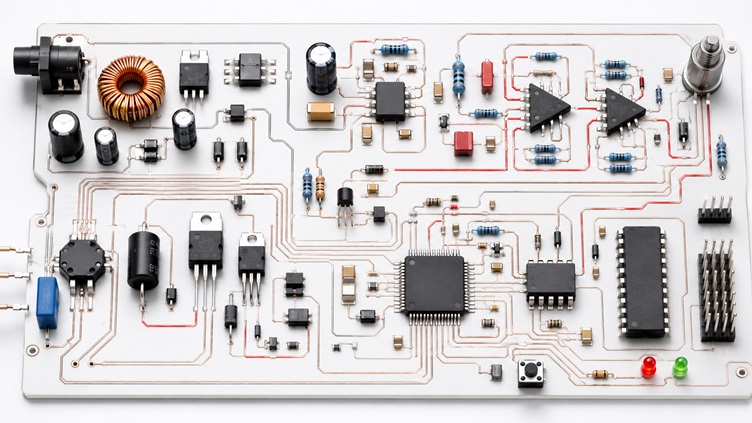
Core Circuit Building Blocks
Basic circuit blocks are the link between device theory and real applications. Each block teaches a repeatable engineering idea: voltage division, current limiting, rectification, amplification, filtering, timing, switching, or regulation.
| Circuit Block | Main Devices | Function | Typical Application |
|---|---|---|---|
| Voltage divider | Two resistors | Scales a voltage to a lower level | ADC input scaling, reference generation, bias circuits |
| LED current limiter | LED and resistor | Limits LED current to a safe value | Indicators, control panels, basic output circuits |
| Rectifier | Diodes and capacitors | Converts AC into DC | Power adapters, input protection, AC sensing |
| Amplifier | Transistor or op amp plus feedback network | Increases signal amplitude or buffers a signal | Sensors, audio, instrumentation, analog front ends |
| RC filter | Resistor and capacitor | Passes or attenuates selected frequency ranges | Signal conditioning, noise reduction, ADC input filtering |
| Switching circuit | BJT, MOSFET, diode, driver resistor | Controls a load from a low-power signal | Relays, motors, lamps, solenoids, heaters |
| Timer / oscillator | 555 timer, RC network, comparator, logic | Generates time delay or repetitive waveform | Pulse generation, blinking LEDs, one-shot timing, basic clocks |
| Regulator | Regulator IC, feedback resistors, capacitors | Maintains stable output voltage | Power rails, battery systems, embedded electronics |
Basic Circuit Calculation Checkpoints
Basic circuit calculations are often used before simulation or hardware testing. They help verify resistor ratios, LED current limits, op-amp gain settings, RC cutoff frequency, timer values, and component identification before a circuit is built.
Voltage Dividers and Resistor Networks
A voltage divider is often the first practical circuit used to connect theory with measurement. It is used for biasing, ADC input scaling, reference generation, and simple signal attenuation. When selecting resistor values, the output voltage, divider current, source impedance, and load effect should be considered. The Voltage Divider Calculator can be used to check the relationship between input voltage, output voltage, R1, and R2.
Resistor networks are also used when a required resistance value is not available or when power sharing is needed. The Parallel Resistor Combination Calculator is useful for finding practical resistor pairs that approximate a target resistance.
LED Current Limiting
An LED is a simple semiconductor device, but it still needs current control. Connecting an LED directly to a supply can damage the device because current rises quickly once the forward voltage is exceeded. A series resistor is commonly used to limit current in basic indicator circuits. The LED Resistor Calculator & Polarity Guide can be used when selecting a safe resistor value from supply voltage, LED forward voltage, and target current.
Op-Amp Gain Circuits
Op amps are central devices in analog circuits. The two most common starting circuits are the inverting amplifier and non-inverting amplifier. Both depend on feedback resistor ratios, input impedance, output range, supply voltage, and bandwidth. The Op-Amp Inverting Resistor Calculator and Op-Amp Non-Inverting Resistor Calculator can help verify feedback resistor values before simulation or breadboard testing.
RC Filters and Timing Circuits
RC networks appear in low-pass filters, timing circuits, reset circuits, debouncing, sensor inputs, and noise reduction. The cutoff frequency should be selected based on the useful signal bandwidth and the noise that must be attenuated. The RC Low-Pass Filter Calculator is useful for checking resistor, capacitor, and cutoff frequency relationships.
For basic oscillator and timing applications, the 555 timer remains a useful learning device because it combines comparators, an internal divider, flip-flop behavior, discharge control, and an RC timing network. The 555 Timer Design Calculator can help check astable or monostable timing values.
Component Identification
Circuit learning also requires recognizing real components on a bench or PCB. Resistor color bands and SMD resistor codes are common sources of confusion for beginners. The Resistor Color Code & SMD Code Decoder is useful when identifying through-hole and surface-mount resistor values before measurement or replacement.
Semiconductor Devices in Circuit Theory
Semiconductor devices form the active part of many electronic circuits. They allow current steering, switching, amplification, voltage regulation, protection, and logic operation. Learning their operating regions is more important than memorizing part names.
| Device | Key Concept | Common Circuit Function | Design Check |
|---|---|---|---|
| PN junction diode | Forward conduction and reverse blocking | Rectification, clamping, polarity protection | Forward current, reverse voltage, power dissipation |
| Zener diode | Reverse breakdown at a controlled voltage | Voltage reference, clamp, simple shunt regulator | Zener current, resistor value, power rating |
| BJT | Base current controls collector current | Amplifier, switch, current source | Bias point, gain variation, saturation, thermal behavior |
| MOSFET | Gate voltage controls channel conduction | Power switch, logic interface, motor control, load switch | VGS threshold, RDS(on), gate charge, SOA, thermal margin |
| Op amp | Differential input with high gain and feedback | Amplifier, buffer, filter, comparator-like function | Input common-mode range, output swing, bandwidth, stability |
| Logic gate | Boolean operation using voltage-defined logic levels | Digital decision, enable control, state logic | Logic level compatibility, propagation delay, fan-out, supply voltage |
In circuit theory, devices are often simplified into models. A diode may be represented by an ideal switch plus voltage drop. A BJT may be modeled by current gain or small-signal parameters. A MOSFET may be treated as a voltage-controlled switch in digital circuits, but power circuits require gate charge, switching loss, and thermal behavior.
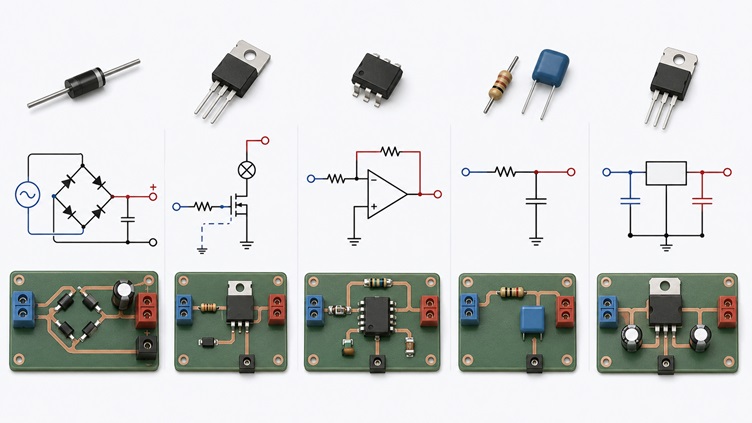
Analog and Digital Circuit Applications
Electronic devices and circuits are used across analog systems, digital systems, power electronics, sensors, automotive electronics, industrial control, and communication equipment. The same device may serve different purposes depending on the circuit topology.
| Application Area | Common Devices | Typical Circuit Function |
|---|---|---|
| Power supply | Rectifiers, regulators, MOSFETs, inductors, capacitors | AC-DC conversion, DC-DC conversion, voltage regulation, filtering |
| Sensor interface | Op amps, resistors, filters, ADCs, references | Signal conditioning, scaling, filtering, conversion to digital data |
| Audio and instrumentation | Op amps, BJTs, JFETs, capacitors, precision resistors | Low-noise amplification, buffering, filtering, gain control |
| Motor and load control | MOSFETs, IGBTs, gate drivers, diodes, current sensors | Switching, speed control, protection, current measurement |
| Digital control | Logic gates, flip-flops, microcontrollers, level shifters | Timing, data handling, state machines, embedded control |
| Automotive electronics | Sensors, TVS diodes, MOSFETs, regulators, MCUs | ECU inputs, actuator control, protection, communication, diagnostics |
| LED and display circuits | LEDs, resistors, drivers, MOSFETs, shift registers | Indicator control, lighting, multiplexing, current regulation |
How to Study Electronic Devices and Circuits
Electronic devices and circuits are easier to learn when theory is connected to circuit examples, datasheets, simulation, and measurement. Textbook equations are useful, but practical understanding comes from checking how real components behave under voltage, current, temperature, frequency, and load conditions.
- Start with voltage, current, resistance, power, and passive components.
- Learn Ohm's law, Kirchhoff's laws, and simple resistor networks.
- Study diode operation, rectifier circuits, clamps, and LED current limiting.
- Move to BJT and MOSFET switching before small-signal amplifier analysis.
- Study op-amp feedback circuits, input/output limits, and practical stability.
- Learn RC filters, time constants, and frequency response.
- Study power supplies, regulators, switching circuits, and protection components.
- Build small circuits and measure real voltage, current, waveform, and temperature.
- Read datasheets to understand ratings, tolerance, thermal limits, and package constraints.
MIT OpenCourseWare's Circuits and Electronics course provides a structured introduction to lumped circuits, MOS transistors, digital abstraction, amplifiers, energy storage elements, frequency-domain design, and analog/digital circuit applications. (MIT OpenCourseWare, Circuits and Electronics)
Lumped Circuit Model and Circuit Analysis
Lumped circuit abstraction is one of the first concepts used to analyze practical electronic circuits. It allows real components and interconnections to be represented as circuit elements such as resistors, capacitors, inductors, sources, and controlled devices.
Common Mistakes in Learning or Designing Circuits
Real circuit design often fails because the design only considers the ideal circuit diagram. Practical components have tolerance, parasitic effects, thermal limits, package constraints, and operating-region restrictions.
| Mistake | Why It Causes Problems | Better Method |
|---|---|---|
| Using ideal component values only | Real parts have tolerance, drift, voltage coefficient, and temperature dependence | Check datasheet tolerance and worst-case values |
| Ignoring transistor bias | Amplifiers may distort, saturate, or stop operating in the intended region | Set and verify DC operating point before signal analysis |
| Using a MOSFET only by threshold voltage | VGS(th) does not mean the MOSFET is fully enhanced | Check RDS(on) at the actual gate drive voltage |
| Driving an LED without a current limit | LED current may exceed safe limits and damage the part | Use a current-limiting resistor or LED driver circuit |
| Ignoring op-amp input/output limits | The circuit may clip or fail near supply rails | Check common-mode input range and output swing |
| Copying a textbook circuit without load analysis | The real load may change gain, timing, or output voltage | Include source impedance, load impedance, and power rating |
| Ignoring heat dissipation | Devices can fail even when voltage and current ratings look acceptable separately | Calculate power loss and verify thermal resistance |
Testing and Troubleshooting Electronic Circuits
Troubleshooting should follow a structured path. Random component replacement often hides the real fault. A good diagnostic process checks power, ground, component orientation, signal path, thermal behavior, and expected operating region.
| Symptom | Possible Cause | Test Method | Correction |
|---|---|---|---|
| No output voltage | Missing supply, open connection, wrong polarity, failed regulator | Measure input voltage, ground continuity, and regulator output | Correct wiring, verify component orientation, replace damaged part if needed |
| Output voltage too low | Excessive load, wrong resistor ratio, input dropout, damaged device | Measure load current, input voltage, and divider values | Reduce load, correct resistor selection, check power supply headroom |
| Amplifier clips or distorts | Wrong bias point, insufficient supply voltage, output swing limit | Check DC operating point and signal waveform with an oscilloscope | Adjust bias, gain, supply voltage, or op-amp selection |
| MOSFET runs hot | Insufficient gate drive, high RDS(on), switching loss, excessive current | Measure gate voltage, drain current, temperature, and switching waveform | Select suitable MOSFET, improve gate drive, add thermal margin |
| Filter does not reduce noise | Wrong cutoff frequency, load interaction, layout parasitics | Check RC values, signal frequency, and output loading | Recalculate cutoff frequency and buffer the filter if needed |
| LED does not light | Wrong polarity, no current path, resistor too large, failed LED | Check LED polarity, voltage drop, and series resistor | Correct polarity and select proper resistor value |
Datasheet-Based Component Selection
Electronic devices should be selected from datasheet limits, not only schematic symbols or textbook examples. A circuit may work in simulation but fail in hardware if device ratings, package limits, and environmental conditions are ignored.
| Datasheet Item | Why It Matters | Example |
|---|---|---|
| Voltage rating | Prevents breakdown or overstress | Reverse voltage for diode, VDS for MOSFET, supply voltage for op amp |
| Current rating | Prevents overheating and electrical failure | LED forward current, regulator output current, transistor collector current |
| Power dissipation | Connects electrical stress to thermal stress | Resistor wattage, MOSFET conduction loss, linear regulator heat |
| Package and thermal resistance | Determines heat removal and PCB footprint compatibility | SOT-23 vs DPAK, SOIC vs QFN, through-hole vs SMD resistor |
| Tolerance | Affects gain, filter frequency, bias point, and output voltage | 1% resistor in precision divider, capacitor tolerance in RC filter |
| Speed and bandwidth | Determines signal response and switching behavior | Op-amp GBW, diode recovery time, MOSFET switching charge |
| Temperature range | Ensures operation under real environment | Industrial, automotive, consumer, or high-temperature designs |
| Protection rating | Improves field reliability | ESD rating, surge capability, TVS clamping voltage |
Learning Resources and Practice Method
Electronic devices and circuits are easier to understand when learning moves from equations to circuit examples, from circuit examples to datasheets, and from datasheets to simulation or measurement. The same voltage divider, diode rectifier, transistor switch, op-amp amplifier, or RC filter should be checked from both a theoretical and practical viewpoint.
| Learning Area | Practical Method |
|---|---|
| Circuit theory | Start with voltage, current, resistance, power, Kirchhoff's laws, and basic network analysis. |
| Semiconductor devices | Study diode conduction, BJT biasing, MOSFET switching, and op-amp feedback using real device limits. |
| Simulation | Use circuit simulation to check expected waveforms, gain, timing, and operating points before hardware testing. |
| Datasheet reading | Verify voltage rating, current rating, tolerance, thermal resistance, bandwidth, switching speed, and package limits. |
| Bench measurement | Measure supply voltage, signal waveform, current draw, voltage drop, temperature rise, and load behavior. |
Frequently Asked Questions
What are electronic devices and circuits?
Electronic devices are components or ICs that perform electrical functions. Electronic circuits connect those devices to process signals, control power, switch loads, amplify signals, filter noise, or perform logic operations.
What is the difference between electronic devices and electronic circuits?
A device is a single functional component, such as a diode or transistor. A circuit is a connected network of devices designed to perform a system task, such as rectification, amplification, filtering, or regulation.
What are examples of basic electronic devices?
Examples include resistors, capacitors, inductors, diodes, LEDs, Zener diodes, BJTs, MOSFETs, op amps, comparators, regulators, logic gates, and microcontrollers.
What are examples of basic electronic circuits?
Common examples include voltage dividers, rectifiers, LED current limiters, RC filters, transistor switches, op-amp amplifiers, voltage regulators, oscillators, and logic circuits.
Is electronic devices and circuits the same as circuit theory?
They overlap but are not identical. Circuit theory explains voltage, current, impedance, and network behavior. Electronic devices and circuits also include component operation, semiconductor behavior, ratings, packages, applications, and practical testing.
What should I learn first?
Start with voltage, current, resistance, power, Ohm's law, Kirchhoff's laws, resistor networks, capacitors, diodes, and simple measurements. Then move to transistors, op amps, filters, regulators, and digital logic.
Why are datasheets important in circuit design?
Datasheets show real operating limits that ideal circuit diagrams do not show, including voltage rating, current rating, power dissipation, package, tolerance, bandwidth, temperature range, and protection limits.
What resources are useful for learning electronic devices and circuits?
Useful resources include textbooks, legal course notes, datasheets, manufacturer application notes, circuit simulators, calculation tools, and hands-on measurement with simple circuits.
Engineering Summary
Electronic devices and circuits should be learned as a connected system. Passive components set voltage, current, timing, and impedance. Semiconductor devices control conduction, switching, amplification, protection, and logic. Circuits combine these behaviors into practical functions such as rectifiers, filters, amplifiers, regulators, timers, and sensor interfaces.
A useful learning method combines theory, calculation, datasheet reading, simulation, and measurement. Tools such as voltage divider, resistor network, LED resistor, op-amp gain, RC filter, resistor code, and 555 timer calculators are most valuable when they are used as checkpoints inside a practical design workflow.


