
 My Inquiry
 My Account


Raspberry Pi Alternatives: Chip-Level Comparison, Compatibility and Replacement Guide
Article Details
Raspberry Pi is widely used as a reference platform for Linux learning, embedded prototypes, home automation, camera projects, GPIO experiments, edge computing and small industrial gateways. Its strength comes from more than the board itself: Raspberry Pi OS, official documentation, camera and display modules, HAT accessories, 40-pin GPIO conventions, community examples and long-term software support all shape the platform.
Replacing Raspberry Pi therefore requires more than comparing processor speed, RAM size, price or the number of USB ports. A board may offer stronger hardware specifications than Raspberry Pi 5 or Raspberry Pi 4, but still require changes to the operating system image, GPIO library, camera stack, HAT overlay, boot workflow, power supply design or thermal structure.
For Linux server projects, media boxes, light edge AI workloads, industrial gateways, and some robotics controllers, Raspberry Pi alternatives can work well. For Raspberry Pi OS tutorials, official camera projects, HAT-based expansion boards, education kits, GPIO timing-sensitive code, or production systems already validated on Raspberry Pi hardware, replacement risk is much higher.
Can Raspberry Pi Be Replaced?
Raspberry Pi can be replaced when the project mainly needs a Linux-capable single-board computer for general computing, networking, media playback, lightweight AI, storage, or embedded gateway work. It should not be replaced blindly when the project depends on Raspberry Pi OS, official accessories, a specific 40-pin HAT, Raspberry Pi camera/display drivers, GPIO timing behavior, or a course written for Raspberry Pi hardware.
| Project Type | Replacement Feasibility | Best Direction |
|---|---|---|
| Linux learning, Python scripts, basic server | Usually replaceable | Raspberry Pi 4/5, Orange Pi, ROCK, Libre Computer, x86 mini PC |
| Raspberry Pi OS tutorial | Not recommended | Use the Raspberry Pi model required by the tutorial |
| GPIO LED or simple sensor project | Replaceable with code changes | Check pin mapping, voltage level, libraries, and kernel support |
| HAT expansion board | High risk | Use Raspberry Pi unless the HAT and overlay support are verified |
| Camera project | Careful validation required | Check CSI connector, camera driver, ISP support, and software pipeline |
| Home Assistant | Replaceable in some cases | Raspberry Pi 4/5, supported SBC image, x86 mini PC, or appliance-style hardware |
| AI vision or robotics | Often better with specialized alternatives | NVIDIA Jetson, RK3588-class SBC, or Raspberry Pi with AI accelerator |
| Industrial or production design | Depends on lifecycle and validation | Compute Module, industrial SBC, SOM, or custom carrier board |
| Microcontroller control | Do not replace with Linux SBC blindly | Raspberry Pi Pico, Pico 2, STM32, ESP32, or other MCU platform |
Raspberry Pi 5 as the Reference Platform
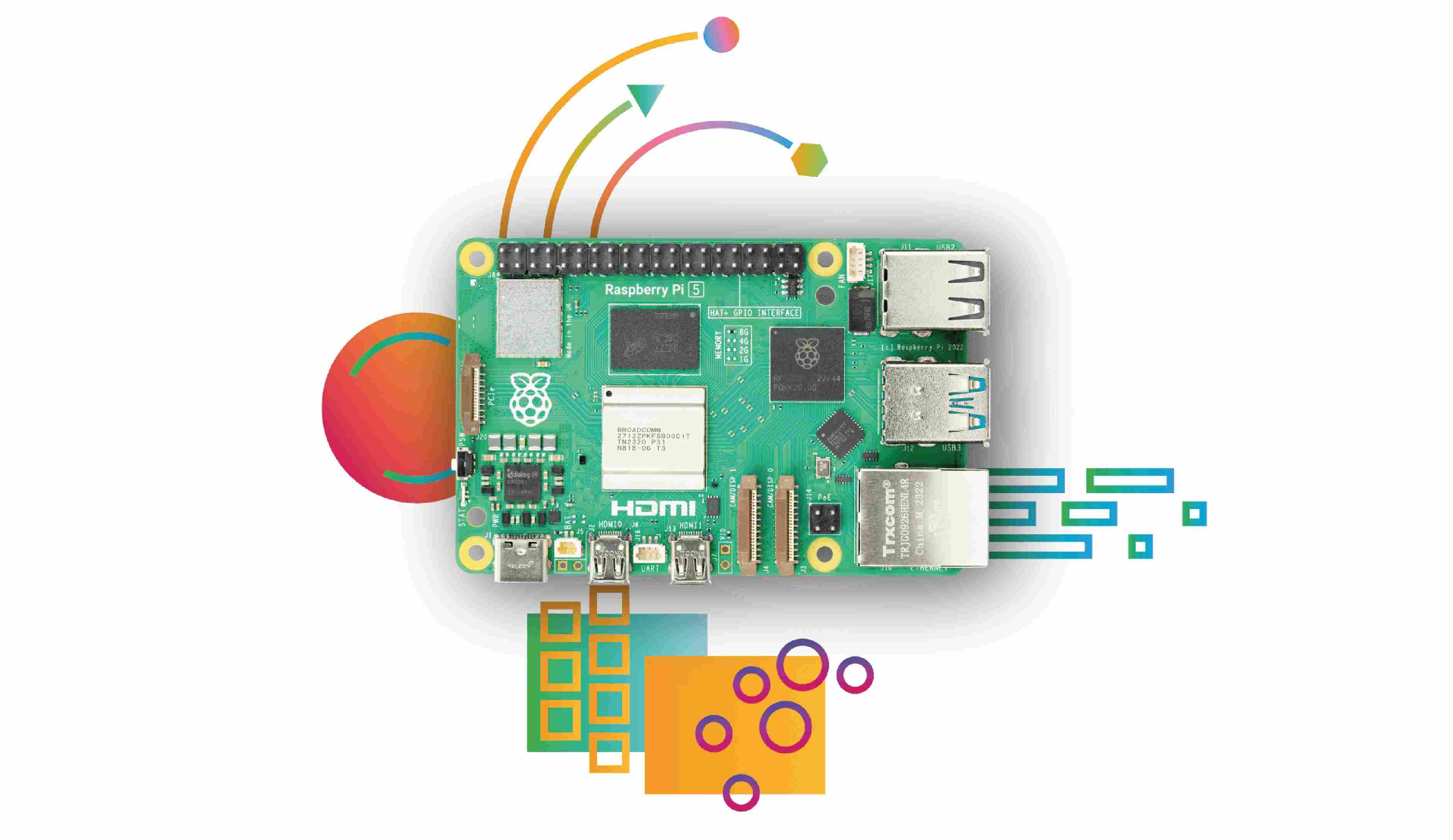
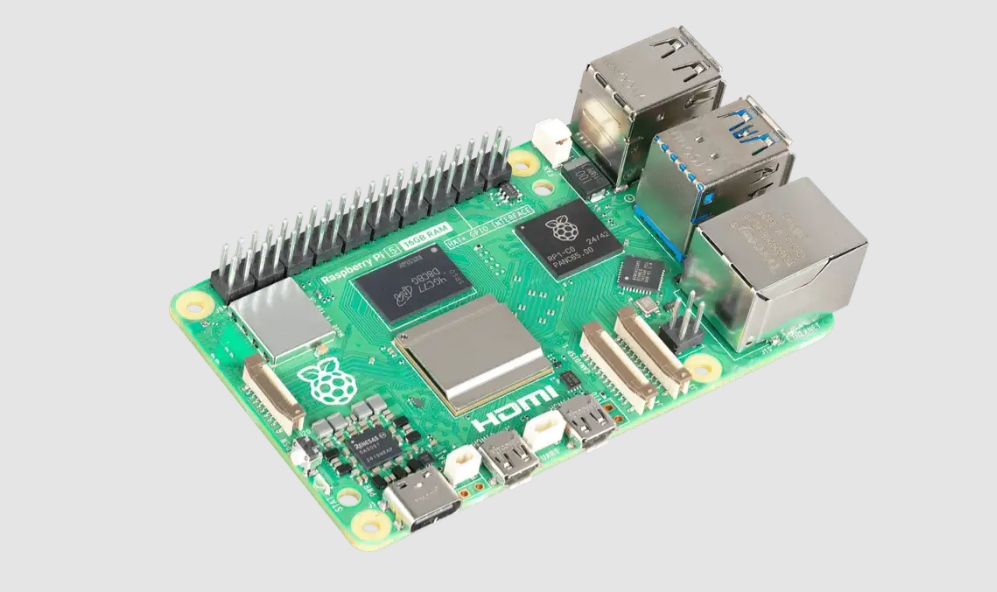
Raspberry Pi 5 is the current reference point for many replacement discussions. It combines a well-supported Linux SBC, official Raspberry Pi OS, broad documentation, strong accessory ecosystem, 40-pin expansion header, camera/display support, USB connectivity, PCIe expansion, and a large project community.
Raspberry Pi's official product page lists Raspberry Pi 5 with a Broadcom BCM2712 quad-core Arm Cortex-A76 processor running at 2.4GHz, RAM variants up to 16GB, and PCI Express expansion for M.2 SSD use. The same page also connects the platform with Raspberry Pi OS support. (Raspberry Pi 5 official product page)
| Raspberry Pi 5 Area | Replacement Impact |
|---|---|
| Broadcom BCM2712 SoC | Alternative boards use different SoCs, kernels, GPU drivers, boot firmware, and media pipelines. |
| Raspberry Pi OS | Many tutorials, packages, overlays, and configuration steps assume Raspberry Pi OS behavior. |
| 40-pin GPIO header | Physical similarity does not guarantee compatible pin functions, overlays, libraries, or HAT behavior. |
| Camera and display connectors | MIPI CSI/DSI connectors require matching electrical interface, driver support, and software pipeline. |
| PCIe expansion | Useful for NVMe and add-on boards, but alternatives may offer different PCIe lane count and connector format. |
| Community ecosystem | Documentation and troubleshooting resources often decide whether a replacement remains maintainable. |
Chip-Level Difference: Broadcom, Rockchip, Amlogic, NVIDIA and RP2040/RP2350
The largest difference between Raspberry Pi and many alternatives is the SoC platform. Raspberry Pi 5 uses Broadcom BCM2712. Many high-performance Chinese alternatives use Rockchip RK3588 or RK3588S. Lower-cost boards may use Amlogic processors. AI-focused boards such as NVIDIA Jetson use GPU-accelerated AI platforms. Raspberry Pi Pico and Pico 2 use microcontroller chips, not Linux application processors.
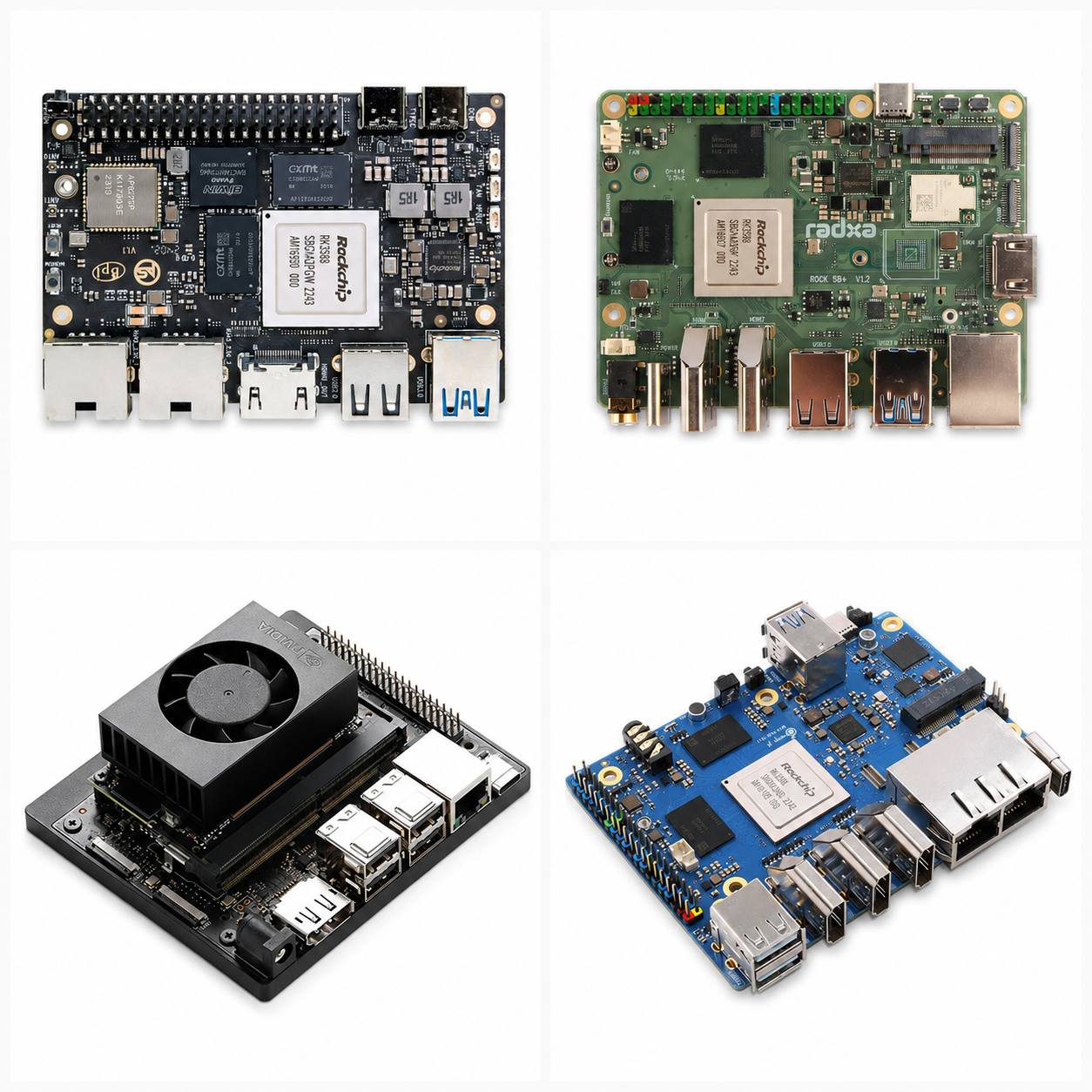
Orange Pi 5 is an example of the Rockchip route. Its official page lists the RK3588S 8-core 64-bit processor with quad-core Cortex-A76 plus quad-core Cortex-A55, Mali-G610 GPU, 6 TOPS NPU, and up to 8K display processing. (Orange Pi 5 official product page)
Radxa ROCK 5B+ is another RK3588-class board. Radxa lists the Rockchip RK3588, quad Cortex-A76 plus quad Cortex-A55 architecture, Mali-G610 graphics, 6 TOPS NPU, dual M.2 M Key PCIe storage connectors, Wi-Fi 6 / Bluetooth 5.2, and 2.5GbE connectivity. (Radxa ROCK 5B+ official product page)
| Platform Type | Example | Replacement Meaning |
|---|---|---|
| Broadcom Raspberry Pi platform | Raspberry Pi 5, Compute Module 5 | Best for official OS, accessories, documentation, camera/display support, and Pi-specific tutorials. |
| Rockchip RK3588 / RK3588S platform | Orange Pi 5, ROCK 5B, Banana Pi BPI-M7, NanoPi R6C | Strong CPU, GPU, NPU, memory and I/O options, with a software ecosystem different from Raspberry Pi. |
| Amlogic SBC platform | Libre Computer Le Potato, some Banana Pi and Khadas boards | Useful for low-cost Linux/media workloads, not usually a Pi 5 performance replacement. |
| NVIDIA Jetson platform | Jetson Orin Nano | Best for AI vision, robotics, CUDA/TensorRT workflows, not low-cost Pi tutorials. |
| Microcontroller platform | Raspberry Pi Pico, Pico 2 | Suitable for real-time control and low-power I/O, not a Linux SBC replacement. |
Chinese Raspberry Pi Alternatives in the SBC Market
Chinese SBC alternatives are a major part of the Raspberry Pi replacement market. Orange Pi, Radxa ROCK, Banana Pi, FriendlyElec NanoPi and Khadas frequently target higher CPU performance, more RAM, eMMC, NVMe, multi-gigabit Ethernet, NPU acceleration, and flexible I/O combinations.
The engineering risk is not usually raw performance. The risk moves to software maturity, kernel maintenance, camera/display drivers, GPIO libraries, HAT compatibility, boot image quality, documentation depth, and long-term update consistency. A Chinese RK3588 board may be much faster than a Raspberry Pi for certain Linux or AI workloads, but that does not make it a drop-in replacement for Raspberry Pi OS projects.
Replacement Matrix: What Can Be Replaced?
A useful Raspberry Pi replacement decision starts from the application. The same board can be a good replacement for one workload and a poor choice for another. The main question is not "which board is faster?" but "which project dependencies must remain compatible?"
| Use Case | Can It Be Replaced? | Recommended Direction | Replacement Risk |
|---|---|---|---|
| Python learning and Linux basics | Yes | Raspberry Pi, Orange Pi, ROCK, Libre Computer, x86 mini PC | Different OS image, package names, and GPIO libraries |
| Raspberry Pi OS classroom tutorial | Not recommended | Use the specified Raspberry Pi model | Course steps, screenshots, and tools may not match alternatives |
| Simple GPIO sensor project | Sometimes | Use an SBC with verified GPIO library support | Pin mapping, voltage levels, library names, permissions |
| Raspberry Pi HAT project | Usually not as a drop-in | Use Raspberry Pi unless HAT support is confirmed | EEPROM, overlays, pin functions, mechanical clearance |
| Camera Module project | Careful validation required | Use Raspberry Pi for official camera workflows; validate CSI stack on alternatives | MIPI connector, sensor driver, ISP pipeline, software support |
| Home Assistant | Often possible | Raspberry Pi 4/5, supported SBC, x86 mini PC | Official image support, storage reliability, USB device pass-through |
| AI vision and object detection | Yes, with a different software stack | Jetson Orin Nano, RK3588-class SBC, Raspberry Pi 5 with AI accelerator | CUDA/TensorRT vs RKNN vs CPU/GPU pipelines |
| Soft router or gateway | Yes | NanoPi R6C/R6S, x86 mini PC, multi-Ethernet SBC | Network driver, OpenWrt/FriendlyWrt support, thermal behavior |
| Industrial embedded product | Depends on lifecycle | Compute Module 5, SOM, industrial SBC, custom carrier | Supply, eMMC, temperature range, carrier board validation |
| Real-time motor control | Use MCU instead of Linux SBC | Pico, Pico 2, STM32, ESP32, dedicated motor-control MCU | Linux scheduling and GPIO timing limitations |
Where Raspberry Pi Alternatives Fit Best
Raspberry Pi alternatives are useful when the project does not depend heavily on the Raspberry Pi software ecosystem and the alternative board offers a clear advantage in performance, I/O, AI acceleration, storage, networking, cost, supply, or product form factor.
- Use a Rockchip RK3588-class board when stronger CPU, GPU, NPU, NVMe, eMMC or multi-display capability is more valuable than Raspberry Pi accessory compatibility.
- Use a Jetson board when the project depends on CUDA, TensorRT, AI vision, robotics perception or GPU-accelerated inference.
- Use a low-cost Amlogic SBC when the project needs basic Linux/media/server capability but not Pi 5-class performance.
- Use Compute Module 5 when the project is moving from prototype to embedded or semi-production hardware and needs a custom carrier board.
- Use Pico or Pico 2 when the project needs deterministic I/O, low power, PWM, ADC, PIO, or microcontroller-style real-time control.
Cases Where Raspberry Pi Should Not Be Replaced Blindly
Raspberry Pi should remain the preferred choice when the project depends on the Raspberry Pi ecosystem more than raw compute performance. Many replacement failures happen because the alternative board looks similar but does not support the same overlays, pin functions, drivers, camera pipeline, or setup commands.
| Do Not Replace Blindly When | Reason |
|---|---|
| The tutorial says Raspberry Pi OS specifically | Commands, raspi-config behavior, overlays and package setup may be Raspberry Pi-specific. |
| The project uses official Camera Module or Display | CSI/DSI hardware and camera software pipelines are not universally compatible. |
| A HAT is used | 40-pin shape similarity does not guarantee EEPROM, overlay, driver or mechanical compatibility. |
| GPIO timing is critical | Different kernels, libraries and hardware access methods can change timing behavior. |
| The project is for education or training | Instructor materials, troubleshooting steps and screenshots usually assume Raspberry Pi hardware. |
| A product has already been validated on Raspberry Pi hardware | Changing board means revalidating thermal behavior, OS image, interfaces, supply chain and firmware. |
Board-by-Board Alternative Analysis
The following boards represent different replacement categories. The goal is not to list every SBC on the market, but to show how replacement logic changes by chip platform, software stack, interface design and project type.
Orange Pi 5: High-Performance Chinese RK3588S Alternative
Orange Pi 5 is one of the most common high-performance Raspberry Pi alternatives. Its RK3588S platform provides much stronger raw CPU/NPU capability than older Raspberry Pi boards, and it is attractive for Linux desktop experiments, AI inference, media processing, edge workloads and high-spec hobbyist projects.
It is not a direct Raspberry Pi replacement for Pi OS tutorials, HAT workflows or official camera projects. The software stack, kernel images, GPU/NPU tools, GPIO libraries and camera drivers should be evaluated before selecting it for a finished project.
| Best For | High-performance Linux, AI experiments, media processing, RK3588S development, edge computing. |
|---|---|
| Not Recommended For | Raspberry Pi OS tutorials, HAT drop-in replacement, official Raspberry Pi camera workflows. |
| Main Replacement Risk | Software ecosystem, kernel support, camera drivers, GPIO libraries and documentation depth. |
Radxa ROCK 5B / 5B+: RK3588 SBC for NVMe, AI and High-End Linux Projects
Radxa ROCK 5B and ROCK 5B+ are suitable when the project needs a more powerful SBC class, especially around NVMe storage, higher memory, 2.5GbE, camera input and RK3588 NPU capability. ROCK 5B+ is positioned by Radxa as an upgraded ROCK 5B with RK3588, multiple storage and I/O improvements, Wi-Fi 6 / Bluetooth 5.2 and 2.5GbE support.
ROCK boards are better viewed as high-performance SBC platforms rather than Raspberry Pi tutorial substitutes. They are useful for developers who can handle board-specific OS images, Linux kernel details, boot configuration and RK3588 software differences.
| Best For | NVMe Linux systems, high-end SBC projects, edge AI, multi-camera experiments, developer workloads. |
|---|---|
| Not Recommended For | Beginner Raspberry Pi lessons, Pi HAT projects, plug-and-play Pi OS workflows. |
| Main Replacement Risk | Higher setup complexity, OS image quality, driver stack, accessory ecosystem differences. |
Banana Pi BPI-M7: RK3588 Board with Strong Networking and Storage Options
Banana Pi BPI-M7 is another Chinese RK3588-based board. Banana Pi documentation lists RK3588, 8GB/16GB/32GB RAM options, 64GB/128GB eMMC, Wi-Fi 6 support, dual 2.5G ports, HDMI output, USB 3.0, Type-C, MIPI CSI, MIPI DSI, M.2 Key M and 40-pin GPIO in a compact board size. (Banana Pi BPI-M7 documentation)
It is a good candidate when the project needs higher networking and storage capability than standard Raspberry Pi boards. It should be evaluated carefully for software maintenance, GPIO compatibility, HAT compatibility and camera/display driver support.
| Best For | High-performance embedded Linux, networking, storage-heavy edge systems, RK3588 development. |
|---|---|
| Not Recommended For | Simple Raspberry Pi classroom use, Pi OS projects, Pi HAT and official camera drop-in use. |
| Main Replacement Risk | Software ecosystem and long-term support consistency compared with Raspberry Pi. |
FriendlyElec NanoPi R6C / R6S: Router and Gateway-Oriented Alternatives
NanoPi R6C and related FriendlyElec boards are not traditional Raspberry Pi desktop substitutes. They are more useful as router, gateway, network appliance, edge box or industrial communication platforms. The NanoPi R6C product page lists Rockchip RK3588S, 4GB/8GB LPDDR4X options, eMMC, M.2 NVMe support, one native Gigabit Ethernet, one 2.5G Ethernet, HDMI output, USB, 30-pin GPIO and multiple supported OS images including FriendlyWrt and Debian/Ubuntu variants. (FriendlyElec NanoPi R6C product page)
This type of board is attractive for network-focused projects where Raspberry Pi would need USB Ethernet adapters or additional HATs. It is less suitable for projects that require Raspberry Pi accessories, classroom tutorials or broad beginner documentation.
| Best For | Soft router, gateway, edge network appliance, OpenWrt/FriendlyWrt-style systems. |
|---|---|
| Not Recommended For | Raspberry Pi desktop replacement, official Pi camera projects, beginner Pi tutorials. |
| Main Replacement Risk | Different GPIO header, network OS support, thermal enclosure design and software image dependence. |
NVIDIA Jetson Orin Nano: AI and Robotics Alternative, Not a Normal Pi Substitute
NVIDIA Jetson Orin Nano belongs in a different category. It is best treated as an edge AI and robotics development platform rather than a low-cost Raspberry Pi replacement. NVIDIA positions Jetson for robotics and edge AI, with the Jetson Orin Nano series offering up to 67 TOPS of AI performance in the small Jetson form factor. (NVIDIA Jetson Orin platform)
Jetson is appropriate when the project depends on GPU acceleration, CUDA, TensorRT, camera AI pipelines, robotics perception or AI model deployment. It is not the right replacement for low-cost Raspberry Pi education projects or simple GPIO experiments.
| Best For | AI vision, robotics, CUDA, TensorRT, multi-camera perception, edge AI inference. |
|---|---|
| Not Recommended For | Budget Raspberry Pi projects, simple Linux learning, Pi HAT drop-in projects. |
| Main Replacement Risk | Different ecosystem, cost, power, thermal design, software workflow and camera stack. |
Libre Computer Le Potato: Low-Cost Pi 3-Class Alternative
Libre Computer Le Potato is closer to a low-cost Raspberry Pi 2/3-style alternative than a Raspberry Pi 5 competitor. Libre Computer describes Le Potato as form-factor compatible with Raspberry Pi 2/3 Model B/B+, with Amlogic S905X platform, quad 64-bit low-power cores and media-oriented features. (Libre Computer Le Potato product page)
It can be useful for basic Linux, simple server, media and education-adjacent work where Pi 5-class performance is not required. It should not be selected as a high-performance replacement for Raspberry Pi 5.
| Best For | Basic Linux, lightweight server, media, low-cost SBC projects. |
|---|---|
| Not Recommended For | Pi 5 performance replacement, AI workloads, Pi-specific camera/HAT projects. |
| Main Replacement Risk | Performance ceiling and Raspberry Pi software/accessory compatibility differences. |
Raspberry Pi Compute Module 5: Better for Production Than a Board Swap
Compute Module 5 is not an alternative brand, but it is often the better replacement form when a project moves from Raspberry Pi Model B prototyping into embedded hardware. Raspberry Pi lists Compute Module 5 with BCM2712 quad-core Cortex-A76 at 2.4GHz, 2GB/4GB/8GB/16GB LPDDR4-4267 SDRAM with ECC, and 0GB/16GB/32GB/64GB eMMC options. (Raspberry Pi Compute Module 5 official product page)
For production and industrial designs, Compute Module 5 can be more appropriate than replacing Raspberry Pi with an unrelated SBC. It allows a custom carrier board while keeping the Raspberry Pi software ecosystem.
| Best For | Embedded products, custom carrier boards, eMMC storage, productized Raspberry Pi designs. |
|---|---|
| Not Recommended For | Quick plug-and-play projects without carrier board design. |
| Main Replacement Risk | Requires carrier design, power validation, thermal review and interface validation. |
Raspberry Pi Pico / Pico 2: Microcontroller, Not Linux SBC Replacement
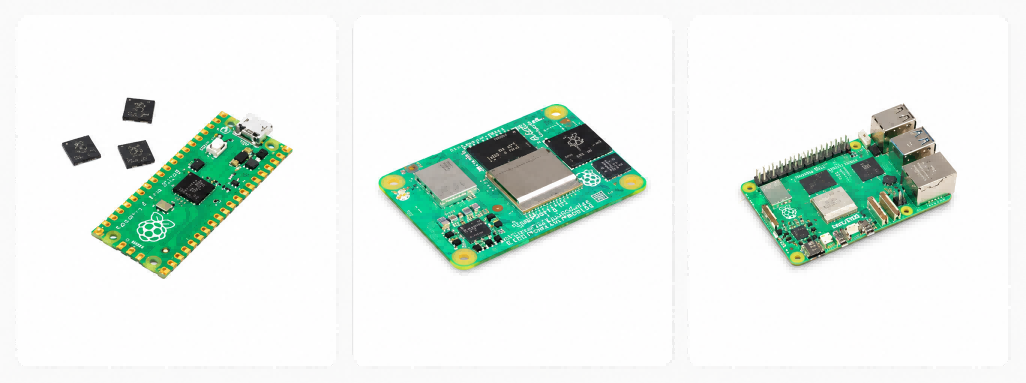
Raspberry Pi Pico and Pico 2 should be separated from Raspberry Pi 4 or Raspberry Pi 5 alternatives. Pico is a microcontroller board, not a Linux single-board computer. Pico 2 is based on Raspberry Pi RP2350, which Raspberry Pi lists with dual Arm Cortex-M33 or dual Hazard3 RISC-V processors at 150MHz, 520KB SRAM, UART, SPI, I2C and PWM peripherals. (Raspberry Pi RP2350 official product page)
Pico and Pico 2 are useful when the project needs low-cost I/O control, PWM, sensor reading, real-time behavior or microcontroller firmware. They are not replacements for Linux desktop, web server, Home Assistant, camera processing or general SBC workloads.
| Best For | MCU control, PWM, sensor I/O, low-power devices, real-time firmware, simple robotics control. |
|---|---|
| Not Recommended For | Linux applications, Raspberry Pi OS, desktop use, media, camera AI, Home Assistant. |
| Main Replacement Risk | Confusing MCU projects with Linux SBC projects. |
Extended Raspberry Pi Alternative Table
The table below lists additional alternatives by role. It is not a ranking. It is a selection aid for matching workload to platform category.
| Alternative Board / Platform | Chip / Platform Direction | Best For | Not Recommended For |
|---|---|---|---|
| Orange Pi 5 | Rockchip RK3588S | High-performance Linux, AI experiments, media | Pi OS and HAT drop-in replacement |
| Radxa ROCK 5B / 5B+ | Rockchip RK3588 | NVMe, high-end SBC projects, edge AI | Beginner Raspberry Pi tutorials |
| Banana Pi BPI-M7 | Rockchip RK3588 | Networking, storage-heavy Linux, high-performance embedded work | Pi camera/HAT drop-in use |
| FriendlyElec NanoPi R6C / R6S | Rockchip RK3588S gateway platform | Router, gateway, firewall, network appliance | General Pi classroom projects |
| NVIDIA Jetson Orin Nano | NVIDIA edge AI platform | AI vision, robotics, CUDA/TensorRT | Low-cost Raspberry Pi replacement |
| Libre Computer Le Potato | Amlogic S905X | Low-cost Linux and media projects | Pi 5 performance replacement |
| Khadas VIM series | Amlogic / embedded media platform | Media, embedded Linux, Android-style workloads | Pi tutorial compatibility |
| ODROID boards | Amlogic / Samsung / x86 depending on model | Linux SBC, media, hobbyist computing | Raspberry Pi accessory ecosystem |
| BeagleBone Black | TI Sitara industrial I/O platform | Industrial I/O, PRU-based real-time control, teaching embedded Linux | Pi-like desktop replacement |
| LattePanda | x86 Windows/Linux SBC | Windows, x86 software, industrial edge computing | Low-cost Pi replacement |
| Raspberry Pi Compute Module 5 | Broadcom BCM2712 compute module | Productized Pi-based embedded design | Projects without carrier board design |
| Raspberry Pi Pico / Pico 2 | RP2040 / RP2350 MCU | Microcontroller control and real-time I/O | Linux SBC replacement |
| Milk-V / RISC-V boards | RISC-V development platforms | RISC-V learning, open hardware/software experiments | Mainstream Pi project replacement |
| Luckfox boards | Low-cost Linux / edge AI board class | Compact AI, Linux experiments, cost-sensitive embedded prototypes | Raspberry Pi OS and HAT compatibility |
Chip and Interface Comparison Checklist
Before replacing Raspberry Pi, compare the platform at chip, board and software levels. A board with a stronger processor may still fail the project if it lacks the required camera driver, HAT overlay, boot support, GPIO library or long-term OS maintenance.
| Comparison Item | What to Check |
|---|---|
| CPU architecture | Core type, clock speed, 32/64-bit OS support, thermal throttling behavior |
| GPU / NPU | Driver maturity, acceleration framework, model deployment path, media support |
| RAM | Capacity, bandwidth, available variants, memory pressure under workload |
| Storage | microSD, eMMC, NVMe, boot support, reliability and write endurance |
| Camera | CSI connector, lane count, sensor driver, ISP pipeline, libcamera support |
| Display | HDMI, DSI, DisplayPort, resolution, refresh rate, driver support |
| GPIO | Pin mapping, voltage level, kernel access, library support, timing behavior |
| HAT compatibility | Mechanical fit, EEPROM, overlays, I2C/SPI/UART pin functions, power pins |
| Operating system | Official image, mainline kernel support, vendor kernel quality, update path |
| Community and documentation | Tutorials, forum support, issue history, driver examples, long-term availability |
| Power and thermal design | Power input, peak current, heat sink requirement, fan support, enclosure temperature |
| Production suitability | Supply continuity, eMMC option, operating temperature, certification, carrier board support |
Home Assistant and Software Ecosystem Considerations
Home Assistant is a common Raspberry Pi use case, but replacement should be based on official image support and storage reliability rather than board speed alone. The official Home Assistant Raspberry Pi installation flow uses Raspberry Pi Imager and provides hardware-specific Home Assistant OS selections for Raspberry Pi 4 or Raspberry Pi 5. (Home Assistant Raspberry Pi installation guide)
If the project uses USB Zigbee adapters, Z-Wave adapters, SSD boot, backup automation, or long-term 24/7 operation, the main checks are stable storage, supported OS image, reliable USB behavior, thermal control and update path. A faster SBC is not automatically a better Home Assistant platform if its OS image or USB support is less stable.
Frequently Asked Questions
What is the best Raspberry Pi alternative?
There is no single best alternative. Orange Pi and ROCK boards are strong for high-performance Linux and RK3588 projects, Jetson is better for AI and robotics, Libre Computer can work for low-cost Linux, and Compute Module 5 is better for production Pi-based designs.
Is Orange Pi better than Raspberry Pi?
Orange Pi 5 can offer stronger raw hardware specifications than many Raspberry Pi boards, especially with RK3588S CPU/NPU capability. Raspberry Pi usually has stronger official OS support, accessory compatibility, documentation and community depth.
Can Orange Pi run Raspberry Pi OS?
It should not be treated as a Raspberry Pi OS drop-in platform. Orange Pi boards normally use board-specific Linux images, Android images or community distributions, depending on model and support status.
Is Raspberry Pi Pico a Raspberry Pi alternative?
Raspberry Pi Pico is a microcontroller board, not a Linux SBC. It can replace Arduino- or MCU-style control boards, but it does not replace Raspberry Pi 4 or Raspberry Pi 5 for Linux applications.
What can replace Raspberry Pi for Home Assistant?
Raspberry Pi 4 and Raspberry Pi 5 remain common choices. Other SBCs or x86 mini PCs can work, but official image support, USB stability, storage reliability and backup workflow should be checked first.
What is the best Raspberry Pi alternative for AI?
NVIDIA Jetson is stronger for CUDA/TensorRT AI workflows. RK3588-class boards such as Orange Pi 5, ROCK 5B and Banana Pi BPI-M7 can be useful for NPU-based edge AI, but their software toolchains differ.
Can Raspberry Pi HATs work on alternatives?
Sometimes, but not as a safe assumption. Physical 40-pin compatibility does not guarantee EEPROM, overlays, driver, pin mapping, power or mechanical compatibility.
Which Raspberry Pi projects should not use alternatives?
Avoid alternatives when the project depends on official camera/display modules, HAT overlays, Raspberry Pi OS tutorials, classroom instructions, tight GPIO timing or production validation already completed on Raspberry Pi hardware.
Is Raspberry Pi 5 better than Orange Pi 5?
Raspberry Pi 5 is generally better for ecosystem support, documentation, official OS and accessory compatibility. Orange Pi 5 can be better for raw RK3588S performance, NPU experiments and certain media or edge workloads.
What should be checked before replacing Raspberry Pi in a product?
Check SoC platform, OS image, kernel support, GPIO libraries, camera/display drivers, HAT compatibility, storage reliability, thermal design, power input, documentation, long-term supply and maintenance path.
Engineering Summary
Raspberry Pi alternatives should be selected by replacement boundary, not by specification ranking alone. A faster board may be a poor replacement if the project depends on Raspberry Pi OS, camera modules, HAT overlays, GPIO libraries or community tutorials. A lower-cost board may be acceptable if the workload is only basic Linux computing or media playback.
For high-performance Linux and edge AI, Chinese RK3588/RK3588S boards such as Orange Pi, Radxa ROCK, Banana Pi and NanoPi are important alternatives, but they require platform-specific validation. For robotics and AI vision, Jetson is a stronger specialized platform. For embedded production, Compute Module 5 may be a better path than changing ecosystems. For real-time I/O, Raspberry Pi Pico or another MCU is often the correct replacement class.


