
 My Inquiry
 My Account


18650 Battery: Voltage, Capacity, Charging and Pack Design
Article Details
An 18650 battery is a cylindrical rechargeable cell format widely used in battery packs, flashlights, power tools, portable instruments, robotics, backup power modules and industrial electronics. Most 18650 cells used in modern electronic products are lithium-ion rechargeable cells, but the number 18650 describes the physical cell size rather than a guaranteed chemistry, capacity, discharge rating or safety structure.
The electrical behavior of an 18650 battery depends on the specific cell datasheet. Two cells with the same 18650 size can have different nominal voltage, capacity, internal resistance, continuous discharge current, cycle life, charge current, temperature range, protection structure and qualification status. Engineering selection should therefore treat 18650 as a mechanical format first, then verify the electrochemical and electrical ratings separately.
What Is an 18650 Battery?
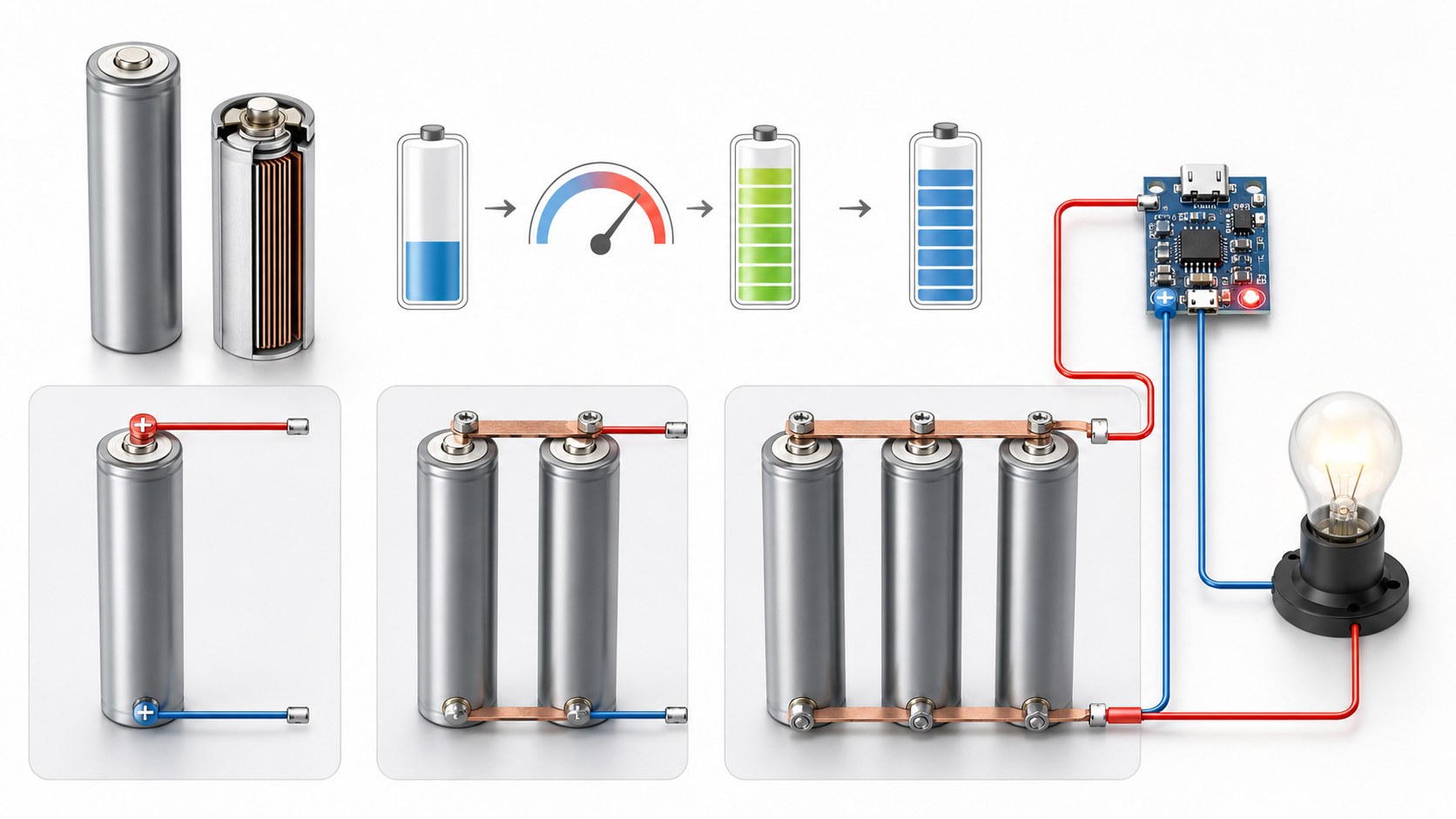
An 18650 battery is a cylindrical cell with an approximate diameter of 18 mm and length of 65 mm. The format became common because it offers a useful balance between energy capacity, mechanical strength, manufacturability and pack assembly density. In electronic products, 18650 cells are often arranged in series, parallel or series-parallel packs to create the required voltage, capacity and current capability.
The most common 18650 battery type in portable electronics is a rechargeable lithium-ion cell. However, "18650 lithium battery" and "18650 lithium-ion battery" are often used loosely in product descriptions. The correct replacement or design choice should always be based on the cell datasheet, equipment requirement and charger design, not only the printed size code.
| Item | Typical Meaning | Engineering Check |
|---|---|---|
| 18650 format | Cylindrical cell size around 18 mm diameter and 65 mm length. | Check actual cell length, button-top or flat-top terminal, and whether a protection PCB is attached. |
| Lithium-ion cell | Rechargeable cell chemistry commonly used in 18650 batteries. | Check nominal voltage, charge voltage, discharge cutoff, charge current and discharge current. |
| Protected 18650 | Cell with an added protection circuit module. | Length may be longer than an unprotected cell; holder and device compatibility must be checked. |
| Unprotected 18650 | Bare cell without individual protection PCB. | Requires external protection in the device or battery pack system. |
Why Is It Called 18650?
The name 18650 comes from the approximate physical dimensions of the cell. The first two digits refer to the diameter in millimeters, and the next digits refer to the cell length. The final "0" is commonly associated with the cylindrical cell format. A standard unprotected 18650 cell is therefore approximately 18 mm in diameter and 65 mm long.
The physical size code does not define capacity or chemistry. A low-cost 18650 cell may have much lower real capacity than a branded industrial cell. A protected 18650 battery can also be longer than 65 mm because the protection circuit and top terminal add extra length. This is one reason why some flashlights, holders and battery compartments cannot accept every 18650 cell.
18650 Battery Voltage: 3.6V, 3.7V and 4.2V
A typical lithium-ion 18650 cell is usually marked as 3.6 V or 3.7 V nominal. This nominal voltage is not the same as the full-charge voltage. Many common Li-ion cells charge to 4.2 V per cell under the correct constant-current / constant-voltage charging profile, while the discharge cutoff voltage depends on the cell chemistry, datasheet and protection circuit.
Battery pack voltage increases when cells are connected in series. A 2S pack built from common 3.6 V or 3.7 V cells is often described as 7.2 V or 7.4 V nominal and 8.4 V fully charged. A 3S pack is often described as 10.8 V or 11.1 V nominal and 12.6 V fully charged. These values are only valid when all cells use the same charging voltage class and are managed by an appropriate protection and balancing system.
| Configuration | Nominal Voltage | Typical Full-Charge Voltage | Design Note |
|---|---|---|---|
| 1S | 3.6 V or 3.7 V | 4.2 V for many common Li-ion cells | Used in single-cell flashlights, portable instruments, modules and small electronics. |
| 2S | 7.2 V or 7.4 V | 8.4 V | Requires a 2S charger and 2S protection/balancing design. |
| 3S | 10.8 V or 11.1 V | 12.6 V | Common in higher-voltage portable packs and requires cell balancing. |
| 4S | 14.4 V or 14.8 V | 16.8 V | Requires correct charger voltage, BMS rating, wiring and insulation design. |
18650 Battery Capacity: mAh and Wh
18650 battery capacity is usually specified in milliamp-hours, such as 2000 mAh, 2600 mAh, 3000 mAh or 3500 mAh. Capacity describes how much charge the cell can deliver under defined test conditions. It does not directly define output power or maximum discharge current. A high-capacity cell may be optimized for runtime, while a high-drain cell may be optimized for current delivery.
Energy is better expressed in watt-hours. For example, a 3000 mAh cell at 3.7 V nominal has an approximate energy of 11.1 Wh. Real usable energy is lower when the load current is high, the cutoff voltage is high, the cell is cold, the cell is aged or the battery protection circuit disconnects early. For runtime estimation, the Battery Life Calculator can help compare rated capacity, usable capacity, load current and battery voltage before hardware testing.
| Parameter | Meaning | Common Mistake |
|---|---|---|
| mAh | Charge capacity under specified discharge conditions. | Assuming mAh alone determines runtime in every load condition. |
| Wh | Energy estimate based on voltage and amp-hour capacity. | Comparing packs with different voltages only by mAh. |
| C-rate | Current relative to capacity; 1C for a 3000 mAh cell is 3 A. | Using a high charge or discharge C-rate without checking the datasheet. |
| Continuous discharge current | Maximum sustained current under defined conditions. | Using pulse-current numbers as a continuous rating. |
| Internal resistance | Contributes to voltage sag and heat at load current. | Ignoring heat and voltage drop in high-current applications. |
18650 Lithium Battery vs 18650 Lithium-Ion Battery
In many product listings, "18650 lithium battery" refers to a rechargeable lithium-ion 18650 cell. In engineering documentation, lithium-ion should be specified more carefully because cell chemistry affects voltage profile, energy density, cycle life, thermal behavior, safety limits and recommended charging method.
Common lithium-ion cylindrical cells may use chemistries optimized for high energy, high power, long cycle life or improved safety behavior. The cell format alone does not show which chemistry is inside. The datasheet should identify the nominal voltage, charge voltage, recommended charge current, maximum discharge current, temperature range and safety test information.
| Description | Practical Meaning |
|---|---|
| 18650 battery | Size format. It does not automatically define chemistry, voltage or current rating. |
| 18650 rechargeable battery | Usually a rechargeable lithium-ion cell, but the exact chemistry and charging limits must be confirmed. |
| 18650 lithium-ion battery | Rechargeable Li-ion cell in 18650 cylindrical format. |
| 18650 lithium battery | Common marketing term; should be checked against datasheet chemistry and charger requirement. |
Protected vs Unprotected 18650 Battery
A protected 18650 battery includes a small protection circuit attached to the cell. This circuit may disconnect the cell during overcharge, over-discharge, overcurrent or short-circuit conditions, depending on the protection design. Protected cells are common in some flashlights, portable devices and user-replaceable battery applications.
An unprotected 18650 cell is only the cylindrical cell. It requires protection from the host product, charger or battery pack BMS. Many industrial packs use unprotected cells with a pack-level BMS because the BMS manages series balancing, overvoltage, undervoltage, overcurrent, temperature and pack-level fault detection.
| Type | Advantages | Design Risk |
|---|---|---|
| Protected 18650 | Additional cell-level protection for some user-replaceable applications. | Longer cell length may not fit all holders; protection trip current may limit high-power loads. |
| Unprotected 18650 | Common for battery packs, high-current applications and controlled product designs. | Unsafe without proper charger, protection circuit, BMS or host-system cutoff. |
| Button-top cell | Positive terminal protrudes and may fit consumer holders more easily. | Extra height can create mechanical incompatibility. |
| Flat-top cell | Common in pack assembly and welded tab designs. | May not make contact in holders designed for button-top cells. |
18650 Battery Charger and Recharge Safety
A lithium-ion 18650 battery requires the correct charger. It should not be charged with a NiMH, NiCd or lead-acid charger. A typical Li-ion charging process uses a constant-current stage followed by a constant-voltage stage. For many common 4.2 V Li-ion cells, the charger first supplies controlled current until the cell approaches the charge voltage, then holds voltage while the current tapers down. Texas Instruments describes this constant-current and constant-voltage behavior in its Li-ion battery charging training material. (TI Introduction to Li-Ion battery charging)
Charging time cannot be calculated only by dividing capacity by charger current because the constant-voltage stage adds time near the end of charge. Temperature, battery age, charger termination current, cable loss and protection-circuit behavior also change charge time. The Battery Charging Time Calculator can help estimate charging time from capacity, charging current, efficiency and charging profile factor before a charger IC or battery module is selected.
| Charging Item | Engineering Check |
|---|---|
| Charge voltage | Must match the cell chemistry and datasheet. Many common Li-ion cells are charged to 4.2 V per cell, but this is not universal. |
| Charge current | Must stay within the manufacturer recommended range. Higher current can increase heat and reduce cycle life. |
| Temperature monitoring | Charging should be controlled or disabled outside the allowed temperature range. |
| Series pack charging | Requires a charger and BMS designed for the exact series-cell count. |
| Termination behavior | Charger must stop or reduce current according to the cell and charger IC requirements. |
| Reverse polarity and short circuit | Battery holder, wiring, connector and protection design should prevent unsafe faults. |
18650 Battery Charging Video
The video above gives an engineering-focused explanation of lithium-ion and lithium-polymer battery charging, including charger IC selection, over-discharge, overvoltage and short-circuit considerations. It is useful background before selecting an 18650 charger, protection circuit or battery-management device for a real product.
18650 Battery Pack Design: Series, Parallel and BMS
An 18650 battery pack combines cells in series, parallel or series-parallel arrangements. Series connection increases pack voltage. Parallel connection increases capacity and current capability when cells are properly matched. A pack used in a product should be designed with electrical protection, mechanical insulation, temperature sensing and fault handling.
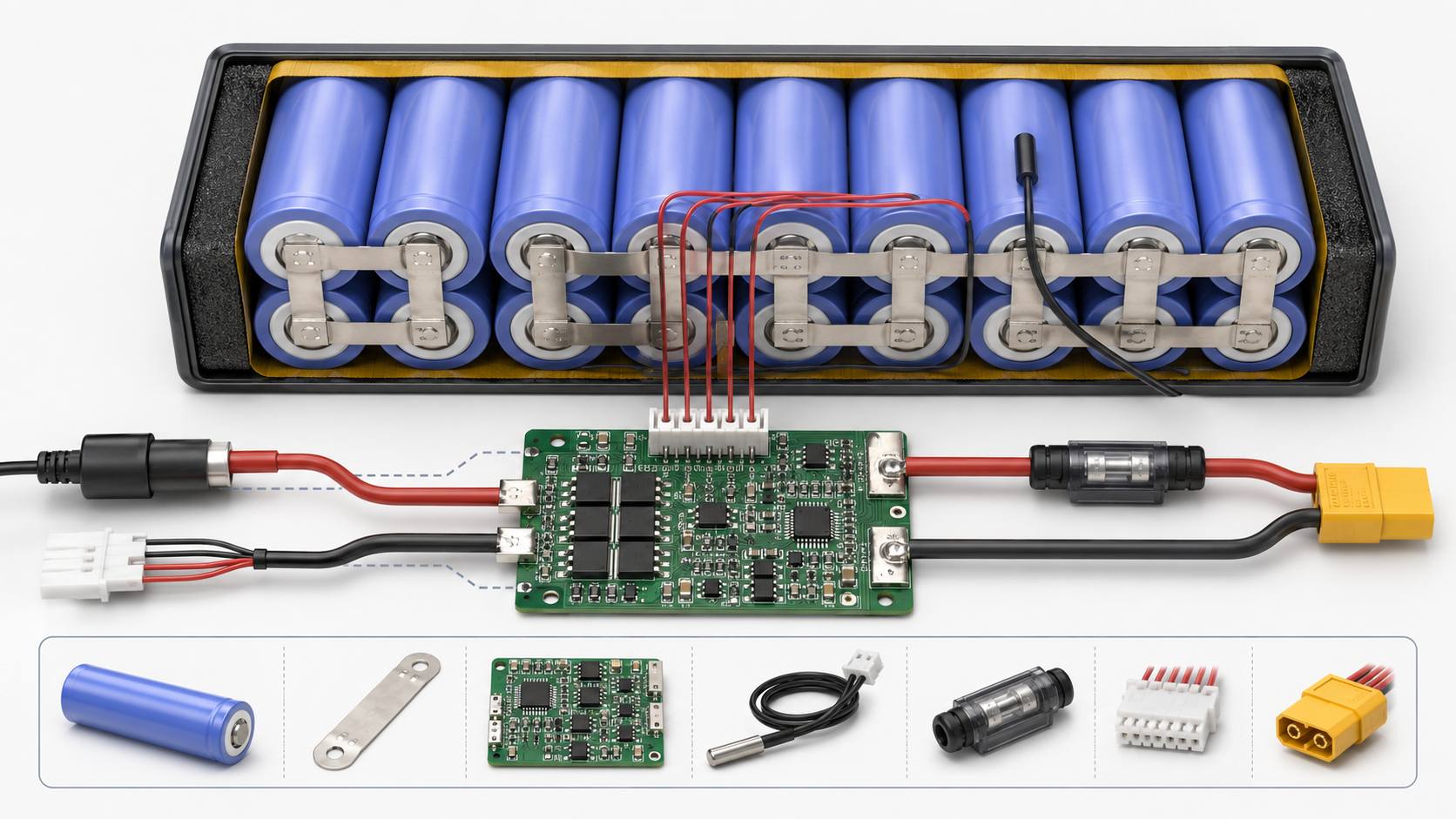
A battery management system is usually required for multi-cell lithium-ion packs. The BMS monitors cell voltages, pack current and temperature. It may provide overcharge protection, over-discharge protection, overcurrent protection, short-circuit protection, balancing, charge/discharge control and communication with the host system. The BMS rating must match the pack voltage, maximum current, charger behavior and application safety requirements.
| Pack Term | Meaning | Design Check |
|---|---|---|
| 1S | One cell or one parallel cell group in series. | Single-cell charger and protection may be used when current and safety requirements allow. |
| 2S / 3S / 4S | Two, three or four cells/groups in series. | Use correct charger voltage, BMS series count and balancing design. |
| Parallel group | Cells connected positive-to-positive and negative-to-negative. | Cells should be matched in capacity, resistance, state of charge, age and model. |
| Cell balancing | Controls voltage differences between series cells. | Important for charge safety, usable capacity and long-term pack reliability. |
| NTC temperature sensing | Temperature feedback for charger or BMS. | Sensor placement should represent the hottest relevant pack location. |
| Fuse or protection link | Fault-current protection path. | Coordinate with BMS, wire gauge, connector rating and expected load current. |
18650 Battery Holder, Tabs and Welding
An 18650 battery holder is useful when the cell must be replaceable, the current is moderate and the mechanical environment is controlled. Holders are common in prototypes, flashlights, test fixtures and portable devices. For high-current packs, ordinary spring holders can create excessive contact resistance, voltage drop, heating or intermittent connection under vibration.
Pack assemblies often use nickel strip spot welding instead of direct soldering to the cell terminal. Direct soldering can overheat the cell, damage internal seals or reduce safety margin unless a manufacturer-approved process is used. Mechanical spacing, insulation rings, fishpaper, heat-shrink sleeve, strain relief and connector rating should be reviewed before the battery pack is released for production.
| Connection Method | Suitable Use | Risk to Check |
|---|---|---|
| Spring holder | Replaceable cells, low to moderate current, serviceable devices. | Contact resistance, vibration, heat and terminal style compatibility. |
| Button-top cell | Consumer holders that require raised positive terminal contact. | Extra length and current limitation from protection circuit. |
| Flat-top cell | Pack assembly and welded-tab construction. | Poor contact in holders designed for button-top cells. |
| Nickel strip spot welding | Battery packs requiring durable, low-resistance interconnects. | Weld energy, strip thickness, insulation and quality inspection. |
| Direct soldering | Only when specifically allowed by the cell manufacturer or controlled process. | Cell overheating, seal damage and safety risk. |
18650 Battery Applications
18650 batteries are used when a compact rechargeable energy source is needed and the product can accommodate a cylindrical cell or pack structure. Applications include flashlights, laptop battery packs, power banks, cordless tools, e-bikes, robotics, wireless instruments, UPS modules, test equipment, handheld industrial devices and energy-storage prototypes.
| Application | Why 18650 Is Used | Design Focus |
|---|---|---|
| Flashlight | High energy in a compact cylindrical format. | Protected vs unprotected compatibility, button-top length, discharge current and charger safety. |
| Laptop battery pack | Multiple cells can be arranged into compact high-energy packs. | Cell matching, BMS, thermal layout and pack authentication. |
| Power tool | High-drain cells can deliver large current bursts. | Continuous current, pulse current, heat rise, welded interconnects and pack cooling. |
| Robotics | Rechargeable pack can support motors, controllers and sensors. | Peak current, voltage sag, BMS trip point and charger interface. |
| Industrial handheld device | Rechargeable energy source for portable electronics. | Runtime, temperature range, certification, serviceability and traceable cell sourcing. |
| Backup power module | Cells can be configured for required voltage and capacity. | Float/storage policy, aging, protection, state-of-charge monitoring and replacement interval. |
Samsung 18650 Battery and Brand Cell Selection
Samsung, Panasonic/Sanyo, LG Energy Solution, Murata/Sony and Molicel are common names in cylindrical lithium-ion cells. Brand alone is not enough to select an 18650 battery. Each manufacturer may offer high-capacity cells, high-drain cells, long-cycle-life cells and application-specific models with different voltage curves, internal resistance and current ratings.
Counterfeit, rewrapped, salvaged and grade-mixed cells are major risks in the 18650 market. For production procurement, engineers and buyers should request datasheets, manufacturer markings, lot traceability, supplier documentation and consistent packaging. If a battery listing claims unrealistic capacity or current rating for an 18650 cell, it should be treated as a sourcing risk until verified by test and documentation.
| Procurement Check | Reason |
|---|---|
| Manufacturer and exact model | Different models from the same brand can target different capacity and discharge-current ranges. |
| Datasheet availability | Confirms electrical limits, charge conditions, discharge rating, temperature range and safety notes. |
| Lot traceability | Supports quality control, failure analysis and production consistency. |
| Authentic markings | Helps detect counterfeit, rewrapped or salvaged cells. |
| Cell matching | Important for series and parallel battery packs. |
How to Select an 18650 Battery
18650 battery selection should begin with the load profile, mechanical envelope and charger architecture. A low-current sensor node, a high-lumen flashlight, a motorized tool and a multi-cell backup pack require different cell priorities. The key decision is not the highest advertised capacity; it is whether the cell can safely support the required voltage, current, temperature and cycle-life conditions.
| Selection Item | What to Check |
|---|---|
| Cell chemistry | Nominal voltage, charge voltage, discharge cutoff, safety behavior and cycle life. |
| Capacity | Rated mAh under test conditions and usable capacity under real load. |
| Continuous discharge current | Must exceed the sustained load current with thermal margin. |
| Pulse current | Check pulse width, duty cycle, temperature and voltage sag conditions. |
| Charge current | Use manufacturer-recommended standard and maximum charge current. |
| Internal resistance | Affects voltage drop, heat generation and high-current performance. |
| Protected or unprotected | Match protection architecture with holder, device cutoff, charger and BMS design. |
| Flat top or button top | Controls holder compatibility and pack assembly method. |
| Actual length | Protected cells and button-top cells may be longer than standard unprotected flat-top cells. |
| Operating temperature | Check charge and discharge temperature ranges separately. |
| Certification and safety data | Required for many commercial products, transport and regulated applications. |
| Supplier traceability | Reduces counterfeit and inconsistent-cell risk. |
18650 Battery Datasheet Checklist
The 18650 datasheet should be reviewed before a cell is used in a product or pack. Datasheet limits are also necessary for charger IC selection, BMS threshold setting, fuse rating, thermal design and runtime testing.
| Datasheet Field | Design Use |
|---|---|
| Nominal voltage | Used for system voltage and energy calculation. |
| Charge voltage | Defines charger constant-voltage setting. |
| Standard charge current | Recommended current for normal charging and cycle-life performance. |
| Maximum charge current | Upper limit for fast charging under defined conditions. |
| Discharge cutoff voltage | Defines host cutoff, BMS undervoltage threshold and usable capacity. |
| Maximum continuous discharge current | Sets load-current limit and thermal design target. |
| Internal resistance | Used for voltage sag and heating estimates. |
| Temperature range | Charge and discharge ranges may differ and must be checked separately. |
| Cycle life | Shows expected capacity retention after defined charge/discharge cycles. |
| Dimensions and mass | Required for holder fit, pack layout and mechanical design. |
| Safety and handling notes | Defines limits for charging, discharging, storage, short-circuit prevention and assembly handling. |
Frequently Asked Questions
What is an 18650 battery?
An 18650 battery is a cylindrical cell format approximately 18 mm in diameter and 65 mm long. Most 18650 batteries used in portable electronics are rechargeable lithium-ion cells.
Is an 18650 battery rechargeable?
Most 18650 batteries sold for electronics are rechargeable lithium-ion cells. The charger must match the cell chemistry, charge voltage and charge current limits.
What voltage is an 18650 battery?
A common lithium-ion 18650 cell is usually 3.6 V or 3.7 V nominal and often charges to 4.2 V per cell. Exact voltage limits depend on the specific cell chemistry and datasheet.
Can I recharge an 18650 battery?
Yes, if it is a rechargeable 18650 lithium-ion cell and it is charged with a proper Li-ion charger. Do not use chargers intended for NiMH, NiCd or lead-acid batteries.
Do 18650 batteries need a special charger?
A lithium-ion 18650 battery needs a charger designed for Li-ion charging, usually with constant-current and constant-voltage control. Multi-cell packs require a charger and BMS matched to the series-cell count.
What is the difference between protected and unprotected 18650 batteries?
A protected 18650 battery includes a protection circuit. An unprotected 18650 cell relies on the device, charger or pack-level BMS for protection.
What does 3000 mAh mean on an 18650 battery?
3000 mAh means the cell has a rated charge capacity of 3 Ah under specified test conditions. It does not automatically mean the cell can deliver high current.
Can 18650 batteries be connected in series?
Yes, 18650 cells can be connected in series to increase voltage, but series packs require matched cells, balancing and a BMS designed for the correct series count.
Can 18650 batteries be connected in parallel?
Yes, parallel cells increase capacity and current capability when cells are properly matched. Cells should be at similar state of charge and from the same model and condition before pack assembly.
Can I solder directly to an 18650 battery?
Direct soldering is generally avoided because heat can damage the cell. Battery packs commonly use spot-welded nickel strip unless the cell manufacturer approves a specific soldering process.
Are Samsung 18650 batteries better?
Samsung is a recognized cylindrical cell manufacturer, but the exact model matters more than the brand name alone. Capacity, discharge rating, cycle life, authenticity and datasheet limits must be checked.
What should be checked before buying 18650 batteries?
Check chemistry, nominal voltage, charge voltage, capacity, continuous discharge current, protected or unprotected structure, terminal style, dimensions, manufacturer model, datasheet and supplier traceability.


