
 My Inquiry
 My Account


Electronic Component Obsolescence: EOL Risks, Replacement Options and Last-Time Buy Strategy
Article Details
Electronic component obsolescence is the risk that a semiconductor, passive component, connector, module or other electronic part becomes unavailable, unsupported, not recommended for new designs, or officially discontinued before the end of the product that uses it. This risk is common in industrial equipment, medical devices, transportation systems, energy infrastructure, aerospace electronics, test instruments and other long-life products.
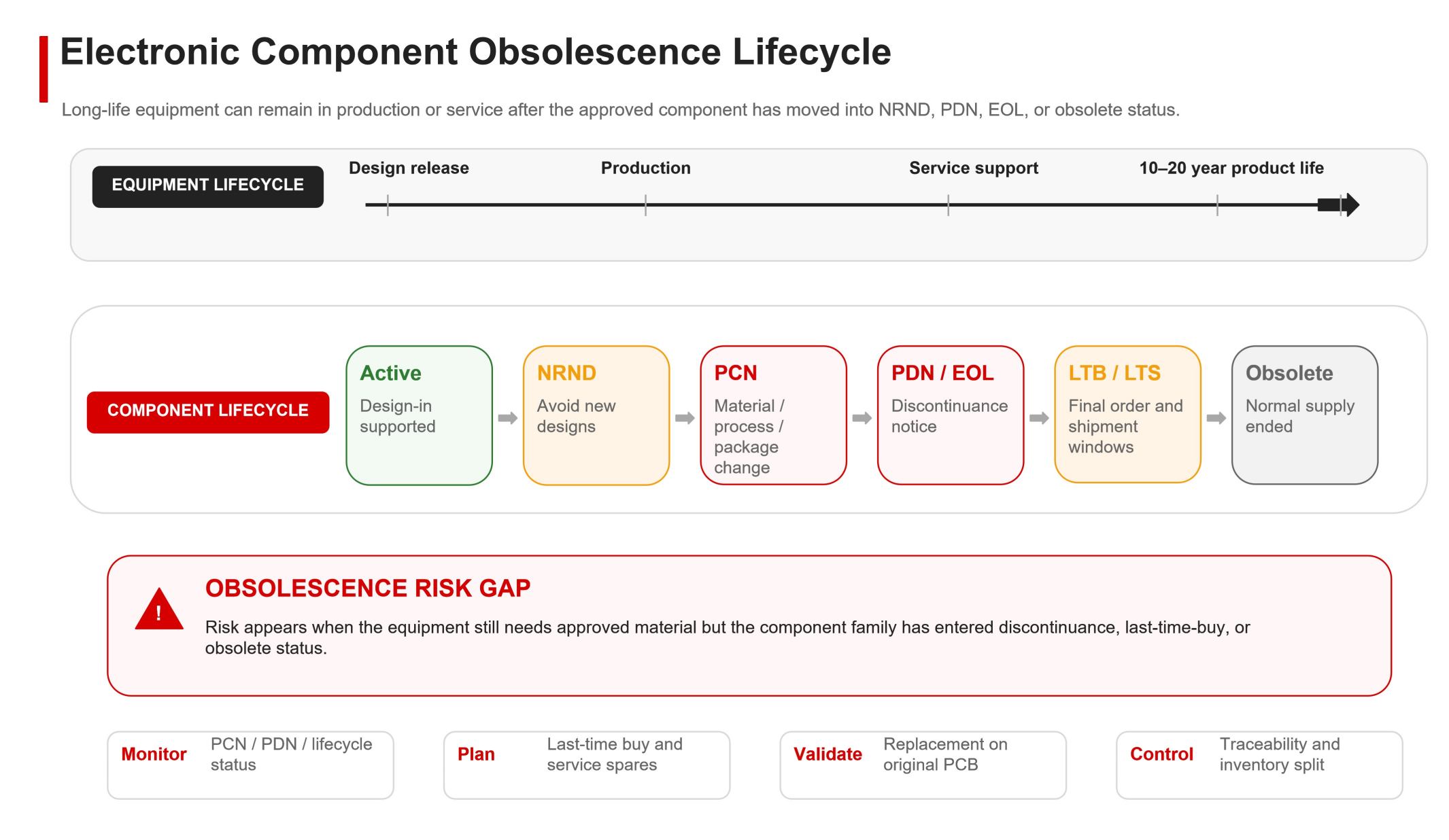
The problem is caused by a lifecycle mismatch. Equipment may remain in production or service for 10, 15 or 20 years, while semiconductor suppliers continue to move to newer processes, smaller packages, updated test platforms and higher-volume product families. A part that was stable during design can become NRND, EOL or unavailable before the product reaches full production.
What Is Electronic Component Obsolescence?
Electronic component obsolescence means that a component can no longer be used, sourced or supported in the same way as before. It may still appear in distributor listings, but the manufacturer may have stopped recommending it for new designs, issued a product discontinuance notice, ended production, closed the last-time-buy window or removed technical support for future use.
In practice, obsolete electronic components can appear in several states. Some parts are still available but risky for new designs. Some parts are available only through remaining authorized inventory. Some can be purchased only from independent distributors or brokers. Some have suggested replacement parts, while others require redesign, emulation, ASIC recreation or a lifetime-buy strategy.
| Status | Meaning | Engineering / Supply Action |
|---|---|---|
| Active | The manufacturer still supports production and new designs. | Continue lifecycle monitoring and check PCN notices. |
| NRND | Not recommended for new design. | Avoid new design-in; start alternative review for existing products. |
| PCN | Product change notification for material, process, package, test, marking or manufacturing-site changes. | Review changed material and validate form, fit, function and reliability impact. |
| PDN / EOL | Product discontinuance or end-of-life notice. | Check last-time-buy date, last-shipment date, remaining demand and replacement path. |
| LTB | Last-time buy window before production stops. | Calculate lifetime demand, service spares, yield loss, safety stock and storage requirements. |
| Obsolete | Manufacturer support and normal production have ended. | Use approved stock, qualified replacement, redesign or controlled obsolete sourcing. |
Why Electronic Components Become Obsolete
Component obsolescence usually follows normal semiconductor business and manufacturing decisions. Suppliers retire products when demand falls, wafer processes move, package lines close, test systems become expensive to maintain, raw materials change, or newer product families replace older devices. A manufacturer may also discontinue a part when the original process node, mask set, assembly line or qualification flow is no longer economical.
This is especially difficult for long-life systems. A control board used in a factory machine may depend on a microcontroller, power IC, logic device, optocoupler, sensor or memory chip selected years earlier. The equipment may still be selling and supported, but the semiconductor product family may already have moved into a discontinuance phase.
PCN, PDN, EOL, LTB and LTS
Obsolescence management starts with understanding supplier notices. A PCN does not always mean a part is discontinued. It means the product, process, package, test flow, marking, manufacturing site or material may change. A PDN or EOL notice is more serious because it indicates planned product discontinuance and usually includes last-time-buy and last-shipment dates.
Standards help define this communication. IPC J-STD-046A covers customer notification for product and process changes by electronic product suppliers. J-STD-048A covers notification for planned product discontinuance. These notices should feed directly into BOM review, engineering validation and supply planning.
| Notice / Term | What It Usually Means | Risk if Ignored |
|---|---|---|
| PCN | The part may continue, but something about the product or manufacturing process changes. | Changed lots may behave differently in timing, thermal, EMC, soldering or reliability tests. |
| PDN | The supplier plans to discontinue the product. | The purchasing window may close before replacement qualification is complete. |
| EOL | The product is reaching end of life. | Future production, repair and warranty support may lose an approved source. |
| LTB | Last-time buy deadline. | Insufficient final order can stop production or service support. |
| LTS | Last-time shipment deadline. | Inventory must be received, inspected, stored and controlled before normal supply ends. |
Component Obsolescence Management
Obsolescence management is a planned process for identifying at-risk parts, checking lifecycle status, forecasting demand, selecting mitigation actions and keeping production supportable. IEC 62402:2019 provides requirements and guidance for obsolescence management for organizations that depend on external suppliers for the items they use.
Defense and long-life system programs also use the term DMSMS, or Diminishing Manufacturing Sources and Material Shortages. The Defense Standardization Program treats DMSMS as a formal lifecycle issue involving loss or impending loss of suppliers, manufacturing sources, materials or support. The same thinking is useful for commercial electronics when production continuity matters.
A practical program does not wait for a discontinuance notice. It monitors approved parts, identifies single-source risks, tracks PCN and PDN notices, reviews lifecycle codes, prepares alternate sources and keeps customer-approved replacement options ready before production is affected.
Electronic Component Lifecycle Video
This video gives a practical overview of electronic component lifecycle and parts obsolescence. It is useful background before building a formal process for PCN review, EOL notice handling, alternate part approval and BOM lifecycle monitoring.
First Response to an EOL Component
When an electronic component is marked EOL, the first step is not to search the open market immediately. The first step is to confirm the original notice, affected part numbers, package codes, date codes, recommended replacement, last-time-buy date, last-shipment date and remaining authorized inventory. A wrong reaction at this stage can create excess inventory, failed qualification or counterfeit exposure.
| Step | Action | Reason |
|---|---|---|
| Confirm the notice | Check the manufacturer PCN, PDN or EOL document. | Affected ordering codes may be narrower than the whole product family. |
| Check current BOM use | Find all assemblies, revisions and customer programs using the part. | One EOL part can appear in multiple boards and service kits. |
| Estimate demand | Count production demand, repair demand, warranty demand and safety stock. | Last-time buy depends on the remaining product life, not only current backlog. |
| Review replacement path | Compare successor, alternative, redesign and final-buy options. | The lowest unit price may not be the lowest total risk. |
| Control sourcing | Prioritize original manufacturer, authorized distributors and traceable stock. | Obsolete parts attract counterfeit, recycled and remarked material. |
Last-Time Buy and Lifetime Buy Planning
Last-time buy is often the fastest response when a discontinued component is already qualified and the product does not have enough time for redesign. The goal is to buy enough approved material to support production, repair and service until the end of the equipment lifecycle.
This approach is simple in concept, but difficult in execution. The buyer must estimate future build quantity, service spares, expected field failures, production yield loss, customer warranty obligations and safety stock. The company must also consider cash flow, storage conditions, moisture-sensitive packaging, solderability aging, oxidation, shelf life, inspection, traceability and insurance risk.
| Last-Time Buy Item | What to Include |
|---|---|
| Production demand | Forecasted builds until the product is redesigned or retired. |
| Service demand | Repair, warranty and field-support parts. |
| Manufacturing loss | Assembly yield loss, test failures, rework and scrap. |
| Safety stock | Buffer for forecast error, customer schedule changes and quality holds. |
| Storage cost | Humidity control, ESD control, packaging, inventory audit and warehouse space. |
| Inventory aging | MSL control, solderability, oxidation, date-code limits and retest requirements. |
Obsolete Component Replacement Options
Replacement is not a single method. Some EOL parts have a manufacturer-recommended successor. Some have pin-compatible alternatives. Some require a board change. Older logic, memory, interface and analog devices may require emulation, gate array, standard cell, ASIC recreation or FPGA redesign. Each option has different cost, schedule and qualification risk.
| Replacement Option | Suitable Case | Main Risk |
|---|---|---|
| Manufacturer-recommended successor | The original supplier provides a defined replacement or migration path. | Still requires datasheet comparison and board-level validation. |
| Pin-compatible alternative | Package and pinout appear compatible. | Electrical behavior, timing, capacitance, EMC and reliability may differ. |
| Form-fit-function replacement | Replacement is reviewed against mechanical, electrical and functional requirements. | May still need qualification, customer approval and firmware testing. |
| Emulation | Older IC behavior is recreated using a new device or module. | Timing, noise sensitivity and system behavior may not fully match the original. |
| ASIC recreation | High-volume or long-life programs need a custom equivalent. | High NRE cost, long development time and full requalification. |
| Gate array | Logic function can be recreated with configurable interconnect layers. | Not suitable for every analog, timing or mixed-signal behavior. |
| Standard cell | Optimized custom IC is justified by volume or criticality. | Design, mask and validation cost can be high. |
| FPGA redesign | Digital logic can be migrated into programmable logic. | FPGA lifecycle, power, boot time, timing closure and qualification must be checked. |
| Board redesign | No safe drop-in replacement exists. | PCB change, firmware change, EMC retest and customer approval may be required. |
Why Pin-Compatible Replacements Can Fail
A replacement can have the same package and pinout but still fail in the original circuit. Older semiconductor parts may have slower edges, different input capacitance, different output drive, wider voltage tolerance, different ESD structures, different leakage behavior or different analog response. A newer device made on a smaller process may switch faster and consume less power, but faster is not always safer in an old board.
Faster switching can create ringing, spikes, false triggering, race conditions or new EMC problems. Different input or output capacitance can change loading and timing margin. A revised die in the same package can have different bond-wire length, lead-frame parasitics and thermal behavior. These differences may not appear in a simple continuity check or a short bench test.
| Hidden Difference | Possible Failure Mode | Validation Check |
|---|---|---|
| Faster switching edge | Ringing, EMI, false clocking, latch-up or race condition. | Check waveform, overshoot, timing margin and EMC behavior on the original PCB. |
| Different input capacitance | RC timing shift, sensor loading or analog filter behavior change. | Compare datasheet capacitance and test the full signal path. |
| Different output drive | Excessive current, slow transition, relay/LED/logic mismatch. | Measure output level, rise/fall time, load current and heat. |
| Different threshold voltage | Logic errors, ADC scaling errors or startup faults. | Check worst-case thresholds against the system voltage range. |
| Different ESD structure | Reduced robustness on exposed connectors or field wiring. | Review ESD ratings and repeat protection validation where required. |
| Different radiation tolerance | Latch-up, bit upset or data loss in high-altitude or space-related applications. | Use application-specific radiation and reliability data where required. |
| Different package construction | Thermal path, stress, coplanarity or solder-joint reliability change. | Check package drawing, thermal resistance, MSL and assembly behavior. |
Form, Fit, Function and Reliability Review
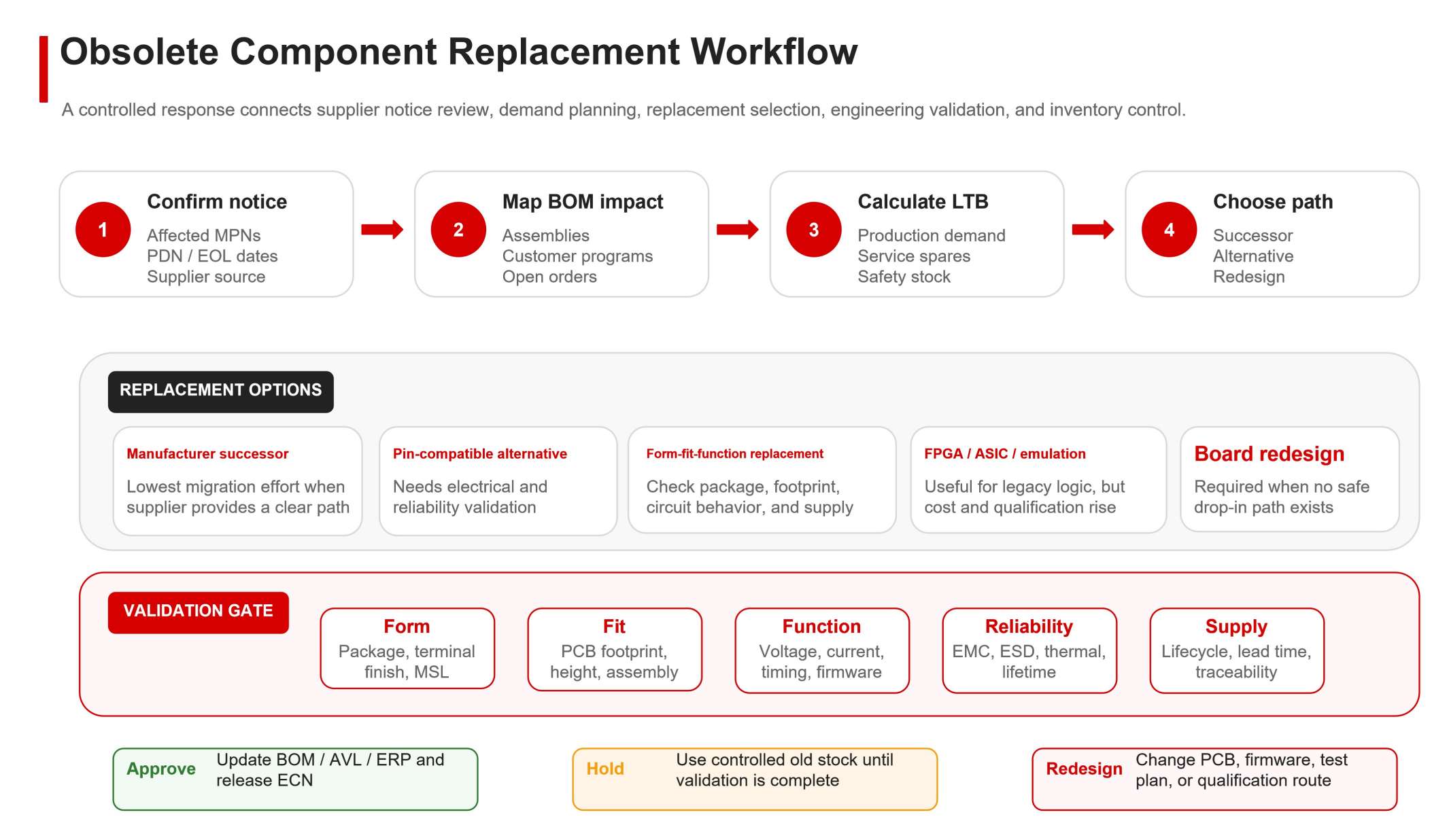
Obsolete component replacement should be reviewed through form, fit, function and reliability. This method prevents the common mistake of approving a replacement only because the part number looks similar or the package fits the footprint.
| Review Area | What to Check |
|---|---|
| Form | Package type, body size, pin count, terminal finish, MSL, thermal resistance and marking. |
| Fit | PCB footprint, height, mechanical clearance, soldering process, connector position and assembly tolerance. |
| Function | Voltage, current, timing, logic thresholds, analog behavior, firmware interaction and startup sequence. |
| Reliability | Temperature range, ESD, EMC, vibration, humidity, lifetime, qualification and stress margin. |
| Supply | Lifecycle status, authorized availability, lot traceability, lead time and future PCN/PDN risk. |
High-Reliability Products Need More Than a Substitute
Industrial, medical, aerospace, transportation, energy and infrastructure systems cannot treat obsolete component replacement as a simple purchasing exercise. A substitute designed for consumer electronics may not have the same lifetime expectation, temperature margin, EMC robustness, ESD tolerance, radiation behavior or documentation support needed by a long-life product.
Some replacement technologies can recreate the logical function of an old device, but they may not recreate the full behavior of the original silicon. Timing, drive strength, input loading, analog response, noise immunity and power-up behavior can all affect the final system. For safety-critical equipment, the replacement must be tested in the actual application, not only in a simulation environment.
Counterfeit Risk in Obsolete Components
Counterfeit risk increases after a component becomes hard to buy through normal channels. The market may contain recycled parts, remarked parts, mixed lots, salvaged material, poor-storage inventory or parts with incomplete documentation. This risk is not limited to expensive ICs; obsolete connectors, passives, logic parts, power semiconductors and sensors can also be affected.
SAE AS5553E addresses avoidance, detection, mitigation and disposition of counterfeit electrical, electronic and electromechanical parts. For obsolete sourcing, the practical controls include supplier qualification, traceability review, packaging inspection, marking inspection, X-ray or electrical testing when needed, and lot-level documentation.
| Counterfeit / Quality Risk | What to Check |
|---|---|
| Remarked parts | Surface texture, laser marking, date code, lot code and manufacturer logo consistency. |
| Recycled parts | Lead damage, solder residue, scratches, oxidation and package wear. |
| Mixed lots | Different date codes, inconsistent packaging and unmatched factory labels. |
| Poor storage | Moisture exposure, broken dry pack, expired MSL label and oxidized terminals. |
| Fake documentation | Unverifiable certificates, inconsistent label data and missing chain of custody. |
Obsolete Semiconductor Sourcing
Obsolete semiconductor sourcing should follow a controlled path. The best source is still the original manufacturer or authorized distributor. If the last-time-buy window is closed, the next step is to check traceable authorized residual stock, approved franchise channels, manufacturer-approved replacement options and qualified independent sources.
Independent sourcing may be necessary when production must continue and no approved replacement is ready. In that case, purchasing should not rely only on quoted quantity and price. The supplier should provide traceability, photos, labels, date codes, storage history, inspection support and clear return terms. Engineering and quality teams should decide the required inspection level based on product criticality.
Obsolescence Management Workflow
A useful obsolescence workflow connects engineering, purchasing, quality, production planning and customer approval. The process should be active during design, production and service, not only after a part becomes unavailable.
| Workflow Stage | Action | Output |
|---|---|---|
| BOM lifecycle audit | Check lifecycle status, manufacturer support, source count and historical notices. | Risk-ranked BOM list. |
| PCN / PDN monitoring | Track supplier notices for process changes, package changes and discontinuance. | Action list with deadlines. |
| Risk classification | Separate low-risk alternatives from parts requiring full qualification. | Engineering priority list. |
| LTB calculation | Estimate lifetime demand, spares, scrap and safety stock. | Final-buy recommendation. |
| Replacement search | Compare successor, alternate, emulation, FPGA, ASIC and redesign options. | Candidate replacement list. |
| Engineering comparison | Review form, fit, function, reliability and supply continuity. | Approved test plan. |
| Sample validation | Test the replacement on the original PCB under real operating conditions. | Electrical, thermal, EMC and functional evidence. |
| BOM / AVL update | Update approved vendor list, drawings, ERP data and customer documentation. | Controlled production release. |
| Inventory control | Store approved obsolete stock with traceability, date-code control and quality inspection. | Safe production and service inventory. |
How to Prevent Future Obsolescence Problems
The best time to reduce obsolescence risk is during design. A new design should avoid single-source parts when possible, check lifecycle status before schematic release, prefer suppliers with clear PCN/PDN processes, and select components with available alternates. For long-life products, lifecycle risk should be reviewed during design reviews in the same way as cost, thermal performance and EMC risk.
| Design Practice | Benefit |
|---|---|
| Check lifecycle status before design-in | Reduces the chance of selecting NRND or near-EOL components. |
| Use approved second sources where possible | Improves sourcing flexibility during shortages or discontinuance. |
| Keep functional margins in the circuit | Makes future replacement easier when electrical parameters shift. |
| Document critical parameters | Helps engineers find replacements based on actual circuit needs, not only package and pinout. |
| Monitor PCN and PDN notices | Gives more time for last-time buy, qualification or redesign. |
| Review BOM regularly | Finds hidden lifecycle risks before production is blocked. |
Frequently Asked Questions
What is electronic component obsolescence?
Electronic component obsolescence is the risk that a part becomes unavailable, unsupported, not recommended for new designs or discontinued before the product using it reaches the end of production or service life.
What does EOL mean for electronic components?
EOL means end of life. It usually indicates that the manufacturer plans to stop production or support for a component and may provide last-time-buy and last-shipment dates.
What is the difference between PCN, PDN and EOL?
A PCN announces a product or process change. A PDN announces product discontinuance. EOL describes the end-of-life status of the product and the need to plan replacement, final purchase or redesign.
What is last-time buy?
Last-time buy is the final ordering opportunity before a component is discontinued. It is used to purchase enough approved material for future production, repair and service needs.
What is lifetime buy?
Lifetime buy is the calculation and purchase of enough stock to support the remaining life of a product or system. It should include production demand, spare parts, yield loss and safety stock.
How do you replace an obsolete electronic component?
Start by confirming the manufacturer notice, then compare manufacturer successors, pin-compatible alternatives, form-fit-function replacements, emulation, FPGA, ASIC recreation or board redesign. The final option must be validated on the actual circuit.
Is a pin-compatible replacement always safe?
No. A pin-compatible component can still differ in timing, capacitance, thresholds, output drive, noise immunity, ESD robustness, thermal behavior and reliability. Board-level validation is required.
What is form-fit-function replacement?
Form-fit-function replacement means the alternative is reviewed for physical package, mechanical fit, electrical function and system-level behavior. Reliability and supply continuity should also be checked.
What is DMSMS?
DMSMS means Diminishing Manufacturing Sources and Material Shortages. It describes the loss or impending loss of manufacturing sources, suppliers, materials or support needed for a system.
Why do obsolete components increase counterfeit risk?
When original production stops and authorized inventory becomes limited, demand may move to the open market. This increases exposure to recycled, remarked, mixed-lot or poorly stored material.
What should engineers check before approving an alternative component?
Engineers should check package, pinout, voltage, current, timing, thresholds, capacitance, thermal behavior, EMC, ESD, firmware interaction, qualification status and lifecycle support.
How can companies reduce component obsolescence risk?
Companies can reduce risk by checking lifecycle status during design, monitoring PCN and PDN notices, keeping approved alternatives, reviewing BOMs regularly, planning last-time buys and controlling obsolete sourcing.
Engineering Summary
Electronic component obsolescence is a normal risk in products with long production or service lives. The safest response is not a single purchasing action, but a controlled process that connects lifecycle monitoring, engineering review, last-time-buy planning, replacement qualification and inventory control.
A discontinued component can be handled through final buy, manufacturer successor, pin-compatible replacement, form-fit-function replacement, emulation, ASIC recreation, FPGA redesign or board redesign. Each option has different cost, schedule and technical risk. The replacement must be checked against the original board conditions, especially timing, capacitance, switching behavior, EMC, ESD, thermal margin, reliability and sourcing traceability.


