
 My Inquiry
 My Account


Product Change Notification (PCN) in Electronic Components: Meaning and Supply Chain Response
Article Details
A Product Change Notification, usually shortened to PCN, is a formal notice issued by an electronic component manufacturer when a part, process, material, package, assembly site, test flow, marking, datasheet, qualification status or supply chain source is planned to change. In semiconductor and electronic component supply chains, a PCN gives buyers, distributors, hardware engineers and quality teams time to review the change before changed material enters production.
PCN review does not end after a component has been selected into a design. Long-life products may stay in production for three, five or more years, while the component inside the BOM may go through wafer fab transfers, assembly-site changes, bond-wire changes, mold-compound updates, marking changes, test-limit updates or final product discontinuance. For power ICs, MOSFETs, analog ICs, automotive devices, industrial control boards and certified equipment, a missed PCN can turn into line-down risk, qualification delay, excess inventory, customer return or field reliability issue.
What Is a Product Change Notification (PCN)?
A Product Change Notification is a structured change notice from a component supplier to affected customers. It is used when a planned product or process change may affect form, fit, function, quality, reliability, manufacturing traceability, qualification status or customer use conditions. ANSI's listing for IPC J-STD-046A describes the standard as establishing requirements for timely customer notification of changes to electronic products and associated processes. (ANSI IPC J-STD-046A standard listing)
Major semiconductor manufacturers commonly align their PCN processes with JEDEC J-STD-046. Infineon states that it issues product/process change notifications for major changes that may affect form, fit, function, quality or reliability, and that its process follows JEDEC J-STD-046. Infineon also states that customers are notified a minimum of 90 days before the proposed first ship date of changed product. (Infineon product change notification process)
Analog Devices also states that its PCN policy complies with JEDEC Standard 046 and that PCNs are published at least 90 days before implementation and shipment of changed material. ADI lists typical PCN content such as PCN number, publication date, effectivity date, change description, reason for change, anticipated impact on fit, form, function, quality or reliability, affected model numbers, supporting information and contact information. (Analog Devices PCN and PDN policy)
| PCN Item | What It Tells the Customer |
|---|---|
| PCN number | Unique reference for tracking, supplier communication and internal approval records. |
| Issue date | Date the supplier released the notification. |
| Effective date or first ship date | Earliest date changed material may be shipped or implemented. |
| Affected part numbers | Exact manufacturer part numbers, product families or package options affected by the change. |
| Change description | What changes: material, process, package, site, marking, test flow, datasheet or lifecycle status. |
| Reason for change | Manufacturing improvement, capacity transfer, supplier change, compliance update, process consolidation or discontinuance. |
| Impact statement | Supplier assessment of form, fit, function, quality and reliability impact. |
| Qualification data | Reliability test results, comparison data or qualification report supporting the change. |
| Sample availability | Whether changed material can be requested for engineering validation. |
| Customer response deadline | Deadline for acknowledgment, sample request, objection or additional questions. |
PCN vs PDN, EOL, LTB, LTS and ECN
PCN is often discussed together with PDN, EOL, LTB, LTS and ECN, but these terms do not mean the same thing. PCN is mainly about product or process change. PDN is about product discontinuance. EOL describes lifecycle ending. LTB and LTS define purchasing and shipment deadlines during discontinuance. ECN is usually an internal engineering change notice used by the customer or manufacturer to control design and documentation changes.
Product discontinuance has its own notification framework. J-STD-048 is the notification standard for product discontinuance, and its stated purpose is to help customers manage disruption caused by product discontinuation and maintain continuity of supply or transition to alternate products. (J-STD-048 product discontinuance notification standard overview)
| Term | Full Name | Meaning in Component Lifecycle Management |
|---|---|---|
| PCN | Product Change Notification | Notice of planned product or process change, such as material, site, package, test, marking or datasheet update. |
| PDN | Product Discontinuance Notification | Notice that a product is being discontinued or withdrawn from production. |
| EOL | End of Life | Lifecycle status showing that a part is approaching or has reached discontinuance. |
| LTB | Last Time Buy | Final date for placing orders before discontinuance. |
| LTS | Last Time Ship | Final date by which the supplier expects to ship discontinued material. |
| ECN | Engineering Change Notice | Internal engineering document used to approve and control changes to BOM, schematic, PCB, firmware, qualification or production process. |
Common Types of Component PCN
PCNs can range from low-risk packaging updates to high-risk die, wafer, package or electrical-limit changes. For passive components, a PCN may involve plating, dimensions, material or packaging. For semiconductors, it may involve wafer fab, assembly plant, bond wire, lead frame, mold compound, test site, die revision, datasheet limit or qualification status.
| PCN Type | Typical Change | Engineering Concern |
|---|---|---|
| Wafer fab change | Production moves from one fab or process line to another. | Electrical distribution, thermal behavior, leakage, switching behavior, long-term reliability. |
| Assembly site change | Package assembly moves to another factory or subcontractor. | Package quality, traceability, lot control, qualification report review. |
| Test site or test flow change | Final test location, test equipment, limits or flow changes. | Outgoing quality consistency, datasheet compliance, screening coverage. |
| Die revision | Internal silicon revision changes while orderable part number may remain similar. | Functional behavior, errata, timing, analog performance, software or register compatibility. |
| Bond wire change | Gold wire changes to copper, palladium-coated copper or another wire material. | Current path, thermal margin, humidity reliability, package stress, long-term field behavior. |
| Mold compound change | Plastic encapsulation material changes. | Moisture sensitivity, thermal expansion, reflow behavior, package warpage, reliability. |
| Lead frame or lead finish change | Lead frame material, plating or terminal finish changes. | Solderability, wetting behavior, corrosion resistance, SMT yield. |
| Package outline change | Dimensions, tolerances, coplanarity or package drawing changes. | PCB footprint, stencil, pick-and-place, clearance and mechanical fit. |
| Top marking or label change | Laser marking, logo, trace code, reel label or carton label changes. | Incoming inspection, traceability, anti-counterfeit screening, warehouse sorting. |
| Datasheet update | Electrical limits, thermal data, graphs, application notes or absolute maximum ratings are updated. | Design margin, qualification status, customer approval, application safety margin. |
| Compliance update | RoHS, REACH, material declaration, halogen-free or automotive qualification status changes. | Audit evidence, environmental compliance, automotive or medical documentation. |
| Product discontinuance | Supplier stops producing the part and issues PDN/EOL notice. | LTB planning, replacement sourcing, redesign, customer notice and inventory coverage. |
PCN Review from Distributor and Factory Perspectives
A distributor and a factory review the same PCN from different operating positions. The distributor sees inventory risk, customer warning signals, lot traceability, old/new revision management and alternative sourcing opportunities. The factory sees design stability, production continuity, qualification risk, SMT yield, certification records and customer approval obligations.
| Role | PCN Review Focus | Business Impact |
|---|---|---|
| Electronic component distributor | Inventory coverage, old/new revision separation, date code, lot code, customer notice, LTB window, alternate part preparation. | Better stock planning, lower shortage exposure, stronger customer support and lower return risk. |
| Hardware engineer | Form, fit, function, electrical margin, thermal behavior, firmware impact, datasheet revision and application validation. | Lower redesign risk and fewer field failures after changed material enters production. |
| Quality engineer | Qualification report, reliability test data, PPAP/AEC-Q status, material declaration, incoming inspection and traceability. | Better audit readiness, lower quality-claim exposure and clearer approval records. |
| Purchasing team | Open orders, last-time buy, last-time ship, lead time, inventory split, supplier allocation and market pricing. | Lower line-down risk and better negotiation timing. |
| Factory or OEM | BOM stability, SMT compatibility, production approval, customer notification, certification and requalification scope. | Lower risk of production interruption, rework, shipment delay and certification nonconformance. |
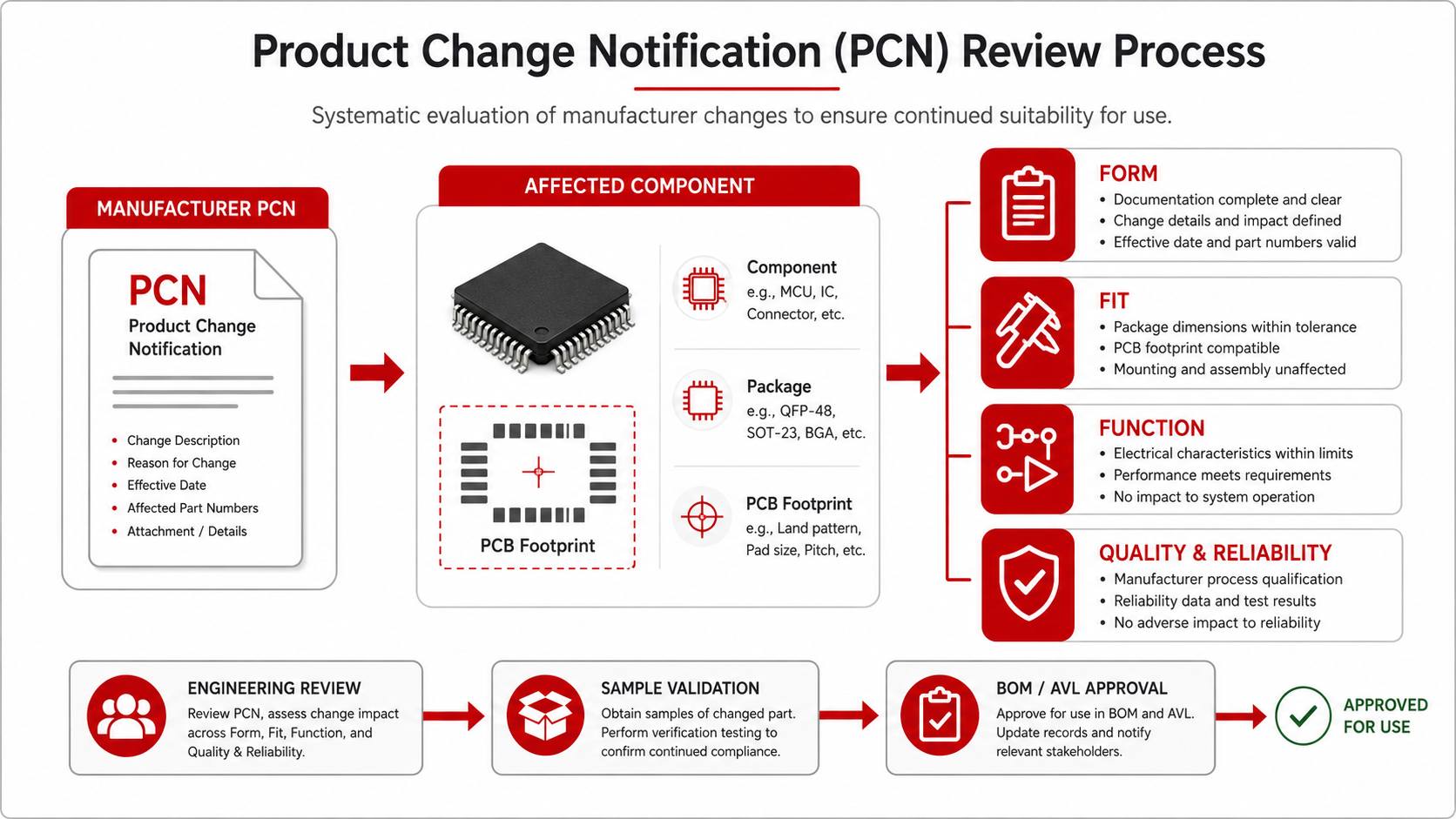
Form, Fit and Function: The Core PCN Review Method
Form, fit and function review is the central method for evaluating whether changed material can continue in the same application. A supplier may state that a change has no expected impact, but the customer still needs to check the application-level margin.
| Review Area | What to Check | Examples of PCN Impact |
|---|---|---|
| Form | Package body, marking, dimensions, pin count, terminal finish, reel, tray, tape, label and visual identification. | Top marking changes may affect inspection. Package tolerance changes may affect mechanical clearance or SMT handling. |
| Fit | PCB footprint, solder pad, coplanarity, package height, orientation, pick-and-place, stencil and connector/mechanical fit. | Lead frame or package outline changes may require SMT process review or footprint verification. |
| Function | Electrical limits, timing, thermal resistance, leakage, switching behavior, ESD rating, noise, analog accuracy and firmware behavior. | Power IC or MOSFET changes may affect loop stability, ripple, heat rise, surge margin or switching loss. |
| Quality and reliability | Qualification report, HTOL, temperature cycling, humidity, solderability, MSL, automotive grade and field history. | Mold compound, bond wire or assembly-site changes can require reliability data review and sample validation. |
PCN Risk Levels: Low, Medium and High
PCN handling should be risk-based. A carton-label change should not receive the same engineering effort as a wafer fab transfer or electrical-limit change. At the same time, a change described as "minor" may still be critical in a tightly margined design.
| PCN Type | Typical Risk Level | Recommended Action |
|---|---|---|
| Outer carton label, packing label or logistics label change | Low | Archive the PCN and update receiving inspection instructions if needed. |
| Top marking, logo or laser code format change | Low to medium | Update incoming inspection, traceability records and anti-counterfeit screening rules. |
| Reel, tape, tray or packing method change | Low to medium | Check pick-and-place compatibility, feeder setup and warehouse labeling. |
| Assembly site change | Medium | Review qualification data, date code control and first-lot inspection plan. |
| Test site or test program change | Medium | Check test limits, outgoing quality data and datasheet coverage. |
| Mold compound, lead frame or lead finish change | Medium to high | Review reliability, solderability, MSL, reflow and mechanical stress data. |
| Bond wire material change | Medium to high | Check current path, thermal margin, humidity reliability and field-use conditions. |
| Wafer fab transfer or BCD process line transfer | High | Request samples, compare electrical and thermal behavior, and run application-level validation. |
| Die revision | High | Review errata, firmware impact, analog behavior, timing, qualification and customer approval needs. |
| Package outline, pin definition or pad dimension change | High | Check PCB footprint, SMT process and mechanical fit; do not treat as direct replacement without validation. |
| Electrical limit, thermal resistance, ESD rating or absolute maximum rating change | High | Run engineering requalification, margin review and design approval before release. |
| PDN / EOL notice | Supply-chain critical | Plan LTB/LTS, alternative sourcing, customer approval and possible redesign. |
"Pin-to-Pin Compatible" Still Needs Validation
"Pin-to-pin compatible" means the changed device can connect to the same pin locations or package interface. It does not automatically mean the device will behave the same under load, temperature, switching, surge, humidity, aging or system-level stress.
This distinction is especially relevant for power ICs, MOSFETs, BCD-process devices, analog front-end ICs, RF components, sensors, automotive devices and protection components. A small change in on-resistance, thermal resistance, leakage, ESD rating, dropout voltage, switching speed, current limit, loop response or soldering behavior may not appear in a basic power-on test, but can show up during high-temperature operation, low-temperature startup, long-duration aging or high-load production use.
| PCN Scenario | Supplier Statement May Say | Application-Level Check |
|---|---|---|
| Wafer fab transfer for a power IC | No change to datasheet limits or package outline. | Check loop stability, ripple, transient response, thermal rise and load margin. |
| Bond wire change from gold to copper or palladium-coated copper | No expected form, fit or function impact. | Review current path, humidity reliability, thermal margin and long-life operating environment. |
| Mold compound or lead frame update | Material change with completed qualification. | Check MSL, reflow profile, package warpage, solderability and SMT defect rate. |
| Electrical limit change | Datasheet updated to reflect improved specification clarity. | Recheck design margin against absolute maximum ratings, derating, surge and temperature conditions. |
| Marking or date-code rule change | Cosmetic or traceability-only change. | Update incoming inspection and anti-counterfeit reference records. |
PCN Monitoring After Component Selection
Component selection does not end when the schematic is released or the PCB enters mass production. Once a part is locked into a BOM, the engineering, purchasing and quality teams still need to monitor PCN and PDN notices during the product's full production life. A component that passed the original design validation may later receive a wafer fab transfer, assembly-site change, bond-wire change, package material update, test-limit revision, datasheet update or final discontinuance notice.
When a PCN is released, the key engineering question is not only whether the manufacturer part number remains the same. The changed material must still be checked against the actual board that originally selected the component. Power rails, compensation networks, thermal paths, PCB footprints, soldering process windows, firmware assumptions and system-level reliability margins may have been designed around the old version of the part.
| After PCN Release | Engineering Check on the Existing Board |
|---|---|
| Same MPN, new wafer fab or process line | Retest electrical behavior, thermal rise, startup, load transient, ripple and margin on the original PCB. |
| Same package, new mold compound or lead frame | Check SMT reflow behavior, package warpage, solderability, board stress and long-term reliability. |
| Same pinout, changed electrical limits | Compare the updated datasheet against circuit derating, absolute maximum ratings and worst-case operating conditions. |
| Same part number, new die revision | Check timing, analog behavior, firmware interaction, errata and application-level performance. |
| Same function, package outline or pad tolerance update | Review PCB footprint, stencil, placement accuracy, coplanarity and mechanical clearance. |
Standard PCN Workflow for Engineers, Buyers and Quality Teams
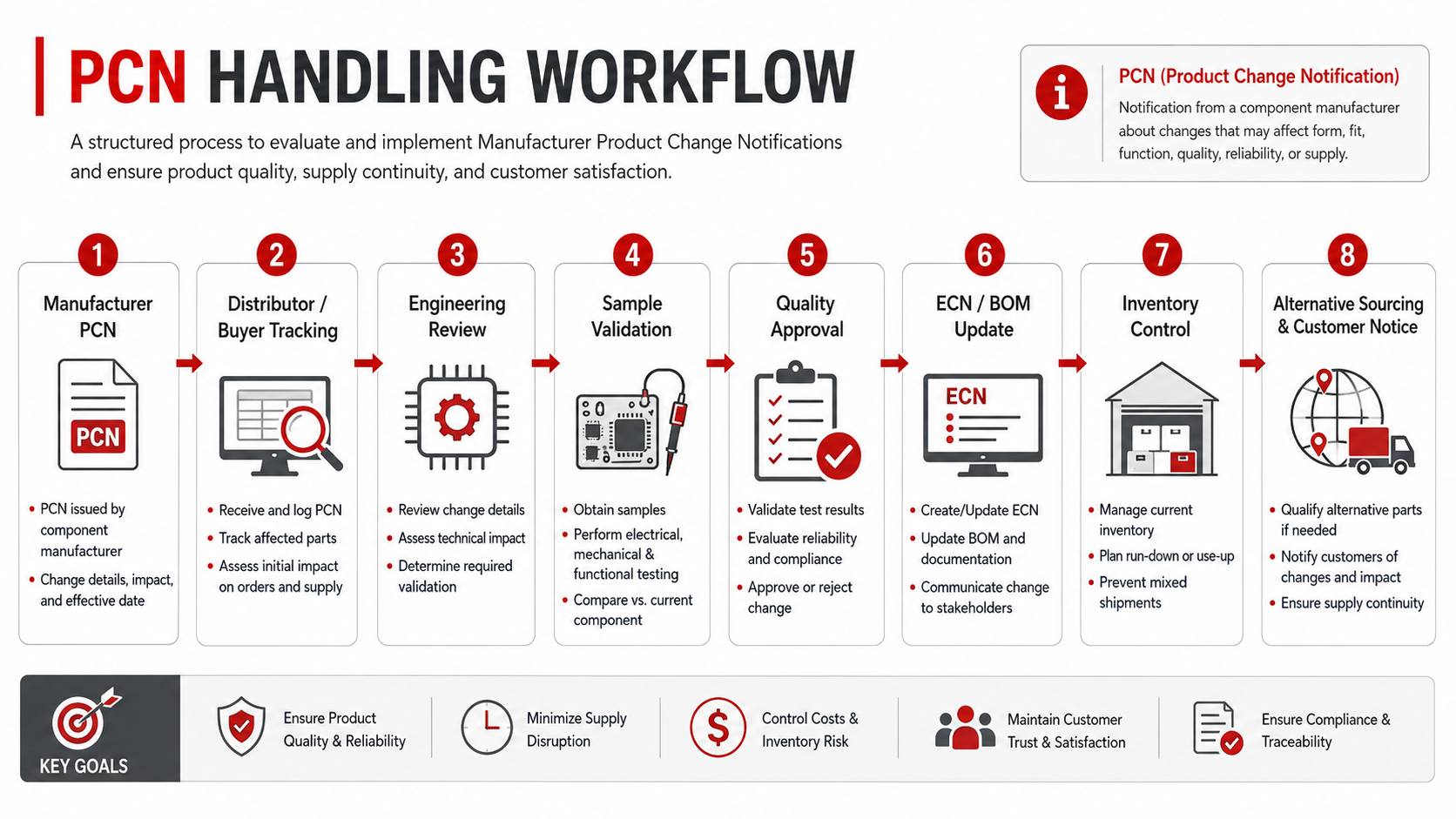
A PCN should move through a controlled workflow. The goal is not to reject every change, but to identify which changes can be archived, which need sample validation, which require internal ECN approval, and which trigger last-time-buy or redesign planning.
| Step | Action | Output |
|---|---|---|
| 1. Receive and register PCN | Record PCN number, supplier, issue date, affected MPNs and effective date. | PCN tracking record. |
| 2. Identify affected BOMs | Search internal BOM, AVL, ERP, open orders, customer programs and inventory. | Affected project and customer list. |
| 3. Classify change type | Separate labeling, packing, material, process, site, die, package, datasheet and discontinuance changes. | Low, medium, high or supply-chain-critical classification. |
| 4. Review form, fit and function | Compare package, footprint, pinout, electrical limits, thermal behavior, quality and reliability data. | Initial engineering impact assessment. |
| 5. Request samples when needed | Ask manufacturer or distributor for changed material, especially for medium- and high-risk PCNs. | Sample lot for validation. |
| 6. Run application-level tests | Test on the actual board under load, temperature, startup, shutdown, aging and process conditions. | Validation report comparing old and new material. |
| 7. Decide disposition | Archive, approve, requalify, block, last-time-buy or redesign. | PCN decision record. |
| 8. Issue internal ECN | When changed material is approved, release an engineering change notice and update internal documents. | Approved BOM, AVL, drawing, specification or process update. |
| 9. Control inventory transition | Separate old and new revisions, date codes, lot codes and customer-approved material. | Warehouse and shipment control rule. |
| 10. Archive records | Store PCN, supplier data, test report, ECN, approval and customer communication. | Traceable technical file for audit and future failure analysis. |
PCN Impact on Inventory, Lot Control and Old/New Revision Shipments
For distributors and factories, the PCN problem does not end after engineering approval. Old and new revision material may exist at the same time in distributor stock, factory stock, subcontractor inventory and open orders. Without revision and lot control, a customer may receive mixed material that behaves slightly differently or fails their internal approval rule.
Date code, lot code, trace code, top marking, label format and packing method can all become part of PCN control. In quality-sensitive sectors, the customer may require approval before the new revision can be shipped. In some cases, the old and new versions must not be mixed in the same production lot, shipment, repair batch or field-service replacement program.
| Control Point | Required Action |
|---|---|
| Old revision stock | Identify quantity, date code, lot code, storage location and customer allocation. |
| New revision stock | Keep separate until engineering and customer approval are complete. |
| Incoming inspection | Update marking, label, package and traceability references. |
| Warehouse storage | Separate old/new material physically or digitally to prevent accidental mixing. |
| Shipment documentation | Include approved revision, date code or lot code information when required by the customer. |
| Customer communication | Notify customers before shipping changed material when their approval process requires it. |
| Failure analysis | Use PCN history and lot traceability to determine whether a field issue relates to a material change. |
PCN Impact on Certified and Long-Life Products
Certified products are more sensitive to PCN changes than short-life consumer products. Industrial controllers, automotive modules, medical equipment, telecom systems, metering devices, aerospace equipment and safety-related products often have locked BOMs, approved suppliers, traceability rules and customer qualification documents.
A change in package material, lead finish, electrical limits, thermal performance or compliance status may require internal approval, customer notification, test rerun or certification-file update. Even when the supplier has completed qualification, the factory may still need to validate the part in its own application.
| Product Type | PCN Sensitivity | Typical Action |
|---|---|---|
| Consumer product with short lifecycle | Lower, unless the component affects safety, battery, thermal or RF performance. | Engineering review plus limited validation. |
| Industrial control board | Medium to high due to long service life and field reliability expectations. | Sample validation, thermal/electrical review and BOM approval update. |
| Automotive electronics | High due to PPAP, AEC qualification, traceability and customer approval requirements. | Formal quality review, customer communication and production approval control. |
| Medical or regulated equipment | High due to certification files and change-control documentation. | Risk assessment, validation record and regulatory documentation update if required. |
| Power supply, charger or high-current module | High when power ICs, MOSFETs, rectifiers, magnetics or protection devices change. | Load testing, temperature testing, surge review, EMI check and reliability assessment. |
When PCN Turns into Supply Chain Action: LTB, Alternatives and Redesign
Some PCNs are only documentation or process updates. Others become immediate supply-chain actions. A discontinuance notice, last-time-buy date, production transfer, capacity constraint or high-risk material change can force the customer to choose between stocking old material, approving changed material, qualifying alternates or redesigning the circuit.
For PDN and EOL cases, manufacturers may provide LTB and LTS timelines. ADI states that its PDNs provide a standard 12-month Last Time Buy period and an 18-month Last Time Ship period from notification. This is an ADI policy statement, not a universal rule for every supplier, but it shows the type of timing data buyers should extract from a discontinuance notice. (ADI PDN policy and LTB/LTS timing)
| Situation | Short-Term Action | Long-Term Action |
|---|---|---|
| Low-risk label or packaging change | Archive PCN and update inspection references. | Continue normal sourcing. |
| Medium-risk assembly or material change | Request samples and review qualification data. | Approve changed material through ECN if validation passes. |
| High-risk die, wafer or electrical-limit change | Block automatic substitution and run application-level testing. | Requalify, redesign or source an approved alternative. |
| PDN / EOL with LTB deadline | Calculate demand and place last-time-buy orders if needed. | Qualify alternate MPNs, redesign PCB or update customer-approved BOM. |
| Changed material fails validation | Separate old/new inventory and stop production release of new revision. | Use controlled old stock while redesign or alternate qualification proceeds. |
PCN and Counterfeit Risk Control
PCN documents can also support anti-counterfeit and traceability checks. When a manufacturer changes top marking, label format, laser code, date-code rule, lot-code format or package appearance, that information becomes useful for incoming inspection and market-source screening.
If the open market later offers material with an old logo, unexpected marking, inconsistent date code or mismatched label format, the PCN history can help determine whether the part is legitimate old stock, changed production material, relabeled material, refurbished stock or a counterfeit-risk item. This is especially relevant when shortages force buyers into broker markets.
Component PCN Management for Distributors
Distributors can use PCN monitoring as more than a compliance task. It can become a service layer for customers that do not have strong lifecycle-management systems. A distributor that tracks PCN, PDN, date code, lot code, LTB, LTS and alternate-source data can warn customers earlier and reduce emergency sourcing pressure.
| Distributor Task | Practical Value |
|---|---|
| Subscribe to manufacturer PCN/PDN alerts | Track changes for key franchises, power ICs, MOSFETs, analog ICs, MCUs and customer BOM items. |
| Create PCN tracking records | Maintain affected MPNs, dates, change type, risk level, customer impact and inventory action. |
| Separate old and new revision stock | Prevent mixed shipments and support customer-specific approval rules. |
| Prepare alternative part lists | Support customers during EOL, allocation, long lead time or failed validation. |
| Monitor power and BCD-process PCNs closely | Power ICs and MOSFETs often have thermal, current, switching and qualification margins that need closer review. |
| Use PCN data for authenticity checks | Compare marking, label, date-code and lot-code information against manufacturer change history. |
| Notify customers before critical dates | LTB, LTS and effective-date reminders help avoid last-minute shortages and production delays. |
Power IC, MOSFET and BCD-Process PCN Risk
Power components deserve closer PCN review because small changes can interact with board-level thermal design, current margin, switching losses, EMI behavior and protection limits. BCD-process power ICs, load switches, gate drivers, DC/DC converters, MOSFETs, rectifiers and protection devices are often used near real operating limits in compact power supplies and industrial control systems.
A wafer fab transfer, bond-wire change, lead frame change, mold compound update, package thermal-resistance update or electrical-limit revision may still keep the same orderable part number. The real question is whether the changed material stays inside the customer's application margin across voltage, current, temperature, startup, load transient, surge, EMI and aging conditions.
| Component Type | PCN Change to Watch | Application Test Direction |
|---|---|---|
| DC/DC converter IC | Wafer fab, die revision, test limit, thermal data or package change. | Load transient, ripple, startup, loop stability, thermal rise and EMI check. |
| MOSFET | Die, package, lead frame, RDS(on), gate charge, thermal resistance or avalanche data change. | Conduction loss, switching loss, heat rise, SOA and surge margin check. |
| Gate driver | Die revision, output current, propagation delay, UVLO or package update. | Timing, dead time, switching edge, EMI and protection behavior check. |
| Protection device | ESD, surge, capacitance, clamping or package change. | Interface protection, signal integrity and system-level transient test. |
| Automotive or industrial IC | Assembly site, material, qualification, AEC status or datasheet update. | Customer approval, reliability data review and traceability control. |
Frequently Asked Questions
What does PCN mean in electronic components?
PCN means Product Change Notification. It is a formal notice from a component supplier that a product, process, material, package, test flow, marking, datasheet or qualification status is changing.
Is PCN the same as EOL?
No. PCN covers product or process changes. EOL means End of Life and usually relates to product discontinuance. A discontinuance notice may include LTB and LTS deadlines.
What is the difference between PCN and PDN?
PCN is a product or process change notice. PDN is a product discontinuance notice. PDN is used when a part is being withdrawn or discontinued.
Does a PCN mean the part is bad or obsolete?
No. A PCN may describe a routine process improvement, material update, site transfer or marking change. It only becomes a major risk when the change affects application performance, production approval or supply continuity.
Does "pin-to-pin compatible" mean the new material can be used directly?
Not always. Pin compatibility only confirms the interface or package relationship. Application compatibility still depends on electrical, thermal, reliability, mechanical, firmware and production-process margins.
When does a PCN require requalification?
Requalification is commonly needed when the change affects die revision, wafer fab, assembly material, package dimensions, electrical limits, thermal data, automotive status, safety-critical functions or certified products.
What should buyers do after receiving a PCN?
Buyers should identify affected part numbers, check open orders and inventory, notify engineering and quality teams, review effective dates, request samples when needed, and prepare LTB or alternate-source plans if supply continuity is at risk.
Can old and new revision parts be mixed?
It depends on customer approval rules and the change type. For low-risk label changes, mixing may be acceptable. For electrical, thermal, material or qualification changes, old and new revisions may need separate lot control.
Why are power IC and MOSFET PCNs more sensitive?
Power devices often operate near thermal, current, voltage, switching and protection margins. Small changes in RDS(on), thermal resistance, gate charge, switching behavior or package material can affect system performance.
How can a distributor help with PCN risk?
A distributor can track PCNs and PDNs, separate old and new revision stock, warn customers before effective dates, support LTB planning, provide traceability data and prepare alternative sourcing options.
Practical Summary
A PCN is an early-warning document for electronic component change control. It gives engineering, purchasing, quality and distributor teams time to review what changed, when changed material may ship, which part numbers are affected, and whether the change touches form, fit, function, quality, reliability or supply continuity.
Low-risk PCNs can usually be archived after inspection records are updated. Medium-risk PCNs require qualification data review and possible sample testing. High-risk PCNs involving wafer fab transfers, die revisions, package changes, bond-wire changes, thermal data updates, electrical-limit changes or EOL status need formal engineering review, internal ECN control, inventory separation, customer communication and alternative-source planning.


