
 My Inquiry
 My Account


Blend Door Actuator: Symptoms, Location, Reset and Replacement Guide
Article Details
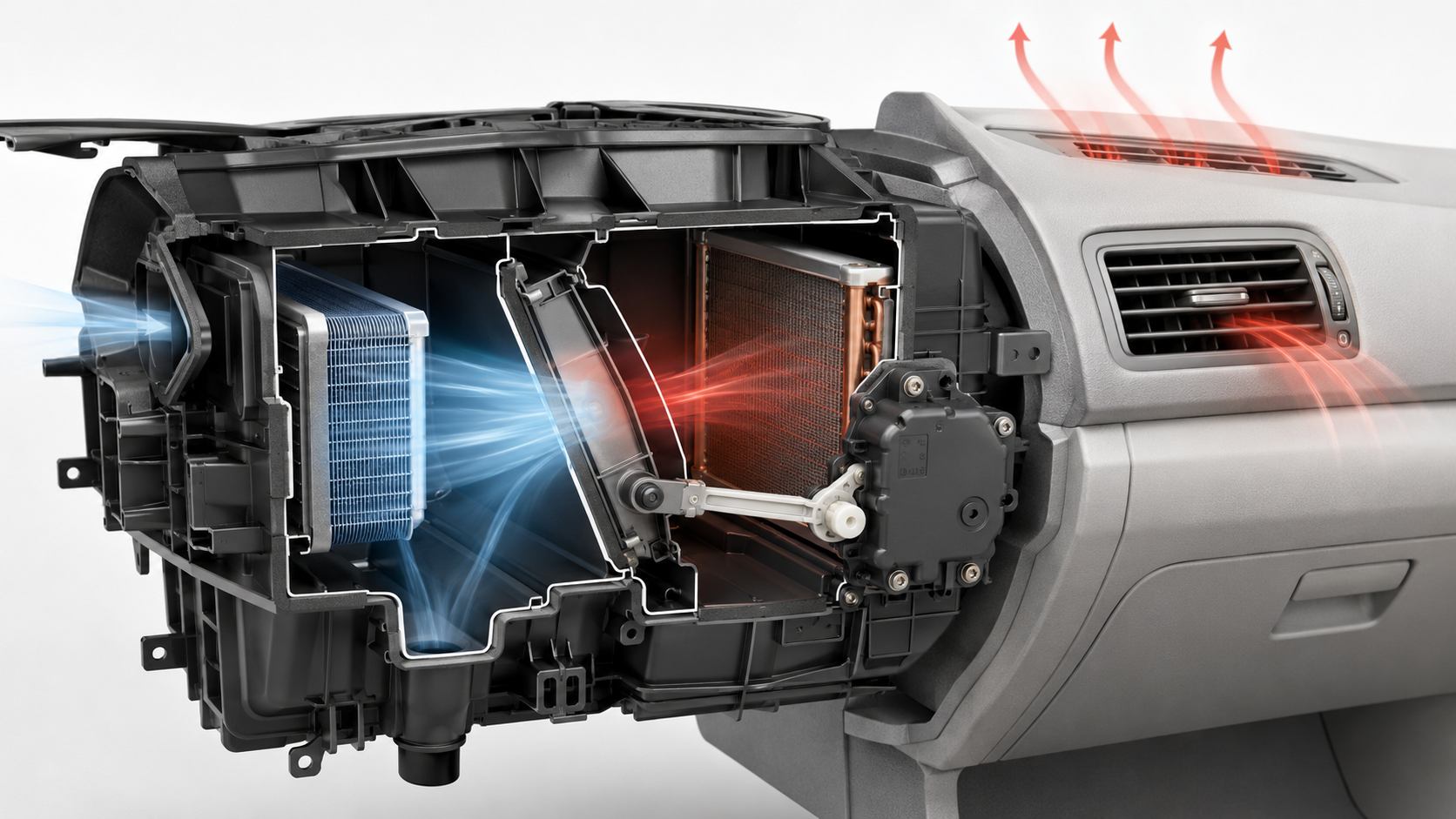
A blend door actuator is a small electric actuator used inside an automotive HVAC system. It moves an air-mixing door inside the HVAC case so the cabin air can pass through the heater core, the evaporator side, or a mixed path between the two. The result is temperature control at the dashboard vents, floor vents, defrost vents, or separate driver and passenger zones.
The part is simple from the outside, but the failure symptoms can look confusing. A clicking sound behind the dashboard, air stuck hot or cold, one side blowing warm while the other side blows cold, or a temperature knob that no longer changes cabin temperature can all point toward a blend door actuator problem. The same symptoms can also come from a stuck blend door, broken gear, wiring fault, HVAC control module issue, calibration error, or incorrect replacement part.
What Is a Blend Door Actuator?
A blend door actuator is a motorized HVAC door controller. It receives a command from the climate control panel or HVAC control module, rotates a small output shaft, and changes the position of the blend door inside the air box. The blend door decides how much air passes through the heater core and how much bypasses it.
Most blend door actuators contain a small DC motor, reduction gears, a plastic output shaft, and in many designs a position feedback element. The control module uses the actuator position to match the requested temperature setting. When gears strip, the motor stalls, the feedback signal becomes inaccurate, or the door binds inside the HVAC case, the system can lose temperature control.
| Part | Function | Failure Result |
|---|---|---|
| Actuator motor | Creates the rotary movement needed to drive the HVAC door. | No movement, weak movement, intermittent response, or motor noise. |
| Gear set | Reduces motor speed and increases output torque. | Clicking, knocking, slipping, or actuator movement without door movement. |
| Output shaft | Connects the actuator to the blend door shaft. | Wrong fit, stripped coupling, limited travel, or no door response. |
| Position feedback | Reports actuator position to the HVAC control module in feedback-type systems. | Calibration errors, incorrect temperature response, or trouble codes. |
| Electrical connector | Provides power, ground, command signal and feedback signal where applicable. | No operation, intermittent operation, or incorrect actuator command. |
What Does a Blend Door Actuator Do?
The blend door actuator controls cabin air temperature by moving the blend door. When the temperature is set colder, the door allows more air to bypass the heater core or pass through the evaporator side. When the temperature is set warmer, the door allows more air through the heater core. In automatic climate control systems, this movement may be commanded by the HVAC control module based on cabin temperature, sunlight, outside temperature and selected setpoint.
A single-zone system may use one blend door actuator. Dual-zone and tri-zone systems may use separate actuators for driver side, passenger side and rear climate zones. This is why one side of a vehicle can blow hot while the other side blows cold even when the air conditioning and heater core are both working.
| HVAC Behavior | Blend Door Actuator Role |
|---|---|
| Temperature changes from cold to hot | Actuator rotates the blend door toward the heater core airflow path. |
| Temperature changes from hot to cold | Actuator rotates the blend door toward the cooler airflow path. |
| Driver and passenger temperatures differ | Separate blend actuators may control each side in a dual-zone system. |
| Temperature does not match the setting | Actuator, door shaft, calibration, feedback circuit or HVAC control logic may be incorrect. |
Blend Door Actuator vs Mode Door Actuator vs Recirculation Actuator
HVAC systems often use several air door actuators. Replacing the wrong actuator is a common repair error because different doors can sit close together behind the dashboard. The blend door actuator controls temperature. The mode door actuator controls where the air exits. The recirculation actuator controls whether air is drawn from outside or recirculated from the cabin.
| Actuator Type | Controls | Typical Symptom |
|---|---|---|
| Blend door actuator | Hot/cold air mixture | Wrong temperature, one side hot and one side cold, clicking during temperature adjustment. |
| Mode door actuator | Vent outlet direction | Air stuck at defrost, floor, dashboard vent, or one outlet position. |
| Recirculation door actuator | Fresh air vs recirculated cabin air | Recirculation button does not respond, odor control issue, outside air always entering. |
AC Blend Door Actuator vs Heater Blend Door Actuator
Search terms such as AC blend door actuator and heater blend door actuator often describe the same temperature-control actuator from different symptom angles. When the air conditioning system produces cold refrigerant-side cooling but the vents still blow warm air, the blend door may be stuck toward the heater side. When the heater core is hot but the vents stay cold, the same door may be stuck toward the cool-air bypass path.
Some vehicles use more than one temperature actuator, especially in dual-zone and rear HVAC systems. In those cases, the driver side, passenger side, or rear zone may have its own blend actuator. The repair part must match the exact zone and door function, not just the general HVAC actuator name.
| Search Term or Complaint | Technical Meaning | Diagnostic Direction |
|---|---|---|
| AC blend door actuator | The air conditioning may work, but the blend door may be routing too much air through the warm path. | Check full-cold command, actuator movement, door travel and temperature change at vents. |
| Heater blend door actuator | The heater core may be hot, but the blend door may not move toward the heat path. | Check full-hot command, heater hose temperature, actuator shaft and door movement. |
| One side hot and one side cold | Dual-zone HVAC may use separate left and right blend actuators. | Identify the failed side before ordering the actuator. |
| Air direction stuck | This usually points to a mode door actuator, not the temperature blend actuator. | Check mode door function before replacing the blend actuator. |
Common Blend Door Actuator Symptoms
Blend door actuator symptoms usually appear inside the cabin. They may happen every time the ignition is turned on, only when the temperature is adjusted, or after a battery disconnect or HVAC repair.
| Symptom | Likely Area to Check |
|---|---|
| Clicking or knocking behind the dashboard | Stripped actuator gears, actuator reaching travel stop repeatedly, stuck blend door. |
| Air stuck hot | Blend door position, actuator command, heater-core airflow path, calibration. |
| Air stuck cold | Blend door position, actuator motor, door shaft, control signal. |
| Driver side and passenger side temperatures differ | Dual-zone blend actuator, side-specific door, zone calibration. |
| Temperature changes slowly or randomly | Weak motor, worn feedback track, connector issue, HVAC control module command. |
| Actuator moves but temperature does not change | Broken door shaft, disconnected linkage, stuck blend door, incorrect actuator installed. |
| New actuator still clicks after installation | Calibration not completed, wrong part position, door binding, shaft alignment error. |
Blend Door Actuator Symptoms by Scenario
The same actuator fault can appear differently depending on HVAC layout, outside temperature and control-panel setting. Matching the symptom to the operating condition helps avoid replacing the wrong actuator.
| Scenario | Most Likely Pattern | Check First |
|---|---|---|
| Clicking starts when the key is turned on | The HVAC module may be trying to initialize actuator travel and repeatedly hitting a failed gear or stop position. | Listen near the HVAC case, then command temperature changes to identify the noisy actuator. |
| Clicking starts only when changing temperature | The actuator may slip when it tries to move the blend door through part of its range. | Move from full cold to full hot and note where the noise begins. |
| Air conditioning is cold at the evaporator, but vents blow warm | The blend door may be allowing heater-core airflow into the outlet path. | Check actuator position, full-cold command and door movement. |
| Heat is available under the hood, but vents stay cold | The heater core may be hot, but the blend door may not be routing air through it. | Check heater hose temperature, actuator output shaft and blend door travel. |
| Passenger side responds, driver side does not | A dual-zone driver-side actuator or door may be faulty. | Identify side-specific actuator location and compare left/right command response. |
| New actuator works once, then stops or clicks | The door may be binding, the shaft may be misaligned, or calibration may not have completed. | Remove the actuator, move the door by hand and perform the correct relearn procedure. |
| Temperature is wrong but there is no noise | The actuator may have an electrical issue, feedback error, no command, or no power/ground. | Check connector voltage, ground, command signal, HVAC codes and fuse condition. |
Where Is the Blend Door Actuator Located?
The blend door actuator is usually mounted on the HVAC air box behind the dashboard. Depending on the vehicle, it may sit behind the glove box, near the center console, above the driver footwell, behind the radio area, or deeper inside the dashboard. Dual-zone vehicles may have separate left and right temperature blend actuators.
Location depends on vehicle year, make, model, trim and HVAC option. Some actuators can be reached after removing the glove box or lower dash panel. Others require more dashboard disassembly. Before removing parts, identify whether the failed unit is the temperature blend actuator, mode actuator or recirculation actuator.
| Vehicle Layout | Possible Actuator Location | Access Notes |
|---|---|---|
| Single-zone manual HVAC | One temperature blend actuator near the main HVAC case | Often accessible from glove box or lower dash area, depending on model. |
| Dual-zone climate control | Separate driver-side and passenger-side blend actuators | One side may be much harder to reach than the other. |
| Rear climate system | Rear HVAC case or quarter-panel HVAC module | Symptoms may appear only in rear vents. |
| Compact dashboard design | Actuator buried deeper inside dash structure | Labor time can exceed the part cost when access is restricted. |
Vehicle-Specific Location Notes
Ford, Chevy, Dodge, Jeep, Honda and other vehicles do not use one universal actuator location. Even within the same brand, a pickup, SUV, sedan and minivan can place the blend actuator in different positions. Model year changes can also move the actuator, change the connector, or split one temperature actuator into separate left and right zone actuators.
When searching for a diagram or replacement part, use the full vehicle information: year, make, model, engine where required, trim level, manual or automatic climate control, single-zone or dual-zone HVAC, and the exact symptom side. A search such as blend door actuator location may return a visually similar actuator from the wrong zone. A more precise search such as 2011 Ford F-150 driver side temperature blend door actuator or Honda Civic HVAC air mix actuator passenger side is more useful.
How to Diagnose a Bad Blend Door Actuator
Diagnosis should separate actuator failure from door binding, wiring faults and HVAC module issues. Start with simple cabin observations, then move to electrical and mechanical checks.
- Listen during key-on and temperature changes. Repeated clicking behind the dashboard often indicates gear slip or actuator travel hunting.
- Move the temperature setting from full cold to full hot. Watch whether vent temperature changes smoothly, slowly, or not at all.
- Check whether only one zone is affected. A dual-zone vehicle may have a failed side-specific actuator.
- Scan HVAC codes where supported. Many automatic climate control systems can store actuator position or calibration faults.
- Inspect the connector. Loose pins, corrosion, broken locks or stretched wiring can interrupt command or feedback signals.
- Check fuse, power and ground. A dead actuator may have no supply voltage or no ground path.
- Remove the actuator if access allows. Command temperature change and check whether the actuator output shaft moves.
- Move the blend door shaft by hand. A stuck or broken door can mimic a bad actuator and damage a replacement unit.
Electrical Diagnosis: Power, Ground, Command and Feedback
A blend door actuator is an electrical component as well as a mechanical one. If the actuator does not move, the fault may be inside the actuator, but it may also be outside the actuator. A missing power supply, weak ground, damaged connector, broken wire, failed control head, or module communication issue can stop a good actuator from moving.
Feedback-style actuators may use a position sensor so the HVAC module can compare commanded position with actual position. If the feedback signal is erratic, stuck, or outside the expected range, the control module may store a fault code, stop movement, or keep trying to recalibrate the door.
| Electrical Check | What It Can Reveal | Repair Direction |
|---|---|---|
| Power supply at connector | No actuator operation due to missing voltage. | Check fuse, HVAC module output and wiring path. |
| Ground circuit | Weak or open ground causing intermittent or no movement. | Check ground pin, harness continuity and connector condition. |
| Command signal | HVAC module may not be requesting movement. | Check control panel input, module codes and command output. |
| Feedback signal | Module cannot confirm actuator position. | Check feedback circuit, actuator sensor and calibration status. |
| Harness movement test | Intermittent faults caused by stretched or damaged wiring. | Inspect wire near dash brackets, connectors and repair areas. |
Before Replacing the Actuator, Check These Items
Many unnecessary replacements happen when the actuator is treated as the only possible failure point. A short pre-replacement check can prevent repeat repairs and wrong-part orders.
| Check Item | Reason |
|---|---|
| Correct actuator function | Temperature blend, mode and recirculation actuators can look similar but control different doors. |
| Correct side or zone | Dual-zone systems may use separate driver, passenger and rear temperature actuators. |
| Door shaft movement | A stuck door can damage the new actuator or make the replacement appear defective. |
| Connector match | Same shape, pin count and latch style reduce wrong-part risk. |
| Mounting orientation | A similar actuator may rotate differently or mount in another position. |
| HVAC calibration requirement | Some vehicles must relearn actuator travel after installation. |
| Stored HVAC fault codes | Codes can identify the affected actuator or show feedback/calibration problems. |
| Defrost function | Loss of windshield clearing should be treated as a safety-related HVAC problem. |
Blend Door Actuator Reset and Calibration
A blend door actuator reset or HVAC recalibration can help when the actuator position is lost after battery replacement, dead battery, fuse removal, HVAC control module reset or actuator replacement. A reset cannot repair broken gears, a burned motor, a cracked door shaft, damaged wiring or a jammed blend door.
Reset methods vary by vehicle. Some vehicles relearn door positions automatically after an ignition cycle. Others use a fuse-pull procedure, battery disconnect, specific climate-control button sequence, scan-tool calibration, or manufacturer service routine. Vehicle-specific service information should be followed before forcing the actuator by hand.
| Reset Method | Used When | Limit |
|---|---|---|
| Ignition cycle relearn | Some systems relearn actuator positions during key-on initialization. | Will not fix mechanical gear damage. |
| HVAC fuse pull | Used on some vehicles to force HVAC module initialization. | Procedure and fuse location vary by model. |
| Battery disconnect | Sometimes used to clear learned positions or module memory. | May reset radio, windows, steering angle or other systems on some vehicles. |
| Control-panel button sequence | Some automatic HVAC panels support built-in calibration commands. | Sequence is vehicle-specific. |
| Scan-tool calibration | Used when the HVAC module supports actuator relearn or position calibration. | Requires compatible diagnostic tool and vehicle support. |
The video above covers several general blend door reset approaches and shows the difference between a calibration issue and a part that still needs replacement.
Blend Door Actuator Replacement Cost
Blend door actuator replacement cost depends more on access than on the actuator itself. The part may be relatively inexpensive, but labor can increase sharply when the actuator is behind the center dash, near the upper HVAC case, or blocked by dashboard structure. RepairPal lists the average HVAC blend door actuator replacement cost between $457 and $599, with vehicle-specific estimates varying by model. (RepairPal HVAC blend door actuator replacement cost estimate)
| Cost Factor | Effect on Final Price |
|---|---|
| Actuator location | Easy glove-box access costs less than deep dashboard access. |
| OEM vs aftermarket part | OEM parts usually cost more; aftermarket options vary by fit, durability and calibration behavior. |
| Single-zone vs dual-zone HVAC | Multiple actuators can create side-specific failures and part-position confusion. |
| Calibration requirement | Some vehicles require relearn or scan-tool calibration after replacement. |
| Dash disassembly | Labor time can dominate the repair cost if panels, console parts or dash structure must be removed. |
Replacement and Compatibility Notes
Blend door actuator replacement requires more than matching the vehicle model name. Many vehicles use several HVAC actuators that look similar but have different internal travel range, shaft orientation, connector pinout, mounting position or function. Product application notes should be checked carefully before purchase; several aftermarket listings specify that the buyer must verify actuator position and function for the application. (AutoZone application note example)
NAPA describes some replacement air door actuators as direct replacements made to match the fit and function of the original actuator on certain vehicle years, makes, models and configurations. That wording is a useful reminder: fitment depends on configuration, not just visual similarity. (NAPA air door actuator product reference)
| Compatibility Item | Check Before Replacement |
|---|---|
| Vehicle year, make, model and trim | HVAC layouts can change across model years and trim levels. |
| HVAC system type | Manual, automatic, single-zone, dual-zone and rear HVAC systems can use different actuators. |
| Actuator position | Temperature blend, mode and recirculation actuators should not be mixed. |
| Connector | Pin count, latch style and wiring function must match. |
| Output shaft | Spline, flat, D-shape, offset and rotation direction must match the door shaft. |
| Mounting holes | Hole pattern and actuator orientation must match the HVAC case. |
| Calibration behavior | Some replacements require an HVAC relearn procedure before normal operation. |
Can You Drive With a Bad Blend Door Actuator?
A failed blend door actuator usually does not stop the engine or transmission from operating. The main risk is cabin comfort and windshield visibility. If the actuator prevents the defrost system from clearing the windshield, the vehicle should be repaired before driving in cold, wet or humid conditions.
A stuck-hot or stuck-cold condition can also create driver fatigue in extreme weather. If the actuator clicks continuously, unplugging it is sometimes used as a short-term noise control step during diagnosis, but the climate system will lose normal temperature control until the fault is repaired.
Quick Troubleshooting Table
| Problem | Possible Cause | First Check |
|---|---|---|
| Clicking behind dash | Stripped gears, travel-stop hunting, stuck blend door | Listen while changing temperature; inspect actuator movement. |
| Only hot air | Door stuck toward heater core, actuator not moving, control issue | Command full cold and check actuator shaft movement. |
| Only cold air | Door stuck away from heater core, actuator failed, heater-side airflow blocked | Command full hot and check door movement. |
| One side hot, one side cold | Dual-zone side actuator fault or calibration error | Identify driver-side and passenger-side actuator positions. |
| Air direction stuck at defrost or floor | Mode door actuator, not blend door actuator | Check mode actuator before ordering a blend actuator. |
| Recirculation not working | Recirculation actuator or recirculation door fault | Check recirculation door movement separately. |
| New actuator clicks immediately | Wrong part, misaligned shaft, no calibration, stuck door | Remove actuator and test door shaft by hand. |
Frequently Asked Questions
What does a blend door actuator do?
It moves the HVAC blend door so the system can mix heated and cooled air. This controls cabin air temperature at the vents.
What are the symptoms of a bad blend door actuator?
Common symptoms include clicking behind the dashboard, air stuck hot or cold, one side blowing a different temperature, slow temperature response, or no temperature change when the control is adjusted.
Where is the blend door actuator located?
It is usually mounted on the HVAC case behind the dashboard. Depending on the vehicle, access may be behind the glove box, under the dash, near the center console, or deeper inside the dashboard.
Is the AC blend door actuator different from the heater blend door actuator?
In many vehicles, the same temperature blend actuator affects both cooling and heating by changing the air path through or around the heater core. Some dual-zone or rear HVAC systems use additional actuators for separate zones.
How do I reset a blend door actuator?
Reset procedures vary by vehicle. Some systems relearn automatically during an ignition cycle, while others use a fuse pull, battery disconnect, control-panel sequence or scan-tool calibration.
Will a blend door actuator reset fix clicking?
A reset can help if the actuator position is lost. It will not fix stripped gears, a damaged motor, a broken door shaft or a jammed blend door.
Can a bad blend door actuator affect air conditioning?
Yes. The air conditioning system may still produce cold air, but the blend door may route or mix the air incorrectly, causing warm air at the vents.
Can a bad blend door actuator affect heat?
Yes. If the door does not move toward the heater core airflow path, the cabin may receive little or no warm air even when the cooling system and heater core are working.
Is a blend door actuator the same as a mode door actuator?
No. A blend door actuator controls air temperature. A mode door actuator controls vent direction, such as defrost, floor or dashboard vents.
How much does blend door actuator replacement cost?
The cost depends on vehicle model and access. RepairPal lists a general average range of $457 to $599, but some vehicles may be lower or higher depending on labor time and actuator location.
Do I need calibration after replacing a blend door actuator?
Many vehicles need some form of HVAC relearn or calibration after replacement. The procedure depends on the vehicle and control system.
Can I drive with a bad blend door actuator?
Usually yes, but defrost performance and cabin visibility can be affected. If the windshield cannot be cleared properly, the repair should not be delayed.
Why is one side hot and the other side cold?
In a dual-zone HVAC system, the driver and passenger sides may use separate blend door actuators. One side can fail while the other side continues to work.
Practical Repair Notes
Blend door actuator repair starts with correct identification. Confirm the actuator function, location and part number before removing panels. Check whether the vehicle has more than one similar actuator. Test the door shaft before installing a new unit. Complete any required HVAC calibration before judging the new actuator as defective.
The actuator is only one part of the temperature-control system. A reliable repair checks the HVAC control command, actuator power and ground, position feedback, door movement, mechanical linkage, fuse condition, and vehicle-specific relearn procedure.


