
 My Inquiry
 My Account


Crankshaft Position Sensor Guide: Symptoms, Testing, Replacement and How It Works
Article Details
A crankshaft position sensor is one of the most important engine management sensors in a modern vehicle. It monitors crankshaft position and engine speed so the engine control unit can calculate ignition timing, fuel injection timing, misfire detection, and synchronization with the camshaft position sensor. When the crankshaft position sensor signal is missing, unstable, or out of range, the engine may crank without starting, stall unexpectedly, misfire, run roughly, or set diagnostic trouble codes.
Search terms such as crankshaft position sensor, crankshaft sensor symptoms, crankshaft position sensor replacement, how to test crankshaft position sensor, and camshaft and crankshaft position sensor all point to the same basic problem: the ECU needs a reliable timing signal from the rotating crankshaft. The sensor itself is usually small, but its signal controls core engine functions.
This guide explains what a crankshaft position sensor does, how Hall effect and variable reluctance crank sensors work, where the sensor is usually located, common bad crankshaft position sensor symptoms, how to test the signal, what to check before replacement, and how sensor electronics relate to automotive ICs and signal-conditioning circuits.
What Is a Crankshaft Position Sensor?
A crankshaft position sensor, often abbreviated as CKP sensor or crank sensor, detects the rotational position and speed of the crankshaft. The sensor normally reads a toothed wheel, reluctor ring, trigger wheel, or timing rotor attached to the crankshaft, flywheel, harmonic balancer, or crank pulley area.
As the crankshaft rotates, teeth or gaps pass the sensor face. The changing magnetic field or switching Hall element creates a pulse signal. The ECU uses this pulse pattern to determine engine RPM and crankshaft angle. Missing teeth or special reference gaps on the trigger wheel help the ECU identify a known reference point in the crankshaft rotation.
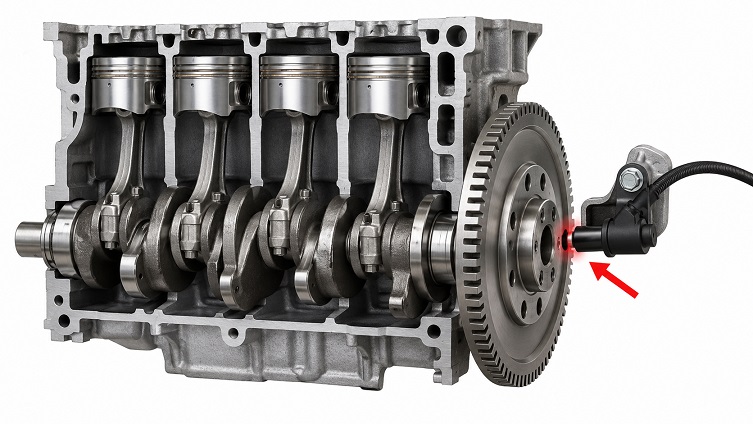
DENSO describes camshaft and crankshaft sensors as devices that help the ECU calculate the position of the camshaft and crankshaft. The crankshaft sensor faces the timing rotor and counts the passing teeth so the ECU can determine crankshaft position through a 360-degree rotation. (DENSO, Camshaft and Crankshaft Sensors)
| Function | What the Sensor Provides | Why the ECU Needs It |
|---|---|---|
| Engine speed detection | Pulse frequency related to crankshaft rotation speed | Used for RPM calculation and engine control timing |
| Crankshaft position detection | Reference point from teeth, gaps, or trigger pattern | Used for ignition and fuel injection timing |
| Misfire monitoring | Small changes in crankshaft speed between combustion events | Used by the ECU to detect cylinder combustion irregularities |
| Synchronization | Crank signal compared with camshaft position sensor signal | Used to identify engine phase and cylinder timing |
How a Crankshaft Position Sensor Works
Crankshaft position sensors are usually built around magnetic sensing. The two most common types are variable reluctance sensors and Hall effect sensors. Both detect the movement of metal teeth or target features, but their wiring, signal waveform, and testing methods are different.
Variable Reluctance Crankshaft Sensor
A variable reluctance sensor is a passive magnetic sensor. It usually has two wires and contains a coil and permanent magnet. As a tooth on the reluctor wheel approaches and leaves the sensor tip, magnetic flux changes through the coil and an AC voltage is generated.
The signal amplitude depends on engine speed and air gap. At cranking speed, the waveform may be relatively small. At higher RPM, the voltage amplitude increases. This is why a weak variable reluctance signal can cause starting problems even if the sensor appears to produce a signal at higher engine speeds.
Hall Effect Crankshaft Sensor
A Hall effect crankshaft sensor is an active sensor. It normally has three wires: reference voltage, ground, and signal output. Instead of generating its own AC voltage, it switches the output signal as target teeth or slots pass the sensing element. The ECU usually reads the output as a digital square wave.
Hall effect crank sensors generally produce a cleaner signal at low speed, but they require a correct supply voltage and ground. If the reference voltage, ground, connector, or wiring is faulty, the sensor may not switch even if the sensing element itself is not physically damaged.
UnderhoodService describes two basic crankshaft position sensor types: magnetic field or variable reluctance sensors, and Hall effect sensors. Variable reluctance sensors produce an alternating current signal as the magnetic field changes, while Hall effect sensors switch on and off to produce a digital signal that the PCM reads for crank position and speed. (UnderhoodService, Understanding Crankshaft Position Sensors)
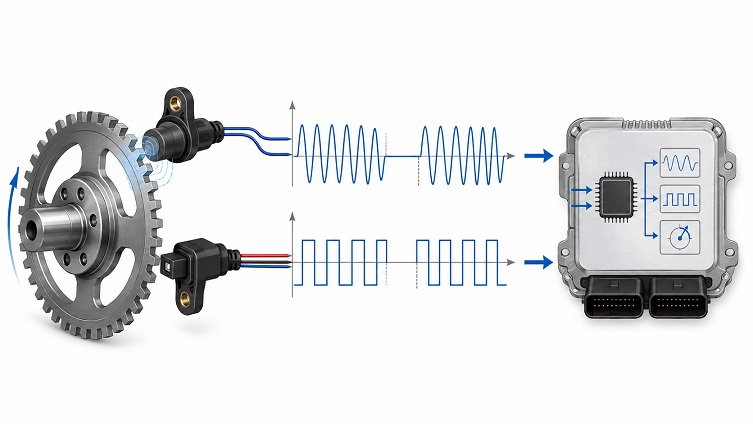
| Sensor Type | Typical Wires | Signal Type | Testing Focus |
|---|---|---|---|
| Variable reluctance sensor | Usually 2 wires | AC waveform generated by rotating target teeth | Resistance, AC voltage while cranking, waveform shape, air gap |
| Hall effect sensor | Usually 3 wires | Digital square wave from powered sensor electronics | Reference voltage, ground, signal switching, connector integrity |
| MRE / magnetoresistive sensor | Application dependent | Conditioned electronic signal from magnetic target movement | Supply, signal output, sensor orientation, air gap, ECU requirements |
Crankshaft Position Sensor vs Camshaft Position Sensor
The crankshaft position sensor and camshaft position sensor work together, but they do not measure the same part. The crankshaft sensor tracks crankshaft angle and engine speed. The camshaft position sensor tracks camshaft position and valve timing phase.
In many engines, the crankshaft sensor provides the primary engine speed and timing reference, while the camshaft sensor helps the ECU identify cylinder phase for sequential fuel injection, variable valve timing, and synchronization. When either signal is incorrect, the ECU may lose timing confidence and set fault codes.
| Sensor | Measures | Common Use | Typical Fault Effect |
|---|---|---|---|
| Crankshaft position sensor | Crankshaft speed and position | RPM, ignition timing, fuel injection timing, misfire detection | No start, stalling, misfire, RPM signal loss, P0335-related codes |
| Camshaft position sensor | Camshaft position and engine phase | Cylinder identification, sequential injection, variable valve timing | Long crank, rough running, timing correlation codes, VVT issues |
Common Symptoms of a Bad Crankshaft Position Sensor
A failing crankshaft position sensor can create intermittent or complete engine control problems. Symptoms may appear only when the engine is hot, only during cranking, or only under vibration. This makes diagnosis more difficult than a simple open-circuit failure.
| Symptom | Possible Reason | Diagnostic Note |
|---|---|---|
| Engine cranks but does not start | ECU may not receive a valid crankshaft position signal | Check RPM data during cranking and verify sensor signal. |
| Engine stalls while driving | Intermittent CKP signal loss due to heat, vibration, wiring, or sensor failure | Fault may disappear after cooling down. |
| Hard starting or long crank | Weak signal, wrong sensor gap, slow switching, or synchronization issue | Compare crank and cam signals if possible. |
| Rough idle or misfire | Incorrect timing reference or unstable signal | Other ignition, fuel, or compression faults can cause similar symptoms. |
| Check engine light | Crankshaft position sensor circuit or correlation fault | Common related codes include P0335, P0336, P0337, P0338, and P0339. |
| Tachometer drops to zero while cranking or running | ECU may not be calculating RPM from the crank signal | Use scan data and waveform testing instead of replacing parts immediately. |
Common Crankshaft Position Sensor Trouble Codes
OBD-II trouble codes help narrow the diagnostic direction, but they do not automatically identify the failed part. A code related to the crankshaft position sensor circuit can be caused by the sensor, wiring, connector, trigger wheel, ECU input circuit, or signal quality problem.
| Code | General Meaning | What to Check |
|---|---|---|
| P0335 | Crankshaft Position Sensor A Circuit | Sensor signal, wiring, connector, ECU input, reluctor wheel |
| P0336 | Crankshaft Position Sensor Range / Performance | Signal pattern, air gap, damaged teeth, timing relationship |
| P0337 | Crankshaft Position Sensor Low Input | Weak signal, short to ground, low output, poor connection |
| P0338 | Crankshaft Position Sensor High Input | Open ground, short to voltage, signal circuit fault |
| P0339 | Crankshaft Position Sensor Intermittent | Heat-related sensor failure, loose connector, wire chafing, vibration fault |
Where Is the Crankshaft Position Sensor Located?
The exact crankshaft position sensor location depends on the engine design. It is usually mounted where it can read crankshaft rotation through a trigger wheel, reluctor ring, flywheel, or crank pulley. On some engines, the sensor is near the crank pulley or harmonic balancer. On others, it is mounted in the engine block, timing cover, transmission bell housing, or near the flywheel.
| Common Location | What It Reads | Access Notes |
|---|---|---|
| Near crank pulley / harmonic balancer | Front trigger wheel or reluctor pattern | May require removing covers, splash shields, or belts. |
| Engine block side | Reluctor wheel inside or near crankshaft area | Often inserted into the block with an O-ring seal. |
| Transmission bell housing | Flywheel or flexplate teeth | Access may be tight, especially on transverse engines. |
| Timing cover area | Crankshaft timing rotor | May require careful alignment and correct air gap. |
Vehicle-specific location matters. A Nissan, Ford, Chevy, Jeep, Honda, Hyundai, or BMW crankshaft position sensor may be placed in a very different area even though the sensor's basic job is similar. Always confirm the location with the correct service information for the engine code and model year.
How to Test a Crankshaft Position Sensor
Testing should start with the symptom and vehicle data, not with part replacement. A scan tool can show whether the ECU sees RPM during cranking. A multimeter can check power, ground, resistance, or AC voltage depending on sensor type. An oscilloscope is the best tool for checking waveform shape, missing pulses, amplitude, noise, and intermittent dropouts.
The following video is useful in this section because it shows multiple crankshaft position sensor testing methods, including analog variable reluctance sensor checks, digital Hall effect sensor wiring checks, and signal testing. It fits naturally after the basic testing explanation.
Basic Test Flow
| Step | What to Check | Why It Matters |
|---|---|---|
| 1. Read codes and live data | Check CKP codes and RPM while cranking | If RPM stays at zero during cranking, the ECU may not see the crank signal. |
| 2. Identify sensor type | Two-wire variable reluctance or three-wire Hall effect | Testing method depends on sensor type. |
| 3. Inspect connector and wiring | Corrosion, broken locking tab, chafed wire, oil contamination | Many CKP faults are caused by harness and connector problems. |
| 4. Check power and ground | For Hall effect sensors, verify reference voltage and ground | A good sensor cannot switch without proper supply and ground. |
| 5. Check signal | Use oscilloscope where possible | Waveform quality shows missing pulses, noise, weak signal, or irregular timing. |
| 6. Inspect mechanical trigger | Reluctor teeth, trigger wheel, air gap, sensor mounting | A good sensor can still read incorrectly if the target is damaged or misaligned. |
Testing a Variable Reluctance Crank Sensor
A variable reluctance crank sensor can often be checked for resistance and AC output while cranking, but exact values vary by vehicle. The better test is to view the waveform. A healthy signal should show repeating pulses that increase in frequency with speed. Missing teeth or reference gaps should appear in the expected pattern.
Weak amplitude at cranking speed, distorted waveform, unexpected dropouts, or excessive noise can point to sensor weakness, air gap problems, damaged reluctor teeth, poor wiring shielding, or ECU input issues.
Testing a Hall Effect Crank Sensor
A Hall effect sensor should first be checked for reference voltage and ground. Then the signal wire can be monitored while cranking or while the target moves past the sensor. A good Hall effect sensor normally switches between low and high states, creating a square-wave-like signal for the ECU.
Bosch Motorsport describes Hall effect speed sensors as devices used for incremental measurement of rotational speed, including crankshaft or wheel speed. The sensor responds to a ferromagnetic target wheel, and the magnetic field modulation is converted into an output signal. (Bosch Motorsport, Speed Sensor Hall-Effect HA-M)
Crankshaft Position Sensor Replacement Notes
Replacing a crankshaft position sensor is often physically simple, but diagnosis should come first. A new sensor will not fix a damaged connector, incorrect air gap, broken trigger wheel, shorted harness, weak battery, starter speed problem, or ECU input fault.
| Replacement Check | Why It Matters |
|---|---|
| Match the exact vehicle application | Connector shape, sensor length, mounting depth, and signal type can differ. |
| Inspect the O-ring or seal | A damaged seal can cause oil leaks or improper sensor seating. |
| Clean the mounting area | Dirt, rust, or debris can change sensor position or air gap. |
| Check the connector lock | A loose connector can cause intermittent stalling or no-start faults. |
| Route wiring correctly | Harness contact with exhaust, belts, or metal edges can create repeat failure. |
| Perform relearn if required | Some vehicles require crankshaft variation or position relearn after replacement. |
Replacement cost varies by vehicle, labor access, sensor type, and whether additional relearn or diagnostic work is needed. A sensor mounted near the front of the engine may be quick to access, while one near the bell housing or behind other components can require more labor.
Crankshaft Position Sensor Electronics and IC-Level Design
From an electronics perspective, the crankshaft position sensor is part of a harsh-environment signal chain. The sensing element must survive heat, vibration, oil exposure, electrical noise, and fast magnetic target movement. The ECU input circuit must convert the raw sensor signal into a reliable timing edge without false triggering.
Variable reluctance sensors often need a conditioner circuit that converts the AC waveform into a clean logic-level pulse. Hall effect sensors may include internal amplification, switching, and signal conditioning. Automotive designs may use dedicated interface ICs, comparators, protection networks, filters, and microcontroller timer inputs to process the crank signal.
| Electronic Block | Purpose | Design Concern |
|---|---|---|
| Magnetic sensing element | Detects moving crankshaft target teeth | Air gap, magnetic strength, temperature, target geometry |
| Signal conditioner | Converts raw waveform into ECU-readable pulse | Noise immunity, threshold, low-speed cranking signal |
| Input protection | Protects ECU input from transients and wiring faults | Load dump, ESD, reverse polarity, short circuit |
| Microcontroller timer input | Measures pulse timing and tooth pattern | Edge accuracy, missing tooth detection, interrupt timing |
In ECU or test circuit design, engineers may use VR sensor interface or signal-conditioning ICs such as MAX9926, MAX9924, or LM1815 depending on the circuit architecture, voltage environment, and signal requirements. These are not direct replacement crankshaft sensors; they are electronic interface parts used to process magnetic pickup or variable reluctance signals in appropriate designs.
How to Choose the Right Crankshaft Position Sensor
For vehicle repair, the correct replacement sensor should match the vehicle year, make, model, engine code, connector, mounting length, and sensor type. For engineering work, the correct sensor or sensing IC depends on target geometry, speed range, output format, temperature range, air gap, vibration, and signal-conditioning requirements.
| Selection Factor | Repair Context | Engineering Context |
|---|---|---|
| Sensor type | Must match original two-wire or three-wire design | Choose VR, Hall, MRE, or another magnetic sensing approach |
| Connector and mounting | Must fit the original harness and engine location | Define connector sealing, mechanical tolerance, and mounting depth |
| Signal output | Must match ECU expectation | Analog waveform, open collector, push-pull, active high, active low |
| Temperature range | Must survive engine bay conditions | Specify automotive-grade temperature and long-term drift limits |
| Noise immunity | Important for intermittent no-start or stalling diagnosis | Requires filtering, shielding, hysteresis, and robust thresholds |
| Availability | Check OEM, aftermarket quality, and cross-reference fitment | Check lifecycle, qualification, package, and supply continuity |
Common Mistakes When Diagnosing or Replacing a Crankshaft Sensor
Many crankshaft position sensor replacements are performed because a trouble code points toward the CKP circuit. That can work when the sensor is truly failed, but it can also waste time if the problem is wiring, power supply, ECU input, or mechanical trigger damage.
- Replacing the sensor without checking whether the ECU sees RPM during cranking.
- Assuming a P0335 code always means the sensor itself is bad.
- Ignoring damaged wiring near hot exhaust parts, brackets, or moving components.
- Testing a Hall effect sensor like a variable reluctance sensor.
- Testing a variable reluctance sensor without checking waveform quality.
- Installing the wrong sensor length or wrong connector version.
- Forgetting to inspect the reluctor wheel, flywheel teeth, or trigger ring.
- Leaving metal debris on a magnetic sensor tip.
- Not performing a crankshaft position relearn when the vehicle requires it.
- Using a low-quality replacement sensor in a circuit that is sensitive to signal shape and timing.
Quick Reference: Crankshaft Position Sensor Diagnosis
| Question | Practical Answer |
|---|---|
| Can a bad crankshaft position sensor cause no start? | Yes. If the ECU does not receive a valid crank signal, spark and injector operation may be disabled or incorrectly timed. |
| Can a crankshaft position sensor fail when hot? | Yes. Heat-related intermittent faults can cause stalling or restart problems after the engine warms up. |
| Can a multimeter test a crankshaft sensor? | Sometimes. A multimeter can check resistance, AC voltage, power, and ground, but an oscilloscope is better for waveform quality. |
| Is a crankshaft sensor the same as a camshaft sensor? | No. They work together, but the crank sensor tracks crankshaft position and RPM, while the cam sensor tracks camshaft phase. |
| Should the sensor be replaced immediately after a code appears? | Not always. Check wiring, connector, power, ground, waveform, and mechanical trigger condition before replacing parts. |
Frequently Asked Questions
What does a crankshaft position sensor do?
It detects crankshaft speed and position so the ECU can control ignition timing, fuel injection timing, misfire detection, and engine synchronization.
What are the symptoms of a bad crankshaft position sensor?
Common symptoms include cranking but no start, stalling, hard starting, rough running, misfire, tachometer dropouts, and crankshaft position sensor fault codes.
How do you test a crankshaft position sensor?
Identify whether it is a variable reluctance or Hall effect sensor, then check the correct signals. Use scan data for RPM, a multimeter for basic checks, and an oscilloscope for waveform testing.
Where is the crankshaft position sensor located?
It may be near the crank pulley, harmonic balancer, timing cover, engine block, transmission bell housing, or flywheel area depending on the engine design.
Can I drive with a bad crankshaft position sensor?
It is not recommended. A failing crankshaft position sensor can cause sudden stalling, no-start conditions, or unstable engine operation.
Does replacing a crankshaft position sensor require relearning?
Some vehicles require a crankshaft position variation relearn or related procedure after replacement. Check the correct service information for the vehicle.
A crankshaft position sensor is small, but its signal is central to engine control. It tells the ECU where the crankshaft is, how fast it is rotating, and whether the engine timing reference is stable. A faulty sensor, damaged connector, weak signal, incorrect air gap, or damaged trigger wheel can cause symptoms that range from intermittent stalling to complete no-start.
The most reliable approach is to diagnose the signal before replacing parts. Check codes, live RPM data, power and ground, wiring condition, waveform quality, and sensor fitment. For electronics engineers, the crankshaft position sensor is also a good example of a harsh-environment magnetic sensing system where the sensor, signal conditioner, ECU input circuit, and mechanical target must all work together.


