
 My Inquiry
 My Account


Mass Air Flow Sensor Guide: Symptoms, Cleaning, Testing, Replacement and How It Works
Article Details
A mass air flow sensor, often called a MAF sensor, measures the amount of air entering an engine. The engine control unit uses this information to calculate fuel injection, air-fuel ratio, engine load, and emission control strategy. When the MAF sensor signal is dirty, weak, unstable, or missing, the engine may idle poorly, hesitate, stall, consume more fuel, or trigger a Check Engine Light.
A MAF sensor is usually small, but its signal has a large effect on drivability. If the ECU receives incorrect airflow data, it may add too much fuel, add too little fuel, or calculate engine load incorrectly. This can create symptoms that look similar to ignition problems, fuel delivery problems, intake leaks, or throttle body issues.
This guide explains what a mass air flow sensor does, how hot wire and hot film MAF sensors work, common symptoms of a bad or dirty MAF sensor, how to clean the sensor safely, how to test it, when replacement makes sense, what affects replacement cost, and how MAF sensor electronics relate to ECU signal processing.
What Is a Mass Air Flow Sensor?
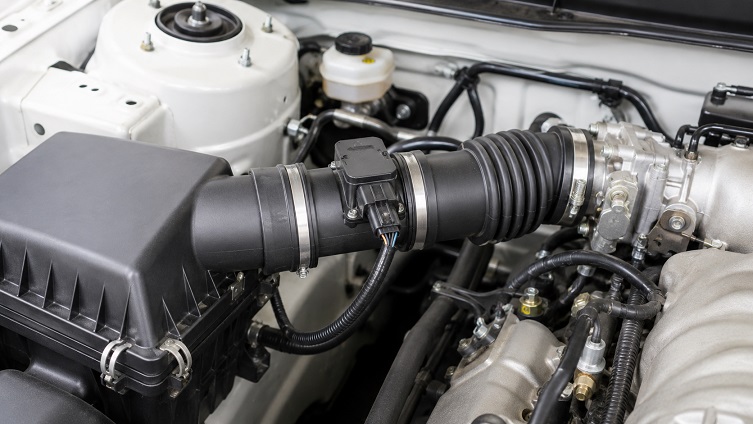
A mass air flow sensor is an intake air measurement device installed in the engine air intake system. In most vehicles, it is located between the air filter box and the throttle body. This position allows the sensor to measure incoming air before the air reaches the intake manifold.
The ECU needs air measurement because fuel delivery must match the amount of oxygen entering the engine. Too much fuel can create a rich mixture, poor fuel economy, black smoke, and emissions problems. Too little fuel can create a lean mixture, hesitation, rough running, and drivability issues.
In many modern engines, the MAF sensor works with the intake air temperature sensor, throttle position sensor, oxygen sensors, manifold pressure data, and crankshaft speed signal. The ECU combines these inputs to control fuel injection, ignition timing, idle stability, and load calculation.
| MAF Sensor Function | What It Measures or Supports | Why It Matters |
|---|---|---|
| Airflow measurement | Mass of air entering the engine | Helps the ECU calculate fuel injection accurately. |
| Engine load calculation | Air demand at idle, cruise, and acceleration | Supports throttle response and drivability. |
| Fuel trim control | Air-fuel correction with oxygen sensor feedback | Helps maintain efficiency and emissions control. |
| Fault detection | Airflow plausibility compared with engine condition | Can trigger codes such as P0100, P0101, P0102, P0103, or P0104. |
How a Mass Air Flow Sensor Works
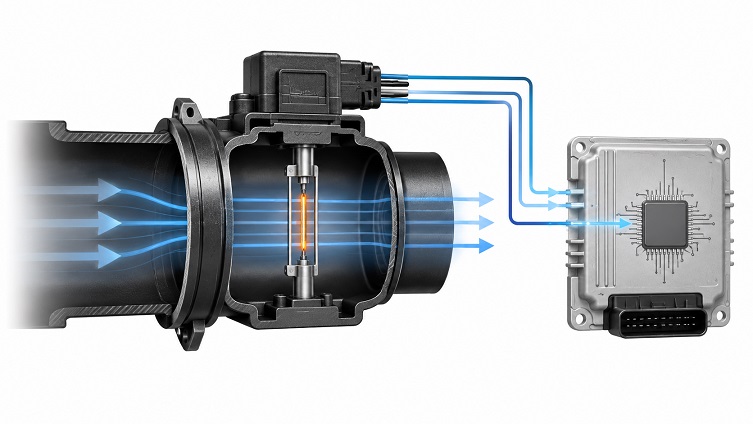
Most modern MAF sensors use a hot wire or hot film sensing element. The sensor heats a small element in the intake air stream. As air flows across the element, the air cools it. The sensor electronics measure how much current or power is needed to maintain a controlled temperature difference.
When airflow increases, the heated element cools faster. The sensor circuit provides more energy to maintain the target temperature. That electrical change is converted into a signal that the ECU can read. Depending on the sensor design, the output may be an analog voltage, frequency signal, digital signal, or processed signal.
Bosch describes the hot-film air-mass meter as a sensor that measures the air mass entering the engine, helping the control unit adapt injected fuel quantity to the air mass for efficient combustion. (Bosch, Hot-film mass meter)
Hot Wire MAF Sensor
A hot wire MAF sensor uses a thin heated wire in the airflow path. As air passes over the wire, it removes heat. The sensor circuit changes current to keep the wire temperature controlled. This current change is related to the amount of air entering the engine.
Hot Film MAF Sensor
A hot film MAF sensor uses a heated film or membrane structure rather than a simple exposed wire. Hot film sensors are common in modern vehicles because they can be compact, responsive, and integrated with electronics for signal processing and temperature compensation.
MAF Sensor Output Signal
Some MAF sensors output an analog voltage that changes with airflow. Others output a frequency or digital signal. A scan tool may display the reading in grams per second, pounds per minute, voltage, frequency, or calculated load depending on the vehicle and diagnostic system.
| Output Type | Typical Behavior | Testing Consideration |
|---|---|---|
| Analog voltage | Signal changes with airflow | Check voltage at idle and during throttle changes. |
| Frequency output | Frequency changes as airflow changes | Use frequency mode or an oscilloscope. |
| Digital or processed output | Conditioned data is sent to the ECU | Use scan data and vehicle-specific procedures. |
Mass Air Flow Sensor Symptoms
A dirty, failing, or disconnected MAF sensor can produce several drivability symptoms. The exact symptom depends on whether the sensor is reading too high, reading too low, dropping out intermittently, or producing a signal that does not match actual airflow.
| Symptom | Possible MAF-Related Cause | Diagnostic Note |
|---|---|---|
| Rough idle | Incorrect airflow signal at low engine speed | Also check vacuum leaks, throttle body condition, and fuel trims. |
| Hesitation or poor acceleration | MAF signal does not rise correctly with airflow demand | Watch live airflow data while opening the throttle. |
| Stalling | Intermittent signal dropout or incorrect low-speed airflow reading | Wiggle-test connector and harness if the fault is intermittent. |
| Poor fuel economy | ECU may command too much fuel because airflow is misread | Check fuel trims and oxygen sensor feedback. |
| Black smoke | Rich mixture from incorrect air measurement | Also check fuel pressure, injectors, and air filter restriction. |
| Hard starting | Incorrect airflow data during startup | MAF is one possible cause, not the only cause. |
| Check Engine Light | MAF circuit, range, or performance problem | Common codes include P0100, P0101, P0102, P0103, and P0104. |
Common Mass Air Flow Sensor Trouble Codes
MAF-related diagnostic trouble codes can help narrow the direction of testing. However, a trouble code should not be treated as automatic proof that the sensor itself must be replaced. Circuit faults, intake leaks, incorrect installation, air filter problems, or wiring issues can also trigger MAF-related codes.
| Code | General Meaning | What to Check |
|---|---|---|
| P0100 | Mass or Volume Air Flow Circuit | Connector, wiring, power, ground, sensor signal, ECU input |
| P0101 | MAF Circuit Range / Performance | Sensor signal plausibility, intake leaks, air filter, contamination |
| P0102 | MAF Circuit Low Input | Low signal, open circuit, poor power supply, sensor contamination |
| P0103 | MAF Circuit High Input | Short to voltage, abnormal signal, wiring problem, sensor failure |
| P0104 | MAF Circuit Intermittent | Loose connector, harness movement, intermittent sensor output |
Can You Clean a Mass Air Flow Sensor?
Yes, a MAF sensor can often be cleaned if the problem is caused by contamination on the sensing element. Dust, oil vapor, filter oil, pollen, and intake residue can coat the hot wire or hot film element and change how it responds to airflow.
Cleaning is most useful when the sensor is dirty but still electrically functional. It will not repair a broken sensing element, failed internal electronics, damaged connector, incorrect voltage supply, or ECU circuit problem.
How to Clean a Mass Air Flow Sensor
Cleaning a MAF sensor is usually simple, but the sensing element must be handled carefully. The goal is to remove contamination without touching or mechanically stressing the sensor.
| Step | Action | Important Note |
|---|---|---|
| 1 | Turn off the engine and allow the intake area to cool. | Do not work near hot engine parts or moving belts. |
| 2 | Locate the MAF sensor in the intake tube. | It is usually between the air filter box and throttle body. |
| 3 | Disconnect the electrical connector carefully. | Do not pull on the wires. |
| 4 | Remove the sensor or air tube section if required. | Use the correct tool to avoid damaging screws or plastic housing. |
| 5 | Spray the sensing element with dedicated MAF cleaner. | Do not touch the sensing element directly. |
| 6 | Allow the sensor to dry completely. | Do not reinstall while wet. |
| 7 | Reinstall the sensor and reconnect the connector. | Make sure the intake tube is sealed and clamps are tight. |
| 8 | Start the engine and verify operation. | Clear codes and test drive if necessary. |
The following video fits this cleaning section because it shows how a MAF sensor is removed and cleaned, while also discussing hesitation, stalling, fuel economy, and MAF-related codes.
How to Test a Mass Air Flow Sensor
Testing a MAF sensor depends on the vehicle, sensor type, and output signal. The best starting point is scan data. If the scan tool shows airflow in grams per second, watch the reading at idle and during throttle changes. The value should respond smoothly when airflow changes.
A multimeter can help verify power, ground, and signal voltage on many sensors. An oscilloscope is better when the sensor outputs a frequency signal or when you need to detect dropouts, noise, or unstable response.
| Test Method | What It Shows | Limitations |
|---|---|---|
| Scan tool live data | Airflow value, fuel trims, load data, fault codes | Values must be interpreted for the specific engine. |
| Multimeter | Power supply, ground, analog voltage signal | May miss fast dropouts or noisy signal behavior. |
| Oscilloscope | Waveform shape, frequency, signal stability, intermittent faults | Requires correct setup and signal interpretation. |
| Visual inspection | Contamination, broken housing, connector damage, intake leaks | Cannot confirm electronic accuracy by itself. |
Testing with Scan Data
With the engine idling, the MAF reading should be stable and reasonable for that engine size. When the throttle is opened, the reading should rise smoothly. If the reading is fixed, erratic, too low, too high, or inconsistent with engine load, further testing is needed.
Testing Power, Ground, and Signal
Many MAF sensors require a power supply and ground. Some use battery voltage, some use a 5V reference, and some have multiple circuits depending on whether an intake air temperature sensor is integrated. A missing supply voltage or poor ground can make a good sensor appear faulty.
Testing with an Oscilloscope
An oscilloscope can show whether the MAF signal changes smoothly and whether the signal has noise, dropouts, or distorted transitions. This is especially useful for frequency-output sensors and intermittent faults.
Mass Air Flow Sensor Replacement
A MAF sensor may need replacement if cleaning does not restore proper operation, the signal is missing, the sensor electronics are damaged, or the sensor housing and connector are physically broken. Replacement should be based on diagnosis rather than the trouble code alone.
| When Replacement Makes Sense | Reason |
|---|---|
| Sensor signal is dead | Power and ground are correct, but the sensor output does not respond. |
| Cleaning does not help | Contamination was not the only problem, or the sensing element is degraded. |
| Sensor is physically damaged | Broken housing, damaged connector, cracked air tube, or damaged sensing element. |
| Signal is unstable | Intermittent internal failure may cause hesitation or stalling. |
| Wrong or poor-quality sensor installed | Incorrect calibration can cause drivability and fuel trim problems. |
When replacing the sensor, match the vehicle year, make, model, engine, connector style, housing design, and calibration. Some sensors are sold as an insert only, while others are supplied with the sensor housing. The housing shape can affect airflow measurement, so replacing only the element may not always be equivalent to replacing the complete calibrated assembly.
Mass Air Flow Sensor Replacement Cost
Mass air flow sensor replacement cost depends on the vehicle, part quality, labor access, diagnostic time, and whether the sensor is sold separately or with the housing. A sensor for a common compact vehicle may cost much less than a sensor for a luxury vehicle, turbocharged engine, or application-specific housing.
| Cost Factor | Why It Changes the Price |
|---|---|
| Vehicle application | Different engines use different sensor housings, connectors, and calibrations. |
| OEM vs aftermarket | OE-quality sensors may cost more but can reduce calibration and fitment issues. |
| Sensor insert vs complete assembly | A complete sensor housing may be more expensive than a removable insert. |
| Labor access | Most MAF sensors are easy to access, but some intake layouts take longer. |
| Diagnosis required | Testing wiring, fuel trims, intake leaks, and scan data can add labor time. |
A low replacement cost is not useful if the root cause is an intake leak, wiring fault, contaminated air filter, or poor connector contact. Diagnosis before replacement is usually cheaper than replacing multiple parts by guesswork.
Mass Air Flow Sensor vs MAP Sensor
A MAF sensor and MAP sensor are both used for engine load calculation, but they measure different things. Some engines use one, some use the other, and some use both.
| Sensor | Measures | Typical Location | ECU Use |
|---|---|---|---|
| MAF sensor | Mass of air entering the engine | Intake tube between air filter and throttle body | Direct airflow measurement for fuel calculation |
| MAP sensor | Manifold absolute pressure | Intake manifold or connected vacuum passage | Speed-density calculation and load estimation |
If a vehicle uses both sensors, the ECU may compare MAF and MAP data for plausibility. A fault in one sensor, an intake leak, or an airflow restriction can cause inconsistent readings between the two.
Electronics Behind a Mass Air Flow Sensor
From an electronics perspective, a MAF sensor is a thermal sensing and signal-conditioning system designed for a harsh automotive environment. The sensing element, heater control, temperature compensation, signal amplifier, protection circuitry, and ECU input must work together reliably.
A hot wire or hot film element changes thermal behavior as air passes over it. The internal electronics convert this thermal change into an output signal. The ECU then reads the signal through analog, timer, digital, or interface circuitry depending on the sensor design.
| Electronic Block | Purpose | Design Concern |
|---|---|---|
| Heated sensing element | Detects airflow through thermal cooling effect | Contamination, aging, response time, thermal stability |
| Temperature compensation | Corrects signal for intake air temperature changes | Accuracy under hot, cold, and transient intake conditions |
| Signal conditioning | Converts sensor behavior into voltage, frequency, or digital output | Noise immunity, linearity, calibration, response time |
| Protection network | Protects the ECU and sensor input circuits | ESD, load dump, reverse polarity, short circuit, EMI |
| ECU input circuit | Reads and processes the sensor signal | ADC accuracy, timer capture, filtering, diagnostic thresholds |
In automotive electronics and ECU-related design work, engineers may use supporting components such as automotive operational amplifiers, comparators, ADC devices, voltage references, TVS diodes, and automotive microcontrollers around sensor input and signal-conditioning circuits. These links can be updated later to point to specific Aetrix product pages.
Common Mistakes When Cleaning, Testing, or Replacing a MAF Sensor
MAF sensor problems are often misdiagnosed because airflow measurement is affected by more than the sensor itself. The intake tube, air filter, vacuum leaks, connector condition, engine load, and ECU fuel trim strategy all matter.
- Using brake cleaner, carburetor cleaner, or throttle body cleaner on the sensing element.
- Touching the hot wire or hot film with a cloth, brush, cotton swab, or fingers.
- Reinstalling the sensor before the cleaner has fully evaporated.
- Ignoring air leaks after the MAF sensor.
- Using an over-oiled air filter that contaminates the sensing element.
- Replacing the sensor without checking power, ground, and connector condition.
- Assuming every P0101 or P0102 code means the MAF sensor itself is bad.
- Installing the sensor backward or leaving intake clamps loose.
- Comparing scan data without considering engine size, RPM, and load.
- Using a poor-quality replacement sensor with incorrect calibration.
Quick Reference: MAF Sensor Diagnosis
| Question | Practical Answer |
|---|---|
| Can a dirty MAF sensor cause poor acceleration? | Yes. If the sensor underreports or overreports airflow, fuel delivery may not match engine demand. |
| Can a MAF sensor be cleaned? | Yes, if contamination is the problem. Use dedicated MAF sensor cleaner only. |
| Can a bad MAF sensor cause stalling? | Yes. Incorrect airflow data can affect idle control and fuel mixture. |
| Can a multimeter test a MAF sensor? | It can check power, ground, and some signal outputs, but scan data or oscilloscope testing gives more useful information. |
| Should I clean or replace the MAF sensor? | Clean it if contamination is likely and the sensor is still electrically functional. Replace it if diagnosis confirms sensor failure. |
Frequently Asked Questions
What does a mass air flow sensor do?
It measures the amount of air entering the engine so the ECU can calculate fuel injection, air-fuel ratio, engine load, and drivability control.
What are bad mass air flow sensor symptoms?
Common symptoms include rough idle, hesitation, poor acceleration, stalling, poor fuel economy, black smoke, hard starting, and Check Engine Light codes such as P0100 to P0104.
Can I clean a mass air flow sensor?
Yes, but only with dedicated MAF sensor cleaner. Do not touch the sensing element and do not use harsh cleaners or compressed air.
How do I test a mass air flow sensor?
Use scan data to watch airflow readings, check power and ground with a multimeter, and use an oscilloscope if you need to inspect waveform or frequency output.
Where is the mass air flow sensor located?
It is usually located in the intake tube between the air filter box and the throttle body.
Is it better to clean or replace a mass air flow sensor?
Cleaning is worth trying if the sensor is dirty but functional. Replacement is better when the sensor signal is dead, unstable, physically damaged, or still incorrect after cleaning and diagnosis.
How much does mass air flow sensor replacement cost?
Cost depends on the vehicle, sensor design, part quality, and labor access. Some sensors are simple inserts, while others are calibrated assemblies with the intake housing.
A mass air flow sensor is a small intake sensor, but it has a large effect on engine control. It helps the ECU match fuel delivery to the air entering the engine. When the signal is dirty, delayed, incorrect, or missing, the engine can hesitate, idle poorly, stall, use more fuel, or set airflow-related diagnostic codes.
The best approach is to diagnose before replacing parts. Check intake leaks, air filter condition, wiring, connector quality, power, ground, scan data, and signal behavior. Clean the sensor only with proper MAF cleaner, and replace it only when the sensor is confirmed faulty or no longer responds correctly.


