
 My Inquiry
 My Account


Resistor Color Code Guide: Charts, Calculator, 1K, 10K and 100 Ohm Resistor Codes
Article Details
Resistor color code systems are used to identify the resistance value, tolerance, and sometimes the temperature coefficient of through-hole resistors. Instead of printing numbers directly on small resistor bodies, manufacturers use colored bands to represent electrical values.
Learning how to read resistor color codes is one of the most important basic skills in electronics, PCB repair, prototyping, circuit design, and component identification.
Modern engineers, students, hobbyists, and repair technicians frequently use:
- resistor color code charts
- resistor band references
- resistor color code calculators
- SMD resistor code tools
Online resistor color code calculator and decoder tool: Resistor Color Code & SMD Code Decoder Calculator

What Is a Resistor Color Code?
A resistor color code is a standardized system that uses colored bands to indicate resistor resistance values and tolerance levels.
Each color represents a number. By reading the bands from left to right, the resistor value can be calculated.
| Color | Digit | Multiplier | Tolerance |
|---|---|---|---|
| Black | 0 | ×1 | - |
| Brown | 1 | ×10 | ±1% |
| Red | 2 | ×100 | ±2% |
| Orange | 3 | ×1K | - |
| Yellow | 4 | ×10K | - |
| Green | 5 | ×100K | ±0.5% |
| Blue | 6 | ×1M | ±0.25% |
| Violet | 7 | ×10M | ±0.1% |
| Gray | 8 | ×100M | ±0.05% |
| White | 9 | ×1G | - |
| Gold | - | ×0.1 | ±5% |
| Silver | - | ×0.01 | ±10% |
How to Read Resistor Color Codes
Most standard resistors use either a 4-band resistor color code system or a 5-band resistor color code system.
4 Band Resistor Color Code
A 4-band resistor usually contains:
- Band 1 = first digit
- Band 2 = second digit
- Band 3 = multiplier
- Band 4 = tolerance
Example:
| Band Colors | Meaning | Final Value |
|---|---|---|
| Brown Black Red Gold | 1, 0, ×100, ±5% | 1KΩ ±5% |
5 Band Resistor Color Code
5-band resistors are commonly used in precision electronics.
- Band 1 = first digit
- Band 2 = second digit
- Band 3 = third digit
- Band 4 = multiplier
- Band 5 = tolerance
Example:
| Band Colors | Meaning | Final Value |
|---|---|---|
| Brown Black Black Red Brown | 1,0,0 ×100 ±1% | 10KΩ ±1% |
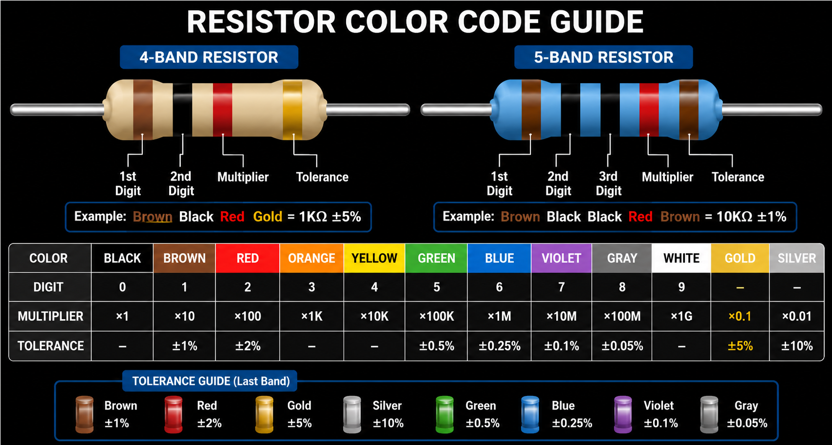
Resistor Color Code Chart
A resistor color code chart is one of the fastest ways to identify resistor values during PCB assembly, electronics repair, or troubleshooting.
Technicians often keep resistor charts near soldering stations because resistor bands can be difficult to identify quickly during practical work.
| Resistance Value | 4-Band Color Code |
|---|---|
| 100Ω | Brown Black Brown Gold |
| 220Ω | Red Red Brown Gold |
| 1KΩ | Brown Black Red Gold |
| 10KΩ | Brown Black Orange Gold |
| 100KΩ | Brown Black Yellow Gold |
1K Resistor Color Code
The 1k resistor color code is one of the most searched resistor values because 1KΩ resistors are widely used in LED circuits, pull-up resistors, voltage dividers, and microcontroller applications.
| Value | Color Bands |
|---|---|
| 1KΩ | Brown Black Red Gold |
In a 4-band resistor:
- Brown = 1
- Black = 0
- Red multiplier = ×100
- 10 × 100 = 1000Ω
10K Resistor Color Code
The 10k resistor color code is extremely common in embedded systems, analog circuits, sensors, and pull-up resistor networks.
| Value | Color Bands |
|---|---|
| 10KΩ | Brown Black Orange Gold |
The orange multiplier band indicates ×1000.
10 × 1000 = 10,000Ω.
100 Ohm Resistor Color Code
The 100 ohm resistor color code is another commonly used resistor value in signal conditioning, current limiting, and interface circuits.
| Value | Color Bands |
|---|---|
| 100Ω | Brown Black Brown Gold |
The brown multiplier band represents ×10.
10 × 10 = 100Ω.
220 Ohm Resistor Color Code
The 220 ohm resistor color code is widely used with LEDs and small signal circuits.
| Value | Color Bands |
|---|---|
| 220Ω | Red Red Brown Gold |
This resistor is commonly found in Arduino projects, indicator circuits, and educational electronics kits.
100K Resistor Color Code
The 100k resistor color code is frequently used in analog signal circuits, sensor interfaces, and timing applications.
| Value | Color Bands |
|---|---|
| 100KΩ | Brown Black Yellow Gold |
The yellow multiplier represents ×10,000.
Resistor Color Code Calculator
Manual resistor decoding is useful, but many engineers and technicians prefer using a resistor color code calculator for faster identification.
An online resistor calculator helps:
- decode resistor bands instantly
- reduce reading errors
- identify damaged components
- convert color bands into resistance values
- decode SMD resistor markings
Online Tool:
Resistor Color Code Calculator & SMD Decoder
Why Resistor Bands Use Colors Instead of Numbers
Traditional through-hole resistors are physically small. Printing complete numeric values on cylindrical resistor bodies would be difficult to read and expensive to manufacture.
Color bands provide:
- compact marking
- fast visual identification
- low manufacturing cost
- standardized global coding
Even today, color coded resistors remain common in industrial electronics and educational hardware.
Resistor Tolerance Bands
Tolerance indicates how much the actual resistor value may vary from its nominal resistance.
| Tolerance Color | Tolerance Value |
|---|---|
| Brown | ±1% |
| Red | ±2% |
| Gold | ±5% |
| Silver | ±10% |
Precision circuits often use tighter tolerance resistors.
Common Problems When Reading Resistor Color Codes
Incorrect Reading Direction
Many beginners read resistor bands backward. The tolerance band is usually separated slightly from the other bands.
Confusing Brown and Red
Lighting conditions sometimes make brown and red appear similar.
Faded Colors
Older resistors exposed to heat may become difficult to identify.
Mixing 4-Band and 5-Band Systems
Precision resistors often use 5 bands, which changes how values are calculated.
SMD Resistor Codes vs Color Codes
Modern surface-mount resistors usually use printed numeric codes instead of color bands.
Examples include:
- 103 = 10KΩ
- 104 = 100KΩ
- 221 = 220Ω
This is why many engineers use combined resistor color code and SMD code decoder tools.
Resistor Color Codes in Electronics Repair
Resistor color code knowledge is extremely useful during:
- PCB troubleshooting
- power supply repair
- industrial maintenance
- DIY electronics projects
- component replacement
- prototype development
Many damaged resistors lose printed documentation, making color band identification one of the only practical ways to determine resistor values.
4 Band vs 5 Band Resistors
| Feature | 4-Band Resistor | 5-Band Resistor |
|---|---|---|
| Digits | 2 significant digits | 3 significant digits |
| Typical Precision | Standard tolerance | Higher precision |
| Common Use | General electronics | Precision electronics |
| Tolerance | Usually ±5% | Often ±1% or better |
How Engineers Quickly Identify Resistor Values
Experienced engineers often memorize the most common resistor color combinations:
| Resistance | Color Bands |
|---|---|
| 220Ω | Red Red Brown |
| 1KΩ | Brown Black Red |
| 10KΩ | Brown Black Orange |
| 100KΩ | Brown Black Yellow |
This reduces lookup time during assembly and troubleshooting work.
Resistor color code systems remain one of the most practical identification standards in electronics manufacturing and repair. Whether working with 1K, 10K, 100 ohm, or 100K resistors, understanding resistor band colors helps engineers and technicians identify components quickly and accurately.


