
 My Inquiry
 My Account


Soldering Iron Guide for Electronics Repair, PCB Work and Precision Soldering
Article Details
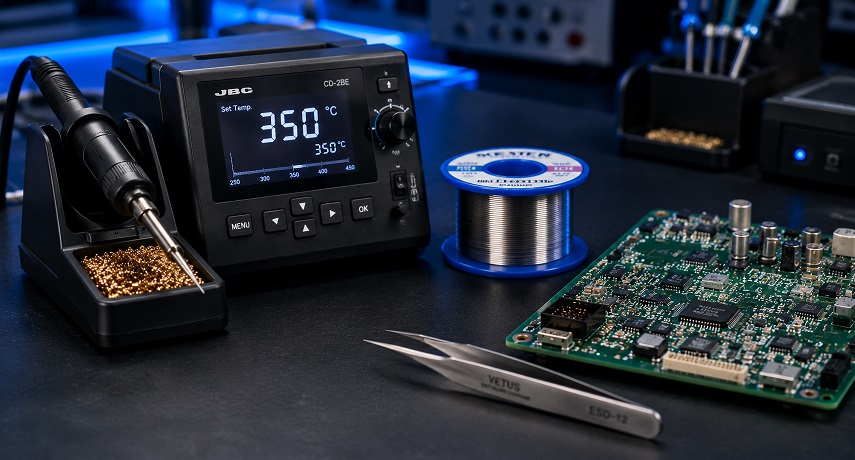
A soldering iron is one of the most commonly used tools in electronics repair, PCB assembly, prototype development, and component replacement work. From simple through-hole boards to fine-pitch surface-mount devices, reliable soldering directly affects electrical stability and long-term hardware reliability.
In electronics work, soldering quality is not only about melting solder. Tip temperature, thermal recovery, tip shape, PCB copper thickness, and solder type all influence the final joint quality. A stable solder joint improves conductivity, mechanical strength, and long-term durability under heat and vibration.
Modern electronics benches commonly include temperature-controlled soldering irons, soldering stations, precision tips, flux, solder wick, and ESD-safe work surfaces. Even small differences in soldering setup can noticeably change repair efficiency and PCB safety.
What Is a Soldering Iron?
A soldering iron is a handheld heating tool designed to melt solder for creating conductive electrical connections. In electronics assembly, the heated tip transfers thermal energy into pads, leads, and wires so solder can properly flow across metal surfaces.
Most soldering irons contain:
- a heating element
- a replaceable soldering tip
- temperature regulation circuitry
- an insulated handle
- a power source or power adapter
Basic soldering irons operate at fixed temperatures, while more advanced soldering stations continuously regulate heat output to maintain stable working temperatures during PCB soldering.
| Part | Purpose |
|---|---|
| Heating Element | Generates thermal energy |
| Soldering Tip | Transfers heat to solder joints |
| Handle | Provides insulation and grip |
| Temperature Controller | Maintains stable heat output |
| Power System | Supplies electrical or gas power |
Why Temperature Control Matters in Electronics Soldering
Soldering iron temperature is one of the most important factors in electronics assembly and repair.
If the iron temperature is too low, solder may not properly wet the PCB pad or component lead. This often creates cold joints with poor conductivity and unstable mechanical strength.
If the temperature is too high, PCB pads can lift from the board, flux burns too quickly, and semiconductor components may experience thermal stress.
For small PCB repair jobs, a stable temperature is usually more important than extremely high wattage. Many beginners increase temperature excessively when solder does not flow properly, but poor heat transfer is often caused by an oxidized tip or insufficient contact area rather than low temperature itself.
| Application | Typical Temperature Range |
|---|---|
| Lead-based solder | 320°C – 350°C |
| Lead-free solder | 350°C – 380°C |
| Small SMD components | 300°C – 340°C |
| Connector soldering | 360°C – 400°C |
| Heavy copper ground planes | 370°C – 420°C |
Soldering Iron Wattage and Thermal Recovery
Soldering iron wattage affects how quickly heat can recover after contacting large copper areas or connectors.
Low-power irons may reach the correct idle temperature but struggle when soldering components connected to large ground planes. The tip temperature can collapse quickly once heat is transferred into the PCB.
This is why many professional soldering stations use higher wattage designs combined with closed-loop temperature regulation.
| Wattage Range | Common Usage |
|---|---|
| 15W – 25W | Small hobby electronics |
| 40W – 60W | General PCB soldering |
| 60W – 90W | Ground planes and connectors |
| 90W+ | Industrial and heavy wiring applications |
For PCB repair work, a 60W temperature-controlled soldering station is usually easier to work with than a very low-power fixed-temperature iron.
Soldering Iron Tips
Soldering iron tips strongly influence heat transfer efficiency and soldering precision.
Very fine needle tips look precise, but they often transfer heat poorly during practical PCB repair. In many electronics applications, a small chisel tip provides better thermal contact and more stable solder flow.
| Tip Type | Typical Use |
|---|---|
| Conical Tip | General precision work |
| Chisel Tip | PCB pads and connectors |
| Knife Tip | Drag soldering and SMD work |
| Bevel Tip | Larger solder joints |
| Needle Tip | Very small components |
For most PCB soldering tasks, chisel tips are easier to control than extremely sharp tips because they transfer heat more efficiently into pads and leads.
Tip maintenance is also important. Oxidized tips reduce heat transfer and often force users to raise temperatures unnecessarily. Keeping the tip lightly coated with solder helps protect the plating surface and improves thermal performance.
Soldering Station vs Basic Soldering Iron
A soldering station combines a soldering iron with an external control unit that regulates temperature more accurately.
Compared with basic fixed-temperature irons, soldering stations usually provide:
- faster thermal recovery
- adjustable temperature settings
- more stable heating
- replaceable tip systems
- better long-term reliability
For repeated PCB work, stable temperature control noticeably reduces pad damage and improves solder consistency.
Digital soldering stations are especially useful when working with:
- surface-mount components
- fine-pitch ICs
- multilayer PCBs
- heat-sensitive semiconductors
Cordless Soldering Iron
A cordless soldering iron uses rechargeable battery systems instead of direct AC power. Portable soldering tools are increasingly common in field maintenance and mobile repair applications.
Modern cordless soldering irons are commonly used for:
- automotive electronics
- portable repair kits
- outdoor installations
- quick field modifications
Portable models are convenient, although their thermal recovery performance is often lower than full-size soldering stations.
Butane Soldering Iron
A butane soldering iron generates heat using gas combustion instead of electrical heating elements.
Butane soldering tools are useful when electrical power is unavailable. Industrial technicians often use them for remote maintenance work, cable repair, and outdoor service applications.
Compared with electric soldering stations, butane tools are generally less temperature stable but offer excellent portability.
PCB Soldering Basics
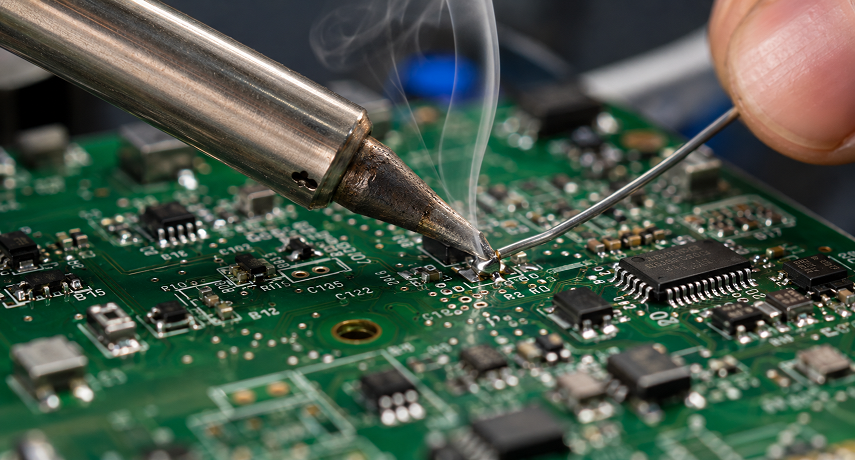
PCB soldering requires controlled heat transfer and clean solder flow.
A proper solder joint normally forms when both the component lead and PCB pad reach sufficient temperature before solder is applied. Applying solder directly onto the iron tip instead of the heated joint often creates weak or uneven connections.
- Clean the PCB surface if necessary.
- Position the component correctly.
- Heat both the pad and component lead together.
- Feed solder into the joint area.
- Allow solder to flow naturally.
- Remove solder wire first.
- Remove the soldering iron.
- Allow the joint to cool without movement.
Good solder joints are usually smooth, evenly wetted, and mechanically stable without excessive solder buildup.
Soldering Surface-Mount Components
Surface-mount soldering requires more precise temperature control and tip positioning than traditional through-hole assembly.
Small SMD pads can overheat quickly, especially on compact multilayer boards.
Common SMD soldering methods include:
- fine-tip soldering
- drag soldering
- hot air rework
- reflow soldering
For small IC packages, flux quality often affects soldering results more than temperature alone. Additional flux helps solder flow evenly and reduces bridging between adjacent pins.
Soldering Iron Kit
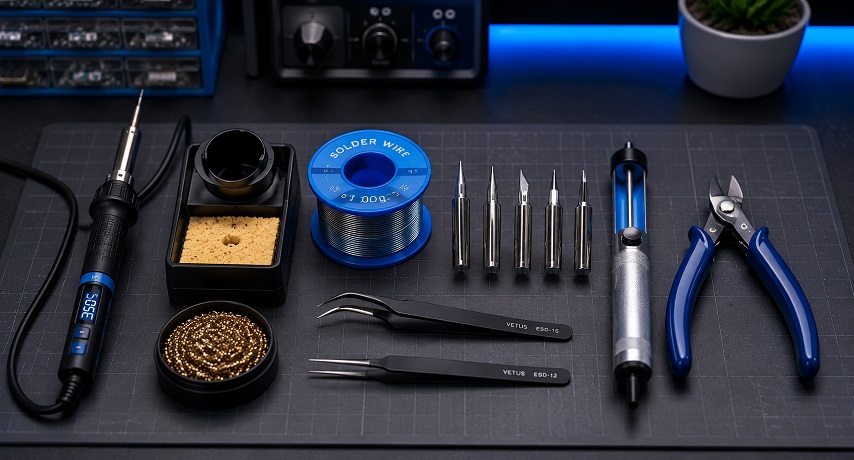
A soldering iron kit typically includes multiple tools required for electronics repair and assembly.
Most electronics soldering kits include:
- soldering iron
- solder wire
- replacement tips
- desoldering pump
- solder wick
- tip cleaner
- tweezers
- wire cutters
- small tool case
For beginners learning PCB soldering, a complete soldering kit is usually more practical than purchasing tools separately.
Lead-Free vs Leaded Solder
Modern electronics manufacturing commonly uses lead-free solder due to environmental regulations.
| Solder Type | Characteristics |
|---|---|
| Lead-Based Solder | Lower melting point and smoother flow |
| Lead-Free Solder | Higher temperature requirement and environmental compliance |
Lead-free solder generally requires slightly higher soldering temperatures and longer heat transfer times.
Some older PCB repair technicians still prefer leaded solder for delicate rework because it flows more easily and reduces thermal stress on pads.
Hakko vs Weller Soldering Iron
Hakko soldering iron and Weller soldering iron systems are widely used in professional electronics environments.
Hakko stations are commonly known for:
- fast thermal recovery
- stable digital temperature control
- compact station designs
Weller products are often associated with:
- industrial durability
- broad service availability
- long-term reliability
Both brands are widely used in electronics manufacturing, repair laboratories, and engineering workshops.
Common Soldering Problems
Cold Joints
Cold joints usually appear dull or uneven and may create intermittent electrical connections.
Lifted PCB Pads
Excessive heat or repeated rework can separate copper pads from the PCB substrate.
Solder Bridges
Excess solder between adjacent pins may short circuit neighboring connections.
Oxidized Tips
Poorly maintained soldering tips reduce heat transfer efficiency and make solder flow unstable.
Insufficient Flux
Low flux activity often causes uneven wetting and difficult solder flow on oxidized surfaces.
ESD Protection During Electronics Soldering
Many semiconductor devices are sensitive to electrostatic discharge.
Professional electronics repair benches often include:
- ESD-safe soldering stations
- grounded anti-static mats
- wrist grounding straps
- ESD-safe tweezers and tools
Electrostatic discharge can damage MOSFETs, logic ICs, microcontrollers, and RF devices even when no visible damage appears immediately.
Applications of Soldering Irons
| Industry | Typical Applications |
|---|---|
| Consumer Electronics | PCB repair and component replacement |
| Automotive | Wiring repair and sensor replacement |
| Industrial Automation | Control board maintenance |
| Telecommunications | RF board servicing |
| Education | Electronics training and prototyping |
| DIY Electronics | Arduino and embedded system projects |
Choosing the Right Soldering Tool
The best soldering setup depends on the type of electronics work being performed.
| Application | Recommended Tool |
|---|---|
| General PCB repair | Temperature-controlled soldering station |
| Portable maintenance | Cordless soldering iron |
| Outdoor service work | Butane soldering iron |
| Precision SMD work | Digital station with fine tips |
| Beginner electronics | Complete soldering iron kit |
Reliable soldering depends on stable temperature control, proper tip selection, clean surfaces, and controlled heat transfer. In practical electronics repair work, consistent soldering technique is usually more important than extremely high temperature or expensive equipment alone.


