
 My Inquiry
 My Account


What Is SiC? Silicon Carbide Semiconductors, MOSFETs and Power Devices Explained
Article Details
SiC, or silicon carbide, is a wide-bandgap semiconductor material used in high-efficiency power electronics. Its value is most visible in high-voltage and high-power conversion systems where switching loss, conduction loss, heat, size, and efficiency all affect the final design. SiC MOSFETs, SiC Schottky diodes, and SiC power modules are now common in electric vehicles, solar inverters, industrial motor drives, onboard chargers, DC fast chargers, energy storage systems, and high-density power supplies.
Unlike a simple package change or pin-compatible replacement, SiC often changes the design method of a power stage. It allows faster switching and lower loss, but it also makes layout parasitics, gate-drive behavior, EMI, and thermal interfaces more important. A good SiC design is therefore not only about choosing a lower RDS(on) device. It is a system-level decision involving the semiconductor, driver, package, PCB or busbar layout, magnetic components, cooling path, and protection circuit.
What Is SiC Semiconductor Technology?
Silicon carbide is a compound semiconductor made from silicon and carbon. In power electronics, it is used because its wide bandgap and high critical electric field allow devices to block high voltage with a thinner drift region than comparable silicon structures. This helps reduce resistance in high-voltage devices and supports faster switching in demanding power conversion circuits.
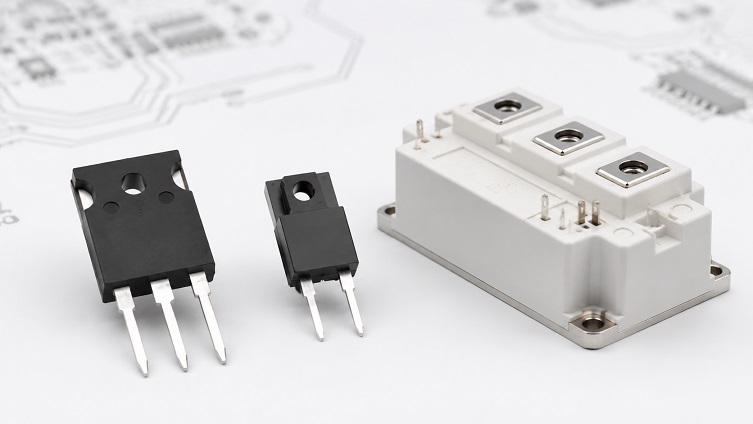
In practical component selection, SiC usually appears in three major forms: SiC MOSFETs, SiC Schottky diodes, and SiC power modules. Discrete devices are common in power supplies, onboard chargers, PFC stages, and medium-power converters. Modules are used when current, thermal density, insulation, and mechanical integration become more demanding.
SiC power devices are used to improve conversion efficiency, increase power density, reduce switching losses, and support smaller system designs in EV, industrial, renewable energy, and high-power conversion applications.
Why Silicon Carbide Matters in Power Electronics
The main reason SiC matters is that many modern power systems are limited by heat and size rather than by basic circuit function. A silicon-based inverter, charger, or converter can work, but efficiency loss may require a larger heatsink, larger magnetic components, slower switching, or a larger enclosure. SiC gives designers another path: reduce switching loss, raise switching frequency, and improve power density.
This does not mean SiC is automatically better in every circuit. In low-voltage, low-cost, or moderate-frequency applications, silicon MOSFETs and diodes are often still the better choice. SiC becomes more attractive as voltage rises, switching loss becomes a major part of the loss budget, or the system needs high efficiency in a compact space.
A useful way to evaluate SiC is to look at the whole power stage. If SiC allows a smaller inductor, smaller heatsink, higher efficiency target, easier thermal compliance, or higher output power in the same enclosure, the higher device cost may be justified. If the surrounding design cannot use the faster switching speed or lower loss, the benefit may be limited.
Key Material Properties of SiC
SiC has several material-level advantages over standard silicon. These properties explain why it is used in high-voltage MOSFETs, Schottky diodes, and power modules.
| Property | Design Meaning | Practical Effect |
|---|---|---|
| Wide bandgap | Higher energy is required to move electrons into conduction. | Supports high-temperature and high-voltage operation. |
| High critical electric field | The device can withstand stronger electric fields before breakdown. | Allows thinner drift regions and lower resistance in high-voltage devices. |
| High thermal conductivity | Heat can move through the semiconductor material more effectively. | Helps thermal performance, though package and heatsink design still dominate in real systems. |
| Fast switching capability | Device capacitances and structure support rapid transitions. | Reduces switching loss and enables higher switching frequency. |
| Low reverse recovery behavior in SiC diodes | Less stored charge must be removed during switching. | Reduces switching stress and improves efficiency in hard-switching circuits. |
The most important point is that these properties show up at system level only when the circuit is designed for them. If a SiC MOSFET is placed into a slow silicon layout with long gate loops and high power-loop inductance, the design may suffer from overshoot and EMI before it gains the expected efficiency advantage.
SiC MOSFETs: High-Speed Switching and High-Voltage Efficiency
A SiC MOSFET is a power switching transistor fabricated using silicon carbide. It is used in high-voltage switching circuits where efficiency, power density, and switching speed are important. Common voltage classes include 650 V, 750 V, 900 V, 1200 V, and 1700 V, with higher-voltage devices and modules used in specialized systems.
Compared with high-voltage silicon MOSFETs, SiC MOSFETs can offer lower resistance at higher voltage ratings and lower switching loss. Compared with IGBTs, SiC MOSFETs switch faster and do not have the same tail-current behavior during turn-off. This makes them useful in converters and inverters where switching frequency and efficiency are both important.
The design challenge is that faster switching creates sharper voltage and current transitions. A SiC MOSFET can reduce loss, but the same speed can increase dv/dt, di/dt, ringing, overshoot, and EMI. Gate resistor selection, gate driver strength, Kelvin source connection, DC-link decoupling, and PCB layout become part of the device selection process.
| SiC MOSFET Parameter | Why It Matters |
|---|---|
| Drain-source voltage rating | Defines blocking voltage margin for DC bus and transient conditions. |
| RDS(on) | Determines conduction loss during on-state operation. |
| Gate charge | Affects driver power, switching speed, and gate transition control. |
| Switching energy | Determines turn-on and turn-off loss under specified conditions. |
| Output capacitance | Affects switching behavior, resonant transitions, and turn-on loss. |
| Package inductance | Affects voltage overshoot, ringing, and EMI during fast switching. |
| Thermal resistance | Controls how easily heat moves from junction to case, board, or heatsink. |
SiC Diodes: Reverse Recovery and High-Frequency Rectification
SiC diodes are widely used where fast rectification and low switching loss are required. The most common type is the SiC Schottky barrier diode. Its main advantage is very low reverse recovery behavior compared with many silicon PN diodes. In hard-switching converters, this can reduce switching loss, voltage stress, current spikes, and thermal load.
SiC Schottky diodes are used in PFC stages, boost converters, solar inverters, high-voltage power supplies, EV charging circuits, and industrial power systems. They are especially useful when a diode commutates quickly with a MOSFET or IGBT and reverse recovery loss would otherwise become a major problem.
SiC Schottky diodes are commonly used in hard-switching applications such as high-end server and telecom power supplies, and they are also intended for solar inverters, motor drives, uninterruptible power supplies, and EV applications where low loss and fast switching are required. (STMicroelectronics, SiC Diodes)
| SiC Diode Parameter | Design Relevance |
|---|---|
| Repetitive peak reverse voltage | Must exceed the maximum circuit voltage and transient stress. |
| Average forward current | Defines continuous current capability under thermal limits. |
| Forward voltage | Affects conduction loss during forward operation. |
| Surge current capability | Important for startup, inrush, and fault events. |
| Package thermal resistance | Determines practical current capability in the real layout. |
SiC Power Modules and Packaging
SiC power modules integrate multiple SiC chips into a module package for high-current or high-power applications. Common topologies include half-bridge modules, full-bridge modules, six-pack inverter modules, boost modules, and application-specific power modules. They are used when discrete devices are not enough for current handling, thermal density, mechanical integration, or assembly efficiency.
In a SiC module, the internal structure matters as much as the die rating. Substrate material, baseplate structure, terminal placement, bond wires or sintered interconnects, internal inductance, isolation rating, and thermal interface all affect performance. A module with a poor external busbar or poor gate-drive layout can lose much of the advantage of the SiC chips inside.
SiC power modules are used to improve system-level efficiency and reduce system size, and SiC-optimized module packaging is aimed at power-density-sensitive applications where thermal performance, low inductance, and mechanical robustness are important design factors. (Wolfspeed, Silicon Carbide Power Modules)
Why SiC Packaging Matters
SiC devices switch fast enough that packaging becomes a performance variable rather than only a mechanical format. The difference between a standard three-lead package and a Kelvin-source package can be important because common source inductance affects the gate-drive reference during switching. This can distort gate voltage, slow switching, or increase ringing.
TO-247 packages remain common for high-power discrete SiC MOSFETs and diodes because they are familiar and easy to mount to heatsinks. TO-247-4 or Kelvin-source versions provide a separate source reference for the driver, helping reduce the effect of power source inductance on the gate loop. Surface-mount packages such as TO-263 or D2PAK can support automated assembly, but thermal performance depends strongly on PCB copper and board stackup.
| Package Type | Typical Use | SiC-Specific Concern |
|---|---|---|
| TO-247-3 | High-power discrete MOSFETs and diodes | Lead inductance and heatsink mounting must be managed. |
| TO-247-4 / Kelvin source | Fast-switching SiC MOSFETs | Improves gate-drive reference and reduces common-source inductance effects. |
| TO-263 / D2PAK | Surface-mount power designs | Thermal spreading depends heavily on PCB copper and vias. |
| Power module | Inverters, chargers, motor drives, high-current converters | Requires careful busbar, gate-drive, insulation, and cooling design. |
For this reason, selecting a SiC MOSFET only by voltage and RDS(on) is incomplete. Package inductance, thermal path, creepage, clearance, mounting method, and assembly process can decide whether the device performs well in the final product.
SiC MOSFET vs IGBT
In many high-power systems, the real comparison is not only SiC versus silicon MOSFET. It is SiC MOSFET versus IGBT. IGBTs have been widely used in traction inverters, motor drives, UPS systems, welding equipment, and industrial converters because they are robust, available, and cost-effective at high voltage and high current.
SiC MOSFETs are attractive because they can reduce switching loss and remove the turn-off tail current associated with IGBTs. This allows higher switching frequency and better light-load efficiency in many inverter and converter designs. The tradeoff is cost, gate-drive sensitivity, short-circuit protection requirements, and EMI control.
| Comparison Point | IGBT | SiC MOSFET |
|---|---|---|
| Switching behavior | Slower turn-off due to tail current | Faster switching with lower turn-off loss |
| Conduction behavior | Voltage-drop dominated | Resistance-dominated |
| Switching frequency | Usually lower in high-power systems | Can support higher switching frequency |
| Cost | Often lower | Often higher |
| Design difficulty | Mature and well understood | Requires more careful gate drive, layout, EMI, and protection design |
| Best fit | Cost-sensitive high-power systems with moderate switching frequency | High-efficiency, high-density, high-frequency, or thermal-constrained systems |
IGBTs are not obsolete. They remain practical where cost, ruggedness, and established design practice matter more than switching frequency or maximum efficiency. SiC MOSFETs become stronger when reducing loss, increasing frequency, shrinking passive components, or improving thermal performance is worth the added design effort.
SiC vs Silicon and GaN
Silicon, SiC, and GaN each have different strengths. Silicon remains the broadest and lowest-cost option. SiC is strong in high-voltage and high-power systems. GaN is strong in compact, high-frequency power supplies and lower-to-mid-voltage designs. The right choice depends on voltage, current, frequency, thermal design, cost, package availability, and reliability requirements.
| Technology | Main Strength | Typical Applications | Design Note |
|---|---|---|---|
| Silicon | Low cost, mature process, broad availability | General converters, low-voltage switching, cost-sensitive designs | Still preferred where performance margin is sufficient. |
| SiC | High voltage, high power, lower loss at high switching stress | EV inverters, solar inverters, motor drives, fast chargers | Best when system-level efficiency and power density matter. |
| GaN | Very fast switching and compact high-frequency design | USB-C chargers, adapters, telecom power, compact power supplies | Strong in high-frequency designs with suitable voltage range. |
SiC and GaN should not be treated as interchangeable wide-bandgap devices. SiC is usually preferred when the application is high-voltage, high-current, and thermally demanding. GaN is often selected where switching frequency and compact magnetic design are the main drivers.
Gate Drive Design Challenges for SiC MOSFETs
Gate-drive design is one of the main differences between a good SiC design and a problematic one. SiC MOSFETs can switch very quickly, but fast transitions require controlled gate impedance, a strong driver, a clean source reference, and careful protection against false turn-on.
The recommended gate voltage differs by device family and manufacturer. Some SiC MOSFETs use a positive turn-on voltage around 15 V to 18 V, while some designs use a small negative turn-off voltage to improve noise immunity. These values cannot be assumed from a silicon MOSFET design. The datasheet and gate-driver reference design should be checked before finalizing the driver.
| Gate-Drive Item | Why It Matters for SiC |
|---|---|
| Turn-on gate voltage | Affects RDS(on), conduction loss, and device stress. |
| Turn-off voltage | Negative bias may help prevent false turn-on in noisy half-bridges. |
| Gate resistor | Controls switching speed, EMI, overshoot, and ringing. |
| Kelvin source | Provides a cleaner driver reference and reduces common-source inductance effects. |
| Driver CMTI | High dv/dt requires robust isolation and transient immunity. |
| Protection | Short-circuit and desaturation protection must respond quickly enough for SiC behavior. |
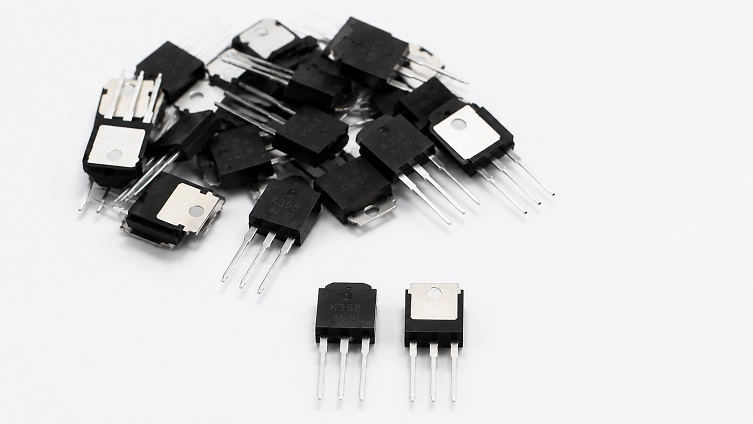
A common mistake is reducing the gate resistance to get the fastest possible switching edge. This may reduce switching loss in a test waveform, but it can create excessive overshoot and EMI in the real system. Gate tuning should balance efficiency, waveform quality, thermal result, and EMC compliance.
Thermal Design: Why SiC Still Needs Careful Cooling
SiC devices reduce loss, but they do not remove heat. In many designs, SiC enables higher power density, which means the same or greater amount of power may be handled in a smaller physical area. That can make thermal design more demanding, not less.
The thermal path includes junction-to-case resistance, package material, die attach, substrate, thermal interface material, heatsink, airflow or liquid cooling, and ambient temperature. In surface-mount designs, PCB copper area, thermal vias, copper thickness, and board stackup become part of the cooling system.
| Thermal Path Element | Design Impact |
|---|---|
| Junction-to-case | Defines how easily heat leaves the semiconductor die. |
| Case-to-heatsink | Depends on mounting pressure, flatness, and thermal interface material. |
| PCB copper | Important for surface-mount SiC devices and auxiliary power stages. |
| Baseplate or substrate | Critical in SiC modules for spreading heat and handling thermal cycling. |
| Cooling method | Air, conduction, and liquid cooling change usable current and reliability margin. |
Thermal design should be checked at realistic operating conditions, not only at room temperature. RDS(on), switching behavior, diode forward voltage, and cooling performance all change with temperature. A design that looks efficient in a short bench test can still run too hot in a sealed enclosure, vehicle environment, or outdoor inverter cabinet.
Layout, EMI and Protection Considerations
SiC layout needs tighter control than many slower silicon designs. The power loop should be short and low inductance. The gate loop should be compact and separated from noisy power paths. DC-link capacitors should be placed close to the switching devices. Current return paths should be intentional, not accidental.
Fast dv/dt and di/dt can cause conducted and radiated EMI, capacitive coupling into gate circuits, common-mode current, and stress on insulation systems. In motor drive applications, fast switching can also increase voltage stress on motor windings and long cable runs. Snubbers, gate resistors, shielding, filtering, and layout control may be needed to keep the system reliable and compliant.
- Use short, low-inductance power loops.
- Place DC-link capacitors close to the switching stage.
- Keep the gate driver close to the SiC MOSFET gate and source reference.
- Use Kelvin source packages where fast switching and clean gate control are required.
- Check drain-source overshoot under worst-case current and temperature.
- Verify EMI behavior early instead of waiting for the final enclosure.
Protection design also needs attention. SiC MOSFETs may have shorter short-circuit withstand time than older IGBT designs, so overcurrent detection and shutdown timing must be fast. Gate-driver UVLO, desaturation detection, active Miller clamp, soft turn-off, and surge protection should be selected according to the application risk.
Major Applications of SiC Power Devices
SiC is used where efficiency, thermal performance, and power density create direct value. The same device family may be used in very different systems, but each application has a different selection priority.
| Application | Why SiC Is Used | Selection Focus |
|---|---|---|
| EV traction inverter | Reduces inverter loss and supports high-voltage battery systems. | 1200 V class modules, short-circuit protection, thermal cycling, low-inductance layout. |
| Onboard charger | Improves AC/DC conversion efficiency and supports compact charger design. | PFC stage, LLC stage, switching frequency, thermal path, EMI. |
| DC fast charger | Supports higher power density and lower cooling demand. | Module topology, current rating, cooling method, protection strategy. |
| Solar inverter | Reduces switching loss in high-voltage DC/AC conversion. | DC bus voltage, outdoor temperature, efficiency curve, lifetime reliability. |
| Industrial motor drive | Improves efficiency in high-voltage variable-speed systems. | dv/dt control, motor insulation stress, long cable effects, EMI filtering. |
| Server and telecom power | Improves efficiency and power density in high-power conversion stages. | PFC efficiency, thermal density, layout, switching frequency. |
Silicon carbide power semiconductors are widely used in electric vehicles, charging infrastructure, renewable energy, industrial drives, and other power conversion systems where efficiency, compactness, and thermal performance are central design goals. (Infineon, Silicon Carbide Power Semiconductors)
How to Select SiC MOSFETs, Diodes and Modules
SiC selection should start with the application requirement rather than the material name. A 650 V SiC MOSFET for a PFC stage, a 1200 V SiC module for a traction inverter, and a SiC diode for a boost converter are different selection problems. The correct device depends on voltage margin, current waveform, switching frequency, topology, thermal structure, protection method, and cost target.
For SiC MOSFETs
Check drain-source voltage rating, continuous and pulsed current, RDS(on) at operating temperature, switching energy, gate charge, recommended gate voltage, package inductance, short-circuit withstand time, and thermal resistance. The selected gate driver must match the device's recommended voltage and protection behavior.
For SiC Diodes
Check reverse voltage, average forward current, surge capability, forward voltage, package thermal resistance, and operating junction temperature. A SiC diode may cost more than a silicon diode, but it can reduce reverse recovery loss and improve switching behavior in high-frequency circuits.
For SiC Modules
Check voltage class, current rating, topology, insulation voltage, baseplate material, terminal arrangement, gate connection, thermal resistance, mounting method, and cooling interface. In high-power modules, the external busbar and thermal system are part of the electrical design, not just mechanical accessories.
Common Mistakes in SiC Design
- Selecting SiC only because it is newer, without checking whether the system benefits from it.
- Comparing only device cost instead of total system efficiency, heatsink size, magnetic size, and enclosure cost.
- Using a silicon MOSFET or IGBT gate-drive approach without checking SiC requirements.
- Ignoring package inductance and PCB parasitics in fast-switching layouts.
- Driving the MOSFET too fast and creating overshoot, ringing, or EMI problems.
- Assuming lower semiconductor loss eliminates the need for thermal analysis.
- Choosing a package without checking creepage, clearance, mounting pressure, and assembly process.
- Relying only on typical datasheet values instead of checking worst-case temperature and operating conditions.
SiC technology is strongest when the design takes advantage of its high-voltage and fast-switching capability while controlling the side effects of that speed. The device can improve efficiency and power density, but the final result depends on the surrounding system: driver, layout, package, thermal path, EMI control, and protection circuit.
For engineers and buyers evaluating SiC MOSFETs, SiC diodes, or SiC power modules, the practical approach is to begin with the power stage requirements, then compare device ratings, switching behavior, thermal limits, package structure, and supplier availability. A well-chosen SiC device can improve a converter or inverter significantly, but only when the complete design is built to support its voltage, speed, and thermal characteristics.


