My Inquiry
 My Account


AI Server MLCC Shortages: Capacity Reallocation and High-Capacitance Pressure
Last updated: August 31, 2026
August 2026 Update: The capacity-reallocation trend described in this article is now reaching OEM and ODM contract pricing. Samsung Electro-Mechanics has raised Q4 quotations for consumer-grade X5R MLCCs by an average of 25%–30%, while high-end X6S products used in AI servers are seeing customer-specific increases of about 10%–20%. TrendForce also expects mid- and high-capacitance consumer MLCC prices at other suppliers to rise about 10%–20% as order spillover pushes some production lines close to 90% utilization. The latest development shows that AI-driven capacity allocation is no longer affecting only high-end availability and lead times; it is now influencing mainstream MLCC pricing as well. (TrendForce, August 27, 2026) Read our latest analysis: MLCC Price Increase 2026: Samsung Raises Q4 X5R Prices 25–30% as AI Capacity Shift Spreads.
The MLCC market is entering a new supply-tightening cycle, but this round is different from earlier shortages. The pressure is not mainly coming from smartphones, consumer electronics, or a broad automotive rebound. The main driver is the rapid expansion of AI infrastructure.
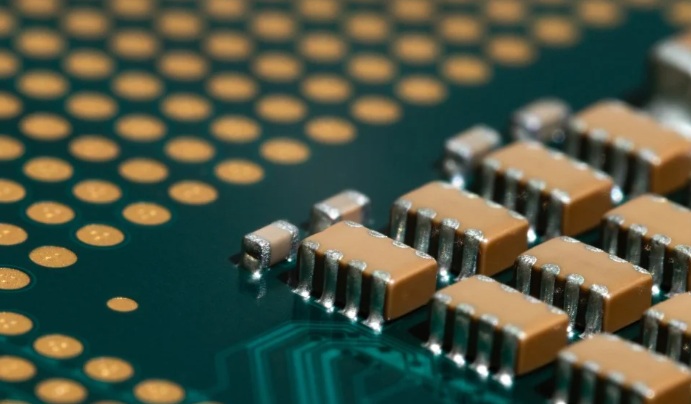
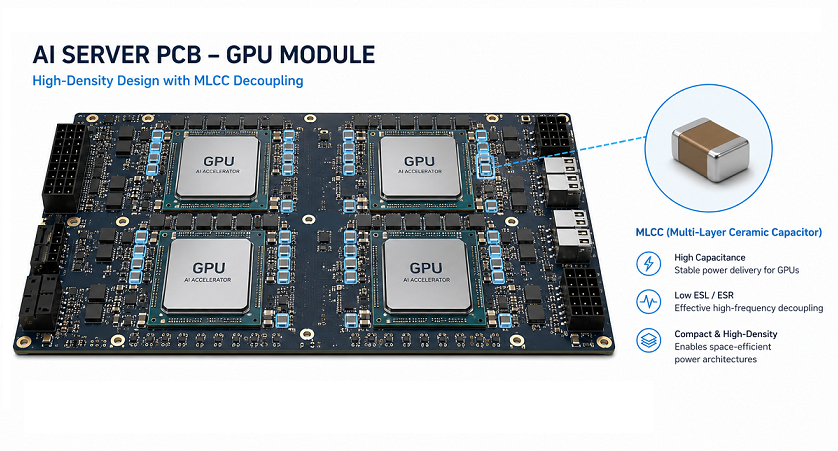
AI servers, GPU accelerator boards, high-current VRM stages, 48V power systems, and increasingly dense data center racks are changing the demand structure for multilayer ceramic capacitors. The shortage is not only about more MLCC units being consumed. It is also about the type of MLCCs now required: higher capacitance, higher reliability, higher voltage, smaller size, and better performance under severe power transients.
This creates a difficult market condition. AI hardware is pulling the highest-end MLCC capacity toward data center applications, while consumer electronics, industrial hardware, medical electronics, and standard computing products are left competing for a smaller and less flexible supply pool.
AI Servers Are Now the Main Driver Behind MLCC Tightness
Traditional servers already use large quantities of MLCCs for decoupling, filtering, and power rail stabilization. AI servers multiply that requirement because modern GPU platforms draw extremely high current and switch workloads at high speed.
Compared with general-purpose enterprise servers, AI servers can use roughly 10 to 15 times more MLCCs. The difference becomes even more dramatic at board and rack level.
| Platform | Typical MLCC Count | Market Meaning |
|---|---|---|
| Traditional server | 1,800 – 2,500 | Stable baseline demand |
| 8-GPU AI server | 15,000 – 25,000 | MLCC usage increases by roughly 10–15 times |
| NVIDIA GB200 board | ~6,500 | High-density capacitor deployment around advanced AI hardware |
| NVIDIA Rubin board | ~12,000 | Next-generation platforms require even higher capacitor density |
| GB200 NVL72 rack | ~440,000 | Rack-level MLCC demand becomes extremely large |
| Rubin VR200 rack | ~600,000 | Future AI systems may push demand even higher |
Industry estimates suggest that global AI server MLCC demand could reach approximately 72.6 billion units in 2026 and 136.7 billion units in 2027. Even if exact demand varies by platform configuration, the direction is clear: AI servers are turning MLCCs from a standard passive component into a strategic power-delivery component.
The Real Shortage Is in High-Capacitance and High-Reliability MLCCs
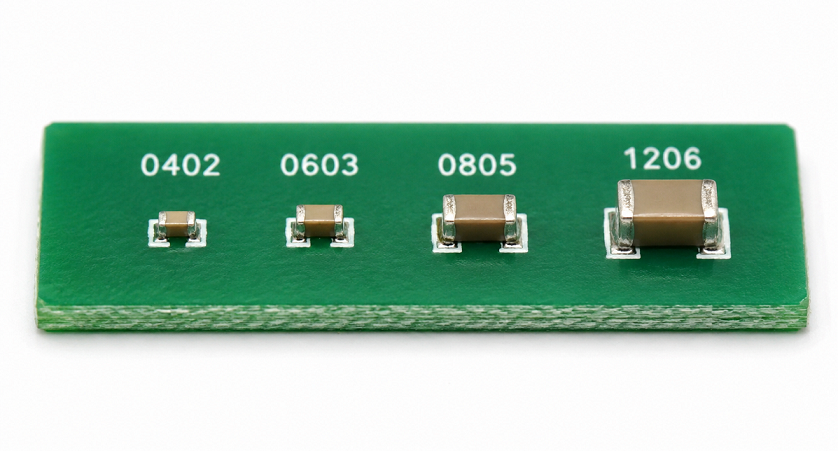
The current shortage is not evenly distributed across all MLCC categories. Standard 0402 and 0603 commodity parts may still remain available in many channels, while larger case sizes and high-capacitance products are already under more visible pressure.
The tightest categories are high-capacitance MLCCs used in power delivery networks, especially values such as:
- 22μF MLCCs
- 47μF MLCCs
- 100μF MLCCs
- larger high-value ceramic capacitors for power rails
- large-case high-capacitance parts such as 1206 and 1210
Astute reported that while standard 0402 and 0603 MLCCs remain relatively available, specialized large-case components are seeing lead times extend beyond 20 weeks. This is especially painful for industrial automation and medical electronics manufacturers because redesigning a PCB around different capacitor footprints can be costly and time-consuming.
Why AI Power Architecture Requires More Advanced MLCCs
AI server power architecture is becoming more complex. The industry is moving from traditional 12V distribution toward 48V power lines, because higher voltage can reduce current and lower distribution losses. At the same time, AI server power systems are using more advanced conversion stages, including high-efficiency resonant converters such as LLC topologies.
Some next-generation AI power systems are also moving toward higher-voltage architectures, including 800V-class systems for large power shelves. These systems need more demanding capacitors for input filtering, power conversion, and transient suppression.
Near the GPU and CPU, the challenge is different. Advanced processors may operate at very low voltages, sometimes around 0.8V, while drawing extremely high current. To keep these rails stable, the system needs very high capacitance close to the load, low loop inductance, and fast transient response.
This is why MLCCs are increasingly placed close to GPU packages, under advanced packages, or near landside power delivery areas. Embedded MLCCs and landside MLCCs help reduce loop inductance while increasing local capacitance density.
The Industry Is Moving Toward Smaller MLCCs With Higher Capacitance
The technical challenge is not simply adding more capacitors. AI boards have limited space. As GPU performance increases, the available mounting area often becomes smaller, while the required capacitance increases.
This is pushing suppliers toward extremely compact, high-capacitance MLCCs. Recent product developments show how aggressive this direction has become.
| Supplier | Recent High-Capacitance MLCC Development | Market Significance |
|---|---|---|
| Murata | 0402-inch 47μF MLCC mass production | Higher capacitance in a very small footprint for AI-related systems |
| Kyocera AVX | 0402-inch 47μF MLCC scheduled for mass production | Ultra-compact high-capacitance component for limited board space |
| Samsung Electro-Mechanics | 0402 47μF X6S 2.5V and 0603 100μF X6S 2.5V MLCCs | Targeted at AI server applications requiring dense capacitance |
| Taiyo Yuden | Embedded MLCC development for IC power line decoupling | Supports high-density power delivery near semiconductor packages |
These developments show that MLCC suppliers are not only increasing output. They are changing the product mix toward smaller, denser, more technically demanding capacitors.
Manufacturing High-End MLCCs Consumes More Capacity
High-capacitance MLCCs are much harder to manufacture than standard low-value capacitors. They require ultra-thin ceramic dielectric layers, more internal electrodes, precise stacking, advanced sintering control, and stricter reliability testing.
For AI-grade MLCCs, the production burden is even higher. These parts often require better thermal performance, tighter capacitance control, higher voltage reliability, and stronger quality validation. Industry estimates suggest that high-end AI-grade MLCCs can consume four to seven times more effective production capacity than standard consumer-grade products.
This is one of the least understood causes of the shortage. A factory may be operating at high utilization, but if more production is allocated to complex high-capacitance products, the total number of units shipped may not increase proportionally.
The Shortage Is Not Mainly a Raw Material Problem
The current MLCC shortage is often misunderstood as a raw material issue. Materials such as nickel, palladium, silver, copper, and aluminum do affect cost trends, but the deeper issue is capacity allocation.
Suppliers are prioritizing higher-margin MLCCs used in AI servers, data centers, automotive electronics, and industrial power systems. From a business standpoint, this is logical. Premium MLCCs generate better margins and are tied to growth markets.
The result is a structural supply imbalance:
- AI-grade high-capacitance MLCCs receive more production priority.
- Consumer-grade MLCC capacity becomes less flexible.
- Large-case MLCC lead times extend.
- Standard hardware manufacturers face less predictable availability.
- Distributors and agents begin preemptive stock building.
This explains why the shortage can spread even when general component demand is not strong. The issue is not that every market is booming. The issue is that production capacity is being redirected toward one extremely strong end market.
Price Increases Are Already Appearing
MLCC pricing is no longer flat across all categories. TrendForce reported that in April 2026, Taiyo Yuden raised prices for low-capacitance consumer and automotive MLCCs by 6% to 13%. At the same time, Taiwanese and mainland Chinese agents have reportedly started stocking X5R standard products from 1000pF to 10μF in response to tighter inventory controls.
Market reports also indicate that high-end MLCC product lines have seen stronger pricing pressure, especially where AI server, automotive, and industrial demand overlap.
| Market Segment | Current Condition | Reason |
|---|---|---|
| AI-grade high-capacitance MLCC | Strong demand and rising price pressure | AI server and data center expansion |
| Large-case high-capacitance MLCC | Lead time extension | Power management and high-current applications |
| Consumer-grade MLCC | Capacity flexibility tightening | Production reallocated to premium products |
| Automotive MLCC | Selective price recovery | Reliability requirements and supplier margin discipline |
The price increase does not mean all MLCCs are unavailable. It means the market is becoming segmented. High-end products are tightening first, while lower-end products may tighten later if capacity reallocation continues.
Consumer Demand Is Weak, But MLCC Supply Is Still Tightening
One unusual feature of this cycle is the split between AI demand and consumer demand. AI server demand is strong, while PC, notebook, and consumer electronics demand remains uneven.
TrendForce noted that the market is showing a clear polarization: AI-driven demand is strong, while consumer demand is weak. This creates a strange market condition where some ODMs are not raising full-year shipment targets, but MLCC prices and lead times can still move upward because high-end capacity is being absorbed by AI infrastructure.
Geopolitical uncertainty, energy price volatility, inflation, and monetary policy changes may continue to pressure end-market demand. However, these risks do not fully relieve MLCC supply pressure because AI-related demand is concentrated in the most capacity-intensive product categories.
Inventory Strategy Is Changing From JIT to Long-Term Allocation
For many years, electronics manufacturers relied heavily on just-in-time inventory models. That strategy becomes risky when lead times move quickly and suppliers prioritize large AI and automotive customers.
As high-capacitance MLCC availability tightens, procurement teams are shifting toward longer-term agreements and earlier allocation planning. Distributors may provide a temporary buffer, but once major OEMs consume available stock, smaller manufacturers may face stronger competition for remaining supply.
This is especially important for:
- industrial automation manufacturers
- medical electronics companies
- power supply makers
- networking equipment suppliers
- non-AI server hardware manufacturers
- smaller OEMs without strong allocation leverage
The problem is not only price. A missing high-capacitance MLCC can delay production if the PCB was designed around a specific package size, voltage rating, capacitance value, and DC bias behavior.
Why Redesigning Around MLCC Shortages Is Difficult
MLCC replacement is not as simple as selecting the same capacitance value from another supplier. Several electrical and mechanical factors must be checked before a substitute can be approved.
- Case size and land pattern compatibility
- Voltage rating and derating margin
- Effective capacitance under DC bias
- Temperature characteristic such as X5R, X6S, X7R, or X7T
- ESR and impedance behavior
- Mechanical stress and board flex cracking risk
- Reliability grade and qualification requirements
This is why high-capacitance 1206 and 1210 shortages are particularly disruptive. If a board is already space-constrained, moving to a different footprint may require layout changes, electrical revalidation, and production approval.
The Strategic Problem: AI Gets Priority, Standard Hardware Gets Exposed
The deeper risk is not only that AI servers need more MLCCs. The bigger issue is that suppliers are rationally allocating their best capacity to the highest-value applications.
AI servers, automotive systems, and high-end industrial power electronics can support premium pricing. Commodity consumer hardware usually cannot. When suppliers maintain discipline on capital expenditure and avoid overbuilding low-margin capacity, standard hardware makers lose flexibility.
This creates a procurement gap. Non-AI hardware manufacturers may not see strong end-market demand, but they can still face rising costs and longer lead times because their components share production resources with AI-related products.
What Buyers Should Watch Next
MLCC buyers should monitor more than spot price. In a capacity-driven shortage, early warning signs often appear through delivery behavior and supplier communication before broad price changes become visible.
| Signal | What It May Indicate |
|---|---|
| Lead times above 20 weeks | Capacity pressure in specific large-case or high-capacitance parts |
| Distributor stock drawdown | OEMs or agents building inventory ahead of price movement |
| Supplier reluctance to quote long coverage | Allocation risk may be rising |
| Selective price increases | Suppliers testing market acceptance for broader price recovery |
| Longer confirmation time for common values | Capacity reallocation may be affecting standard products |
The most important practical step is to approve alternatives before the shortage becomes urgent. Waiting until production is already short creates less negotiating power and fewer engineering options.
Why This MLCC Cycle Could Last Longer Than Expected
MLCC capacity expansion is slow. New production lines require precision tape casting, electrode printing, stacking, lamination, sintering, termination, testing, and qualification. For high-reliability AI and automotive products, validation requirements add more time.
Murata has continued expanding its MLCC capacity, including a major facility in Izumo, Japan, intended to support long-term global demand. However, even new capacity does not immediately remove shortages because ramp-up and product qualification take time.
Meanwhile, AI accelerator demand continues to rise. Cloud service providers such as Microsoft, AWS, Google, and Meta are increasing investment in AI infrastructure, custom ASICs, advanced packaging, and high-density computing platforms. This suggests that MLCC demand from AI systems is not a one-quarter event.
Market Outlook: Structural Tightness, Not a Simple Shortage
The MLCC market is moving into a more segmented structure. Commodity MLCCs may not always be short, but high-capacitance, high-reliability, and AI-related MLCCs are becoming more strategically important.
The root cause is a combination of three forces:
- AI servers require far more MLCCs than traditional servers.
- High-capacitance MLCCs are harder and slower to manufacture.
- Suppliers are reallocating capacity toward higher-margin applications.
This creates a market where demand can remain weak in some consumer segments while supply still tightens for specific passive components.
For engineers and procurement teams, the lesson is clear: high-capacitance MLCCs should no longer be treated as simple commodity passives. They are becoming a supply-chain-sensitive component in AI servers, power delivery networks, industrial hardware, and high-reliability electronics.
Companies that secure allocation early, approve alternative suppliers, and review package flexibility before shortages worsen will have a stronger position as AI infrastructure continues absorbing premium MLCC capacity.
August 2026 Update: Capacity Reallocation Is Now Reaching MLCC Pricing
The market developments since this article was published provide stronger evidence that MLCC capacity reallocation is moving beyond high-end supply constraints. Samsung Electro-Mechanics has begun raising Q4 2026 quotations for OEM and ODM customers, with consumer-grade X5R products increasing by an average of 25%–30%. High-end X6S MLCCs used in AI-server applications are seeing negotiated increases averaging 10%–20%. (TrendForce, SEMCO Leads 4Q26 OEM Price Hikes)
The larger X5R increase is particularly significant. TrendForce says SEMCO is using higher X5R pricing partly to reduce incoming demand and release manufacturing capacity for premium product lines. This directly reinforces the capacity-allocation mechanism discussed earlier in this article: strong AI demand can raise sourcing pressure for products that are not themselves used in AI servers when those products compete for the same manufacturing resources.
The effect is also spreading beyond SEMCO. Consumer mid- and high-capacitance orders are moving toward Taiwanese and Chinese suppliers, supporting expected Q4 price increases of roughly 10%–20%. Some suppliers are approaching 90% utilization, reducing the spare capacity available to absorb further order transfers.
| MLCC Segment | Q4 2026 Signal | What Has Changed |
|---|---|---|
| Consumer mid/high-capacitance X5R | SEMCO +25% to +30% | Capacity reallocation is now directly affecting OEM and ODM contract pricing |
| AI-server high-capacitance X6S | +10% to +20% | Supply remains tight, with customer-specific pricing and allocation |
| Other mid/high-capacitance suppliers | About +10% to +20% | Order spillover is raising utilization and reducing second-source capacity |
The market is still segmented. Low-capacitance commodity MLCCs do not necessarily face the same pricing or availability conditions, and Murata, Taiyo Yuden and Kyocera had not followed SEMCO with broad price increases as of late August. The important change is that capacity pressure previously concentrated in high-capacitance AI products is now influencing pricing further down the MLCC product mix.
For a detailed analysis of the Q4 pricing structure, the difference between X5R and X6S, supplier utilization and the outlook into 2027, see MLCC Price Increase 2026: Samsung Raises Q4 X5R Prices 25–30% as AI Capacity Shift Spreads.