My Inquiry
 My Account


Last updated: August 20, 2026
August 2026 Update: STM32 supply conditions have tightened further since this article was published. Selected STM32H7 and H5 MPNs that were previously represented by an approximately 30-week family-level lead time are now showing standard lead times of 52 weeks. Lead-time risk has also become more dependent on the exact MPN, package and customer allocation status. Read the latest update: STM32H7 Lead Times Reach 52 Weeks as ST MCU Supply Tightens Further.
STMicroelectronics has updated distributors on longer factory lead times across a broad range of STM32, STM8, wireless, and microprocessor product families. According to the ST notice sent to distributors, several 90nm STM32 families moved from approximately 30 weeks in the April update to 52 weeks in the July update.
Older products manufactured on 110nm, 130nm, and 180nm processes have moved to approximately 40 weeks. Newer 40nm and 16nm platforms have also extended to 30 weeks, compared with the previous 15- to 20-week range.
The same notice asks distributors to encourage customers to place 100% of their 2027 orders now. It also directs channel partners to promote migration from 90nm STM32F4, F2, L4, G4, and G0 products toward the 40nm STM32H7, H5, and C5 platforms.
These instructions provide a clear view of ST's current supply strategy. The company is seeking longer demand visibility, reducing uncertainty around future capacity commitments, and guiding new projects toward manufacturing platforms that have a clearer long-term supply path.
Key findings from the ST MCU lead-time update:
- Several 90nm STM32 families have moved from 30 weeks to 52 weeks.
- STM32F0, F1, F3, STM32L0, L1, and STM8 products have moved to approximately 40 weeks.
- STM32H7, H5, C5, U3, U5, STM32MP1, STM32N6, and STM32MP2 have moved to approximately 30 weeks.
- ST is asking distributors to secure full-year 2027 customer orders.
- Customers using selected 90nm products are being encouraged to migrate to 40nm STM32 platforms.
- Longer factory scheduling could increase spot-market volatility for widely used F1, F4, G0, and G4 devices.
- Exact availability will continue to vary by part number, package, quantity, temperature grade, customer status, and regional allocation.
STMicroelectronics MCU Lead Times Rise to 30–52 Weeks
The July update shows a broad extension in ST MCU production schedules. Every product group with both April and July figures recorded an increase.
The largest change appears across the 90nm portfolio. STM32G0, G4, L4, L5, U0, C0, WB, WL, F2, F4, and F7 families now carry a reference lead time of 52 weeks. That represents an increase of 22 weeks from the previous 30-week estimate.
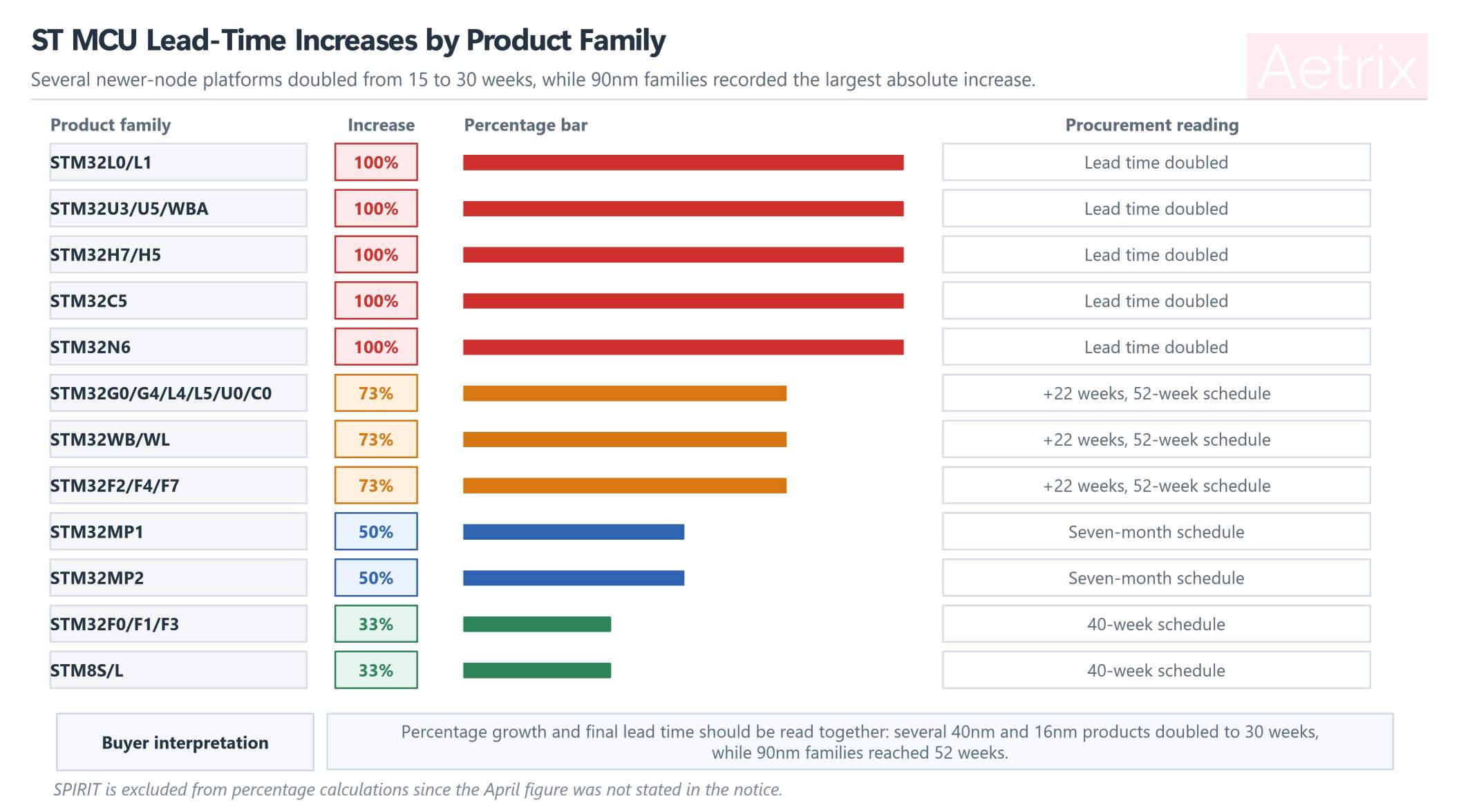
STM32L0 and L1 recorded the largest proportional increase, rising from 20 weeks to 40 weeks. STM32F0, F1, F3, and STM8S/L increased from 30 weeks to 40 weeks.
The newer-node portfolio also tightened. Several 40nm and 16nm product groups moved from 15–20 weeks to 30 weeks. A 30-week schedule remains shorter than the 52-week window assigned to many 90nm families, although it still requires purchasing decisions roughly seven months before planned production.
The figures represent factory planning lead times. They are reference schedules for new orders under current allocation and production assumptions. Confirmed shipment dates can move according to the exact orderable part number, package, order quantity, backlog position, regional supply, and customer allocation status.
Complete ST MCU Lead-Time Table: April vs July 2026
| Process node | Product families | April lead time | July lead time | Increase | Procurement exposure |
|---|---|---|---|---|---|
| 180nm | STM32F0 / F1 / F3 | 30 weeks | 40 weeks | +10 weeks | Long planning window for established, high-volume designs |
| 110/130nm | STM32L0 / L1 | 20 weeks | 40 weeks | +20 weeks | Lead time has doubled for legacy low-power applications |
| 130nm | STM8S / STM8L | 30 weeks | 40 weeks | +10 weeks | Increased risk for long-running 8-bit industrial and appliance designs |
| 90nm | STM32G0 / G4 / L4 / L5 / U0 / C0 | 30 weeks | 52 weeks | +22 weeks | Twelve-month factory planning exposure across mainstream MCU families |
| 90nm | STM32WB / WL | 30 weeks | 52 weeks | +22 weeks | Higher planning risk for Bluetooth, multiprotocol, and LoRa-connected products |
| M10T-90nm | STM32F2 / F4 / F7 | 30 weeks | 52 weeks | +22 weeks | High exposure for installed industrial, control, graphics, and embedded platforms |
| 90nm | SPIRIT RF products | Not stated | 52 weeks | - | Extended scheduling for sub-GHz RF and connectivity applications |
| 40nm | STM32U3 / U5 / WBA | 15 weeks | 30 weeks | +15 weeks | More manageable than 90nm supply, with earlier ordering still required |
| 40nm | STM32MP1 | 20 weeks | 30 weeks | +10 weeks | Longer planning window for Linux-capable industrial MPU platforms |
| 40nm | STM32H7 / H5 | 15 weeks | 30 weeks | +15 weeks | Strategic migration platform with a seven-month procurement window |
| 40nm | STM32C5 | 15 weeks | 30 weeks | +15 weeks | New entry-level platform promoted for future cost-sensitive designs |
| 16nm | STM32N6 | 15 weeks | 30 weeks | +15 weeks | Longer planning for edge-AI and computer-vision MCU projects |
| 16nm | STM32MP2 | 20 weeks | 30 weeks | +10 weeks | Earlier commitment required for advanced industrial MPU designs |
The 90nm groups form the clearest risk cluster. Most have moved to a full 52-week factory schedule, while the listed 40nm and 16nm products converge at 30 weeks.
Process node alone cannot determine availability for an individual order. A popular package with limited open inventory can remain constrained even when its broader product family carries a shorter reference lead time. A less frequently used 90nm device may still be available from existing channel inventory while new factory orders remain scheduled far into the future.
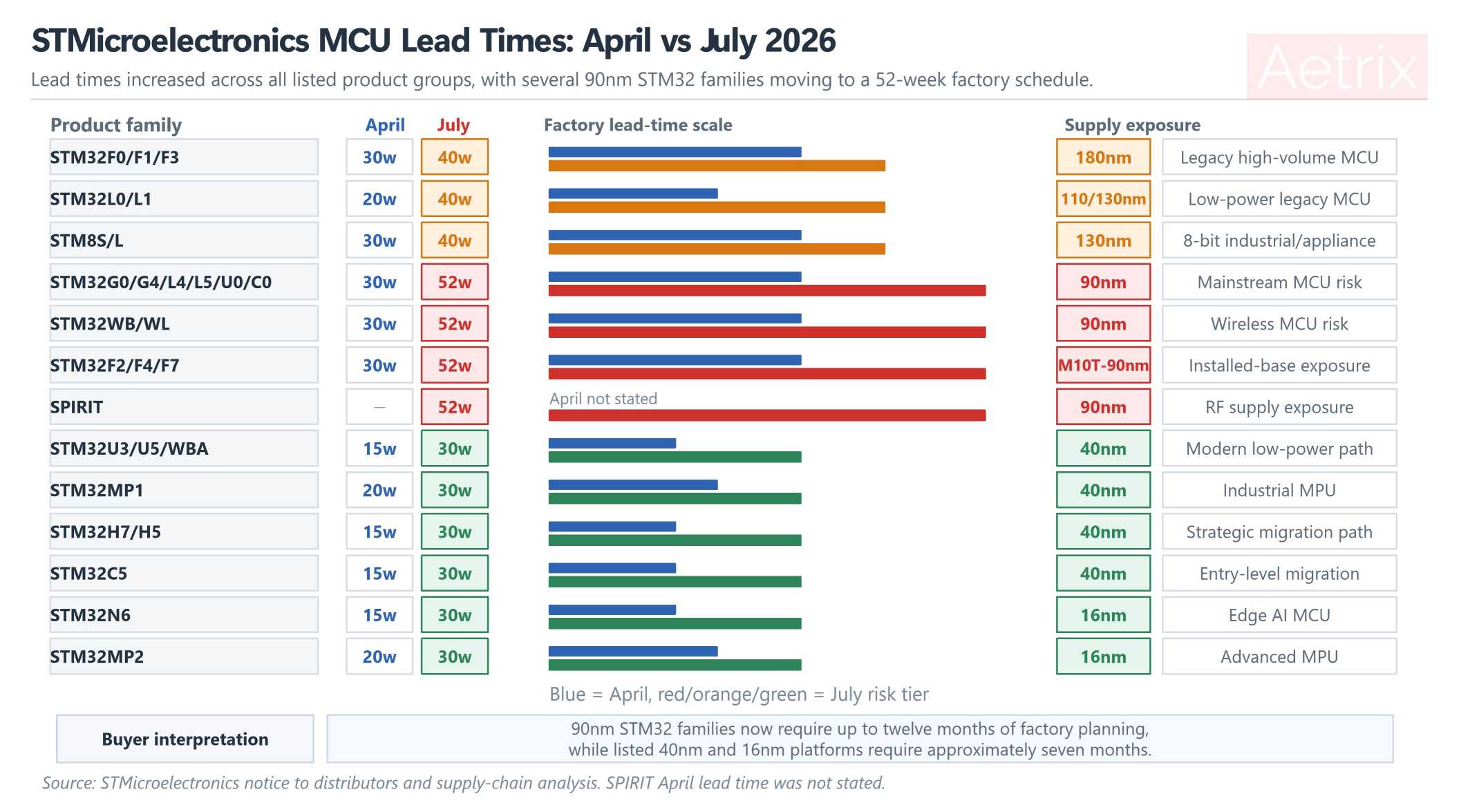
The July data shows a clear separation in planning exposure. Several mature-node product groups now carry lead times of 40 or 52 weeks, while the listed 40nm and 16nm platforms are scheduled at approximately 30 weeks. These newer platforms have also experienced significant extensions, while ST is giving them a more prominent role in its future MCU portfolio.
The percentage change provides another view of the update. The 90nm portfolio carries the longest absolute lead time, while several 40nm and 16nm platforms recorded a 100% increase from their previous 15-week schedules.
Why ST Is Asking for 100% of 2027 Orders
The request for customers to place their full-year 2027 orders carries more weight than a standard forecast request. A forecast provides expected demand and can usually change as production plans develop. A formal purchase order can create firm commercial and inventory obligations.
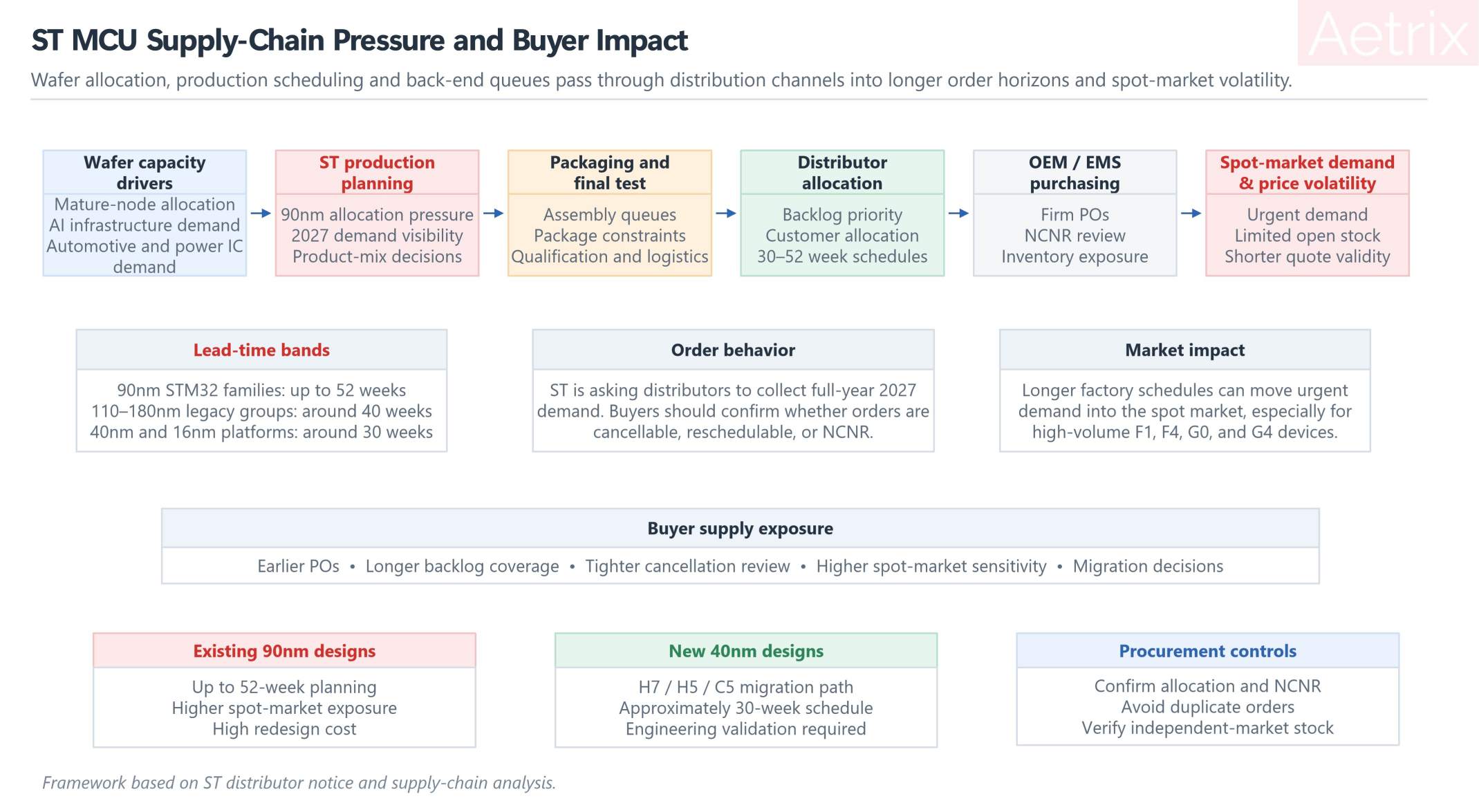
ST gains earlier visibility into wafer starts, assembly requirements, test capacity, package demand, and regional allocation by collecting orders well before the required delivery dates. That visibility can support negotiations with external foundries and subcontractors while helping internal factories plan product mix across a constrained portfolio.
Customers also need to understand the commercial exposure created by a long order horizon. Demand forecasts for an entire year can change through product delays, customer cancellations, economic conditions, engineering revisions, or slower sell-through. A buyer that locks too much volume may trade supply risk for excess-inventory risk.
Submitting a full-year order also provides no automatic guarantee that every requested unit will receive immediate allocation. Suppliers and authorized distributors may continue to prioritize orders according to historical consumption, forecast accuracy, customer size, application, contractual commitments, and available capacity.
Before placing 2027 orders, procurement teams should obtain written clarification on:
- Whether the order is cancellable, reschedulable, or NCNR
- The permitted cancellation and rescheduling windows
- Minimum order quantity and standard package quantity
- Whether delivery dates are confirmed or estimated
- Whether allocation is tied to forecast history
- How price changes will apply to future scheduled shipments
- Whether blanket orders require scheduled releases
- Which party will hold inventory when customer demand changes
Duplicate orders create another risk. During tight supply cycles, some buyers place the same requirement with several distributors in an attempt to improve allocation. Those orders can arrive together after capacity improves, creating excess inventory and cancellation disputes. An accurate demand plan and a clearly defined primary channel provide a safer basis for long-term supply coverage.
Aetrix previously reported that Analog Devices asked customers to place orders at least six months ahead. ST's current message reaches further into the planning cycle by asking for 2027 demand and adding a process-node migration request.
Why 90nm STM32 Families Face the Highest Supply Risk
The 52-week figures suggest tighter allocation and less production flexibility across several 90nm MCU programs. Supply-chain sources indicate that the external wafer capacity available to parts of ST's mature-node portfolio has been compressed as foundries adjust production toward applications with stronger demand, larger commitments, and higher wafer value.
AI infrastructure consumes advanced processors and memory, while the supporting systems also require power-management ICs, controllers, connectivity devices, drivers, protection products, and other chips manufactured on mature processes. That wider component requirement can affect nodes far above the leading edge.
TrendForce reported in May 2026 that average utilization across the world's top ten 8-inch foundries was expected to approach 90% during the year. It also reported that foundries were reallocating mature-node capacity toward power-related processes to improve average selling prices and profitability. The same analysis identified potential reductions in some mature 12-inch capacity as another source of order redistribution (TrendForce, Capacity Cuts and Surging Demand for AI Power ICs).
Supply-chain contacts also report that TSMC, UMC, and other foundry operators have placed greater emphasis on customers offering long-term volume commitments and higher-value programs. Under those conditions, a lower-priced general-purpose MCU can have less scheduling flexibility than power, automotive, communications, or AI-infrastructure products using compatible manufacturing resources.
ST has internal manufacturing capabilities, although its complete MCU supply chain also involves external wafer, assembly, and test partners. Channel sources say the available allocation for some 90nm MCU families has tightened, contributing to the move from 30-week schedules to 52 weeks.
Back-End Packaging and Test Add Further Delay
Wafer output represents one stage of the delivery cycle. Completed wafers must still move through wafer probe, dicing, packaging, final testing, qualification, marking, and logistics.
Supply-chain sources point to longer queues at selected packaging and test operations. Higher demand for power semiconductors, automotive devices, AI-related products, and advanced packaging can affect equipment availability, substrate supply, test resources, and investment priorities across the wider outsourced semiconductor assembly and test market.
These constraints do not affect every package equally. LQFP, QFN, BGA, WLCSP, and other formats use different production flows and equipment. A lead-time problem can remain concentrated in a particular package or assembly location even when wafers for the same MCU family are available.
The combined cycle therefore includes wafer allocation, fabrication time, assembly queues, test capacity, qualification, and final logistics. Pressure in more than one stage can turn a 30-week planning window into a 40- or 52-week factory estimate.
What the Move Toward STM32H7, H5, and C5 Reveals
ST's migration request aligns with its publicly stated investment in 40nm STM32 manufacturing. In March 2026, ST announced volume production of China-manufactured STM32 microcontrollers, beginning with STM32H7 and followed by STM32H5 and STM32C5. The company described this as part of a dual-supply-chain strategy covering wafer manufacturing, packaging, and testing (STMicroelectronics, China-manufactured STM32 microcontrollers begin volume production).
The three promoted families cover different market levels:
- STM32H7 serves high-performance control, graphics, communications, industrial, and computing applications.
- STM32H5 combines Cortex-M33 performance with stronger security, connectivity, and industrial functionality.
- STM32C5 targets cost-sensitive mainstream and entry-level designs using a newer 40nm platform.
ST identifies STM32H7 as a 40nm embedded-flash platform. The company also states that STM32H5 uses its 40nm eSTM technology, while the STM32C5 series uses a 40nm flash platform designed to improve performance and Flash density in cost-sensitive applications (STMicroelectronics, eSTM technology) (STMicroelectronics, STM32C5 launch announcement).
Moving more customer demand to these families gives ST an opportunity to concentrate development, manufacturing investment, ecosystem support, and future capacity on a smaller number of modern platforms. It can also reduce the number of older process and product combinations that must compete for limited manufacturing resources.
The current lead-time table still assigns 30 weeks to these products. Their strategic position improves the long-term supply outlook, while buyers still need to plan several quarters ahead for production orders.
Migration from STM32F4, G0, G4, or L4 Requires Engineering Work
The word "migrate" can make the transition appear simpler than it is. Moving an established product from STM32F4, F2, L4, G4, or G0 to H7, H5, or C5 can involve a full platform review.
Some STM32 families offer pin-compatible options in selected packages, and the STM32 ecosystem can reduce software development time. Compatibility still needs to be confirmed at the exact orderable-part level.
| Migration area | Required review | Potential project impact |
|---|---|---|
| Package and pinout | Pin assignment, package dimensions, exposed pad, unused pins, and alternate functions | PCB layout changes or a new board revision |
| Power architecture | Supply rails, internal regulators, decoupling, sequencing, current demand, and low-power modes | BOM and power-tree changes |
| Clock system | Oscillator ranges, PLL configuration, clock tree, peripheral clocks, and timing dependencies | Firmware changes and timing revalidation |
| Memory architecture | Flash organization, SRAM regions, cache, ECC, boot memory, and external-memory interfaces | Linker, bootloader, and memory-map changes |
| Peripherals | ADC, timers, communication interfaces, DMA, interrupts, and peripheral feature differences | Driver updates and functional retesting |
| Firmware ecosystem | HAL and LL drivers, middleware, RTOS support, third-party libraries, and security configuration | Software porting and regression testing |
| Qualification | EMC, thermal, reliability, safety, cybersecurity, and customer approval requirements | Additional testing, certification cost, and schedule delay |
Existing products often remain on their original MCU platform because the redesign cost exceeds the temporary premium paid for available inventory. New projects have greater flexibility. Design teams can compare lifecycle support, current lead time, software maturity, security requirements, and sourcing options before the PCB and firmware architecture are fixed.
For buyers, the migration recommendation should trigger an engineering assessment. It should not be treated as confirmation that H7, H5, or C5 devices are direct drop-in replacements for every affected 90nm MCU.
Does the Update Indicate a Broad STM32 Shortage?
The notice shows widespread planning pressure across the listed families. Actual availability remains part-specific.
A factory lead time of 52 weeks can coexist with existing distributor stock or independent-market inventory. That stock may have been produced months earlier, assigned to a previous order, held as buffer inventory, or purchased before the latest scheduling change.
The opposite situation can also occur. A product family may carry a 30-week reference lead time while a particular package, memory density, or temperature grade has no immediately available inventory.
Buyers should separate three supply indicators:
- Factory lead time: the estimated production and delivery schedule for a new accepted order.
- Authorized-channel availability: inventory already held by authorized distributors or assigned to existing backlog.
- Independent-market availability: inventory held outside the authorized channel, with varying price, date code, traceability, and quality documentation.
A complete supply review should include all three indicators. A single stock listing cannot confirm that factory supply has recovered, while a long factory schedule cannot confirm that every exact part number is unavailable.
What the Update Means for STM32 Spot Prices
A 52-week factory schedule can push buyers toward immediately available inventory when production cannot wait for future deliveries. Higher urgent demand and limited open stock can raise prices or shorten quote validity.
Widely used STM32F1, F4, G0, and G4 products may face greater spot-market sensitivity because they appear in large numbers of established industrial, consumer, IoT, power-control, and embedded designs. Many of those designs cannot change MCUs without board and firmware work.
Supply-chain participants expect selected F1, F4, and G0 spot prices to remain relatively elevated over the next two to three years if factory lead times stay extended and installed products migrate slowly. This is a conditional outlook. A faster demand slowdown, inventory release, capacity improvement, or successful customer migration could reduce the pressure earlier.
Price behavior will also vary across the same STM32 family. Package, Flash capacity, temperature grade, date code, quantity, production location, and regional inventory can create large differences between two related part numbers.
The 52-week update therefore provides a warning signal for spot pricing. It does not establish a universal price increase across every STM32 device. Buyers should monitor exact part numbers and compare market prices with confirmed factory schedules.
Spot-market checks for STM32 buyers:
- Confirm the complete manufacturer part number and package suffix.
- Check quantity, date code, factory marking, and moisture-sensitivity packaging.
- Review traceability documents and supplier chain of custody.
- Compare the spot premium with the cost of a production delay.
- Check whether lower-priced inventory has older date codes or limited documentation.
- Use electrical inspection or third-party testing for higher-risk purchases.
Impact on OEMs, EMS Providers, and Smaller Buyers
Large OEMs
Large OEMs usually have stronger forecast history, direct supplier relationships, negotiated pricing, and established allocation procedures. They are also more likely to receive requests for full-year 2027 purchase orders.
Placing those orders can improve demand visibility and support allocation, while creating commitments that must be managed against real production schedules. OEMs should divide demand into firm production, expected production, service inventory, and contingency requirements before issuing long-horizon orders.
New platforms can be directed toward H7, H5, C5, or another modern MCU family where the performance, cost, security, power, and lifecycle fit the project. Existing products require a separate decision based on migration cost and remaining product lifetime.
EMS Providers and Contract Manufacturers
EMS providers may receive pressure from both directions. Customers want supply protection, while distributors may request firm orders with limited cancellation rights.
The EMS provider should document who owns the inventory when customer forecasts change. NCNR conditions, customer authorization, excess-stock responsibility, and rescheduling limits need to be agreed before a long-term order is placed.
Customer-provided forecasts should also be checked for duplication. A customer may have ordered the same STM32 demand through another EMS company, distributor, or regional procurement team.
Small and Medium-Sized Buyers
Smaller buyers often have less allocation priority and lower forecast visibility. A 40- or 52-week factory schedule can make ordinary replenishment difficult, especially for low-volume orders.
These buyers may need to combine authorized-channel backlog, qualified independent inventory, buffer stock, and engineering alternatives. The lowest unit price may provide little value if the selected source cannot support traceability or deliver within the production schedule.
For smaller production runs, the financial comparison should include:
- Spot-market premium
- PCB redesign cost
- Firmware porting cost
- Certification and validation cost
- Production-line delay
- Customer delivery penalties
- Engineering resources required for migration
A temporary spot premium can be economically reasonable for a mature product near the end of its commercial life. A new product expected to ship for many years may justify a platform redesign with a stronger long-term supply path.
Could Long Lead Times Weaken ST in General-Purpose MCUs?
ST retains a large installed base, a broad STM32 portfolio, mature development tools, extensive software support, and strong recognition among embedded engineers. Those advantages create substantial customer retention in existing products.
Long lead times can still affect new design decisions. A design team starting a low-cost controller, appliance, IoT node, industrial module, or general-purpose embedded platform may compare ST with NXP, Microchip, Renesas, Silicon Labs, GigaDevice, WCH, Espressif, and other MCU suppliers.
Supply availability becomes one selection criterion alongside price, performance, development tools, power consumption, security, software support, and lifecycle commitments. Repeated 40- to 52-week schedules can reduce the appeal of a product family during the early design stage.
Supply-chain sources expect ST's influence in selected low-cost and general-purpose MCU projects to face more pressure if mature-node lead times remain extended. Chinese MCU suppliers may gain additional opportunities in domestic industrial, appliance, consumer, and IoT designs where local support and shorter procurement cycles carry greater weight.
The effect on existing production should develop more slowly. Firmware investment, qualified PCB designs, regulatory approvals, installed manufacturing tests, and field-service requirements create high switching costs. Many customers will continue buying their current STM32 devices while evaluating alternatives for the next product generation.
ST may therefore strengthen its position in newer high-performance, secure, automotive, and 40nm platforms while facing more competition in mature general-purpose designs. The final market impact will depend on lead-time duration, pricing, migration support, and the availability offered by competing MCU suppliers.
What STM32 Buyers Should Do Now
Procurement teams should review exposure at the complete manufacturer-part-number level. Family-level data is useful for risk screening, while actual buying decisions depend on the exact device, package, memory configuration, temperature grade, quantity, and required delivery date.
| Priority area | Recommended action | Question to confirm |
|---|---|---|
| BOM exposure | Identify all STM32, STM8, SPIRIT, and STM32MP devices used in active products | Which production lines would stop if the MCU arrived late? |
| Demand coverage | Map inventory and confirmed backlog against 12–18 months of expected usage | How many months of confirmed supply are already covered? |
| Open orders | Check acknowledgment dates, delivery commitments, and allocation status | Is the date confirmed by ST or still estimated by the distributor? |
| 2027 orders | Separate firm demand from forecast and contingency volume | What volume can the company accept if demand falls? |
| Commercial terms | Confirm MOQ, NCNR, cancellation, rescheduling, and price-adjustment terms | Who carries the inventory obligation? |
| High-risk families | Prioritize F1, F2, F4, F7, G0, G4, L4, WB, and WL reviews | Does current coverage match a 40- or 52-week factory schedule? |
| New designs | Review 40nm STM32 platforms and alternative MCU suppliers before design freeze | Can the design support a second source or alternate footprint? |
| Migration planning | Estimate PCB, firmware, testing, and certification effort | Is redesign cheaper than several years of supply premiums? |
| Spot purchases | Verify traceability, labels, packaging, date codes, and test requirements | Can the source support the project's quality requirements? |
| Duplicate demand | Coordinate regional buyers, EMS companies, and distribution channels | Has the same demand been ordered elsewhere? |
The most exposed products should receive priority. These include single-source MCUs with no approved alternative, devices used in products with long qualification cycles, and parts serving high-volume lines where a production interruption would carry substantial financial cost.
Engineering teams should join the review before supply becomes critical. Alternative selection, firmware migration, test development, and product requalification usually require more time than procurement teams expect.
Key Takeaways
- STMicroelectronics has extended factory lead times across a wide range of MCU and MPU families.
- Several 90nm STM32 families moved from approximately 30 weeks to 52 weeks between the April and July updates.
- STM32F0, F1, F3, L0, L1, and STM8 products now carry approximately 40-week reference schedules.
- Selected 40nm and 16nm families have moved to approximately 30 weeks.
- ST is asking distributors to secure 100% of customer demand for 2027.
- The company is also encouraging migration from F4, F2, L4, G4, and G0 products toward H7, H5, and C5 platforms.
- Supply-chain sources point to tighter mature-node allocation, stronger competition from AI-related and power-semiconductor demand, and longer back-end production queues.
- ST's public manufacturing plans support a longer-term shift toward 40nm STM32H7, H5, and C5 products.
- Migration can require PCB, firmware, power, clock, peripheral, testing, and certification changes.
- Long factory lead times may support higher spot prices for selected STM32F1, F4, G0, and G4 devices, with significant differences between exact part numbers.
- Persistent lead-time pressure could weaken ST's position in some new general-purpose MCU designs while its installed customer base remains comparatively difficult to displace.
- Buyers should review backlog coverage, 2027 demand, NCNR conditions, allocation status, alternate parts, and spot-market quality controls now.
The ST notice signals a longer procurement cycle for MCU buyers and a clearer product transition inside the STM32 portfolio. Customers continuing with established 90nm designs need enough backlog and inventory coverage to manage schedules reaching 52 weeks. Teams developing new products should evaluate the 40nm roadmap, migration cost, second-source options, and long-term supply conditions before design decisions become difficult to reverse.
Latest update – August 2026: Supply conditions have continued to tighten since this July report. Selected STM32H7 and H5 MPNs are now showing 52-week standard lead times, and production planning is becoming increasingly dependent on exact-MPN availability and customer allocation. Read the follow-up analysis: STM32H7 Lead Times Reach 52 Weeks as ST MCU Supply Tightens Further.