My Inquiry
 My Account


Analog Devices has warned customers that semiconductor supply is tightening, with lead times extending up to six months across part of its product portfolio. In a customer communication dated July 3, 2026, ADI said the tightening is being driven by a broad-based increase in demand and is now affecting a portion of its portfolio.
The message is important for buyers because it moves the ADI supply-chain discussion beyond pricing and into delivery planning. Earlier in the year, ADI had already signaled pricing pressure tied to raw materials, labor, energy, and logistics. By July, the issue had shifted toward lead times, backlog coverage, and the need to place orders at least six months in advance.
This does not mean every Analog Devices product is unavailable or that all ADI parts now carry a six-month lead time. The communication refers to an impacted portion of ADI's portfolio. But for OEMs, EMS providers, industrial customers, and design teams using ADI products in critical signal-chain systems, the message is clear: short-term ordering may no longer be enough.
Key Findings:
- ADI has warned customers of ongoing semiconductor supply tightening driven by broad-based demand growth.
- The tightening is affecting a portion of Analog Devices' product portfolio.
- Lead times are extending up to six months for impacted products.
- Customers are being asked to place orders through their preferred channel partner at least six months in advance.
- ADI's earlier 2026 pricing adjustment shows that cost pressure appeared before the latest lead-time warning.
- For buyers, the main risk is not only higher cost, but longer backlog coverage and reduced flexibility in production planning.
What Analog Devices Told Customers
ADI's July 3 customer letter states that the company is seeing ongoing tightening of semiconductor supply driven by a broad-based increase in demand. The company said the tightening is affecting a portion of its product portfolio, with lead times extending up to six months. The letter does not specify which product lines are included.
ADI lead times are extending because demand is increasing while near-term supply remains tight across an impacted portion of the portfolio. For buyers, this means order timing, backlog coverage and channel coordination are becoming more important than short-term spot availability.
ADI also asked customers to place orders with their preferred channel partner at least six months in advance and to extend backlog coverage accordingly. The company noted that orders will be fulfilled in adherence to lead times, and that customers who extend backlog coverage early will be better positioned to secure supply and avoid disruption.
| Item | Details |
|---|---|
| Company | Analog Devices |
| Notice date | July 3, 2026 |
| Main issue | Semiconductor supply tightening |
| Demand signal | Broad-based increase in demand |
| Affected scope | A portion of ADI's product portfolio (not specified in the letter) |
| Lead time message | Lead times extending up to six months |
| Buyer instruction | Place orders at least six months in advance |
| Order channel | Preferred channel partner |
Why ADI Lead Times Matter
Analog Devices is not a supplier of easily replaceable commodity components in many designs. ADI products are widely used in precision signal chains, data acquisition, industrial automation, power systems, communications equipment, automotive electronics, instrumentation, medical devices, and high-reliability embedded platforms.
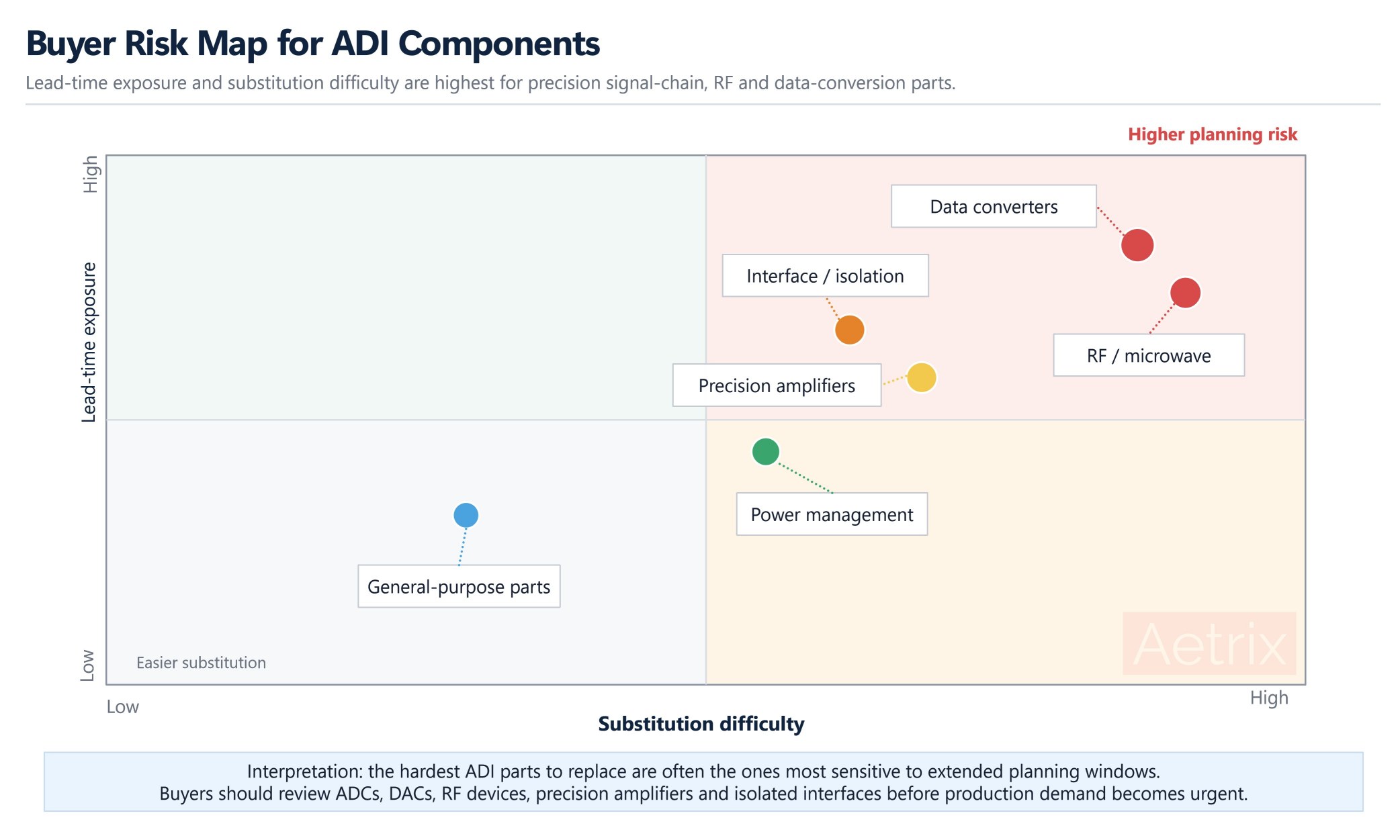
That makes lead time pressure more serious. A buyer cannot always replace an ADI converter, amplifier, isolation device, RF component, or power management IC with a similar-looking part from another supplier. Noise, offset, bandwidth, sampling rate, timing, package, safety requirements, reference design compatibility, and system-level calibration can all affect substitution.
For production teams, a six-month ordering window changes procurement behavior. It requires earlier forecast locking, better backlog coverage, and closer coordination with channel partners. For engineering teams, it means alternate-part evaluation should begin before supply becomes critical, not after a production line is already exposed.
| Product Area | Why Lead Time Risk Matters |
|---|---|
| Data converters | ADC and DAC replacements may require system-level validation, firmware checks, and performance testing |
| Precision amplifiers | Noise, offset, bandwidth, drift, and stability can affect the entire signal chain |
| Power management | Board-level testing, thermal limits, efficiency, and sequencing requirements can slow replacement |
| RF and microwave | Frequency response, layout sensitivity, and matching requirements make substitution difficult |
| Interface and isolation | Safety, compliance, timing, and protocol requirements may limit available alternatives |
| Industrial signal chain | Long product lifecycles and qualification requirements make sudden design changes risky |
From Price Adjustment to Lead Time Pressure
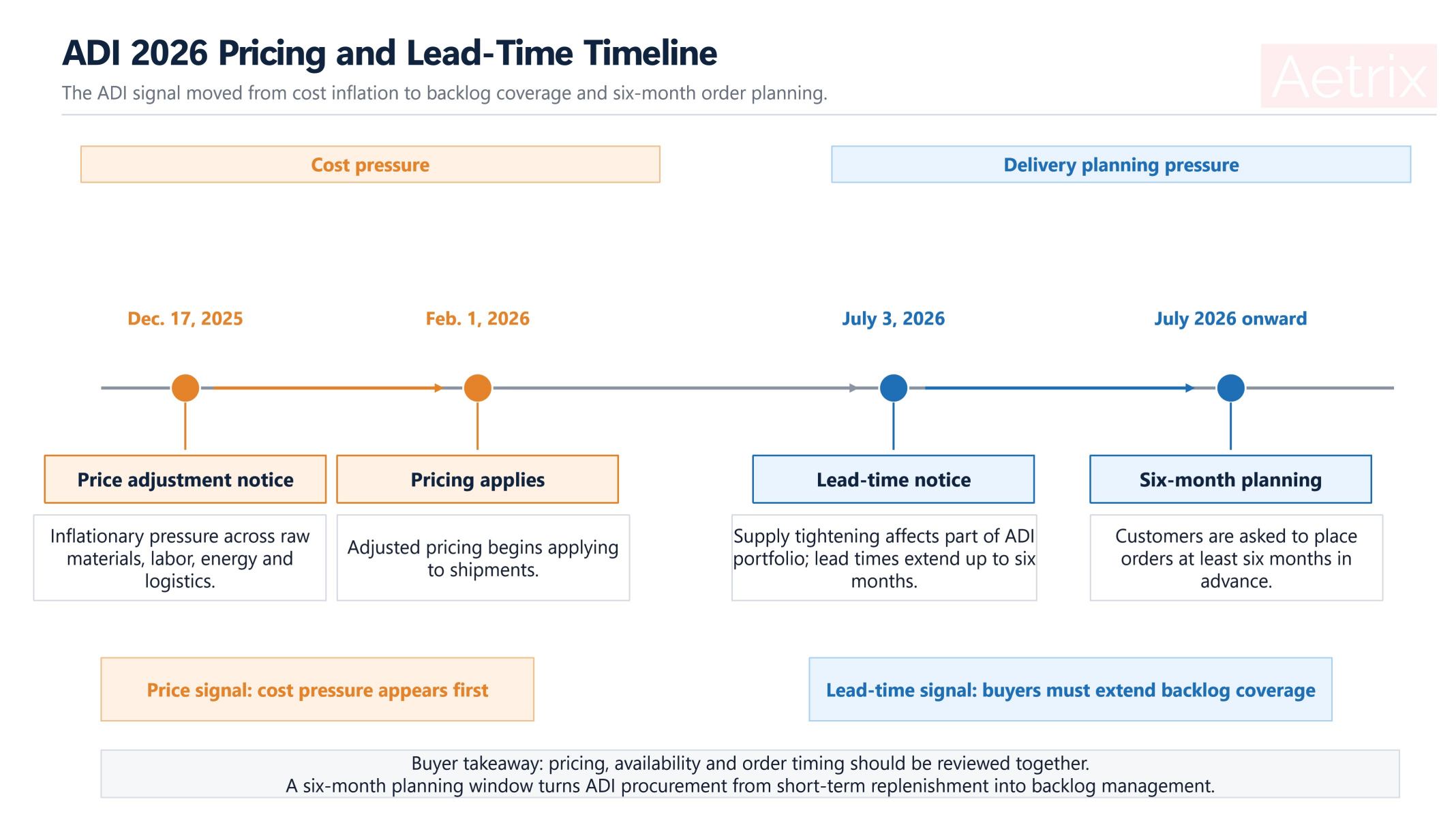
ADI's July lead-time notice should also be viewed alongside the company's earlier pricing communication. In a distribution partner letter dated December 17, 2025, ADI informed partners of an upcoming pricing adjustment driven by persistent inflationary pressure across raw materials, labor, energy, and logistics. That price adjustment was set to start applying to shipments on February 1, 2026.
The sequence matters. The earlier communication pointed to cost pressure. The July communication points to supply tightening and order coverage. Together, they show that the 2026 ADI cycle is not only about cost recovery. It is also about longer delivery planning and more disciplined backlog management.
| Date | ADI Signal | Main Message | Buyer Meaning |
|---|---|---|---|
| Dec. 17, 2025 | Price adjustment notice | Inflationary pressure across raw materials, labor, energy and logistics | Cost planning needed before 2026 shipments |
| Feb. 1, 2026 | Price adjustment begins applying | Adjusted pricing starts applying to shipments | Existing quotes and customer pricing require review |
| July 3, 2026 | Lead time notice | Demand increase and supply tightening, with lead times extending up to six months | Orders should be placed at least six months ahead |
Why Six-Month Order Planning Changes Procurement Behavior
A six-month planning window is not a normal spot-buy signal. It changes how OEMs, EMS providers, and industrial customers manage demand. Instead of waiting for production releases or short-term material requirements planning, buyers need to extend backlog coverage and make earlier decisions on forecast, allocation risk, and alternate parts.
ADI's message also places more importance on channel coordination. The company specifically asked customers to place orders through their preferred channel partner and extend backlog coverage accordingly. That means procurement teams should not treat authorized channel communication as a passive quotation process. It becomes part of supply assurance.
The timing also matters for production planning. Customers that extend backlog coverage early are likely to be better positioned to secure supply. Customers that delay orders may face longer fulfillment timelines if demand continues to outpace near-term supply.
| Buyer Action | Why It Matters |
|---|---|
| Review ADI BOM exposure | Identify production lines exposed to ADI lead time risk |
| Confirm impacted part numbers | Not all ADI products may be affected equally |
| Extend backlog coverage | ADI specifically asked customers to place orders at least six months ahead |
| Check quote validity | Price and lead time may change together in a tighter supply environment |
| Review alternates early | ADI alternatives may require engineering validation or board-level changes |
| Coordinate with channel partner | Order visibility and backlog coverage are more important when lead times extend |
Does This Mean ADI Products Are in Shortage?
A longer lead time is not the same as a blanket shortage. ADI's communication does not say that every product is unavailable. It says that demand has increased, supply is tightening, and a portion of the portfolio is affected by lead times extending up to six months.
For buyers, that distinction matters. A part can still be available, but only with longer planning. A part can still be orderable, but not suitable for last-minute replenishment. The real issue is whether demand coverage, backlog placement, and production schedules are aligned with ADI's updated lead-time expectations.
Lead time pressure becomes more serious when it appears together with price changes, shorter quote validity, reduced available stock, allocation notes, or NCNR requirements. Our related analysis of semiconductor lead times in 2026 explains why buyers should read lead time changes as a supply-chain signal, not just as a delivery estimate.
How This Fits the 2026 Semiconductor Supply Cycle
ADI's July notice fits a broader 2026 semiconductor supply cycle in which pricing pressure and lead time pressure are increasingly connected. Earlier in the year, several suppliers reviewed pricing because of rising material, logistics, energy, labor, and supplier costs. By mid-year, some parts of the market began showing longer delivery windows.
Analog and mixed-signal devices are especially important in this cycle because they are used across industrial, automotive, communications, medical, instrumentation, and power systems. These components often remain in production for many years, and substitution can require extensive validation.
New wafer capacity does not immediately solve these lead time issues. Analog and signal-chain products depend on mature process capacity, packaging, test resources, product qualification, and long-lifecycle support. Our report on new foundry capacity and semiconductor lead times in 2027 explains why equipment move-in and capacity announcements do not instantly become effective supply for buyers.
ADI's signal also follows a broader pricing pattern already visible across the industry. The Renesas price increase in July 2026 showed how chip suppliers are trying to manage cost pressure, long-term supply commitments, and customer support at the same time.
What Buyers Should Do Now
Buyers should move ADI parts from ordinary replenishment lists into a higher-priority supply review. That does not mean every ADI part needs emergency buying. It means production-critical ADI components should be mapped by demand, current inventory, open backlog, approved alternatives, and substitution difficulty.
The highest priority should go to single-source ADI parts used in industrial control, data acquisition, RF systems, precision measurement, automotive systems, power designs, and long-lifecycle platforms. These parts are often difficult to replace quickly, and late ordering can create schedule risk even when the part is technically still available.
For new designs, engineering teams should review alternate footprints, second-source strategies, and approved vendor lists earlier in the design cycle. For existing production, procurement teams should confirm whether backlog coverage extends far enough to match ADI's six-month order-planning guidance.
| Priority Area | Recommended Action |
|---|---|
| Single-source ADI parts | Identify whether approved alternatives exist and whether engineering validation is required |
| Six-month demand coverage | Check whether open backlog matches production demand at least six months forward |
| Critical signal-chain devices | Review ADCs, DACs, amplifiers, RF devices, isolation, and power ICs used in active BOMs |
| Channel partner communication | Confirm affected part numbers, lead times, pricing, MOQ, quote validity, and backlog status |
| Future designs | Consider alternate footprints or qualified second-source options before production release |
Key Takeaways
- Analog Devices has warned customers that semiconductor supply is tightening.
- The July 2026 notice says lead times are extending up to six months across an impacted portion of ADI's portfolio.
- Customers are being asked to place orders with preferred channel partners at least six months in advance.
- ADI's earlier 2026 price adjustment shows that cost pressure appeared before the latest lead-time signal.
- The July notice indicates that buyers now need to manage both price exposure and delivery planning.
- ADI components used in precision signal chains, data conversion, RF, power, isolation, and industrial systems can be difficult to replace quickly.
- Buyers should review ADI BOM exposure, backlog coverage, quote validity, lead times, and approved alternatives now.
ADI's July 2026 notice shows that the 2026 semiconductor supply cycle is moving beyond pricing pressure into delivery planning, backlog coverage, and longer procurement windows for analog and signal-chain components.
For buyers, the most important response is not panic ordering. It is structured planning: identify affected ADI part numbers, confirm whether six-month backlog coverage is in place, and review alternative options before the supply risk reaches the production line.