My Inquiry
 My Account


A foundry raises wafer prices. A semiconductor manufacturer reports stronger bookings. Factory utilization moves higher. Yet distributors may still have stock, existing contracts continue at old prices, and many component buyers see little immediate change.
Then the market looks very different a few months later. Lead times extend, quote validity becomes shorter, authorized channel inventory falls, and buyers start competing for the same parts.
This delay is one of the most important features of the semiconductor supply chain. Changes in demand, capacity and cost rarely reach every layer at the same time. They move through wafer fabrication, assembly and test, semiconductor manufacturers, distributors and customer inventories before the full impact becomes visible in component availability and pricing.
For procurement teams, this creates both a risk and an opportunity. By the time spot prices rise sharply, much of the adjustment may already have happened upstream. Buyers that understand the transmission process can often identify tightening conditions earlier.
Why Semiconductor Supply Signals Take Months to Reach Buyers
Semiconductors have an unusually long and layered supply chain.
A change in end demand can pass through several stages before it reaches the buyer of a finished MCU, power MOSFET, ADC or memory device:
| Supply-Chain Stage | What Happens There | Why It Adds Delay |
|---|---|---|
| Materials and equipment | Wafers, chemicals, gases, metals and manufacturing tools enter production | Capacity and material supply cannot always be increased immediately |
| Wafer fabrication | Devices move through repeated deposition, lithography, etch, implant and inspection steps | The physical manufacturing cycle takes weeks or months |
| Assembly and test | Finished wafers are cut, packaged and electrically tested | Backend capacity can become a separate bottleneck |
| Semiconductor manufacturer | The supplier allocates inventory, accepts orders and adjusts commercial terms | Existing backlog and customer agreements remain in place |
| Distribution | Authorized distributors supply customers from local and regional inventory | Channel stock can temporarily hide upstream shortages |
| OEM / EMS | Factories consume existing component inventory | Safety stock delays the point when production feels the shortage |
The result is simple: what a component buyer sees today may reflect production and purchasing decisions made several months earlier.
Where the Transmission Delay Comes From
1. Manufacturing Lead Time
The first delay is physical.
A semiconductor manufacturer cannot react to stronger demand by producing finished chips the following week. New wafer starts have to enter the fab, pass through hundreds of process steps, complete wafer testing, move into assembly and packaging, and then pass final test before shipment.
The Semiconductor Industry Association has noted that manufacturing a finished chip can take as long as 26 weeks. Wafer fabrication alone averages around 12 weeks, while some advanced processes can take 14 to 20 weeks. (Semiconductor Industry Association, Why Semiconductor Production Takes Time)
That means even a supplier with available equipment needs time before additional wafer starts become additional packaged units.
The same delay works in the opposite direction. If customer orders suddenly fall, wafers that entered production several weeks earlier may still continue through the fab and arrive as finished inventory after demand has already weakened.
2. Contract and Pricing Lag
Production cost can change before the customer's purchase price changes.
Semiconductor transactions are often covered by existing purchase orders, scheduled releases, annual agreements, long-term agreements or negotiated distributor pricing. A foundry price increase therefore does not automatically reprice every finished IC already sitting in backlog.
Different customers may experience the same upstream cost increase at different times.
One customer may receive new pricing immediately on new orders. Another may have price protection. A distributor may still hold inventory acquired at the previous cost. An OEM may have several months of scheduled deliveries already confirmed.
This is why an upstream price increase can be real while the downstream market still looks relatively stable.
3. Distributor and OEM Inventory
Inventory is the main buffer between an upstream supply problem and a downstream production problem.
Suppose the normal supply of a particular MCU begins to slow. If an authorized distributor still has ten weeks of inventory and the OEM has another six weeks in its own warehouse, production does not immediately stop.
During that period, the shortage exists upstream but remains partly hidden downstream.
The market changes when those buffers are consumed. Distributor stock falls, customers begin placing larger forward orders, and the available inventory has to support more weeks of future demand.
This is why inventory data can sometimes give buyers a better early signal than spot pricing. Spot prices usually react strongly after readily available stock has already become scarce.
4. Buyer Behavior and Order Adjustment
The final delay comes from how customers respond.
Buyers rarely react to the first sign of a longer lead time by immediately doubling inventory. Most companies first check whether the problem is temporary.
If lead times continue rising, the response changes. Forecasts are extended. Purchase orders are placed earlier. Safety stock targets increase. Customers that previously ordered three months ahead may begin covering six months or more.
That behavior can increase the pressure seen by semiconductor suppliers even when final product consumption has not increased by the same amount.
Why a Six-Month Window Often Appears in Semiconductor Markets
In semiconductor markets, a six-month period is often a useful window for observing how upstream supply changes reach downstream buyers, although the actual timing varies by product, inventory position and market conditions.
There is no need for every stage to take exactly the same amount of time. The delay appears because several independent buffers overlap.
| Source of Delay | What It Can Delay |
|---|---|
| Wafer and backend manufacturing | Physical increase or decrease in finished-chip supply |
| Existing backlog and contracts | New pricing and allocation terms |
| Distributor inventory | Visible shortage at the channel level |
| OEM safety stock | Impact on production schedules |
| Customer ordering behavior | Full backlog and spot-market reaction |
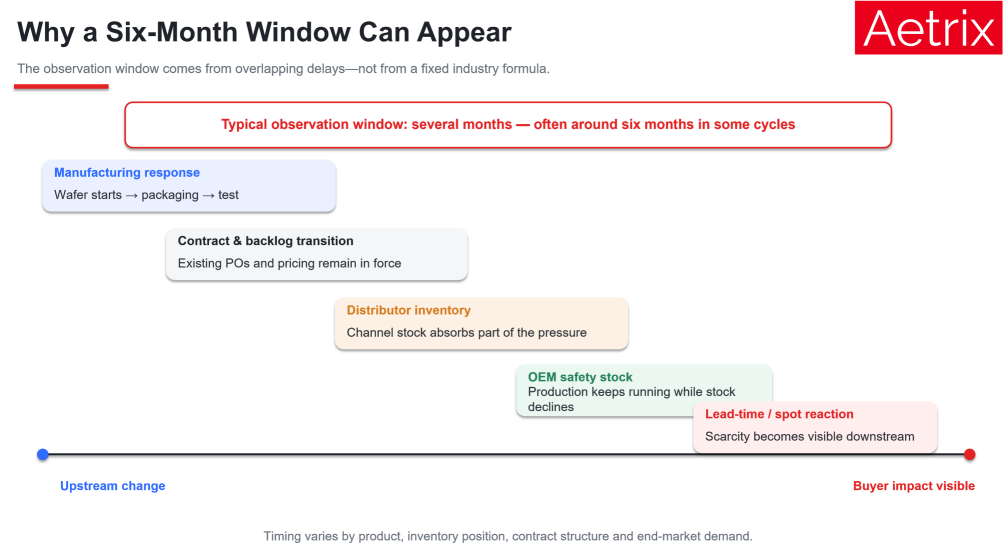
An upstream change that starts in the first quarter may therefore begin affecting manufacturer pricing or lead times in the second quarter and become much more visible to distributors and OEM buyers in the third quarter.
Some markets move faster. Others take longer. A commodity memory product with transparent pricing and short contract cycles behaves differently from an automotive MCU tied to a qualified platform and a multi-year production program.
The useful insight is the lag itself. An upstream change and a downstream shortage are usually different points in the same process.
Transmission Lag and the Bullwhip Effect Are Different
Supply-chain transmission lag is closely related to another well-known supply-chain concept: the bullwhip effect. They describe different problems.
Transmission lag describes how long a supply, demand or pricing signal takes to move through the chain.
The bullwhip effect describes how that signal can become distorted or amplified as orders move upstream. Research on the bullwhip effect shows that order variability can become larger than the underlying sales variability seen at the customer level. (Stanford Graduate School of Business, Information Distortion in a Supply Chain)
A simple semiconductor example shows the difference.
An OEM expects actual component consumption to increase by 10%. Because lead times are rising, it increases its order by 20% to create a buffer. A distributor sees several customers doing the same thing and raises its own orders. The semiconductor manufacturer then sees bookings increasing much faster than actual end demand.
If supply is tight, customers may also place orders with multiple suppliers or channels to improve the chance of receiving material.
The original demand signal has now been amplified.
Transmission lag delays the signal. The bullwhip effect can amplify it.
The two often appear together during semiconductor shortages. Long manufacturing cycles make customers more nervous about future availability, and that uncertainty encourages earlier and larger ordering.
The 2020–2021 Chip Shortage Shows How the Lag Works
The COVID-era semiconductor shortage provides a clear example of supply-chain transmission in practice.
Early 2020: Orders and Capacity Shift
When the pandemic began, automotive production stopped in many regions and some automakers reduced or cancelled semiconductor orders because they expected vehicle demand to remain weak.
At the same time, semiconductor demand increased in other markets as remote work, cloud infrastructure and home electronics changed purchasing patterns.
The Semiconductor Industry Association later identified early automotive order cancellations as an important contributor to the automotive chip shortage. When automotive production recovered in the second half of 2020, automakers returned to a semiconductor supply base where capacity had already been committed to other markets. (Semiconductor Industry Association, Response on Semiconductor Supply-Chain Risks)
This is a useful example of why a shortage does not always begin with a physical reduction in total semiconductor output. Capacity allocation can change before end customers realize that their own future supply position has weakened.
Mid-2020: Capacity Tightens
As electronics demand strengthened, available semiconductor manufacturing capacity became increasingly valuable.
Automotive demand then recovered faster than many forecasts expected. The problem was that wafer capacity could not be moved back instantly.
A wafer start assigned to another product cannot be turned into an automotive MCU the following week. Production recipes, mask sets, wafer starts, packaging, testing and customer qualification all impose limits on how quickly output can change.
The supply problem was therefore already forming before many vehicle assembly lines experienced the full effect.
Late 2020 to 2021: Inventory Buffers Disappear
The next stage appeared when inventories were consumed.
A U.S. Department of Commerce survey later found that median semiconductor inventory held by buyers had fallen from about 40 days in 2019 to less than five days in 2021. (U.S. Department of Commerce, Semiconductor Supply-Chain Survey Results)
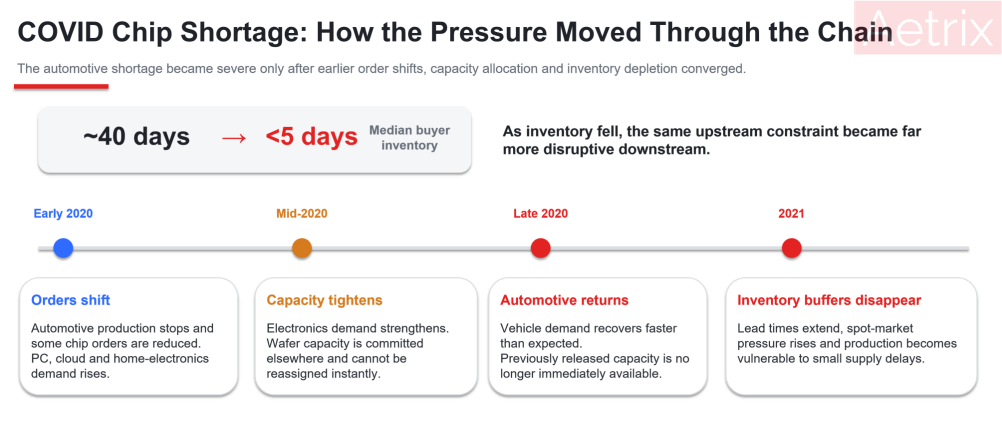
At five days of inventory, a delay of several weeks is no longer an inventory-management problem. It can stop a production line.
That change explains an important feature of the 2021 shortage. The manufacturing constraint had been developing for months, but the operational impact became much more severe after downstream inventory stopped absorbing the disruption.
Once that happened, buyers competed for available supply, lead times extended sharply, and the spot market became a much more important source of emergency material.
The Same Transmission Mechanism Works in Reverse
The semiconductor supply chain does not only transmit shortages. It also transmits demand weakness.
The process usually begins before buyers see broad price declines.
An OEM reduces its production forecast. New orders to distributors fall. Distributor inventory begins to rise because previously ordered material is still arriving. Semiconductor manufacturers then see weaker bookings, but existing backlog continues to ship. Wafers already in production also continue moving through the factory.
For a period, demand is falling while supply is still arriving.
That is how an industry can move from shortage to excess inventory surprisingly quickly.
| Upcycle Transmission | Downcycle Transmission |
|---|---|
| Demand increases | Demand falls |
| Bookings increase | New bookings weaken |
| Factory utilization rises | Backlog continues to ship |
| Distributor inventory falls | Distributor inventory rises |
| Lead times extend | Lead times normalize |
| Spot premiums increase | Channel discounting increases |
This reverse transmission helps explain why semiconductor inventory corrections often last longer than the original demand decline. Every layer needs time to reduce its own stock and reorder level.
Why Different Semiconductor Categories Move at Different Speeds
There is no single transmission period for the entire semiconductor industry. Product structure matters.
Memory
Memory tends to show market changes relatively quickly because pricing is more transparent, suppliers are concentrated, and large volumes are traded through contract and commodity-like markets.
Changes in inventory, contract pricing and fab utilization can therefore become visible relatively early in the cycle.
This does not mean every DRAM or NAND product moves together. Industrial, automotive and legacy-density products can behave differently from high-volume server or consumer products.
Analog, MCU and Power Semiconductors
Analog ICs, microcontrollers and power semiconductors are more fragmented.
One manufacturer may have thousands of active part numbers built across different fabs, process nodes and package families. Distributor inventory also varies widely by MPN.
A supplier can therefore have normal availability on one MCU family while another family becomes difficult to source.
This is why average supplier lead-time figures can be misleading. Buyers need to monitor the actual MPNs used in production.
Automotive Semiconductors
Automotive creates an additional delay because changing components is difficult.
A replacement MCU, sensor, power device or interface IC may require engineering validation, software changes, functional-safety review or customer approval.
Long qualification cycles reduce the buyer's ability to respond after supply has already tightened.
For automotive procurement, early signals therefore have more value because the alternative-sourcing process itself can take months.
AI and Advanced Semiconductor Supply Chains
AI infrastructure creates a different type of supply-chain problem.
The bottleneck does not have to be the processor wafer itself. HBM, advanced packaging, optical connectivity, substrates, high-current power delivery and thermal-management components can all constrain system output.
Demand can also move across process generations. Rapid growth in AI servers can increase demand for advanced compute while simultaneously increasing demand for mature-node power-management and power semiconductor products.
That connection has become increasingly important in 2026.
2026: Where Is the Semiconductor Supply Chain Now?
The current market is showing several signals associated with an early-to-middle tightening cycle, but the pressure is not uniform across every semiconductor category.
Global semiconductor demand is clearly strong. SIA reported worldwide semiconductor sales of $403.3 billion in the second quarter of 2026, up 35.1% from the first quarter. June sales alone reached $134.5 billion. (Semiconductor Industry Association, Q2 2026 Global Semiconductor Sales)
The more useful supply-chain signals, however, are appearing below the industry-wide sales number.
Manufacturer Demand Is Strengthening
Several large analog, MCU and power semiconductor suppliers are reporting stronger demand at the same time.
Analog Devices reported record fiscal Q2 2026 revenue of $3.62 billion and record bookings across Industrial, Automotive and Communications. (Analog Devices, Fiscal Q2 2026 Results)
Texas Instruments reported Q2 revenue growth of 13% sequentially and 23% year over year, with broad growth led by Industrial, Data Center and Automotive. (Texas Instruments, Q2 2026 Results)
Infineon reported record Q3 FY2026 sales of €4.172 billion and raised its full-year revenue outlook. Its Automotive business benefited from stronger microcontroller and smart-power demand, while AI-related power demand remained a major growth driver. (Infineon, Q3 FY2026 Results)
These results do not prove that every analog IC, MCU or power semiconductor is entering shortage. They do show that demand is strengthening across several of the markets that consume large volumes of these devices.
Channel Inventory Is Changing
STMicroelectronics provides a useful example of why channel inventory deserves close attention.
In Q2 2026, ST said demand had increased further, bookings were strong, and its overall book-to-bill ratio was close to 2. The company also reported signs of tight supply in several product categories.
At the same time, inventory in distribution had fallen below ST's standard target. Industrial revenue increased 20% sequentially and 34% year over year, with general-purpose MCUs, analog products and power-conversion products contributing to the growth. (STMicroelectronics, Q2 2026 Earnings Results)
This combination is more important to component buyers than revenue growth alone:
- bookings are increasing;
- some supply categories are tightening;
- distribution inventory is falling;
- industrial MCU and analog demand is recovering.
Those are the conditions under which an upstream recovery can begin moving toward downstream lead-time pressure.
Mature-Node Capacity Is Tightening Selectively
The foundry market also shows why buyers should avoid treating the semiconductor cycle as one uniform shortage.
TrendForce expects average 8-inch utilization among the world's top foundries to approach 90% in 2026, up from roughly 80% in 2025. AI server and general server growth is increasing demand for power-management ICs and power devices that still depend heavily on mature manufacturing platforms. At the same time, some major foundries have been reducing or reallocating older 8-inch capacity. (TrendForce, 2026 Mature-Node Capacity Outlook)
This creates selective pressure rather than a universal shortage.
Power-management ICs, power discretes and certain analog products can tighten while other mature-node categories remain adequately supplied. Consumer-oriented products with excess capacity may continue to face pricing pressure even while industrial or AI-related products move in the opposite direction.
The semiconductor market can therefore tighten and remain oversupplied at the same time, depending on the product category.
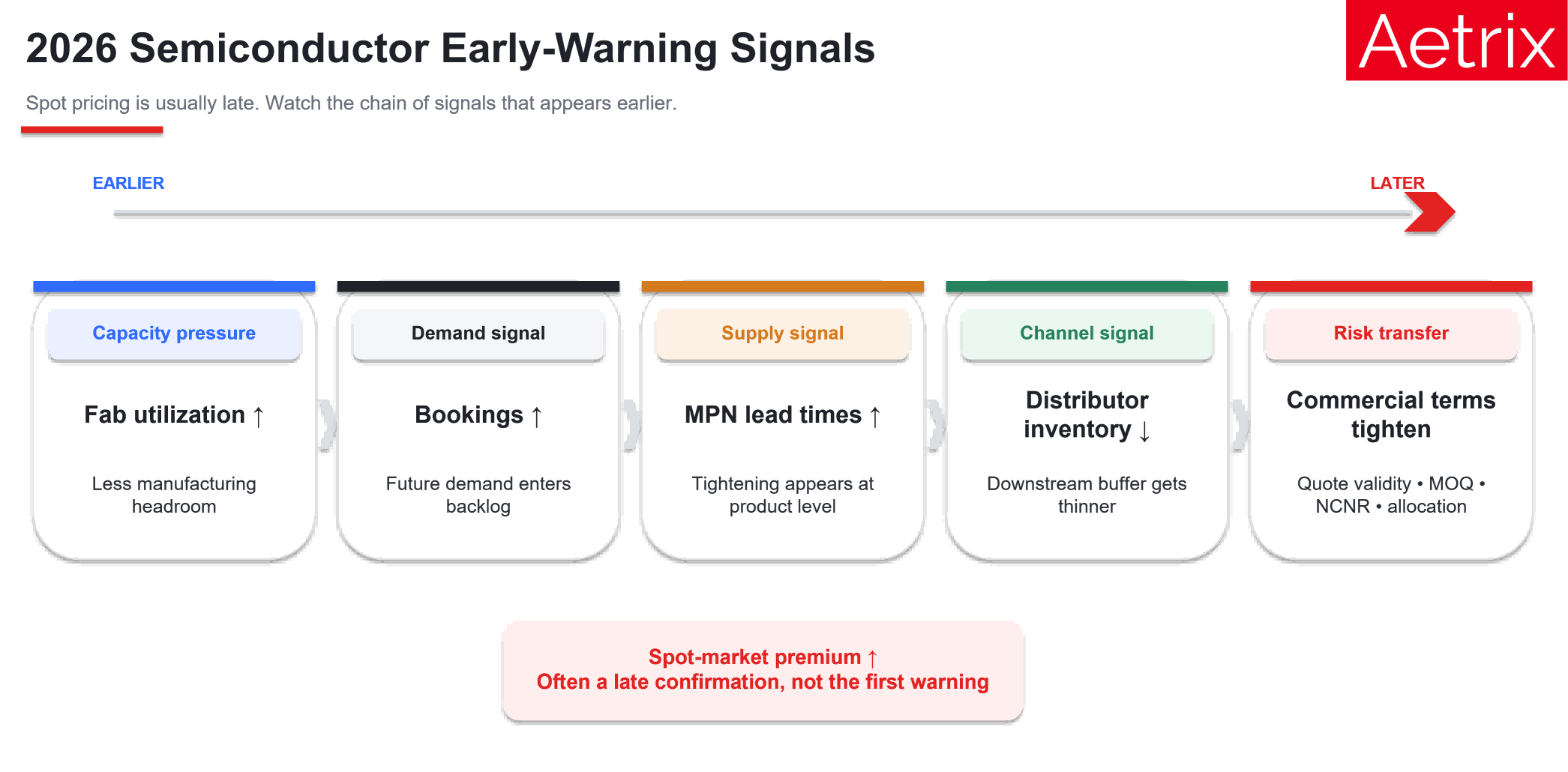
Five Early Signals That Matter More Than Spot Prices
Spot pricing is useful, but it is usually a late indicator. Buyers trying to identify an emerging supply problem should look further upstream.
| Signal | What It Tells Buyers | Why It Can Appear Early |
|---|---|---|
| Fab utilization | How much manufacturing headroom remains | Capacity becomes tight before distributor shelves are empty |
| Bookings and book-to-bill | Whether future demand is entering manufacturer backlog | Orders rise before those units need to ship |
| MPN-level lead time | Where product-specific supply is tightening | Individual families usually tighten before an entire supplier does |
| Authorized distributor inventory | How much downstream buffer remains | Falling inventory can precede spot-market scarcity |
| Commercial terms | How aggressively suppliers are managing availability and price risk | Quote validity, MOQ or NCNR terms can change before public shortage reports |
1. Fab Utilization
Higher fab utilization does not automatically mean shortage, but it reduces the supplier's ability to absorb another demand increase without adding capacity or outsourcing more production.
The important question is not whether a fab is busy. It is whether utilization is rising while bookings and lead times are also moving higher.
2. Manufacturer Bookings and Backlog
Revenue tells buyers what has already shipped. Bookings give a better view of what customers are asking manufacturers to produce next.
A sustained increase in book-to-bill above 1 means new orders are entering faster than current revenue is being shipped. That can build backlog if supply does not increase at the same pace.
Bookings should still be interpreted carefully because customers may increase orders defensively when they fear future shortages.
3. MPN-Level Lead Times
For day-to-day procurement, this is often the most useful signal.
A manufacturer's average lead time can remain reasonable while a small group of high-demand parts moves from 12 weeks to 20 weeks and then to 30 weeks.
Those individual movements often reveal the real bottleneck earlier than a broad supplier-level statistic.
Buyers should track the exact MPNs that have limited alternatives, long qualification cycles or high production importance.
4. Authorized Channel Inventory
A part can have a long factory lead time and still be easy to buy if distributors hold enough stock.
The more serious signal appears when both conditions occur together:
- factory lead time is extending; and
- authorized channel inventory is falling.
At that point the market is losing both its production flexibility and its inventory buffer.
5. Quote Validity, MOQ, NCNR and Allocation
Commercial terms can change before the market receives a formal shortage announcement.
A quote that was previously valid for 90 days may move to 30 days or seven days. A normal purchase order may become NCNR. Minimum order quantities may increase. Price protection may become more limited.
These changes tell buyers that the supplier or distributor is less willing to carry future price or inventory risk.
For procurement teams, that can be an important warning even when physical stock is still available.
What Buyers Should Do Before the Pressure Reaches the Spot Market
Separate Real Demand From Defensive Ordering
The first response to a tightening market should not be to increase every order.
Buyers need to separate actual consumption from protection against future shortages.
Compare customer forecast, historical consumption, current inventory, confirmed backlog and distributor availability. If all customers respond to a small supply problem by placing much larger orders, the bullwhip effect can make the situation worse and leave the market with excess inventory later.
Prioritize High-Risk MPNs
Not every component deserves the same inventory coverage.
Higher priority should go to parts that combine several risks:
- few technically acceptable alternatives;
- long qualification or approval cycles;
- long factory lead times;
- low authorized channel inventory;
- high impact on production if unavailable.
Precision analog, automotive ICs, RF components, specialized power devices and application-specific MCUs can require more attention than commodity parts with multiple drop-in alternatives.
Validate Alternatives Before Supply Tightens
A cross-reference on a spreadsheet is not the same as a production-ready alternate.
Pinout, voltage range, timing, thermal behavior, EMC performance, firmware, safety requirements and package details may all need validation.
The best time to complete that work is while the original device is still available.
Once the original MPN becomes a line-down issue, engineering teams have less time to evaluate the replacement and procurement teams have less negotiating power.
Watch Price and Delivery Together
A low unit price is not enough if the factory cannot confirm delivery before the production requirement.
Procurement should review the commercial and supply terms together:
- current unit price;
- quote validity;
- factory lead time;
- confirmed ship date;
- price protection;
- MOQ;
- NCNR status;
- authorized channel inventory;
- alternative readiness.
This gives a much more useful picture than looking at price alone.
What the Transmission Lag Means for Component Buyers
Semiconductor shortages rarely begin on the day buyers see empty distributor shelves.
The first signals usually appear earlier: higher bookings, rising fab utilization, tighter wafer or backend capacity, falling channel inventory, longer lead times and changes in commercial terms.
The same is true when the cycle turns down. Weak end demand can appear months before excess inventory, falling utilization and lower prices move through the rest of the supply chain.
A six-month period often captures a large part of this adjustment because semiconductor manufacturing, backlog, distribution inventory and customer stock all create their own delays. The exact timing changes from one product to another, so the calendar itself is less useful than the sequence of signals.
In 2026, that sequence deserves close attention. Global semiconductor sales are rising rapidly, several major analog, MCU and power suppliers are reporting stronger bookings or revenue, ST has reported distribution inventory below its normal target, and 8-inch mature-node utilization is moving higher in areas linked to power and AI infrastructure.
For component buyers, the practical advantage is time. By the time spot prices move sharply, the easier decisions may already be gone. Watching upstream signals gives procurement teams a better chance to secure supply, validate alternatives and adjust backlog before the rest of the market reacts.