My Inquiry
 My Account


STMicroelectronics entered the second half of 2026 with a stronger order book, lower distribution inventory and the first visible signs of tighter supply in selected product categories.
The company reported second-quarter net revenue of $3.49 billion, up 26% year over year and 12.7% sequentially. Gross margin reached 34.8%, operating margin improved to 5.4%, and net income returned to $222 million from a loss in the same period a year earlier.
The financial recovery was led by communications equipment, computing infrastructure, automotive programs and general-purpose microcontrollers. ST also reported strong bookings across every end market, improved customer visibility and distribution inventory below its standard target level. (STMicroelectronics, Q2 2026 Financial Results)
Those signals mark a change in the semiconductor cycle. The broad destocking that weighed on industrial, automotive and general embedded products is losing influence. New demand is reaching the supply chain more directly, especially where AI infrastructure and industrial replenishment draw on the same MCU, analog and control-device resources.
Spot-market activity moved in the same direction before the earnings release. Search interest and inquiries for several STM32 families increased from late June, followed by higher prices for selected high-volume and high-performance MCUs. The rally later became less uniform: some prices remained firm, others eased, and distributors reported a mix of end-customer demand, precautionary buying and dealer-to-dealer trading.
The combined evidence supports a selective-tightness outlook. General-purpose MCUs, optical-connectivity controllers and certain industrial products deserve closer monitoring, while ST's power and discrete business still shows weak utilization and significant operating losses.
ST Q2 2026 Financial Snapshot
| Metric | Q2 2026 Result | Supply-Chain Meaning |
|---|---|---|
| Net revenue | $3.49 billion, up 26% year over year | Demand recovery has moved beyond one isolated end market |
| Gross margin | 34.8% | Lower unused-capacity costs and improved product mix are supporting profitability |
| Distribution inventory | Below ST's standard target | Less channel buffer is available when demand or lead times change |
| Company inventory | $3.19 billion | Total inventory remains substantial, but the mix and location determine availability |
| Inventory days | 126 days, down from 140 days in Q1 and 166 days a year earlier | The inventory correction is progressing across the supply chain |
| Order visibility | Strong bookings across all end markets | Customers are rebuilding forward coverage after an extended destocking cycle |
Distribution Inventory Has Fallen Below Normal Levels
Distribution inventory is one of the most important signals in ST's results. The company stated that inventory in distribution had fallen below its standard target.
During the previous downcycle, distributors and OEMs reduced orders while consuming stock accumulated during the global component shortage. That process weakened factory bookings even when end-product consumption remained relatively stable.
The inventory position has now changed. Lower channel stock means that distributors have less ability to absorb a sudden increase in customer demand from inventory already on hand. More of that demand must be passed through to ST's order book or covered through independent spot inventory.
This usually produces an uneven recovery. Distributors rebuild stock first for products with strong point-of-sale demand, limited substitutes or less reliable factory delivery. Slow-moving components can remain readily available even while selected high-volume MPNs begin to tighten.
ST's own inventory remained close to the previous-quarter level, but days sales of inventory fell from 140 to 126 days. The decline from 166 days a year earlier shows that sales growth is absorbing stock faster than the company is rebuilding it. (STMicroelectronics, Q2 2026 Financial Results)
The location and composition of inventory remain critical. Finished STM32 devices held at an authorized distributor provide immediate customer supply. Work-in-process wafers, unfinished devices or inventory concentrated in weaker product categories provide less protection for a specific MCU shortage.
Book-to-Bill Near 2 Requires Careful Interpretation
ST reported an overall book-to-bill ratio close to 2, with every end market above 1. Communications equipment, computers and peripherals were significantly above 2, supported by optical-connectivity and silicon-photonics demand.
A ratio above 1 means new orders exceeded recognized revenue during the period. A level near 2 indicates a substantial increase in forward demand visibility.
The figure includes orders scheduled beyond the immediate quarter. AI infrastructure, optical interconnect and customer-specific programs often use long planning horizons, reserved capacity and multi-quarter delivery schedules. The order ratio therefore describes the strength of the backlog more accurately than near-term unit consumption.
Several outcomes can follow:
- ST receives stronger visibility for factory loading and capital planning.
- Customers secure production slots earlier for strategic programs.
- Lead times may extend where a high-growth product shares capacity with general-purpose devices.
- Some long-dated orders may be adjusted if project schedules or end demand change.
The order data supports a stronger supply environment. It does not establish a near-term doubling of shipments or an identical demand increase across the STM32 portfolio.
General-Purpose MCUs Are the First Clear Tightness Signal
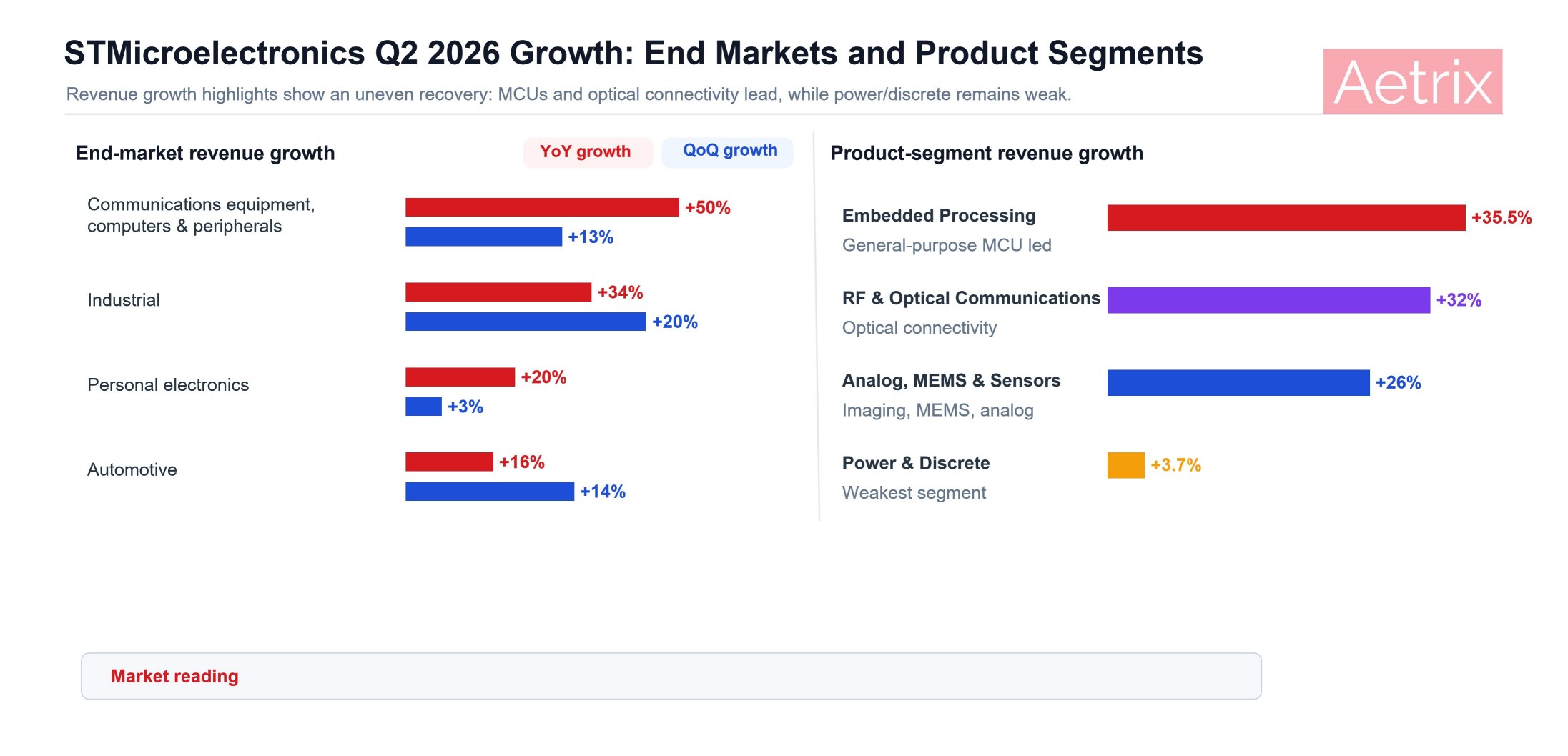
Embedded Processing was ST's fastest-growing reportable segment in the second quarter. Revenue reached $1.147 billion, up 35.5% year over year, with general-purpose microcontrollers providing the main contribution.
The segment's operating margin increased from 13.5% a year earlier to 19.7%, reflecting higher revenue, stronger product mix and improved factory utilization. ST also identified supply pressure in several categories during the quarter. (STMicroelectronics, Q2 2026 Earnings Presentation)
Two demand streams are converging around general-purpose MCUs.
Industrial customers are returning after reducing inventory for several quarters. Factory automation, motor control, energy systems, appliances, building controls and robotics use broad STM32 product families with long production lives.
AI infrastructure is adding a second source of demand. Optical modules, network equipment, power systems and thermal-control subsystems need embedded controllers for monitoring, sequencing, communication and fault management.
These applications do not necessarily use the same MPNs, but they can share wafer technologies, packaging lines, test resources and MCU production capacity. Strong optical-connectivity orders can therefore affect the scheduling flexibility available for general industrial devices.
Current evidence points to selected family and configuration exposure rather than uniform STM32 tightness. Memory size, package, temperature grade, embedded peripherals and customer qualification can create very different supply conditions within the same MCU family.
The Spot-Market Move Began Before the Earnings Release
Spot-market interest began rising from the middle to the end of June, several weeks before ST published its results on July 23.
The turning point appeared around the week of June 22. Frequently traded F1 and F4 devices shifted from declining attention to several consecutive weeks of stronger searches and inquiries. By early July, the activity had spread to H7, STM8, G0, L4, F7 and selected MEMS products.
The timing suggests that channel participants were reacting to market conditions already visible before the financial report:
- Distribution inventory was becoming thinner.
- Industrial inquiries were improving.
- Optical-connectivity demand was increasing.
- Distributors were reassessing replacement cost and future availability.
- Circulated price notices, lead-time tables and channel-control claims influenced expectations.
The earnings report later confirmed stronger MCU demand, low distribution inventory and signs of tighter supply. It gave fundamental support to an existing market movement rather than creating the movement by itself.
Selected STM32 Spot-Market Price Increases
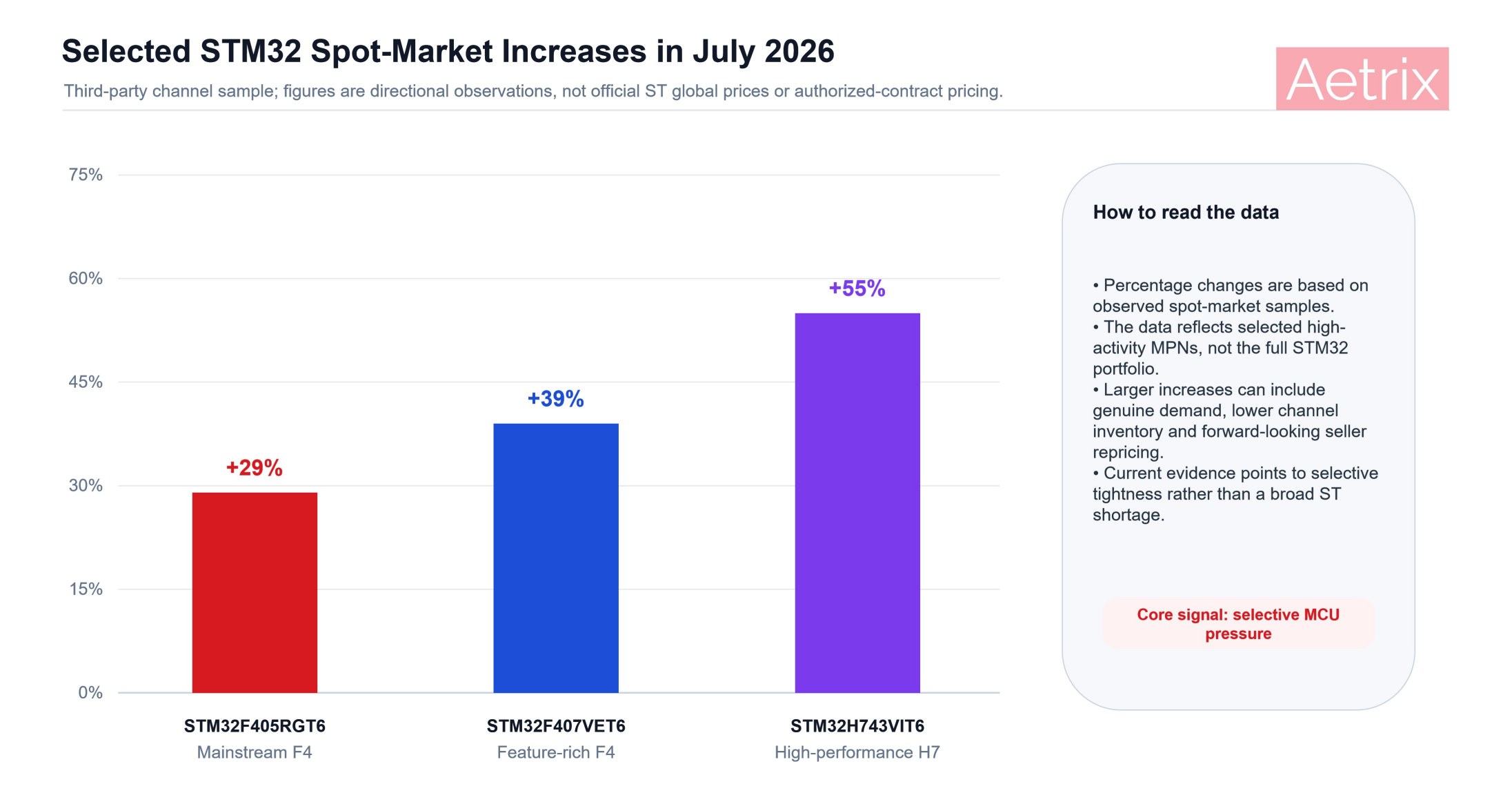
A third-party channel sample recorded significant increases for three actively traded STM32 devices during July 2026.
| Part Number | Product Position | Observed Spot-Market Increase | Market Interpretation |
|---|---|---|---|
STM32F405RGT6
|
Mainstream high-performance STM32F4 MCU | Approximately 29% | High trading liquidity made the device an early indicator of changing channel expectations |
STM32F407VET6
|
Feature-rich STM32F4 MCU used across industrial and embedded systems | Approximately 39% | The increase shows that the rally extended beyond one frequently traded F4 configuration |
STM32H743VIT6
|
High-performance Cortex-M7 MCU for demanding control applications | Approximately 55% | The larger movement reflects stronger sensitivity in high-performance configurations with fewer easy substitutes |
The percentages are calculated from third-party spot-market observations reviewed by Aetrix Electronics. They represent selected channel transactions during a limited period and do not constitute ST's official pricing, authorized-distribution contract pricing or a global market index.
Transaction Demand and Market Expectations Moved at Different Speeds
The spot market showed a wide difference between completed transactions and seller expectations. Some sellers raised offers faster than buyers accepted them, while other distributors reported that inventory remained available.
This gap is common during the early stage of a component rally. Sellers reprice stock based on anticipated replacement cost, circulating lead-time information and the possibility of further increases. Buyers continue to compare authorized supply, alternative MPNs and their actual production requirements.
Price discovery becomes less stable when:
- available quantities differ between sellers;
- date codes and packaging conditions vary;
- some inventory is held for speculation rather than immediate customer demand;
- quotes have very short validity;
- the same stock moves between distributors before reaching an OEM or EMS customer.
The July STM32 movement included both genuine demand and forward-looking channel repricing. The financial results support the underlying demand improvement. The size and speed of some spot movements also reflect market expectations that had not yet been confirmed by sustained end-customer consumption.
Market Attention Broadened Beyond the First Active Families
The initial activity centered on familiar F1 and F4 products. Search and inquiry interest later expanded to H7, STM8, G0, L4, F7 and selected MEMS devices.
This expansion shows that procurement teams and distributors were reviewing a wider ST exposure rather than concentrating on one part number. It also reflects the way component-market expectations spread: once several liquid MPNs rise, buyers begin checking related families before their own supply positions change.
Search growth can come from several sources:
- OEM and EMS customers checking upcoming requirements;
- distributors rebuilding inventory;
- engineers looking for substitutes;
- traders identifying the next products likely to move;
- existing holders testing higher resale levels.
Search interest is an early market signal. Factory lead time, confirmed allocation, authorized-channel inventory and end-customer consumption provide stronger evidence of a sustained shortage.
Dealer-to-Dealer Trading Amplified Spot-Market Activity
Channel feedback indicated that a meaningful share of trading occurred between distributors rather than directly between sellers and end users.
Dealer-to-dealer activity has legitimate supply-chain functions. A distributor may need to cover an urgent customer order, rebalance regional inventory or obtain a package and date code unavailable through its normal source.
It can also amplify price volatility. Inventory may change hands several times, each transaction creating another reference price without corresponding to additional OEM consumption.
This behavior suggests that part of the July rally involved inventory repositioning. Distributors were reacting to expected replenishment costs and possible future shortages before the full strength of end-customer demand was visible.
The distinction affects procurement decisions. Rising dealer activity signals lower confidence in future availability, but it does not provide the same evidence as an OEM production shortage, a formal ST allocation or persistent authorized-channel backorders.
AI Optical Connectivity Is Creating a New MCU Demand Layer
ST's strongest end-market growth came from communications equipment, computers and peripherals. Revenue in that category rose 50% year over year and 13% sequentially.
The growth was supported by engaged customer programs, custom-designed products and microcontrollers used in optical connectivity. RF and Optical Communications segment revenue increased 32% year over year.
ST raised its data-center revenue ambition to more than $1 billion for 2026 and more than $2 billion for 2027, assuming current project momentum continues. The company also expects fourth-quarter revenue above $4 billion, supported partly by AI data-center and low-earth-orbit satellite programs. (STMicroelectronics, Q2 2026 Financial Results)
ST's AI exposure extends beyond processors. Its opportunity includes:
- silicon-photonics and optical-communication ICs;
- MCUs used inside optical modules and network equipment;
- power conversion and power-management devices;
- temperature, motion and system-monitoring sensors;
- embedded security and connectivity functions.
Optical modules require local control for startup, calibration, telemetry, fault reporting and communication with the host system. These functions can use general-purpose embedded controllers similar to devices used in industrial equipment.
AI infrastructure is therefore adding demand to parts of the MCU and analog supply chain that previously depended mainly on industrial, consumer and conventional communications applications.
Industrial Demand Has Moved From Destocking to Replenishment
ST's industrial revenue increased 34% year over year and 20% sequentially. General-purpose MCUs, analog products and application-specific analog devices led the improvement, with power-conversion products providing additional growth.
The industrial recovery covers a wide set of applications:
- factory automation and programmable control;
- industrial motor drives and robotics;
- energy generation, storage and distribution;
- building control and HVAC;
- professional appliances and power tools;
- industrial sensing and condition monitoring.
Many industrial products have long lifecycles and use approved MCU configurations for several years. Customers often delay switching suppliers because redesigning firmware, pinout, peripherals and qualification documentation creates additional engineering cost.
When channel inventories fall, these customers may increase order coverage earlier than consumer customers. The result can be a steady replenishment cycle concentrated in specific MPNs rather than a broad surge across every industrial semiconductor.
Automotive and Personal Electronics Are Recovering Through Specific Programs
Automotive revenue rose 16% year over year and 14% sequentially. Growth came from application-specific ICs and sensors used in conventional vehicles, electric powertrains and advanced driver-assistance systems.
This recovery is tied to product content and customer programs. It does not indicate the same demand profile for every automotive MCU, power device or sensor.
Personal-electronics revenue increased 20% year over year and 3% sequentially. ST attributed the growth to higher content per device within engaged customer programs and better-than-normal seasonality.
The distinction matters for supply planning. Customer-specific programs can create strong volume for selected products while adjacent standard components remain readily available.
Power and Discrete Remains the Weakest Part of the Recovery
ST's Power and Discrete segment provides the clearest evidence that the company is not experiencing one uniform upcycle.
Segment revenue reached $464 million, up only 3.7% year over year. Operating loss widened from $56 million to $99 million, producing a negative operating margin of 21.4%.
The result indicates weak utilization, unfavorable product mix and continuing cost pressure in parts of the power portfolio. ST also expects unused-capacity charges to remain in the third quarter.
Broad power discretes and some SiC products therefore remain in a different stage of the cycle from general-purpose MCUs and optical-connectivity products.
This two-speed recovery affects sourcing strategy:
- MCU buyers need to watch lead times and channel inventory more closely.
- Power-device buyers may still find available capacity and commercial flexibility in standard products.
- Product-specific automotive or data-center power devices can still behave differently from the wider segment.
ST Product Supply-Risk Assessment
| Product Category | Current Market Signal | Supply-Risk Assessment | Primary Buyer Concern |
|---|---|---|---|
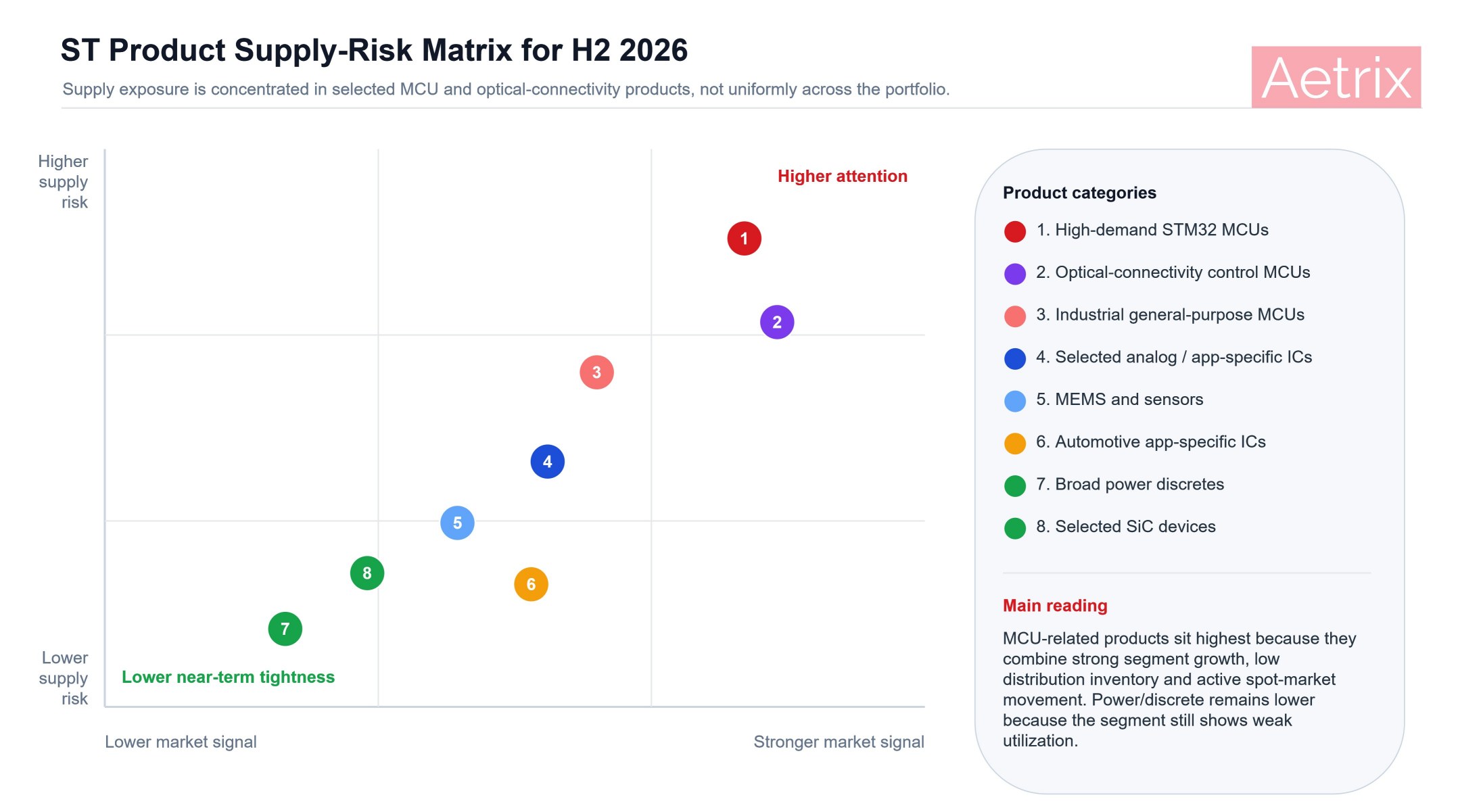
| High-demand general-purpose STM32 MCUs | Strong segment growth, low distribution inventory and active spot-market movement | Higher attention | MPN-level lead time and backlog coverage |
| Optical-connectivity control MCUs | AI data-center and optical-module demand | Higher attention | Capacity allocation to long-term customer programs |
| Industrial general-purpose MCUs | Destocking is ending and replenishment is recovering | Moderate to higher | Long qualification cycles and limited firmware flexibility |
| Selected analog and application-specific products | Industrial and automotive project growth | Moderate | Project-specific demand and limited direct substitutes |
| MEMS and sensors | Improved revenue and wider channel interest | Moderate, series-specific | Customer program concentration and qualification |
| Automotive application-specific ICs | Selected programs remain strong | Moderate | Single-program exposure and long approval cycles |
| Broad power discretes | Low segment growth and continuing operating losses | Lower near-term tightness | Price pressure and supplier capacity rationalization |
| Selected SiC devices | Long-term AI and automotive opportunity with uneven current utilization | Lower to moderate | Program-specific demand and future capacity strategy |
Risk levels represent Aetrix Electronics' assessment based on ST's Q2 2026 results, reported channel inventory conditions and third-party spot-market observations. They are not ST allocation or official lead-time classifications.
Three Market Scenarios Through the End of 2026
Selective Tightness
The base case is continued strength in popular STM32 products, optical-connectivity MCUs and selected industrial devices.
Lead times become less predictable for individual MPNs, while most of ST's wider portfolio remains available. Authorized distributors replenish carefully rather than rebuilding all inventory categories at once.
Spot-market prices remain firm for parts with strong actual consumption and difficult substitutions. Products that moved mainly on market sentiment give back part of their earlier gains.
Broader Channel Replenishment
A stronger scenario would develop if industrial customers and distributors rebuild stock across more MCU and analog families.
Factory lead times would extend beyond the first active products, authorized inventory would decline, and higher spot-market expectations would receive more support from completed end-customer transactions.
Demand could also spill into comparable MCU families from Renesas, NXP, Infineon, Microchip and other suppliers as customers search for capacity and alternatives.
Spot-Market Cooling
The third scenario keeps AI and optical-connectivity demand strong while the wider industrial and consumer recovery loses momentum.
Dealer-to-dealer activity declines, sellers reduce speculative offers, and parts without persistent end-customer demand continue to soften. Supply pressure remains concentrated in a small group of strategic or high-performance products.
Current evidence most closely supports the selective-tightness scenario.
Buyer Priorities for the Second Half of 2026
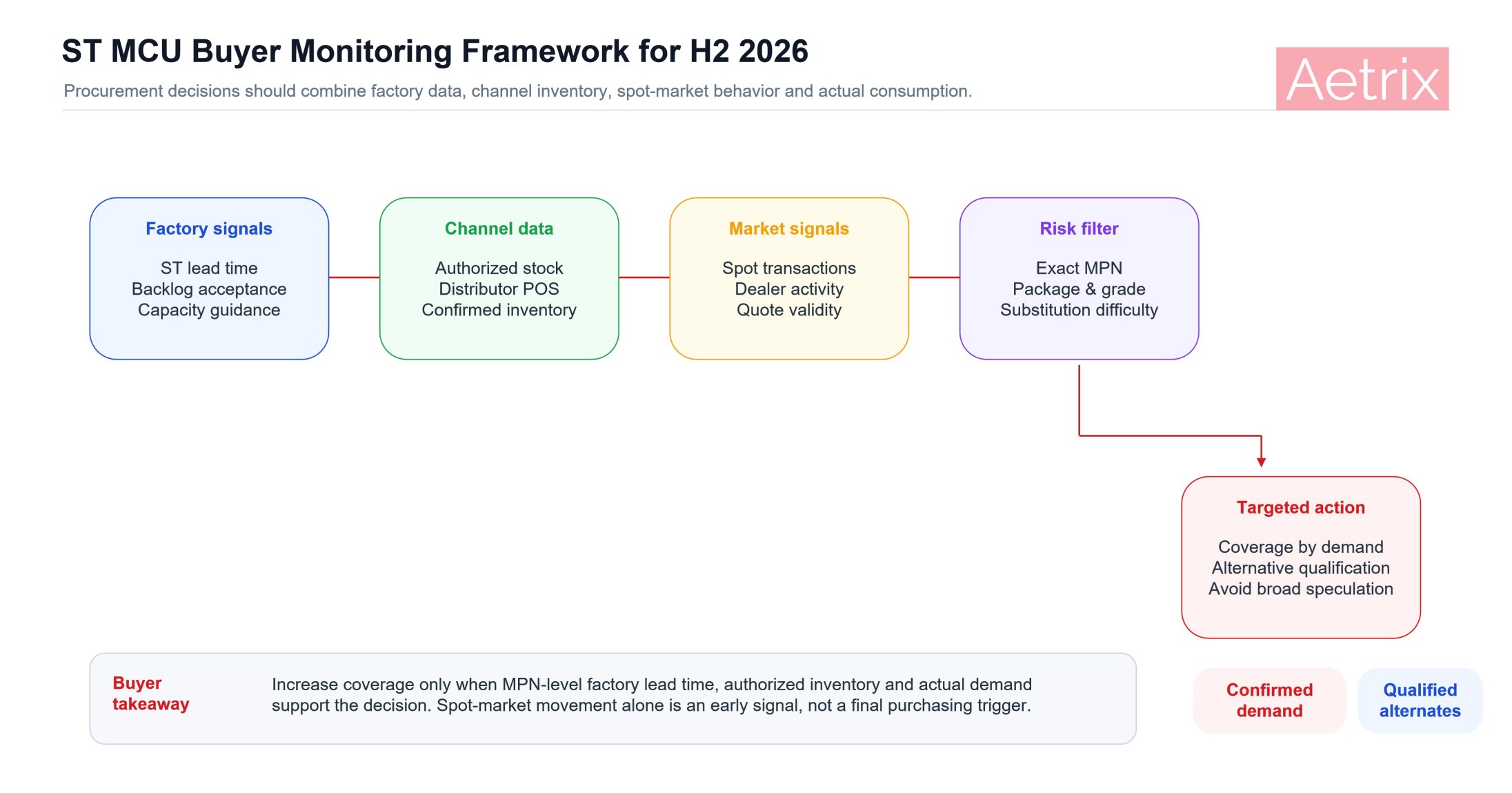
Procurement teams need to separate factory evidence from market noise. The most useful comparison is between ST's confirmed lead time, authorized-distribution inventory, open backlog and actual consumption for each MPN.
Spot-market movement becomes more meaningful when it is accompanied by falling authorized inventory, delayed factory confirmations and stronger OEM demand. Search activity or dealer offers alone provide an earlier but less reliable signal.
Price analysis should distinguish manufacturer pricing, authorized-distribution pricing, contract pricing, completed independent-market transactions and unaccepted seller offers. Combining them into one market price can overstate the cost increase.
For active STM32 requirements, buyers should review whether open orders cover the full manufacturing lead time and whether the distributor has confirmed stock ownership or only an expected factory allocation.
Quote validity, MOQ, NCNR conditions and requested delivery schedules can tighten before formal allocation appears. Changes in these commercial terms often provide an earlier warning than a public shortage announcement.
Inventory increases are most effective when tied to confirmed demand, longer lead times and limited alternatives. Broad speculative buying across unrelated STM32 families would raise working-capital exposure and reinforce the same channel distortion visible in dealer-to-dealer trading.
Alternative qualification remains useful for high-risk MPNs. Engineers need to compare package, pinout, flash and RAM capacity, peripheral set, operating temperature, analog functions, timing behavior, security features and software migration cost. A nearby part number within the same STM32 family may still require PCB or firmware changes.
Outlook
STMicroelectronics' second-quarter results confirm a meaningful change in the semiconductor supply cycle.
Distribution inventory has fallen below the company's standard target, customer bookings have strengthened, and general-purpose MCUs are leading the recovery. AI data centers and optical connectivity are adding demand to embedded-control and analog resources that also serve industrial applications.
The spot market reacted before the earnings release. Selected STM32 products recorded substantial increases, and attention broadened across additional MCU families and sensors. The later reduction in market activity, mixed inventory reports and dealer-to-dealer trading show that the rally contained both fundamental demand and channel-driven repricing.
The recovery remains divided. Embedded Processing and RF Optical Communications are growing rapidly. Power and Discrete continues to operate at a loss with weaker utilization. Automotive and personal-electronics growth depends heavily on selected customer programs.
The most likely second-half outcome is selective supply pressure rather than a broad ST shortage. High-demand general-purpose MCUs, optical-connectivity controllers and qualified industrial products face the greatest exposure. Standard power devices and slower-moving products retain more supply flexibility.
The next confirmation will come from MPN-level factory lead times, authorized-channel stock, backlog acceptance and the durability of end-customer orders. Sustained tightening across those indicators would support a wider replenishment cycle. A continued gap between spot-market activity and OEM consumption would keep the market narrow and volatile.
Key Takeaways
- ST's Q2 2026 revenue increased 26% year over year, supported by communications infrastructure, automotive and general-purpose MCU growth.
- Distribution inventory has fallen below ST's standard target, reducing the channel buffer available when demand increases.
- Embedded Processing revenue rose 35.5%, with general-purpose MCUs providing the main growth contribution.
- AI optical connectivity and industrial replenishment are creating overlapping demand for MCU and analog resources.
- The spot-market rally began before ST's earnings release and later broadened beyond the first active STM32 families.
- STM32F405RGT6, STM32F407VET6 and STM32H743VIT6 recorded approximate increases of 29%, 39% and 55% in the reviewed spot-market sample.
- Dealer-to-dealer trading and circulated market claims amplified price movement beyond confirmed end-customer transactions.
- Power and Discrete remains the weakest ST segment, showing that the recovery is not uniform across the product portfolio.
- The base-case outlook is selective MCU and optical-connectivity tightness rather than a portfolio-wide shortage.
- Buyers should combine MPN-level factory lead times, authorized inventory, backlog coverage and actual consumption before increasing stock.