My Inquiry
 My Account


Analog Devices is preparing another pricing adjustment across its product portfolio, effective September 13, 2026.
The new customer notice gives a broader explanation than ADI's earlier 2026 price action. The company says demand is growing across the business while it is also facing higher manufacturing and inflation-related costs. ADI is securing additional supply, expanding capacity, and continuing investments in fab, assembly and test operations.
That puts the new pricing action in a different part of the supply cycle. Earlier in 2026, ADI was mainly passing through higher input costs. By July, selected products were moving to lead times of up to six months. The September adjustment now arrives while demand, manufacturing utilization and capacity requirements are all moving higher at the same time.
For buyers, the issue has expanded from unit price to a combination of price, backlog coverage and supply assurance.
ADI Price Adjustment Takes Effect September 13
The latest customer communication states that ADI will adjust pricing across its product portfolio effective September 13, 2026.
The notice does not publish a single percentage increase or a list of affected MPNs. Customers will therefore need updated quotations from ADI or their authorized channel partners to understand the actual change for each part number.
ADI gives two main reasons for the adjustment.
- Broad demand growth is requiring the company to secure more semiconductor supply and add capacity.
- Inflation and manufacturing costs remain elevated across the semiconductor supply chain.
The company also links the pricing action directly with continued fab, assembly and test expansion, as well as wider geographic sourcing.
This makes the September change broader than a routine annual price reset. ADI is managing higher production costs while also investing in the additional manufacturing capability needed to support stronger customer demand.
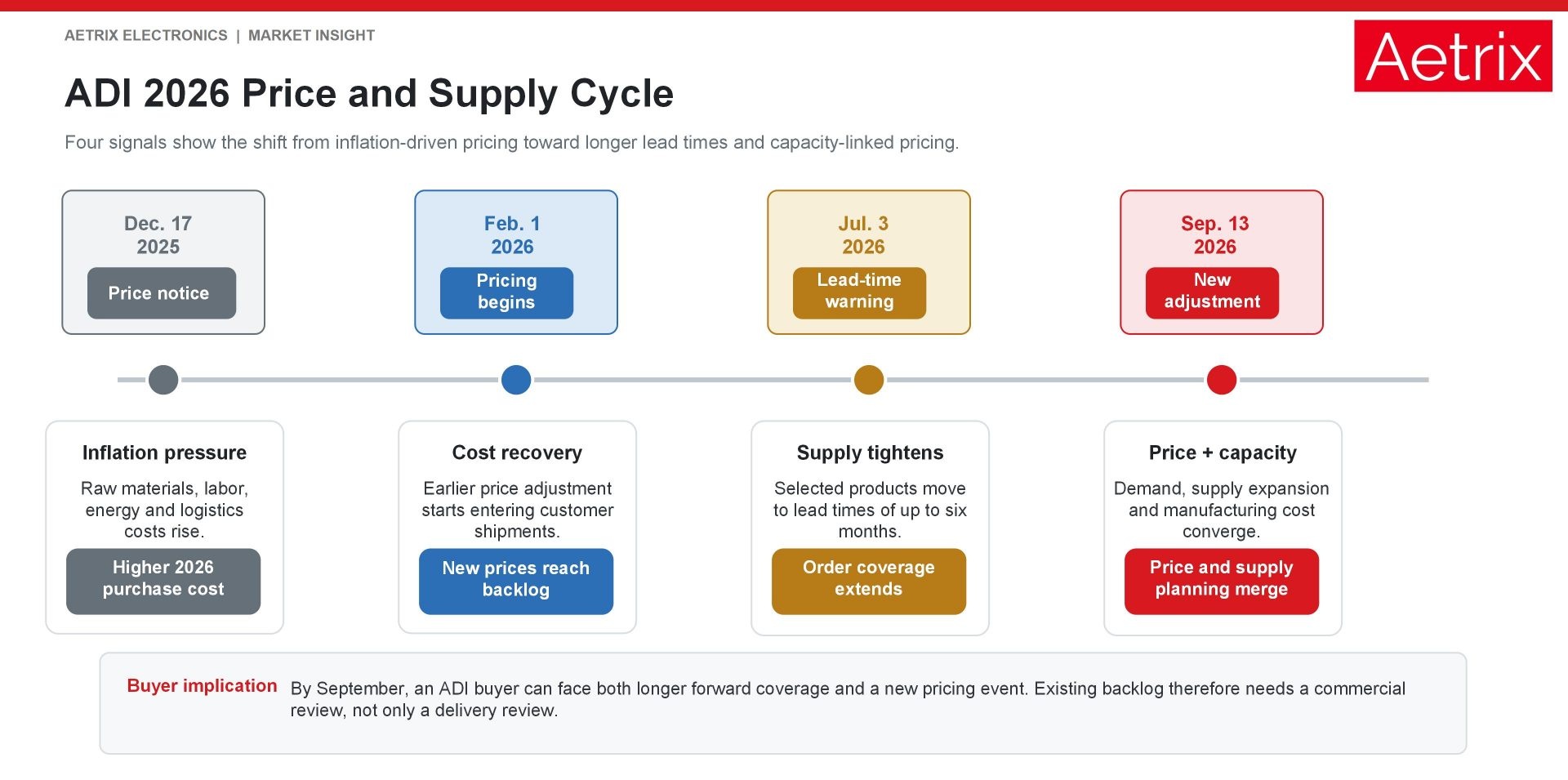
ADI's 2026 Supply Cycle: From Price Increases to Longer Lead Times
The new notice makes more sense when it is viewed together with ADI's earlier customer communications.
| Date | ADI Signal | Main Driver | Buyer Impact |
|---|---|---|---|
| Dec. 17, 2025 | Price adjustment notice | Raw materials, labor, energy and logistics inflation | Higher 2026 purchasing cost |
| Feb. 1, 2026 | Earlier price adjustment begins | Cost recovery | New pricing enters customer shipments |
| July 3, 2026 | Lead-time warning | Broad demand growth and tighter supply on part of the portfolio | Lead times up to six months for impacted products |
| Sept. 13, 2026 | New portfolio pricing adjustment | Strong demand, additional supply and manufacturing expansion | Price and supply planning now need to be managed together |
Our July analysis covered the earlier step in this cycle, when ADI warned that lead times were extending to as much as six months for an impacted portion of its portfolio and asked customers to place orders at least six months ahead. (Aetrix Electronics, Analog Devices Lead Times 2026)
The September pricing action adds another layer. Customers that responded to the July warning by extending forward order coverage now also need to understand the price attached to those future deliveries.
What Changed Between ADI's First and Second 2026 Price Actions?
ADI's earlier price communication was mainly about inflation. Raw materials, labor, energy and logistics had become more expensive, and the company adjusted pricing to recover those input costs.
ADI management confirmed this during its May earnings call. CEO Vincent Roche said the company's earlier 2026 price increases were intended to offset inflation in the business. CFO Richard Puccio added that those earlier pricing actions were expected to contribute a couple of percentage points to ADI's full-year 2026 growth. (Analog Devices, Q2 2026 Earnings Call)
The new customer notice adds another factor: ADI now needs more manufacturing supply.
The company says demand growth is broad, and the pricing adjustment will support continued capacity expansion in fabs, assembly and test. Part of the pricing discussion has therefore shifted from inflation recovery toward the cost of supporting a larger and more resilient production network.
ADI is facing higher manufacturing costs at the same time that it is preparing to produce more semiconductor content for customers.
Record Bookings Explain the Demand Side
ADI's latest reported financial results support the demand claims in the customer notice.
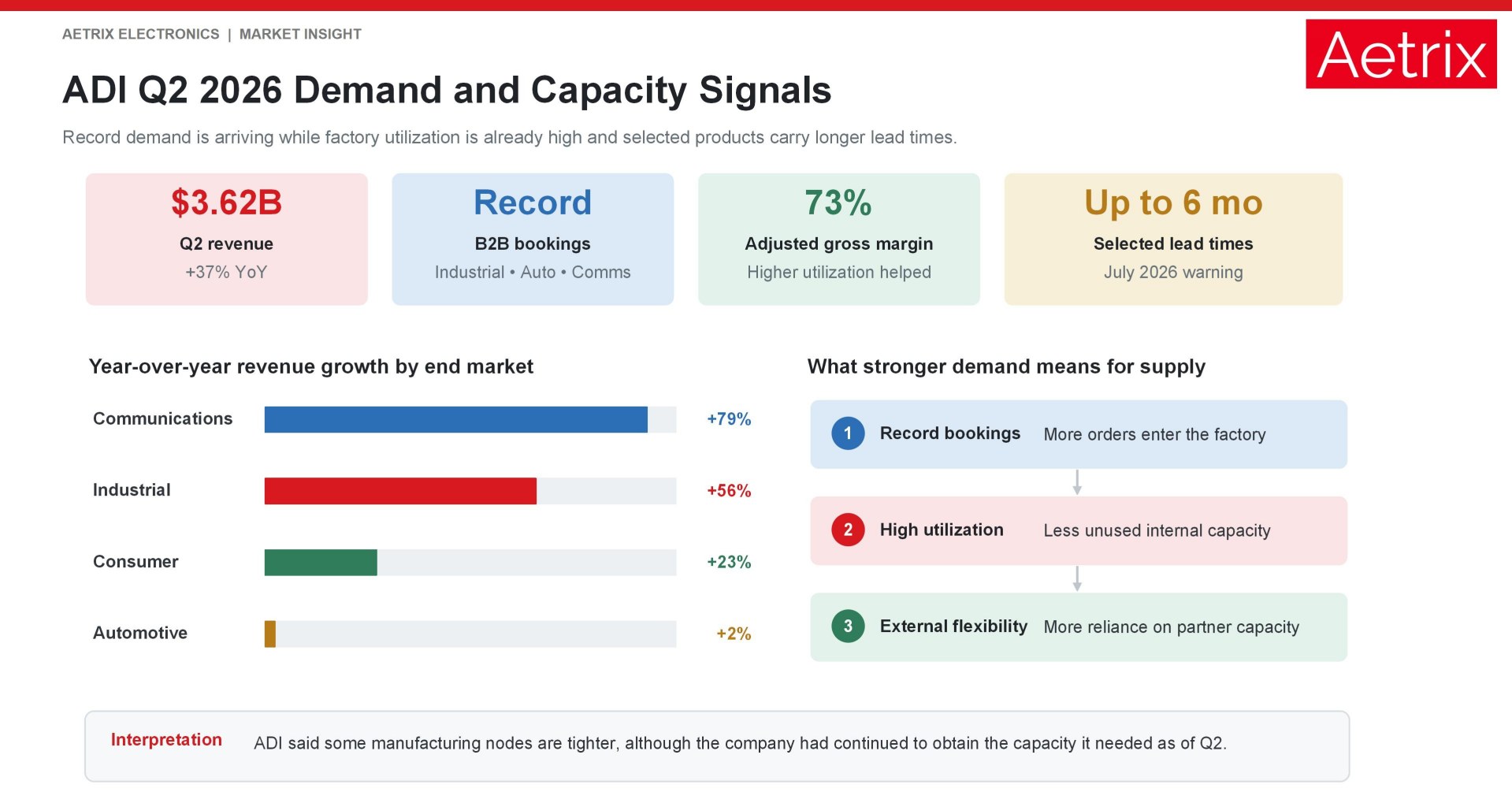
Fiscal Q2 2026 revenue reached a record $3.62 billion, up 37% year over year and 15% sequentially. Industrial revenue grew 56% year over year, Communications grew 79%, Automotive grew 2%, and Consumer grew 23%. ADI also reported record bookings across its B2B markets of Industrial, Automotive and Communications. (Analog Devices, Fiscal Q2 2026 Results)
| End Market | Q2 2026 Share of Revenue | YoY Growth | Supply-Chain Signal |
|---|---|---|---|
| Industrial | 50% | +56% | Broad-market recovery is increasing orders across long-lifecycle analog products |
| Automotive | 24% | +2% | Bookings are strengthening after the earlier inventory digestion cycle |
| Communications | 15% | +79% | Data-center optical and power demand is growing rapidly |
| Consumer | 11% | +23% | Premium and prosumer exposure remains relatively strong |
ADI guided fiscal Q3 revenue to $3.9 billion, plus or minus $100 million. Management also said the outlook assumes above-seasonal sequential growth in Industrial, Automotive and Communications. (Analog Devices, Q2 2026 Results and Q3 Outlook)
ADI Factory Utilization Is Already High
Strong bookings become a supply issue when factories have less unused capacity.
ADI's Q2 adjusted gross margin reached 73%, helped by higher factory utilization, favorable product mix and pricing. Management said there was limited additional gross-margin upside available from utilization because of where its factories were already running. (Analog Devices, Q2 2026 Earnings Call)
The company has much more capacity than it had before the pandemic. CEO Vincent Roche said ADI has more than doubled internal capacity and built more flexibility into external supply sources. Management also said that some manufacturing nodes are tighter, although ADI has so far been able to obtain the capacity it needs. (Analog Devices, Q2 2026 Earnings Call)
This does not indicate that ADI's manufacturing network has stopped delivering. It shows that stronger demand is moving through a network with higher internal utilization and increasing reliance on external manufacturing flexibility.
An analyst asked whether additional revenue growth would require more outsourcing as internal utilization moved higher. ADI's CFO agreed that this was a reasonable way to think about the near-term manufacturing mix. (Analog Devices, Q2 2026 Earnings Call)
Why Additional Supply Can Carry Higher Manufacturing Cost
Higher semiconductor volume does not automatically make every incremental unit cheaper. When unused factory capacity is available, a supplier can increase production by loading existing equipment more heavily. As utilization rises, further growth can require additional wafer starts, external foundry capacity, assembly and test resources, equipment, labor and logistics.
ADI's new notice specifically refers to continued expansion in fab, assembly and test, together with broader geographic sourcing. Those investments can improve supply resilience and increase available production, but they also add qualification, operating and capital costs to the manufacturing network.
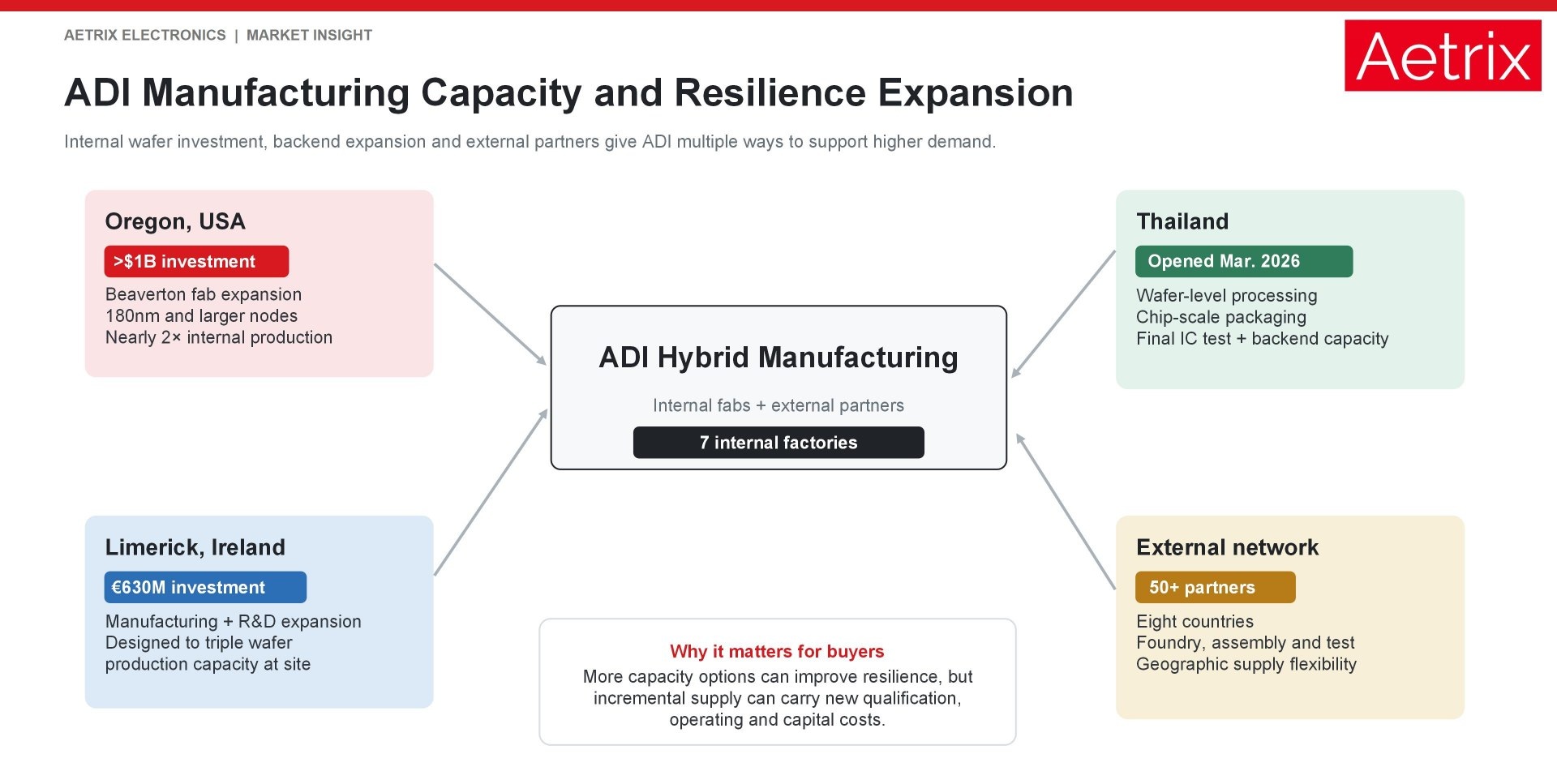
ADI's hybrid manufacturing model combines internal fabs with more than 50 supply-chain partners across eight countries. The company says it qualifies and matches processes across internal and partner facilities so production can be shifted or scaled when conditions change. (Analog Devices, Resilient Hybrid Manufacturing)
AI Data Centers Are One Major Demand Driver
AI infrastructure is clearly contributing to ADI's current demand, especially in Communications.
Data-center revenue grew more than 90% year over year in Q2 and represented more than 75% of ADI's Communications business. Management said the growth was being driven by optical and power products at similar rates. (Analog Devices, Q2 2026 Earnings Call)
ADI's current data-center exposure is concentrated primarily in two areas:
- optical connectivity and signal-chain products;
- power delivery and power-management products.
AI-related semiconductor investment can also support adjacent ADI markets. Automated test equipment and electronic test and measurement were among the areas contributing to Industrial growth during Q2.
AI does not explain the whole pricing action. Industrial represented half of Q2 revenue and grew 56% year over year. ADI also reported record bookings in Automotive, while its wireless communications business grew more than 35%. (Analog Devices, Q2 2026 Earnings Call)
The new customer notice uses broad-based demand language because several major end markets are strengthening at the same time.
Six-Month Lead Times Now Carry a Price Question
ADI's July 3 communication asked customers to extend backlog coverage and place orders at least six months in advance for products affected by the tighter supply environment. (Aetrix Electronics, ADI Six-Month Lead-Time Analysis)
Customers that followed that recommendation may already have extended their forward order coverage. The September price adjustment now raises a second question: what price applies to those already placed future orders?
The new notice reviewed by Aetrix Electronics does not state that all existing backlog will automatically be repriced. It also does not explain how blanket orders, contract pricing or distributor price protection will be handled.
Buyers with six-month backlog therefore need to verify the commercial terms directly.
The practical risk now has three parts:
| Risk | What Changed | Buyer Exposure |
|---|---|---|
| Availability | Selected lead times extended to as much as six months | Short-term replenishment becomes difficult |
| Price | New portfolio pricing takes effect September 13 | Future deliveries may require revised budget assumptions |
| Working capital | Longer backlog coverage locks purchasing decisions earlier | More cash and forecast accuracy are required |
ADI Has Already Been Expanding Manufacturing Capacity
The fab, assembly and test expansion mentioned in the new price letter is part of a manufacturing strategy ADI has been building for several years.
ADI invested more than $1 billion to expand its Beaverton, Oregon wafer fab. The project expanded cleanroom space and was designed to nearly double internal production for products built on 180nm and larger process nodes. (Analog Devices, Beaverton Wafer Fab Expansion)
In Ireland, ADI announced a €630 million manufacturing and R&D investment in Limerick. The facility was designed to triple wafer production capacity at the site and support the company's wider goal of expanding internal manufacturing. (Analog Devices, Limerick Manufacturing Expansion)
Capacity expansion has continued in 2026. In March, ADI opened a new advanced manufacturing facility in Thailand, adding cleanroom and backend manufacturing capacity for wafer-level processing, chip-scale packaging, final IC test and broader test operations. The expansion strengthens the assembly-and-test side of ADI's global manufacturing network at the same time that customer demand is increasing. (Analog Devices, Thailand Manufacturing Expansion)
ADI also operates a geographically diversified manufacturing network that combines seven internal factories with more than 50 supply-chain partners across eight countries. (Analog Devices, Resilient Hybrid Manufacturing)
The manufacturing strategy increases available output while reducing dependence on a single plant, supplier or geographic region.
ADI Is Building More Supply Buffer
ADI is also carrying more inventory to support higher demand.
During Q2, inventory increased by $81 million sequentially as the company built strategic die-bank and finished-goods buffers. Days of inventory ended the quarter at 168, while channel inventory remained within ADI's six-to-seven-week range and moved lower. (Analog Devices, Q2 2026 Earnings Call)
Die-bank inventory provides manufacturing flexibility because die can be converted into different finished configurations later in the production process, rather than requiring every unit to be held as a completed part.
The customer side is less buffered in some markets. ADI said automotive customers were relatively lean on inventory after the earlier digestion cycle, which supports stronger new ordering when vehicle programs improve. (Analog Devices, Q2 2026 Earnings Call)
This creates a different supply-chain structure from the previous downcycle: customer inventories are lean in some segments, ADI is building strategic production buffers, and new orders are moving further into the manufacturing network.
Which ADI Product Categories Carry the Highest Substitution Risk?
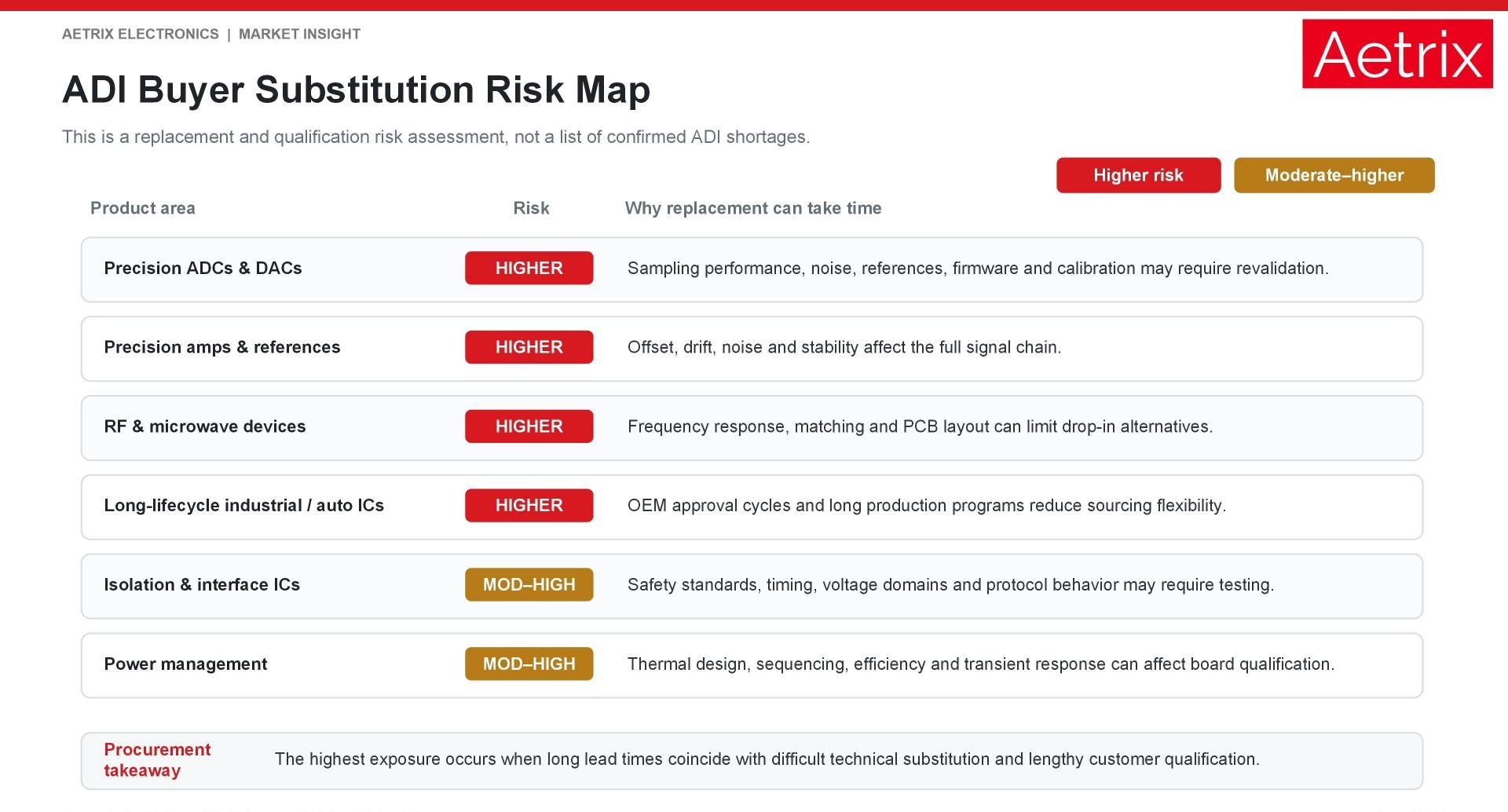
ADI has not published a product list for the September pricing adjustment, and the July lead-time notice only said that part of the portfolio was affected by longer lead times.
The table below is therefore a buyer-risk assessment based on substitution difficulty and typical qualification requirements, not a list of confirmed ADI shortages.
| Product Area | Substitution Risk | Why Replacement Can Take Time |
|---|---|---|
| Precision ADCs and DACs | Higher | Sampling performance, noise, reference requirements, firmware and calibration may need revalidation |
| Precision amplifiers and references | Higher | Offset, drift, noise and stability affect the full signal chain |
| RF and microwave devices | Higher | Frequency response, matching and PCB layout can limit drop-in alternatives |
| Isolation and interface ICs | Moderate to higher | Safety standards, timing, voltage domains and protocol behavior may require testing |
| Power management | Moderate to higher | Thermal design, sequencing, efficiency and transient response can affect board qualification |
| Long-lifecycle industrial and automotive ICs | Higher | OEM approval cycles and long production programs reduce sourcing flexibility |
Risk levels represent Aetrix Electronics' assessment of substitution and procurement exposure. ADI has not identified these categories as a complete list of products affected by the September pricing adjustment or July lead-time extension.
What Buyers Need to Confirm Before September 13
Existing backlog is the first place to look.
Many customers may already have extended ADI backlog after the July six-month lead-time notice. Those orders now need a price review before the new adjustment takes effect.
The key questions are practical:
- Does the existing PO retain its current price after September 13?
- Is the order covered by contract or distributor price protection?
- Which date controls pricing: PO date, requested delivery date, confirmed ship date or actual shipment date?
- How will blanket orders and scheduled releases be treated?
- Has the distributor changed quote validity?
- Have MOQ or NCNR terms changed together with pricing?
ADI's new notice does not answer these questions in detail, so buyers need written confirmation from ADI or the authorized distributor handling the order.
The second check is backlog coverage. A six-month order is useful only if the confirmed ship schedule actually covers the production requirement. Buyers need to separate requested dates from factory-confirmed dates.
The third check is alternative readiness. A technically acceptable alternate that has never been validated does not provide immediate supply protection. Engineering review is most useful while current ADI supply is still available.
What Happens After September 13?
The months following the adjustment should provide a clearer view of whether ADI's current pressure remains primarily commercial or begins to show up more broadly in product availability.
If pricing rises while lead times remain stable, that would be consistent with ADI maintaining supply availability while absorbing higher manufacturing and capacity costs.
If longer lead times spread to more products, capacity constraints would become a more important part of the supply picture. Buyers would then need to watch more closely for changes in allocation, order acceptance, MOQ and NCNR terms.
ADI entered fiscal Q3 with record bookings, a positive book-to-bill ratio in Automotive, strong Industrial demand and continued data-center growth. Management has also said that some manufacturing nodes are tighter even though the company has continued to obtain the capacity it needs. (Analog Devices, Q2 2026 Earnings Call)
The most useful indicators through the rest of 2026 are MPN-level lead time, confirmed factory backlog, authorized channel inventory, quote validity and customer-specific pricing.
Outlook
ADI's 2026 supply picture has moved through three connected stages. The first price action addressed inflation. The July lead-time communication showed that stronger demand was tightening supply on selected products. The September adjustment now links pricing more directly with the cost of securing additional supply and expanding manufacturing capability.
ADI enters this period with substantially more production flexibility than it had before the pandemic. Internal manufacturing capacity has more than doubled from its pre-COVID base, major wafer investments have been made in Oregon and Limerick, backend manufacturing has expanded in Thailand, and external sourcing provides additional foundry, assembly and test options.
Demand remains strong, with factory utilization already high even after those earlier capacity investments. Industrial and Communications are growing rapidly, data-center revenue is up more than 90% year over year, and Automotive bookings have strengthened while customer inventory remains relatively lean in parts of that market.
For procurement teams, price and delivery planning now need to be managed together. A six-month backlog may improve availability protection while creating additional price exposure. Buyers should therefore evaluate confirmed delivery dates, price protection, quote validity, MOQ and NCNR terms alongside technical alternatives rather than treating unit price as a separate decision.
Key Takeaways
- Analog Devices will implement a new product-portfolio pricing adjustment effective September 13, 2026, citing broad demand growth, manufacturing costs and the need for additional supply and capacity.
- The notice does not provide a universal percentage increase or detailed MPN list, so the actual impact will depend on customer- and part-specific pricing.
- The adjustment follows ADI's July warning that selected products were moving to lead times of up to six months.
- Fiscal Q2 revenue reached a record $3.62 billion, with record B2B bookings and high factory utilization supporting the stronger demand picture.
- ADI continues to expand manufacturing flexibility through internal wafer capacity, external partners and additional backend manufacturing and test capacity.
- Buyers with forward backlog should confirm price protection, shipment dates, quote validity, MOQ, NCNR terms and alternative readiness before the September adjustment takes effect.