My Inquiry
 My Account


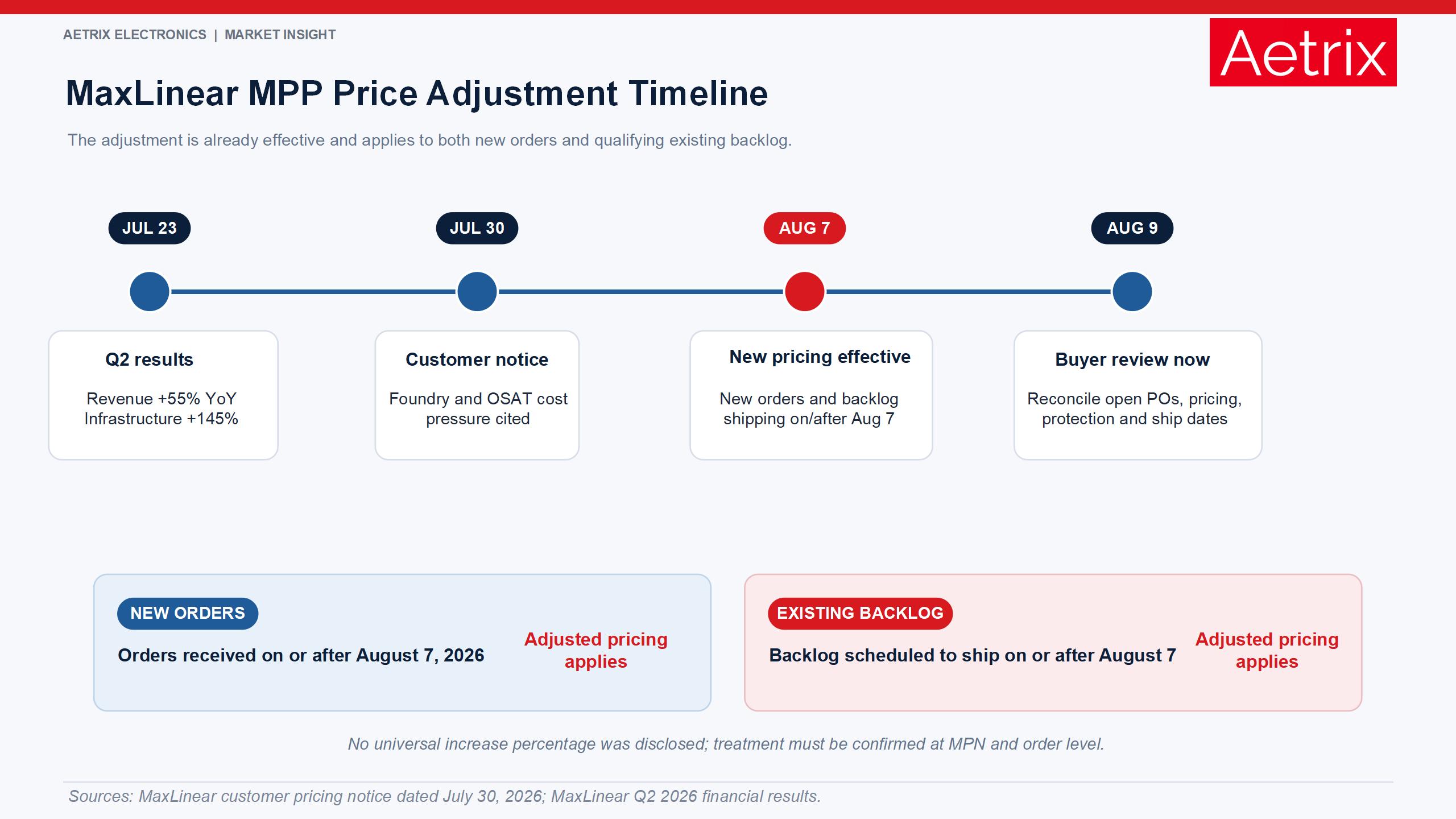
MaxLinear's latest price adjustment is already in effect. A customer notice dated July 30, 2026 states that pricing for its MPP product portfolio changed on August 7, covering both new orders received from that date and existing backlog scheduled to ship on or after August 7.
The company points to higher costs across wafer fabrication, outsourced assembly and test, labor, energy, logistics and materials. MaxLinear says it had previously absorbed part of those increases through efficiency and cost-control measures, but the continued pressure now requires a pricing adjustment.
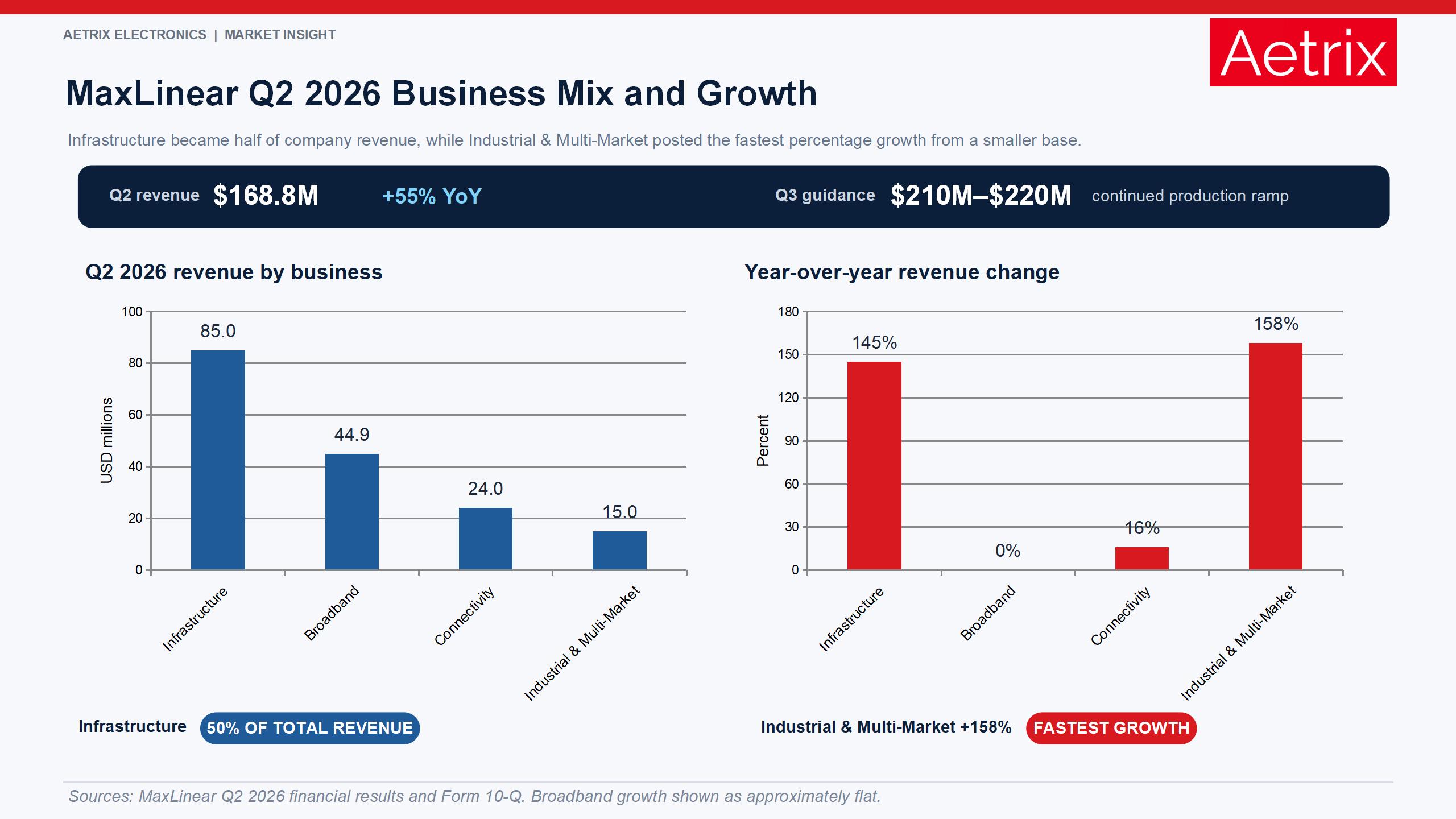
The timing deserves attention. One week before the notice, MaxLinear reported Q2 2026 revenue of $168.8 million, up 55% year over year and 23% sequentially. Infrastructure revenue increased 145% as AI data-center optical products moved into higher-volume production. MaxLinear also guided Q3 revenue to $210 million to $220 million. (MaxLinear, Q2 2026 Financial Results)
The revenue growth did not come from higher prices. MaxLinear's Q2 filing states that price changes had no material impact on year-over-year revenue growth through June. Volume growth in optical products, high-performance analog devices, wireless backhaul, industrial components and Wi-Fi products drove the improvement. (MaxLinear, Q2 2026 Form 10-Q)
That creates a useful supply-chain picture for the second half of 2026: MaxLinear is buying more manufacturing capacity to support stronger demand at the same time that its foundry and OSAT costs are rising. The August price adjustment is the point where part of that higher manufacturing cost begins moving downstream to customers.
MaxLinear's New MPP Pricing Is Already in Effect
The August 7 effective date has passed, so the purchasing question has changed. Buyers are no longer deciding whether to place an order before the adjustment. The immediate task is to understand how the new pricing applies to open orders and future deliveries.
| Order Situation | Treatment in MaxLinear Notice | Buyer Check |
|---|---|---|
| New order received on or after August 7 | New pricing applies | Request updated quote and validity period |
| Existing backlog scheduled to ship on or after August 7 | Pricing adjustment applies | Confirm revised price against each open PO |
| Order partially shipped before August 7 | Notice does not provide detailed treatment for split shipments | Verify pricing on the remaining balance |
| Distributor blanket or scheduled order | Customer-specific handling may apply | Confirm price protection and shipment schedule |
MaxLinear specifically directs customers to its sales representatives or authorized distribution partners for updated pricing details. The notice does not provide a universal percentage increase, which suggests that buyers need to work from actual MPN-level quotations rather than assume one increase across the portfolio.
Existing Backlog Is the Most Immediate Buyer Issue
Applying the adjustment to existing backlog makes this notice more important than a standard change affecting only future purchase orders.
A customer may already have an accepted PO, a delivery schedule and an internal project cost based on the previous price. If the remaining delivery falls after the effective date, the order now requires another commercial check.
MaxLinear also operates a distribution model that already includes price-protection and price-adjustment mechanisms. At June 30, its estimated price-protection obligations to end customers totaled $31.2 million, up from $26.5 million at the end of 2025. Separate estimated distributor price-adjustment obligations totaled $10.4 million. These balances predate the August notice and therefore are not evidence of costs created by this specific increase, but they show that channel pricing can involve more than the price printed on the original PO. (MaxLinear, Q2 2026 Form 10-Q)
For open requirements, buyers now need the latest confirmed commercial position: the revised unit price, remaining backlog quantity, actual shipment schedule, applicable price protection and any change in order terms. Blanket orders and partially shipped POs deserve particular attention because the same PO can span both sides of the August 7 effective date.
Why MaxLinear Raised Prices
MaxLinear's notice identifies several cost inputs rather than one isolated shortage. Wafer fabrication partners and outsourced semiconductor assembly and test providers have increased pricing, while labor, energy, logistics and material expenses are also higher.
These expenses sit at different points in the manufacturing chain.
| Cost Layer | Where It Enters MaxLinear's Cost | Potential Effect |
|---|---|---|
| Silicon wafer materials | Upstream of semiconductor foundries | Higher wafer input cost |
| Wafer fabrication | Third-party foundry | Higher processed-wafer cost |
| Assembly and packaging | OSAT | Higher finished-device manufacturing cost |
| Test | OSAT and production test flow | Higher cost per qualified device |
| Energy and labor | Wafer, assembly and logistics network | Raises several cost layers at once |
| Freight and logistics | Movement between wafer fab, OSAT and customer | Higher landed manufacturing cost |
MaxLinear's financial filing confirms how these costs enter the business. Cost of revenue includes finished silicon wafers processed by third-party foundries, outsourced packaging and assembly, test, shipping, manufacturing-support equipment, logistics and quality assurance. (MaxLinear, Q2 2026 Form 10-Q)
Fabless Does Not Remove Manufacturing Cost
MaxLinear designs chips but does not own the wafer fabs that manufacture most of them. Its outsourced model relies heavily on third-party semiconductor manufacturing.
MaxLinear's 2025 annual filing states that a large portion of its products are manufactured by TSMC and UMC at foundries in Taiwan, Singapore and China. Third-party contractors also handle its assembly and test operations. (MaxLinear, 2025 Form 10-K)
That means a fabless supplier still purchases manufacturing. It pays for processed wafers, packaging, test and associated production services instead of owning the facilities directly.
When foundry pricing increases, MaxLinear's unit cost can increase. When assembly and test providers raise prices, another layer is added. Higher freight, electricity and material costs can appear again inside the suppliers' own pricing.
The commercial question is how much of that total MaxLinear can offset through yield improvement, product mix, purchasing efficiency and internal cost control. Its July notice indicates that the remaining pressure had become large enough to pass part of the cost to customers.
MaxLinear Is Putting More Money Into Production
MaxLinear's balance sheet shows how quickly its production pipeline expanded during the first half of 2026.
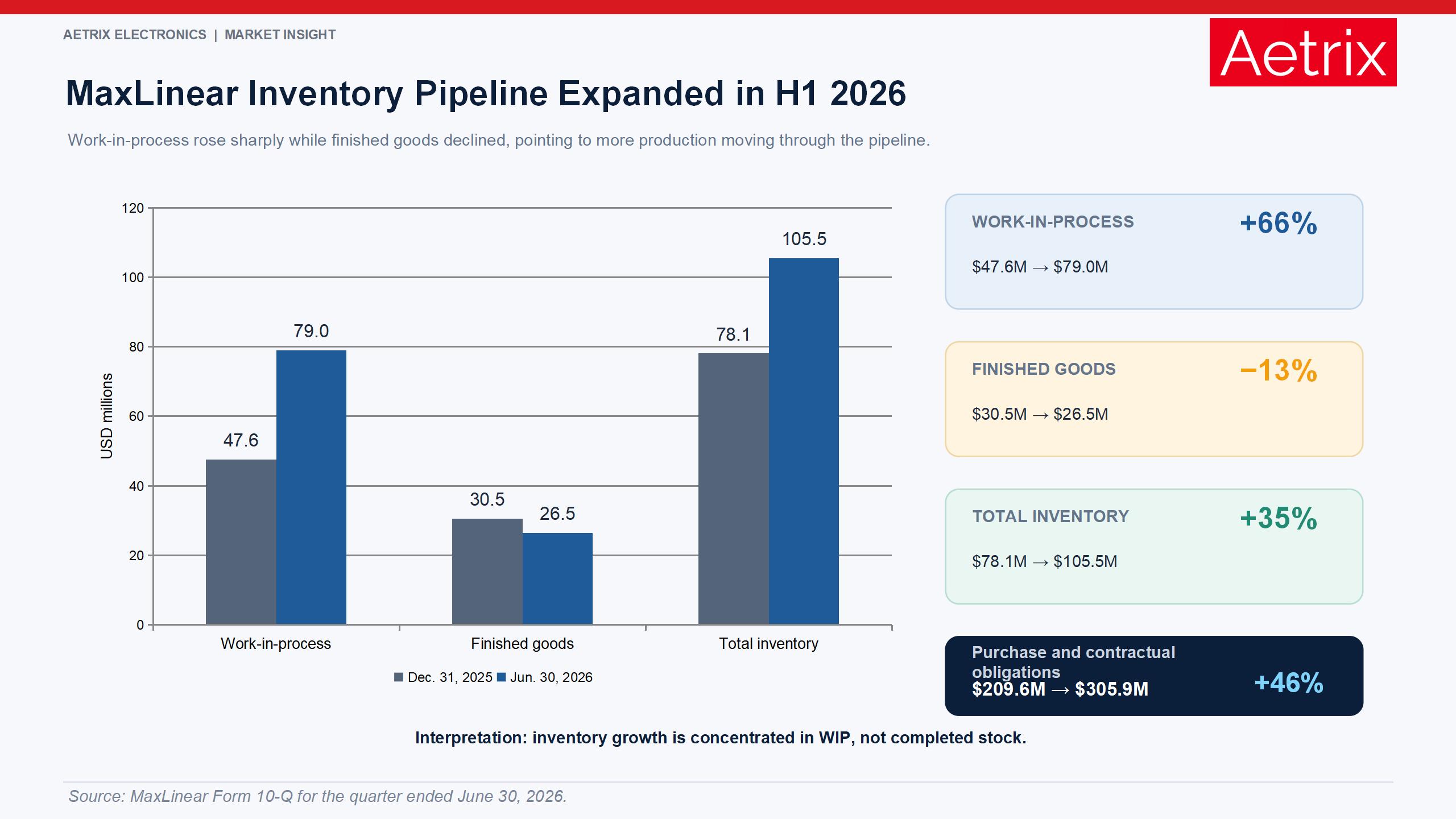
Total inventory increased from $78.1 million at the end of 2025 to $105.5 million at June 30, an increase of about 35%. The mix changed even more sharply. Work-in-process inventory rose from $47.6 million to $79.0 million, approximately 66%, while finished goods fell from $30.5 million to $26.5 million. (MaxLinear, Q2 2026 Form 10-Q)
| Inventory | Dec. 31, 2025 | Jun. 30, 2026 | Change |
|---|---|---|---|
| Work-in-process | $47.6M | $79.0M | +66% |
| Finished goods | $30.5M | $26.5M | -13% |
| Total inventory | $78.1M | $105.5M | +35% |
The important movement is the WIP increase. MaxLinear has more inventory moving through fabrication and production while finished-goods inventory is lower than it was six months earlier.
This pattern fits a business increasing manufacturing activity rather than simply building a warehouse of completed chips.
Purchase Commitments Increased With Demand
The same trend appears in MaxLinear's contractual commitments.
Inventory purchase and other contractual obligations increased from $209.6 million at the end of 2025 to $305.9 million at June 30, an increase of about 46%. MaxLinear says the increase was driven by stronger sales demand that required incremental purchase orders, together with additional software licenses. Of the June balance, $221.3 million represented inventory purchase obligations. (MaxLinear, Q2 2026 Form 10-Q)
MaxLinear also expects capital expenditures to increase to support production needs.
The numbers show a company committing more cash to manufacturing at the same point in the cycle that foundry and OSAT suppliers are passing through higher costs.
AI Infrastructure Is Changing MaxLinear's Business Mix
Infrastructure has become MaxLinear's largest business.
Q2 infrastructure revenue reached $85.0 million, up 145% year over year and equal to 50% of company revenue. MaxLinear attributed the growth to higher shipments of optical products, high-performance analog products and wireless backhaul devices. The company also highlighted the production ramp of its Keystone PAM4 DSP platform for 800G AI data-center applications. (MaxLinear, Q2 2026 Financial Results) (MaxLinear, Q2 2026 Form 10-Q)
| Business | Q2 2026 Revenue | YoY Change | Main Q2 Signal |
|---|---|---|---|
| Infrastructure | $85.0M | +145% | Optical AI data center and high-performance analog growth |
| Broadband | $44.9M | Approximately flat | Lower cable-data volume offset by higher broadband SoC shipments |
| Connectivity | $24.0M | +16% | Higher Wi-Fi shipments |
| Industrial & Multi-Market | $15.0M | +158% | Higher component and high-performance analog shipments |
Infrastructure growth is clearly the largest driver, but the industrial and multi-market result is also useful for supply-chain analysis. Revenue in that business increased 158% from a small base, driven by higher shipments of component products and high-performance analog devices. (MaxLinear, Q2 2026 Form 10-Q)
MaxLinear therefore enters the second half with demand coming from both high-growth AI infrastructure and more traditional analog and component markets.
GlobalWafers Adds Another H2 Wafer-Cost Signal
Upstream silicon wafer pricing adds another variable to MaxLinear's manufacturing-cost outlook.
GlobalWafers said in May that it was seeking higher wafer pricing in the second half of 2026 as raw-material, manufacturing, labor, energy and logistics costs increased. Chairperson Doris Hsu said the company had reached the point where the increases were difficult to absorb entirely through manufacturing efficiency and cost savings. (Taipei Times, GlobalWafers H2 2026 Pricing Discussions)
GlobalWafers' latest Q2 presentation shows that the supply environment remained firm into August. Existing 12-inch wafer lines were fully utilized, excluding new capacity still ramping. Eight-inch utilization remained high, while recovery was beginning to extend into 6-inch production. The company also built more inventory during Q2 in preparation for anticipated second-half demand. (GlobalWafers, Q2 2026 Earnings Presentation)
GlobalWafers also reported continuing pressure from depreciation, freight and energy expenses. Those are similar to several of the cost categories identified in MaxLinear's own customer notice. (GlobalWafers, Q2 2026 Earnings Presentation)
How GlobalWafers Connects to MaxLinear's Supply Chain
The connection between GlobalWafers and MaxLinear is indirect.
MaxLinear identifies TSMC and UMC as major manufacturing partners. GlobalWafers is a confirmed supplier to TSMC: GlobalWafers has publicly described factories supplying TSMC and received TSMC's 2023 Best Carbon Reduction Partner Award as one of the foundry's suppliers. (MaxLinear, 2025 Form 10-K) (GlobalWafers, TSMC Supplier Award)
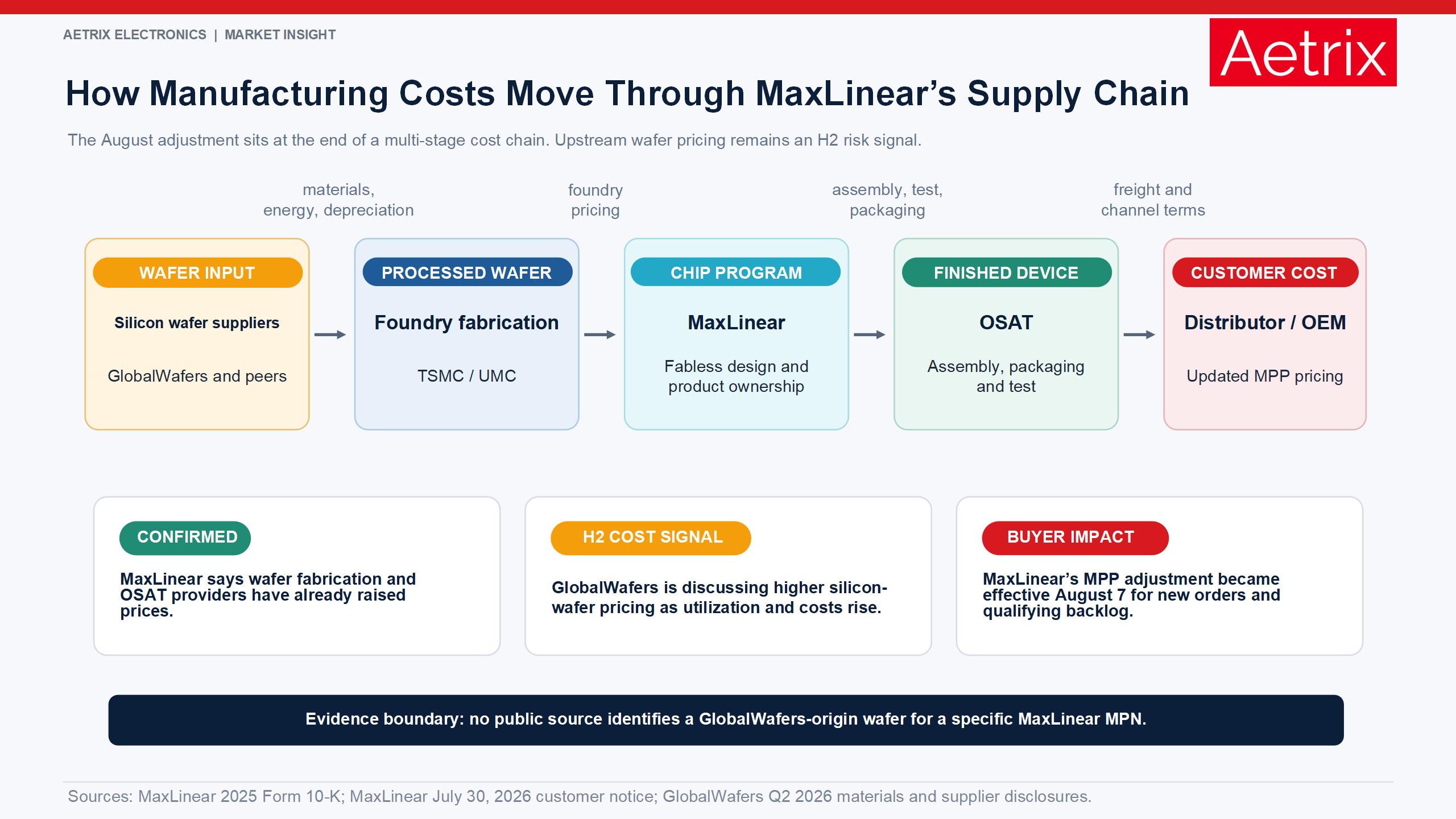
Public information does not identify which MaxLinear MPNs, wafer processes or TSMC production lots use silicon originating from GlobalWafers. GlobalWafers' H2 pricing discussions therefore represent an upstream cost-risk signal rather than evidence of a direct price increase on a specific MaxLinear product.
The cost path can be viewed in four stages:
Silicon Wafer Supplier → Foundry Wafer Fabrication → MaxLinear → OSAT Assembly & Test → Distributor / OEM
GlobalWafers sits at the first stage for part of TSMC's supply chain. TSMC sits inside MaxLinear's foundry network. Any cost increase still has to move through foundry contracts, process-specific pricing and MaxLinear's own cost structure before it reaches a finished component.
Could Manufacturing Costs Rise Further in H2 2026?
The August adjustment may not close the cost issue for the rest of the year.
GlobalWafers is discussing higher silicon-wafer pricing, while its 12-inch lines remain fully utilized and smaller-diameter utilization is improving. MaxLinear's own notice says both wafer fabrication partners and OSAT suppliers have already implemented additional pricing increases.
MaxLinear is also increasing production commitments as infrastructure and industrial demand grows. More WIP and larger purchase obligations mean a greater amount of manufacturing input is moving through the cost base.
There are several buffers before another customer price change would become necessary. Foundries can negotiate wafer contracts, MaxLinear can improve product mix or manufacturing efficiency, and stronger volume can spread fixed costs over more units.
A further MaxLinear price increase is therefore not established. The more defensible conclusion is that upstream cost pressure remains active, making additional price action possible if wafer, foundry and OSAT expenses continue rising faster than MaxLinear can absorb them.
Another industry signal is worth watching beyond 2026. Reuters reported in July that TSMC plans foundry price increases of up to 10% for 2027 depending on customer and product, citing higher material, equipment and overseas manufacturing costs. MaxLinear has substantial manufacturing exposure to TSMC, so future foundry pricing will remain part of its cost outlook. (Reuters, TSMC 2027 Foundry Pricing)
Which MaxLinear Products Are Actually Affected?
The customer notice applies specifically to the "MPP product portfolio." The notice reviewed by Aetrix Electronics does not provide an affected MPN list, define the full MPP scope or publish one universal percentage increase.
That makes portfolio-level assumptions risky. MaxLinear sells products across infrastructure, broadband, connectivity, industrial and multi-market applications, including optical DSPs, high-performance analog devices, interface ICs and power-management products. The notice itself does not establish that every MaxLinear product belongs to the affected MPP portfolio.
Buyers need confirmation at the exact MPN level. An updated authorized quote or MaxLinear sales confirmation provides stronger evidence than applying the notice to an entire website product category.
What Buyers Need to Check Now
Open backlog comes first. Purchasing teams should match every unshipped MPP order against the latest MaxLinear or authorized-distributor confirmation and record the new unit price, remaining quantity and confirmed shipment schedule.
Partially shipped POs require a separate check on the outstanding balance. Blanket orders need clarification on whether pricing follows the original agreement, release date, confirmed ship date or another contract term.
Price protection should also be documented rather than assumed. MaxLinear already operates customer and distributor price-adjustment programs, but their existence does not mean every open order is protected from the August change.
For new demand, quote validity becomes more useful than the headline price increase. Shorter validity periods can indicate that the supplier or distributor has less confidence in future replacement cost.
Lead time should be monitored separately from price. The July notice announces a pricing adjustment, not a general allocation or company-wide lead-time extension. A specific MPN becomes a stronger supply-risk candidate when higher pricing appears together with longer factory confirmation, lower authorized inventory or tighter order terms.
MOQ and NCNR conditions also deserve attention. A higher unit price changes purchasing cost; a higher MOQ or stricter NCNR condition changes inventory risk. The two should be evaluated separately.
For long-running industrial designs, buyers can start alternative qualification before availability becomes difficult. Interface, power-management and analog devices often remain in equipment for years, and a technically suitable alternative may still require PCB, software or qualification work.
What MaxLinear's Price Increase Says About the 2026 Semiconductor Supply Chain
MaxLinear provides a useful example of how the semiconductor market is changing after the long inventory correction.
The first stage of the recovery was demand. Customer orders improved and distributors reduced excess inventory.
The next stage is showing up in production. MaxLinear's WIP increased, purchase commitments expanded and infrastructure revenue accelerated as AI data-center products entered higher-volume production.
The third stage is manufacturing cost. Silicon wafer suppliers, foundries and OSAT providers face higher energy, labor, freight, material and depreciation expenses. Some of those costs are now moving into semiconductor customer pricing.
That does not create one universal semiconductor inflation rate. Pricing will remain dependent on process node, package, manufacturing site, customer contract and product demand.
The practical shift for buyers is clear: inventory is no longer the only supply-chain variable to watch. Replacement cost and manufacturing economics are becoming increasingly important as utilization improves.
Outlook
MaxLinear enters the second half of 2026 with much stronger demand than a year ago. Q2 revenue grew 55%, infrastructure revenue grew 145%, Industrial & Multi-Market grew 158%, and Q3 guidance points to another large sequential increase. (MaxLinear, Q2 2026 Financial Results)
The production pipeline is expanding at the same time. Work-in-process inventory is up about 66% from year-end, and total inventory purchase and other contractual obligations increased about 46%. (MaxLinear, Q2 2026 Form 10-Q)
The August MPP pricing adjustment shows that some manufacturing cost increases are now reaching customers. GlobalWafers' H2 wafer-pricing discussions and continuing high utilization add another upstream cost signal, while MaxLinear's dependence on outsourced foundry and OSAT manufacturing keeps it exposed to supplier pricing.
The next signals to watch are straightforward: another MaxLinear customer pricing notice, changes in MPN-level lead time, tighter quote validity, revised MOQ or NCNR terms, and further foundry or OSAT price announcements.
If prices rise while delivery remains normal, the story remains mainly a cost reset. If higher pricing is joined by longer lead times and tighter order acceptance, the market has moved closer to a capacity-driven supply problem.
Key Takeaways
- MaxLinear's MPP price adjustment became effective on August 7, 2026.
- The change applies to new orders and existing backlog scheduled to ship on or after the effective date.
- MaxLinear cites higher wafer fabrication, OSAT, labor, energy, logistics and material costs.
- Q2 revenue increased 55% year over year, while infrastructure revenue increased 145% on strong optical AI data-center demand.
- Work-in-process inventory increased about 66% from the end of 2025, while finished goods declined.
- Inventory purchase and other contractual obligations increased from $209.6 million to $305.9 million as sales demand increased.
- GlobalWafers is seeking higher silicon-wafer pricing in H2 2026 and reports full utilization on existing 12-inch production lines.
- GlobalWafers is part of TSMC's upstream supplier network, while TSMC is one of MaxLinear's major foundry partners; no public data identifies a GlobalWafers-origin wafer for a specific MaxLinear MPN.
- The current notice covers the MPP portfolio, but the reviewed notice does not provide a complete affected MPN list or one universal increase percentage.
- Buyers now need to verify revised backlog pricing, price protection, shipment schedules, quote validity and MPN-level lead times.