My Inquiry
 My Account


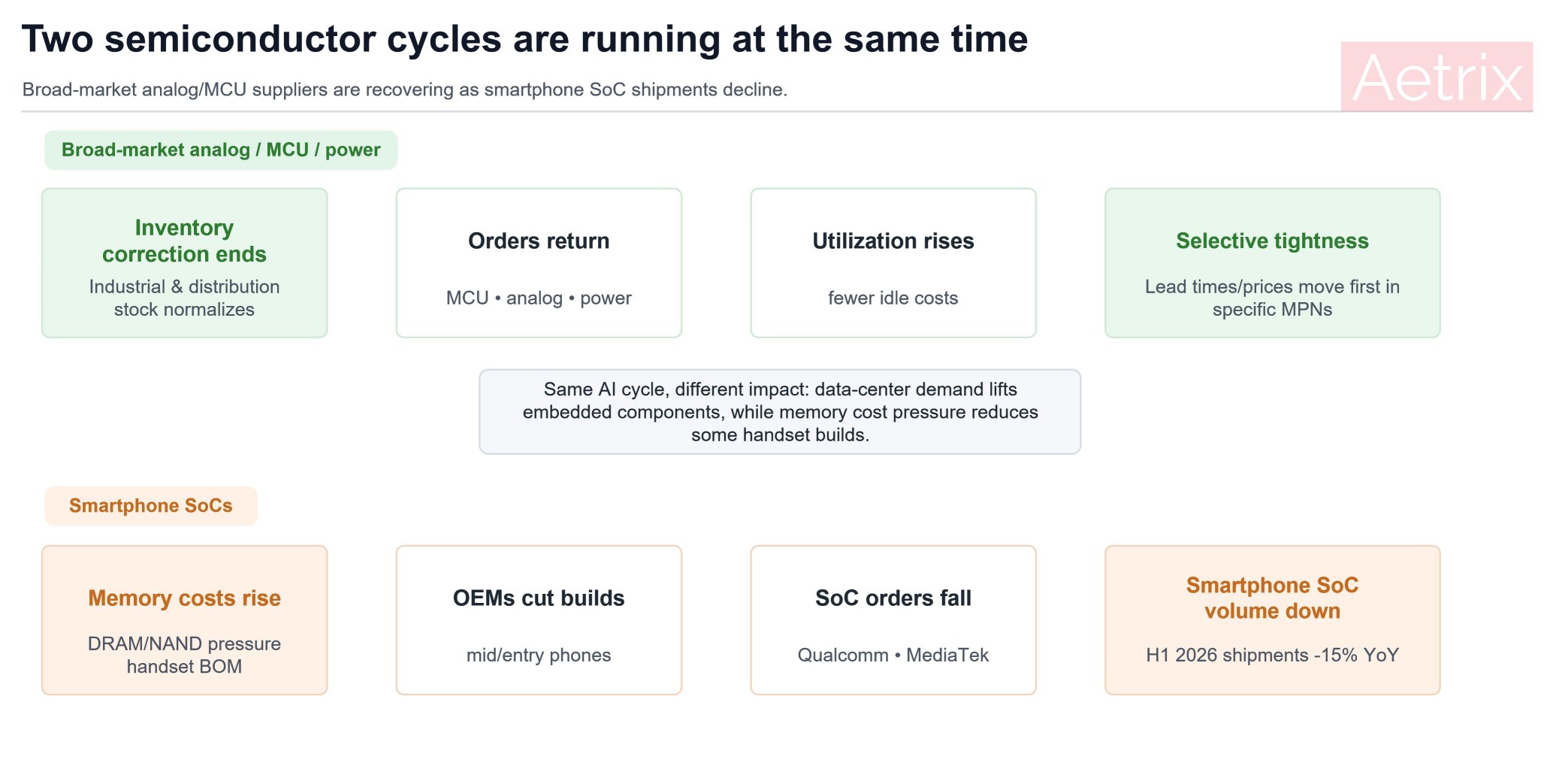
The semiconductor market is moving in two different directions in 2026.
Suppliers focused on analog chips, microcontrollers, power devices and general embedded components are reporting strong revenue growth. Texas Instruments, STMicroelectronics, Analog Devices, Microchip, Diodes, onsemi, Infineon and Renesas have all reported improving demand, stronger bookings or better factory utilization.
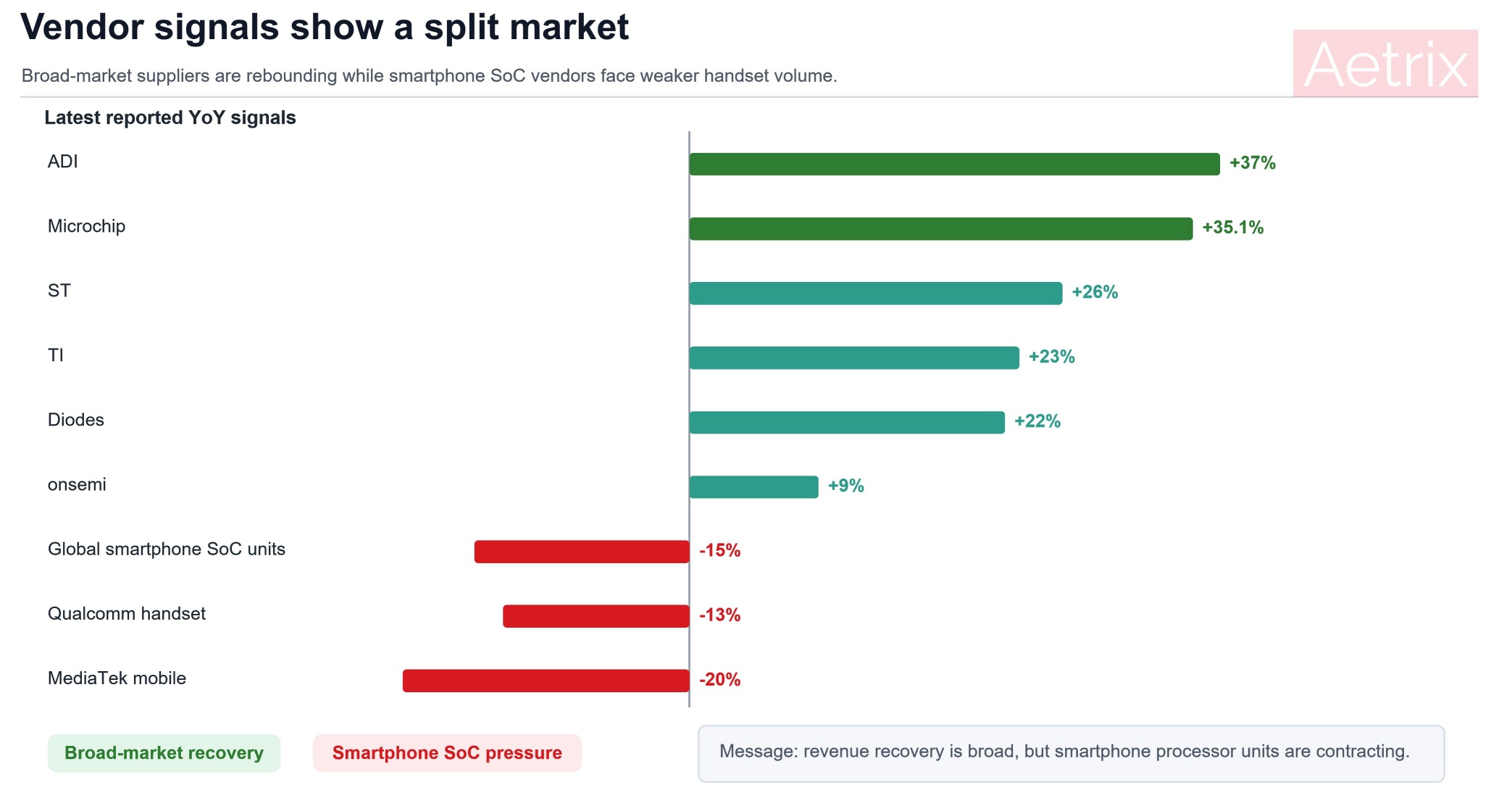
The smartphone processor market tells a different story. Global smartphone system-on-chip shipments fell 15% year over year in the first half of 2026. Qualcomm's handset-chip revenue declined 13% in its fiscal second quarter, while MediaTek's mobile-phone business fell 20% year over year.
The difference comes from product mix, customer inventory and end-market demand. Broad-market semiconductor companies are recovering from a long inventory correction. Smartphone SoC suppliers are dealing with lower handset production, higher memory costs and weaker demand in the mass market.
This split explains why buyers can see higher prices and longer lead times for selected MCUs, analog ICs and power-management devices while smartphone processor shipments continue to decline.
One Semiconductor Market, Two Different Cycles
Semiconductor companies are often grouped together, but their products can follow very different demand cycles.
A Texas Instruments analog IC may be used in a factory controller, vehicle, data-center power supply, medical system or building automation product. The same device can remain in production for ten years or longer.
A smartphone SoC is tied much more closely to one generation of handsets. Orders depend on the production plans of a small number of smartphone brands, and those plans can change quickly when phone sales or component costs move.
| Market Group | Typical Products | Current 2026 Cycle | Main Driver |
|---|---|---|---|
| Broad-market semiconductor suppliers | Analog ICs, MCUs, sensors, power ICs and discrete devices | Inventory recovery and selective supply tightening | Industrial replenishment, automotive demand and AI infrastructure |
| Smartphone SoC suppliers | Application processors, cellular modems and integrated mobile platforms | Lower unit shipments and weaker handset orders | Rising phone BOM costs and reduced OEM production plans |
Broad-Market Semiconductor Suppliers Are Recovering
The latest financial results show a broad improvement across analog, MCU, embedded-processing and selected power-semiconductor companies.
| Supplier | Latest Reported Signal | Supply-Chain Meaning |
|---|---|---|
| Texas Instruments | Q2 revenue of $5.46 billion, up 23% year over year | Broad growth led by industrial, data center and automotive markets |
| STMicroelectronics | Q2 revenue of $3.49 billion, up 26% | General-purpose MCU demand and optical-connectivity projects are strengthening |
| Analog Devices | Record fiscal Q2 revenue of $3.62 billion, up 37% | Growth across all end markets, led by industrial and communications |
| Microchip | March-quarter revenue of $1.31 billion, up 35.1% | The recovery has spread across its broad embedded-product portfolio |
| Diodes Incorporated | Q1 revenue increased from $332.1 million to $405.5 million | Automotive, industrial and computing demand is supporting multiple quarters of growth |
| onsemi | Q2 revenue of $1.60 billion, up 9% | Demand is improving, although recovery remains uneven across automotive and industrial products |
| Infineon | Fiscal Q2 revenue of €3.81 billion; full-year guidance raised | AI data-center power demand and improving automotive orders are lifting the outlook |
| Renesas | Q2 non-GAAP revenue of ¥405.3 billion, higher than Q1 | Automotive, industrial and embedded demand is supporting sequential improvement |
TI said its growth was led by industrial, data center and automotive demand. ST reported that its distribution inventory had fallen below its normal target and that general-purpose MCUs were a major growth driver. ADI reported record bookings across industrial, automotive and communications markets. Microchip described its improvement as broad-based.
These results show that customers are buying again after spending several quarters reducing excess inventory.
(Texas Instruments, Q2 2026 Results; STMicroelectronics, Q2 2026 Results; Analog Devices, Fiscal Q2 2026 Results; Microchip, Fiscal Q4 2026 Results)
The Long Inventory Correction Is Reaching Its End
The recovery began with inventory.
Industrial and automotive customers ordered heavily during the 2021–2022 component shortage. Many companies placed duplicate orders or bought more parts than they immediately needed. When supply improved, customers were left with excess inventory.
From 2023 through 2025, OEMs and distributors reduced new orders while consuming those parts. Semiconductor revenue fell faster than actual equipment production because customers could build products from stock already held in warehouses.
That stock has now fallen closer to normal levels. ST said its distribution inventory was below its standard target. ADI reported record bookings across its business-to-business markets. Microchip's quarterly revenue rose both year over year and sequentially.
Once inventory becomes lean, new customer demand reaches the semiconductor factory more quickly. A modest rise in equipment production can produce a much larger rise in chip orders because customers must cover current consumption and rebuild part of their safety stock.
This is why analog and MCU revenue can grow by more than 20% while the related industrial or automotive end market grows at a much slower rate.
AI Infrastructure Is Pulling More Than GPUs and Memory
AI data centers are creating demand across a much wider semiconductor supply chain.
A server rack needs processors and high-bandwidth memory, but it also needs power conversion, voltage monitoring, temperature sensing, optical communication, cooling control and system management.
This creates demand for products sold by broad-market suppliers:
- power-management ICs and voltage regulators;
- MOSFETs, gate drivers and power modules;
- precision analog and signal-chain devices;
- microcontrollers used in optical modules, power supplies and cooling systems;
- sensors for current, temperature and equipment monitoring;
- clock, interface and connectivity components.
TI identified data centers as one of its leading growth markets. ST reported strong demand in optical connectivity and silicon photonics. Infineon said demand for AI data-center power solutions was very high. ADI's communications business also benefited from data-center demand.
Infineon raised its full-year outlook after reporting stronger AI power demand and improving automotive orders. Its fiscal second-quarter revenue reached €3.81 billion, and the company now expects revenue to increase significantly for the full fiscal year. (Infineon, Fiscal Q2 2026 Results and Updated Outlook)
This demand reaches older and less visible parts of the supply chain. A high-performance AI server can use advanced processors together with mature-node analog ICs, controllers and power devices that have existed for many years.
Why Price and Lead-Time Pressure Remains Selective
Better financial results do not mean every analog IC, MCU or power device is becoming difficult to buy.
Supply conditions vary by part number, package, wafer process and factory. A supplier can have spare capacity in one product group and limited capacity in another.
ST provides a clear example. Its Embedded Processing business grew 35.5%, led by general-purpose MCUs. At the same time, its Power and Discrete segment grew only 3.7% and remained loss-making.
Infineon reported strong demand for AI power products, while high-voltage products for electric vehicles remained challenging. onsemi's overall revenue improved, but recovery across automotive and industrial applications remained mixed.
The first products to tighten usually share several features:
- customer inventory is already low;
- demand is increasing from more than one end market;
- the part uses a specific wafer or package process;
- customers have few approved alternatives;
- production capacity cannot be added quickly.
These conditions can lead to shorter quote validity, firmer order commitments, higher minimum quantities or longer lead times. Standard products with multiple alternatives may remain readily available.
A supplier's revenue growth is therefore a useful early signal. MPN-level lead time and distributor inventory provide the stronger purchasing signal.
Smartphone SoC Shipments Are Moving in the Opposite Direction
Counterpoint Research reported that global smartphone SoC shipments fell 15% year over year in the first half of 2026. The research firm linked the decline to rising memory costs and weaker smartphone production.
The market-share changes also show a clear shift:
| SoC Supplier | H1 2025 Share | H1 2026 Share | Market Direction |
|---|---|---|---|
| MediaTek | 37% | 32% | Lower mid-range and mass-market shipments |
| Qualcomm | 26% | 22% | Weaker Android handset production |
| Apple | 15% | 19% | Share gained through stronger premium-device demand |
| UNISOC | 11% | 13% | Share gained in lower-cost 4G and entry-level 5G products |
| Samsung | 5% | 8% | Greater use of internal Exynos platforms |
(Counterpoint Research, Global Smartphone SoC Shipments in H1 2026)
The figures show more than a normal seasonal decline. Smartphone manufacturers are changing their production mix as component costs rise.
Premium products remain more resilient because buyers are less sensitive to price and manufacturers have more room to absorb higher component costs. Entry-level products can also retain demand where customers need the lowest available price.
The middle of the market faces the greatest pressure. These phones need enough memory, storage, cameras and processing performance to remain competitive, while their retail prices leave limited room for higher costs.
Qualcomm and MediaTek Show the Handset Pressure Clearly
Qualcomm's total business remains profitable and its automotive and IoT operations are growing. The weakness is concentrated in handsets.
In Qualcomm's fiscal second quarter, QCT handset revenue fell 13% year over year. Automotive revenue rose 38%, and IoT revenue increased 9%. Qualcomm said memory supply constraints and higher memory prices caused several phone manufacturers to reduce production plans and use existing channel inventory. (Qualcomm, Fiscal Q2 2026 Earnings Presentation)
MediaTek reported a similar split. Its total second-quarter revenue increased 1.2% year over year because Smart Edge Platforms grew strongly. Its mobile-phone business fell 20% year over year and 14% sequentially.
MediaTek attributed the decline to weak demand caused by rising smartphone BOM costs. The company expects global smartphone shipments to fall about 15% in 2026 and has started adjusting product prices to reflect higher supply-chain costs. (MediaTek, Q2 2026 Earnings Remarks)
Both companies are expanding beyond smartphones. Qualcomm is growing in automotive, industrial IoT and data-center products. MediaTek's Smart Edge Platforms business grew 26% year over year, while its Power IC business grew 6%.
The handset decline is therefore a product-market issue rather than a failure across every Qualcomm or MediaTek business.
Memory Costs Connect the Two Semiconductor Cycles
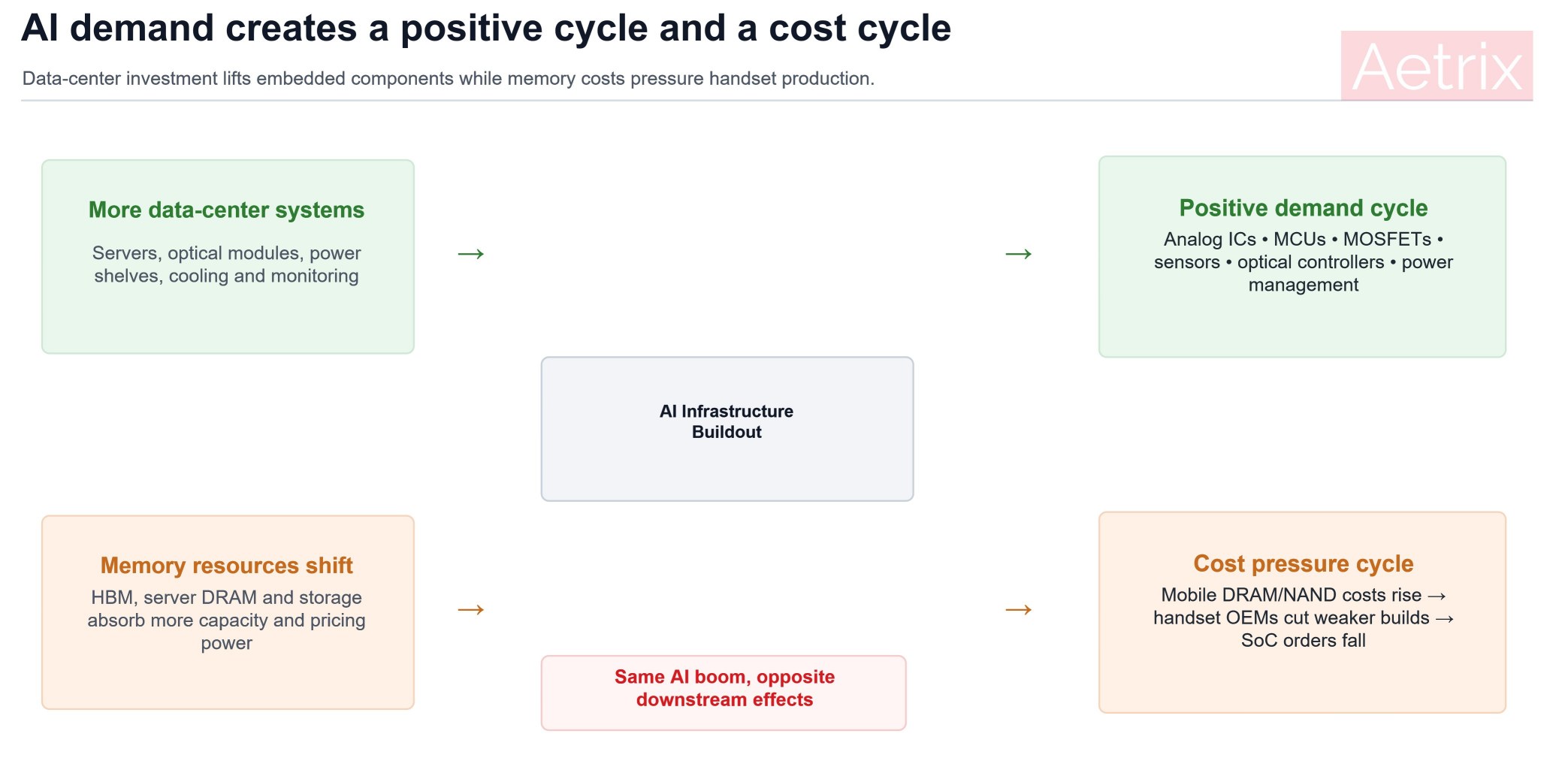
AI demand connects the rising and falling sides of the semiconductor market.
Data-center operators are buying more HBM, server DRAM, storage and advanced packaging capacity. Memory suppliers are directing more investment and production resources toward higher-value AI products.
Smartphone manufacturers are seeing higher costs for mobile DRAM and NAND storage. These components make up a meaningful part of a phone's bill of materials.
A phone manufacturer has four main choices when memory costs rise:
- increase the retail price;
- reduce memory or storage specifications;
- accept a lower profit margin;
- reduce production of less profitable models.
Many brands are choosing the fourth option for weaker mid-range and entry-level models. Fewer phones produced means fewer application processors and modem chips ordered from Qualcomm and MediaTek.
At the same time, AI data-center construction increases demand for analog, power, MCU and connectivity products from TI, ST, ADI and Infineon.
The Two Groups Also Use Different Manufacturing Models
Most broad-market analog and MCU suppliers sell thousands of products to a large number of customers.
Demand is spread across factories, vehicles, appliances, servers, medical equipment and infrastructure. A decline in one market can be offset by growth in another.
Many of these devices use mature wafer processes. Production capacity changes slowly, and customers often need months to approve an alternative. When demand returns after a long inventory correction, selected parts can tighten quickly.
Smartphone SoCs are usually built on advanced process nodes at external foundries. The products are produced in high volume for a limited number of phone platforms.
The advanced-node supply chain may have enough wafer capacity, but an OEM production cut can immediately reduce SoC orders. The supplier cannot easily redirect a smartphone processor to an industrial or automotive customer because the chip was designed for a specific mobile platform.
This explains why older analog and MCU products can see longer lead times while highly advanced smartphone SoCs face lower shipments.
What the Split Market Means for Component Buyers
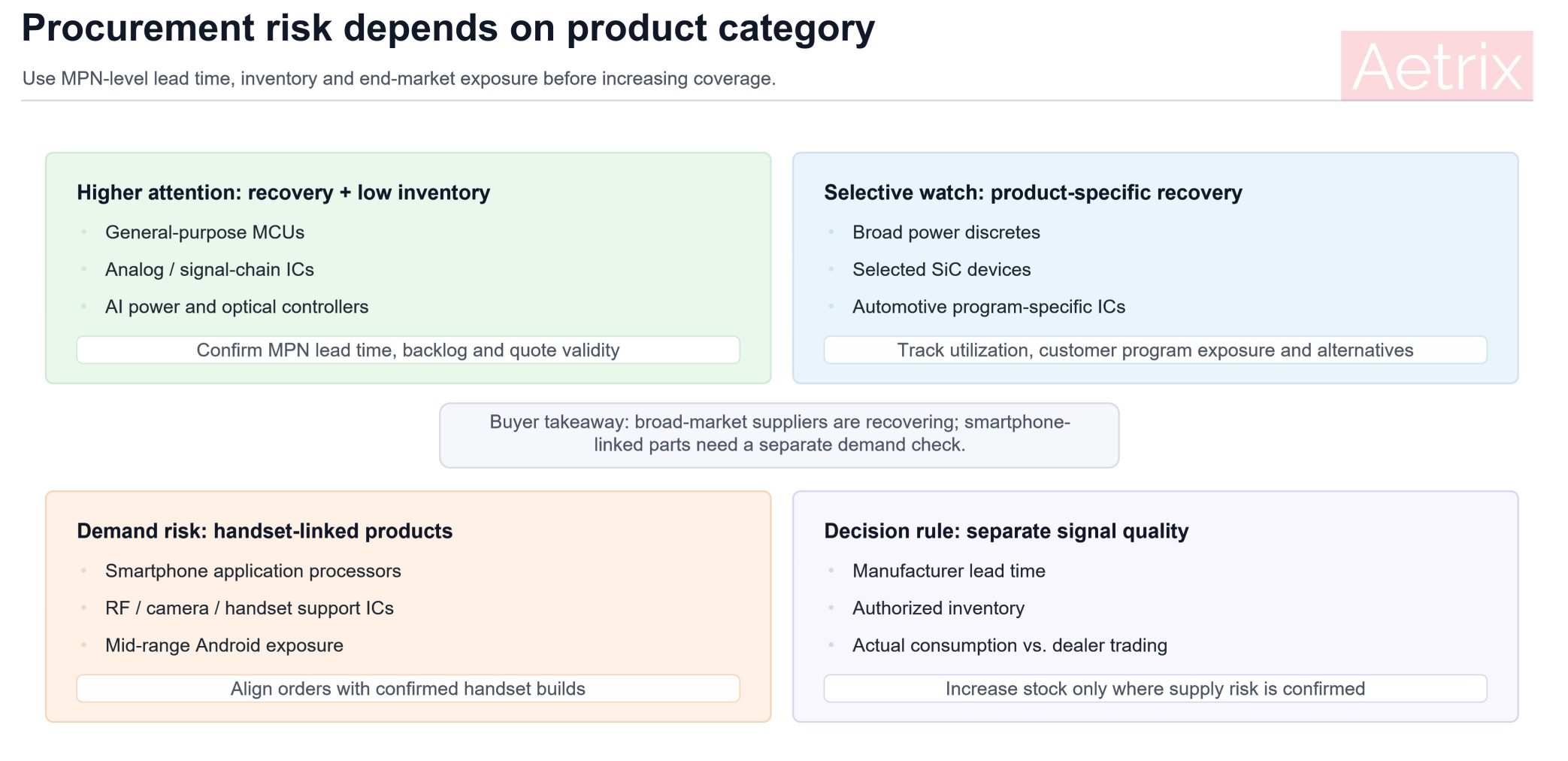
Buyers need to evaluate semiconductor risk by product category rather than by the overall direction of the chip market.
For analog, MCU, power-management and embedded products, the main indicators are factory lead time, authorized-distributor inventory, backlog confirmation and changes in commercial terms.
A revenue increase at TI or ST is an early warning that customer ordering has improved. Risk becomes more immediate when a specific MPN also shows lower channel inventory, shorter quote validity, higher MOQ or delayed factory confirmation.
Products used in both AI infrastructure and industrial systems deserve closer attention. Optical-module controllers, power-supply ICs, current-sense amplifiers, voltage regulators, gate drivers and thermal-monitoring devices can receive demand from several growing markets at the same time.
Standard products with several approved alternatives require less inventory protection. Devices tied to one process, package or customer qualification may need longer purchasing coverage.
The smartphone supply chain requires a different approach. Falling SoC shipments can create excess inventory in supporting products used mainly in mid-range Android devices. Display drivers, RF front-end components, camera ICs and power-management devices with heavy handset exposure may not follow the same recovery as industrial analog products.
Qualcomm and MediaTek are also raising their exposure to automotive, IoT, edge computing and data centers. Procurement forecasts need to separate their handset products from these growing businesses.
| Product Group | Current Buyer Signal | Recommended Action |
|---|---|---|
| General-purpose MCUs | Demand recovery and lower distributor inventory | Review MPN-level lead times and increase coverage for approved high-use parts |
| Analog and signal-chain ICs | Strong industrial and communications bookings | Identify single-source and package-specific exposure |
| AI power and optical components | Strong project demand and longer planning cycles | Confirm backlog, allocation rules and long-term forecast requirements |
| Broad power discretes | Mixed utilization and product-specific recovery | Avoid applying AI-related tightness to the entire category |
| Smartphone application processors | Lower unit shipments and reduced OEM production plans | Align orders closely with confirmed handset builds |
| Handset support ICs | Risk varies by phone tier and customer program | Separate premium, mid-range and entry-level exposure |
Outlook for the Rest of 2026
The most likely second-half pattern is continued recovery for broad-market semiconductor suppliers and continued pressure on smartphone SoC volumes.
Industrial and distributor replenishment can support analog and MCU demand through the rest of the year. AI data-center construction will continue to add demand for power, optical, control and monitoring components.
Price and lead-time pressure will remain concentrated in products where low channel inventory meets limited manufacturing flexibility. Broad supplier-wide shortages are less likely while several power and automotive categories still have available capacity.
Smartphone SoC demand depends on memory costs and handset production plans. A decline in memory prices would give phone manufacturers more room to rebuild production. Continued high memory costs would keep pressure on mid-range Android devices and the SoC suppliers serving them.
Qualcomm and MediaTek are becoming less dependent on phones. Automotive, IoT, edge computing, connectivity and data-center ASICs are growing. Their total company results can improve even while smartphone processor shipments remain weak.
The semiconductor market in 2026 is best understood through end-market exposure. Suppliers selling into industrial systems, data centers and embedded equipment are moving through an inventory-led recovery. Suppliers tied closely to smartphone production are facing a unit-demand and cost problem.
Key Takeaways
- The semiconductor market is running through two different cycles in 2026.
- TI, ST, ADI, Microchip, Diodes, onsemi, Infineon and Renesas are benefiting from lower customer inventory and improving demand.
- Industrial replenishment, automotive projects and AI infrastructure are supporting analog, MCU, power and embedded products.
- Supply pressure remains product-specific and is strongest where channel inventory is low and alternatives are limited.
- Global smartphone SoC shipments fell 15% year over year in the first half of 2026.
- Qualcomm handset revenue declined 13%, while MediaTek's mobile-phone business declined 20%.
- Higher memory costs are causing smartphone manufacturers to reduce production of less profitable models.
- AI demand supports broad-market chip suppliers while creating memory-cost pressure for mass-market smartphones.
- Qualcomm and MediaTek continue to grow in automotive, IoT, edge computing and data-center products.
- Buyers need to track risk by MPN and end market instead of treating the semiconductor industry as one uniform cycle.