My Inquiry
 My Account


STM32 supply conditions have tightened again since our July update. Selected STM32H7 devices that were previously planned around a roughly 30-week family-level lead time are now showing standard lead times of 52 weeks, while some new production orders face later scheduling or allocation uncertainty.
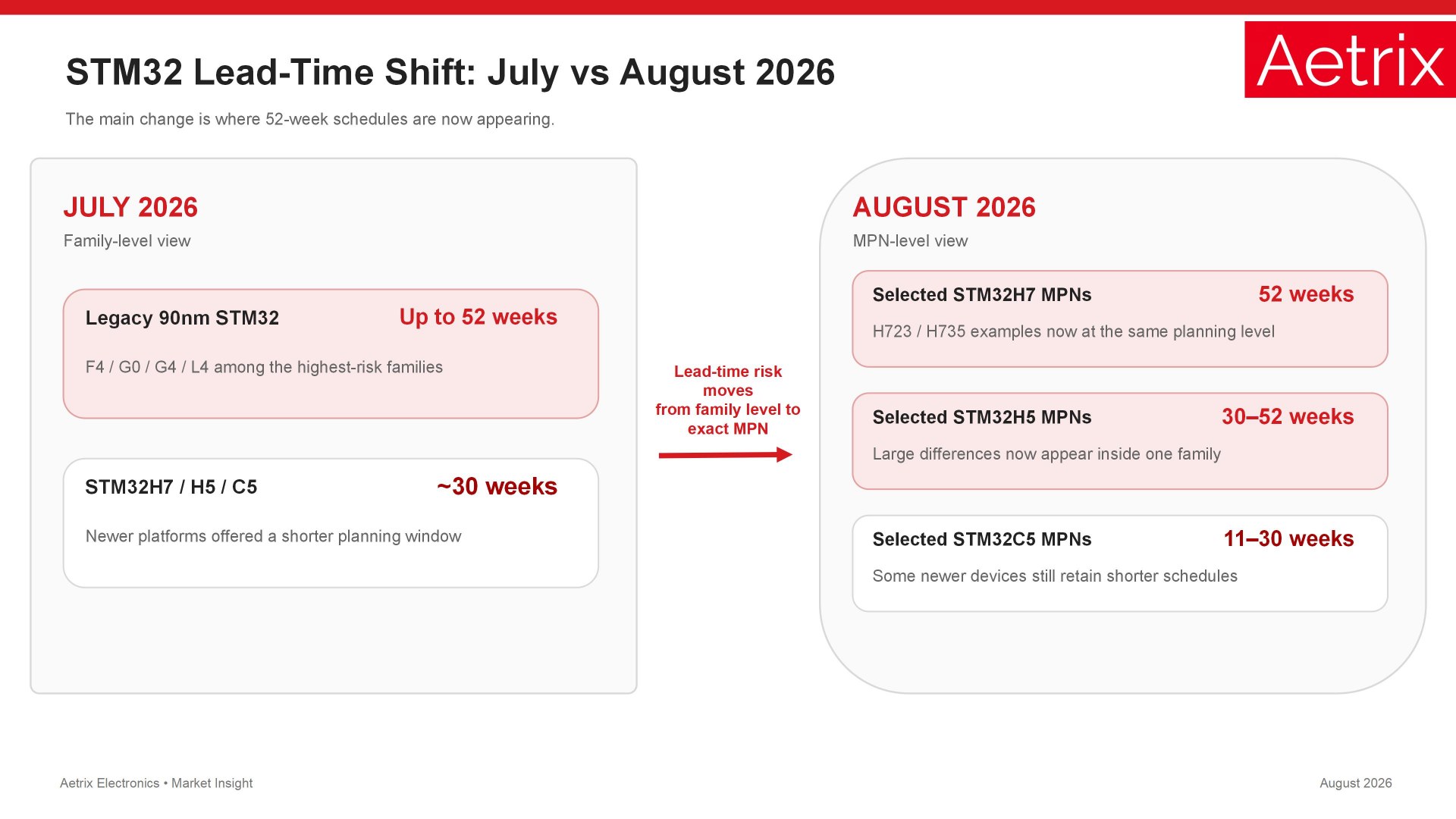
The location of the pressure has changed. In July, the longest schedules were concentrated mainly in older 90nm STM32 families. H7, H5 and C5 still offered a shorter planning window and were part of ST's migration path for customers moving away from constrained legacy devices.
That distinction is becoming less useful. Current channel data shows 52-week schedules on selected H7 and H5 orderable part numbers, while other devices in the same families remain at 30 weeks or less. Procurement risk is moving from the family level down to the exact MPN, package and customer allocation position.
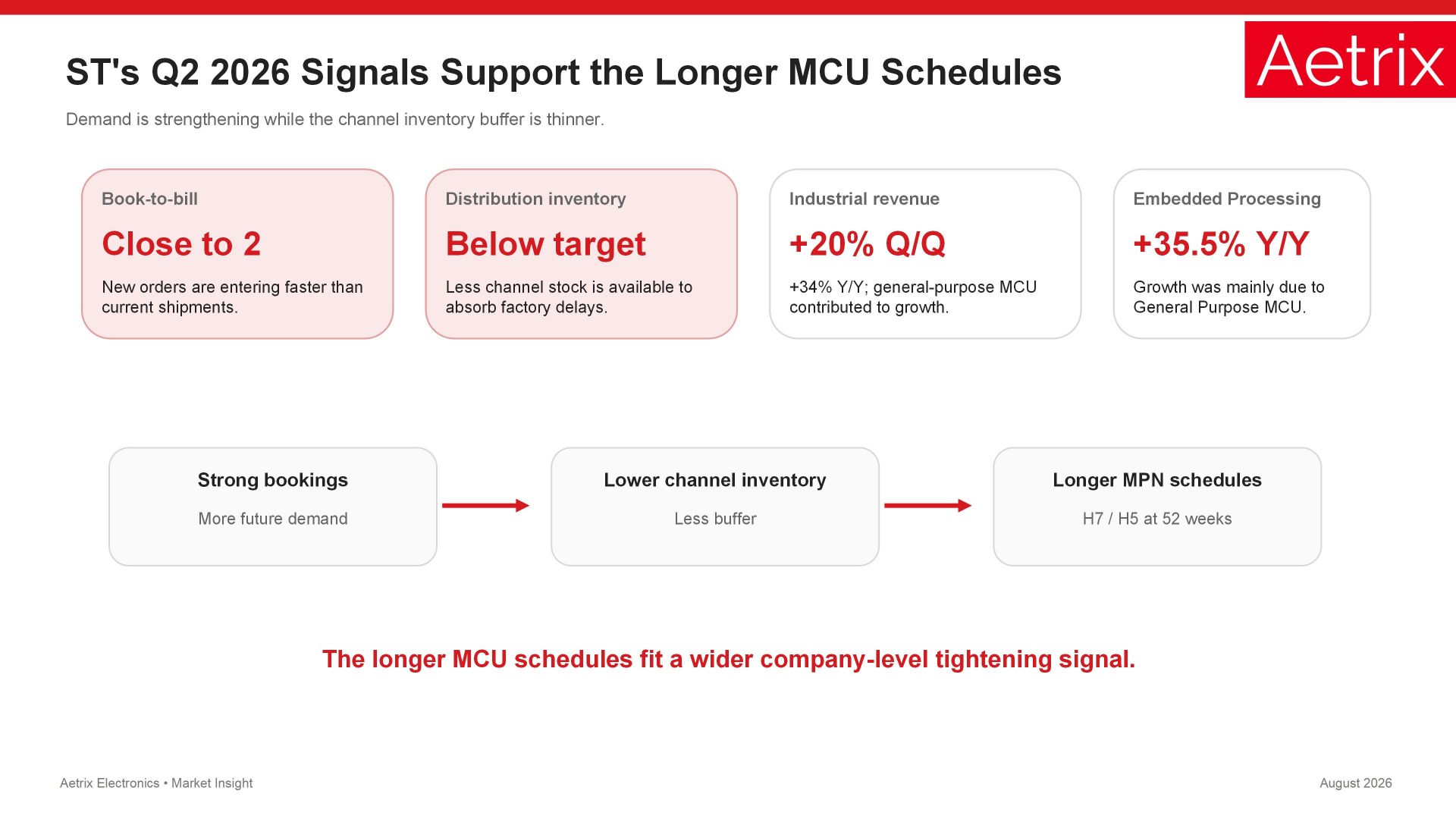
ST's own second-quarter results point in the same direction. The company reported strong bookings, an overall book-to-bill ratio close to 2, signs of tight supply in several product categories, and distribution inventory below its standard target. (STMicroelectronics, Q2 2026 Earnings Results)
Selected STM32H7 MPNs Have Reached 52 Weeks
Our July 11 supply-chain update showed several mainstream 90nm STM32 families moving toward 52-week planning lead times, while H7, H5 and C5 were still around 30 weeks at the family level. ST was also encouraging customers using selected older platforms to evaluate newer 40nm MCU families. (Aetrix Electronics, STMicroelectronics MCU Lead Times July 2026)
Current authorized-channel data reviewed by Aetrix Electronics shows that several H7 orderable part numbers have now reached the same 52-week standard lead-time level.
| MPN | Family | Package | Current Standard Lead Time |
|---|---|---|---|
| STM32H723VGT6 | STM32H7 | LQFP-100 | 52 weeks |
| STM32H723VGH6 | STM32H7 | TFBGA-100 | 52 weeks |
| STM32H735IGK6 | STM32H7 | UFBGA-176 | 52 weeks |
Those figures refer to new factory supply. Existing authorized inventory may still be available for the same devices, so an H7 part can be in stock today while factory replenishment carries a one-year schedule.
For a production buyer, the replenishment number is the more important one. Existing inventory can cover an urgent build, but it does not show how quickly the next several thousand units can be replaced after that stock is consumed.
The Pressure Is No Longer Limited to Legacy STM32 Families
In July, one practical way to think about STM32 supply risk was by process generation. Older 90nm families carried the greatest exposure, while H7 and H5 provided more supply flexibility.
August data shows a more fragmented picture.
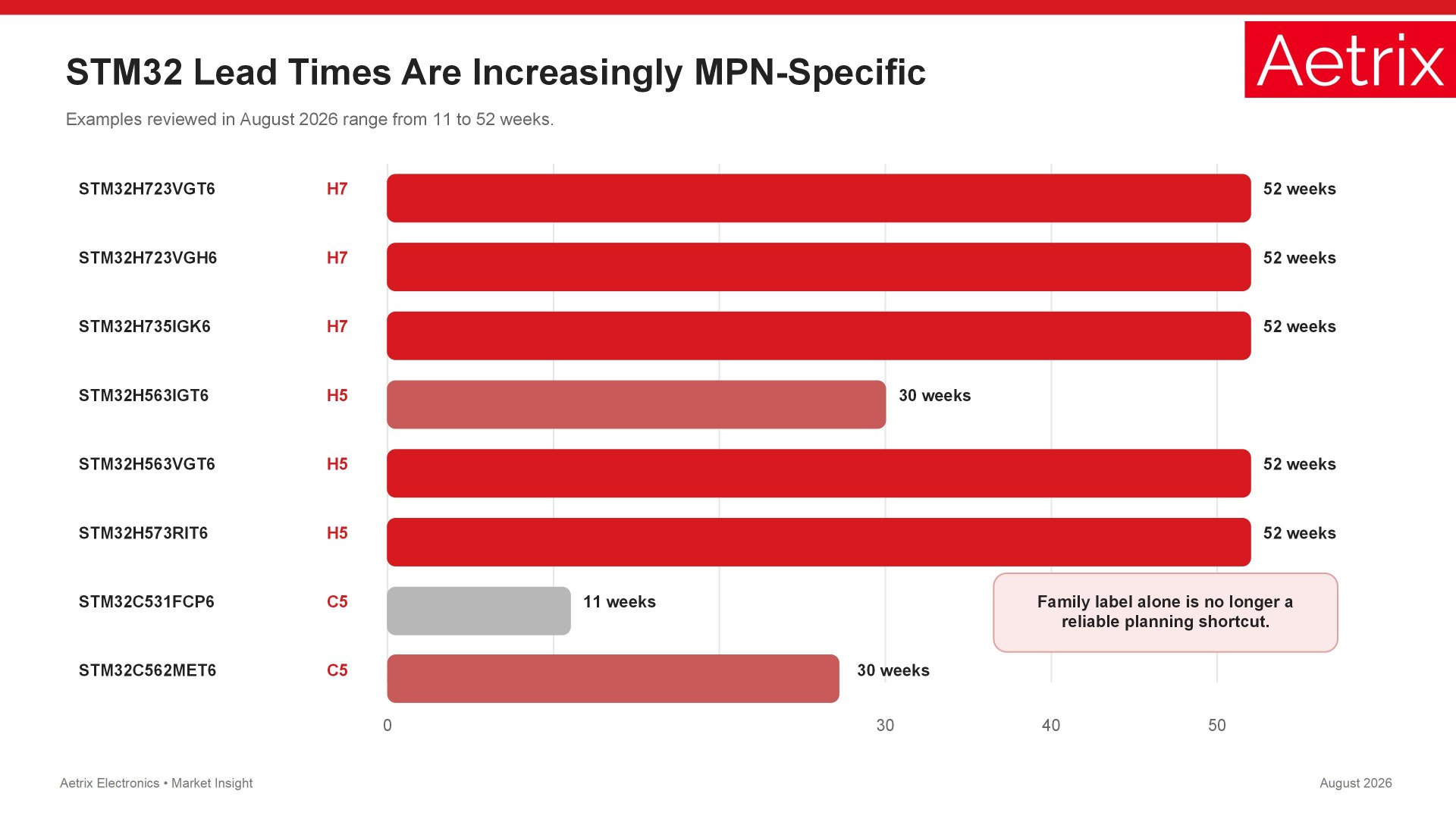
Selected H5 parts are now also listed at 52 weeks, while other H5 devices remain around 30 weeks. C5 shows an even wider range, with some orderable parts still carrying much shorter schedules.
| Example MPN | Family | Package | Standard Lead Time |
|---|---|---|---|
| STM32H563IGT6 | H5 | LQFP-176 | 30 weeks |
| STM32H563VGT6 | H5 | LQFP-100 | 52 weeks |
| STM32H573RIT6 | H5 | LQFP-64 | 52 weeks |
| STM32C531FCP6 | C5 | TSSOP-20 | 11 weeks |
| STM32C562MET6 | C5 | LQFP-80 | 30 weeks |
A buyer planning around "H5 at 30 weeks" can therefore be badly wrong even when the family-level assumption was reasonable only a few weeks earlier. The complete orderable part number now matters more than the family label.
Newer platforms still have a better long-term manufacturing path in many cases, but migration alone no longer removes short-term supply risk. Before approving a new design, engineering and procurement teams need to check the exact package and MPN rather than assume that every H7, H5 or C5 part shares the same availability.
Package Still Matters, but It Does Not Explain the Entire Increase
Recent channel scheduling feedback continues to show package-related differences. High-density BGA devices can face additional assembly and test constraints, and industrial variants may move through different backend schedules from higher-volume versions.
The public lead-time picture is broader than a simple BGA bottleneck, however. STM32H735IGK6 in UFBGA-176 is at 52 weeks, but STM32H723VGT6 in LQFP-100 is also at 52 weeks. H5 shows the same pattern, with long schedules appearing in more than one package type.
Package selection can still improve or worsen supply exposure, especially when two package options use different assembly and test capacity. It should be treated as one variable among several, together with die configuration, temperature grade, customer backlog and allocation.
ST's Q2 Data Explains Why MCU Lead Times Are Moving Higher
The longer H7 and H5 schedules are appearing against a much stronger demand backdrop than earlier in the year.
ST said Q2 demand increased further, bookings were strong and its overall book-to-bill ratio was close to 2. The company was above 1 across all end markets and also reported tight-supply signals in several product categories. (STMicroelectronics, Q2 2026 Earnings Results)
Channel inventory has tightened at the same time. ST described distribution inventory as normalized in Q1. By Q2, distribution inventory had fallen further and was below the company's standard target. (STMicroelectronics, Q1 2026 Financial Results)
Industrial demand is particularly relevant to STM32. ST's Industrial revenue increased 20% sequentially and 34% year over year in Q2, with general-purpose microcontrollers contributing to the growth. Embedded Processing revenue increased 35.5% year over year, mainly due to General Purpose MCU. (STMicroelectronics, Q2 2026 Earnings Results)
| ST Q2 Signal | Reported Position | MCU Supply Implication |
|---|---|---|
| Book-to-bill | Close to 2 overall | New orders are entering faster than current shipments |
| Distribution inventory | Below standard target | Less channel stock is available to absorb factory delays |
| Industrial revenue | +20% Q/Q, +34% Y/Y | Demand is strengthening in a major general-purpose MCU market |
| Supply visibility | Tight-supply signs in several categories | Longer MCU schedules fit a wider company-level supply trend |
A 52-Week Lead Time Is Increasingly an Allocation Question
The July distributor communication asked channel partners to obtain full-year 2027 customer orders, giving ST earlier visibility into future demand. Recent supply-chain feedback reviewed by Aetrix indicates that this forward demand visibility is now playing a larger role in production scheduling.
Customers with established backlog and a documented 2027 production forecast generally have better visibility into future allocation than a customer placing a new volume order without an existing framework. Two companies ordering the same STM32 MPN can therefore receive very different scheduling responses.
For constrained parts, a quoted 52-week standard lead time may still sit alongside an unconfirmed factory date or allocation conditions. Some new orders are being scheduled beyond the nominal planning window when capacity has not yet been assigned.
Procurement teams should therefore separate the published lead time from the actual order position. The useful questions are whether capacity has been allocated, how much volume is covered, which shipment dates are factory-confirmed, and how the customer's 2027 forecast is represented in ST's planning system.
A confirmed allocation for 5,000 units in a required production month is more useful than a generic 52-week lead-time figure with no firm shipment commitment behind it.
Current Stock and Factory Replenishment Are Moving Apart
Some STM32H7 devices carrying 52-week standard lead times can still be purchased from existing distribution inventory. That stock can be enough for engineering builds, service demand or a short production run.
The situation changes for a program consuming several thousand devices each month. A distributor may be able to supply the first order from inventory while the next factory replenishment remains many months away.
For that reason, buyers should track immediate stock and future replenishment separately. Current stock answers whether material can ship today. Factory backlog and confirmed delivery dates show whether the same supply can be repeated next quarter.
The second issue is becoming more important for H7 production programs as standard factory schedules move toward 52 weeks.
What Has Changed Since the July STM32 Lead-Time Update?
| July 2026 | August 2026 |
|---|---|
| 52-week schedules concentrated mainly in older 90nm STM32 families | Selected H7 and H5 MPNs also show 52-week standard lead times |
| H7/H5/C5 family reference was around 30 weeks | Newer families now show wide MPN-level differences |
| Migration to newer platforms reduced planning exposure | Every migration candidate now needs its own supply check |
| Lead-time planning was the main concern | Allocation and confirmed ship dates now matter just as much |
| Distribution inventory had normalized earlier in the year | ST now reports distribution inventory below its standard target |
The August picture is more difficult to manage because the shortage signal is no longer concentrated neatly by process node or product family. An STM32 family can contain both relatively manageable and highly constrained orderable parts at the same time.
What STM32 Buyers Should Do Now
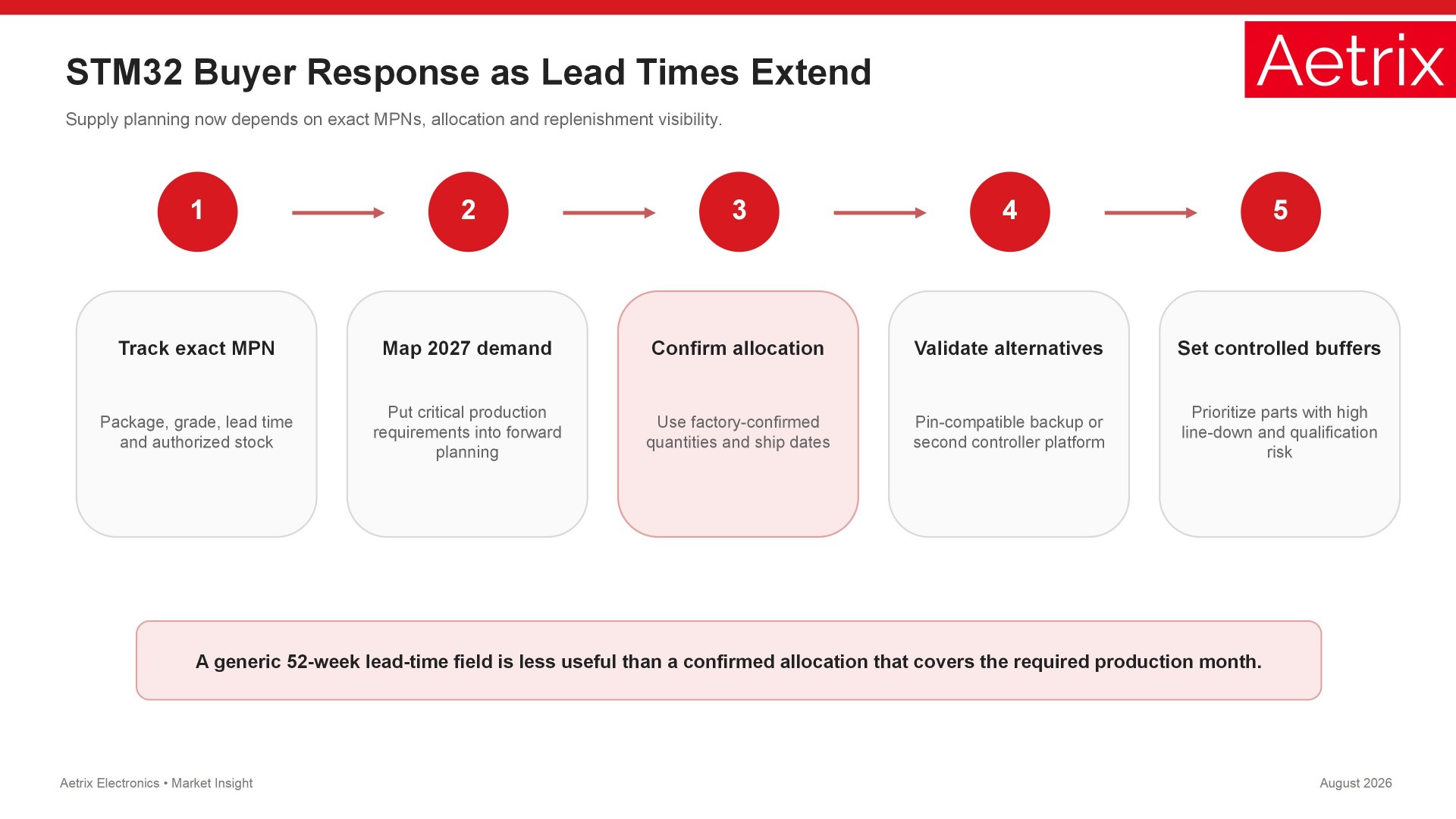
Production planning should start with the complete orderable MPN. Package, temperature grade and specific configuration now matter enough that a family-level estimate can easily understate the real schedule. Critical BOM items should be reviewed against three separate numbers: current authorized inventory, new factory lead time and confirmed backlog.
Existing STM32 programs with limited substitution options also need a clearer 2027 demand picture. Current channel feedback favors customers with established backlog and longer-range forecasts, so waiting until existing stock is nearly exhausted can leave the order much further back in the production queue. A factory-confirmed shipment schedule should carry more weight in the build plan than a generic lead-time field.
Alternative-controller work is another area where earlier preparation matters. Some industrial manufacturers now maintain a second validated controller option for products where an MCU shortage would stop a high-value production line. In some designs, the backup is a pin-compatible MCU that can use the same PCB with software changes prepared in advance. Other companies maintain two separate PCB and firmware versions of the same product and switch production according to component availability.
The second approach is expensive. Firmware has to be maintained twice, qualification work increases, and products that depend heavily on STM32-specific peripherals or software may be difficult to move. For lower-volume equipment, validating one realistic alternate MPN in advance is often a better use of engineering resources.
Inventory policy should follow the same risk ranking. An H7 device with no qualified alternative, a long customer approval cycle and a 52-week replenishment schedule deserves more safety coverage than an MCU with several proven substitutes. Existing spot inventory can be used to bridge a gap, but it should not become the basis for a long-term production forecast.
What Would Confirm Further STM32 Supply Tightening?
The next meaningful signal would be broader movement across the portfolio. If more H7 and H5 orderable parts reach 52 weeks while currently shorter C5 devices also begin extending, the present MPN-level pressure would be developing into a wider STM32 supply problem.
Channel inventory will be equally important. Longer factory schedules become much harder for buyers to absorb when authorized stock on the same MPN is falling. Factory-confirmed dates moving deeper into 2027, tighter quote validity, more NCNR or allocation conditions and rising spot premiums would add further evidence that the pressure is moving beyond isolated parts.
ST's Q2 numbers already provide two of those signals: bookings are running well ahead of shipments, and distribution inventory is below the company's standard target. The move to 52 weeks on selected H7 and H5 parts adds another.
The practical change since July is therefore larger than another increase in a published lead-time number. Supply planning can no longer rely on a simple distinction between constrained legacy STM32 families and newer H7/H5/C5 platforms. Exact MPN availability, confirmed allocation and replenishment visibility now determine the real exposure.
If the 52-week schedules remain limited to selected orderable parts, the current problem will stay manageable through tighter planning and allocation. If the same pattern spreads across more H7, H5 and C5 devices while channel inventory continues to fall, buyers will be dealing with a broader STM32 supply cycle rather than a handful of isolated long-lead-time parts.