My Inquiry
 My Account


The next foundry capacity cycle is already visible. From the second half of 2026 through 2027, several wafer foundries are scheduled to move equipment into new fabs, begin pilot production, or ramp new capacity across both advanced and mature process nodes.
For buyers, however, the most important question is not whether new fabs are being built. The real question is when that capacity becomes usable supply. Equipment move-in, risk production, customer qualification, yield ramp and stable volume output are different stages. Treating them as the same thing can lead to a false expectation that semiconductor lead times will improve as soon as a new factory is announced.
The 2026–2027 foundry expansion cycle will not affect all markets equally. Advanced-node capacity at 3nm, 4nm and Intel 18A is likely to remain tight because much of the early output is tied to AI, cloud, automotive and large strategic customers. Mature-node capacity at 22nm, 28nm and 40nm may improve earlier, but the relief will be gradual and uneven.
Key Findings:
- 2026 H2 is mostly an equipment move-in, pilot production and early ramp period, not a broad supply relief window.
- 2027 is the main year when new foundry capacity may begin to affect semiconductor lead times.
- Advanced-node capacity will remain concentrated around AI, HPC, cloud ASIC and automotive AI customers.
- Mature-node capacity should improve earlier, especially in 22nm, 28nm and 40nm specialty processes.
- Buyers should distinguish nominal wafer capacity from effective capacity available to the open market.
2026–2027 Foundry Capacity Timeline
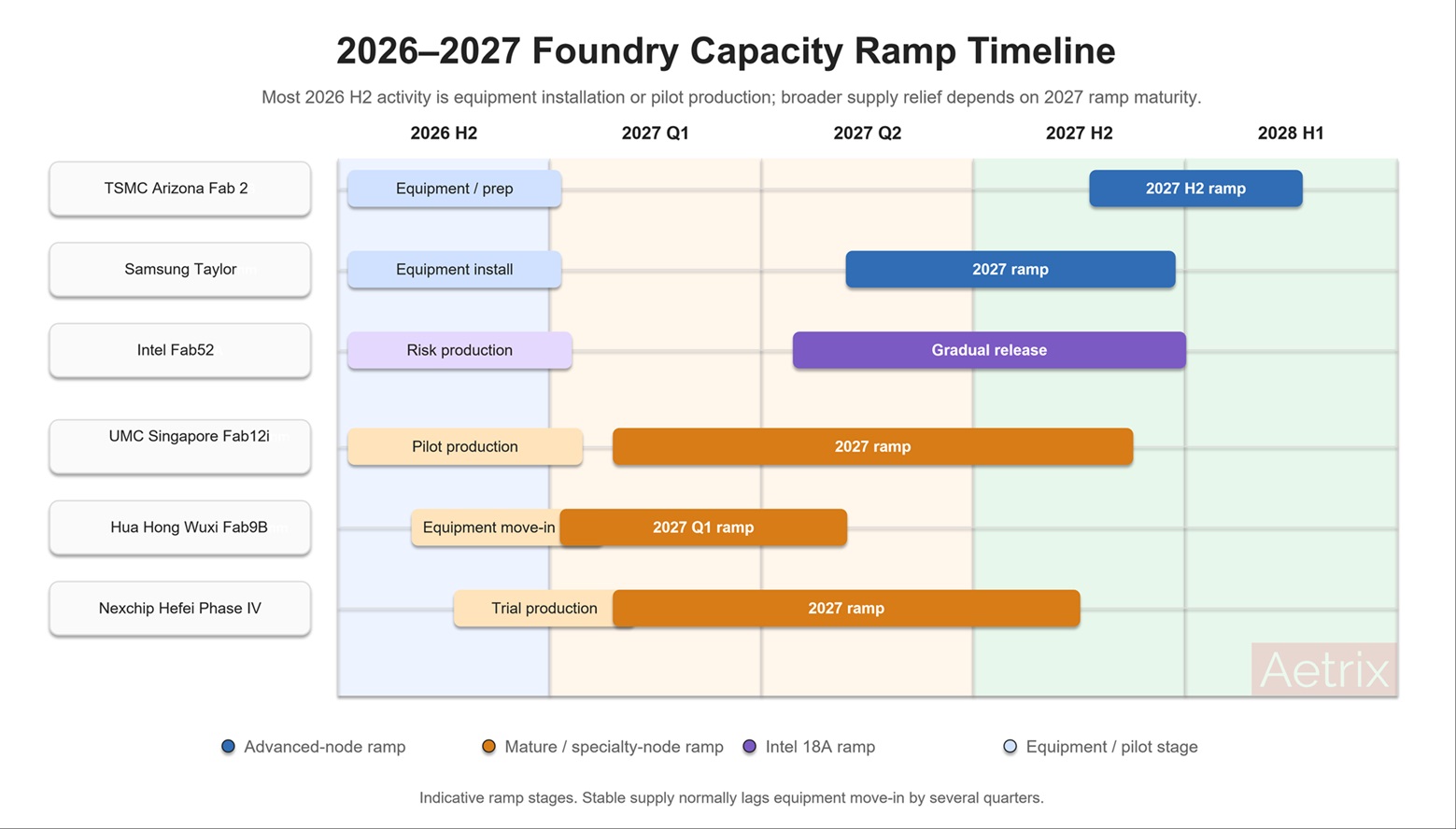
The next major foundry capacity additions are split between advanced fabs in the United States and mature-node expansions in Asia. TSMC's second Arizona fab targets N3 volume production in the second half of 2027, while Samsung's Taylor site is part of the company's plan to expand advanced-node capacity in the United States. UMC's Singapore expansion adds 22nm and 28nm capacity, and Chinese foundries such as Hua Hong and Nexchip are expanding capacity for mature and specialty processes.
| Foundry | Fab / Location | Stage in 2026 H2 | Stable Ramp Window | Process Node | Planned Capacity |
|---|---|---|---|---|---|
| TSMC | Arizona Fab 2 | Equipment installation / ramp preparation | 2027 H2 | N3 / 3nm | Initial capacity expected to ramp gradually |
| Samsung Foundry | Taylor, Texas | Equipment installation / early readiness | 2027 ramp | 4nm / 3nm | Advanced-node capacity expansion |
| UMC | Singapore Fab12i expansion | Pilot / early volume transition | 2027 ramp | 22nm / 28nm | 30,000 wafers per month in first phase |
| Hua Hong Semiconductor | Wuxi Fab9B | Equipment move-in expected | 2027 Q1 onward | 22nm / 40nm specialty | Mature-node specialty capacity |
| Nexchip | Hefei Phase IV | Construction / trial production preparation | 2027 ramp | 28nm / 40nm | 55,000 wafers per month planned |
| Intel Foundry | Arizona Fab52 | 18A production ramp / internal product focus | 2027 gradual external availability | Intel 18A | Primarily tied to internal and strategic programs initially |
TSMC states that its first Arizona fab began high-volume production on N4 in the fourth quarter of 2024, while the second fab targets N3 volume production in the second half of 2027 (TSMC Arizona, Key Milestones). UMC's Singapore expansion is designed for 22nm and 28nm technologies, with the first phase planned for 30,000 wafers per month (Singapore EDB, UMC Singapore Fab Expansion).
Equipment Move-In Is Not the Same as Effective Capacity
The market often counts new fab capacity too early. A wafer fab can be structurally complete and still be many months away from stable customer supply. Equipment must be installed, calibrated and qualified. Process recipes need tuning. Customers must validate the node. Yield must climb before commercial volume becomes meaningful.
This is why 2026 H2 should be treated as a preparation window for many new fabs. A fab that receives tools in late 2026 may not provide stable supply until mid or late 2027. In advanced nodes, the ramp can be slower because the process technology is more complex and customer qualification is more demanding.
| Stage | What It Means | Buyer Interpretation |
|---|---|---|
| Equipment move-in | Tools are installed inside the fab | Not yet meaningful commercial supply |
| Risk production | Early wafers are produced for process validation | Useful signal, but not broad availability |
| Customer qualification | Customers validate design, reliability and yield | Lead time relief depends on approval speed |
| Yield ramp | Output improves as process stability increases | Supply improves gradually, not immediately |
| Stable volume supply | Fab output becomes commercially reliable | This is the stage that can reduce lead times |
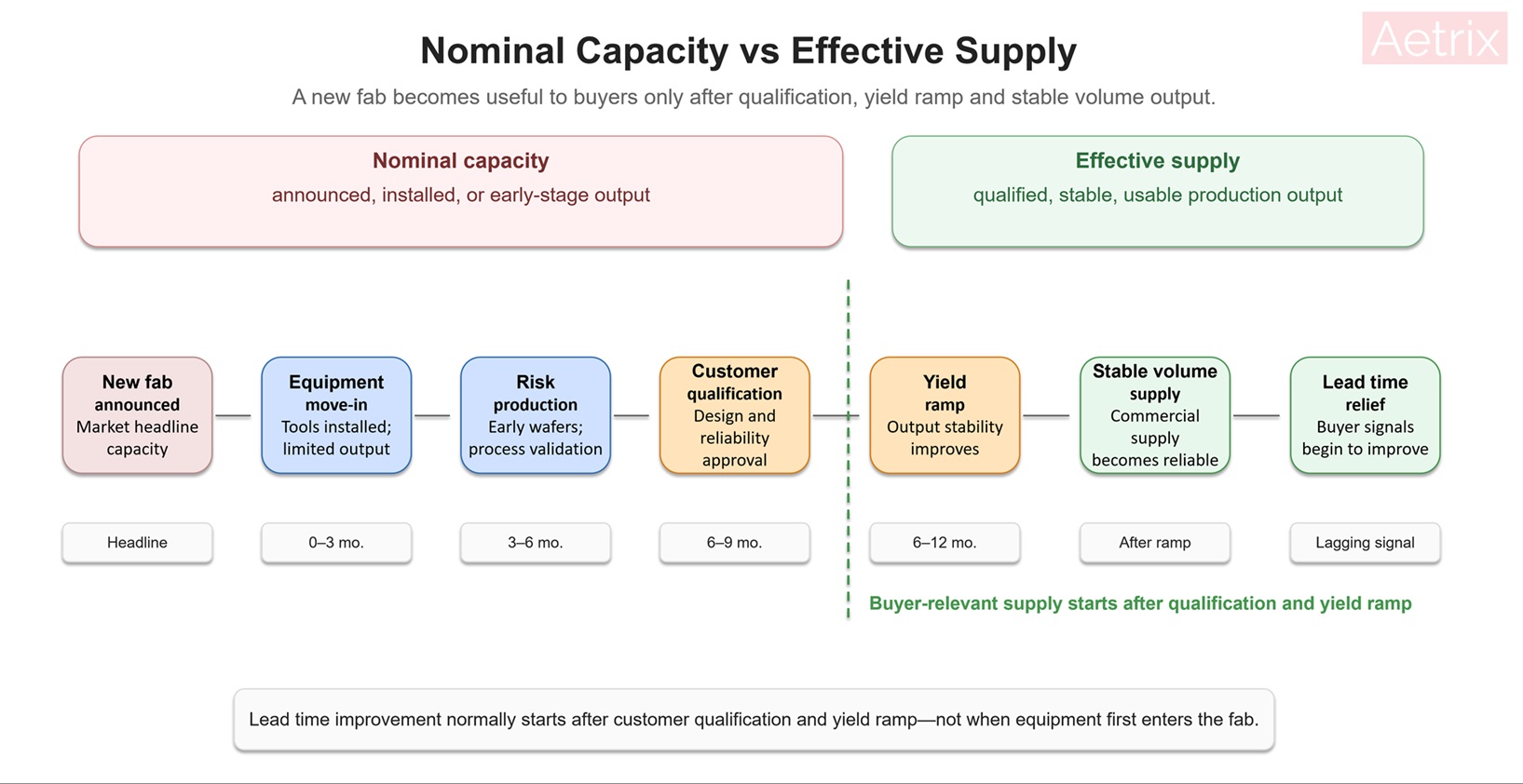
For procurement teams, this distinction is critical. A new fab entering the equipment stage may reduce long-term supply risk, but it does not immediately shorten semiconductor lead times. Lead time improvement usually begins only when stable output reaches customers beyond the first anchor accounts.
Advanced Nodes Will Stay Tight Longer
The most visible advanced-node capacity additions are in the United States. TSMC's Arizona Fab 2 is planned for N3 production. Samsung Taylor is positioned as part of Samsung Foundry's advanced-node capacity expansion. Intel's Arizona Fab52 is tied to Intel 18A, with Intel highlighting Panther Lake and Clearwater Forest as major products manufactured on the node (Intel Newsroom, Panther Lake on Intel 18A).
Even when this capacity ramps, the open-market impact may be limited. AI accelerators, data center processors, cloud ASICs, automotive AI chips and flagship computing platforms are usually supported by long-term capacity planning. Early wafers from new advanced fabs are more likely to be allocated to strategic customers than to broad spot-market demand.
| Foundry | Node | Likely Demand Drivers | Supply Chain Impact |
|---|---|---|---|
| TSMC Arizona Fab 2 | 3nm / N3 | AI GPU, HPC, data center processors and advanced U.S. customer demand | Adds U.S.-based advanced capacity, but early availability may remain concentrated |
| Samsung Taylor | 4nm / 3nm | Automotive AI chips, inference accelerators, mobile SoCs and HPC applications | Adds an alternative advanced foundry source in the U.S. |
| Intel Fab52 | Intel 18A | AI PC, server CPU and strategic foundry programs | Important for U.S. advanced-node diversification, but external availability may ramp gradually |
Samsung has described plans to expand advanced-node capacity and included Taylor, Texas among its foundry manufacturing locations (Samsung Global Newsroom, Foundry Capacity Strategy). But like other advanced-node ramps, the capacity path from facility readiness to broad customer availability will depend on tool installation, yield, customer design qualification and demand allocation.
The result is that advanced-node semiconductor lead times may remain long through much of 2027. New capacity will help, but it is unlikely to create immediate broad relief for smaller fabless companies or buyers outside strategic customer programs.
Mature Nodes May See Earlier Relief
The mature-node side of the market may improve earlier because new 22nm, 28nm and 40nm capacity is closer to mainstream industrial, display, power management, CIS and IoT demand. UMC Singapore, Hua Hong Wuxi and Nexchip Hefei are especially relevant for buyers watching mature-node supply.
UMC's Singapore expansion is aimed at 22nm and 28nm products used in communications, IoT, automotive and AI-related applications. Nexchip's Phase IV project is designed around 40nm and 28nm processes for CIS, OLED and logic processes, with planned capacity of 55,000 wafers per month according to TrendForce's report on China's foundry expansion (TrendForce, China Foundry Expansion).
| Period | Mature-Node Supply Condition | Likely Impact on Buyers |
|---|---|---|
| 2026 H2 | Ramp begins, but output is limited or still in pilot stage | Little immediate relief for most production buyers |
| 2027 Q1 | Early output from mature-node lines begins to enter supply chains | Some relief for consumer, DDI, CIS and standard IC categories |
| 2027 Q2–Q4 | Capacity ramps toward higher utilization | Lead times may improve for non-locked customers and standard parts |
| 2028 H1 | More fabs approach stable volume output | Broader normalization becomes more realistic |
The key distinction is that mature-node capacity is more likely to reach a wider customer base than early advanced-node capacity. However, the improvement will still be uneven. Automotive-grade and industrial-grade products may remain tight longer because they require qualification, long product lifecycles and stable supply agreements.
Who Benefits First From New Capacity?
New foundry capacity does not enter the market evenly. The first beneficiaries are usually long-term anchor customers that helped justify the fab investment or signed capacity commitments. Strategic automotive, cloud, AI and regional customers may also receive priority. Smaller fabless companies and open-market demand usually benefit later, after utilization stabilizes and more capacity becomes available outside committed programs.
Representative Brands Behind the New Capacity Cycle
New foundry capacity is usually absorbed first by customers with long-term commitments, strategic product roadmaps or large-volume platform demand. The following table shows representative brands and demand areas that may benefit earlier from the 2026–2027 foundry ramp cycle. These examples should be read as market-facing demand groups, not as a confirmation that every brand has formally locked capacity at every fab.
| Capacity Layer | Representative Brands | Main Product Direction | Why They Benefit Earlier |
|---|---|---|---|
| Advanced AI / HPC capacity | NVIDIA, AMD, Apple, Google, Amazon AWS, Microsoft Azure, Meta | AI GPUs, data center processors, cloud ASICs, flagship SoCs | Large-volume demand, long-term capacity planning and strategic foundry relationships |
| Automotive AI and edge inference | Tesla, Groq, Samsung Exynos-related platforms | Autonomous driving chips, inference accelerators, mobile and edge AI processors | High-value products are more likely to receive early advanced-node allocation |
| Mature-node automotive and industrial ICs | STMicroelectronics, Infineon, TI, NXP, Renesas | MCUs, PMICs, power management ICs, industrial control chips | Automotive and industrial customers usually require qualified, stable long-term supply |
| Display driver and image sensor supply chain | Chipone Technology, Fitipower, SmartSens, GalaxyCore, OmniVision, BOE | DDI, OLED display driver ICs, CIS image sensors, panel-related chips | 28nm and 40nm capacity additions can reach these markets earlier than advanced-node AI capacity |
| Open-market and smaller fabless customers | Smaller MCU, IoT, power IC and specialty logic suppliers | Standard logic, IoT chips, power ICs, consumer and industrial components | They usually benefit later, after anchor customers and strategic accounts absorb early capacity |
The brand examples show why the first wave of new capacity does not always translate into immediate supply relief for ordinary buyers. Advanced-node customers often have stronger long-term commitments, while mature-node customers may see relief earlier only when the new lines move beyond pilot production and customer qualification.
| Customer Type | Access to New Capacity | Lead Time Improvement |
|---|---|---|
| Long-term anchor customers | Highest priority | Earliest benefit, especially in advanced nodes |
| Automotive / cloud strategic accounts | High priority | Gradual improvement as qualified output ramps |
| Mid-size fabless companies | Limited early access | More visible in late 2027 for mature nodes |
| Small customers / spot demand | Lowest priority | May not see meaningful relief until 2028 |
This customer-priority structure explains why nominal new capacity often looks larger than the supply that buyers can actually access. A fab may be ramping, but if most wafers are reserved by long-term customers, semiconductor lead times in the broader market may not improve immediately.
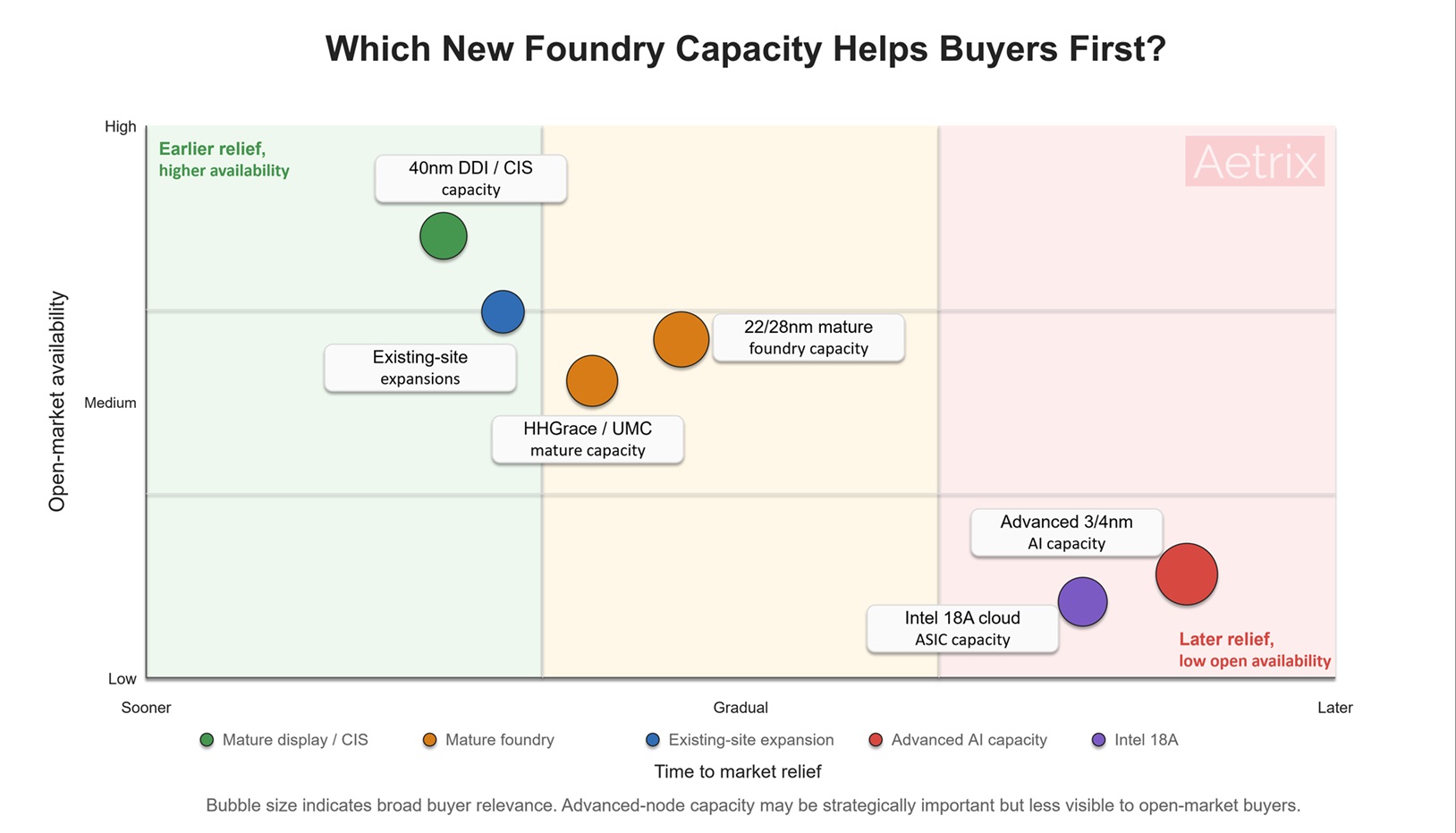
Will New Fabs Reduce Semiconductor Lead Times?
Yes, but not immediately and not evenly. New fabs should gradually reduce semiconductor lead times, but the timing depends on process node, customer priority and ramp maturity.
Advanced nodes are likely to remain tight through 2027 because demand from AI, HPC, cloud ASICs and automotive AI continues to absorb early output. Mature nodes should see earlier relief because more capacity is being added for 22nm, 28nm and 40nm products. The biggest improvement is likely to be visible in standard logic, display driver ICs, CIS, IoT, consumer ICs and some power-related products before it reaches tighter automotive or industrial-grade categories.
This means the lead time recovery path is not a simple straight line. Buyers may see consumer or standard-grade components improve before automotive MCUs, industrial FPGAs or high-reliability power management devices. Distributor-visible lead time changes may also lag foundry ramp progress by several months. This follows the same procurement logic discussed in our related analysis of semiconductor lead times in 2026.
What Buyers Should Watch in 2026–2027
Buyers should avoid treating every new fab headline as a near-term supply solution. Instead, they should track practical signals that show whether capacity is moving from nominal to effective supply.
| Signal | Why It Matters |
|---|---|
| Equipment move-in date | Shows when ramp preparation begins, not when supply improves |
| Risk production status | Indicates early process readiness, especially for advanced nodes |
| Customer qualification | Determines when chips can ship commercially to production customers |
| Yield ramp | Shows whether the fab can deliver stable and economical output |
| Authorized distributor lead time trend | Confirms whether capacity is reaching the broader component market |
| Packaging and testing capacity | A wafer supply improvement may still be blocked by downstream constraints |
Packaging is especially important for AI-related products. A new wafer fab can help only if packaging, substrates, HBM integration and testing capacity are also available. For mature nodes, the bottleneck may be less about advanced packaging and more about customer qualification, product mix and automotive or industrial reliability requirements.
GlobalFoundries and Other Expansions Still Matter, Even Without New Greenfield Fabs
Not all important capacity expansion comes from brand-new factories. GlobalFoundries, for example, has announced a €1.1 billion investment to expand its Dresden manufacturing capabilities, with a target to increase capacity to more than one million wafers per year by the end of 2028 (GlobalFoundries, Dresden Expansion).
These expansions may not fit the strict definition of a new fab, but they still matter for supply resilience. Existing-site expansions can sometimes ramp with less risk than greenfield fabs because they build on established teams, infrastructure and customer flows. For automotive, industrial, communications and specialty-node demand, this type of incremental expansion can be just as important as new facility announcements.
Key Takeaways for Foundry Capacity and Lead Times
- New foundry capacity is real, but its effect on semiconductor lead times will be delayed.
- 2026 H2 is mainly an equipment move-in, pilot production and early ramp period.
- 2027 is the main window when new capacity may begin to affect supply more visibly.
- Advanced-node capacity will likely remain tight because early output is tied to AI, HPC, cloud and strategic customers.
- Mature-node capacity at 22nm, 28nm and 40nm should improve earlier, but automotive and industrial grades may remain tight longer.
- Buyers should separate nominal wafer capacity from effective supply available to the broader market.
- Semiconductor lead times may not normalize broadly until 2027 H2–2028 H1.
The next foundry capacity cycle should eventually help the semiconductor supply chain, but it will not solve lead time pressure overnight. The improvement will be delayed, uneven and highly dependent on process node, customer priority and ramp maturity.
For procurement teams, the practical conclusion is clear: do not count new fabs too early. Track when capacity moves from announcement to equipment installation, from risk production to qualification, and from yield ramp to stable volume. That is when foundry capacity begins to matter for real semiconductor lead time relief.