My Inquiry
 My Account


Semiconductor lead times are becoming a procurement signal again in 2026. Buyers, EMS procurement teams and component planners may already be seeing longer factory lead times, reduced authorized distributor inventory, limited allocation notes and shorter quotation windows across selected semiconductor categories.
This does not look like the broad shortage cycle seen in 2021 and 2022. The current pressure appears more selective. Mature-node FPGAs, automotive MCUs, industrial control ICs, networking chips and some 28nm-related products are showing more visible stress, while leading-edge AI GPUs and custom ASICs remain largely outside the general authorized distribution channel.
The key change is that semiconductor lead times are no longer only a demand-recovery signal. In 2026, lead time changes are increasingly shaped by AI-driven foundry capacity reallocation, mature-node supply pressure and delayed authorized distributor visibility. AI infrastructure demand is not only pulling capacity into 3nm, 5nm and advanced packaging. It may also be changing the allocation logic for older process nodes that still support automotive, industrial, networking and embedded applications.
Key Findings:
- Some 28nm-related semiconductor lead times have stretched to 24–60 weeks in selected categories.
- AI demand is changing foundry capacity allocation, not only advanced-node supply.
- Authorized distributor lead times can help validate supply stress, but they usually lag real foundry changes.
- Automotive, industrial and networking chips appear more exposed than broad consumer components.
Semiconductor Lead Times Are Stretching Again in 2026
For procurement teams, semiconductor lead time is more than a delivery estimate. It is an early warning signal for allocation, price volatility, factory scheduling pressure and supplier prioritization. When lead times stretch across multiple brands in the same category, the issue is usually deeper than a single product shortage.
In 2026, the warning signs are becoming more visible in selected areas. Buyers may see authorized distributor pages showing "factory lead time extended," limited stock for industrial or automotive grades, smaller available quantities and longer delivery windows for batch orders. These signals are most relevant when they appear across similar process nodes, similar applications or similar qualification grades.
However, longer semiconductor lead times do not automatically mean the whole market is short. A commercial-grade MCU may still be available, while an industrial or automotive version of the same family becomes difficult to source. A consumer networking chip may remain manageable, while an industrial-grade switch IC or FPGA becomes allocation-sensitive. This is why lead time analysis must be done by process node, product class, temperature grade and end-market exposure.
| Signal | What Buyers See | Possible Meaning | Procurement Relevance |
|---|---|---|---|
| Factory lead time extended | Authorized distributor pages show longer delivery windows | Supplier allocation may be tightening | High |
| Limited allocation | Batch orders require confirmation | OEM or direct customers may be prioritized | High |
| Spot inventory falling | Only small quantities remain available | Channel buffer is being consumed | Medium-High |
| Industrial or automotive grades worse than commercial grades | I-grade or AEC-Q grade parts show longer lead times | High-reliability parts face tighter supply | High |
| Quote validity shortened | Prices and availability change faster | Supply uncertainty is increasing | Medium-High |
AI Demand Is Reshaping Foundry Capacity Allocation
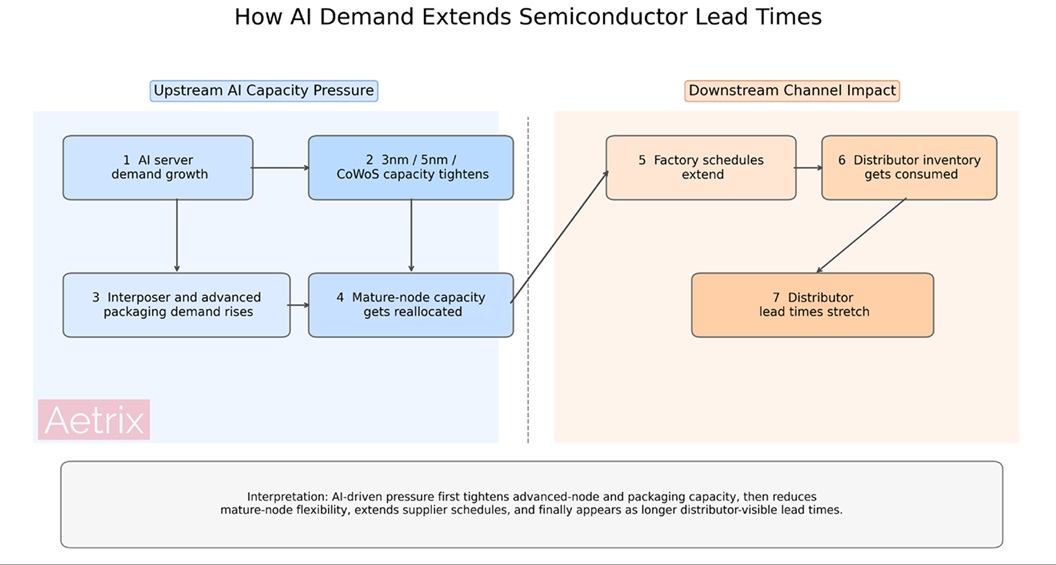
The AI supercycle is usually discussed through GPUs, HBM, high-end processors and advanced packaging. But its impact on semiconductor lead times can reach further down the supply chain. AI servers require advanced logic chips, CoWoS-type packaging, interposers, HBM, server memory, high-speed networking, power management, FPGAs, MLCCs, connectors and thermal components.
That demand can change how foundry capacity is allocated. According to recent supply chain reports, TSMC's 28nm-related capacity has been under structural adjustment, with part of the resource moving toward interposer and CoWoS-related applications. At the same time, 3nm capacity is increasingly prioritized for AI, HPC and large customers with long-term commitments.
For buyers, the important point is not only whether one foundry increases or reduces one process node. The larger issue is capacity reallocation. If mature-node capacity becomes less flexible while AI packaging demand expands, the effect can appear in factory schedules, product allocation and authorized distributor lead times months later.
The same AI infrastructure cycle has already affected other component categories. Our related analysis of AI server memory chip shortages, HBM, DDR5 and CXL demand explains how memory and server architecture are being reshaped by AI workloads. A separate report on AI server MLCC shortages and high-capacitance passive component demand shows how the same pressure is spreading into passive components.
TSMC 28nm Capacity Reallocation May Tighten Mature-Node Supply
The 28nm node remains important because it supports a wide range of products that buyers still need every day: automotive MCUs, industrial FPGAs, WiFi and router SoCs, networking switch chips, PMICs, control ICs and embedded processors. These are not the most advanced chips in the market, but they are deeply embedded in long-lifecycle systems.
Supply chain reports indicate that part of TSMC's 28nm mature-node capacity has been adjusted as the company shifts more resources toward higher-value AI-related packaging and interposer applications. This should not be interpreted simply as a collapse in mature-node supply. A more accurate reading is that mature-node capacity is becoming more selective, especially for low-margin or non-long-term orders.
For buyers, the practical effect is straightforward. If mature-node wafers become harder to schedule, suppliers may extend factory lead times, prioritize direct OEM customers, reduce authorized distribution-channel allocation or raise prices on products that remain difficult to source.
| Product Area | Typical Components | Possible Impact | Buyer Risk Level |
|---|---|---|---|
| Automotive MCU | TI TMS570, NXP S32K, Renesas RH850, ST automotive MCU families | Longer allocation cycle and tighter batch-order confirmation | High |
| Industrial FPGA | AMD Xilinx Zynq-7000 | Longer factory lead time and reduced channel availability | Very High |
| WiFi / router SoC | MediaTek MT76XX, Realtek RTL83XX | Standard lead times may stretch as channel inventory declines | Medium-High |
| Networking switch IC | Broadcom BCM56 series and related switching ICs | Long factory lead time risk and limited distribution visibility | Very High |
| PMIC / control IC | Automotive PMIC, industrial control IC, signal-processing devices | Higher quote and delivery volatility | Medium-High |
| Low-margin mature-node orders | Custom 28nm logic, older IoT and consumer ICs | More likely to be deprioritized if capacity tightens | High |
Which Components Are Showing the Longest Lead Time Signals?
The strongest lead time signals are appearing in products that combine mature-node dependency, industrial or automotive qualification and limited easy substitutes. FPGA and automotive MCU lead times are especially important because they are difficult to replace once designed into equipment, vehicles or industrial control systems.
The lead time data below should not be read as a universal rule for every part number. It is a procurement signal based on selected product families and channel observations. Still, it is useful because it shows where pressure is becoming visible to buyers.
| Component Type | Example Part / Family | Recent Lead Time Signal | Historical Baseline | Change | Risk Level |
|---|---|---|---|---|---|
| 28nm FPGA | AMD Xilinx Zynq-7000 | 36–40 weeks | 8–12 weeks | ~3x–4x longer | Very High |
| Automotive MCU | TI TMS570 | 18–40 weeks | 6–10 weeks | ~2x–4x longer | High |
| Automotive MCU | NXP S32K | ~16 weeks | 6–8 weeks | ~2x longer | Medium-High |
| Automotive MCU | ST / Renesas auto series | Up to 45–55 weeks | 8–12 weeks | ~4x–5x longer | Very High |
| WiFi / router SoC | MediaTek MT76XX | 22–30 weeks | 7–10 weeks | ~2x–3x longer | High |
| Networking switch IC | Broadcom BCM56 series | 48–60 weeks | 10–16 weeks | ~3x–5x longer | Very High |
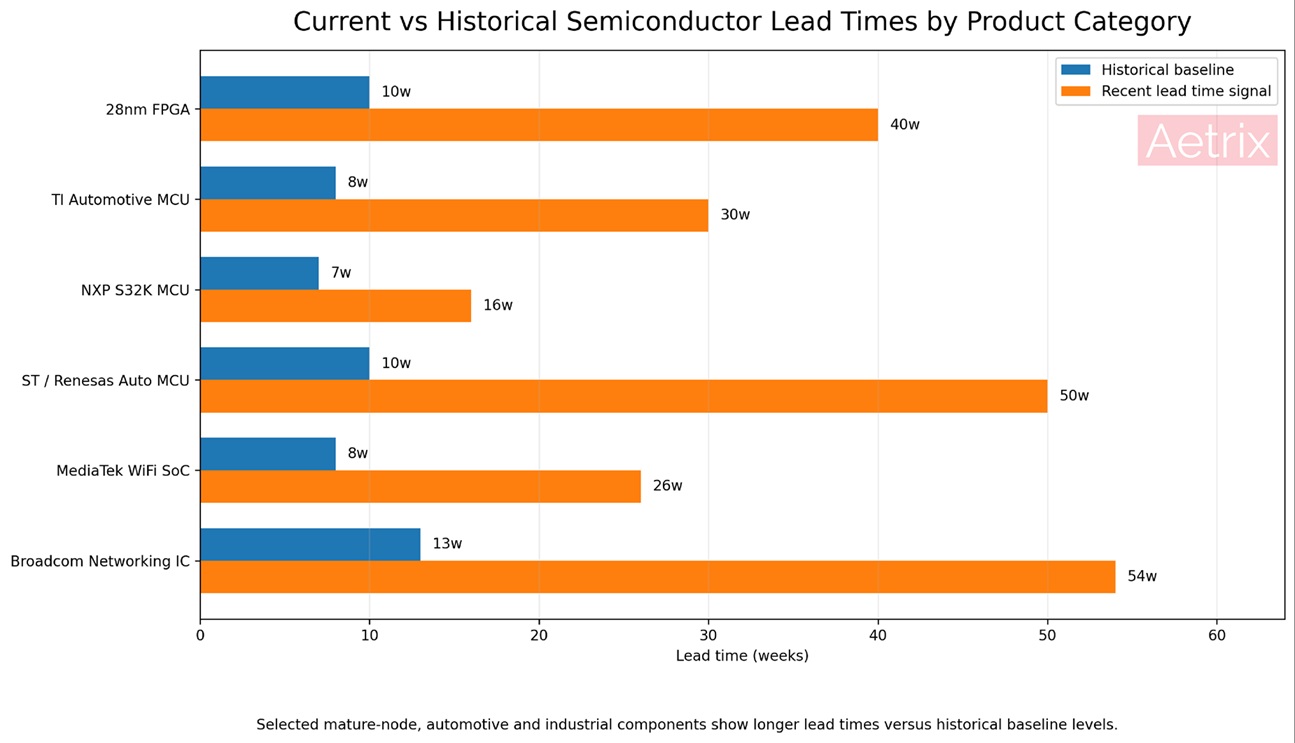
For buyers, this kind of table is more useful than a single average semiconductor lead time number. A market-wide average can hide the real problem. Procurement risk is usually concentrated in parts that are difficult to redesign, difficult to qualify or tied to specific production platforms.
Can Authorized Distributor Lead Times Confirm a Foundry Shortage?
Authorized distributor lead time data can help validate supply stress, but it cannot directly predict or prove foundry capacity changes. Distributor data is most useful when it shows cross-brand pressure in the same process node or product category. It is less useful when buyers use one part number to explain the entire semiconductor market.
The most important limitation is timing. A foundry capacity change does not appear instantly on an authorized distributor website. The chain usually moves from wafer schedule pressure to chip supplier allocation, then to distributor stock depletion, and finally to visible factory lead time extension. That process can take several months.
Distributor inventory also acts as a buffer. A popular mature-node part may remain available for weeks or months after wafer supply tightens. Only after repeated replenishment delays does the distributor page begin to show a longer factory lead time, limited quantity or restricted batch availability.
| Authorized Distributor Lead Time Data Can Show | Authorized Distributor Lead Time Data Cannot Show |
|---|---|
| Channel inventory is being consumed | Exact TSMC wafer allocation |
| Factory lead time is extending | Real-time foundry output changes |
| Cross-brand mature-node stress | Whether the cause is only foundry reduction |
| Auto or industrial grade pressure | 3nm GPU / ASIC capacity availability |
| Quote and allocation pressure | Direct hyperscaler capacity commitments |
Another limitation is attribution. A longer lead time can result from foundry capacity constraints, but it can also come from packaging bottlenecks, substrate shortages, raw material issues, supplier inventory control, export restrictions or a sudden end-market demand spike. For this reason, buyers should treat authorized distributor data as validation signals, not as complete supply-chain proof.
Why 3nm Lead Time Pressure Does Not Appear on Distributor Websites
The most advanced AI chips are almost invisible in general distributor lead time data. NVIDIA GPUs, Apple processors, Google TPU, AWS Trainium, Meta AI ASICs and similar products are not normally sold through authorized distribution channels. They are allocated directly through OEM, hyperscaler, foundry and assembly supply agreements.
This creates a major visibility gap. The most important AI capacity pressure may be in 3nm wafers, CoWoS packaging, HBM integration and substrate supply, but a buyer will not see that directly on a distributor page. Instead, the buyer may see secondary signals: longer lead times for power ICs, industrial FPGAs, high-end networking components, connectors, MLCCs or thermal management components.
That is why procurement teams should separate two questions. The first is whether AI demand is creating high-end capacity pressure. The second is whether that pressure has reached the components visible in authorized distribution channels. The answer to the first may be yes before the second becomes visible.
How Buyers Should Interpret Semiconductor Lead Time Data
When semiconductor lead times stretch, buyers should avoid reading too much into one isolated part number. A better approach is to build a category-level view. If similar products across TI, NXP, ST, Renesas, AMD Xilinx, Broadcom and MediaTek all show longer lead times, the signal becomes more meaningful.
Buyers should also compare commercial, industrial and automotive grades separately. Industrial and automotive-grade components often show more severe lead time stress because suppliers prioritize direct customers and high-commitment orders. In many cases, the commercial grade may still appear available while the industrial grade becomes difficult to source.
The strongest procurement signal usually appears when three things happen together: available stock falls, factory lead time extends and quote validity becomes shorter. When all three occur across multiple product families, the buyer should treat the category as a supply risk.
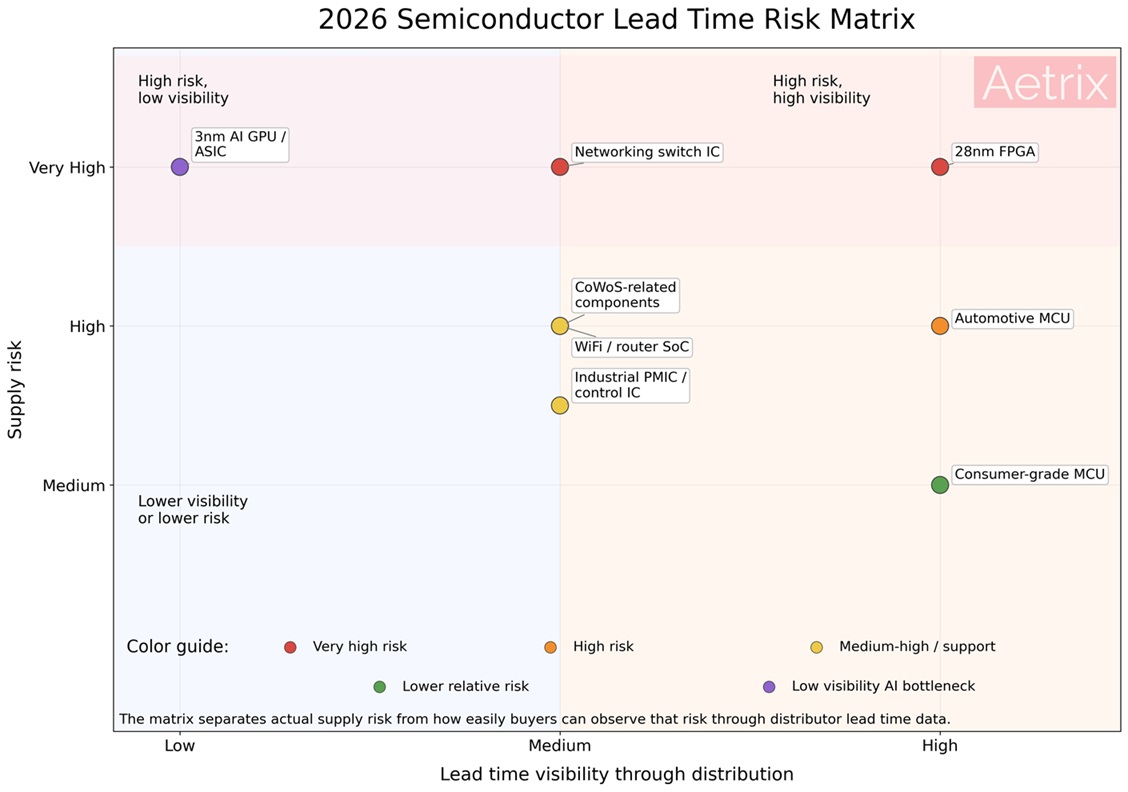
This framework is especially useful for EMS companies and OEM purchasing teams. Instead of reacting to every single lead time change, teams can identify which categories deserve priority review and which changes may be isolated supplier events.
What Buyers Can Do When Semiconductor Lead Times Stretch
When semiconductor lead times begin to stretch, buyers should first identify long lead-time parts inside the production BOM. These are the parts that can stop production if they become unavailable. Automotive MCUs, industrial FPGAs, networking switch ICs, control ICs and certain PMICs should usually be reviewed before more generic components.
Second, buyers should maintain an AVL strategy for critical components. Alternative suppliers or qualified second sources should be reviewed early, not after the main part reaches allocation. For automotive and industrial systems, replacement approval can take months, so waiting until shortage conditions are obvious may be too late.
Third, procurement teams should distinguish between spot buys and production buys. A small available distributor quantity may solve a prototype or repair need, but it does not protect a production schedule. For production volumes, buyers should confirm factory lead time, allocation status and supplier delivery commitments.
Fourth, quote validity should be monitored closely. A shortening validity window often indicates that suppliers or distributors are no longer confident about stable price and availability. That is usually a warning sign before the lead time number itself becomes extreme.
| Buyer Checkpoint | Why It Matters | What to Do |
|---|---|---|
| Same-category lead times across multiple brands | Reduces single-supplier bias | Compare TI, NXP, ST, Renesas, AMD Xilinx and other relevant suppliers |
| Commercial vs industrial vs automotive grade | Shows allocation priority and reliability-grade pressure | Track grade-specific lead time instead of family-level availability only |
| Stock quantity trend | Reveals channel buffer consumption | Monitor availability week by week for critical parts |
| Factory lead time wording | Confirms official delivery extension | Watch for extended factory lead time or allocation notes |
| Quote validity period | Shows pricing and availability volatility | Lock pricing early for production-critical components |
Key Takeaways for 2026 Semiconductor Lead Times
- Semiconductor lead times in 2026 appear more structural and selective than the broad shortage cycle seen earlier in the decade.
- 28nm mature-node products, industrial FPGAs, automotive MCUs and networking ICs deserve closer procurement attention.
- AI demand can affect mature-node supply indirectly through CoWoS, interposer demand and foundry capacity reallocation.
- Authorized distributor data is useful for validating channel stress, but it usually lags real foundry and supplier decisions.
- 3nm AI GPUs, custom ASICs and flagship processors are mostly invisible in general distributor lead time data.
- Buyers should move from single-part searches to category-level, process-node-level and grade-level lead time monitoring.
The main message for buyers is simple: semiconductor lead times are becoming more strategic again. A longer lead time does not always mean a new industry-wide shortage, but it may signal that capacity allocation, AI demand, supplier prioritization and channel inventory are changing underneath the surface.
In 2026, the procurement teams that understand this distinction will be better prepared. The right question is not only "how many weeks is the lead time?" It is also "which process node, which product grade, which application, which supplier channel and which demand cycle is driving that number?" That is the level of analysis now required to manage semiconductor supply risk.