My Inquiry
 My Account


STMicroelectronics is preparing another round of price increases across several product lines, effective August 23, 2026. According to an ST price adjustment notice dated July 23, the company points to sharply higher semiconductor demand across multiple sectors together with rising costs for transportation, energy, materials and manufacturing services.
The August adjustment follows reported ST pricing actions in April and June, making this the third major pricing point for customers to account for in roughly four months. No single increase percentage or complete affected-product list has been disclosed in the latest notice, so the actual impact will depend on the product line, MPN and customer pricing arrangement.
The timing is also notable. ST issued the July 23 notice as its second-quarter results showed strong bookings across every end market, distribution inventory below the company's standard target and signs of tight supply in several product categories. Price increases are now arriving alongside longer factory schedules on selected STM32 devices, giving buyers both cost and availability exposure going into the second half of 2026.
ST Sets Another Price Increase for August 23, 2026
The July 23 price adjustment notice states that prices will increase across several product lines in the ST portfolio from August 23.
ST does not give a portfolio-wide percentage increase in the notice, and it does not identify the individual product families or MPNs covered by the change. Customers are expected to receive more specific pricing information through their normal account channels.
The wording is broader than a single-product adjustment. It refers to several ST product lines and links the move to conditions across the semiconductor supply chain rather than to one isolated manufacturing issue.
For procurement teams, the August 23 date is therefore only the first part of the pricing question. The more useful information will be the revised price attached to each production MPN, whether existing backlog retains its current price, and how already negotiated project pricing is treated after the effective date.
April, June and August: ST Pricing Has Changed Three Times in 2026
The August increase follows two earlier ST pricing actions reported this year. A price adjustment across multiple product lines was reported for April 26, followed by another MCU-related increase effective June 28. Industry reporting described the June action as ST's second price increase of 2026. (TrendForce, STMicroelectronics June 2026 Price Increase)
| Effective Date | 2026 ST Pricing Development | Buyer Impact |
|---|---|---|
| April 26 | First reported 2026 price adjustment across multiple product lines | Annual pricing assumptions began changing early in Q2 |
| June 28 | Second reported price increase, with MCU products among the focus areas | Customers had to review pricing again within roughly two months |
| August 23 | New price increase across several ST product lines | Q4 and 2027 BOM cost assumptions require another review |
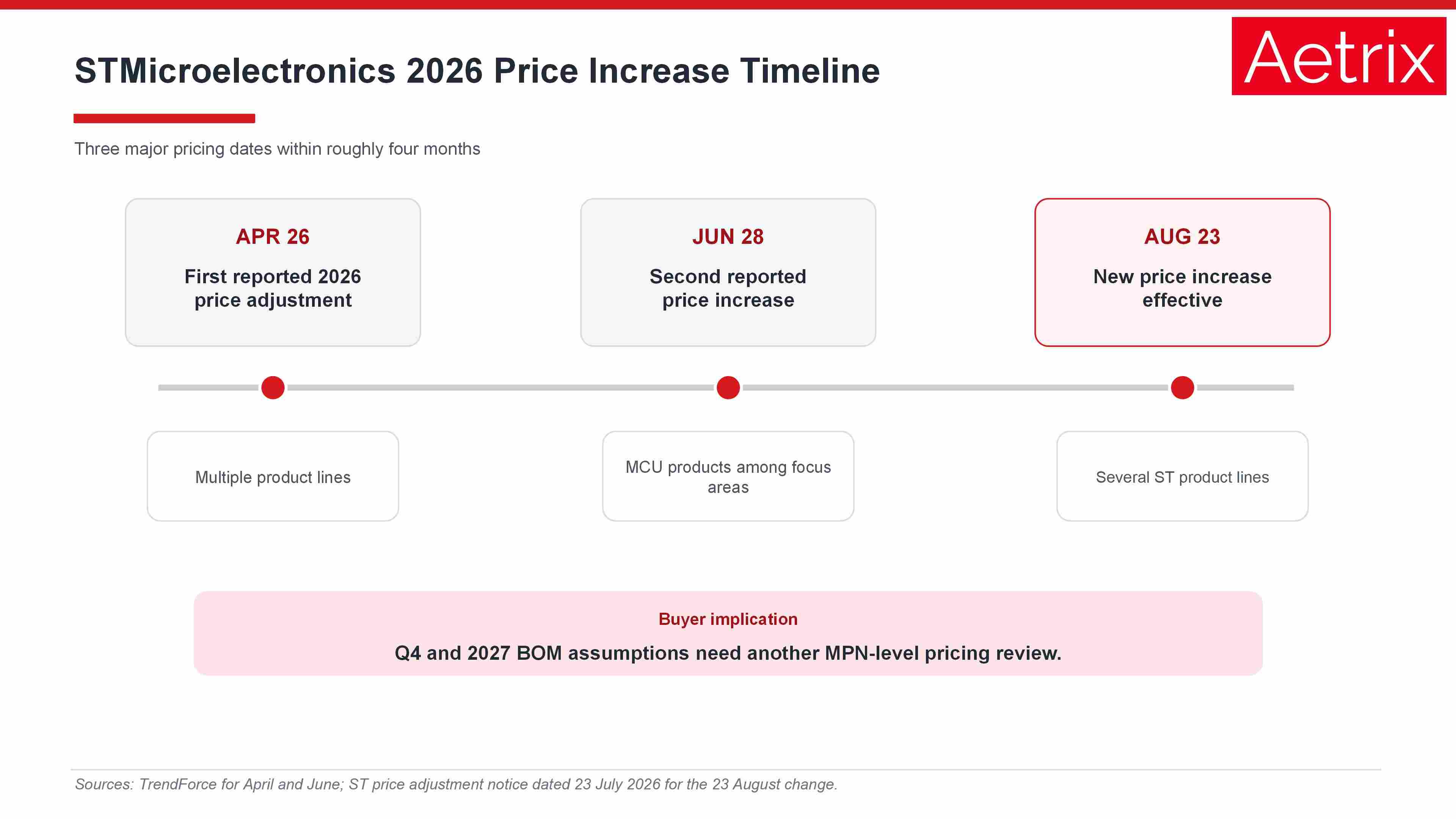
Three pricing changes in such a short period make static annual cost assumptions increasingly difficult to use. Industrial and automotive programs often purchase the same semiconductor for years, while customer quotations and finished-product budgets may be fixed months before components are delivered.
A BOM cost calculated in the first quarter can therefore be outdated before Q4 production begins. Buyers with a high concentration of ST analog, MCU or power products should review pricing at the MPN level instead of applying one assumed percentage across the portfolio.
ST Points to Stronger Demand and Higher Supply-Chain Costs
The latest notice gives a clearer explanation of the pricing environment than many semiconductor price announcements.
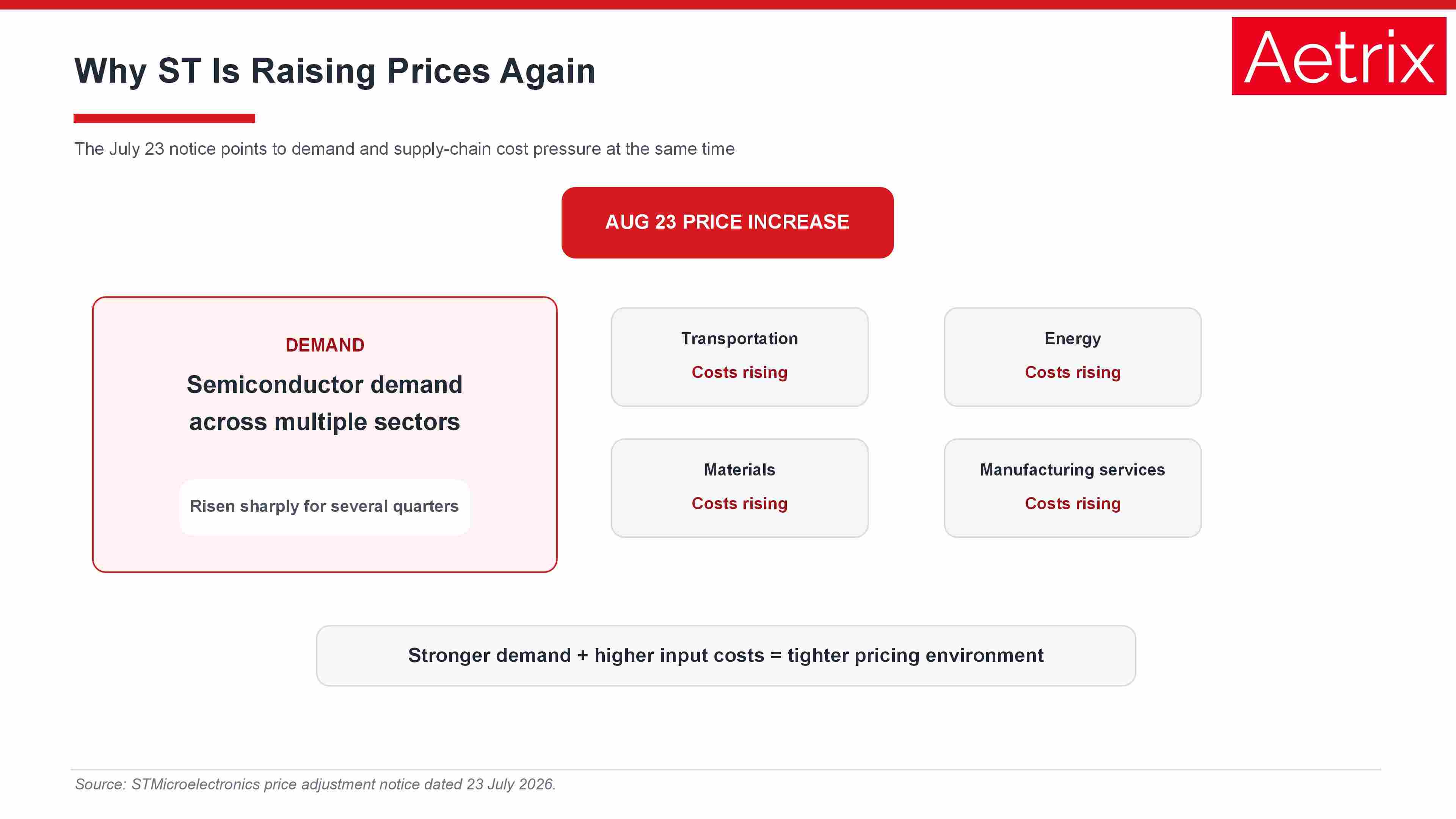
ST says semiconductor demand across multiple sectors has risen sharply for several quarters and is placing sustained pressure on the global supply chain. The notice also identifies price increases across transportation, energy, materials and manufacturing services.
Those two forces can affect pricing in different ways. Stronger demand increases factory loading and reduces available supply flexibility, while higher input and manufacturing-service costs raise the cost base behind finished semiconductor products. Both are now moving in the same direction.
| Pressure | ST Notice | Supply-Chain Effect |
|---|---|---|
| Semiconductor demand | Demand has risen sharply across multiple sectors | Higher factory loading and less supply flexibility |
| Transportation | Prices increasing | Higher logistics cost through a globally distributed manufacturing chain |
| Energy | Prices increasing | Additional pressure on energy-intensive wafer and backend manufacturing |
| Materials | Prices increasing | Higher production input costs |
| Manufacturing services | Prices increasing | Higher external fab, assembly, test or related service costs where applicable |
Earlier industry reports on ST's June price increase had already pointed to mature-node capacity pressure, higher manufacturing costs and rising memory-related input costs within the MCU supply chain. The August notice broadens the explanation by explicitly including demand, logistics, energy, materials and manufacturing services. (TrendForce)
ST's Q2 Results Support the Demand Side of the Notice
ST's financial results released on July 23 provide useful context for the demand language in the pricing notice.
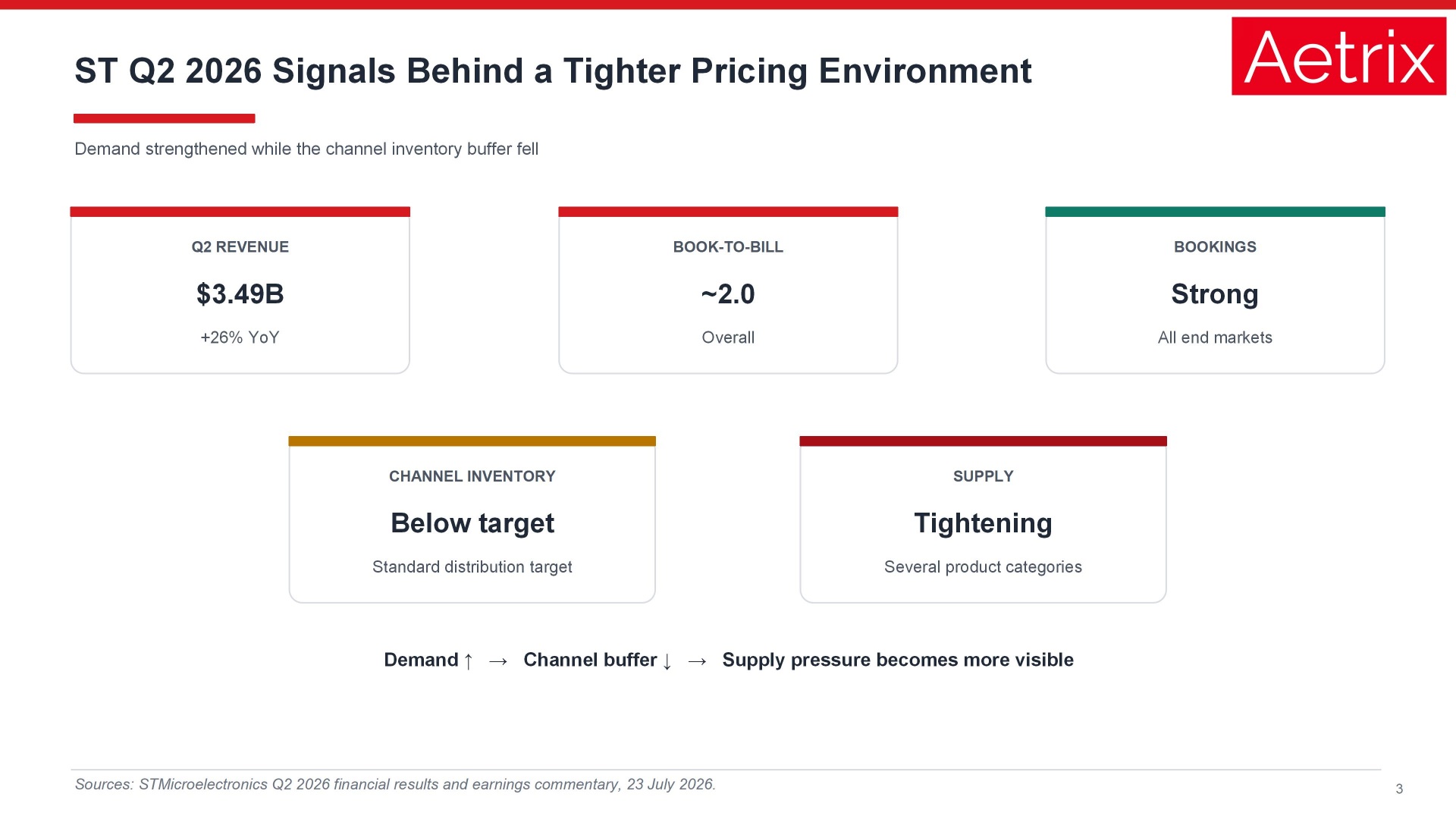
The company reported Q2 2026 revenue of $3.49 billion, up 26% year over year. More important for supply conditions, ST said demand increased further during the quarter, bookings were strong across all end markets, and it saw improved visibility together with signs of tight supply in several product categories. Distribution inventory had fallen below the company's standard target. (STMicroelectronics, Q2 2026 Financial Results)
Detailed Q2 commentary put the overall book-to-bill ratio close to 2. Industrial revenue increased 20% sequentially and 34% year over year, with general-purpose microcontrollers, analog and power-conversion products among the contributors to growth. (STMicroelectronics, Q2 2026 Earnings Results)
The pricing notice and the earnings release were both dated July 23. The two documents describe the same market from different angles: the customer notice points to stronger semiconductor demand and rising supply-chain costs, while the financial results show stronger bookings, lower channel inventory and initial signs of tighter supply.
A more detailed look at those Q2 inventory and booking signals is available in our earlier analysis, What ST's Q2 2026 Results Reveal About MCU Supply, Channel Inventory and Spot-Market Risk.
Price Increases and Longer STM32 Lead Times Are Now Overlapping
The August pricing action is arriving while factory schedules for selected STM32 products are also extending.
A July distributor update showed several mainstream 90nm STM32 families moving from roughly 30 weeks to 52 weeks, while newer 40nm H7, H5 and C5 platforms moved to around 30 weeks. That update also asked distributors to obtain full-year 2027 customer orders, giving ST greater visibility into future demand. The complete July lead-time changes are covered in STMicroelectronics MCU Lead Times Extend to 52 Weeks as Distributors Seek Full-Year 2027 Orders.
The supply picture tightened further in August. Selected STM32H7 and H5 orderable parts now carry 52-week standard lead times, including devices that belonged to the newer platforms previously associated with shorter schedules. The latest MPN-level changes are detailed in STM32H7 Lead Times Reach 52 Weeks as ST MCU Supply Tightens Further.
That overlap changes the commercial risk for an OEM. A long-lead-time MCU can already require a purchasing commitment many months before production. If its price also changes while the order is sitting in backlog, the project can face both schedule risk and BOM-cost uncertainty.
| Current ST Signal | Procurement Exposure |
|---|---|
| Repeated 2026 price adjustments | BOM cost can change several times within one annual production plan |
| Selected STM32 lead times at 52 weeks | Orders must be committed much earlier |
| Distribution inventory below target | Less channel stock is available to absorb factory delays |
| Strong bookings | Future capacity can become harder to secure on constrained MPNs |
This does not mean every ST product is simultaneously short and rising in price. Availability remains highly dependent on the exact MPN, package, customer backlog and existing channel inventory. The important change is that the two pressures are now appearing in the same part of the cycle.
What the New ST Notice Does Not Tell Buyers Yet
Several details required for production cost planning are absent from the July 23 notice.
There is no universal increase percentage, no complete product-family list and no MPN-level price table. The notice also does not explain how orders already in the system will be handled after August 23.
| Still to Be Confirmed | Why Buyers Need It |
|---|---|
| Affected product lines and MPNs | Shows which production BOMs require repricing |
| Actual increase by MPN | Determines the real annual cost impact |
| Existing PO treatment | Establishes whether already placed orders retain current pricing |
| Backlog pricing | Critical for long-lead-time orders shipping after August 23 |
| Project or LTA pricing | Existing program pricing may follow separate commercial terms |
| Effective-date rule | Buyers need to know whether pricing follows order date, shipment date or another rule |
These details can produce very different outcomes for two customers using the same device. One may have existing backlog covered by earlier project pricing, while another may be placing new orders under the August price structure.
Until product-level price updates are available, applying one assumed increase across all ST components would give a misleading view of future BOM cost.
What ST Buyers Should Check Before August 23
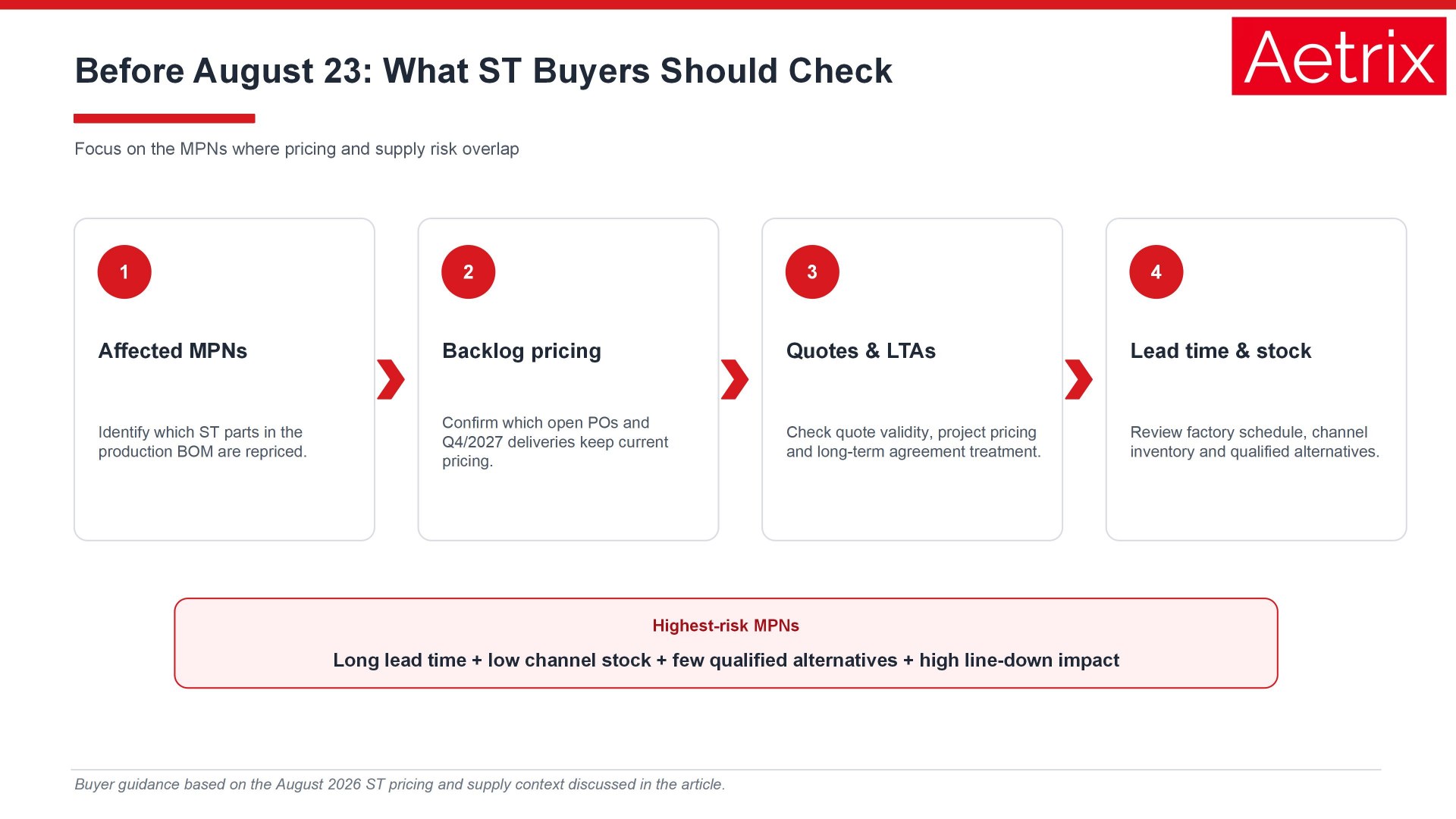
Existing backlog deserves the first review. Orders scheduled into Q4 or 2027 may have been placed months before this adjustment, especially for STM32 devices carrying long factory schedules. Buyers should confirm which quantities retain current pricing and which deliveries will use the new price.
Quotes that remain open beyond August 23 should also be checked before being used in a customer quotation or annual cost forecast. A valid quotation period and price protection are separate commercial issues, and the treatment can vary by account.
Long-term agreements and project pricing need the same attention. Industrial and automotive programs often operate with customer-specific terms linked to annual volumes or product lifetimes. Those agreements should be reconciled with the August adjustment at the exact MPN level.
For parts already facing long lead times, availability should be reviewed alongside pricing. Bringing forward an order may secure a production slot and reduce exposure to a future price increase, but excessive pre-buying can leave the buyer with expensive inventory if end demand changes. Purchase quantities should follow confirmed production consumption and realistic safety-stock requirements.
The highest priority should go to MPNs where several risks overlap: long factory lead time, low authorized-channel inventory, limited qualified alternatives and high production impact if supply is interrupted.
What to Watch Next
The next useful information will come from revised product-level pricing. Affected MPN lists will show whether the August increase is concentrated in MCU products or reaches more deeply into analog, power, MEMS and other ST product groups.
The size of the increase will matter, but backlog treatment may matter more for customers already carrying orders into 2027. A large price increase limited to new orders creates a different procurement problem from a smaller increase applied to existing long-dated backlog.
Supply data also needs to be watched alongside the revised price books. If additional STM32 families move toward longer factory schedules while distribution inventory remains below target, the current pricing cycle will be occurring in a progressively tighter supply environment.
ST's 2026 pattern is already different from the market seen during the earlier inventory correction. Demand has strengthened, channel inventory has fallen, selected MCU lead times have extended and a third major price adjustment is now scheduled for August 23.
For buyers, the practical work is increasingly MPN-specific: confirm the new price, check the backlog rule, verify the factory schedule and identify the parts where no qualified alternative exists. Those four pieces of information will provide a clearer view of Q4 and 2027 risk than any portfolio-wide price-increase headline.