My Inquiry
 My Account


Texas Instruments is planning another round of price increases effective October 1, 2026. According to an internal TI pricing notice, the adjustment will apply to selected products, with pricing exceptions expected to be extremely limited.
The notice does not provide a single increase percentage or a complete list of affected part numbers. TI also states that its long-term global pricing strategy remains unchanged. The actual impact will therefore depend on the individual MPN and customer pricing arrangement.
The October increase follows reported TI pricing actions in April and July, giving component buyers three separate pricing dates to account for in 2026. For customers with Q4 production or 2027 backlog, the immediate issues are affected MPNs, existing order pricing, quote validity and any approved pricing exceptions.
TI Sets Another Price Adjustment for October 1, 2026
The latest communication covers selected TI products and sets October 1 as the effective date for the new pricing. No portfolio-wide percentage has been disclosed, and the wording does not suggest that every Analog or Embedded Processing device will move by the same amount.
That distinction matters for TI's portfolio. A customer may use hundreds of TI part numbers across power management, amplifiers, data converters, interface ICs, microcontrollers and embedded processors. A percentage applied broadly across the portfolio would have a very different cost impact from selective repricing concentrated on specific technologies or manufacturing flows.
The communication also says TI's long-term global pricing strategy remains unchanged. The October action therefore appears to be another product-level pricing adjustment within the existing commercial framework rather than the introduction of a new company-wide pricing model.
April, July and October: TI Pricing Has Changed Three Times in 2026
The October adjustment follows two earlier pricing events reported during 2026. Industry reports indicated that selected TI products received new pricing from April 1. Another round followed from July 1, with the affected products and adjustment levels varying across the portfolio. (TrendForce, TI April 2026 Pricing Report) (TrendForce, TI July 2026 Pricing Report)
| Effective Date | Pricing Development | Procurement Impact |
|---|---|---|
| April 1, 2026 | Reported new pricing on selected TI products | Customers reviewed pricing early in the year |
| July 1, 2026 | Another reported adjustment across multiple product lines | Q3 pricing required another review only three months later |
| October 1, 2026 | New pricing scheduled for selected TI products | Q4 and 2027 cost planning may need to be updated again |
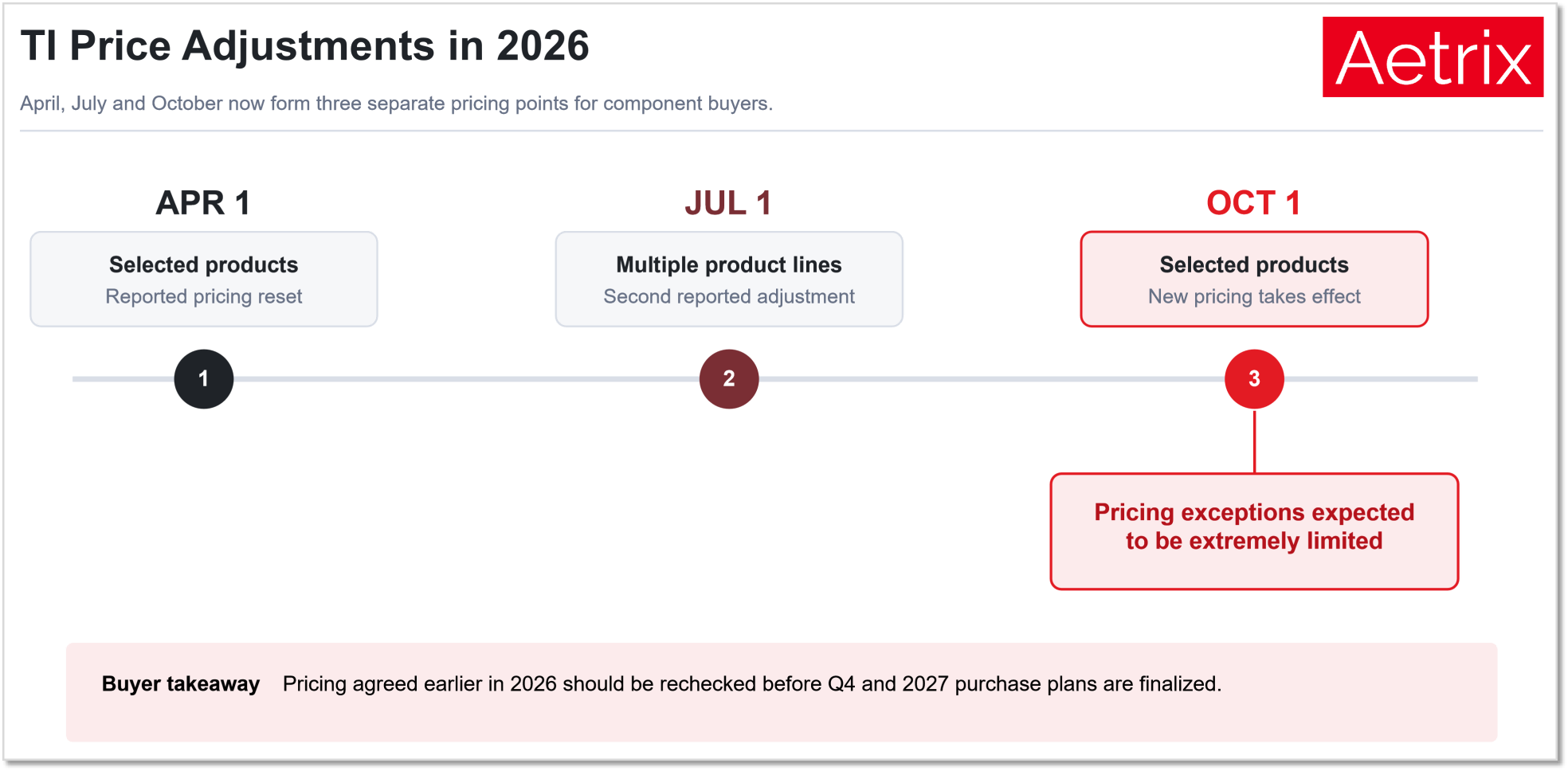
All three dates fall at the start of a calendar quarter. There is no indication that TI has established a formal quarterly repricing policy, but the pattern has already changed the way customers need to manage pricing. A quote or project price agreed earlier in the year can no longer be assumed to remain unchanged through December.
This is particularly relevant for industrial and automotive programs with long production lives. The purchasing cycle for those products often extends well beyond one quarter, so several pricing changes can affect the same annual production plan.
What Makes the October Adjustment Different?
Four details in the latest communication deserve attention.
First, the adjustment applies to selected products. The information available today does not support treating the October change as a uniform increase across the entire TI portfolio.
Second, October 1 is a firm implementation date. Buyers with Q4 production requirements now have a relatively short window to establish which MPNs are affected and how current orders will be handled.
Third, exceptions are expected to be extremely limited. That wording is significant for customers that normally rely on project pricing, negotiated account terms or sales-level exceptions when supplier pricing changes.
Fourth, TI says its long-term global pricing strategy has not changed. The company is therefore maintaining the broader pricing framework while adjusting selected products inside it.
Taken together, these points suggest that the purchasing impact will depend heavily on the individual account and MPN. Two customers buying different TI devices may see very different October cost changes, and two customers buying the same device may still have different outcomes if their commercial agreements are different.
Limited Exceptions Are the Most Important Commercial Signal
The restriction on pricing exceptions may prove more important to some customers than the headline percentage increase once individual price lists become available.
Large TI customers often operate under project pricing, annual volume agreements, distributor-negotiated pricing or other account-specific commercial structures. When a supplier changes pricing, customers may ask for the old price to be extended, for the new effective date to be delayed, or for a high-volume program to receive an exception.
The October guidance leaves less room to assume that such requests will be accepted. Exceptions are expected to be rare and subject to the normal escalation process, so any pricing treatment that is important to a Q4 or 2027 budget should be formally confirmed.
This is particularly relevant where a sales discussion has already taken place but the exception has not completed the required approval process. Procurement teams should base their cost planning on approved pricing rather than an informal expectation that an existing price will continue.
The same issue applies to long production programs. A five-year industrial design may have been sourced around a specific TI price structure, yet the purchasing team still needs to determine whether that program pricing remains protected after October 1.
TI Enters the October Price Adjustment With Demand Recovering
The latest pricing action comes during a much stronger demand environment for TI than the semiconductor market experienced during the recent inventory correction.
TI reported Q2 2026 revenue of $5.46 billion, up 13% sequentially and 23% year over year. The company said growth was broad, led by Industrial, Data Center and Automotive. Analog revenue increased 26% year over year, while Embedded Processing grew 16%. (Texas Instruments, Q2 2026 Financial Results)
TI also guided Q3 revenue to between $5.65 billion and $6.15 billion, pointing to another quarter of strong sales if results fall within that range. (Texas Instruments, Q2 2026 Earnings Call Prepared Remarks)
| TI Q2 2026 Metric | Result |
|---|---|
| Revenue | $5.46 billion |
| Revenue growth | +23% year over year |
| Analog | +26% year over year |
| Embedded Processing | +16% year over year |
| Leading end markets | Industrial, Data Center, Automotive |
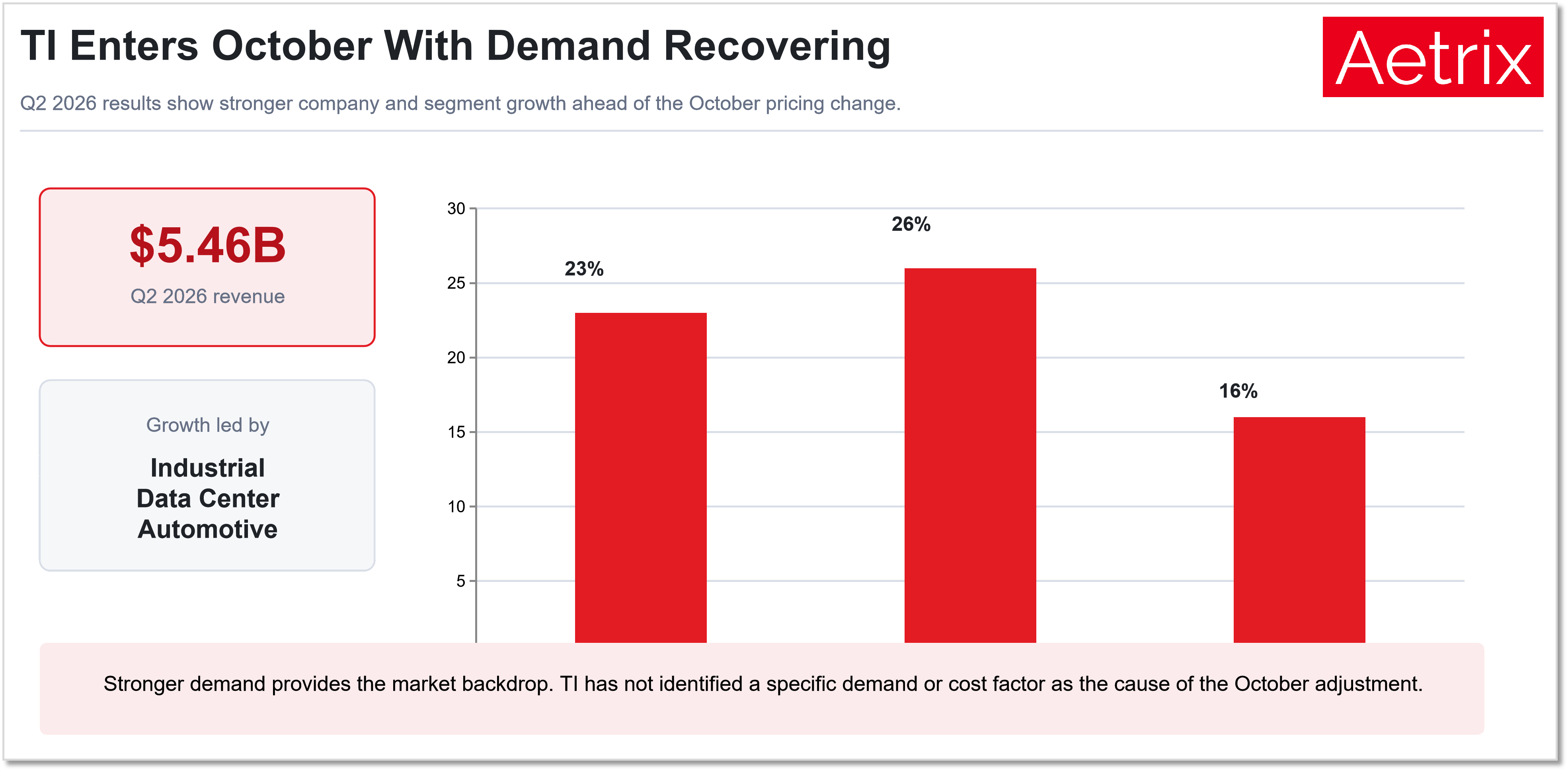
These results establish the market backdrop for the October adjustment. The pricing communication itself does not identify demand growth, AI infrastructure, raw materials, manufacturing costs or any other single factor as the reason for the new pricing.
TI's manufacturing strategy also makes broad cost explanations difficult to apply without product-level evidence. The company has continued investing heavily in internal 300mm analog manufacturing and says an unpackaged chip produced on a 300mm wafer costs roughly 40% less than an equivalent chip produced on a 200mm wafer. (Texas Instruments, Annual Report)
The October price changes should therefore be evaluated from the affected MPNs and commercial terms once those details become available. The stronger demand environment is relevant context, but it does not establish the cause of this specific pricing decision.
What the October Notice Does Not Tell Buyers Yet
Several details that determine the actual purchasing impact are still missing.
The communication does not provide a complete affected-MPN list or a universal increase percentage. It also does not explain whether Analog, Embedded Processing or specific technology groups will carry most of the adjustment.
The treatment of existing orders also needs to be established. Buyers need to know whether open purchase orders retain their current pricing, whether Q4 backlog will be repriced, and whether the applicable date is determined by order entry, shipment or another commercial rule.
Project pricing and long-term agreements require the same check. A customer with an established annual program may have different protection from a customer placing a new order after the October effective date.
| Still to Be Confirmed | Why It Matters |
|---|---|
| Complete affected MPN list | Identifies which BOMs need repricing |
| Product-level increase percentage | Determines the actual Q4 and 2027 cost impact |
| Open-order treatment | Shows whether existing POs retain current pricing |
| Backlog pricing | Long-lead-time orders may ship after October 1 |
| Project pricing / LTA treatment | Existing agreements may follow separate commercial rules |
| Regional or account differences | Final pricing can vary by account structure and market |
These gaps matter more to an existing production program than the October 1 date alone. A buyer with substantial 2027 backlog could face very little immediate impact if pricing is protected, while another customer using the same device could see the new price much earlier.
What Buyers Should Confirm Before October 1
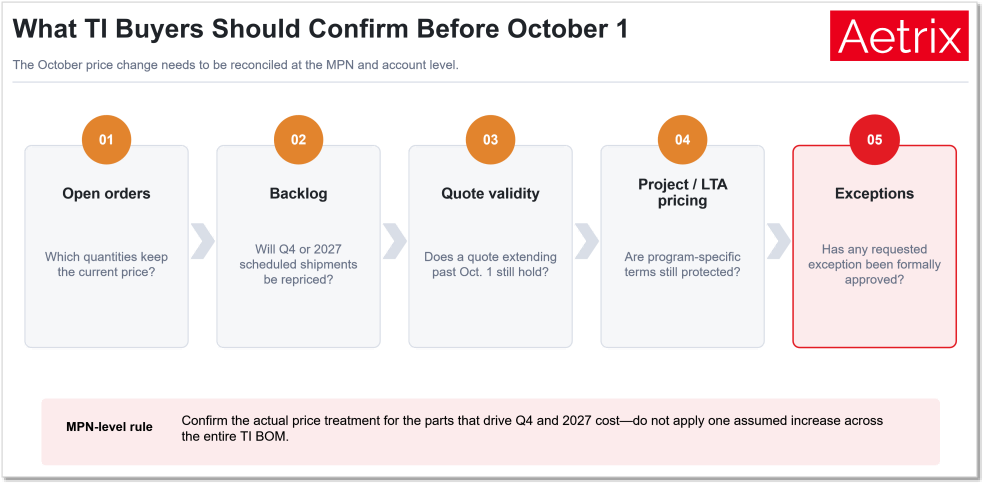
The first review should cover open purchase orders and scheduled backlog. Buyers need a clear answer on which quantities remain at the current price and which deliveries will use the October price. This is especially important for orders already scheduled into Q4 or 2027.
Current quotes should be checked at the same time. A quotation issued in August or September may show a validity date extending beyond October 1, but buyers should confirm how the new TI pricing affects that quote before using it as the basis for a production budget or customer quotation.
Project pricing, annual volume agreements and long-term arrangements need account-level confirmation. Where an exception is required, the approval status should be documented before the effective date. The latest guidance indicates that exceptions will be tightly controlled, so an unapproved request should not be treated as protected pricing.
The financial impact is best calculated by MPN rather than by applying one assumed increase to the entire TI BOM. High-volume analog and power-management devices can materially change the annual cost of a product even with a relatively small percentage adjustment, while a larger increase on a low-volume device may have little effect on total BOM cost.
Buyers considering additional purchases before October should compare the expected price change with actual consumption and current inventory. Pulling forward several months of demand can reduce the effect of a price increase, but it also consumes working capital and creates inventory risk if customer demand changes.
What to Watch Next
The next useful information will be the affected MPNs and their actual price changes. Revised price books and customer-level quotations will show whether the October adjustment is concentrated in a narrow group of products or spread across a broader part of TI's Analog and Embedded Processing portfolio.
Backlog treatment is the second key issue. Broad protection for existing orders would push most of the impact toward new Q4 and 2027 business. Repricing of scheduled backlog would bring the change into customer cost structures much sooner.
Exception approvals will also show how strictly the new guidance is being applied. Customers with price-sensitive programs should have any approved treatment documented before the effective date, particularly where annual volume or project pricing is involved.
The larger 2026 pattern is already visible. TI customers have dealt with reported pricing changes in April and July, and another adjustment is now scheduled for October 1. Pricing has become a recurring procurement variable during the year, alongside lead time, inventory and allocation.
Over the next several weeks, the most useful work is at the part-number level: identify the TI devices that matter to Q4 and 2027 production, confirm their current commercial terms, reconcile open backlog with the October effective date, and resolve any required pricing exceptions before the new prices take effect.