My Inquiry
 My Account


Memory chip prices are rising again, but this cycle is not a simple repeat of the old DRAM boom-and-bust pattern. The memory market is still cyclical. Prices will still correct when supply catches up. But AI infrastructure has changed the demand base, capacity allocation, and the timing of the next correction.
The old DRAM cycle was usually driven by consumer electronics, PC upgrades, smartphone replacement waves, or short bursts of server demand. Those cycles often ended with sharp price collapses after new capacity arrived. This time, the demand engine is different. AI servers require much more memory, HBM consumes more wafer capacity per gigabyte, and cloud customers are locking supply through multi-year agreements.
That does not mean memory prices will never fall. It means the correction is likely to be more selective. HBM and server DDR5 may remain tight, consumer DDR5 may correct more gradually, and older products such as DDR4 or DDR3 may not return to previous lows if capacity continues to shift away from them.
Key Findings:
- The old DRAM cycle often ended with severe price corrections of 70%–90% during major downturns.
- This cycle is different because AI servers can use roughly 8–10 times more memory than traditional servers.
- HBM can consume about three times as much wafer capacity per gigabyte as DDR5.
- Memory makers are shifting 70%–90% of advanced capacity toward HBM and server DDR5.
- The current cycle may correct after 2027, but a 10%–15% pullback would be more consistent with the new AI demand structure than a historical-style collapse.
Why Memory Chips Have Always Been Cyclical
Memory chips have always been one of the most cyclical categories in the semiconductor industry. The basic pattern is familiar: demand rises, prices climb, suppliers expand capacity, new output arrives with a delay, inventories build, and prices fall.
In previous cycles, the demand shock usually came from one dominant end market. PC upgrades, the internet boom, smartphones, or server replacement cycles could push DRAM and NAND prices higher for a period. But when prices rose too far, demand could be delayed. Consumers could wait to buy a new PC or phone. OEMs could slow orders. Distributors could draw down inventory.
Supply behaved differently. Memory fabs are capital-intensive and slow to build. Once Samsung, SK hynix, Micron, or earlier memory players committed to new capacity, the output often arrived two or three years later. If demand had already cooled by then, the industry moved from shortage to oversupply quickly.
| Cycle Stage | What Usually Happens | Market Result |
|---|---|---|
| Demand surge | PC, smartphone, server, or internet demand rises | Memory prices increase |
| Capacity expansion | Memory makers invest heavily in new wafer capacity | Supply begins to catch up later |
| Demand cools | Consumer and OEM orders slow after price increases | Inventory starts building |
| Price correction | New capacity arrives after demand has weakened | DRAM prices can fall sharply |
The Learning Curve That Defines the Memory Industry
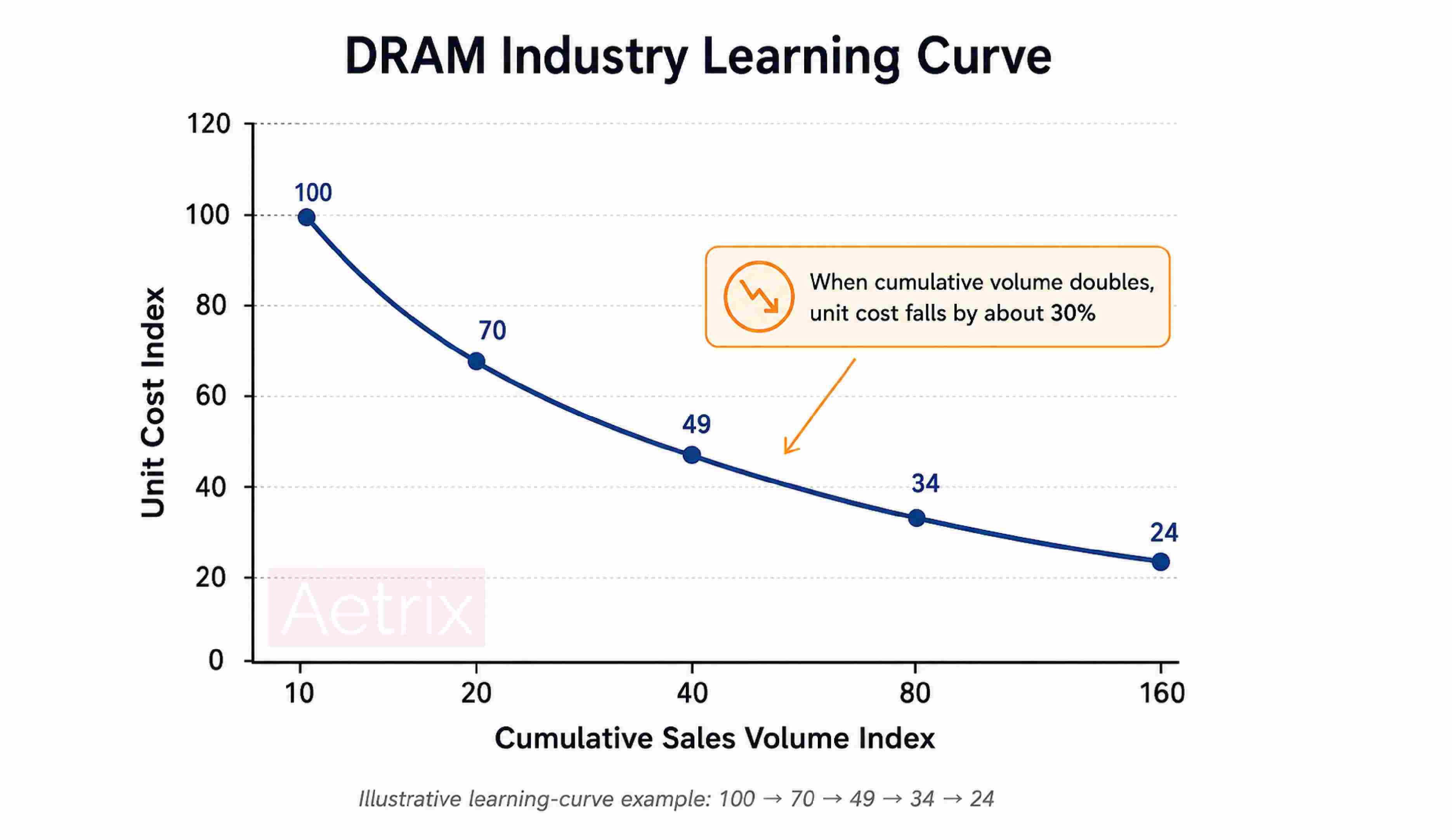
The memory industry is shaped by a brutal learning curve. As cumulative output doubles, unit cost can fall by roughly 30%. That rule explains why memory makers have historically been willing to expand, cut prices, take share, and repeat the cycle.
In memory, scale is not optional. A company that expands faster can reduce cost faster. A company that reduces cost faster can lower prices and still survive. A company that refuses to invest through the cycle can temporarily report better margins, but it risks falling behind the cost curve.
This is why memory pricing often looks aggressive in upcycles and destructive in downcycles. Memory makers are not only selling chips. They are fighting for position on the cost curve. If a company loses that position, it may not get another chance.
| Learning-Curve Logic | Business Effect | Industry Behavior |
|---|---|---|
| Cumulative output doubles | Unit cost falls by about 30% | Companies race to scale production |
| Lower cost enables lower pricing | Cost leaders can survive price cuts | Price wars eliminate weaker players |
| Scale improves cycle position | Large players gain more pricing power | Industry consolidation increases |
| Underinvestment raises long-term risk | Short-term profit can turn into long-term decline | Counter-cycle investment becomes a weapon |
How DRAM Leadership Shifted From the U.S. to Japan, Then to Korea
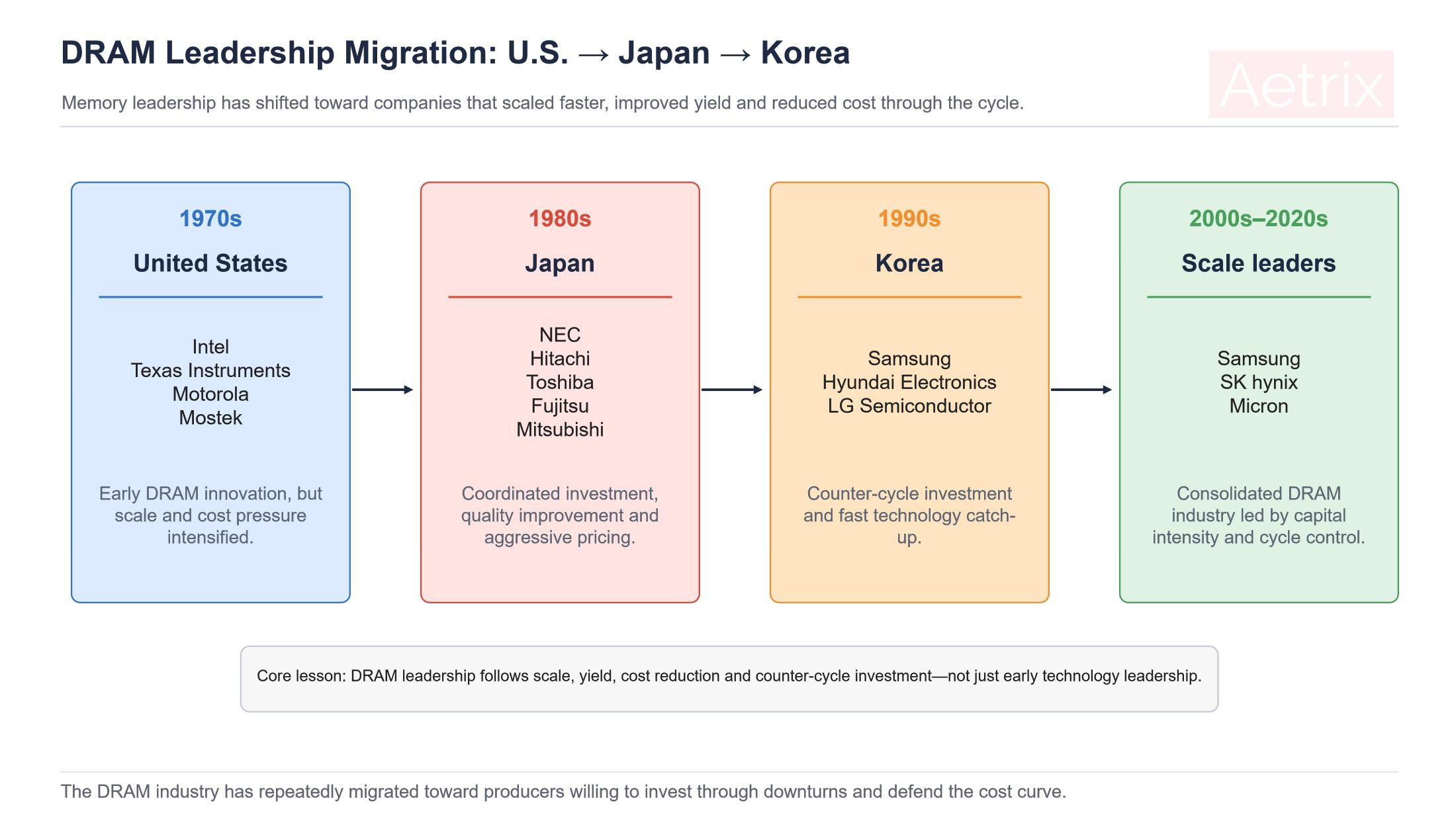
DRAM leadership has repeatedly moved to the companies and regions that were willing to scale faster, improve yield faster, and reduce cost faster. The U.S. led the early memory market. Japan took leadership in the 1980s. Korea then overtook Japan in the 1990s. These transitions were not only technology shifts. They were scale, investment, and cost-curve shifts.
In the 1970s, U.S. companies such as Intel, Texas Instruments, Motorola, and Mostek were among the most important memory players. They helped define the early DRAM market. But Japanese producers including NEC, Hitachi, Toshiba, Fujitsu, and Mitsubishi used coordinated investment, government-backed R&D, quality improvement, and aggressive pricing to win major customers.
By the 1980s, Japanese DRAM producers had built a powerful position. Japan's VLSI program brought together leading companies and research resources. Japanese suppliers improved quality, drove down cost, and gained share rapidly. Intel's decision to exit memory and focus on processors became one of the most important strategic shifts in semiconductor history.
Japan's leadership did not last forever. In the 1990s, Samsung, Hyundai Electronics, and LG Semiconductor used counter-cycle investment and rapid technology catch-up to challenge Japanese memory makers. Samsung entered DRAM in 1983, overtook NEC in 1992, and by the late 1990s Korean producers had taken the lead. Japan later attempted to consolidate DRAM through Elpida, but Elpida eventually failed and was acquired by Micron.
| Period | Leading Region | Representative Companies | How Leadership Changed | Core Lesson |
|---|---|---|---|---|
| 1970s | United States | Intel, Texas Instruments, Motorola, Mostek | U.S. companies led early DRAM innovation but later struggled against lower-cost Japanese producers. | Technology leadership was not enough without scale and cost discipline. |
| 1980s | Japan | NEC, Hitachi, Toshiba, Fujitsu, Mitsubishi | Japanese producers used coordinated R&D, quality improvement, and aggressive pricing to gain DRAM share. | Scale, yield, and pricing power could shift global leadership. |
| 1990s | Korea | Samsung, Hyundai Electronics, LG Semiconductor | Korean firms invested through downturns, caught up technologically, and overtook Japanese producers. | Counter-cycle investment became a decisive weapon. |
| 2000s–2020s | Korea / U.S.-based scale leaders | Samsung, SK hynix, Micron | The industry consolidated around a few capital-intensive memory leaders. | DRAM became a scale game dominated by capital, technology, and cycle control. |
Why This Memory Cycle Is Different
The current memory cycle is different because AI has changed the demand structure. In older cycles, the biggest demand driver was often a short consumer electronics pulse. This time, the main driver is AI infrastructure.
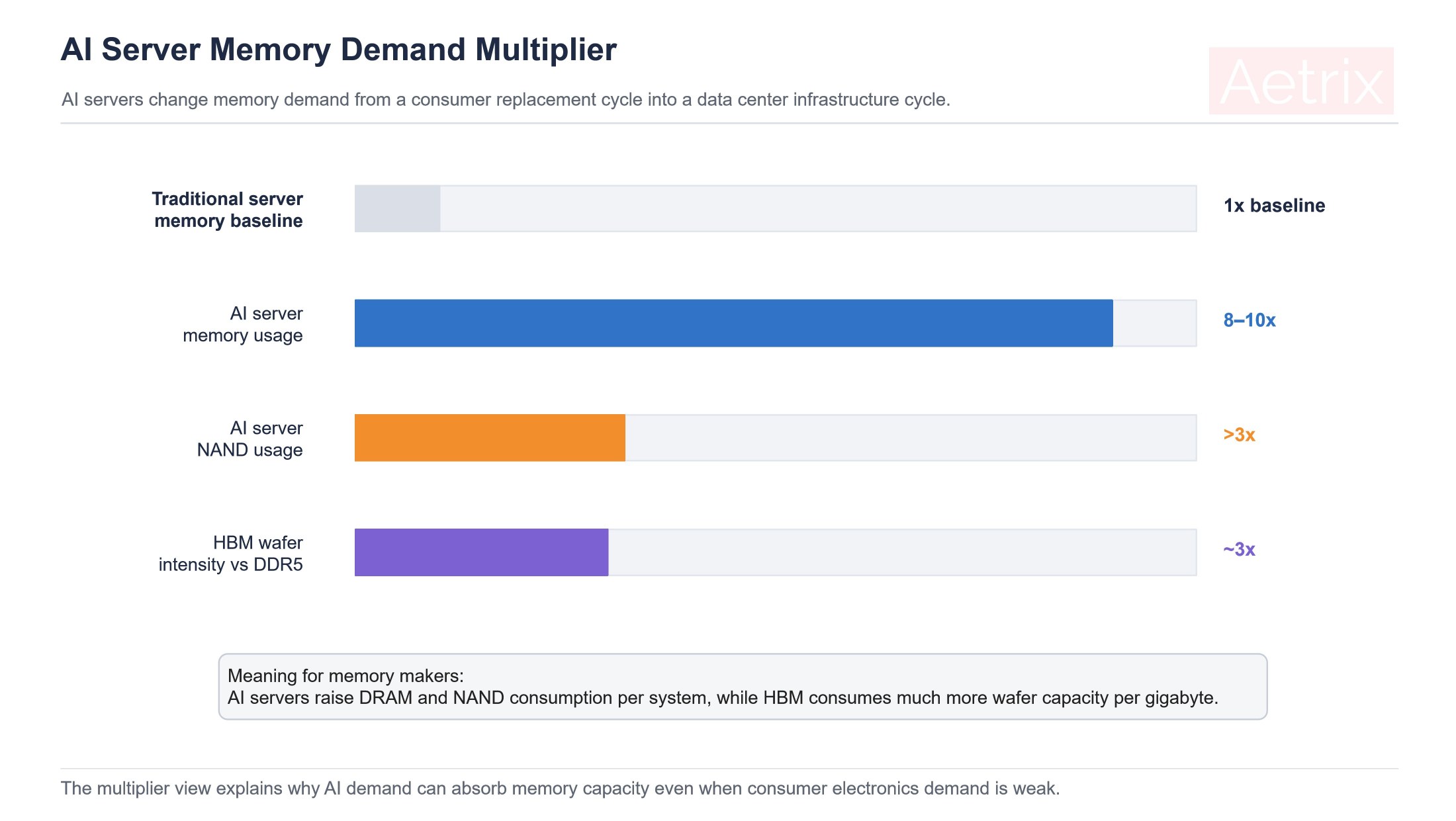
A single AI server can use roughly 8–10 times more memory than a traditional server. NAND consumption can be more than three times higher. This changes memory demand from a replacement cycle into a data center buildout. Large cloud customers are not buying memory only for short-term device production. They are building long-lived AI training and inference infrastructure.
HBM changes the supply equation even more. Each gigabyte of HBM can consume roughly three times as much wafer capacity as DDR5. As Samsung, SK hynix, and Micron redirect 70%–90% of advanced capacity toward HBM and server DDR5, consumer memory becomes structurally supply-constrained even when PC and smartphone demand is weak.
This is the same AI infrastructure pressure discussed in our analysis of AI server memory chip shortages, HBM, DDR5 and CXL demand. AI demand is not only lifting HBM prices; it is changing how memory makers allocate wafer starts across product categories.
| AI Memory Demand Signal | Data Point | Market Meaning |
|---|---|---|
| AI server memory content | 8–10x traditional server memory usage | AI servers create a much higher memory bill per system |
| AI server NAND usage | More than 3x traditional server usage | AI also affects storage demand, not only DRAM |
| AI server shipment growth | 2026 shipment growth estimated at 180% | AI demand is large enough to reshape memory allocation |
| AI share of storage demand | Estimated at 53% of total storage demand | AI becomes the main demand center rather than a niche segment |
| HBM wafer intensity | Around 3x DDR5 per GB | HBM absorbs wafer capacity faster than conventional memory |
AI Is Changing Memory Capacity Allocation
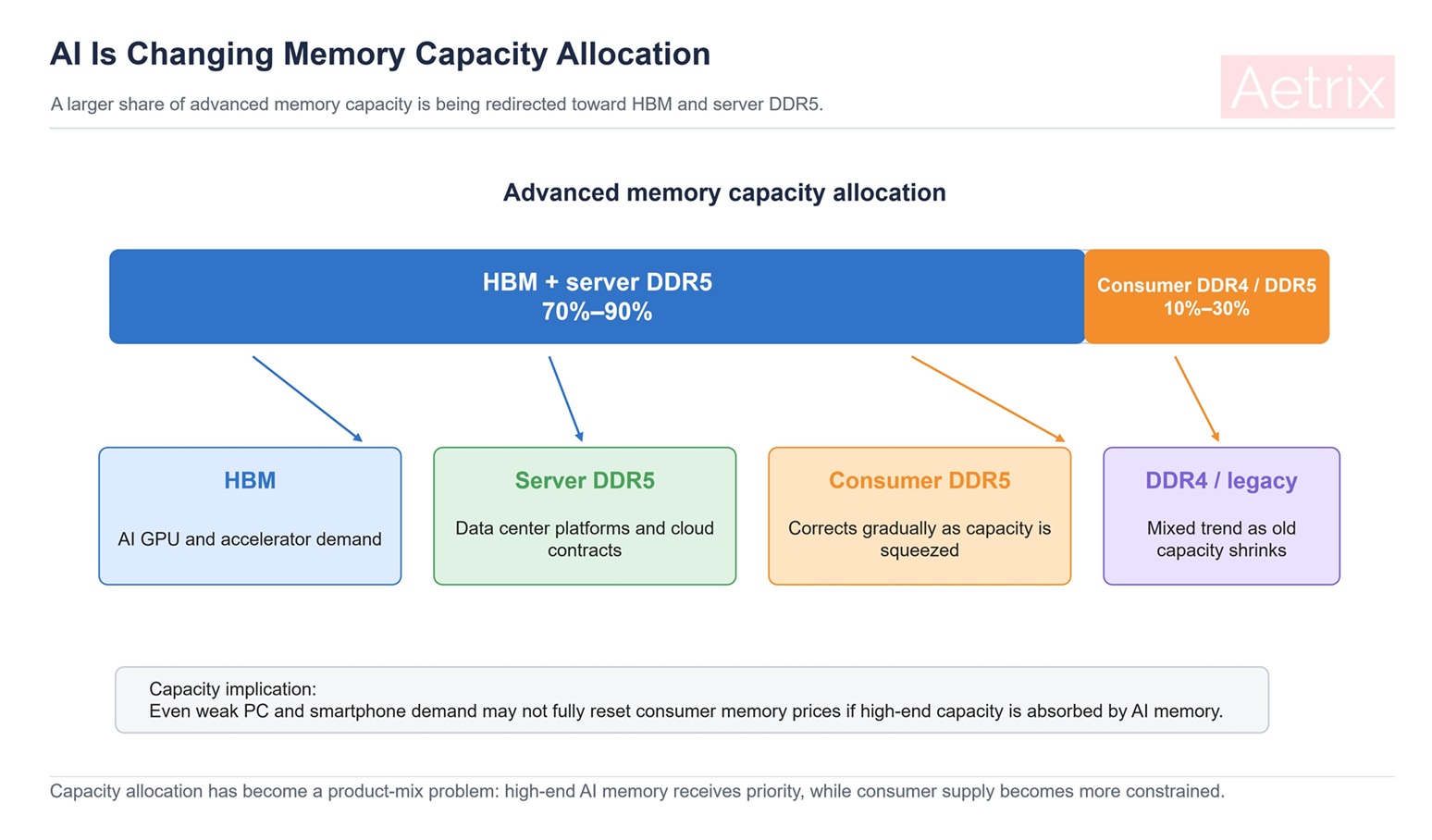
The tightness in memory is not only about demand volume. It is also about which products receive capacity. HBM and server DDR5 now carry higher strategic priority because they are directly tied to AI GPUs, accelerators, and data center platforms.
When 70%–90% of advanced memory capacity is redirected toward HBM and server DDR5, the supply available for consumer DDR4, consumer DDR5, and lower-priority products becomes structurally smaller. This is why weaker PC or smartphone demand does not automatically send memory prices back to previous lows.
The result is a split memory market. High-end AI memory remains tight. Server DDR5 stays relatively firm. Consumer memory may correct, but its downside is limited by capacity migration. Legacy memory can even stay firm if older production lines are retired or converted.
Will Memory Chip Prices Crash After the Current Upcycle?
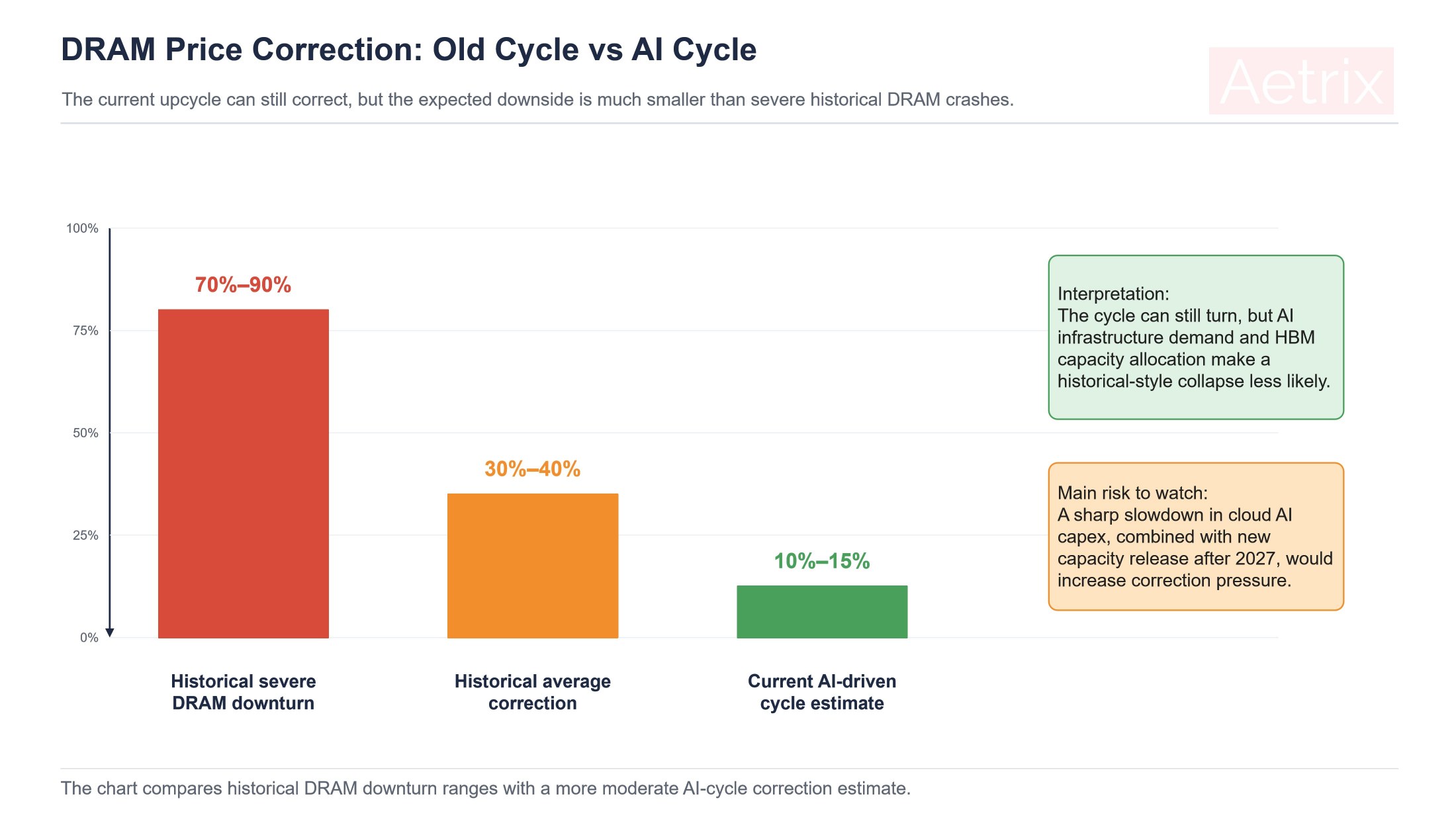
The correction will still come, but it is unlikely to look like the old 70%–90% DRAM crashes. A more moderate 10%–15% correction after 2027 fits the new supply-demand structure better than a historical-style collapse.
The reason is simple: demand is more rigid, and supply is more selective. AI infrastructure does not behave like a smartphone replacement cycle. Cloud companies cannot simply stop building AI clusters if memory prices rise. They may optimize spending, but the need for HBM, server DDR5, and high-capacity storage remains tied to long-term compute deployment.
Memory makers are also more disciplined than in earlier cycles. Capital expenditure growth has moved away from the aggressive 30%–50% expansion style seen in past booms toward a more controlled level around 14%. That does not eliminate oversupply risk, but it reduces the chance of a sudden flood of undifferentiated capacity.
| Correction Scenario | Typical / Expected Decline | Why It Matters |
|---|---|---|
| Historical severe DRAM downturn | 70%–90% | Old cycles could collapse when demand cooled and new capacity arrived together |
| Historical average correction | 30%–40% | Typical correction still reflected strong consumer-cycle sensitivity |
| Current AI-driven cycle estimate | 10%–15% | AI infrastructure demand and HBM allocation may limit downside |
Which Memory Segments Will Stay Tightest?
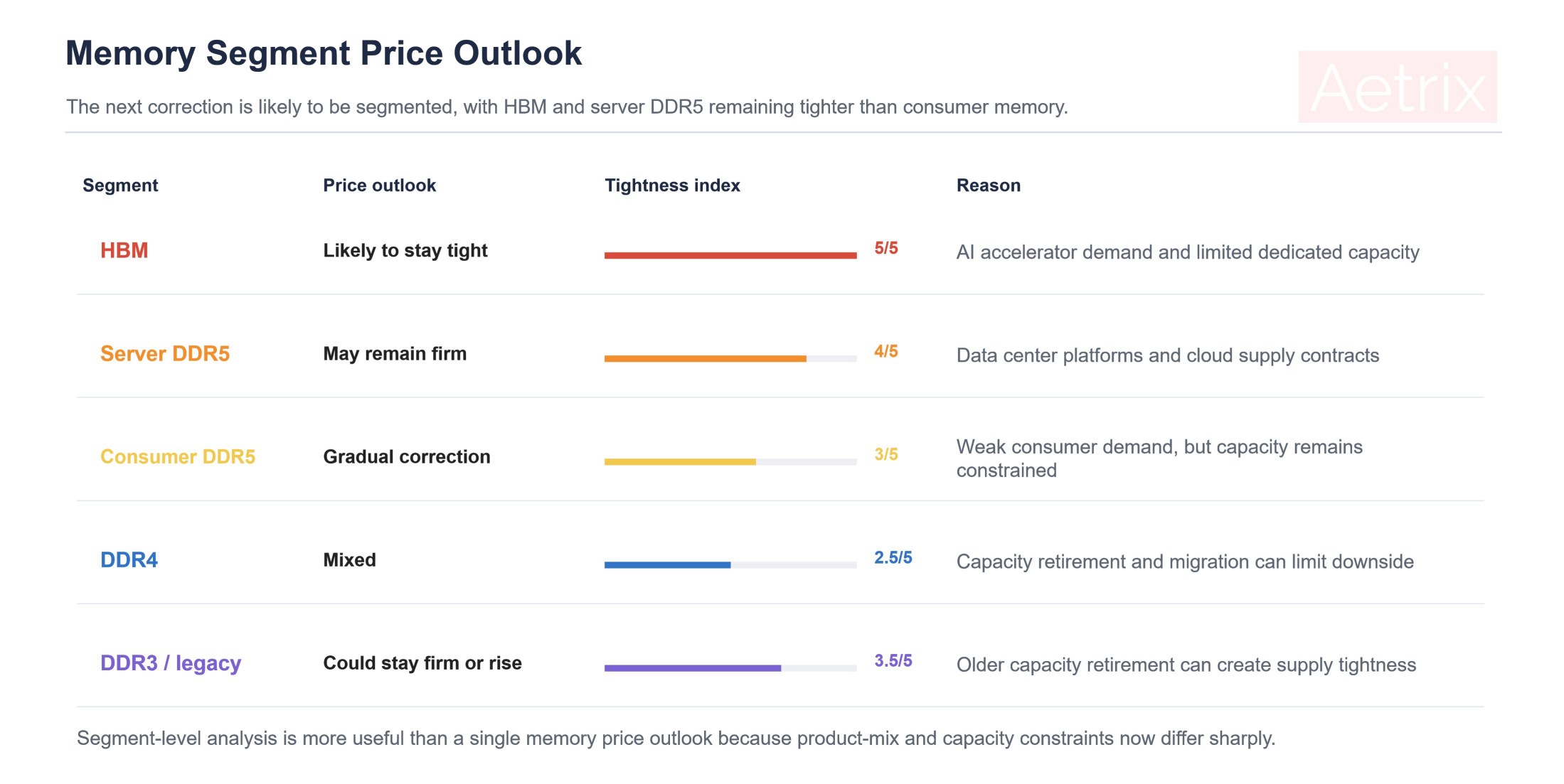
The memory market will not move as one block. HBM, server DDR5, consumer DDR5, DDR4, and older memory categories will behave differently. The next correction is likely to be segmented, not uniform.
HBM should remain the tightest segment because AI accelerator demand continues to grow and HBM capacity is difficult to scale quickly. Server DDR5 should also remain firmer than consumer memory because cloud and enterprise platforms require more memory per system.
Consumer DDR5 may correct as PC and smartphone demand remains weaker, but the downside is limited by capacity reallocation. DDR4 may behave unevenly because some capacity is being retired or converted. Older memory such as DDR3 can even stay firm if legacy capacity continues to shrink.
| Memory Segment | Price Outlook | Reason |
|---|---|---|
| HBM | Likely to stay tight | AI accelerator demand and limited dedicated capacity |
| Server DDR5 | May remain firm | Data center demand and cloud supply contracts |
| Consumer DDR5 | Gradual correction | Consumer demand is weaker, but supply is constrained by AI allocation |
| DDR4 | Mixed | Capacity reduction and migration to newer products can limit downside |
| DDR3 / legacy memory | Could stay firm or rise | Older capacity retirement can create supply tightness |
What Signals Will Show That Memory Prices Are Turning?
The key signal is not only price. Buyers should watch demand, capacity, inventory, and contract behavior together. A real turning point will appear when AI demand growth slows, new capacity ramps, and server memory inventory starts to build.
The most important demand signal is cloud capital expenditure. If Microsoft, Google, Amazon, Meta, and other hyperscalers slow AI server deployment, memory demand will soften. The most important supply signal is HBM and server DDR5 capacity. If SK hynix, Samsung, and Micron expand enough high-end memory capacity after 2027, pricing pressure will ease.
Buyers should also watch whether consumer memory inventory starts rising while HBM remains sold out. That would confirm a segmented correction rather than a broad memory crash.
| Signal | What It Would Mean | Buyer Interpretation |
|---|---|---|
| Cloud capex slows | AI server demand growth may cool | HBM and server DDR5 pricing could lose momentum |
| HBM capacity ramps faster than AI GPU demand | The tightest memory bottleneck starts easing | High-end memory prices may stabilize |
| New memory capacity ramps after 2027 | Supply begins catching up | Correction becomes more visible |
| Consumer memory inventory builds | PC and smartphone demand is not absorbing supply | Consumer DDR5 could correct before HBM |
| Legacy capacity continues shrinking | Older parts remain supply-constrained | DDR3 or older memory may not follow broad price declines |
What Buyers Should Do
Buyers should not treat all memory parts the same. HBM, server DDR5, consumer DDR5, DDR4, NAND, and legacy memory are now moving under different supply conditions. A single view of "memory prices" is no longer enough.
For production programs, the first step is to separate memory demand by end application. AI servers and data center systems need different procurement strategies from consumer electronics, industrial equipment, or legacy embedded systems.
Second, buyers should track price movement together with lead times. A price increase alone does not always mean shortage. But if higher prices come with longer lead times, falling stock, shorter quote validity, or allocation notes, the supply risk is more serious. Our related report on semiconductor lead times in 2026 explains how buyers can interpret lead time signals across component categories.
Third, buyers should avoid blindly chasing every memory rally. If a part is tied to AI infrastructure or server platforms, supply may remain tight longer. If a part is tied mainly to consumer electronics, the price risk may be more two-sided. The right strategy is not to assume either a crash or a permanent shortage, but to map the product to its actual demand driver.
| Buyer Checkpoint | Why It Matters |
|---|---|
| Separate HBM, server DDR5, consumer DDR5, DDR4, and legacy parts | Each segment has a different demand and capacity profile |
| Watch cloud capex and AI server deployment | AI infrastructure is the main driver of high-end memory tightness |
| Track lead time together with price | Price increases are more important when availability also worsens |
| Review BOM exposure by memory type | Production risk depends on the specific memory category used |
| Avoid applying one memory-price rule to every product | HBM, server DDR5, consumer DDR5, DDR4, and legacy products are moving under different cycles |
Key Takeaways
- Memory remains a cyclical semiconductor category, but the AI cycle is structurally different from previous consumer-driven cycles.
- The old DRAM cycle often ended with sharp collapses because demand cooled just as new supply arrived.
- This cycle is supported by AI infrastructure, HBM, server DDR5, and multi-year cloud demand.
- Memory prices can still fall after the upcycle, but a historical-style 70%–90% crash is less likely than a segmented correction.
- HBM and server DDR5 should remain tighter than consumer memory.
- The U.S. → Japan → Korea DRAM migration shows that memory leadership follows cost curves, scale, and counter-cycle investment.
- Buyers should analyze memory by segment rather than treating all memory chip prices as one market signal.
The memory market is still cyclical, but the demand behind this cycle is no longer the same. AI servers have turned memory from a consumer electronics component into a strategic infrastructure input. That does not eliminate the cycle. It changes its shape.
The practical conclusion is simple: memory prices will not stay high forever, but the next correction is likely to be more selective than the old DRAM crashes. Buyers should focus less on whether "memory will fall" and more on which memory segment, which demand driver, and which capacity pool is being affected.