My Inquiry
 My Account


Intel recently confirmed price increases for selected consumer and server processors, putting CPU pricing back on the procurement agenda for PC OEMs, system integrators, workstation builders and data-center buyers. The adjustment is not a full-line increase across every Intel CPU family. It is concentrated in specific Core Ultra 200S Plus desktop processors and selected Xeon server CPUs.
Intel linked the adjustment to current market conditions, higher supply chain costs and strong demand for Core Ultra 200S Plus processors. The affected product mix matters as much as the price increase itself. Intel is raising prices where demand is stronger, where earlier pricing had become more aggressive, or where buyers have limited short-term platform flexibility.
For procurement teams, the immediate issue is commercial control. Buyers need to check whether existing CPU quotes remain valid, whether open orders are protected, and whether second-half PC and server BOM assumptions still match current pricing. In desktop systems, a $20 to $50 CPU change can affect retail configuration decisions. In servers, higher Xeon reference pricing can move a full platform budget because the CPU is tied to memory, board, power, cooling and validation costs.
Key Findings
- Intel's latest adjustment is targeted, not a broad increase across the full CPU portfolio.
- Core Ultra 7 270K Plus and Core Ultra 5 250K Plus show the clearest desktop-side price movement.
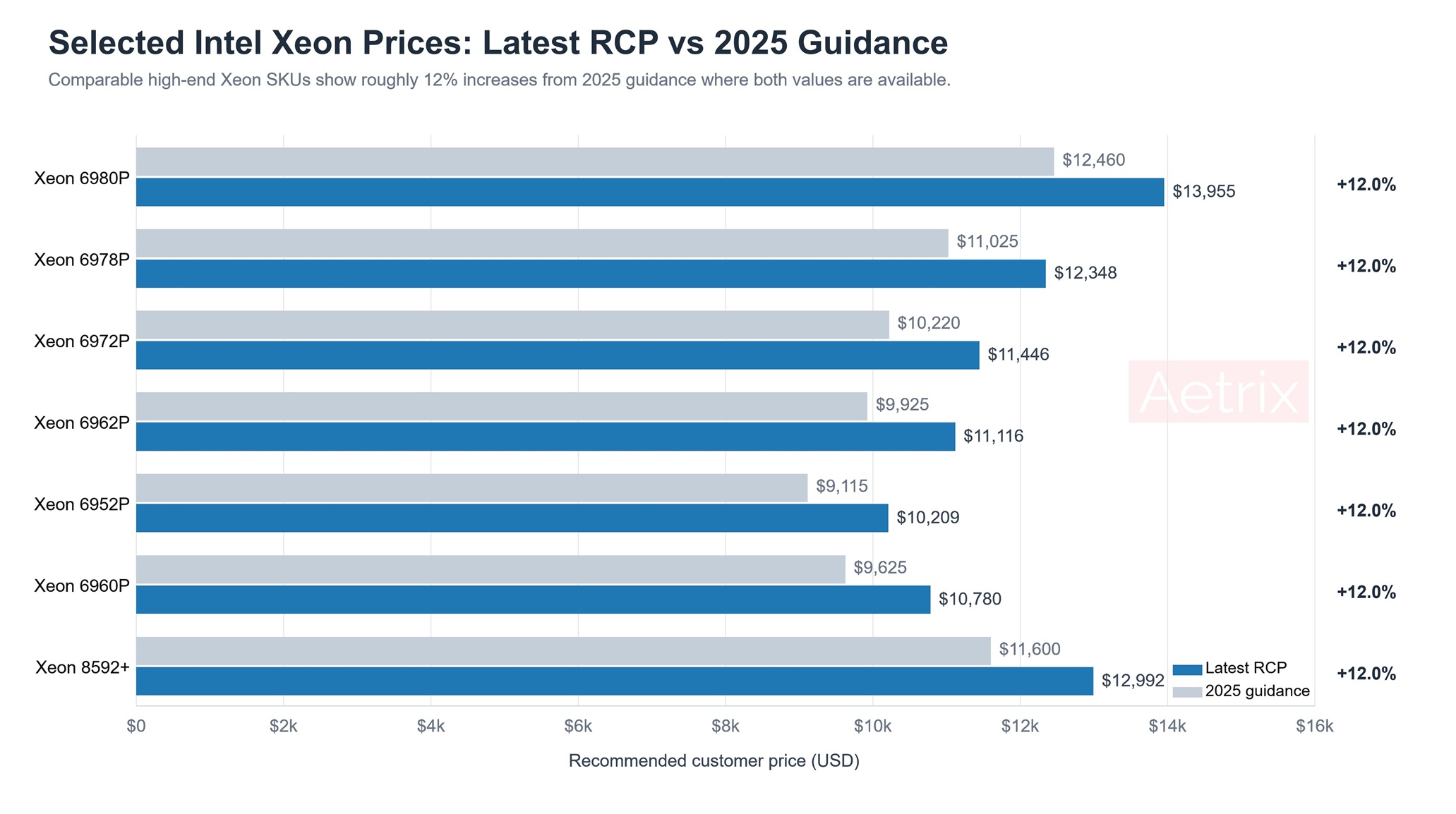
- Several high-end Xeon models have moved higher from 2025 guidance levels, with many listed increases near 12% where comparable data is available.
- The server-side impact is larger because Xeon CPUs sit inside validated platform budgets covering memory, boards, power delivery, cooling and long-term service commitments.
- Buyers should recheck quote validity, open-order protection, backlog coverage, MOQ, NCNR terms and approved alternates before new Q3 and Q4 orders.
Intel's Price Increase Is Targeted, Not Full-Line
The clearest desktop-side movement is in the Core Ultra 200S Plus family. When Intel announced the Core Ultra 7 270K Plus and Core Ultra 5 250K Plus in March, it listed suggested starting prices of $299 and $199, respectively (Intel Newsroom).
Intel's current product pages now list the Core Ultra 7 270K Plus at $339.00–$349.00 and the Core Ultra 5 250K Plus at $219.00–$229.00 (Intel, Core Ultra 7 270K Plus; Intel, Core Ultra 5 250K Plus). That puts the visible increase at roughly $20 to $50, depending on the model and price reference.
The increase is not large enough to change the technical role of these CPUs, but it narrows the value gap that helped the Plus models attract attention after launch. For PC builders selling into fixed retail price bands, the CPU increase can force trade-offs in memory capacity, motherboard tier, SSD size, cooling solution or channel promotion margin.
| Processor | Launch Starting Price | Current Intel RCP | Visible Change | Procurement Impact |
|---|---|---|---|---|
| Core Ultra 7 270K Plus | $299 | $339–$349 | +$40 to +$50 | Higher cost pressure for gaming desktops, creator PCs and performance workstations |
| Core Ultra 5 250K Plus | $199 | $219–$229 | +$20 to +$30 | Narrower margin for mid-range performance desktop builds |
Core Ultra 200S Plus: A Smaller Value Gap for Desktop Builds
The Core Ultra 200S Plus series was introduced to strengthen Intel's desktop offering after the original Arrow Lake launch received mixed market feedback. The Plus models added more efficient cores, higher die-to-die frequency and DDR5-7200 memory support while remaining on the LGA1851 platform with Intel 800-series chipset motherboards (Intel Newsroom).
That combination gave system builders a clearer value story in gaming desktops, creator systems and small workstations. After the price increase, the same parts remain attractive technically, but the commercial room is tighter. A system integrator quoting a fixed-price desktop build now has less space to absorb CPU cost without changing another part of the configuration.
| Desktop BOM Area | Why CPU Pricing Matters | Buyer Checkpoint |
|---|---|---|
| DDR5 memory | Core Ultra 200S Plus supports faster DDR5, so memory selection affects the value of the platform. | Recalculate CPU and memory cost together instead of checking CPU pricing alone. |
| Motherboard | LGA1851 and Intel 800-series platform choices shape the final build cost. | Check whether lower-cost boards still meet I/O, thermal and reliability requirements. |
| Cooling and power | Unlocked performance CPUs normally require stronger thermal and power planning. | Avoid offsetting CPU cost by under-sizing the cooling or power design. |
| Retail bundle | A CPU increase can reduce margin in fixed-price PC bundles and channel promotions. | Refresh system quote sheets before publishing new offers. |
Xeon Price Table: High-End Server CPUs Move Higher from 2025 Levels
The server-side price movement deserves closer attention because the absolute dollar change is larger and the affected CPUs sit inside qualified server platforms. Intel's current ordering page lists the Xeon 6980P, a 128-core Granite Rapids processor, with a Recommended Customer Price of $13,955.00 (Intel, Xeon 6980P).
The table below summarizes the Xeon pricing data shown in the Intel CPU price increase table. Where both the latest RCP and 2025 guidance are available, many listed models show an increase of roughly 12%. This is a pricing-floor recovery from earlier 2025 levels, not a simple claim that every Xeon model is now above its launch guidance.
| Processor | Latest RCP | 2025 Guidance | Change vs 2025 | Launch Guidance | Cores / Threads | Base / Turbo GHz | TDP | L3 Cache | Configurable TDP |
|---|---|---|---|---|---|---|---|---|---|
| Xeon 6980P | $13,955 | $12,460 | +12.0% | $17,800 | 128 / 256 | 2.0 / 3.9 | 500 W | 504 MB | No |
| Xeon 6979P | Not published | $11,025 | N/A | $15,750 | 120 / 240 | 2.1 / 3.9 | 500 W | 504 MB | No |
| Xeon 6978P | $12,348 | $11,025 | +12.0% | N/A | 120 / 240 | 2.1 / 3.9 | 500 W | 504 MB | 400–500 W |
| Xeon 6972P | $11,446 | $10,220 | +12.0% | $11,805 | 96 / 192 | 2.4 / 3.9 | 500 W | 480 MB | No |
| Xeon 6962P | $11,116 | $9,925 | +12.0% | N/A | 72 / 144 | 2.7 / 3.9 | 500 W | 432 MB | No |
| Xeon 6952P | $10,209 | $9,115 | +12.0% | $11,400 | 96 / 192 | 2.1 / 3.9 | 400 W | 480 MB | Not published |
| Xeon 6960P | $10,780 | $9,625 | +12.0% | $13,750 | 72 / 144 | 2.7 / 3.9 | 500 W | 432 MB | No |
| Xeon 8592+ | $12,992 | $11,600 | +12.0% | $11,600 | 64 / 128 | 1.9 / 3.9 | 350 W | 320 MB | No |
| Xeon 8580 | $11,995 | Not published | N/A | $10,710 | 60 / 120 | 2.0 / 4.0 | 350 W | 300 MB | No |
The table shows why the Xeon adjustment should be read as a server platform cost issue rather than a simple CPU price headline. The largest listed Granite Rapids models sit in the 400 W to 500 W range, with 72 to 128 cores and up to 504 MB of L3 cache. These processors are not easy drop-in substitutions in enterprise procurement. They sit inside validated platforms with fixed board, memory, power and thermal assumptions.
The comparison with 2025 guidance also keeps the price story grounded. Several high-end Xeon models remain below their original launch guidance, but they have moved higher from 2025 reference prices. That pattern points to selective price recovery in server CPUs where data-center and AI infrastructure demand can support stronger pricing.
Why Server CPU Pricing Matters Beyond the CPU Line Item
A Xeon-based system is not priced like a standalone component purchase. The processor selection determines the server board, memory topology, firmware, cooling architecture, power delivery, chassis design and qualification path. Once a platform is approved, switching CPU families late in the project cycle can require new firmware checks, board validation, application tuning and customer approval.
Reuters reported earlier this year that Intel and AMD had notified customers in China of lengthy waits for server CPUs, with Intel lead times reaching up to six months for some products and server product prices rising by more than 10% for many customers in that market (Reuters). That report was market-specific, but it shows why server CPU pricing now belongs in the broader AI infrastructure supply discussion, not only in a processor category update.
AI server demand is usually discussed through GPUs, HBM and DDR5 memory, but general-purpose CPUs remain necessary for orchestration, data movement, networking, storage handling and system management. Aetrix has also covered how AI server memory chip shortages, HBM, DDR5 and CXL demand are changing platform-level procurement. Xeon pricing should be reviewed in the same BOM framework.
| Server BOM Area | Cost Link to CPU Pricing | Buyer Concern |
|---|---|---|
| Processor | Higher RCP can reset distributor and system-builder quote baselines. | Open RFQs may need repricing before PO release. |
| Memory | High-core-count CPUs require large DDR5 or MRDIMM configurations. | CPU and memory costs can rise together in server BOMs. |
| Power and thermal design | 350 W to 500 W CPUs require stronger cooling and power delivery. | Late redesign can delay platform approval and shipment schedules. |
| Server board and validation | CPU choice locks the buyer into a platform ecosystem. | Approved alternates should be reviewed before pricing pressure becomes urgent. |
Does This Mean a CPU Shortage?
The price increase does not automatically mean a broad CPU shortage. The current pattern is selective. Intel is adjusting prices in products where demand is stronger, pricing had room to recover, or buyers have fewer practical substitutes. That is different from a market-wide allocation event.
For desktop buyers, the main risk is configuration margin. Core Ultra 200S Plus price changes can affect finished-system price bands even if supply remains available. For server buyers, the risk is broader because CPU availability, memory pricing, platform validation and delivery schedules interact. A server CPU quote that looked acceptable earlier in the year may no longer support the same full-system budget.
Distributors should also separate old-stock offers from new-replenishment pricing. In a rising-price environment, a quote based on existing inventory can differ from a quote based on future replacement cost. Buyers should confirm which basis applies before comparing offers.
Buyer Guidance: What to Check Before New Orders
Intel states that Recommended Customer Price is pricing guidance and does not constitute a formal pricing offer. Final point-of-sale prices can vary by retailer, distributor, tariff, tax and local market conditions (Intel). Buyers should therefore separate public RCP from distributor quote price and contract price.
The first step is to locate all active PC, workstation and server BOMs using affected Intel processors. The next step is to confirm whether existing quotes remain valid after the price change. For high-volume desktop builds, even a modest CPU increase can affect margin. For servers, one CPU price movement can affect a full node, rack or cluster budget.
| Checklist Item | What to Confirm | Why It Matters |
|---|---|---|
| Quote validity | Whether distributor quotes issued before the price change are still valid. | Old RFQs may not reflect current replacement cost. |
| Open orders | Whether backlog is price-protected or subject to revalidation. | Scheduled releases can be exposed if terms are not locked. |
| Backlog coverage | Whether Q3 and Q4 demand is covered by firm orders. | Strong demand can shorten the effective buying window for popular SKUs. |
| Approved alternates | Whether alternate CPUs or platform options are already qualified. | Late platform switching is costly for servers and validated workstations. |
| MOQ and NCNR terms | Whether new pricing comes with minimum order or cancellation restrictions. | Higher prices can combine with stricter commercial terms when supply tightens. |
What to Watch in the Second Half of the Year
The second-half watch point is whether CPU pricing remains limited to selected strong-demand SKUs or spreads into wider processor categories. If the increase stays concentrated, buyers can manage it through quote control, BOM refreshes and platform-level planning. If more CPU families move higher, PC OEMs and server buyers may need broader cost revisions.
For desktop systems, the first signs will appear in gaming PC and creator workstation configurations. For server systems, the stronger indicator will be whether Xeon pricing, server CPU lead times and DDR5 memory costs move together. Aetrix Electronics has also analyzed how AI server MLCC shortages and high-capacitance capacity reallocation are adding another layer of platform BOM pressure for infrastructure buyers.
Key Takeaways
Intel's recent price increase is targeted. It affects selected Core Ultra 200S Plus and Xeon processors, not the full CPU portfolio. The desktop impact is measured in tens of dollars per processor, but that is enough to affect configuration decisions in competitive PC price bands.
The server impact is more important for procurement. Many listed Xeon models show higher pricing from 2025 guidance levels, while remaining below or near original launch references depending on the SKU. That makes the current adjustment a pricing-floor recovery in selected high-end server CPUs rather than a uniform above-launch repricing.
Buyers should treat the change as a pricing and planning issue before treating it as a shortage event. Reconfirm quotes, check open-order protection, update full-system BOMs, extend backlog coverage for firm demand and review approved alternates for Q3 and Q4 production. In PC and server platforms, the CPU is one line item, but it often controls the economics of the whole system.