My Inquiry
 My Account


Last updated: August 28, 2026
August 2026 Update: PCB material pricing has tightened further since this article was published. Nan Ya Plastics is raising CCL and prepreg prices by 20%–25% from September 1 based on shipment date, while Kingboard's August 28 notice raises all FR-4 thicknesses by 10%, PP using 7628 and thicker glass by 10%, and thinner-glass PP by 20%. The latest changes indicate that glass-fabric availability is becoming a more important pricing and stack-up constraint. Read the latest analysis: PCB Material Shortage 2026: Glass Fabric Drives New CCL and FR-4 Price Hikes.
PCB material prices have moved through three stages in recent months: high-speed and specialty laminate suppliers raised prices before July, broader CCL repricing appeared around July 1, and Kingboard Laminates added a second-round increase on July 6 for FR-4, PP, CEM-1 / 22F and copper foil processing fees.
The July 6 Kingboard notice is important because it did not appear in isolation. It followed earlier increases in low-loss and high-speed laminate materials, as well as the first July round of CCL adjustments across FR-4 and AI server-related laminate categories. Shengquan Electronic Materials also issued a separate notice for PPO, PPE, OPE and MPPO oligomer products, with a 15%–20% adjustment effective seven days after the notice date.
For electronics buyers, the issue is not just a higher PCB quote. The larger risk is that glass cloth, copper foil, resin, CCL, prepreg and high-speed laminate prices are moving together. That can shorten quote validity, change open-order terms, tighten allocation for high-speed materials and increase BOM pressure for AI servers, networking equipment, industrial controls and high-layer-count boards.
Key Findings
- Before July, specialty and high-speed laminate suppliers had already raised prices, especially for CCL, prepreg and low-loss materials.
- July 1 marked a broader CCL repricing stage, with FR-4, PP and high-speed AI server materials moving higher across multiple supplier channels.
- Kingboard's July 6 letter added a second-round signal, raising FR-4 by 15%, PP by 15%, CEM-1 / 22F by 10%, and copper foil processing fees by RMB 5–8/kg.
- Shengquan's 15%–20% resin notice effective July 13 shows upstream cost pressure is still spreading into PPO, PPE, OPE and MPPO materials.
- Buyers should review quote validity, open-order protection, backlog coverage, stack-up approval and approved laminate alternatives before Q3 and Q4 builds.
PCB Material Price Hikes Have Moved Through Three Stages
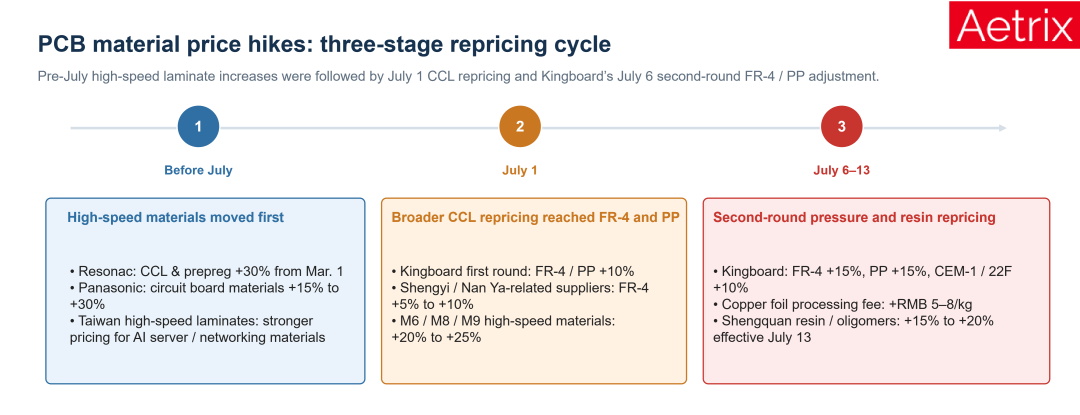
The current PCB material price cycle is best understood as a three-stage repricing process. The first stage started before July, led by specialty and high-speed laminate materials. The second stage appeared around July 1, when broader CCL repricing reached FR-4 and high-speed materials. The third stage came on July 6, when Kingboard issued an additional increase, followed by Shengquan's resin adjustment effective July 13.
The timeline below separates confirmed supplier notices from buyer-side communications. Market relevance is included only as context, because a price move from a leading CCL supplier has a different supply-chain impact from a smaller spot-market adjustment.
| Stage | Timing | Supplier / Segment | Market Relevance | Products Affected | Adjustment | Buyer Meaning |
|---|---|---|---|---|---|---|
| Stage 1 | Before July | Resonac | Japan-based supplier with strong specialty electronic-material exposure | Copper-clad laminates and prepregs | +30% from March 1 shipments | Shows the material cycle began before the latest July FR-4 notices and was already visible in specialty laminates |
| Stage 1 | Before July | Panasonic Industry | Major supplier in circuit board materials and low-loss laminate systems | Glass epoxy multilayer CCL, prepreg, low-transmission-loss CCL, low-transmission-loss prepreg, CEM-3 and FCCL | +15% to +30% depending on material category | Both conventional and low-loss circuit board materials were under pricing pressure before July |
| Stage 1 | Before July | Taiwan-based high-speed laminate suppliers, including TUC, EMC and ITEQ | Important suppliers for high-speed, high-frequency and data-center PCB materials | High-frequency and high-speed CCL | Buyer-side communications indicate high-speed materials moved earlier and more sharply than ordinary FR-4 | AI server and networking materials were the first area of visible pricing pressure |
| Stage 2 | July 1, 2026 | Kingboard first July round | Global CCL leader; price moves can influence FR-4 and PP market expectations | FR-4 and PP | Buyer-side communications indicate FR-4 +10% and PP +10% | Commodity laminate pricing entered the July repricing cycle before the July 6 increase |
| Stage 2 | July 1, 2026 | Shengyi Technology | Major global CCL supplier with strong exposure to high-speed and AI server materials | FR-4 and M6 / M8 / M9 high-speed materials | Buyer-side communications indicate ordinary FR-4 +5% to +10%; high-speed AI materials +20% to +25% | Long-term customers receive better treatment than spot buyers; high-speed laminate remains tighter than commodity FR-4 |
| Stage 2 | July 1, 2026 | Nan Ya-related laminate suppliers | Top-tier laminate group with important high-speed and specialty material supply | FR-4 and high-frequency / high-speed laminates | Buyer-side communications indicate FR-4 +5% to +10%; high-speed materials +20% to +25% | Quota-style supply and limited spot acceptance raise procurement risk for smaller customers |
| Stage 2 | July 1, 2026 | Goldenmax International / spot FR-4 market | FR-4 supplier with exposure to regional spot and mid-range laminate demand | Commodity FR-4 | Buyer-side communications indicate dynamic spot quotation, with FR-4 moving broadly higher | Daily quotation and cash-prepayment preference increase cost uncertainty for spot buyers |
| Stage 3 | July 6, 2026 | Kingboard additional increase | Second-round signal from a leading global CCL supplier | FR-4, PP, CEM-1 / 22F and copper foil processing | FR-4 +15%; PP +15%; CEM-1 / 22F +10%; copper foil processing fee +RMB 5–8/kg | A second July increase can reset pricing expectations across PCB laminate sourcing |
| Stage 3 | July 13, 2026 | Shengquan Electronic Materials | Upstream resin / oligomer supplier; not directly comparable with CCL market-share rankings | PPO / PPE / OPE / MPPO oligomer products | +15% to +20%, final price confirmed at contract signing | Resin cost pressure can move into high-speed laminate pricing after CCL price books are already changing |
Stage 1: Specialty and High-Speed Laminates Raised Prices Before July
The July price cycle did not start with commodity FR-4. Before the latest July CCL notices, specialty and high-speed material suppliers had already moved pricing higher. Resonac announced a 30% increase for all copper-clad laminates and prepregs, effective for shipments from March 1, 2026 (Resonac, Price Adjustment of Copper Clad Laminates and Prepregs). Panasonic Industry announced price revisions for circuit board materials on April 9, including increases for glass epoxy multilayer CCL, prepreg, low-transmission-loss CCL, low-transmission-loss prepreg, CEM-3 and FCCL (Panasonic Industry, Price Revision of Circuit Board Materials).
That timing matters. It shows that high-speed and specialty material pressure appeared before ordinary FR-4 became the center of the July discussion. AI servers, high-speed switches, accelerator cards and data-center networking systems require lower-loss materials, tighter signal-integrity control and more qualified laminate supply. Those requirements make substitution harder and give suppliers more room to adjust pricing.
| Supplier Group | Timing | Material Focus | Price Signal | Why It Matters |
|---|---|---|---|---|
| Resonac | March 2026 shipments onward | CCL and prepreg | +30% | High-end and specialty material suppliers had already moved pricing before July |
| Panasonic Industry | April 2026 announcement | Glass epoxy CCL, prepreg, low-loss materials, CEM-3 and FCCL | +15% to +30% depending on material category | Both conventional and low-loss circuit board materials were under pressure |
| Taiwan-based high-speed laminate suppliers | Before July | High-frequency and high-speed CCL | Buyer-side communications indicate stronger increases than ordinary FR-4 | AI server and networking demand pulled low-loss material pricing higher first |
Stage 2: July 1 Brought Broader CCL Repricing
On July 1, broader CCL repricing reached FR-4 and high-speed materials across multiple suppliers. The important pattern is the difference between commodity and high-speed materials. Ordinary FR-4 moved higher, but M6, M8 and M9 materials used in AI servers and advanced networking saw larger reported increases and tighter customer allocation.
The customer structure also matters. Long-term agreement customers appear to be treated more favorably than spot buyers. Spot orders and smaller customers are more exposed to daily quotation, prepayment preference and limited allocation when materials are tight.
| Supplier / Segment | FR-4 Adjustment | High-Speed Material Adjustment | Customer Treatment | Procurement Signal |
|---|---|---|---|---|
| Kingboard first July round | Buyer-side communications indicate +10% | Not the main focus of the July 1 first-round note | New order pricing should be checked with distributor or laminate supplier | FR-4 and PP had already entered the July repricing cycle before the July 6 increase |
| Shengyi Technology | Buyer-side communications indicate spot +10%, long-term customers +5% | Buyer-side communications indicate M6 / M8 / M9 +20% to +25% | Long-term customers receive lower increases than spot customers | AI server material pricing is rising faster than ordinary FR-4 |
| Nan Ya-related laminate suppliers | Buyer-side communications indicate +5% to +10% | Buyer-side communications indicate +20% to +25% | Quota-style supply and limited spot acceptance | High-speed material buyers should confirm allocation, not only price |
| Goldenmax / FR-4 spot market | Buyer-side communications indicate dynamic FR-4 repricing | Less exposed than high-speed CCL suppliers | Spot quotations updated frequently; cash-prepayment customers may receive priority | Commodity FR-4 spot buyers face higher quote uncertainty |
Stage 3: Kingboard's July 6 Letter Adds a Second-Round Signal
Kingboard's July 6 notice is the most important latest document because it turns the July price cycle into a second-round adjustment. The letter states that market demand has continued to rise, driving tighter supply and sharp price increases for core upstream materials such as glass cloth and copper foil. The new prices apply to new orders received from the notice date; the letter does not state that old orders will be retroactively repriced.
| Kingboard Product | Adjustment | Scope / Rule | Supply Chain Meaning |
|---|---|---|---|
| FR-4, mainly 1.3 mm and above mainstream thicknesses | +15% | New orders from the notice date | Commodity FR-4 is no longer insulated from the high-end material shortage |
| PP prepreg | +15% | New orders from the notice date | Multilayer PCB stack-up cost will rise because prepreg is used between copper layers |
| CEM-1 / 22F | +10% | New orders from the notice date | Cost pressure is also reaching lower-cost composite board materials |
| Copper foil processing fee below 1.5 oz | +RMB 5/kg | Processing fee adjustment | Standard copper-weight boards face higher material conversion cost |
| Copper foil processing fee at 2 oz and above | +RMB 8/kg | Processing fee adjustment | Heavy-copper boards used in power, industrial and high-current designs are more exposed |
The size of Kingboard's adjustment matters because of the company's scale. When a leading laminate supplier moves FR-4 and PP again only days after the broader July 1 adjustment, PCB fabricators are less likely to absorb the increase internally. They will review customer quotes, material surcharges and board-level pricing for new orders.
Shengquan Resin Notice Shows Upstream Cost Pressure Is Still Spreading
The Shengquan Electronic Materials notice covers PPO, PPE, OPE and MPPO oligomer products. These are not commodity PCB line items, but they are relevant to high-frequency and high-speed laminate systems. The notice states that geopolitical tension has caused severe volatility in global raw-material markets, pushing procurement costs sharply higher. It also states that the company had previously maintained stable pricing through stockpiling and internal cost absorption, but inventory has been depleted and costs remain elevated.
The price adjustment range is 15% to 20%, with final pricing to be confirmed at contract signing. The notice says the new prices will take effect seven days after issuance and that confirmed orders before the effective date will be honored at current prices.
| Shengquan Product Group | Adjustment Range | Effective Rule | Relevance to PCB Materials | Buyer Concern |
|---|---|---|---|---|
| PPO oligomer products | +15% to +20% | Effective seven days after the notice date | Used in resin systems for lower-loss electronic materials | High-frequency laminate cost may be revalidated at contract signing |
| PPE oligomer products | +15% to +20% | Final pricing confirmed by contract | Relevant to specialty resin systems in high-speed materials | Open quotations may need resin-cost review |
| OPE / MPPO oligomer products | +15% to +20% | Confirmed orders before the effective date are honored at existing prices | Can feed into advanced laminate formulations | Buyers should confirm whether high-speed laminate quotes include future resin adjustments |
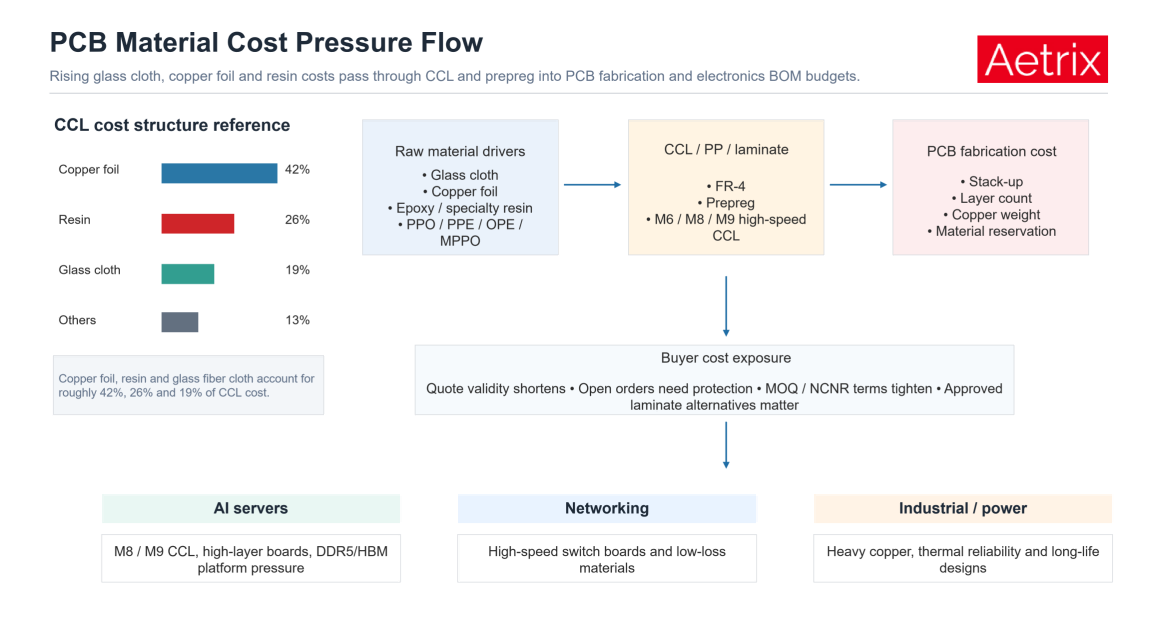
The Shengquan letter matters because it shows the price cycle is not limited to CCL producers. Resin, glass cloth and copper foil are moving at the same time. TrendForce notes that CCL is formed by laminating glass fiber cloth, copper foil and resin, with copper foil, resin and glass fiber cloth accounting for roughly 42%, 26% and 19% of total CCL cost, respectively (TrendForce, Glass Fiber Cloth Shortage). When all three major cost blocks move higher, PCB fabricators have less room to negotiate down laminate increases.
Why the Price Cycle Is Broader Than FR-4
Supplier notices usually describe the immediate reason in standard terms: raw-material costs, tight supply and stronger market demand. Those reasons are valid, but the current cycle has a deeper structure. Tightness is not limited to one input. It is a multi-material constraint affecting glass cloth, copper foil, resin, prepreg and high-speed laminate capacity at the same time.
Reuters reported that PCB prices had been climbing since late 2025, with AI server demand and shortages in epoxy resin, glass fiber and copper foil pushing the cost chain higher. The same report cited industry sources saying PCB prices surged as much as 40% in April from March, and that some epoxy resin lead times stretched to 15 weeks from three weeks previously (Reuters).
| Material Driver | Current Pressure | Affected PCB Material | Buyer Impact |
|---|---|---|---|
| Glass fiber cloth | Tight supply for standard and low-Dk cloth | FR-4, PP and high-speed CCL | Laminate lead time and quote validity become less stable |
| Copper foil | Higher copper and processing costs, with stronger exposure for heavy copper boards | CCL, heavy-copper PCB and power boards | Industrial, power and high-current PCB buyers face material surcharges |
| Epoxy resin and specialty resin | Lead-time extension and contract-level price revalidation | FR-4, low-loss materials and specialty laminate | High-speed material quotes may change before PCB production starts |
| PPO / PPE / OPE / MPPO | 15%–20% price adjustment in Shengquan notice | Advanced resin systems for lower-loss materials | AI server and networking PCB materials face further upstream cost pressure |
| Qualified CCL capacity | High-speed M-series demand absorbs qualified production lines | M6 / M8 / M9 laminate and general FR-4 allocation | Commodity FR-4 can tighten when producers prioritize higher-margin AI materials |
AI Server Demand Is Reshaping PCB Material Allocation
The current CCL cycle is also shaped by product mix. High-speed AI server materials compete for qualified resin systems, HVLP copper foil, low-Dk glass cloth and production capacity. When suppliers allocate more capacity to M6, M8 and M9 high-speed materials, commodity FR-4 supply can tighten even if end demand for ordinary boards has not increased at the same rate.
AI server demand is usually discussed through GPUs, HBM and DDR5 memory, but board materials are now part of the same platform-cost equation. High-layer-count server boards, accelerator cards, high-speed switches and backplane designs need materials that meet loss, skew, CAF, impedance and thermal requirements. Aetrix Electronics has covered the same platform-level pressure in AI server memory chip shortages, HBM, DDR5 and CXL demand.
| PCB Material Segment | Demand Driver | Price Sensitivity | Substitution Difficulty |
|---|---|---|---|
| Commodity FR-4 | General electronics, industrial control, consumer electronics and standard multilayer PCB | Moderate but broad because it affects many board types | Medium; alternate suppliers can be used if stack-up and reliability are approved |
| PP prepreg | Multilayer PCB and high-layer-count boards | High because prepreg is built into stack-up cost | Medium to high; dielectric, thickness and process compatibility must be validated |
| M6 / M8 / M9 high-speed CCL | AI servers, high-speed switches, accelerator cards and data-center networking | Very high because qualified supply is limited | High; signal integrity, loss, CAF, skew and qualification requirements limit replacement |
| Heavy-copper PCB materials | Power electronics, industrial drives, EV systems and high-current boards | High when copper foil processing fees rise | Medium; electrical and thermal performance must be maintained |
Buyer Guidance: What to Review Before Confirming PCB Orders
PCB buyers should not treat the July notices as a single supplier issue. The price changes cover multiple cost layers, and different customer groups will be treated differently. Spot buyers are more exposed than long-term agreement customers. High-speed AI material buyers are more exposed than ordinary FR-4 users. Heavy-copper boards are more exposed to copper foil processing changes.
The first step is to separate confirmed orders from open quotations. Kingboard's letter states new orders will follow the adjusted prices. Shengquan's notice says confirmed orders before the effective date will be honored at current prices. Buyers should check whether their own PCB fabricator or laminate supplier uses the same rule, because downstream quotation terms can differ from upstream supplier letters.
| Checklist Item | What to Check | Why It Matters |
|---|---|---|
| Quote validity | Confirm whether quotes issued before July, July 1, July 6 or July 13 remain valid. | The three-stage repricing cycle means older quotes may no longer match current material cost. |
| Open orders | Check whether confirmed PCB orders are protected under old laminate or resin pricing. | Supplier letters may protect confirmed orders, but downstream PCB terms can vary. |
| Backlog coverage | Extend coverage for firm Q3 and Q4 board demand, especially for high-layer-count and high-speed designs. | Material lead-time and price risk can rise after stack-up approval. |
| Approved laminate alternatives | Review whether second-source CCL, PP or high-speed materials are already approved. | Late material substitution can trigger signal integrity, impedance, reliability and process revalidation. |
| Stack-up approval | Lock stack-up, dielectric thickness, resin system and copper weight earlier in the design cycle. | Open-ended stack-up decisions make pricing and material reservation harder. |
| MOQ and NCNR terms | Check whether suppliers are adding minimum order, prepayment or non-cancelable terms for tight materials. | Short supply often changes commercial terms before formal lead times become extreme. |
What to Watch After the July 6 Increase
The first indicator is whether other large CCL suppliers issue new written notices after Kingboard's July 6 adjustment. As of July 6, the available information points to broader July 1 adjustments across several suppliers, while Kingboard is the visible supplier adding a fresh second-round increase. If more large CCL suppliers issue another round, PCB fabricators will have stronger justification to reprice open RFQs.
The second indicator is whether resin and glass cloth increases continue after CCL suppliers have already updated price books. Shengquan's 15%–20% adjustment shows upstream resin pricing is still moving. If glass cloth or copper foil suppliers continue tightening supply, FR-4 and PP prices will remain difficult for CCL producers to absorb.
The third indicator is AI server material allocation. If high-speed M8 and M9 materials remain heavily booked, suppliers will keep prioritizing higher-margin advanced laminates. That can leave commodity FR-4 buyers facing higher prices even without a proportional increase in their own end-market demand. This is similar to the broader AI server BOM pressure seen in AI server MLCC shortages and high-capacitance capacity reallocation, where high-end applications pull capacity away from more standard product categories.
Key Takeaways
The PCB material price cycle has moved through three stages: specialty and high-speed laminate increases before July, broader CCL repricing around July 1, and Kingboard's July 6 second-round increase for FR-4, PP, CEM-1 / 22F and copper foil processing. Shengquan's July 13 resin adjustment adds another upstream cost signal.
The impact differs by product category. Commodity FR-4 and PP are now under broader pricing pressure, but M6, M8 and M9 high-speed materials face higher allocation and substitution risk. Heavy-copper boards are more exposed to copper foil processing fees, while low-loss materials are more exposed to specialty resin and glass cloth constraints.
Buyers should not treat this as a short-term FR-4-only increase. The right procurement response is to confirm quote validity by order date, separate old-stock and new-replenishment pricing, check open-order protection, extend backlog coverage for firm demand and approve laminate alternatives before Q3 and Q4 builds enter final release.
Latest Update: PCB Material Pricing Enters a Fourth Stage
The PCB material market tightened again after this July analysis. By late August, the pricing cycle had moved beyond the three stages documented above. Nan Ya Plastics announced a 20%–25% increase for CCL and prepreg effective September 1, 2026 based on shipment date, while Kingboard issued another adjustment on August 28 covering FR-4 and prepreg.
The new Kingboard pricing also shows a stronger increase for thinner-glass prepreg: PP using glass styles below 7628 rises 20%, compared with 10% for all FR-4 thicknesses and PP using 7628 and thicker glass. This specification-level difference points to glass-fabric availability becoming a more important part of PCB material sourcing risk.
For the latest pricing data, glass-fabric supply analysis and Q4 2026 buyer guidance, see: PCB Material Shortage 2026: Glass Fabric Drives New CCL and FR-4 Price Hikes.