My Inquiry
 My Account


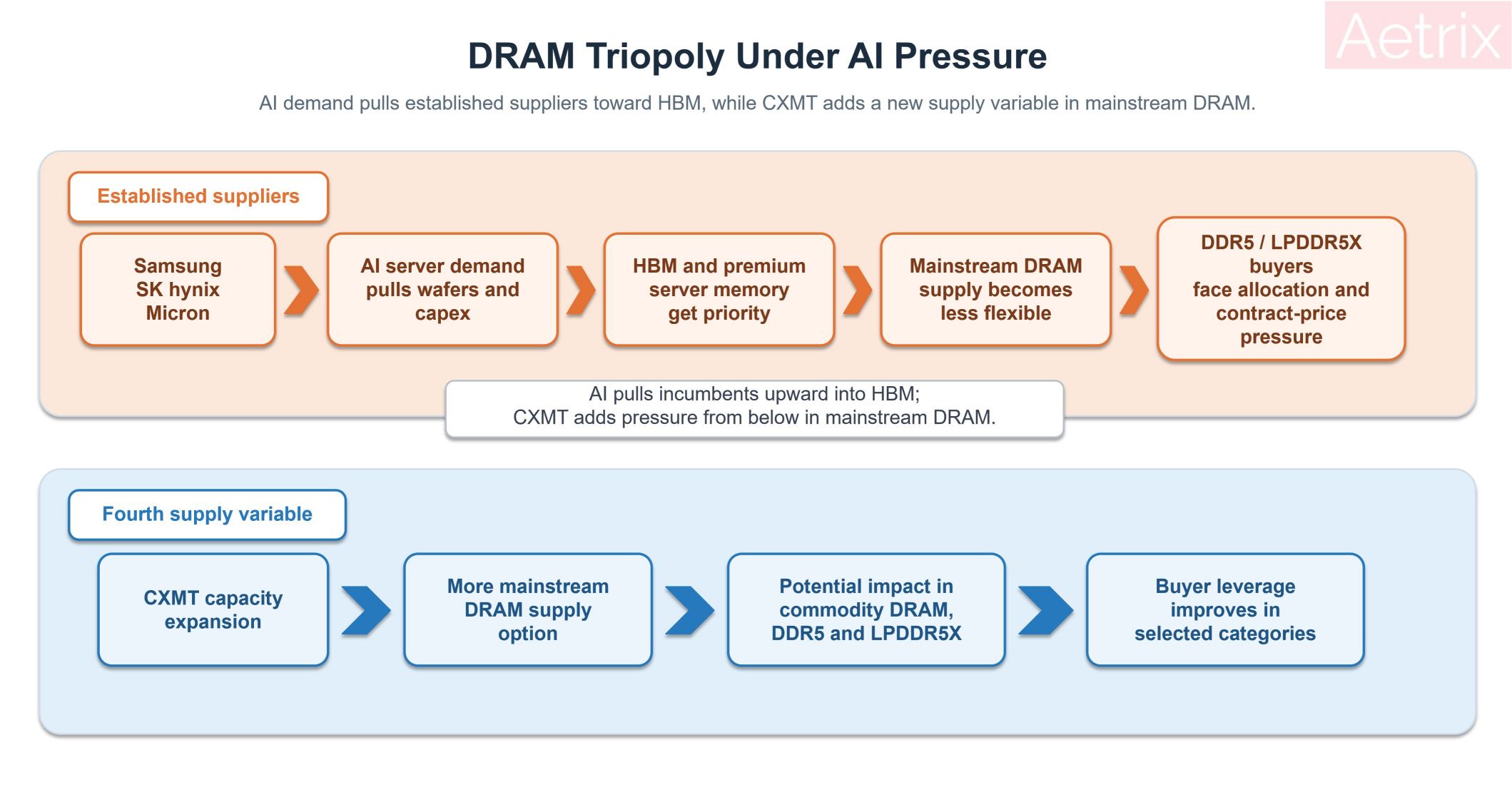
CXMT has become a global memory-market test case: can a policy-backed fourth DRAM supplier weaken the pricing power of the Samsung-SK hynix-Micron triopoly as AI demand pulls the established leaders toward HBM?
The question now reaches beyond China's semiconductor policy. It touches global memory procurement, DRAM pricing power, supplier concentration, AI server capacity allocation and the ability of large OEMs to secure alternative sources when mainstream memory costs rise. CXMT's expansion is being watched by memory buyers, device makers, module companies, cloud infrastructure suppliers and competing DRAM manufacturers.
The most realistic near-term influence is in mainstream DRAM, DDR5, LPDDR5X and selected commodity memory categories, where additional supply can improve buyer leverage. HBM remains a harder battlefield, shaped by advanced packaging, stacking yield, customer certification and platform-level relationships with GPU and cloud customers.
This makes CXMT more than a regional supplier story. Its growth sits at the intersection of AI-driven memory demand, supply-chain concentration, state-backed industrial scale, export-control risk and buyer demand for more sourcing options. For memory buyers, the key question is where CXMT capacity can change contract negotiations, lead-time planning and supplier diversification.
Key Findings
- CXMT is becoming a meaningful fourth variable in global DRAM supply as AI demand pulls Samsung, SK hynix and Micron toward HBM and higher-margin server memory.
- The first market impact is likely to appear in commodity DRAM, DDR5 and LPDDR5X, where additional capacity can change buyer leverage and price expectations.
- HBM remains more difficult to disrupt due to stacking, packaging, yield, reliability testing and platform qualification barriers.
- South Korean market coverage around CXMT's bonded DRAM pilot line shows that CXMT is being watched as a technology-path competitor, not only as a low-cost DRAM producer.
- The Apple-CXMT clearance issue shows that DRAM concentration has become a procurement issue, regulatory issue and cost issue at the same time.
- State-backed industrial coordination can accelerate capacity formation, but customer qualification, yield, export controls and platform access will determine how much global influence CXMT can convert from capacity expansion.
Why the DRAM Triopoly Is Under Pressure
Global DRAM has long been dominated by Samsung, SK hynix and Micron. That structure gave the memory market a familiar cycle: producers expanded capacity, oversupply pressured pricing, capital spending slowed, and the next upcycle followed. AI has changed the allocation logic inside that cycle.
AI servers require HBM, high-density DDR5, CXL-related memory expansion and larger memory footprints across accelerator platforms. This pushes leading memory suppliers to prioritize HBM and high-margin server products, leaving less flexible capacity for mainstream DRAM. The result is a market where high-end memory can remain tight while PC, mobile and general-purpose DRAM buyers face less predictable pricing and allocation.
This capacity shift is part of the broader AI server memory cycle that Aetrix Electronics discussed in memory chip shortages across AI servers, HBM, DDR5 and CXL. As HBM absorbs more wafer capacity and capital spending, mainstream DRAM buyers face a more complicated sourcing environment.
The pressure on the triopoly comes from two directions. At the top end, AI customers are willing to pay for HBM and premium server memory. In the broader market, device makers still need stable DDR5, LPDDR5X and commodity DRAM supply for PCs, smartphones, tablets, consumer electronics and general-purpose servers. When the same suppliers must decide where to allocate wafers, capital spending and customer priority, mainstream memory buyers become more exposed to allocation shifts.
| Market Force | Effect on DRAM Leaders | Effect on Buyers |
|---|---|---|
| AI server demand | More capacity and capital spending move toward HBM and premium server memory | Mainstream DRAM buyers face tighter allocation and higher price sensitivity |
| HBM profitability | Suppliers prioritize high-margin AI customers and long-term platform commitments | PC, mobile and consumer memory buyers have weaker priority in tight cycles |
| Concentrated supply base | Three major suppliers retain strong pricing and allocation influence | OEMs and module makers have limited alternatives when contract prices rise |
| CXMT capacity growth | Adds a fourth supply-side variable in selected DRAM categories | Potentially stronger negotiation leverage in mainstream DRAM sourcing |
CXMT Enters the Global DRAM Question
ChangXin Memory Technologies, or CXMT, is a DRAM manufacturer founded in 2016. CXMT states that its DRAM chips are used in mobile phones, PCs, tablets, servers and other consumer products, and its public product portfolio includes DDR5 / DDR5 modules, LPDDR5 / LPDDR5X and DDR4 / DDR4 modules (CXMT, Company and Product Information).
The company's relevance has increased as its scale, product coverage and customer visibility have improved. Reuters reported that CXMT held about 7.7% of the global DRAM market in 2025, ranking it fourth behind the established leaders, and that the company planned to raise RMB 29.5 billion, or about USD 4.34 billion, in a Shanghai IPO to upgrade production lines and technologies (Reuters).
Market research and buyer-side discussions also point to further scale ambitions. Industry materials indicate a possible capacity target of about 350,000 wafers per month by the end of 2026, with a longer-term target of 500,000 wafers per month by 2028. If those targets are reached with competitive yield and customer qualification, CXMT would become far more relevant to DDR5, LPDDR5X and commodity DRAM sourcing.
The global memory industry has seen new challengers before, but few have reached credible DRAM scale in recent years. DRAM is difficult for new entrants because it requires process control, high-volume manufacturing, large capital spending, customer trust and the ability to survive downcycles. CXMT's significance comes from its combination of scale ambition, state-backed financing, regional supply-chain clustering and product movement into DDR5 and LPDDR5X categories.
| CXMT Variable | What It Means | Why Global Buyers Should Track It |
|---|---|---|
| DRAM scale | Reported fourth-largest DRAM supplier by 2025 market share | Adds a new volume source outside the traditional Samsung-SK hynix-Micron structure |
| Mainstream product coverage | Public portfolio includes DDR5, LPDDR5 / LPDDR5X and DDR4 families | Most relevant to PC, mobile, tablet, module and selected server memory buyers |
| Policy-backed funding | Long-cycle capital and infrastructure support can sustain heavy capacity investment | Capacity additions may continue through cycles that would normally slow market-financed expansion |
| Global OEM interest | Apple-related reporting brought CXMT into global procurement discussion | Top-tier customer evaluation can accelerate broader buyer attention, even before mass adoption |
Where CXMT Can Change the Market First: Commodity DRAM and DDR5
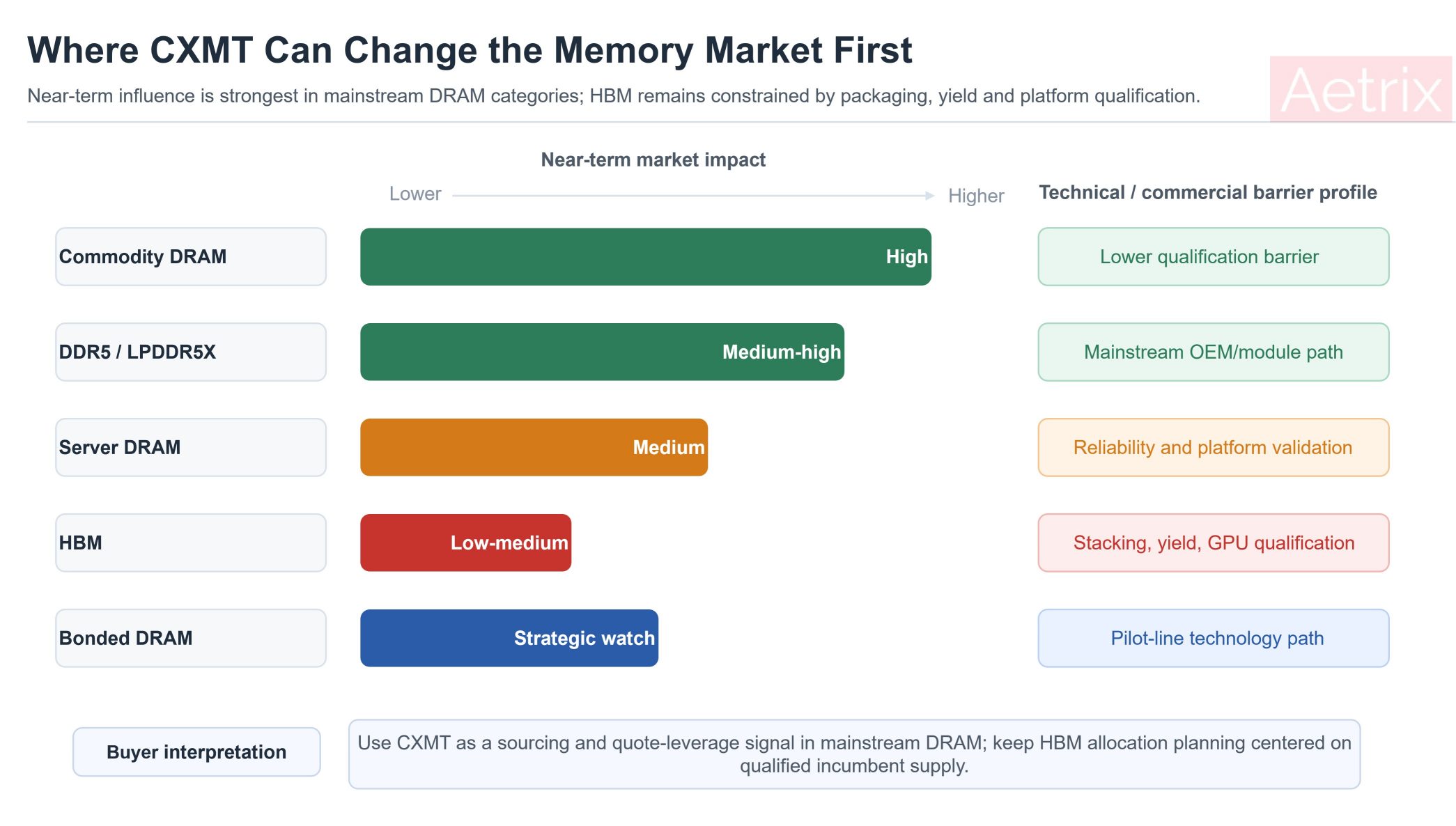
CXMT's first market impact is likely to appear in mainstream DRAM, where additional supply can change contract negotiations, spot-market expectations and buyer leverage. Commodity DRAM, DDR5 and LPDDR5X have clearer substitution paths than HBM. Product qualification still takes time, yet the barriers are more manageable than GPU-linked HBM platform qualification.
The timing is favorable for a new DRAM-scale supplier. AI demand has encouraged leading memory companies to move more capital and wafer allocation toward HBM. That creates space for a supplier focused on mainstream DRAM to gain share among buyers seeking cost control and supply diversification.
For buyers, the likely early effect is stronger quote leverage in specific categories. Module makers, PC OEMs, smartphone supply chains and regional server platforms can use additional qualified supply to reduce dependence on a narrow supplier base. Even before direct sourcing becomes broad, the expectation of additional supply can influence contract-price negotiations.
This is where CXMT's role differs from a pure technology race. In commodity DRAM and mainstream DDR5, buyer adoption depends on performance, cost, availability, compatibility and qualification consistency. A new supplier does not need to dominate every technology frontier to affect market pricing behavior in these categories. Reliable volume in the right product families can already shift buyer leverage.
| Memory Segment | CXMT Near-Term Impact | Reason | Buyer Implication |
|---|---|---|---|
| Commodity DRAM | High | Capacity scale and price-sensitive customers create the clearest entry path | More negotiation leverage and broader sourcing options |
| DDR5 | Medium-high | Public product coverage and rising demand from PC, module and server channels | Potential alternative source once qualification and volume stability are proven |
| LPDDR5 / LPDDR5X | Medium-high | Relevant to mobile, tablet and consumer-device platforms | Could support supplier diversification for large device OEMs |
| Server DRAM | Medium | Platform validation, reliability and ecosystem qualification take longer | Adoption depends on customer qualification rather than capacity alone |
| HBM | Low-medium | Packaging, yield, GPU platform relationships and reliability barriers remain high | Near-term allocation remains centered on established HBM leaders |
How CXMT Could Change DRAM Price Expectations
DRAM price expectations can change before actual market share changes. Buyers, brokers and module makers react to perceived future supply as well as current shipments. If CXMT capacity continues to expand and more product families enter qualification, the market may begin to price in additional supply even before CXMT becomes a direct supplier for every major OEM.
This effect would be strongest in standard memory categories. Commodity DRAM prices are sensitive to inventory signals, supplier output plans, quarterly contract negotiations and spot-market sentiment. A credible fourth source can weaken the assumption that only three companies control the pace of supply. That matters most when the leading suppliers are directing resources toward HBM and AI-linked memory.
The impact will be uneven. DRAM used in cost-sensitive consumer electronics and mainstream computing can respond faster to additional supply. Server and industrial platforms require longer validation. HBM and AI accelerator memory remain governed by allocation, packaging capacity and platform certification. Buyers should avoid treating CXMT capacity as a universal price-relief signal across all memory categories.
| Pricing Layer | How CXMT Can Influence It | Buyer Watchpoint |
|---|---|---|
| Spot market | Additional supply expectations can pressure broker pricing in commodity DRAM | Observe DDR5 and LPDDR5X spot quotes by density and speed grade |
| Quarterly contracts | Large buyers can use alternative supply discussions to improve quote leverage | Track contract changes after major OEM or module qualification news |
| Allocation terms | More mainstream DRAM supply can reduce dependence on incumbent allocation decisions | Compare lead times from incumbent suppliers and alternative sources |
| HBM pricing | Near-term impact remains limited until packaging yield and platform adoption improve | Watch validated HBM shipments rather than development announcements alone |
Why HBM Remains a Harder Battlefield
HBM leadership requires more than DRAM wafer output. It depends on TSV formation, die stacking, thermal control, advanced packaging, known-good-die management, yield stability and platform qualification with GPU suppliers and hyperscale customers. These requirements give SK hynix, Samsung and Micron deeper incumbency than they have in commodity DRAM.
CXMT's HBM ambitions deserve attention, especially as AI memory demand expands. The near-term procurement effect will be limited until yield, packaging throughput, qualification and customer adoption are proven at scale. Industry materials point to HBM3 8-high yield challenges, with reported comprehensive yield around 25% in some development contexts. That level of complexity shows why HBM leadership takes longer to challenge than mainstream DRAM supply.
HBM also sits inside a platform ecosystem. GPU suppliers, accelerator vendors, cloud customers and advanced packaging partners influence which memory supplier can ship at scale. A DRAM manufacturer needs technical capability, but also validated platform support, reliable supply commitments and proven performance under AI workloads. Those relationships are built over multiple product cycles.
| HBM Barrier | What Buyers Should Understand | Impact on CXMT Timing |
|---|---|---|
| Advanced packaging | HBM depends on stacking, TSV and high-density interconnect capability | Extends the path from DRAM wafer production to full HBM supply |
| Yield control | Stacked memory yield compounds across multiple dies and process steps | Commercial competitiveness depends on stable high-volume yield |
| Platform qualification | GPU and accelerator platforms require long validation cycles | Adoption may lag technical progress by several quarters or longer |
| Customer ecosystem | Established suppliers already hold deep relationships with GPU makers and cloud customers | Early impact is more likely in mainstream DRAM than HBM allocation |
Bonded DRAM and Korean Concerns: Why CXMT's Technology Path Deserves Attention
South Korean market coverage has drawn attention to CXMT's reported bonded DRAM pilot line in Hefei. The reported architecture separates the memory-cell array and peripheral circuitry onto different wafers, then uses wafer-to-wafer hybrid bonding to connect them. The approach could enable high-density DRAM using DUV multi-patterning rather than EUV tools, according to Korean market reporting that also noted Samsung's B1b project and SK hynix's similar work in bonded DRAM (Bloomingbit / Hankyung market coverage).
The Korean reaction is a market signal. CXMT is being evaluated as a potential architecture-path competitor, not only as a lower-cost mainstream DRAM supplier. If bonded DRAM reaches commercial maturity, it could create a route around some EUV-related scaling constraints. That would change how investors, buyers and competitors assess long-term DRAM technology competition.
The technical logic is straightforward. In conventional DRAM scaling, memory cells and peripheral logic are built on the same wafer, and density gains depend heavily on process shrink. In a bonded DRAM route, the memory array and control logic can be manufactured separately and connected through hybrid bonding. This gives engineers more room to optimize the memory and logic portions independently.
The potential advantages include shorter interconnect paths, lower parasitic resistance, reduced signal delay and better power behavior. It can also reduce the process conflicts that appear when memory-array requirements and logic-circuit requirements are forced onto the same manufacturing flow. These advantages explain why Korean suppliers are also exploring similar directions.
The technology remains in pilot-line development. Yield, process cost, wafer bonding alignment, defect control and commercial timing remain unproven at scale. The buyer takeaway is clear: bonded DRAM should be treated as a strategic technology watch item, while current sourcing decisions should still be based on qualified, shippable DRAM families.
| Technology Path | Strategic Meaning | Commercial Risk |
|---|---|---|
| Wafer-to-wafer hybrid bonding | Connects separately manufactured memory and logic wafers through high-density bonding | Pilot-line progress still needs volume yield proof |
| DUV-based scaling path | Could reduce dependence on EUV for selected next-generation DRAM approaches | Multi-patterning complexity can raise cost and process difficulty |
| Copper-to-copper direct interconnect | Shorter interconnect paths can support lower latency and better power performance | Defect control and bonding reliability remain key validation points |
| Separate memory and logic wafers | Allows process optimization for memory arrays and peripheral logic | Commercial advantage depends on cost, throughput and product qualification |
Apple, U.S. Clearance and the Cost of Memory Concentration
The Apple-CXMT case shows that DRAM concentration has become a procurement issue, regulatory issue and cost issue at the same time. Reuters, citing the Financial Times, reported that Apple was lobbying the U.S. administration for approval to buy memory chips from CXMT, which Reuters described as blacklisted by the Pentagon for alleged links to the Chinese military (Reuters). The U.S. Department of Defense's 2026 Section 1260H list also identifies ChangXin Memory Technologies, Inc. as a Chinese military company under that framework (U.S. Department of Defense, Section 1260H List).
The sequence is best read as regulatory friction meeting commercial pressure. A hard compliance barrier can still exist for many customers, yet large OEMs face real cost and allocation pressure when memory supply is concentrated. If a global device maker evaluates CXMT for specific markets or product lines, that signals broader buyer interest in alternative DRAM supply.
This event should be interpreted carefully. It does not automatically mean broad global adoption. It does suggest that memory concentration is producing enough cost pressure for a top-tier OEM to examine regulatory pathways. That is significant for procurement teams because it shows how memory sourcing decisions now sit between commercial urgency and geopolitical constraint.
Even a limited adoption path would affect procurement psychology. Top-tier customer evaluation can increase confidence among module makers and device OEMs. It can also pressure incumbent suppliers during contract negotiations. The scope, region, product family and approval conditions would determine the practical market impact.
| Apple-CXMT Signal | Market Meaning | Buyer Interpretation |
|---|---|---|
| Reported U.S. clearance effort | Memory cost and supplier concentration are creating pressure for large OEMs | Regulatory approval scope matters as much as technical availability |
| Pentagon blacklist status | Procurement from CXMT carries compliance and geopolitical complexity | Buyers must separate commercial feasibility from regulatory permissibility |
| Potential OEM qualification | A top-tier customer review can influence broader supplier perception | Qualification progress should be tracked by product family and geography |
Why Policy-Backed Scale Can Change Strategic Component Markets
DRAM is a capital-intensive, infrastructure-heavy and cycle-sensitive industry. New suppliers need fabs, power infrastructure, equipment access, materials, trained engineers, process know-how, customer validation and long-cycle capital. Policy-backed industrial coordination can reduce several of these barriers at the same time.
CXMT's structure gives it access to long-cycle capital, regional industrial coordination and a large downstream electronics ecosystem. These factors do not remove technology risk. They can, however, shorten the time needed to build capacity, recruit suppliers, qualify materials and support customers through early adoption cycles.
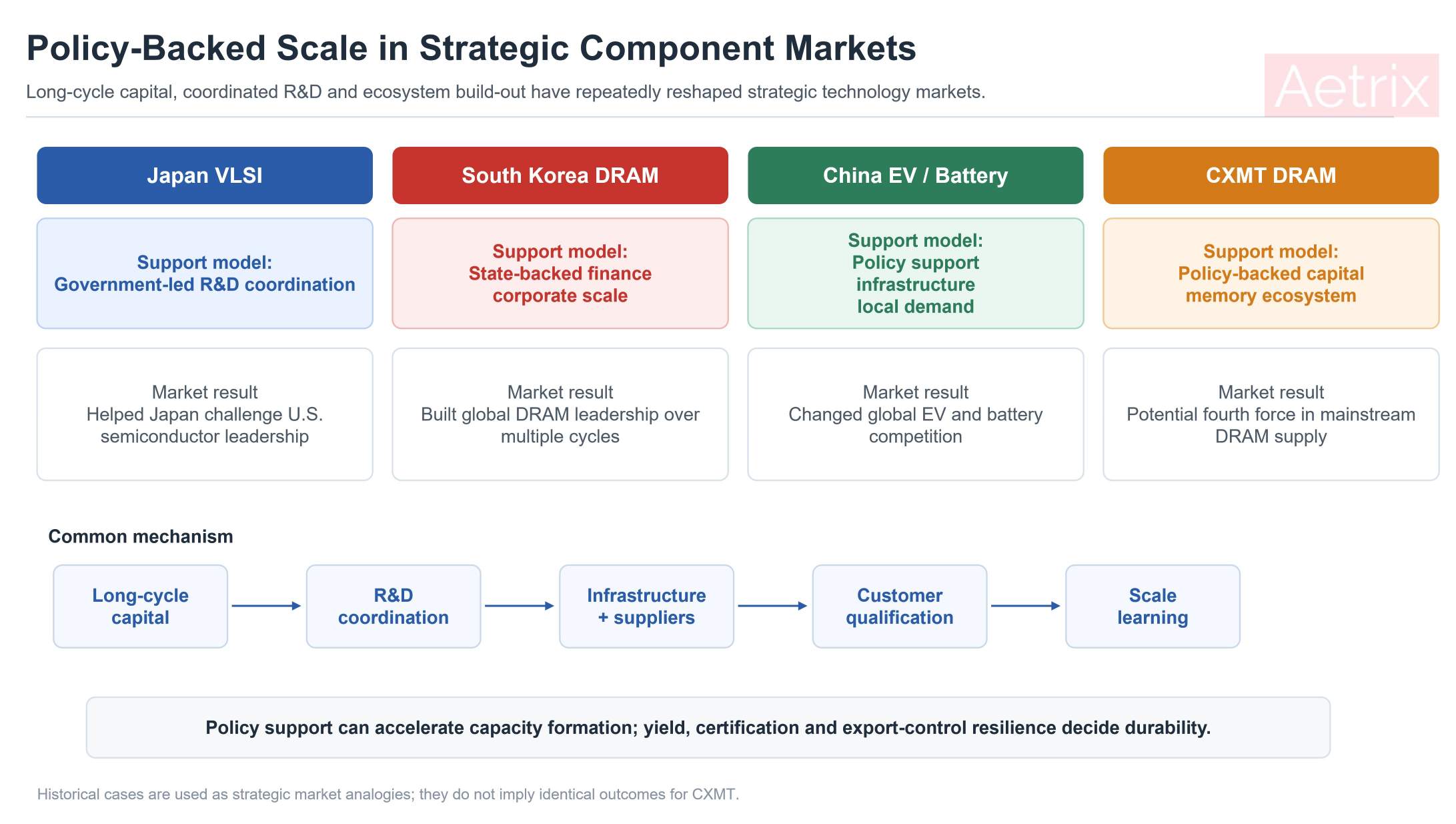
That pattern has appeared in other strategic component and technology markets. Japan's VLSI program helped coordinate semiconductor R&D among major electronics firms during Japan's rise in memory. South Korea's DRAM ascent relied on state-backed finance, industrial policy and large corporate groups willing to invest through long cycles. China's EV and battery industries combined policy support, infrastructure rollout, local demand and supply-chain clustering to change global competition.
The lesson is practical rather than ideological. Policy support reduces some capital and infrastructure constraints, while technical risk remains. In DRAM, that means CXMT can expand capacity and ecosystem relationships faster than many purely market-financed entrants. The company still needs yield, quality, customer certification and export-control resilience to convert capacity into durable global influence.
| Historical Case | Industrial Support Model | Market Result | Relevance to CXMT |
|---|---|---|---|
| Japan VLSI project | Government-led R&D coordination among major electronics firms | Japan became a major memory and semiconductor competitor | Coordinated R&D can accelerate catch-up in strategic semiconductor segments |
| South Korea DRAM industry | State-backed finance, chaebol coordination and long-cycle industrial policy | Korean suppliers became global DRAM leaders | Memory leadership can shift when capital, manufacturing scale and customer demand align |
| China EV and battery industry | Policy support, charging infrastructure, local demand and supply-chain clustering | Global EV and battery competition changed rapidly | Large local markets and ecosystem clustering can help new suppliers reach scale quickly |
What Changes If CXMT Becomes the Fourth DRAM Force?
If CXMT continues to scale, the memory market would not become evenly competitive overnight. The change would start at the layers where qualification is more manageable and supply alternatives have the strongest buyer value. Commodity DRAM, DDR5 and LPDDR5X are the first areas to watch.
A fourth DRAM force would weaken the pricing discipline of the existing triopoly in selected categories. It would also give OEMs, module houses and regional server platforms another negotiation reference. Even where CXMT is not used directly, its capacity expansion can influence price expectations if buyers believe additional supply will reach the market.
The strategic effect could be larger than the immediate shipment effect. Memory buyers negotiate not only on current availability, but also on expected future supply. When another supplier appears credible, incumbents may face more pressure to defend share, offer better terms or protect long-term customer commitments.
| Market Layer | Current Triopoly Model | CXMT Impact If It Scales | Buyer Impact |
|---|---|---|---|
| Commodity DRAM | Supply discipline led by three major suppliers | Additional volume source changes price expectations | More price negotiation and lower concentration risk |
| DDR5 / LPDDR5X | Allocation affected by HBM and premium server memory priority | More sourcing flexibility if CXMT qualifications broaden | Better quote leverage for PC, mobile and module customers |
| HBM | Dominated by established leaders with GPU platform relationships | Limited near-term relief until yield and platform certification improve | Allocation planning remains critical |
| Global OEM sourcing | Supplier base concentrated around Samsung, SK hynix and Micron | Possible new qualified source by product family and region | Improved supplier diversification if compliance conditions allow |
| Regional electronics supply chains | High exposure to imported DRAM in many platforms | Regional supply option grows as CXMT scales | Better continuity planning for approved products |
Risks That Could Slow CXMT's Breakthrough
Several risks can slow CXMT's progress from fourth supplier to structural market changer. The first is export control. DRAM capacity expansion depends on lithography, etch, deposition, metrology, inspection and process-control tools. Restrictions on advanced semiconductor equipment can affect upgrade paths, yield learning and future technology nodes.
The second risk is HBM execution. HBM requires advanced packaging and platform qualification in addition to DRAM wafer manufacturing. A supplier can be relevant in DDR5 and LPDDR5X long before it becomes a meaningful HBM supplier. That gap should remain central to buyer expectations.
The third risk is the DRAM cycle itself. High profitability during an upcycle can reverse quickly if demand growth slows or incumbents change pricing strategy. DRAM remains one of the most cyclical semiconductor markets. A strong capacity buildout can create buyer leverage in one phase and margin pressure in another.
Customer qualification adds another constraint. Consumer memory, mobile DRAM, server memory and HBM all have different qualification paths. A device maker may approve one product family for one region or model while continuing to rely on incumbent suppliers elsewhere. Market impact therefore needs to be measured by product family, density, speed grade, end market and geographic scope.
| Risk Area | Why It Can Slow Market Impact | Buyer Signal to Watch |
|---|---|---|
| Export controls | Equipment and technology access affect node migration and yield learning | Restrictions on tool upgrades, service access or advanced process equipment |
| HBM packaging and yield | Stacked memory requires more than DRAM cell-array manufacturing | Validated HBM shipments, platform qualification and repeat orders |
| Customer qualification | Apple, server, industrial and automotive buyers require long validation cycles | Public platform wins, module certifications and OEM adoption by product family |
| Incumbent price response | Samsung, SK hynix and Micron can adjust pricing or allocation to defend share | Contract-price changes in commodity DRAM and DDR5 |
| Patent, channel and brand trust | Global memory buyers value proven reliability, service history and legal clarity | Expansion into international module brands and long-term OEM programs |
Buyer Guidance: What Memory Buyers Should Watch
Memory buyers should separate CXMT's impact by product category. HBM and AI accelerator memory remain allocation-driven markets led by established suppliers. DDR5, LPDDR5X and commodity DRAM are the more realistic early areas for buyer leverage if CXMT capacity and qualification continue to improve.
For mainstream DRAM buyers, the practical action is to track qualified supplier lists, product family coverage and replenishment stability. For HBM buyers, the priority remains allocation planning with SK hynix, Samsung and Micron, while monitoring CXMT's progress as a longer-term strategic variable. For device OEMs and module makers, Apple's reported clearance effort should be monitored for approval scope, market geography, product family and certification timeline.
Procurement teams should also separate sourcing strategy from headline market narratives. A new DRAM supplier can improve quote leverage in one category while having limited effect in another. DDR5 and LPDDR5X buyers can use alternative-source development as a negotiation tool, but HBM buyers still need long-term allocation discussions with incumbent suppliers.
The most useful approach is category-level tracking. Buyers should monitor CXMT by product density, speed grade, package type, validated platform, customer adoption and geographic availability. A broad statement about CXMT capacity is less useful than a confirmed qualification for a specific DRAM family in a specific end product.
| Buyer Question | What to Track | Procurement Meaning |
|---|---|---|
| Can CXMT reduce DRAM shortage risk? | DDR5, LPDDR5X and commodity DRAM output, qualification and distributor availability | Potential improvement in mainstream DRAM sourcing flexibility |
| Can CXMT reduce HBM allocation risk? | HBM yield, platform validation, packaging capacity and customer adoption | Limited near-term relief; plan around incumbent supplier allocation |
| Will CXMT affect contract pricing? | Spot pricing, quarterly DRAM contracts and quote behavior from incumbent suppliers | Additional supply expectations can improve buyer negotiation leverage |
| How should OEMs read Apple-related reports? | Approval status, regional limits, product scope and certification timeline | Large-OEM evaluation can influence broader market confidence |
| What is the biggest risk? | Export controls, yield progress, platform qualification and incumbent pricing response | CXMT should be tracked as a supply option, not used as a guaranteed price-reduction assumption |
What to Watch Next
The next stage of CXMT's influence will be visible through customer qualification, not only capacity announcements. Buyers should watch whether CXMT gains broader adoption in DDR5 modules, LPDDR5X mobile platforms and mainstream PC memory. Public qualification by a major device maker or module brand would carry more procurement value than a general capacity target.
The Apple clearance issue also deserves continued attention. The practical impact depends on whether any approval is granted, which product lines are covered, whether use is region-limited, and how long validation takes. A narrow approval could still affect market psychology if it signals that large OEMs are willing to test alternative DRAM supply under rising cost pressure.
Bonded DRAM should be tracked as a technology-path signal. Pilot-line progress, process yield, die-level performance and commercial timing will indicate whether CXMT can use architecture innovation to reduce dependence on conventional EUV-based scaling routes. Korean supplier response will provide another market signal, especially if Samsung and SK hynix accelerate similar bonded DRAM development.
| Signal to Watch | What It Would Suggest | Buyer Impact |
|---|---|---|
| More DDR5 / LPDDR5X qualifications | CXMT is moving deeper into mainstream memory sourcing | Improved quote leverage and supplier diversification |
| Apple clearance or limited adoption | Regulatory friction may allow selective commercial exceptions | Large-OEM validation could lift broader market confidence |
| Bonded DRAM pilot-line progress | CXMT may be pursuing an architecture route around some scaling constraints | Long-term technology risk to incumbent DRAM roadmaps could rise |
| Incumbent contract-price reaction | Samsung, SK hynix and Micron may adjust pricing to defend share | Quarterly price negotiation windows may become more active |
| Export-control changes | Tool access and technology migration risk could change quickly | Buyers should avoid over-reliance on unqualified future supply assumptions |
Key Takeaways
CXMT is already a meaningful fourth variable in DRAM supply. Its capacity growth, public DDR5 and LPDDR5X product direction, policy-backed scale and rising OEM attention make it relevant to global memory buyers, especially as AI demand pulls established suppliers toward HBM.
The first influence is likely to appear in commodity DRAM, DDR5 and LPDDR5X. Those categories have clearer sourcing paths, stronger cost sensitivity and more immediate buyer interest in supplier diversification. HBM remains a longer-term challenge due to packaging, yield, certification and ecosystem barriers.
The global significance of CXMT lies in supply optionality. A credible fourth DRAM supplier can change buyer negotiations, price expectations and allocation planning even before it reshapes the entire memory hierarchy. The pace of that change will depend on customer qualification, export-control exposure, production yield and the ability to sustain capacity through the next DRAM cycle.
For procurement teams, CXMT's role should be evaluated by memory type, qualification status and regulatory exposure. The company can improve sourcing optionality and price leverage in selected DRAM categories, while HBM allocation and advanced memory sourcing will continue to depend heavily on Samsung, SK hynix and Micron in the near term.