My Inquiry
 My Account


The MLCC spot market is no longer moving in one direction. High-capacitance, automotive-grade and AI-server-related MLCCs remain tight, while low-capacitance commodity parts used in consumer electronics and low-end IoT devices are showing price softness. For buyers, this means the market should no longer be read as a simple shortage cycle or a simple price correction cycle.
The more accurate view is structural divergence. Factory price adjustments, distributor quotes and spot-market transactions are sending different signals because they reflect different product categories, customer groups and inventory positions. Some high-end MLCCs are still constrained by capacity, yield and qualification requirements, while many 0402 and 0603 low-capacitance parts are being pressured by inventory, weak consumer demand and oversupply in general-purpose specifications.
This split matters because MLCCs are used across nearly every electronics category. A buyer sourcing 0402 100nF parts for a smart-home product faces a very different market from a buyer sourcing high-capacitance MLCCs for an AI server power rail or AEC-Q200 capacitors for an electric vehicle platform. Using one pricing signal to judge the whole MLCC market can lead to the wrong purchasing decision.
Key Findings
- Low-capacitance commodity MLCCs, especially 0402 and 0603 parts below 1μF, are the main area of spot-price softness.
- Some low-end and consumer-grade MLCCs have corrected by 5%–10% since Q2 2026, while selected commodity parts are down more than 40% from their 2023 peak.
- High-capacitance, automotive-grade and AI-server-related MLCCs remain tight because demand quality, qualification requirements and production yield are very different from commodity parts.
- Factory price books and channel spot prices can move in different directions because contract pricing reflects long-term capacity allocation, while spot pricing reflects inventory and reseller liquidity.
- IoT demand is splitting the market: low-end IoT keeps pressure on low-capacitance MLCCs, while industrial IoT, AI gateways and intelligent vehicles pull more capacity toward high-reliability parts.
MLCC Spot Prices Are No Longer Moving Together
The current MLCC cycle is best understood as two parallel markets. One market is still tight: AI servers, electric vehicles, ADAS, industrial electronics and high-end power systems need larger case sizes, higher capacitance, higher voltage, lower ESR, higher reliability or automotive qualification. The other market is softer: low-capacitance commodity MLCCs used in basic filtering, decoupling and signal-matching functions are facing weaker end demand and more available channel inventory.
This is why factory price adjustments and spot-market corrections can coexist. A manufacturer may raise or hold firm on pricing for high-end and strategic MLCCs, while traders still cut prices on excess 0402 or 0603 inventory to free cash. The result is not contradiction; it is segmentation.
| MLCC Segment | Typical Package / Specification | Main Applications | Current Spot-Market Direction | Buyer Interpretation |
|---|---|---|---|---|
| Low-capacitance commodity MLCC | 0402 / 0603, below 1μF, including 100nF, 10nF and 1nF | Consumer electronics, smart-home devices, wearables, low-end IoT sensors, basic signal filtering | Softening; selected parts down 5%–10% since Q2 2026 | Buyers can use competitive quoting, but should avoid excessive long-term inventory |
| High-capacitance MLCC | Larger case sizes such as 0805, 1206 and above; tens of μF in selected designs | AI server power rails, GPUs, high-current digital systems, advanced computing boards | Firm to tight; selected popular parts still see fast quote changes | Spot softness in commodity parts does not apply to high-capacitance supply |
| Automotive-grade MLCC | AEC-Q200, high-reliability, high-voltage or high-temperature specifications | EV power systems, ADAS, battery management, onboard chargers, body electronics | Tight, especially for qualified high-capacitance and high-voltage parts | Approved vendor list and qualification status matter more than spot price |
| Mid-range industrial MLCC | Mixed case sizes, mid-capacitance, standard X5R / X7R dielectric | Industrial control, metering, power modules, communication equipment | Mixed; depends on voltage, capacitance and brand | Buyers should check exact part number trends rather than category-level headlines |
Where Prices Are Softening: Low-Capacitance Commodity MLCCs
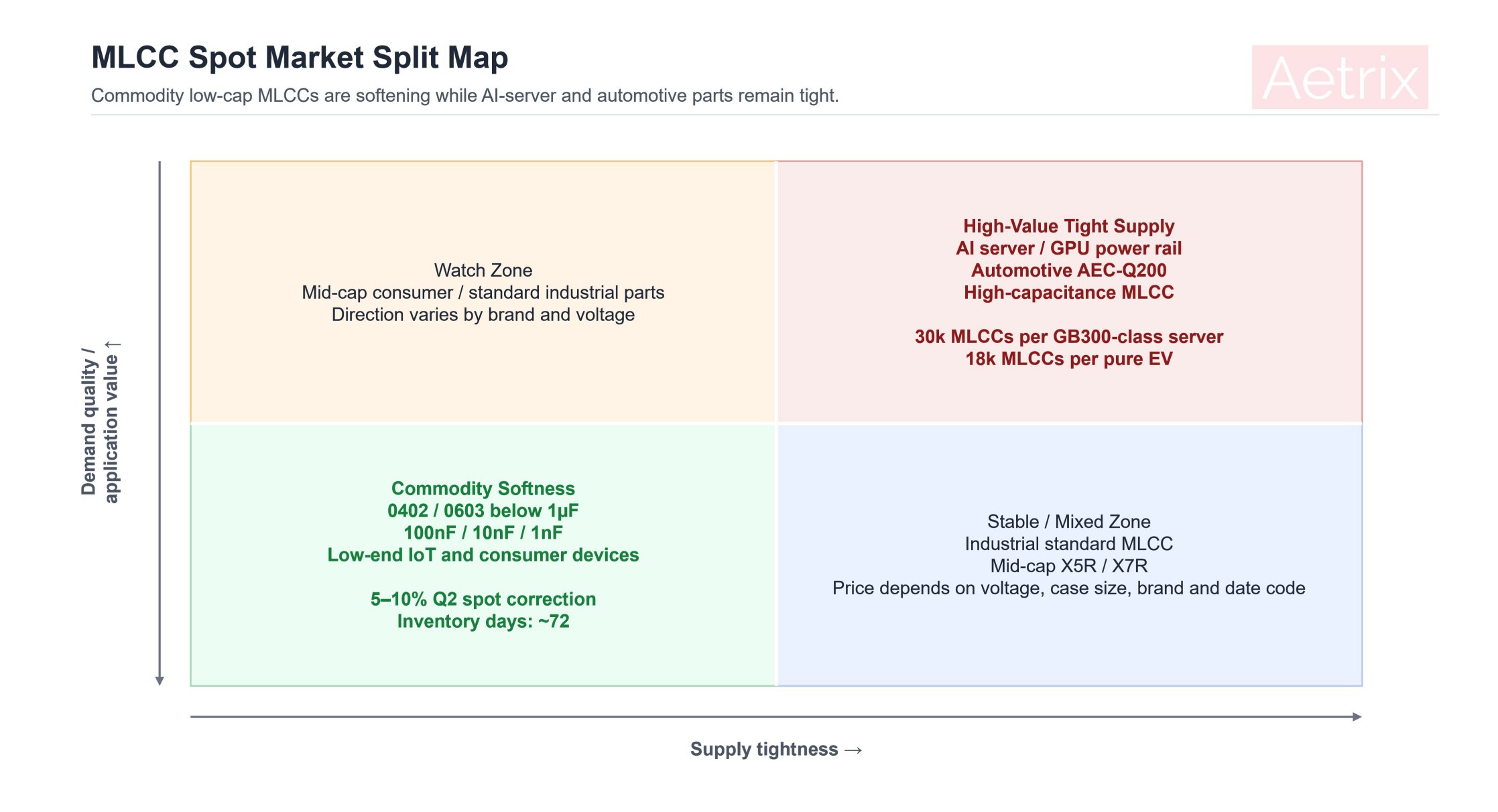
The price correction is concentrated in general-purpose, low-capacitance and consumer-grade MLCCs. The most visible softening is in 0402 and 0603 case sizes below 1μF, including common values such as 100nF, 10nF and 1nF. These parts are widely used in low-end IoT devices, consumer electronics, ordinary power filtering and non-critical signal paths.
The correction is not uniform across all brands and specifications, but the direction is clear. Some low-end MLCC part numbers have moved down by about 5%–10% since Q2 2026, and selected commodity specifications have fallen more than 40% from their 2023 peak. In one channel example, a Murata 0603 4.7nF part was reported to have moved from RMB 1.2 per thousand pieces in 2025 to RMB 0.32 per thousand pieces, a decline of more than 70%.
| Softening Category | Common Specification | Typical Dielectric | Reported Price Signal | Why Prices Are Softer |
|---|---|---|---|---|
| 0402 low-cap MLCC | 100nF, 10nF, 1nF and other values below 1μF | X5R / X7R general-purpose grades | Some low-end parts down 5%–10% since Q2 2026 | High channel inventory and slower demand from smart-home and wearable products |
| 0603 low-cap MLCC | Below 1μF; broad use in consumer and IoT terminals | X5R / X7R | Selected commodity specifications down more than 40% from the 2023 peak | Supply released from earlier expansion meets weaker low-end terminal demand |
| 0603 4.7nF example | Murata 0603 4.7nF channel example | General-purpose ceramic | Reported decline from RMB 1.2/kpcs in 2025 to RMB 0.32/kpcs, down more than 70% | Inventory pressure and aggressive channel clearing in commodity values |
| Low-end smart-home MLCC | 0402 100nF | X5R / X7R | One Q2 2026 procurement case showed a 12% decline from the beginning of the year | Supplier stock was sufficient and terminal orders were below expectation |
Why Commodity MLCC Prices Are Falling
The price correction in commodity MLCCs is driven by three factors: inventory pressure, weak low-end terminal demand and capacity mismatch. These factors are more important for 0402 and 0603 low-capacitance parts than for high-capacitance or automotive-grade MLCCs.
First, inventory remains high in many general-purpose specifications. From 2021 to 2025, global MLCC suppliers expanded capacity, and some of that low-end and mid-range capacity is now being released into a slower market. In 2026, capacity utilization for certain mid- and low-end MLCC lines is reported to have fallen below 60%, while inventory days have climbed to about 72 days. That puts pressure on suppliers and traders to move stock.
Second, low-end IoT demand is not strong enough to absorb the available supply. Smart-home products, TWS earphones, simple sensors and basic wearable devices use many small MLCCs, but their per-device usage is limited. Low-end IoT terminals typically use about 350–600 MLCCs per unit, far below the tens of thousands of MLCCs used in AI servers and electric vehicles. When end-product demand slows, the effect is felt quickly in commodity spot prices.
Third, competition in general-purpose specifications remains intense. Local suppliers have become more aggressive in standard MLCC values, while major Japanese and Korean suppliers are shifting more attention toward AI-server and automotive-grade MLCCs. That strategic shift does not automatically eliminate low-end supply; in some cases, it increases price pressure in commodity inventory because channel stock and local competition remain active.
| Driver | Data Signal | Affected Parts | Spot-Market Effect |
|---|---|---|---|
| Inventory pressure | Inventory days reported at about 72 days for mid- and low-end categories | 0402 / 0603, below 1μF, standard X5R / X7R values | Traders and distributors become more willing to discount slow-moving stock |
| Lower utilization | Mid- and low-end utilization reported below 60% | Commodity capacitance and voltage ratings | Suppliers compete harder for standard-volume business |
| Weak low-end IoT demand | AIoT MLCC shipments in 2026 reported to grow only 4%–7% | Smart-home, wearable and sensor-related MLCCs | Limited demand pull keeps low-capacitance pricing under pressure |
| Low per-device usage | Low-end IoT terminals use about 350–600 MLCCs per unit | Basic filtering and decoupling MLCCs | Demand growth is not strong enough to absorb excess low-end capacity |
Why High-End MLCCs Are Still Tight
High-end MLCCs are not following the same price path because their constraints are different. They are limited by qualification, capacitance density, voltage rating, reliability requirements, production yield and customer allocation. A low-end 0402 capacitor can be replaced more easily than an automotive-qualified or AI-server-qualified high-capacitance MLCC in a validated design.
AI server demand is one of the strongest drivers. GB300-class AI servers are reported to use about 30,000 MLCCs per unit, roughly 15 times the usage of traditional servers. Rack-level consumption is also rising, with MLCC usage moving from about 480,000 units in GB200-class cabinets to about 600,000 units in VR200-class cabinets. The reported value per cabinet rises from about USD 1,530 to USD 4,320, an increase of 182%.
That demand pull is also changing supplier allocation. Aetrix Electronics has covered this issue in AI server MLCC shortages and high-capacitance capacity reallocation, where high-capacitance MLCC demand is shown to draw capacity away from lower-value categories. Electric vehicles add another structural driver: a pure battery-electric vehicle is reported to use about 18,000 MLCCs, around six times the usage of an internal-combustion vehicle. Many of these capacitors also require higher voltage, higher reliability or automotive qualification, which reduces the number of interchangeable suppliers.
| High-End Demand Area | Reported Usage / Growth Signal | MLCC Type Required | Why Supply Is Different From Commodity MLCC |
|---|---|---|---|
| AI server unit | GB300 server: about 30,000 MLCCs per unit, around 15 times a traditional server | High-capacitance, high-reliability and power-rail MLCCs | Large consumption per system absorbs qualified high-end capacity quickly |
| AI server cabinet | MLCC usage reported to rise from 480,000 in GB200-class cabinets to 600,000 in VR200-class cabinets | High-capacitance MLCCs for dense computing power rails | Demand value per cabinet is reported to rise 182%, from USD 1,530 to USD 4,320 |
| Electric vehicles | Pure EV: about 18,000 MLCCs per vehicle, around six times an internal-combustion vehicle | AEC-Q200, high-voltage, high-reliability and high-temperature MLCCs | Qualification and reliability requirements limit fast substitution |
| AI server market demand | 2026 AI server MLCC demand is reported to grow 87% year on year; 2027 demand may exceed 174.3 billion units | High-capacitance and high-reliability MLCCs | Demand growth is faster than new high-end capacity qualification |
Production constraints reinforce the split. High-end MLCC production lines are reported to require 18–24 months to build, while production yield for high-end MLCCs is only about 45%–65%, compared with 85%–95% for conventional products. This means high-end supply cannot respond to demand as quickly as commodity supply can.
Factory Price and Spot Price Are Decoupling
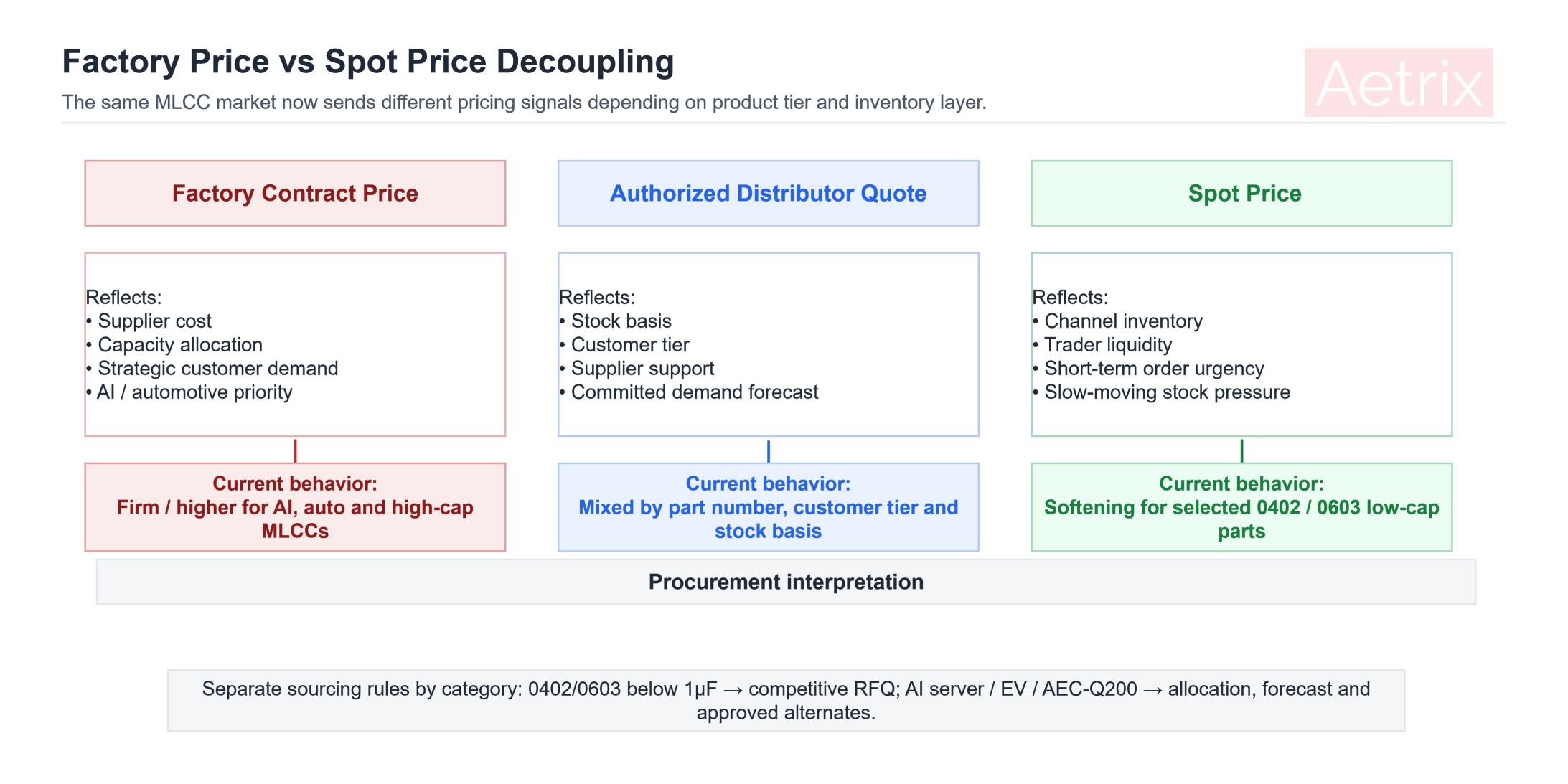
The most important market signal is the decoupling between factory pricing and channel spot pricing. Factory contract prices reflect supplier cost, capacity allocation and long-term demand visibility. Spot prices reflect trader inventory, reseller cash flow, short-term order urgency and part-number-level availability. These two layers can move differently even for the same broad product category.
This is why a broad factory adjustment can coexist with falling spot prices for selected commodity parts. High-end allocation remains tight, but some distributors and traders still hold excess low-capacitance inventory. When end demand is weak, those holders may lower spot prices to clear stock, even if the factory price book has not moved down.
| Pricing Layer | What It Reflects | Current Behavior | Buyer Risk |
|---|---|---|---|
| Factory contract price | Supplier cost, product mix, capacity allocation and strategic customer demand | Firm or higher for AI-server, automotive and high-capacitance MLCCs | Long-term BOM cost may stay elevated even when spot commodity prices soften |
| Authorized distributor quote | Supplier support, customer tier, stock basis and committed demand | Mixed, depending on part number and customer status | Quote validity and allocation terms may differ sharply by customer group |
| Channel spot price | Inventory level, trader liquidity, urgent demand and short-term resale pressure | Softening for selected 0402 / 0603 low-capacitance MLCCs | A low spot quote may not represent sustainable replenishment cost or guaranteed quality |
| High-end allocation price | Scarce supply, approved customer priority and qualification limits | Firm; selected scarce parts can move quickly in the spot market | Delivery risk can be more important than unit-price negotiation |
IoT Demand Is Splitting the MLCC Market
IoT is no longer a single demand category for MLCC buyers. Low-end IoT and high-end connected systems are pulling the market in opposite directions. Smart-home devices, TWS products, basic sensors and simple wearables mainly use low-capacitance 0402 and 0603 MLCCs. Their performance requirements are lower, their per-device MLCC usage is limited, and their customers are highly price-sensitive.
By contrast, industrial IoT, AI gateways, intelligent vehicles and energy systems require more high-reliability, high-voltage and high-capacitance MLCCs. These applications are less exposed to commodity spot-price correction because they depend on qualification, reliability and platform-level supply assurance.
| IoT / Connected Segment | Typical MLCC Demand | Demand Signal | Impact on MLCC Pricing |
|---|---|---|---|
| Smart home | 0402 / 0603 low-capacitance MLCCs for filtering and basic decoupling | Order growth remains uneven; one Q2 procurement case showed 0402 100nF pricing down 12% from the beginning of the year | Weak pull keeps commodity MLCC pricing under pressure |
| Wearables and TWS | Small-size, low-capacitance MLCCs with high price sensitivity | Low-end AIoT MLCC shipment growth reported at only 4%–7% in 2026 | Demand is not strong enough to absorb excess standard-capacity supply |
| Industrial IoT | Higher-reliability MLCCs for power, control and communication modules | Demand is more stable than consumer IoT and less sensitive to short-term spot moves | Mid- and high-reliability parts are more resilient than low-end commodity MLCCs |
| AI gateways and intelligent vehicles | High-capacitance, high-voltage and automotive-grade MLCCs | Automotive-grade MLCC market value is reported to grow 22.3% in 2026 | High-end demand supports capacity reallocation away from low-end categories |
Buyer Guidance: How to Use the Correction Without Taking Supply Risk
The price correction in low-capacitance MLCCs creates an opportunity, but it should be used selectively. Buyers should not assume that every MLCC category is becoming easier to source. The right approach is to separate commodity, mid-range, automotive and AI-server-related part numbers before negotiating price or building inventory.
For 0402 and 0603 low-capacitance parts, competitive spot quoting can be useful. Buyers can use quarterly RFQs, compare distributor and channel stock, and take advantage of inventory pressure without locking excessive long-term stock. The main risks are date code, packaging condition, authenticity, storage history and whether the quoted price reflects sustainable replenishment or one-time inventory clearing.
For high-capacitance, automotive-grade and AI-server-related MLCCs, the strategy is different. Buyers should focus on allocation, forecast sharing, approved alternates and long-term delivery coverage. A soft spot-market price for 100nF commodity parts does not indicate supply relief for 1206 high-capacitance parts, AEC-Q200 capacitors or GPU power-rail MLCCs.
| Buyer Scenario | Recommended Action | Reason | Main Risk to Check |
|---|---|---|---|
| Commodity 0402 / 0603 below 1μF | Use competitive spot quotes and quarterly RFQs | Inventory pressure favors buyers in standard values | Old date codes, mixed lots, packaging condition and one-time liquidation pricing |
| Low-end IoT products | Avoid overstocking beyond confirmed production needs | Low-end demand remains uneven and prices may stay under pressure | Buying too early if further 5%–10% correction appears |
| High-capacitance 0805 / 1206 and larger | Secure allocation and confirm replenishment lead time | High-cap parts are still supported by AI server and power-rail demand | Assuming commodity spot correction applies to high-cap MLCCs |
| Automotive-grade MLCC | Confirm approved alternates and AEC-Q200 qualification status | Qualification limits substitution even if channel inventory exists | Using non-approved alternates to chase short-term price savings |
| AI server and GPU power rail | Share forecasts early and lock backlog coverage for approved parts | Per-system MLCC usage is high and qualified supply is limited | Late-stage allocation shortage and requalification delay |
What to Watch in Q3 and Q4
The first indicator is whether 0402 and 0603 low-capacitance prices continue to soften. If inventory days stay high and low-end IoT demand remains weak, commodity MLCC spot prices may remain under pressure. The correction is most likely to continue in values below 1μF where alternative supply is broad and substitution is easier.
The second indicator is whether high-capacitance MLCC lead times shorten. If high-capacity server and automotive orders continue absorbing qualified production, price softness in commodity MLCCs will not translate into broader supply relief. In that case, the market split will become more visible rather than less visible.
The third indicator is how manufacturers allocate capacity. If major suppliers keep shifting lines and customer priority toward AI server, EV and industrial demand, buyers of low-end products may see more spot-price opportunities, while buyers of high-end parts face continued allocation pressure.
| Signal to Watch | What It Means | Likely Buyer Impact |
|---|---|---|
| 0402 / 0603 low-cap spot prices | Shows whether commodity inventory clearing is continuing | More negotiation room for consumer and low-end IoT buyers |
| Inventory days for mid- and low-end MLCCs | High inventory confirms that the correction is supply-driven, not just temporary quote noise | Buyers can avoid panic purchasing in common values |
| Lead time for high-capacitance and AEC-Q200 parts | Shows whether high-end tightness is easing or continuing | Automotive and AI-server buyers may need earlier backlog coverage |
| AI server MLCC demand growth | Reported 2026 growth of 87% would keep high-end demand elevated | High-capacitance and power-rail MLCCs remain more exposed to allocation risk |
| Low-end IoT order recovery | A recovery could slow the commodity correction | Quarterly RFQs should be adjusted if demand visibility improves |
Key Takeaways
The MLCC spot market has entered a structural divergence phase. Commodity low-capacitance MLCCs, especially 0402 and 0603 parts below 1μF, are facing price softness because inventory is high, low-end IoT demand is uneven and standard specifications are easier to source. This is the part of the market where buyers may have more negotiating power.
High-capacitance, automotive-grade and AI-server-related MLCCs remain a different market. Their supply is constrained by qualification, capacity mix, production yield and strong platform demand. The reported usage gap is large: GB300-class AI servers can use about 30,000 MLCCs per unit, while pure EVs can use about 18,000 MLCCs per vehicle.
For procurement teams, the main lesson is to stop treating MLCC as one price cycle. Commodity spot correction can be used for cost savings, but it should not be used as a signal that all MLCC supply has loosened. Buyers should separate low-capacitance spot sourcing from high-end allocation planning, and manage each category with different price, inventory and risk rules.
August 2026 Update: The MLCC Market Has Developed a Third Pricing Zone
The market structure has changed further since this article was published. The earlier split between softer low-capacitance commodity MLCCs and tight high-end AI products is now developing a middle layer. Consumer-grade mid- and high-capacitance X5R products are moving into a clear Q4 pricing upcycle.
Samsung Electro-Mechanics is raising Q4 2026 X5R quotations for OEM and ODM customers by an average of 25%–30%. TrendForce says the higher pricing is intended partly to reduce incoming X5R orders and release manufacturing capacity for expansion of premium product lines. AI-server X6S products remain tight as well, with customer-specific increases averaging 10%–20%. (TrendForce, SEMCO Leads 4Q26 OEM Price Hikes)
This creates three increasingly distinct MLCC sourcing environments. Low-capacitance commodity inventory can still show price softness in the spot market. Mid- and high-capacitance consumer X5R is now facing stronger factory pricing as capacity shifts toward premium products. High-end X6S and other AI-related specifications remain constrained by utilization, qualification, lead time and customer allocation.
| MLCC Segment | Earlier 2026 Signal | Q4 2026 Signal | Buyer Interpretation |
|---|---|---|---|
| Low-capacitance commodity MLCC | Spot-price softness and high channel inventory | Mixed; many common specifications remain relatively available | Competitive quoting remains possible; avoid applying high-end shortage assumptions to common values |
| Mid/high-capacitance consumer X5R | Mixed pricing and early capacity-reallocation pressure | SEMCO +25% to +30%; other suppliers about +10% to +20% | This segment has moved from market divergence into a clearer contract-pricing upcycle |
| AI-server X6S / premium MLCC | Tight supply, longer lead times and strong allocation pressure | +10% to +20%, depending on customer negotiation | Availability and allocation remain as important as headline price movement |
Order spillover is also changing the middle of the market. TrendForce expects Taiwanese and Chinese manufacturers to maintain upward Q4 pricing as they absorb additional mid- and high-capacitance consumer orders. Some suppliers are already approaching 90% utilization, reducing the spare production capacity available to customers seeking an alternative source.
The latest data therefore strengthens the original conclusion of this article: MLCC pricing cannot be interpreted through one market-wide index. The distinction now needs to go further than commodity versus high-end. Capacitance, case size, temperature characteristic, end application, factory allocation and pricing channel determine whether a buyer is seeing spot-market softness, rising contract prices or structural supply tightness.
For the latest Q4 pricing data, X5R and X6S comparison, capacity-allocation analysis and 2027 outlook, see MLCC Price Increase 2026: Samsung Raises Q4 X5R Prices 25–30% as AI Capacity Shift Spreads.