My Inquiry
 My Account


MCUs rarely carry the highest price in an electronic system, yet they control a remarkable share of its essential functions. Vehicle body electronics, industrial motor drives, battery-management systems, appliance interfaces and sensor nodes all depend on MCUs for real-time processing, peripheral control and system supervision.
Once an MCU enters volume production, it often remains tied to the product for years. Low-level drivers, control algorithms, communication stacks, functional-safety evidence and factory test programs accumulate around the device. Automotive and industrial programs have particularly long lives, with supply and maintenance requirements that can extend beyond a decade. Winning an MCU socket creates recurring silicon revenue and can also pull power-management ICs, power semiconductors, sensors, connectivity devices and analog components into the same platform.
That long commercial life has made the MCU market a strategic battleground for the major semiconductor manufacturers. Early competition centered on processor architecture, clock speed, Flash capacity, peripheral count and price. As Arm Cortex-M spread across the industry, the core itself became less effective as a barrier. Development tools, software libraries, evaluation boards, technical support and migration paths began to carry more weight. The environment an engineering team already knows can influence the controller chosen for its next product.
The market is also wide enough to support very different strategies. At one end are inexpensive 8-bit controllers used in appliances, instruments and simple control systems. At the other are multicore automotive MCUs with hardware security and functional-safety mechanisms. Between them sit low-power wireless devices, mixed-signal controllers, motor-control MCUs, graphics-capable parts and industrial communication platforms. No flagship device can cover this range; suppliers need product families that can expand without forcing customers to rebuild their software at every performance step.
The MCU Battle Is No Longer About a Single Chip
The first major shift came through architecture and development ecosystems. STM32 helped carry Arm Cortex-M into the broad general-purpose control market, weakening the advantage that established MCU suppliers had built around proprietary cores. Electrical specifications still separated products, but engineers could compare several vendors while preserving much of their Arm development experience.
Consolidation then changed the scale of the competitors. Renesas emerged from the combination of NEC Electronics and Renesas Technology. NXP acquired Freescale, Microchip acquired Atmel, Infineon acquired Cypress, and Renesas later added Dialog Semiconductor. These transactions extended MCU portfolios into automotive networking, wireless connectivity, power management, human-machine interfaces and mixed-signal products. They also gave the leading vendors more components to sell around each controller.
The semiconductor shortage of 2020–2022 added manufacturing capacity to the contest. MCU substitution proved slow because a change of controller can affect the PCB, firmware, EMC behavior, functional-safety work and production testing. Delivery performance began to influence design decisions alongside price and peripheral fit. Wafer sources, packaging capacity, regional production and long-term supply policies now enter sourcing reviews much earlier.
A new phase is already under way. Software-defined vehicles require more capable zonal controllers and reusable software platforms. Edge AI is bringing vision recognition, audio detection, condition monitoring and predictive maintenance into MCU-class devices. The competitive package now includes model-conversion tools, security frameworks, middleware, reference designs and software that can migrate across several product generations.
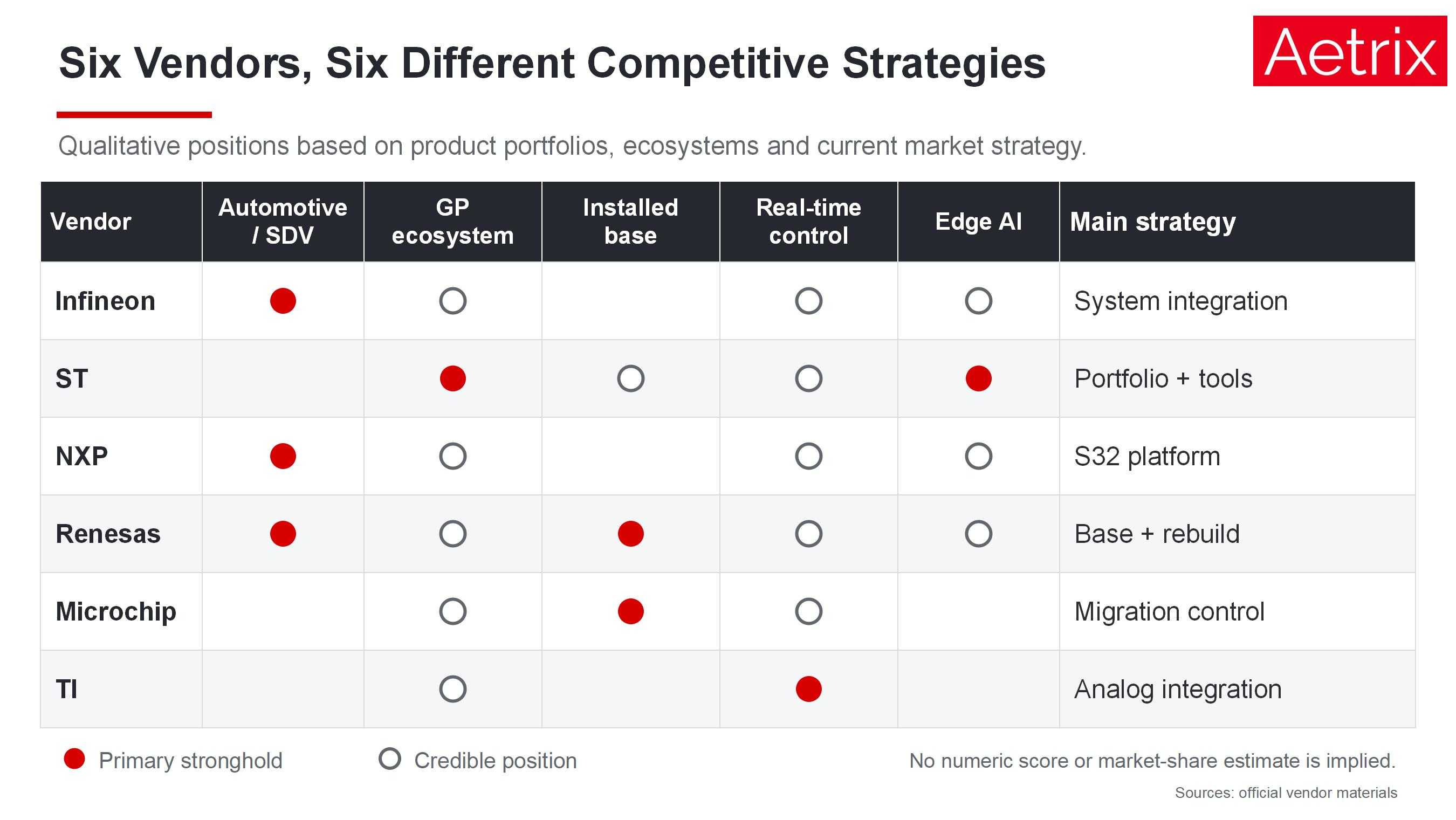
The leading suppliers have responded in different ways. ST continues to widen the STM32 development ecosystem. Infineon connects automotive MCUs with power devices and sensors. NXP is building S32 into a software-defined vehicle platform. Renesas is extending its automotive base into general-purpose control and edge AI. Microchip uses the enormous PIC, AVR and SAM installed base to manage customer migration, while TI continues to press its advantages in analog integration and real-time control.
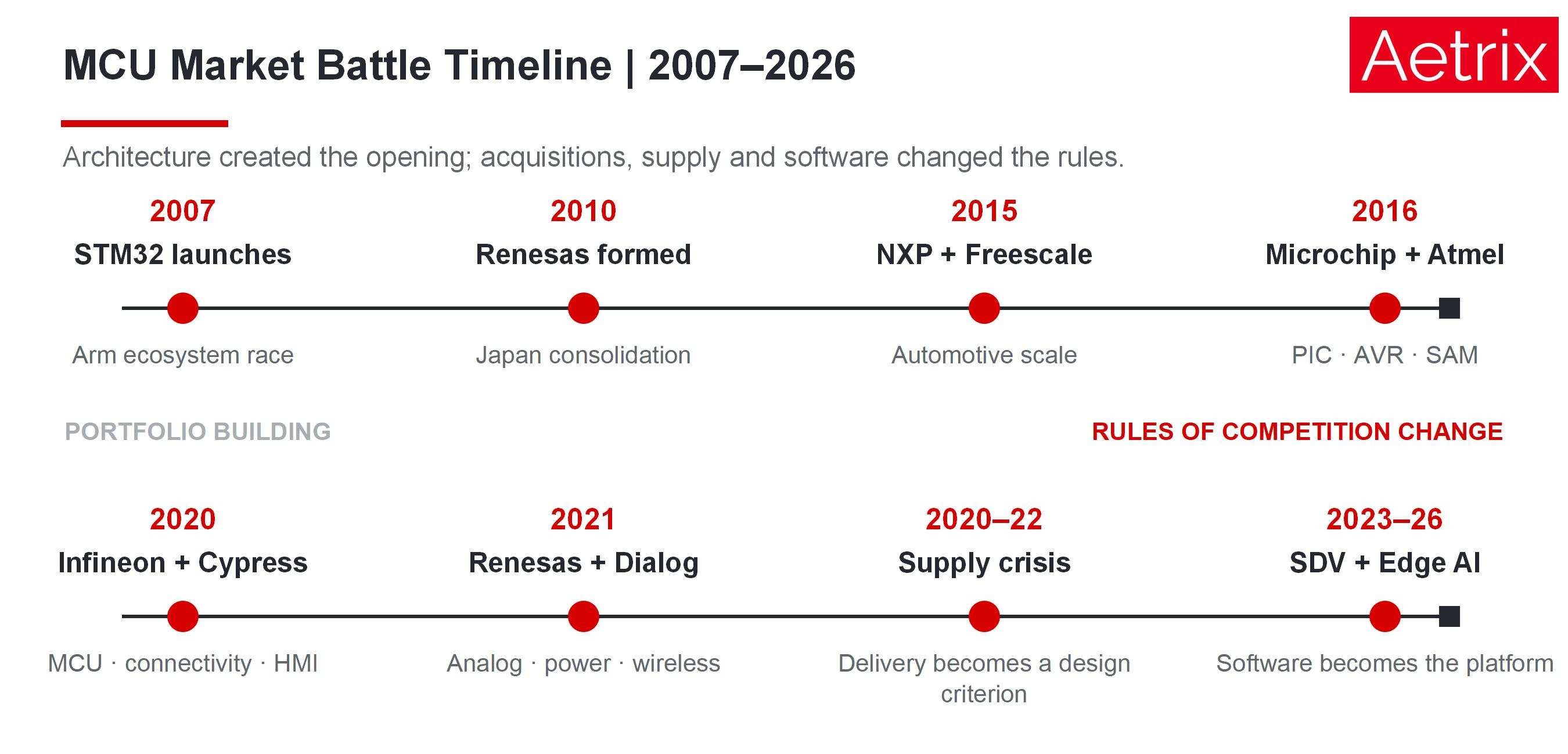
None of these strategies appeared at once. Each grew out of an architectural choice, an acquisition, a supply disruption or a change in the end market. Starting in 2007 makes it possible to see how today's MCU landscape was assembled and why the next phase of competition will look very different from the last.
MCU Market Battle Timeline: 2007–2026
2007–2009: STM32 opens the Arm ecosystem battle
ST introduced the STM32 family in 2007, when many established MCU franchises still depended heavily on proprietary cores. The decision to build a broad family around Arm Cortex-M made the architecture familiar across vendors while leaving ST to compete through peripherals, price, tools and device coverage. That was a structural change: engineers could preserve more software knowledge when moving between suppliers, so the quality of the surrounding ecosystem became a competitive asset.
STM32 grew into more than 1,000 orderable part numbers, backed by the STM32Cube software environment and a stated ten-year product-longevity commitment for qualifying devices. ST says cumulative STM32 shipments have exceeded 13 billion units. The scale was built through repeated expansion-low power, wireless, motor control, graphics, security and, later, AI-rather than a single flagship MCU. (STMicroelectronics)
2010–2014: Renesas consolidates Japan's MCU strength
Renesas Electronics began operations in April 2010 through the combination of NEC Electronics and Renesas Technology. The merger consolidated major Japanese MCU lineages under one supplier and gave Renesas deep positions in automotive, industrial and consumer control. It also created a difficult portfolio-management job: multiple architectures and development environments had to be supported while the company built coherent long-term families. (Renesas)
That legacy explains Renesas' later strategy. RH850 protects and expands the automotive franchise; RX preserves an established proprietary architecture; RA supplies a modern Arm-based route for general embedded development. The company did not abandon its installed base to chase a single standardized core. It layered new platforms over it.
2015: NXP buys Freescale and gains automotive scale
NXP's acquisition of Freescale was announced in March 2015 and completed in December. At closing, NXP described the combined business as the market leader in automotive semiconductors and general-purpose MCUs. Freescale contributed Power Architecture automotive controllers, Kinetis MCUs, networking processors and long customer relationships; NXP added security, identification, connectivity and automotive electronics. (NXP)
The strategic result appeared later in the S32 platform. NXP could address vehicle control as a coordinated compute architecture spanning microcontrollers, processors, networking and software rather than as a collection of independent ECU chips.
2016: Microchip absorbs Atmel's developer base
Microchip completed its $3.47 billion acquisition of Atmel in April 2016. The transaction combined PIC and dsPIC with AVR and SAM, bringing two of the industry's largest embedded installed bases under one company. It was as much a control-of-migration strategy as a scale transaction: a customer moving from an 8-bit AVR or PIC to a 32-bit Arm MCU could remain inside Microchip's commercial and tool ecosystem. (Microchip)
Microchip's position is therefore easy to underestimate if attention stays on new-core announcements. Long-lived industrial, appliance, medical and instrumentation products generate value from package continuity, peripheral familiarity and controlled firmware changes. In those markets, avoiding a board respin can matter more than winning a CoreMark comparison.
2019–2021: MCU companies become system suppliers
Infineon's 2020 acquisition of Cypress added PSoC, Wi-Fi and Bluetooth connectivity, USB controllers and the automotive Traveo family. Infineon already held strong positions in power semiconductors, sensors and AURIX automotive MCUs. Cypress filled gaps around human-machine interfaces, connected embedded systems and body electronics. The enlarged company could sell a wider share of the electronics around the controller rather than compete for the MCU alone. (Infineon)
Renesas followed a comparable logic when it completed the €4.8 billion acquisition of Dialog Semiconductor in August 2021. Dialog added low-power mixed signal, battery and power management, Bluetooth Low Energy and Wi-Fi capabilities. Renesas then packaged MCUs, analog and connectivity into "Winning Combinations," turning cross-selling into pre-engineered system designs. (Renesas)
2020–2022: The shortage makes delivery a product feature
During the semiconductor shortage, an MCU with ideal peripherals but no reliable delivery date was not the best part. Automotive and industrial customers learned that controller substitution is slow because firmware, analog behavior, safety evidence, EMC performance and production tests may all need to be repeated. Purchasing teams learned that a nominal second source is useless if it depends on the same constrained process or has never been validated on the board.
The shortage did not permanently erase price competition. It changed the questions asked before a design is frozen. Manufacturing footprint, assembly location, package capacity, product-longevity policy and the credibility of allocation commitments now enter sourcing reviews earlier.
2023–2026: Software-defined vehicles and edge AI reshape the roadmap
The newest phase is defined by workload consolidation. Vehicle manufacturers want fewer, more capable controllers supporting zonal architectures, centralized compute, over-the-air updates and stronger isolation between software domains. Industrial and consumer products want local inference without the latency, bandwidth cost or privacy exposure of a continuous cloud connection.
These demands pull MCU vendors in two directions. Automotive devices require more compute, memory and software abstraction while retaining deterministic control and safety mechanisms. AI-oriented MCUs require neural acceleration and richer memory systems while staying below application-processor power and cost. The boundary between a high-end MCU and a low-end processor is becoming a product-positioning decision rather than a clean architectural line.
Six Vendors, Six Different Competitive Strategies
Infineon: automotive scale and system integration
Infineon's MCU strategy is anchored in automotive scale. AURIX serves safety-critical powertrain, chassis, domain and zonal control; TRAVEO targets body and cockpit functions; PSoC covers connected industrial and consumer designs. The Cypress acquisition gave these families a wider software and connectivity context, while Infineon's power devices and sensors create system-level selling opportunities unavailable to an MCU-only supplier.
The model is becoming more software-led. Infineon's Drive Core packages software, tools and services around AURIX, TRAVEO and PSoC devices for automotive development. Its announced automotive RISC-V MCU family also shows that the company is willing to add an open architecture where customers want software portability, while continuing to protect the safety-certified AURIX base. (Infineon Drive Core; Infineon automotive RISC-V)
The risk is complexity. A large portfolio created through acquisition must feel like one platform to the engineer. Shared tooling, reusable middleware and a clear migration map will determine whether Infineon's breadth lowers system cost or merely increases the number of catalogs a customer must navigate.
STMicroelectronics: portfolio breadth and developer reach
ST's advantage is the density of the STM32 ladder. An engineer can move from an inexpensive Cortex-M0+ device to wireless, graphics, high-performance or AI-capable families without leaving the same broad software environment. Nucleo boards, STM32Cube packages, application examples and third-party training reduce the cost of starting a project. That reach creates a flywheel: a familiar toolchain puts STM32 on shortlists, and broad design activity encourages more middleware and hardware support.
ST has also started to regionalize MCU production. In March 2026, the company announced first volume deliveries of STM32 products made in China, beginning with STM32H7 and followed by STM32H5 and STM32C5. This is commercially important in local-for-local programs, but it does not make every STM32 device or package regionally interchangeable. Buyers still need order-code-level manufacturing information. (STMicroelectronics)
ST's challenge is the cost of abundance. Closely spaced families, multiple security levels and frequent roadmap expansion can make part selection harder. The ecosystem wins the first evaluation; supply continuity, peripheral stability and disciplined software maintenance have to win production.
NXP: automotive platforms and software-defined vehicles
NXP is turning the Freescale inheritance into a vehicle-wide platform. S32 devices span real-time controllers and higher-level processors, while CoreRide supplies a software and integration framework for new electrical/electronic architectures. The 2025 S32K5 family moved zonal MCU development to 16 nm FinFET technology with embedded MRAM, providing more performance and update flexibility for software-defined vehicle functions. (NXP)
The strategy is already being tested in concentrated architectures. NXP and Rimac Technology disclosed an upcoming domain and zonal control platform using S32E2 processors; Rimac said the design can consolidate more than 20 electronic control units into three. That kind of deployment matters more than an isolated benchmark because it demonstrates the software, networking and integration consequences of controller consolidation. (NXP and Rimac Technology)
NXP's exposure is equally clear. Large automotive platforms take years to qualify and depend on a smaller number of high-value programs. Winning the silicon nomination is only part of the job; the software stack must remain supportable through vehicle production and long field lifetimes.
Renesas: defend automotive leadership while rebuilding the portfolio
Renesas combines a durable automotive franchise with one of the industry's broadest collections of MCU architectures. RH850 is deeply embedded in vehicle control. RA gives the company a current Arm-based general-purpose family. RX remains relevant where existing software and deterministic control matter. Dialog's connectivity and power-management products allow Renesas to surround these controllers with more of the system.
This is a strategy built around customer retention and cross-selling rather than a clean-sheet reset. It protects long-lived programs and gives customers several performance paths, but it asks Renesas to maintain coherent tools and middleware across families with different histories. The winning combination concept helps at the board level; consistent software experience must do the same at the firmware level.
Microchip: installed-base defense and controlled migration
Microchip's strongest weapon is continuity. PIC, AVR, dsPIC and SAM cover products that may remain in production for a decade or longer. Engineers often keep these devices because the code, manufacturing tests and field history already exist. Microchip can then offer an internal migration path when the application needs more memory, digital signal processing, motor-control peripherals or an Arm core.
The 2025 PIC32A family illustrates the next step. It combines a 200 MHz 32-bit MCU with high-performance analog peripherals, targeting applications where control-loop timing and signal-chain integration matter more than generic CPU performance. (Microchip)
Its competitive risk is fragmentation. Supporting multiple architectures preserves customer investments, but each architecture divides tool, library and training attention. Microchip wins when longevity and peripheral fit outweigh the appeal of a more uniform ecosystem.
Texas Instruments: analog integration, real-time control and cost
TI approaches the MCU market from analog and control. C2000 devices are closely associated with digital power and motor-control loops; MSPM0 targets low-cost Arm-based control with analog integration and a broad planned device ladder. When TI launched MSPM0 in 2023, it set starting prices at $0.39 in volume and emphasized dozens of initial devices, more than 100 planned products and internally owned manufacturing capacity. (Texas Instruments)
This is a component-economics strategy. A controller that incorporates suitable comparators, op amps, ADCs or control peripherals can remove external parts and reduce board cost even when its MCU specifications look ordinary. TI is less dependent on an acquisition-built MCU portfolio than several rivals, but it must persuade developers that its software environment is as convenient as the hardware integration is compelling.
The Supply Crisis Changed the Rules
Before 2020, many sourcing reviews treated the MCU as a feature-and-price decision. The shortage exposed the cost of that simplification. A qualified controller sits inside a web of dependencies: boot code, peripheral drivers, interrupt timing, compiler behavior, safety diagnostics, cybersecurity keys, package routing and end-of-line tests. A substitute with the same Arm core does not preserve those dependencies.
Vendors responded with capacity agreements, internal investment and regional production. Infineon signed a multi-year agreement with GlobalFoundries covering 40 nm automotive MCU supply through 2030. ST's China-produced STM32 program addresses local demand. TI continues to use internal manufacturing as part of its cost and supply argument. These moves reduce particular risks; none creates unlimited or geography-independent supply. (Infineon and GlobalFoundries)
The durable result is a change in buyer behavior. Strong programs now qualify the exact order code, package and software baseline; record the wafer, assembly and test footprint where available; and validate an alternate before allocation begins. Inventory is a buffer, not a substitute for a migration plan. A large stock of one device can postpone a redesign while making the eventual transition more abrupt.
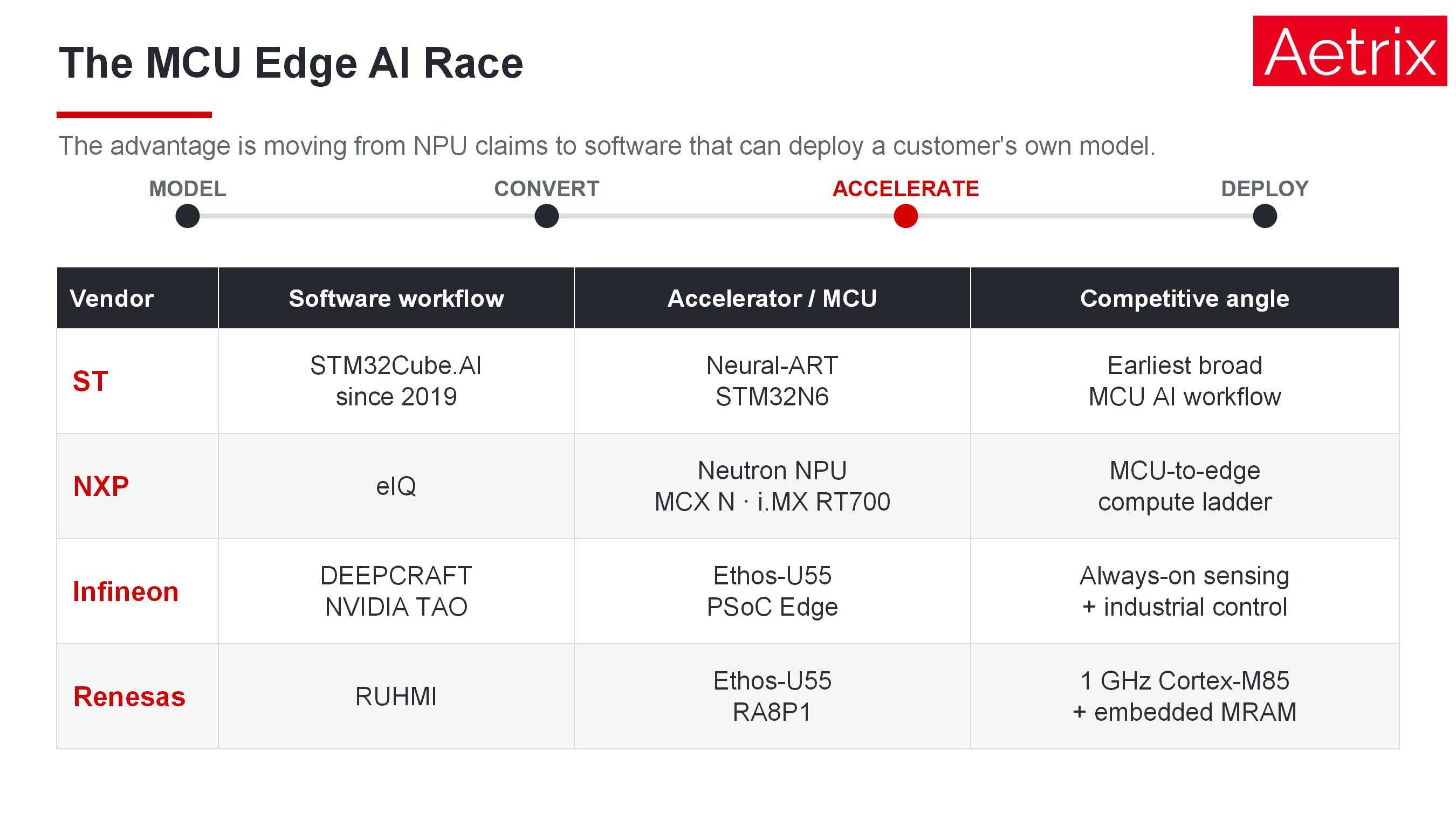
The New Battlefield: Edge AI Moves into the MCU
AI on an MCU does not mean training a large language model inside a tiny controller. The useful workloads are bounded inference tasks: wake-word detection, motor or bearing anomaly detection, people counting, simple vision classification, predictive maintenance, gesture recognition and sensor fusion. They run near the sensor, often under a fixed power budget and a deterministic response requirement.
The commercial value is not the accelerator alone. A vendor must convert models from common frameworks, support the operators the model uses, fit weights and activations into available memory, schedule work across CPU and accelerator, and expose profiling data that explains latency and memory failures. A high TOPS or GOPS figure cannot compensate for a broken conversion path.
ST built the earliest broad MCU AI software position
ST's lead began in software. STM32Cube.AI first appeared at CES 2019, making ST the first major MCU vendor to place neural-network conversion inside its mainstream development environment. The tool allowed developers to import trained models, optimize them for STM32 memory and generate embedded code. ST later documented deployments including a Schneider Electric people-counting application, evidence that the workflow had moved beyond demonstrations. (STMicroelectronics)
The STM32N6 added dedicated neural acceleration to that installed software base. Its Neural-ART accelerator targets computer-vision and audio workloads that would be impractical on a conventional Cortex-M core alone. ST's advantage is sequence: model tooling and developer familiarity arrived before the accelerator, so the hardware did not enter the market without a deployment path. (STM32N6)
NXP connects MCU AI to a broader edge-compute ladder
NXP's eIQ environment spans MCUs and application processors. The eIQ Neutron NPU appears in products including MCX N94/N54 and i.MX RT700, giving customers a route from conventional Cortex-M development to accelerated inference without immediately moving to a Linux-class processor. NXP can also connect edge inference with its automotive, industrial networking and security portfolios. (NXP eIQ Neutron NPU)
The planned acquisition of Kinara pushes NXP further up the performance range. Kinara's discrete edge-AI accelerators do not turn every MCU into an AI device; they broaden the architecture choices NXP can offer when a workload outgrows MCU-class resources. (NXP)
Infineon targets always-on sensing and industrial deployment
PSoC Edge combines Arm Cortex-M55 processing with Ethos-U55 neural acceleration, positioning Infineon for always-on, low-power human-machine interfaces and sensor intelligence. DEEPCRAFT provides the model and software layer, while support for NVIDIA TAO gives developers another route from training to embedded deployment. (Infineon and NVIDIA; DEEPCRAFT)
Infineon's opportunity is system attachment. An inference result can feed an MCU that already controls a motor, power stage, touch interface or secure connected product. Its problem is the same one created by the Cypress acquisition: developers need a consistent experience across product lines that were not originally designed as one family.
Renesas enters with high MCU-class performance and embedded MRAM
Renesas moved aggressively with the RA8P1. The device combines a 1 GHz Cortex-M85, an Ethos-U55 accelerator rated at up to 256 GOPS and embedded MRAM, with the RUHMI framework supplying AI model support and application workflows. Renesas began mass production in July 2025. (Renesas)
That specification gives Renesas a credible hardware entry, especially where real-time control must continue beside inference. Market impact will depend on the less visible work: operator coverage, compiler stability, quantization behavior, example quality and sustained support for deployed models.
| Vendor | MCU-Class AI Platform | Strategic Advantage | What Buyers Still Need to Verify |
|---|---|---|---|
| ST | STM32Cube.AI, STM32N6 | Early model-deployment tooling and a large STM32 developer base | Real latency, external-memory needs and accelerator support for the target model |
| NXP | eIQ, MCX N, i.MX RT700 | A wide ladder from MCU inference to higher edge-compute classes | Portability between device families and software maturity on the selected target |
| Infineon | DEEPCRAFT, PSoC Edge | Low-power sensing plus strong industrial, power and connectivity attachment | Tool consistency and production examples for the intended workload |
| Renesas | RUHMI, RA8P1 | High MCU-class CPU performance, NPU acceleration and embedded MRAM | Operator coverage, profiling depth and long-term ecosystem support |
Who Is Winning the MCU Market in 2026?
Infineon has the clearest claim to the overall MCU revenue lead. The company also said TechInsights placed its 2025 automotive MCU share at 36%, reflecting the depth of AURIX and the added reach of TRAVEO. ST has the clearest claim in general-purpose MCUs, where its stated Omdia category excludes automotive and secure devices. Those results describe two different kinds of scale. (Infineon; STMicroelectronics)
| Market Test | Current Reading | Reason |
|---|---|---|
| Overall MCU revenue | Infineon leads | Scale in automotive and industrial control, expanded by the Cypress portfolio |
| General-purpose MCU | ST leads the stated Omdia category | Broad STM32 coverage, tooling, boards, community and distributor-independent developer reach |
| Automotive MCU | Infineon leads; NXP and Renesas remain major challengers | AURIX scale is formidable, while S32 and RH850 retain deep platform positions |
| 8-bit and long-lived installed base | Microchip has a durable defensive position | PIC and AVR designs persist where revalidation costs outweigh performance gains |
| Real-time control | TI remains highly differentiated | C2000 control focus and analog integration can reduce total board cost |
| MCU AI development workflow | ST holds the early software advantage | STM32Cube.AI preceded the current NPU race and built deployment experience |
| AI MCU hardware | The race remains open | ST, NXP, Infineon and Renesas now offer credible acceleration; model fit will decide projects |
| Software-defined vehicle platforms | Infineon, NXP and Renesas form the leading group | Success depends on OEM platforms, safety software and long production cycles, not launch-year specifications |
Microchip and TI show why a revenue table cannot explain the whole market. Microchip can defend sockets through continuity and migration control. TI can win a power-conversion or motor-control design because its analog and timing architecture cuts system cost. Neither result requires either company to lead total MCU revenue.
The AI ranking is even less settled. ST entered first with a broadly used MCU model-conversion workflow. Renesas now advertises aggressive MCU-class compute. NXP spans a wider edge-compute range. Infineon can tie inference to sensing, power and industrial control. The eventual leader will be the supplier whose tools keep working when customers replace a demonstration network with their own model and production data.
What the MCU Battle Means for Buyers
The safest MCU shortlist starts with the cost of staying in production, not the launch-page feature table. Core architecture matters, but most migration expense sits elsewhere: peripheral registers, driver behavior, middleware licenses, package routing, safety artifacts, manufacturing tests and firmware accumulated over years.
| Buyer Question | Evidence to Request Before Design Freeze |
|---|---|
| Can the design move within the family? | Pin-compatible options, memory steps, peripheral differences, package roadmap and a tested migration example |
| What actually creates software lock-in? | Compiler and middleware licenses, RTOS dependencies, vendor HAL use, debug tools, security provisioning and generated-code ownership |
| Is the supply plan specific enough? | Exact order-code longevity, wafer source where disclosed, assembly and test locations, package capacity and last-time-buy policy |
| Is an alternate real? | A routed board option or adapter, compiled firmware, completed peripheral tests, EMC impact and an estimate of requalification time |
| Does the automotive platform reduce work? | Available AUTOSAR modules, functional-safety evidence, cybersecurity support, hypervisor or isolation plan, update strategy and named integration responsibility |
| Will the AI model fit in production? | Operator report, quantization accuracy, peak RAM, flash or MRAM use, measured latency, accelerator utilization, power and fallback behavior |
For an AI-capable MCU, insist on running the intended model through the vendor's current production toolchain. Compare end-to-end latency, peak memory and accuracy after quantization. Check whether unsupported operators fall back to the CPU and whether that fallback breaks the real-time budget. Demonstration models supplied by the silicon vendor are useful for board bring-up; they are poor substitutes for this test.
For automotive and industrial programs, negotiate software maintenance and product-longevity expectations alongside silicon pricing. A low MCU unit price can be overwhelmed by one unexpected tool license, a mandatory middleware rewrite or a late package change. The winning supplier is the one that minimizes the risk-adjusted cost of the complete program-not the one with the highest clock frequency or the loudest market-share claim.