My Inquiry
 My Account


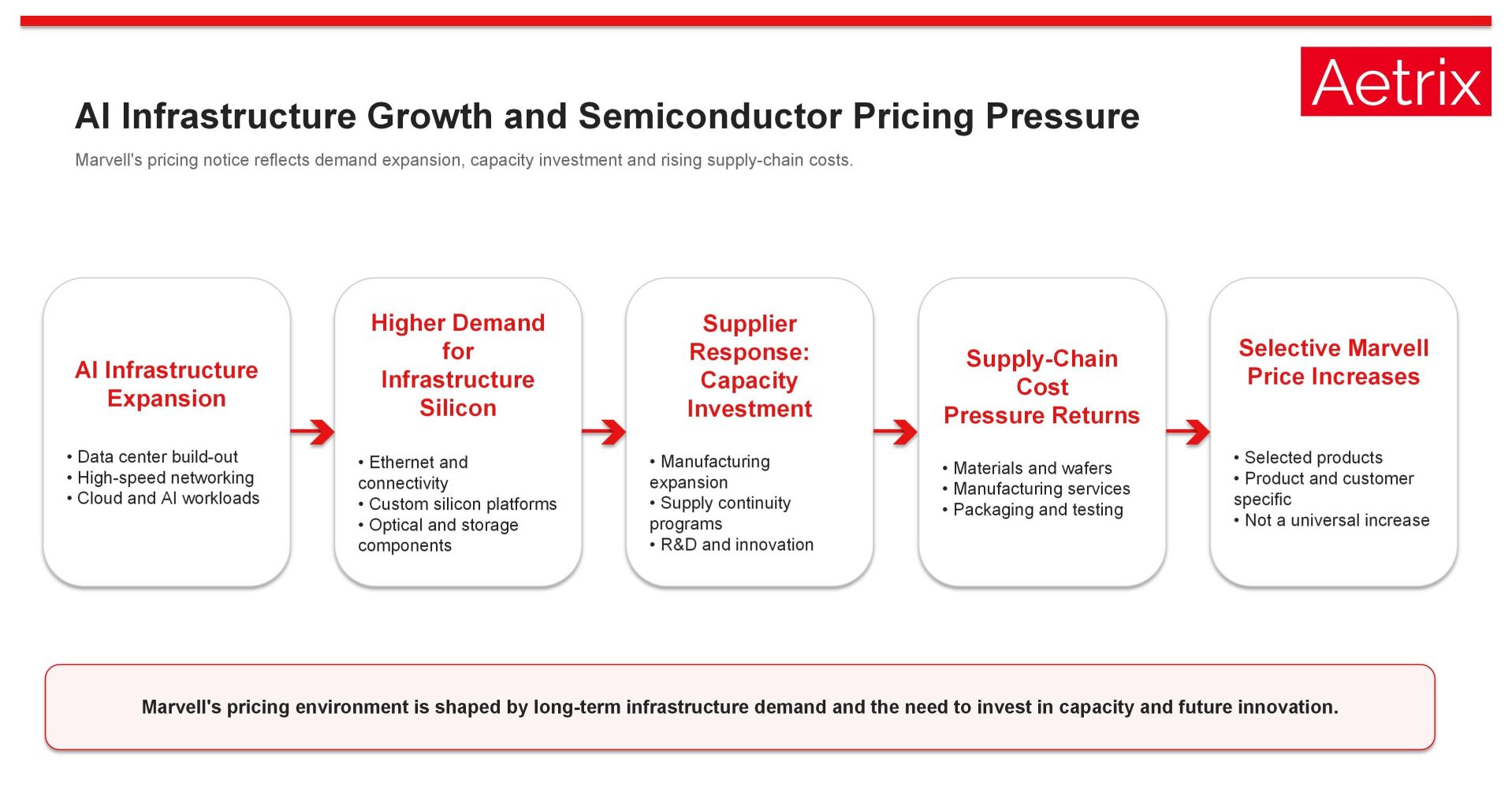
Marvell Technology is preparing selective price increases across its product portfolio as semiconductor demand continues to expand across multiple markets. According to a recent Marvell pricing notice, the company will adjust pricing on selected products while highlighting continued investment in capacity, supply continuity and future innovation.
The notice attributes the pricing changes to higher costs across materials, manufacturing and other market-driven factors. It does not provide a universal increase percentage or a complete list of affected products, meaning the actual impact will depend on the specific MPN, customer agreement and supply arrangement.
Marvell's pricing move arrives during a period of rapid expansion in AI infrastructure, high-speed networking and data center investment. The adjustment reflects a broader pricing environment forming around infrastructure semiconductor demand, where suppliers are balancing capacity investment, supply continuity and rising production costs.
Marvell Implements Selective Price Increases Across Its Product Portfolio
The latest Marvell pricing notice states that selected products within its portfolio will receive price adjustments. The company explains that continued demand growth across multiple markets has resulted in significant investment to support capacity, supply continuity and future innovation.
Marvell also points to increases in materials, manufacturing and other market-driven factors as contributors to the pricing change.
The notice does not indicate that every Marvell product will receive the same adjustment. Semiconductor companies typically manage pricing at the product and customer level, especially for complex infrastructure devices that may involve different manufacturing processes, packaging requirements and customer commitments.
For buyers, the first question is therefore not the overall percentage increase across Marvell's portfolio. The more important questions are which MPNs are affected, when the new pricing applies, and whether existing quotations or production commitments are protected.
AI Infrastructure Demand Is Changing Semiconductor Pricing Conditions
Marvell occupies a different position in the semiconductor supply chain compared with many traditional MCU or analog suppliers. Its products are closely connected with data center infrastructure, networking, storage and high-performance computing applications.
The expansion of AI computing has increased demand for the infrastructure required to move, process and store large volumes of data. This creates additional requirements for high-speed connectivity, Ethernet solutions, optical interconnects and custom silicon platforms.
As infrastructure demand increases, semiconductor suppliers are investing more heavily in manufacturing capacity, supply assurance and technology development. Those investments can influence pricing decisions even when the market does not experience a traditional component shortage.
Marvell's wording reflects this environment. The company connects pricing changes with the need to support capacity and future innovation, indicating that pricing pressure is linked with long-term supply preparation rather than only short-term cost recovery.
This creates a different procurement environment from the inventory correction period of previous semiconductor cycles. The current cycle is increasingly shaped by demand visibility, capacity planning and securing supply for expanding infrastructure markets.
Supply Chain Costs Are Returning as a Semiconductor Pricing Factor
The Marvell notice specifically references higher costs in materials, manufacturing and other market-driven areas. These factors affect multiple stages of semiconductor production.
| Cost Factor | Potential Supply Chain Impact |
|---|---|
| Materials | Higher input costs for semiconductor manufacturing and packaging processes |
| Manufacturing | Higher production expenses across wafer, assembly or testing operations |
| Capacity investment | Additional spending required to support future demand growth |
| Market demand | Higher demand visibility can change supplier pricing decisions |
The semiconductor industry has several cost layers between wafer production and finished components. Changes in manufacturing services, advanced packaging requirements, logistics and material availability can gradually move into product pricing discussions.
For infrastructure semiconductor suppliers, these factors become more important because customers often require long product lifecycles, stable supply and continuous technology upgrades. Maintaining supply continuity can require additional investment before demand reaches production volume.
Why Marvell's Pricing Move Differs From MCU and Analog Price Adjustments
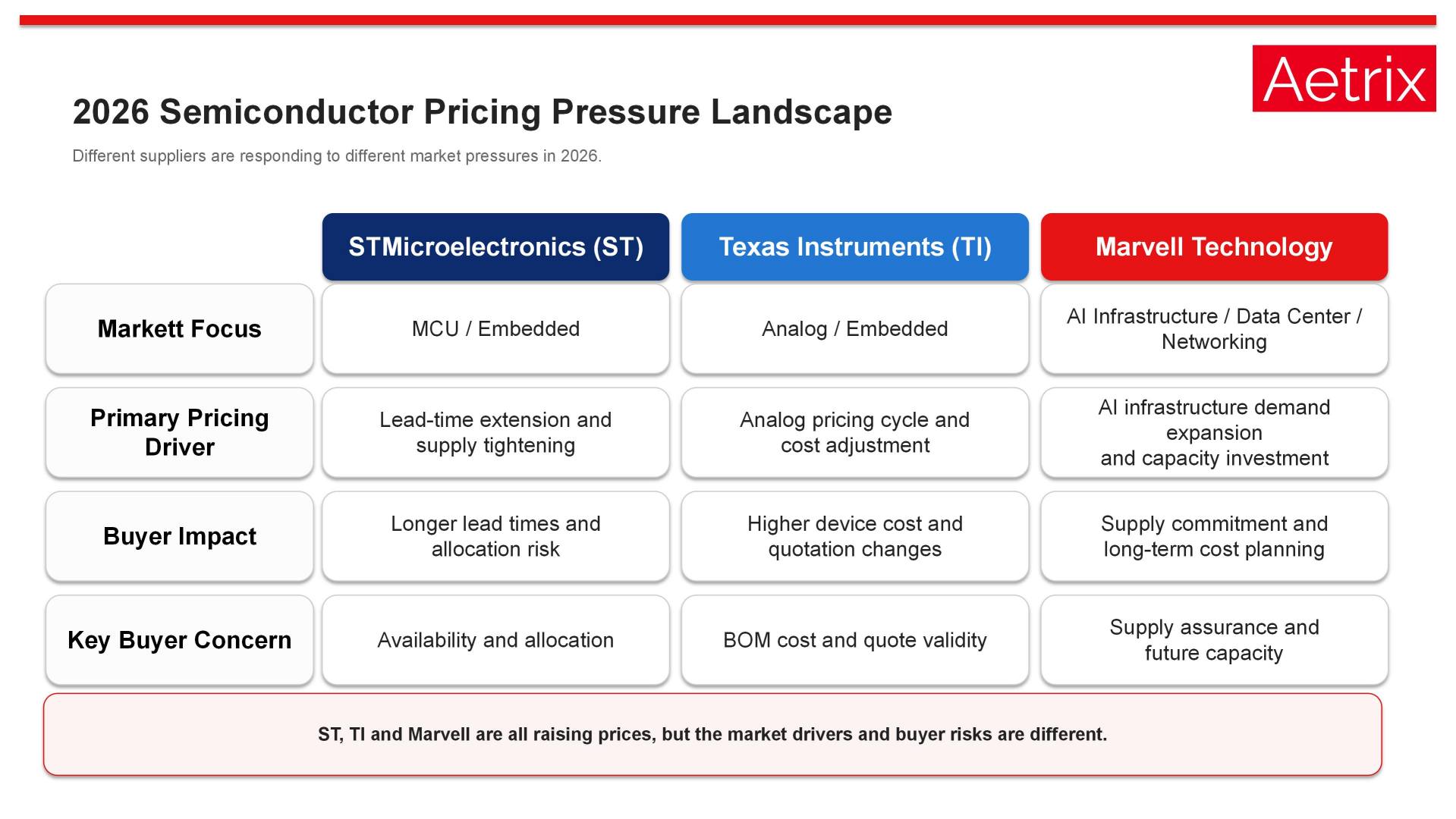
Several semiconductor suppliers have announced pricing changes during 2026, but the underlying market conditions are different.
| Supplier | Main Market Pressure | Procurement Concern |
|---|---|---|
| STMicroelectronics | MCU demand, longer lead times, supply tightening | Production availability and allocation risk |
| Texas Instruments | Analog pricing cycle and cost adjustment | BOM cost changes and quotation validity |
| Marvell | AI infrastructure demand expansion and capacity investment | Supply commitment and long-term infrastructure planning |
ST's recent supply updates have focused heavily on STM32 lead times and production allocation. Selected STM32H7 and H5 devices later moved toward 52-week standard lead times, creating a direct availability concern for MCU buyers. Read the latest analysis: STM32H7 Lead Times Reach 52 Weeks as ST MCU Supply Tightens Further.
Texas Instruments' 2026 pricing changes have focused more on product pricing cycles and commercial planning. Marvell's adjustment is connected more closely with infrastructure expansion, where customers are planning around long-term data center deployment and networking requirements.
What the Marvell Notice Does Not Tell Buyers Yet
The pricing notice provides the direction of the change, but several details required for purchasing decisions are still unavailable.
The notice does not identify the complete list of affected products, the percentage increase for each product category, or the effective date for every customer situation. Those details will determine the actual cost impact on individual production programs.
| Information Still Required | Why It Matters |
|---|---|
| Affected MPN list | Shows which designs and BOMs require cost updates |
| Product-level increase percentage | Determines actual impact on project margins |
| Effective pricing date | Clarifies whether existing quotations remain valid |
| Open order treatment | Determines whether committed orders retain previous pricing |
| Customer-specific agreements | Long-term programs may follow separate commercial terms |
For infrastructure products, pricing changes often require more than a simple component cost update. A Marvell device may be integrated into a networking platform, accelerator system or data center product with long validation cycles. A price adjustment can therefore affect both material cost and project planning.
The absence of product-level details also means buyers should avoid applying one assumed percentage increase across all Marvell components. Different products may have different supply chains, manufacturing requirements and customer agreements.
What Marvell Buyers Should Confirm After a Price Increase Notice
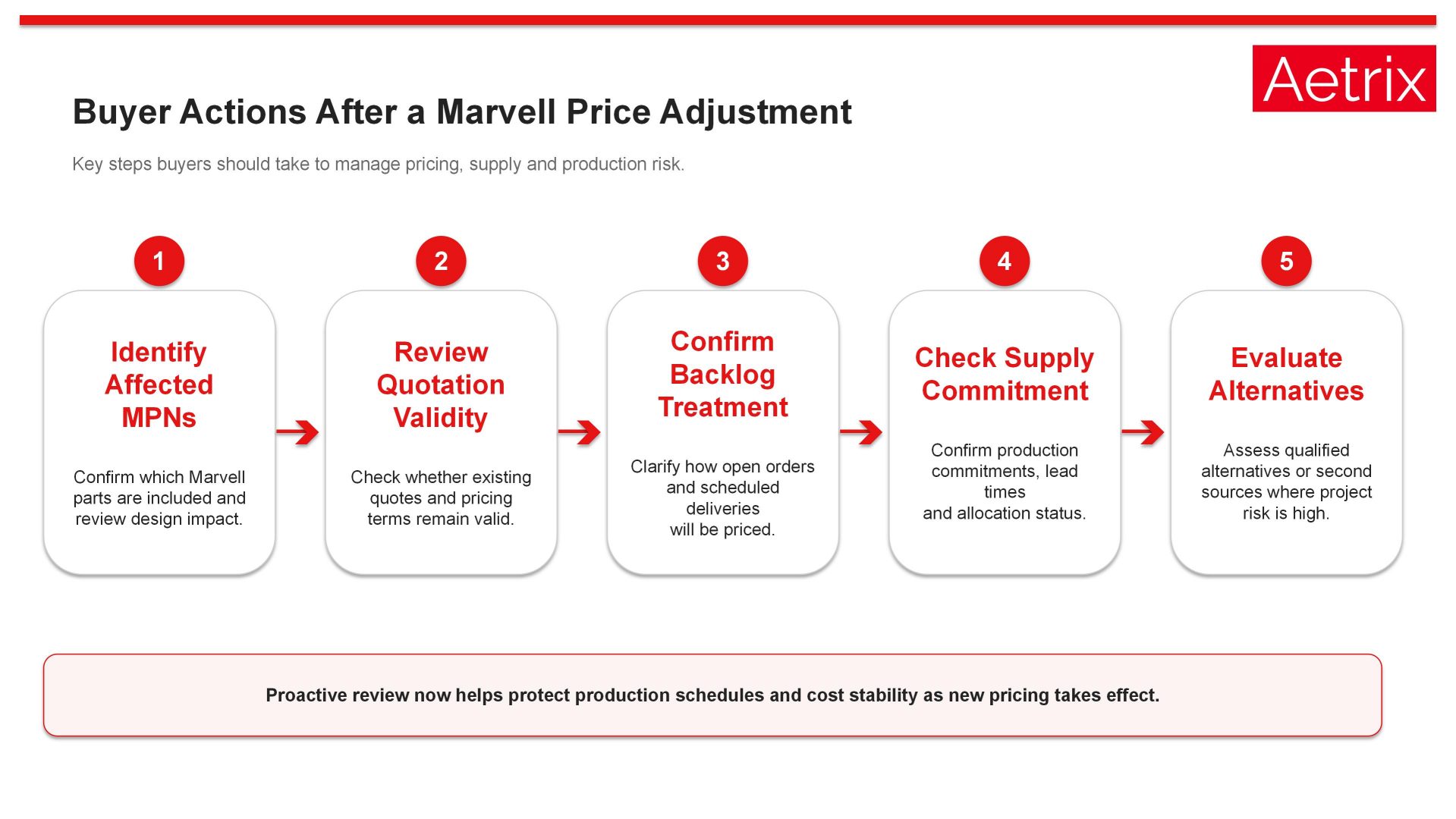
The first review should focus on affected part numbers. Procurement teams need to identify which Marvell devices are included in the adjustment and whether those parts are used in active production, new designs or future infrastructure deployments.
Existing quotations should be reviewed carefully. A quotation created before a pricing update may have a validity period, but buyers should confirm whether that validity protects the final purchase price or only reflects the pricing available when the quotation was issued.
Open orders and scheduled deliveries require the same attention. Customers with long deployment cycles may have orders extending months into the future, and the treatment of those quantities can determine whether the pricing impact appears immediately or later in the program.
Supply commitment should also be discussed alongside pricing. For infrastructure projects, securing availability can be as important as controlling unit cost. A lower component price has limited value if delayed supply affects a data center deployment schedule or network equipment production plan.
| Buyer Review Area | Recommended Check |
|---|---|
| Affected MPNs | Confirm all Marvell devices used in current and planned designs |
| Current quotations | Verify whether existing quotes remain protected |
| Backlog orders | Confirm pricing treatment for scheduled deliveries |
| Production planning | Evaluate cost and supply impact together |
| Alternative sourcing | Review qualified alternatives where project risk justifies evaluation |
Capacity Investment Becomes Part of Semiconductor Supply Planning
One important phrase in Marvell's notice is the company's investment in capacity, supply continuity and future innovation.
For semiconductor suppliers serving infrastructure markets, capacity planning has become a long-term decision. Data center and AI-related demand requires additional semiconductor production, advanced packaging, testing capacity, engineering resources and supply-chain partnerships.
These investments can create a different pricing environment from traditional shortage cycles. Suppliers are preparing manufacturing and technology roadmaps around expected future demand rather than responding only to temporary supply gaps.
For customers, this means supply planning increasingly needs to consider the supplier's investment cycle. A component selected for a long-life infrastructure product may depend on a supplier's ability to expand capacity over several years, not only on current inventory availability.
What to Watch Next
The next important information will be the product-level details behind the pricing change. Affected MPNs and actual adjustment levels will determine whether the impact is concentrated in specific infrastructure products or extends across a broader section of Marvell's portfolio.
AI infrastructure demand will remain a key factor to watch. Continued expansion in data centers, networking equipment and high-speed connectivity could increase the need for semiconductor capacity investment across multiple suppliers.
The broader question is whether more infrastructure semiconductor companies follow similar pricing actions. If additional suppliers begin adjusting prices while investing in capacity expansion, it would indicate that pricing pressure is moving beyond individual components and into the wider AI hardware supply chain.
For buyers, the practical response is straightforward: identify affected Marvell MPNs, confirm commercial terms, review supply commitments and evaluate cost exposure before new pricing takes effect. Infrastructure projects with long deployment cycles need visibility on both price and availability, because either one can affect the final production schedule.