My Inquiry
 My Account


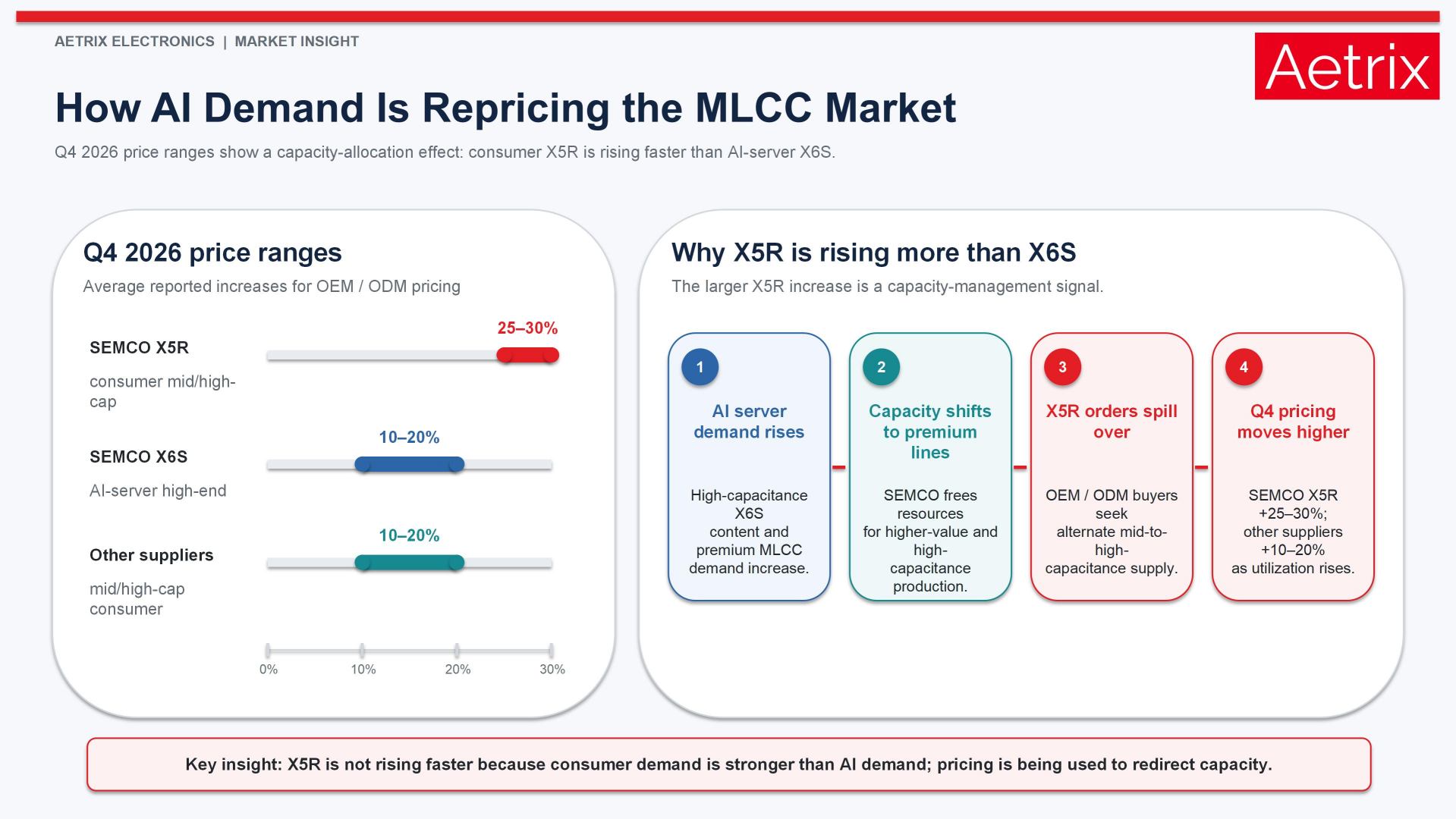
The MLCC market is entering a new pricing phase for the fourth quarter of 2026. Samsung Electro-Mechanics (SEMCO) has taken the lead in raising quotations directly for OEM and ODM customers, with TrendForce estimating an average 25%–30% increase for consumer-grade X5R products. High-end X6S MLCCs used in AI servers are expected to rise by an average of 10%–20%, depending on customer negotiations. (TrendForce, SEMCO Leads 4Q26 OEM Price Hikes)
The larger increase is appearing in X5R rather than the AI-focused X6S segment. That difference is central to the current market. TrendForce says SEMCO's X5R adjustment is intended to curb incoming orders and release capacity for expansion of higher-end production lines. Pricing is therefore being used as a capacity-management tool: demand for premium high-capacitance MLCCs remains strong, while customers using mainstream mid- and high-capacitance X5R products are being asked to pay more for capacity that suppliers increasingly prefer to deploy elsewhere.
This is a further step in a market transition that has been visible throughout 2026. High-capacitance AI-server MLCCs tightened first. Production resources then shifted toward premium specifications, creating a wider gap between high-end and commodity supply. Spot pricing became increasingly fragmented, with some ordinary products remaining relatively available while scarce high-capacitance parts commanded much stronger premiums. Q4 OEM and ODM pricing now shows that the effects of this capacity shift are reaching mainstream customer contracts.
Samsung Electro-Mechanics Raises Q4 MLCC Prices
TrendForce's August 27 research marks an important change in SEMCO's pricing strategy. Previous adjustments had been more concentrated in distribution channels. The latest action reaches OEM and ODM customers directly, providing a clearer signal that the supplier is changing its underlying price structure rather than responding only to short-term spot-market conditions.
| MLCC Segment | 4Q26 Price Signal | Supply Context | Buyer Meaning |
|---|---|---|---|
| SEMCO consumer-grade X5R | +25% to +30% | Pricing intended partly to reduce demand and release production capacity | OEM and ODM customers face higher contract cost even outside the premium AI segment |
| SEMCO AI-server X6S | +10% to +20% | High-capacitance supply remains tight, with pricing dependent on customer negotiations | Allocation and lead time can be as important as the quoted percentage increase |
| Taiwanese and Chinese mid/high-capacitance suppliers | About +10% to +20% | Order spillover is lifting utilization, with some suppliers approaching 90% | Moving an order to another manufacturer may no longer provide the same price relief or capacity buffer |
The spillover effect is significant. If a large OEM resists SEMCO's new X5R pricing and transfers part of its volume to another supplier, that volume does not disappear from the market. It raises utilization elsewhere. TrendForce expects this process to support 10%–20% price increases at other suppliers during Q4, primarily in consumer-grade mid- and high-capacitance products.
Why X5R Is Rising More Than AI-Grade X6S
A simple demand explanation would suggest that X6S should show the larger increase because AI-server demand is stronger. The reported pricing says otherwise. X5R is rising 25%–30%, compared with 10%–20% for X6S. This does not mean consumer-electronics demand has suddenly overtaken AI demand.
The difference reflects production economics and customer management. High-capacitance X6S is already a premium, technically demanding product sold into strategic AI and data-center programs. Customers in this segment often negotiate supply, allocation and longer-term commercial terms directly. An across-the-board price increase can be less useful than customer-specific negotiation when the supplier is already allocating scarce capacity.
X5R sits in a different position. Mid- and high-capacitance X5R orders consume production resources that can increasingly be used for higher-value specifications. Raising X5R prices sharply discourages lower-priority demand, improves the economics of retaining those orders and gives the manufacturer more room to shift resources toward premium products.
X5R and X6S are temperature-characteristic classifications for Class II ceramic capacitors rather than different ceramic materials in a simple sense. X5R specifies operation from -55°C to +85°C with capacitance change within ±15%. X6S extends the upper temperature limit to +105°C with capacitance variation within ±22%. In AI-server power architectures, X6S is increasingly used where high capacitance, compact size and higher-temperature performance need to be combined.
The 2026 MLCC Cycle Has Moved From Shortage Risk to Contract Repricing
The Q4 price action is easier to understand when placed against the earlier stages of the 2026 MLCC market. The first visible signal was not a broad price increase. It was concentration of demand in a relatively narrow group of high-capacitance, small-case and high-temperature products used in AI accelerators and server power systems.
TrendForce reported in June that changes made during final validation of major AI platforms were sharply increasing MLCC content. AMD's MI450 design increased the use of 47µF, 2.5V, X6S 0402 MLCCs from 1,440 to 10,544 units per board. NVIDIA's Vera Rubin platform increased 100µF, 4V, X6S 0805 content from 320 to 500 units per board. (TrendForce, High-End Specialty MLCC Shortage Risk)
These are not ordinary volume changes. Packing tens of microfarads into 0402 or 0603 case sizes while maintaining acceptable DC-bias, temperature and reliability characteristics is technically difficult. Additional nominal factory capacity does not immediately become usable high-end capacity because yield, process control and qualification remain limiting factors.
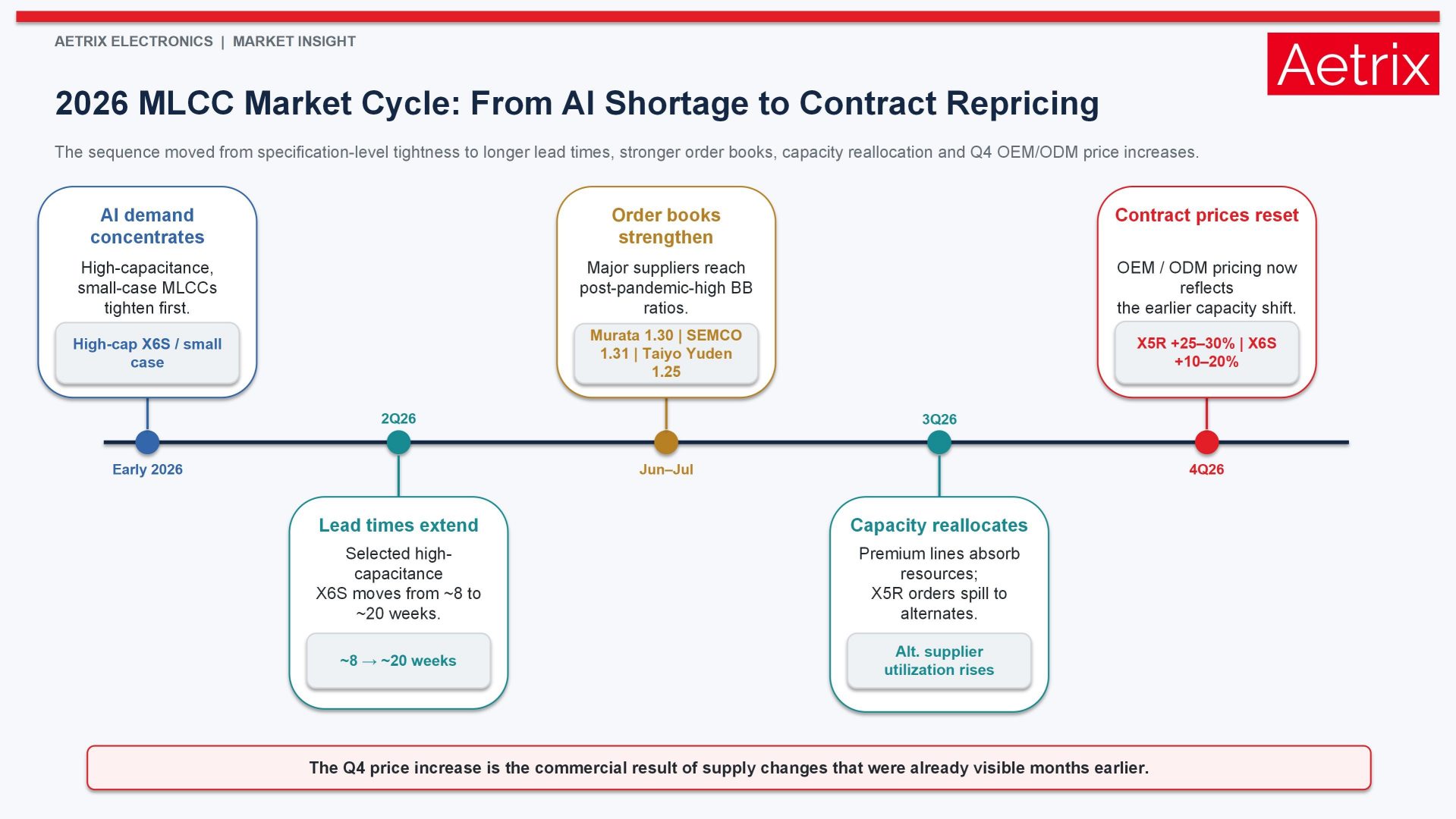
By June, lead times for certain high-capacitance X6S products had already extended from about eight weeks to as much as twenty weeks. The pressure then became visible in supplier order books. By late June, TrendForce calculated book-to-bill ratios of 1.30 for Murata, 1.31 for SEMCO and 1.25 for Taiyo Yuden, the highest levels since the COVID-era shortage. The overall MLCC industry BB ratio reached 1.04. (TrendForce, MLCC Book-to-Bill Ratios Reach Post-Pandemic Highs)
| 2026 Stage | Market Development | Procurement Signal |
|---|---|---|
| Early 2026 | AI platforms concentrate demand on high-capacitance, small-case MLCCs | Selected specifications tighten before the broader market |
| 2Q26 | High-end line utilization rises and X6S lead times extend | Allocation and approved-source availability become more important |
| June–July | Spot prices diverge and supplier BB ratios climb above 1.2 at major Japanese and Korean vendors | High-end shortage no longer matches conditions in commodity MLCCs |
| 3Q26 | Capacity shifts toward higher-value products and X5R orders spill into alternate suppliers | Spare capacity outside the leading suppliers begins to shrink |
| 4Q26 | SEMCO raises OEM/ODM X5R prices 25%–30%; X6S 10%–20% | Capacity reallocation is now reaching contract pricing |
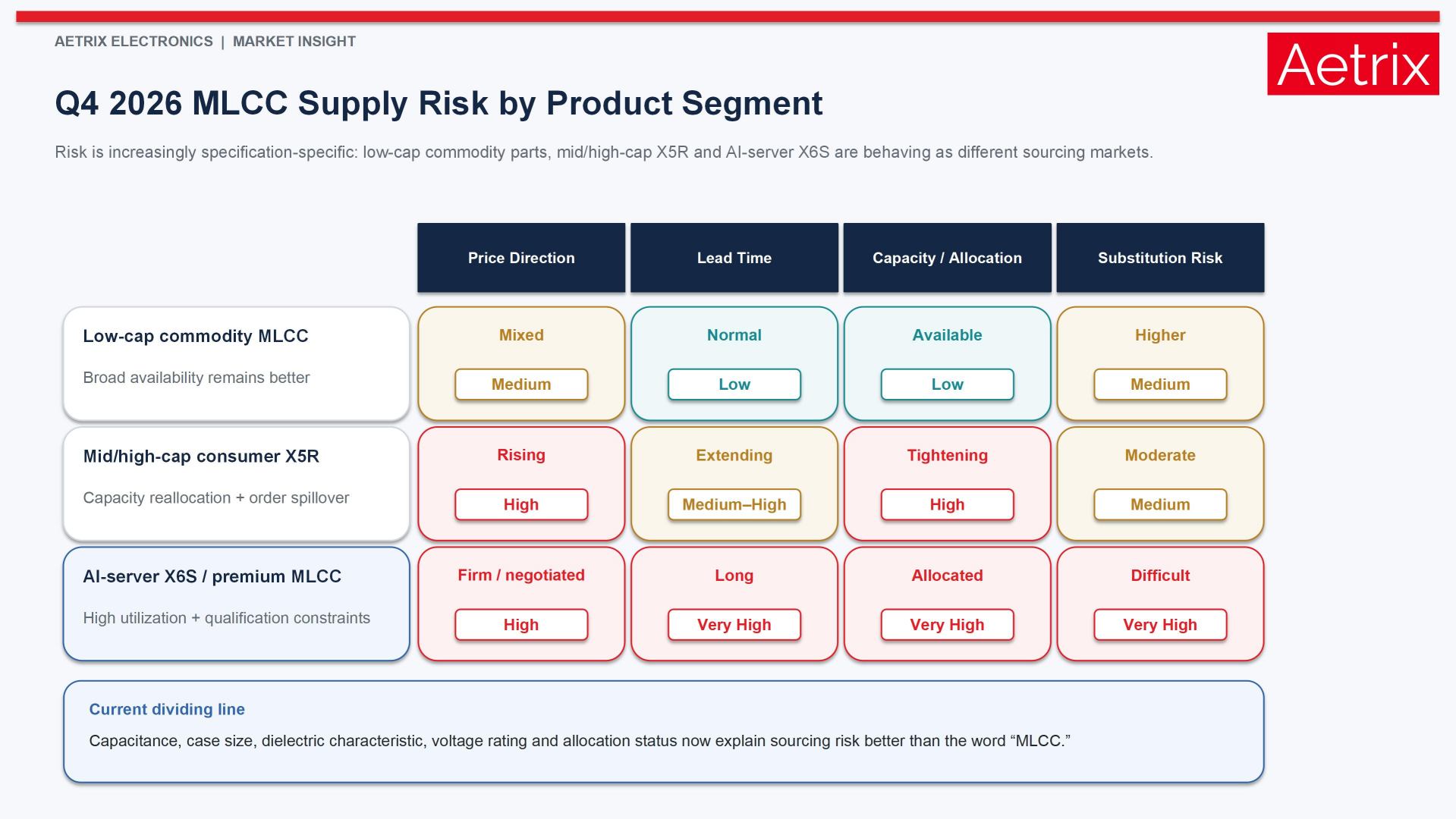
The MLCC Market Still Has Three Different Pricing Zones
Calling the current market an "MLCC price increase" is useful for a headline but too broad for procurement. The direction still changes substantially by capacitance, case size and application. A low-capacitance commodity X5R part can have a completely different supply profile from a 47µF X6S 0402 product even though both are ceramic capacitors supplied by the same manufacturer.
This distinction also explains why earlier signs of softer commodity spot prices do not contradict the latest OEM increases. Aetrix previously examined the split in MLCC Spot Market Divergence: Commodity Prices Soften While AI Demand Stays Tight. The new development is that the tight side of that market is moving further downstream into mid- and high-capacitance consumer products.
| Segment | Current Price Direction | Supply Condition | Main Buyer Risk |
|---|---|---|---|
| Low-capacitance commodity MLCC | Mixed / specification-dependent | Availability generally better than high-capacitance categories | Channel inventory and spot-price volatility |
| Mid/high-capacitance consumer X5R | Rising | Capacity reallocation and order spillover are tightening alternatives | OEM contract repricing and reduced second-source capacity |
| High-capacitance X6S / premium AI MLCC | Firm / customer-specific | High utilization, long lead times and qualification constraints | Allocation and supply continuity |
Order Spillover Is Reducing the Second-Source Capacity Buffer
One of the most important Q4 changes is occurring outside SEMCO itself. Higher SEMCO X5R pricing encourages OEMs and ODMs to ask Taiwanese and Chinese manufacturers for additional volume. Those suppliers benefit from new orders, but their ability to absorb transfers is finite.
TrendForce says some Taiwanese and Chinese suppliers are already approaching 90% utilization. At that level, moving an order away from a higher-priced supplier is no longer a simple sourcing decision. The alternate manufacturer may have less free capacity, longer lead times or its own price adjustment by the time qualification and commercial approval are completed.
This is how a shortage concentrated in premium products can create broader pricing pressure without a matching rebound in consumer electronics. Traditional ICT and automotive demand remains comparatively conservative, according to TrendForce. The price cycle is being transmitted through production allocation and supplier utilization rather than through synchronized growth across every electronics end market.
The mechanism was already visible when high-end MLCC capacity began moving toward AI applications, as discussed in AI Server MLCC Shortages: Capacity Reallocation Tightens High-Capacitance Supply. Q4 pricing provides a stronger commercial confirmation of that process.
Major MLCC Suppliers Are Still Using Different Pricing Strategies
SEMCO's price action does not yet represent a uniform policy across the leading MLCC manufacturers. TrendForce's August 27 assessment says Murata, Taiyo Yuden and Kyocera are currently keeping prices unchanged and taking a wait-and-see approach. Whether those suppliers follow SEMCO is one of the clearest indicators for determining how far the Q4 upcycle spreads.
The difference does not mean Japanese suppliers are seeing weak demand. Murata's own forecast points in the opposite direction. On July 31, Murata raised its FY2026 capacitor revenue forecast to JPY1.1575 trillion, up 23.6% from the prior fiscal year. Revenue in its Computers application category is forecast at JPY502 billion, up 61.7%, with capacitors and power-supply modules for servers among the expected growth drivers. (Murata Manufacturing, FY2026 Earnings Forecast)
Murata can therefore have strong data-center demand while still avoiding a broad price increase across its existing portfolio. Suppliers can respond to tight conditions through capacity expansion, customer allocation, product mix, selective part-number repricing and discontinuation of less efficient products. Aetrix previously examined the product-mix side of this strategy in Murata Large-Case MLCC Withdrawal: Replacement and Sourcing Risk.
Taiyo Yuden has also been increasing MLCC capacity to address structural growth in high-capacitance demand. Capacity additions can relieve part of the pressure, but they do not immediately eliminate shortages in the most difficult specifications because new equipment must reach stable yield and products still require customer qualification. The relationship between AI-server demand and Taiyo Yuden's expansion is covered in AI Server MLCC Demand Drives Taiyo Yuden Capacity Expansion.
High-Capacitance Lead Times Remain a Better Warning Signal Than Average MLCC Availability
Average MLCC lead-time figures can hide the same segmentation seen in pricing. TrendForce reported in June that certain high-capacitance X6S lead times had moved from roughly eight weeks to as long as twenty weeks. These products require high capacitance in small footprints, which increases manufacturing difficulty and limits the number of qualified suppliers.
The widening gap between general-purpose and premium MLCCs means buyers should avoid using one manufacturer-level lead time for an entire family. An available 1µF X5R part does not indicate that a 22µF or 47µF alternative in the same package will be equally easy to source. Voltage rating can narrow the supplier pool further because effective capacitance falls under DC bias and cannot be evaluated from nominal µF value alone.
The same applies to substitutions. Moving from X6S to X5R, changing case size or lowering voltage margin can alter temperature performance, DC-bias behavior, PCB layout and total capacitance under operating conditions. A commercially available part is useful only if the electrical design can accept it.
Long-Term Agreements Show That High-End Capacity Is Being Secured Earlier
The market is also changing in how customers reserve future supply. Samsung Electro-Mechanics disclosed a KRW450 billion one-year agreement covering AI-server MLCC supply during calendar 2027. TrendForce noted that long-term supply agreements are unusual for MLCCs, where shorter ordering cycles have traditionally been common. (TrendForce, SEMCO AI Server MLCC Long-Term Agreement)
For buyers outside large cloud and AI accounts, the relevance is allocation. Capacity committed through longer-term agreements is not equally available to the spot market or to customers entering the queue later. A manufacturer can be adding capacity at the same time that effective open-market supply remains tight because new production is already commercially reserved.
TrendForce has also noted that Murata's new Izumo capacity is not expected to reach full production until 2027. That timing makes a rapid return to excess high-end capacity less likely during the remainder of 2026.
Spot and Contract Pricing Can Move in Different Directions
Another source of confusion is the comparison between spot-market quotes and OEM contract pricing. SEMCO's latest adjustment concerns OEM and ODM customers. It does not mean every reel already sitting in channel inventory immediately rises by the same percentage.
Spot prices reflect local inventory, lot age, availability, immediate buyer urgency and the number of independent sellers holding the same part. Contract prices reflect future production, customer volume, negotiated terms and factory allocation. During a segmented supply cycle, the two can diverge for weeks or months.
A low-capacitance commodity part can therefore remain competitively priced in the channel while the manufacturer raises contract prices for higher-capacitance X5R. A scarce AI-server part can trade far above contract pricing if the buyer needs immediate stock. These are different markets and should not be combined into one average "MLCC price."
What MLCC Buyers Should Check Before Q4 2026 Builds
The current market rewards specification-level sourcing. Buyers should identify which parts in a BOM actually sit in the tightening segment before extending inventory coverage. Broad buying across every MLCC category can lock cash into readily available parts while leaving the genuinely constrained specifications exposed.
| Review Area | What to Confirm | Why It Matters in Q4 |
|---|---|---|
| Capacitance and case size | Exact µF value and package, especially high-capacitance 0402, 0603 and 0805 parts | High capacitance in a small case carries greater manufacturing difficulty |
| Temperature characteristic | X5R, X6S, X7R or another approved characteristic | The same nominal capacitance does not guarantee equivalent temperature behavior |
| Voltage and DC bias | Rated voltage and effective capacitance at the actual operating voltage | An apparently equivalent part may lose too much capacitance under bias |
| Factory allocation | Whether supply is physically allocated or represented only by an open PO | Rising utilization and LTAs can reduce supply available to unallocated backlog |
| Quote type | OEM contract, authorized-channel quote or spot inventory | Each pricing layer can react at a different speed |
| Second source | Approved alternate manufacturer, package, voltage and temperature characteristic | Order spillover is reducing unused capacity at alternate suppliers |
| Q4 and 2027 coverage | Firm demand versus forecast demand and whether long-lead specifications need earlier reservation | High-end capacity may remain tight after ordinary products normalize |
What Would Make the MLCC Price Cycle Broader?
The next major signal is pricing behavior at the Japanese suppliers. If Murata, Taiyo Yuden or Kyocera begin broad OEM increases rather than selective adjustments, the market would have stronger evidence that pricing power has spread across the leading supplier base.
A second signal is utilization among Taiwanese and Chinese manufacturers. Approaching 90% does not automatically mean shortage, but continued order spillover leaves less room to accept incremental business without changing price, lead time or commercial terms. If these suppliers move closer to full effective utilization during Q4, buyers could lose one of the main alternatives currently absorbing SEMCO volume.
The third variable is traditional electronics demand. The current upcycle is developing despite a cautious outlook for conventional ICT and automotive markets. A stronger consumer or industrial recovery would add demand to an MLCC system that is already allocating substantial high-end capacity to AI infrastructure. That would increase the probability of price pressure moving into lower-capacitance products.
High-Capacitance Tightness Can Persist Into 2027 Even If Commodity Supply Improves
The most likely MLCC market entering 2027 is still a segmented one. AI accelerators and data-center systems continue to raise demand for high-capacitance, compact and thermally capable capacitors. New capacity is being added, but the products that are hardest to manufacture also require the longest period to achieve qualified yield.
Commodity MLCC supply can improve without eliminating this constraint. A factory may have excess capacity for ordinary low-capacitance parts while lacking enough qualified output for high-capacitance X6S. For procurement teams, that makes manufacturer-wide capacity figures less useful than specification-level lead time, allocation and yield.
The KRW450 billion SEMCO agreement for 2027 AI-server MLCCs also shows that major customers are reserving supply earlier. If more CSPs and accelerator vendors use similar agreements, a larger portion of premium capacity can be commercially committed before the broader market sees it.
Outlook
SEMCO's Q4 price increase marks a clear transition in the 2026 MLCC cycle. High-capacitance shortages and longer X6S lead times appeared first. Supplier order books then strengthened, production shifted toward premium applications and excess capacity at alternative manufacturers began to narrow. The latest OEM and ODM increases show that these supply changes are now affecting contract pricing.
The 25%–30% X5R increase should not be interpreted as evidence that every X5R MLCC will rise by the same amount. It applies to a pricing strategy aimed at consumer-grade products supplied to OEM and ODM customers, with the greatest pressure concentrated in mid- and high-capacitance demand. Low-capacitance commodity parts remain a different market.
For buyers, the practical dividing line is increasingly clear: capacitance, case size, temperature characteristic, voltage rating, manufacturer allocation and approved alternatives determine supply risk more accurately than the word "MLCC." Q4 pricing will show whether SEMCO remains the most aggressive supplier or whether rising utilization and continued AI demand pull a larger part of the industry into the same cycle.
Key Takeaways
- SEMCO is raising 4Q26 OEM and ODM pricing for consumer-grade X5R MLCCs by an average of 25%–30%.
- AI-server X6S prices are expected to rise about 10%–20%, depending on customer negotiations.
- The larger X5R increase is partly designed to reduce order demand and release manufacturing resources for premium production.
- Taiwanese and Chinese suppliers are receiving spillover orders, with some factory utilization rates approaching 90%.
- Murata, Taiyo Yuden and Kyocera are currently maintaining prices, making their next pricing decisions important indicators for the wider market.
- Selected high-capacitance X6S lead times have already extended from roughly eight weeks to as long as twenty weeks.
- Murata, SEMCO and Taiyo Yuden reached book-to-bill ratios of 1.30, 1.31 and 1.25 respectively by late June, showing strong order accumulation at the leading suppliers.
- Commodity MLCCs, mid/high-capacitance X5R and premium AI-server X6S remain three different sourcing markets.
- Buyers should review Q4 and 2027 exposure at the exact part-number level rather than assuming one price or lead-time trend applies to all MLCCs.