My Inquiry
 My Account


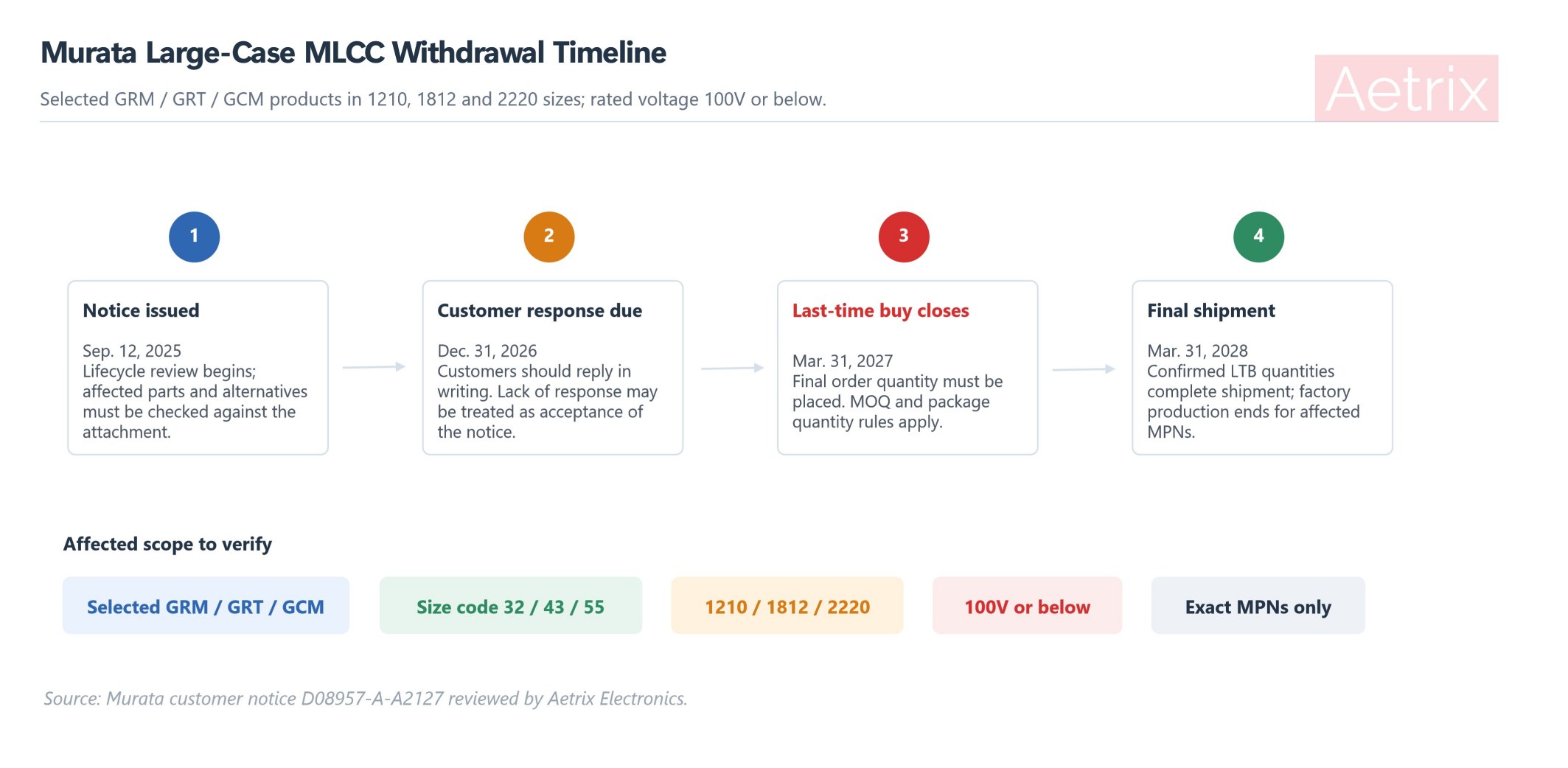
Murata Manufacturing has notified customers that it will discontinue selected large-case multilayer ceramic capacitors from its GRM, GRT and GCM series. The withdrawal covers specified 1210, 1812 and 2220 case-size products rated at 100V or below, rather than every Murata MLCC within those size and voltage categories.
The customer notice gives customers until December 31, 2026 to acknowledge the change. Last-time-buy orders must be placed by March 31, 2027, with final shipments scheduled by March 31, 2028.
Murata's explanation is more significant than the schedule itself. The company states that large-size products create a substantial production burden and restrict its ability to increase overall MLCC capacity. The withdrawal therefore reflects a change in manufacturing priorities: production resources are being concentrated on products that deliver more capacitance, reliability or commercial value from the same manufacturing base.
This does not indicate a broad exit from large-case MLCCs. It points to a narrower transition away from selected low-voltage legacy products that are expensive to maintain, increasingly replaceable by smaller components or supported by relatively limited demand. The immediate risk will be concentrated in older industrial, automotive and communications designs that cannot change footprints quickly.
Murata Large-Case MLCC Withdrawal Snapshot
| Item | Notice Detail |
|---|---|
| Document date | September 12, 2025 |
| Document number | D08957-A-A2127 |
| Affected families | Selected GRM, GRT and GCM MLCCs |
| Case sizes | 1210, 1812 and 2220 |
| Voltage range | 100V or below |
| Customer approval due | December 31, 2026 |
| Last-time-buy deadline | March 31, 2027 |
| Final shipment date | March 31, 2028 |
Which Murata MLCC Products Are Affected?
The notice identifies size codes 32, 43 and 55. In Murata's MLCC nomenclature, these correspond to the following physical sizes:
| Murata Size Code | Metric Size | Imperial Size | Approximate Dimensions |
|---|---|---|---|
| 32 | 3225M | 1210 | 3.2 × 2.5 mm |
| 43 | 4532M | 1812 | 4.5 × 3.2 mm |
| 55 | 5750M | 2220 | 5.7 × 5.0 mm |
The scope is limited to the individual part numbers included in the notice attachments. The document specifically warns that not every product in these sizes with a rated voltage of 100V or below is affected.
Why Large-Case MLCCs Create a Production Burden
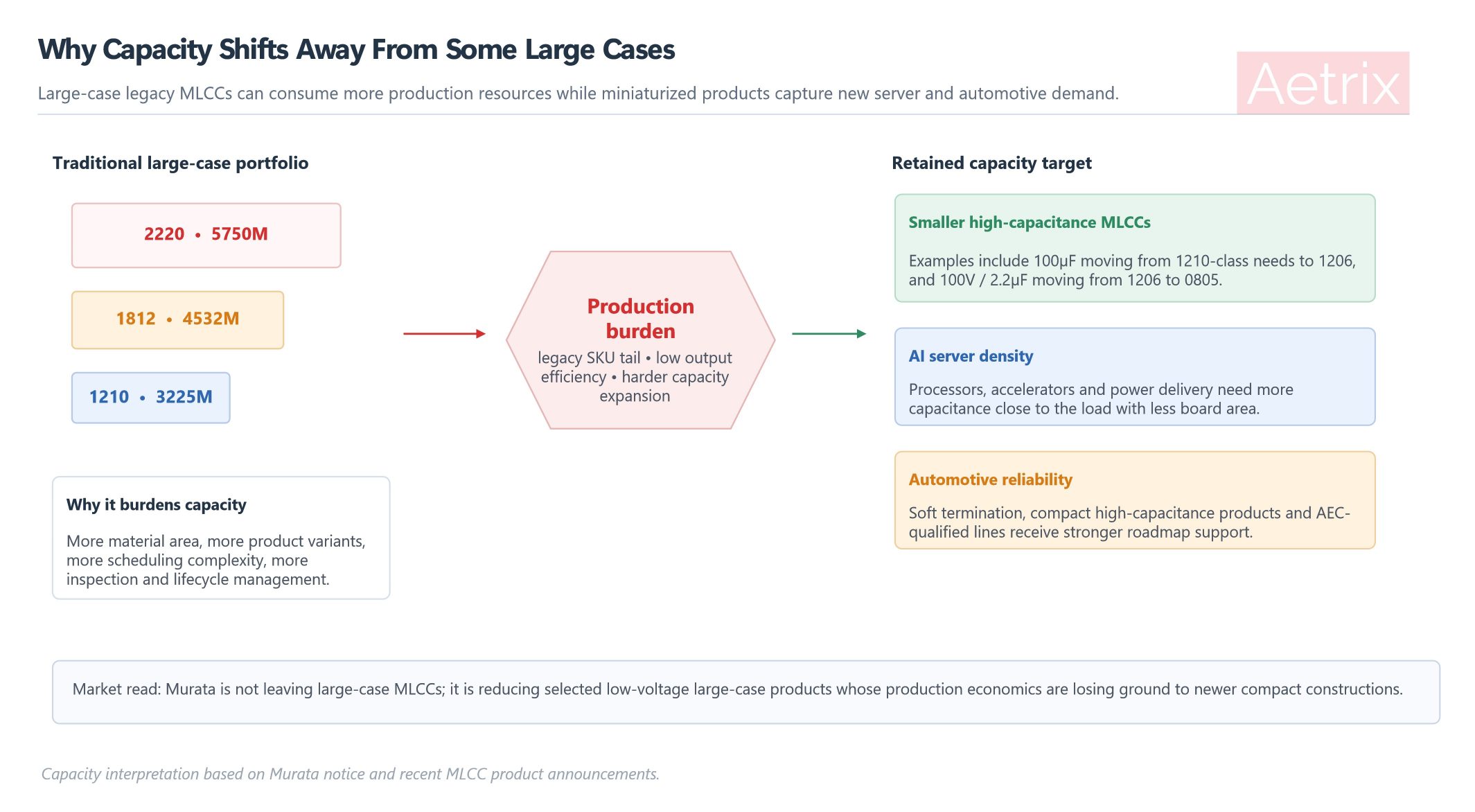
Murata states that large-size MLCCs impose a significant manufacturing burden and prevent the company from expanding overall production capacity as efficiently as it would like.
A large MLCC occupies more physical area and normally requires more ceramic and electrode material per unit than a smaller component. The production impact extends beyond the finished component dimensions. Manufacturers must manage material preparation, electrode printing, stacking, pressing, cutting, firing, termination, plating, inspection and packaging across a wide range of individual constructions.
The burden also comes from product complexity. A long tail of older capacitance, voltage, dielectric and termination combinations creates more production scheduling, changeover, inventory and quality-control work. Low-volume variants can remain technically valid while becoming increasingly inefficient to manufacture.
Removing selected large-case SKUs allows Murata to consolidate demand around fewer constructions. That can improve production planning and increase the output of products serving higher-volume or faster-growing applications.
The notice does not say that affected products are defective or obsolete in function. They are being removed because their continued production makes it harder to increase the capacity and support level of the wider MLCC portfolio.
Miniaturization Is Changing MLCC Product Economics
The withdrawal should be viewed alongside Murata's recent product development. New ceramic formulations, thinner dielectric layers, finer electrodes and improved stacking control allow smaller MLCCs to provide capacitance values that previously required larger cases.
In April 2026, Murata announced seven automotive MLCCs with what it described as world-leading capacitance for their respective voltage and size classes. One important change was the ability to provide 100µF in a 1206 case, a capacitance that had previously required a 1210 package. Murata also expanded high-capacitance options in smaller automotive sizes. (Murata, high-capacitance automotive MLCC expansion)
In June 2026, Murata introduced a 2.2µF, 100V soft-termination automotive MLCC in an 0805 case. According to the company, the same voltage and capacitance combination had previously required a 1206 package. The product illustrates how material and manufacturing improvements can move formerly large-case specifications into substantially smaller footprints. (Murata, 2.2µF 100V automotive MLCC in 0805 size)
Murata began mass production of a 47µF MLCC in the 0402-inch size in 2025. The company connected the development to rising component density in AI servers and data centers, where designers need more capacitance close to processors while preserving board area. (Murata, 47µF MLCC in 0402-inch size)
These developments change the economic position of some older large-case parts. When a smaller component can provide adequate voltage, capacitance, temperature performance and reliability, the larger version consumes more production resources without always providing additional value to the customer.
| Technology Change | Design Effect | Supply Effect |
|---|---|---|
| Higher capacitance in smaller cases | Less PCB area for the same nominal capacitance | Reduces long-term demand for some traditional large-case products |
| Improved ceramic and electrode control | Higher capacitance and voltage density | Makes smaller products more attractive to manufacture |
| Greater component density in servers and vehicles | Stronger pressure to reduce footprint and mounting height | Directs investment toward compact, high-capacitance products |
| Portfolio consolidation | Fewer legacy choices require earlier lifecycle planning | Improves scheduling and capacity efficiency for retained products |
Murata Is Not Exiting Large-Case MLCCs
Large cases still provide technical value when voltage, dielectric stability, pulse capability or mechanical construction cannot be achieved economically in a smaller footprint.
Murata began mass production of a 15nF, 1.25kV C0G MLCC in a 1210 case in late 2025. The component targets resonant and snubber circuits that require low loss and stable capacitance across temperature. Its introduction after the withdrawal notice shows that Murata continues to invest in large cases where the electrical requirements justify the package. (Murata, 15nF 1.25kV C0G MLCC in 1210 size)
The strategic boundary is therefore clearer than a simple size-based withdrawal:
- Selected low-voltage large-case products with inefficient manufacturing economics are being removed.
- Large-case products that support high voltage, low loss, safety, pulse or specialist reliability requirements remain relevant.
- New low-voltage and high-capacitance designs are increasingly directed toward smaller case sizes.
Buyers should not assume that every large MLCC is at equal lifecycle risk. Voltage, dielectric type, application class and available miniaturized alternatives matter more than the case size alone.
Which Applications Face the Highest Lifecycle Risk?
New smartphone and server designs generally adopt small MLCCs early in development. The greatest withdrawal risk lies in equipment with long production lives, frozen PCB layouts and expensive requalification requirements.
| Application | Typical Exposure | Main Migration Barrier |
|---|---|---|
| Industrial power supplies | Long production life and repeated use of established BOMs | Electrical validation and PCB change control |
| Automotive control units | Qualified components may remain in production for many years | AEC-Q200 status, PPAP and customer approval |
| Telecom infrastructure | Installed platforms may require repair support and matching revisions | Reliability testing and service inventory |
| Medical equipment | Design changes can affect regulated documentation | Validation and regulatory change procedures |
| Test and measurement systems | Stable electrical characteristics may be tied to calibration performance | Capacitance stability, ESR and frequency-response validation |
| Legacy consumer or appliance platforms | High redesign cost relative to remaining sales volume | Limited engineering resources and short remaining commercial life |
For these customers, an affected MLCC can create more risk than its unit price suggests. A capacitor costing a fraction of a dollar can force board changes, qualification testing, customer notifications and updated production documentation.
The correct response depends on the remaining product life. A design with twelve months of production remaining may be best served by a last-time buy. A platform expected to remain active for five or ten years will usually require a qualified replacement.
A Smaller MLCC Is Not Automatically a Drop-In Replacement
Miniaturization creates new replacement options, but a smaller component cannot be approved on nominal capacitance and voltage alone.
DC Bias and Effective Capacitance
High-dielectric-constant MLCCs can lose a substantial portion of nominal capacitance when DC voltage is applied. The degree of reduction depends on dielectric formulation, case size, capacitance and rated voltage.
A smaller 10µF capacitor may provide less effective capacitance under operating bias than a physically larger 10µF part. Engineers need the manufacturer's DC-bias curve for the exact MPN and must compare performance at the actual circuit voltage.
Temperature Characteristics and Aging
X5R, X6S, X7R and C0G components do not provide the same temperature range or capacitance stability. High-capacitance Class II ceramics also experience logarithmic aging. A replacement should match the original circuit's temperature and lifetime requirements rather than only its room-temperature measurement.
ESR, ESL and Frequency Response
Smaller case sizes often have lower equivalent series inductance, which can improve high-frequency decoupling. The resulting impedance curve may still differ from the original component. Resonant frequency, ESR and interaction with nearby capacitors should be checked in filters, power converters and noise-suppression networks.
Ripple Current and Self-Heating
Power circuits can expose MLCCs to high AC voltage or ripple current. Dielectric loss can produce self-heating even when the DC voltage remains within rating. A smaller case may require a different thermal assessment.
Mechanical Reliability
Large MLCCs are more exposed to board-flex stress because the ceramic body spans a greater distance across the PCB. Soft-termination products can reduce cracking risk, but the termination structure and permitted flex level must be verified.
Moving to a smaller part may improve resistance to board bending, yet it normally requires a new land pattern. Reusing an oversized footprint without manufacturer guidance can create solder-volume and placement problems.
Automotive and Industrial Qualification
Automotive customers need to confirm AEC-Q200 compliance, change-notification requirements, approved manufacturing sites and customer-specific qualification. A commercial GRM alternative cannot automatically replace a GCM or GRT device in an automotive design.
| Replacement Check | Why It Matters |
|---|---|
| Effective capacitance at operating voltage | Nominal capacitance can overstate in-circuit performance |
| Temperature characteristic | Determines capacitance stability across the operating range |
| ESR, ESL and impedance curve | Affects filtering, decoupling and resonant behavior |
| Ripple and self-heating | Prevents thermal overstress in AC and switching applications |
| Termination construction | Changes board-flex and vibration performance |
| Package height and land pattern | Determines whether the replacement is physically compatible |
| Qualification and compliance | Protects automotive, medical and industrial approvals |
Three Practical Replacement Paths
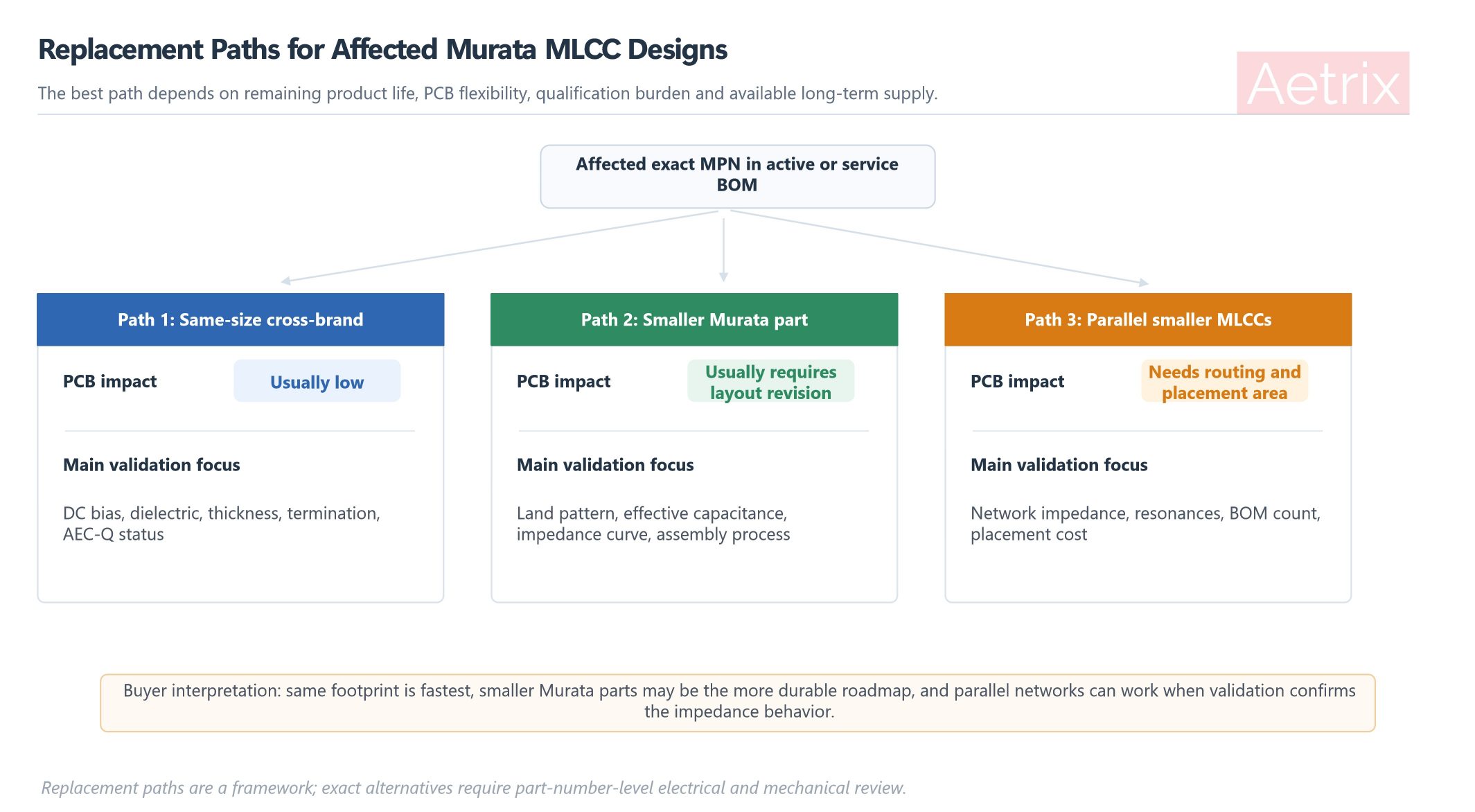
Customers generally have three options. Each carries a different balance of engineering work, supply security and lifecycle risk.
1. Same-Size Cross-Manufacturer Replacement
A part from TDK, Taiyo Yuden, Samsung Electro-Mechanics, Yageo, KEMET, Kyocera AVX, Walsin or another qualified supplier may preserve the existing PCB footprint.
This is often the fastest route for a frozen design, but dimensional compatibility does not prove electrical equivalence. DC-bias performance, dielectric, thickness, termination, reliability grade and packaging must still be compared.
A cross-brand replacement also creates a new lifecycle dependency. Buyers should confirm whether the alternative is an actively promoted product or another low-volume legacy construction that may later face the same economic pressure.
2. Migration to a Smaller Murata Product
A smaller Murata MLCC may provide a more durable product path when the company has transferred equivalent performance into a newer construction.
This option can reduce board area and improve future supply support, but it usually requires a PCB revision, new land pattern and electrical validation. It is more suitable for products with several years of remaining life than for a platform approaching end of production.
3. Multiple Smaller MLCCs in Parallel
Several smaller capacitors can replace one large component when the design needs greater effective capacitance, lower impedance or distributed thermal and mechanical stress.
The trade-off is a higher component count, additional placement cost and more board routing. Parallel combinations must be evaluated as a network because capacitance tolerance, DC bias and resonances can change overall behavior.
How the Withdrawal Could Affect Price, Lead Time and Inventory
The notice does not indicate a general MLCC shortage. Murata has provided an extended transition window, and production continues until the final shipment date for accepted last-time-buy quantities.
Risk will develop at the individual-part level.
Customers that delay lifecycle reviews may place large final orders close to the March 2027 deadline. Demand concentration can increase quoted lead times for affected MPNs, especially when several large customers require the same construction.
Available distributor inventory may also become more valuable as the deadline approaches. Prices can rise before Murata stops production because the market begins assigning a premium to stock that can support legacy designs without requalification.
The notice states that last-time-buy orders are subject to minimum order quantity and package quantity. It also says cancellations and returns will generally be accepted only for quality issues. These conditions convert a final order into a firm inventory commitment.
| Market Phase | Likely Supply Condition | Buyer Risk |
|---|---|---|
| Lifecycle review period | Normal production continues while customers assess alternatives | Failure to identify affected BOMs early |
| Approaching last-time buy | Demand may become concentrated around specific MPNs | Longer lead times and tighter order conditions |
| After order closure | Supply depends on confirmed shipments and remaining channel inventory | Higher spot prices and limited traceable stock |
| After final shipment | No new factory production for affected part numbers | Broker dependence, counterfeit exposure and line-down risk |
Overbuying creates a different problem. MLCC demand can change when a product is redesigned, cancelled or produced below forecast. Excess last-time-buy stock can remain on the balance sheet for years.
The correct purchase quantity should be based on confirmed production, service obligations, expected yield loss, engineering samples and a realistic buffer. Speculative forecasts should be separated from committed demand.
What the Decision Reveals About Murata's Capacity Priorities
Murata continues to invest in MLCC technology and expects the capacitor business to benefit from data-center demand. Its fiscal 2026 outlook identified data-center applications as a driver of expected MLCC revenue growth. (Murata, fiscal 2025 earnings presentation and fiscal 2026 outlook)
AI servers use large numbers of capacitors around processors, accelerators, memory and power-delivery networks. Automotive electrification also increases demand for compact, high-reliability capacitors in powertrains, ADAS, cockpit systems and communication modules.
These markets reward high capacitance density, lower ESL, high temperature capability and robust terminations. They also offer greater production scale and stronger long-term growth than many low-volume legacy products.
The withdrawal is therefore consistent with a wider portfolio strategy:
- Reduce selected products that consume disproportionate production resources.
- Concentrate engineering and capacity on compact, high-capacitance and high-reliability MLCCs.
- Support growing demand from servers, automotive electronics and high-density computing.
- Retain large cases where high voltage or specialist electrical performance still requires them.
Aetrix Electronics does not interpret the notice as evidence that Murata lacks MLCC capacity overall. It shows that Murata is becoming more selective about which products deserve that capacity.
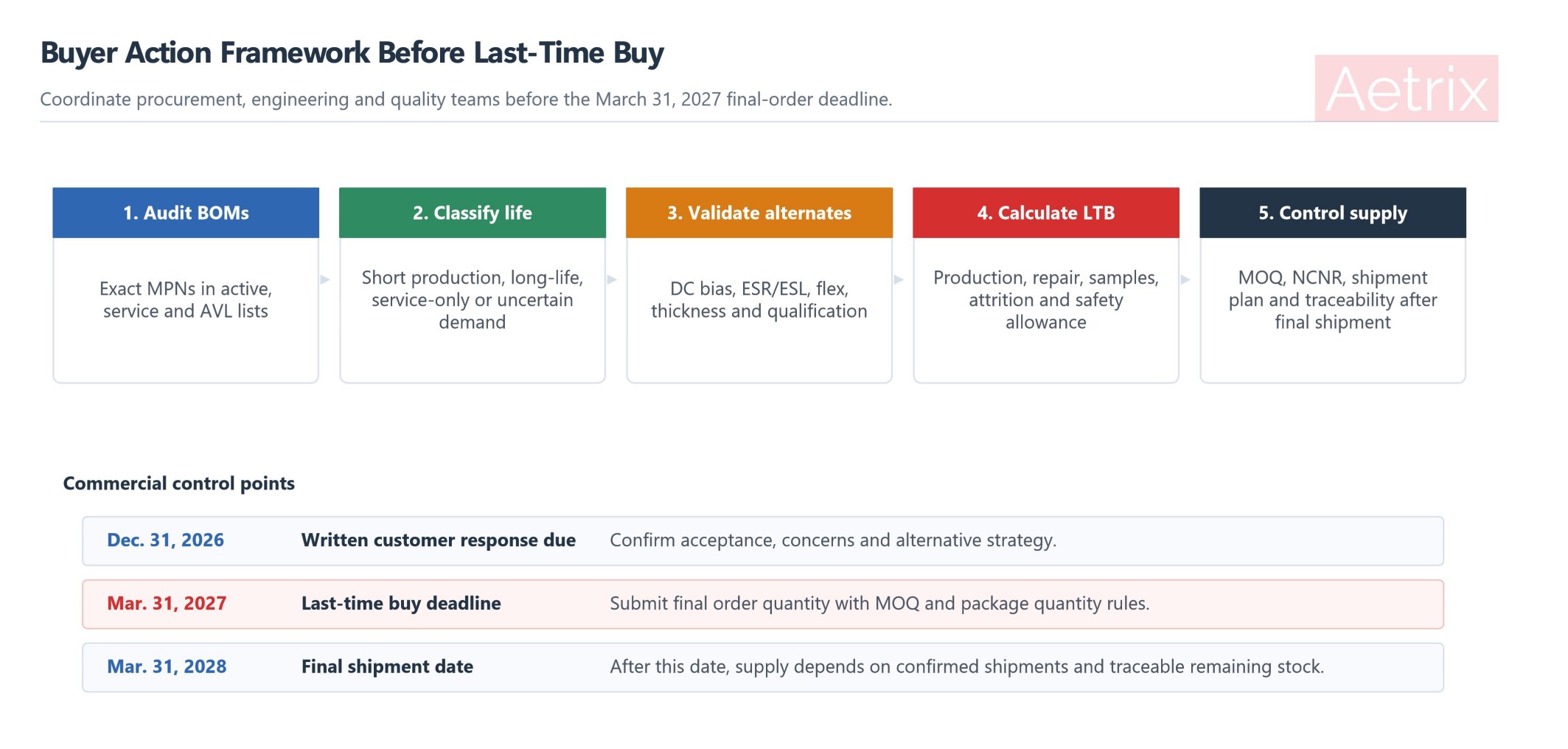
What Buyers Should Do Before March 31, 2027
1. Audit Exact Part Numbers
Search active BOMs, service BOMs, approved-vendor lists, engineering databases and distributor schedules for the exact affected MPNs. Family-level searches can miss suffix-specific products or incorrectly flag unaffected parts.
2. Classify Each Project by Remaining Life
Separate projects into short remaining production, long-term production, service-only and uncertain demand. This classification determines whether a last-time buy or redesign is economically reasonable.
3. Request Alternatives Early
Ask Murata, authorized distributors and qualified independent supply partners for recommended replacements before the market enters the final-order period. Alternative validation capacity can become a bottleneck even when the replacement component itself is available.
4. Compare Electrical and Mechanical Performance
Review effective capacitance, voltage derating, temperature characteristic, ESR, ESL, package thickness, termination type, flex performance, land pattern and qualification status.
5. Build and Test Samples Before Freezing the Last-Time Buy
A successful alternative can reduce the required final purchase quantity. Testing should be completed early enough for the result to affect procurement planning.
6. Calculate Lifetime Quantity by Delivery Period
The forecast should include production, repair obligations, qualification samples, attrition and a controlled safety allowance. It should also deduct existing inventory, open purchase orders and reusable stock held by contract manufacturers.
7. Confirm Commercial Conditions in Writing
Verify MOQ, package quantity, NCNR status, shipment schedule, cancellation terms and whether delivery can be spread across the period ending March 31, 2028.
8. Strengthen Traceability Requirements
After authorized supply closes, affected parts may attract more independent-market activity. Require traceable sourcing, packaging inspection, date-code review and appropriate electrical testing when factory-authorized stock is unavailable.
What the Withdrawal Means for the Wider MLCC Market
The market impact is likely to be selective rather than universal.
There is no evidence in the notice that all 1210, 1812 and 2220 capacitors will become scarce. Competing manufacturers continue to offer large-case products, and Murata is retaining products that support strategically important specifications.
The stronger signal is that MLCC manufacturers are likely to review low-volume legacy portfolios more aggressively as component density and manufacturing technology improve.
A specification that required 1210 ten years ago may now be available in 1206 or 0805. Once that migration becomes technically and commercially viable, manufacturers have less incentive to maintain both old and new constructions indefinitely.
This can produce several long-term changes:
- More lifecycle notices for inefficient or duplicative large-case products.
- Faster adoption of smaller, higher-capacitance MLCCs in new designs.
- Greater differentiation between standard commercial, automotive and specialist high-voltage product lines.
- More engineering work required to verify effective capacitance rather than nominal capacitance alone.
- Higher inventory risk for customers that retain older footprints without a second source.
For new designs, the lesson is not simply to select the smallest available capacitor. Engineers should choose a product family with sufficient electrical margin, an active development roadmap and more than one feasible supply path.
Key Takeaways
- Murata is withdrawing selected GRM, GRT and GCM MLCCs in 1210, 1812 and 2220 sizes with rated voltages of 100V or below.
- The notice does not cover every Murata product within those size and voltage categories.
- Customers must respond by December 31, 2026, place final orders by March 31, 2027 and complete final shipments by March 31, 2028.
- Murata states that large-size products create a production burden and limit its ability to increase overall MLCC capacity.
- Recent Murata product launches show that smaller MLCCs can now provide capacitance and voltage combinations that previously required larger packages.
- The withdrawal does not represent a broad exit from large-case MLCCs; high-voltage and specialist large-case products remain active.
- The greatest lifecycle exposure lies in long-running industrial, automotive, telecom, medical and service-supported designs.
- A smaller MLCC is not automatically equivalent because DC bias, temperature behavior, ESR, ESL, self-heating and qualification can differ.
- Customers can use same-size cross-brand replacements, smaller Murata products or parallel combinations, depending on redesign flexibility.
- The withdrawal may tighten specific MPNs near the last-time-buy deadline without creating a general MLCC shortage.
- Lifetime-buy quantities should be calculated after alternative testing and should account for existing stock, open orders and realistic project demand.
- Murata's decision indicates that MLCC capacity is being directed toward compact, high-capacitance and high-reliability products for servers, vehicles and other high-density systems.