My Inquiry
 My Account


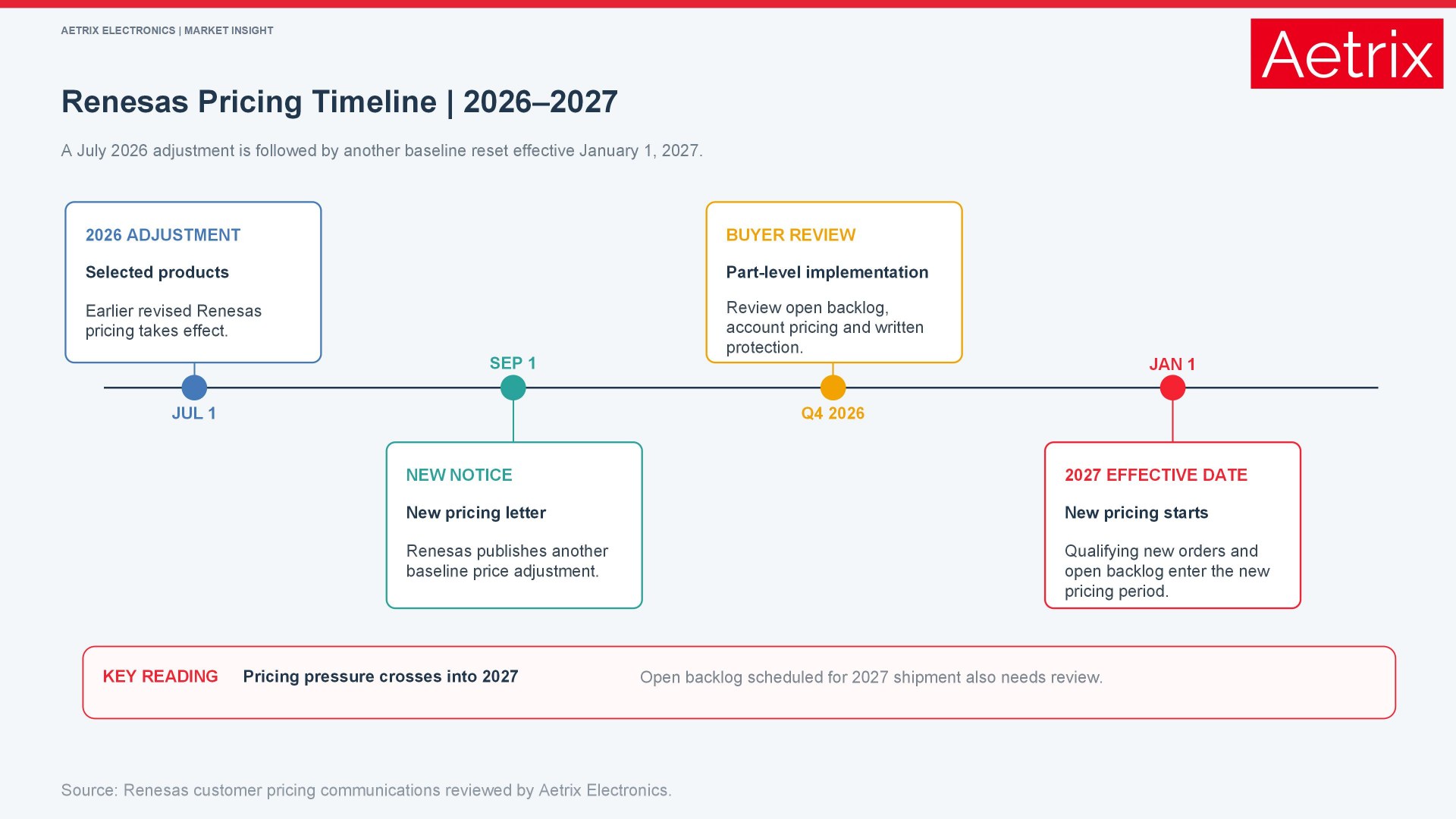
Renesas Electronics has issued a new price adjustment notice dated September 1, 2026, with revised pricing scheduled to take effect on January 1, 2027. The policy covers new purchase orders placed on or after the effective date and open backlog scheduled for shipment on or after January 1, unless otherwise agreed in writing.
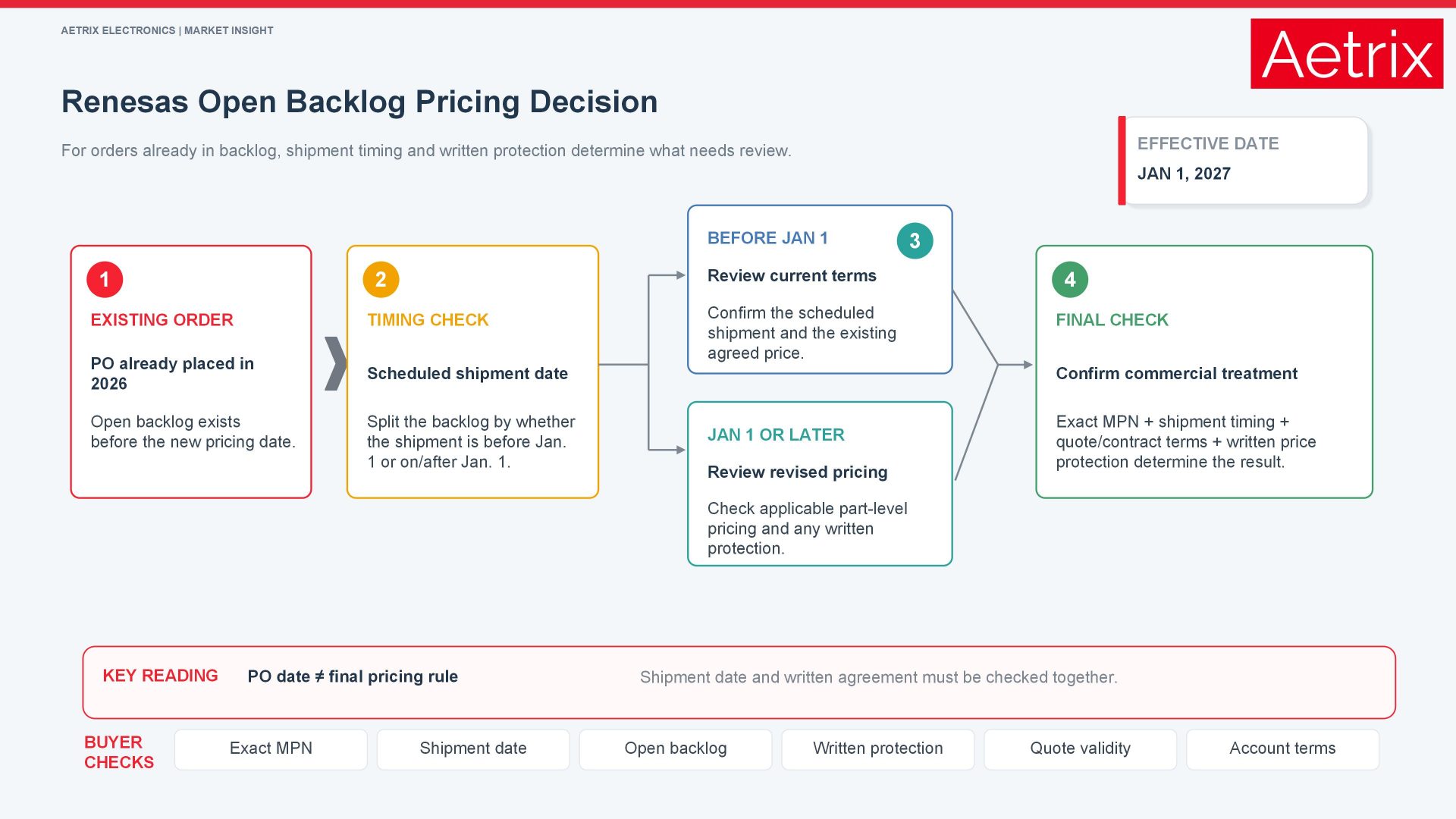
The treatment of open backlog makes this notice more significant for procurement teams than a normal year-end price-book update. An order placed during 2026 may still be exposed to revised pricing if its scheduled shipment falls into 2027, so the purchase-order date alone may not determine the final commercial outcome.
Renesas has not announced a portfolio-wide percentage increase. Customers are instead being directed to their Renesas lead account manager or authorized distribution channel for applicable part-level pricing. The actual impact therefore needs to be reviewed by MPN, shipment schedule and customer agreement.
Renesas Price Increase 2027: What the September Notice Says
The September 1 communication provides a clear implementation framework while leaving the final percentage and affected part numbers to account-level pricing updates.
| Item | Renesas September 2026 Notice |
|---|---|
| Publication date | September 1, 2026 |
| Effective date | January 1, 2027 |
| New purchase orders | Revised pricing applies to orders placed on or after January 1, 2027 |
| Existing backlog | Revised pricing applies to open backlog scheduled for shipment on or after January 1, 2027, unless otherwise agreed in writing |
| Increase percentage | No uniform percentage disclosed in the notice |
| Final pricing | Applicable part-level updates will be provided through Renesas account management or authorized distribution channels |
Renesas attributes the adjustment to sustained structural cost pressure across raw materials, energy, advanced packaging, manufacturing capacity and global logistics. The company says it has continued investing in manufacturing resilience, technology capabilities, supply assurance and internal efficiency, but that cumulative industry cost increases can no longer be fully absorbed while maintaining expected quality, reliability and service levels.
The notice describes the change as a baseline price adjustment. That wording points to a reset of the underlying commercial price structure rather than a temporary surcharge attached to one specific material or logistics expense.
Open Backlog Makes Shipment Date a Pricing Issue
The open-backlog clause is the most important part of the notice for buyers with orders extending into 2027. Procurement teams often treat the PO placement date as the point at which commercial terms are fixed, but the Renesas policy explicitly brings scheduled shipment timing into the implementation framework.
Consider two orders placed on the same day in October 2026:
| PO Date | Scheduled Shipment | What Needs Confirmation |
|---|---|---|
| October 15, 2026 | December 20, 2026 | Whether the shipment remains covered by the existing agreed price |
| October 15, 2026 | January 15, 2027 | Whether the shipment will be repriced under the January structure |
The notice does not establish that every shipment before January retains its current price or that every shipment after January automatically changes. It specifically allows for terms otherwise agreed in writing. Existing contracts, quotations, blanket-order agreements and price-protection arrangements therefore need to be checked individually.
A rescheduled delivery introduces another issue. If a line originally scheduled for December moves into January because of a delivery change, procurement should confirm whether its pricing treatment also changes. The notice does not provide enough information to assume that an existing PO remains protected after its shipment date crosses the January 1 boundary.
2027 Budget Exposure Can Be Larger Than New Orders Alone
Annual purchasing budgets often separate existing backlog from future procurement. The Renesas policy means that distinction can understate the amount of spend that needs to be reviewed for 2027 pricing.
A buyer preparing next year's material budget may initially calculate price exposure from purchase orders that will be placed in 2027. Open orders entered during 2026 can add another layer if their scheduled shipments fall after January 1 and they do not have written protection from the new price structure.
For example, assume a manufacturer has $500,000 of open Renesas backlog at current purchase prices. If $200,000 is scheduled for delivery before year-end and $300,000 is scheduled for January through March, the $300,000 portion deserves a separate pricing review. That amount does not represent the expected cost increase; it represents existing committed spend whose final 2027 price may still need confirmation.
This is particularly relevant for OEMs and EMS providers using blanket POs, scheduled releases or long planning horizons. A large order can contain deliveries on both sides of the January 1 date, so the commercial review may need to be done by line or release rather than by total PO value.
Order Date, Shipment Date and Price Protection Need to Be Separated
Three pieces of purchasing data can now lead to different outcomes: when the order was entered, when the material is scheduled to ship, and whether an agreement explicitly protects the price.
| Commercial Variable | Why Buyers Need It |
|---|---|
| PO placement date | Shows when the purchase commitment was entered, but does not by itself confirm 2027 pricing treatment |
| Scheduled shipment date | Determines whether open backlog falls before or after the January 1 implementation boundary |
| Written price protection | Can alter the treatment otherwise described by the general pricing notice |
ERP reports that show order date and quantity but omit confirmed delivery schedules will not provide a complete view of the exposure. Procurement teams may need to reconcile supplier acknowledgements, scheduled releases and pricing agreements before finalizing 2027 cost assumptions.
Renesas Has Not Announced a Uniform Percentage Increase
The September notice does not say that all Renesas products will rise by the same percentage. It also does not identify a complete list of affected MPNs.
Renesas says customers should work with their lead account manager or authorized distribution channel for applicable part-level updates. Until those details are available, applying one estimated percentage across an entire Renesas BOM can create a misleading 2027 cost forecast.
That distinction has become increasingly relevant in the 2026 semiconductor pricing cycle. NXP's latest September adjustment applies to selected products and is expected to average around 10%, with the actual change varying by part. Its new pricing also involves updated Distributor Book Prices and replacement debit support where applicable. See our analysis of NXP's third 2026 price adjustment.
For both cases, the supplier announcement is only the starting point. Exact MPN pricing, customer-specific support, quotation validity and treatment of backlog determine what an individual buyer ultimately pays.
Renesas Pricing Has Already Changed Once in 2026
The January 2027 adjustment follows an earlier Renesas pricing change that took effect on July 1, 2026. Aetrix previously reported revised pricing on selected products as material, transportation and supplier costs increased, together with a transition in distributor pricing support. See Renesas to Raise Prices in July Amid Rising Supply Chain Costs.
The two effective dates are only six months apart. That cadence makes the January action relevant beyond routine annual budgeting: commercial assumptions that were revised for the second half of 2026 may need to be revised again before the first quarter of 2027.
| Timing | Renesas Pricing Development |
|---|---|
| July 1, 2026 | Earlier revised pricing takes effect on selected products |
| September 1, 2026 | New Renesas price adjustment notice is issued |
| Q4 2026 | Buyers need applicable part-level pricing and should review open backlog extending into 2027 |
| January 1, 2027 | New pricing becomes effective under the September notice |
What Renesas Says Is Driving the January 2027 Adjustment
Renesas identifies five areas of structural cost pressure in its customer notice:
- raw materials;
- energy;
- advanced packaging;
- manufacturing capacity;
- global logistics.
Raw materials, energy and logistics directly affect the cost of operating a globally distributed semiconductor manufacturing network. Advanced packaging and manufacturing capacity reach deeper into the production structure because they depend on long-term investment, qualified manufacturing flows and sufficient wafer and backend capacity.
The notice does not attribute the price adjustment specifically to AI demand. Broader industry data does show unusually strong investment in semiconductor manufacturing capacity during 2026. SEMI reported global semiconductor equipment billings of $40.53 billion in Q2 2026, up 23% year over year and 11% sequentially, with AI-related capacity investment contributing to the record level. (SEMI, Q2 2026 Semiconductor Equipment Billings)
Silicon wafer demand is also strengthening outside advanced compute. SEMI reported Q2 2026 worldwide silicon wafer shipments of 3,573 million square inches, up 7.4% year over year and 9.1% from the first quarter. The organization cited continued AI-related demand together with recovery in industrial and automotive markets. (SEMI, Q2 2026 Silicon Wafer Shipments)
These figures provide context for the manufacturing environment in which Renesas is resetting prices. They do not identify which Renesas MPNs are affected or establish the size of any individual price change.
How the Renesas Price Adjustment Reaches the Buyer
A manufacturer price notice does not translate directly into one identical percentage at every customer. Several commercial layers sit between the supplier's baseline adjustment and the final unit price on an OEM or EMS purchase order.
Renesas first determines the applicable part-level pricing. That pricing then interacts with customer account terms, distribution pricing, existing quotations, scheduled releases and any written price protection. The January 1 shipment rule adds another variable for backlog already in the system.
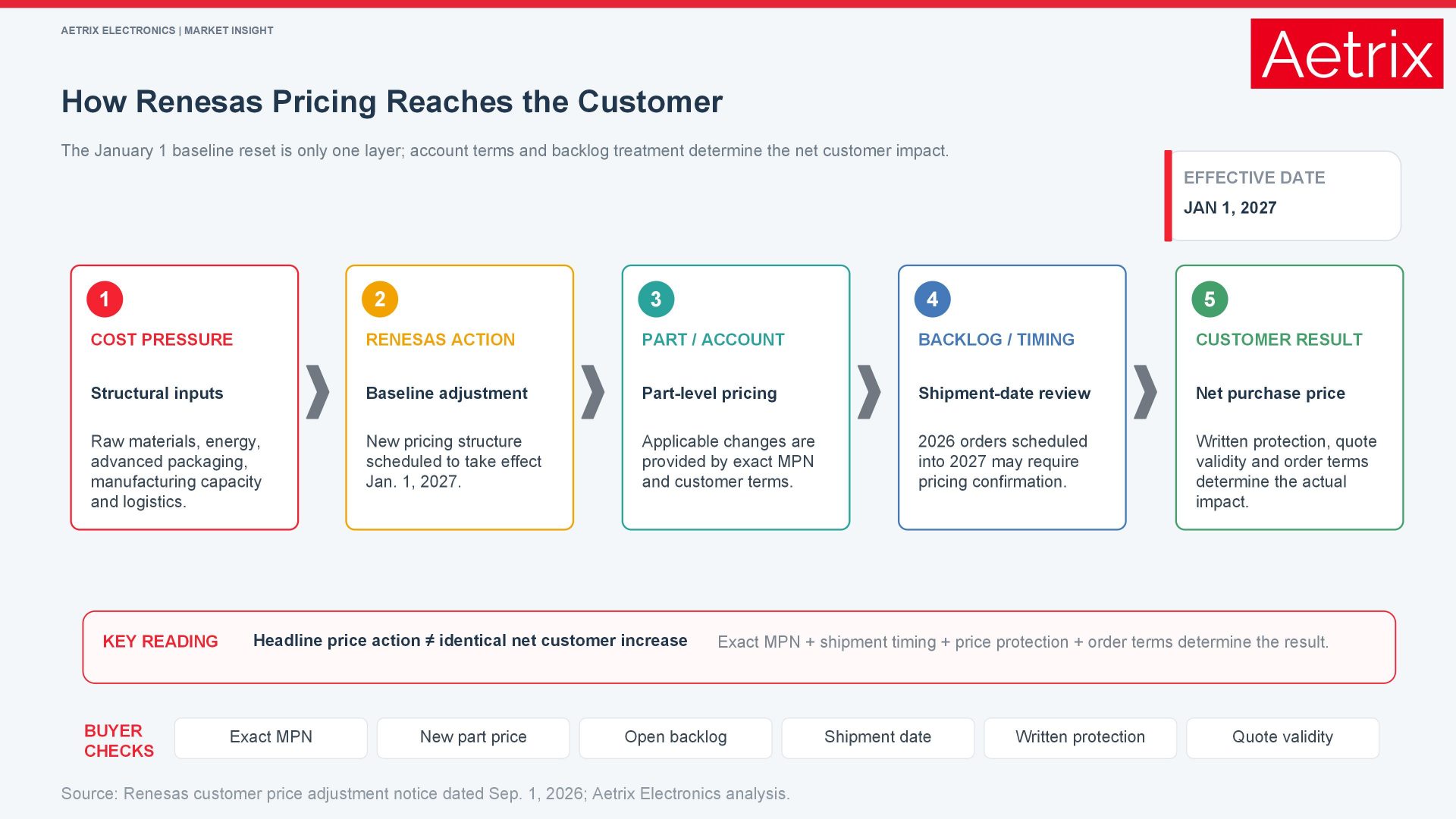
This transmission process explains why two customers buying the same Renesas device can experience different timing or commercial impact. Their quotations, contract terms, shipment schedules and account-specific support may differ even when the underlying manufacturer price structure changes on the same date.
The same principle applies across the wider semiconductor market. Our analysis of how semiconductor supply-chain pressure reaches component buyers examines how manufacturing conditions, inventory, backlog and commercial terms can delay or modify the downstream effect of upstream changes.
The 2026 Semiconductor Repricing Cycle Is Extending Into 2027
Renesas is one of several major semiconductor manufacturers that have adjusted pricing during 2026. STMicroelectronics, NXP, Texas Instruments and other suppliers have also introduced new prices across selected products or customer programs, although the scope and implementation mechanism differ by company. These developments are tracked in our 2026 semiconductor price increase overview.
The Renesas notice adds a different timing signal. Its new structure begins in 2027 and explicitly reaches eligible open backlog already created during 2026. Procurement exposure is therefore crossing the calendar boundary before the year itself ends.
The pricing action is also arriving during a strong semiconductor demand environment. The Semiconductor Industry Association reported July 2026 global semiconductor sales of $146.8 billion, up 6.4% from June and marking the seventeenth consecutive month of sequential growth. (Semiconductor Industry Association, July 2026 Global Semiconductor Sales)
A strong industry sales figure does not imply that every Renesas MCU, analog IC, power semiconductor or connectivity device is supply constrained. Renesas operates a broad portfolio across different process nodes, package families and end markets. Pricing and availability can therefore move differently from one product family to another.
The more useful signal for buyers is the persistence of repricing itself. A supplier that already changed pricing in July is preparing another baseline adjustment for January, while several other semiconductor manufacturers have also moved toward shorter, product-level pricing cycles during 2026.
What Renesas Buyers Should Confirm Before January 1
The notice gives procurement teams several months to identify exposure before the new structure takes effect. The review should start with exact MPNs and open order lines rather than a supplier-wide percentage estimate.
| Check | Why It Matters |
|---|---|
| Exact Renesas MPN | No uniform portfolio-wide percentage has been disclosed |
| Current purchase price | Provides the baseline for measuring the actual part-level adjustment |
| Quote validity | A quotation issued in 2026 may not automatically cover later releases |
| Open backlog | Existing orders can fall within the January pricing policy |
| Scheduled shipment date | January 1 is the implementation boundary stated in the notice |
| Written price protection | The notice allows for terms otherwise agreed in writing |
| 2027 production forecast | The annual BOM budget may still be based on 2026 purchase prices |
| Qualified alternatives | Provides a sourcing option if price or availability risk becomes material on a critical MPN |
Review Open POs by Scheduled Delivery
A backlog report grouped only by order date will not show the complete exposure. Orders should be separated by scheduled delivery before and after January 1, then checked against the applicable price agreement.
Blanket POs deserve particular attention because one order can contain multiple releases across both 2026 and 2027. A line-level review provides a more accurate picture than treating the entire blanket order as one commercial commitment.
Request MPN-Level Pricing Before Finalizing the 2027 BOM Budget
A provisional percentage can be useful for internal scenario planning, but it should not become the final budget assumption if Renesas has not published a uniform increase. Once part-level updates are available, high-value and high-volume BOM positions should be recalculated using the actual applicable pricing.
Low-volume parts can still deserve priority when they have a high production impact, few qualified alternatives or long engineering approval cycles. Annual spend is only one dimension of procurement risk.
Do Not Pull Every Order Forward Solely Because a Price Notice Was Issued
A January effective date can create an incentive to accelerate deliveries, but carrying additional inventory has its own cost. Buyers should compare expected consumption, current stock, open backlog, forecast confidence, shelf-life or MSL considerations, carrying cost and the confirmed price change on the exact MPN before deciding to pull material forward.
A modest price increase can be less expensive than carrying months of excess inventory. The calculation changes when the same part also has an extending factory lead time, low channel inventory or no approved substitute.
Does the Renesas Price Increase Mean Supply Is Tightening?
The September notice itself does not establish a broad Renesas shortage. It identifies structural cost pressure and a need to reset baseline pricing. Buyers should use availability data and commercial behavior around individual MPNs to determine whether pricing pressure is beginning to overlap with supply pressure.
| What the Buyer Sees | Likely Procurement Meaning |
|---|---|
| Price increases while lead time remains stable | Primarily a commercial cost reset; budget and negotiation impact may be greater than availability risk |
| Price increases while factory lead time extends | Pricing pressure and supply pressure may be beginning to overlap on the affected MPN |
| Price increases, channel inventory falls and quote validity shortens | Higher procurement risk; both inventory buffer and commercial flexibility are weakening |
| Price increases while availability remains normal and qualified alternatives exist | Primarily a cost-management and sourcing-negotiation issue |
This distinction prevents buyers from treating every supplier price increase as evidence of shortage. Price, lead time, confirmed delivery, channel inventory and commercial terms should be monitored together at the exact-part level.
What to Watch Between Now and January 1, 2027
The next useful information will come from implementation at the part level. The first question is which Renesas MPNs receive the largest adjustments and whether certain product families are more affected than others.
The second is how open backlog is treated in practice. Customers with scheduled releases extending into January and beyond will need to see whether existing agreements provide protection or whether revised pricing is applied as the notice describes.
The third is whether commercial repricing is accompanied by changes in supply conditions. Longer lead times, reduced authorized-channel inventory, shorter quotation validity or tighter order terms on the same MPNs would have more serious procurement implications than a price reset occurring while availability remains normal.
For now, January 1 provides a defined planning boundary. Buyers with Renesas backlog extending into 2027 have enough time to identify affected order lines, request the applicable part-level price and confirm written protection before those deliveries enter the new pricing period.
FAQ: Renesas Price Increase 2027
Is Renesas raising prices in 2027?
Yes. A Renesas customer notice dated September 1, 2026 states that revised pricing will take effect on January 1, 2027.
How much is the Renesas 2027 price increase?
Renesas has not disclosed a uniform percentage in the notice. Applicable pricing updates are expected to be provided at the part level through Renesas account management or authorized distribution channels.
Will existing Renesas orders be affected?
The notice states that revised pricing applies to open backlog scheduled for shipment on or after January 1, 2027, unless otherwise agreed in writing. Buyers should review shipment dates and written price-protection terms for each relevant order.
Does ordering before January 1 guarantee the current Renesas price?
No general guarantee is stated in the notice. An order placed before January 1 may still fall within the revised pricing policy if its scheduled shipment is on or after the effective date. Written commercial agreements can change the final treatment.
Why is Renesas adjusting prices?
Renesas cites structural cost pressure across raw materials, energy, advanced packaging, manufacturing capacity and global logistics. The company says cumulative industry cost increases can no longer be fully absorbed while maintaining its required investment, quality, reliability and service standards.
Does the Renesas price increase mean its products are in shortage?
The September notice does not provide evidence of a broad Renesas shortage. Buyers should check factory lead time, authorized-channel inventory, confirmed shipment dates and quotation terms for the exact MPN before drawing a supply conclusion.
What should Renesas buyers check before January 1, 2027?
Buyers should review exact MPN pricing, open backlog, scheduled shipment dates, quote validity, written price protection, 2027 production requirements and qualified alternatives. Blanket orders with deliveries spanning both 2026 and 2027 deserve a line-level review.