My Inquiry
 My Account


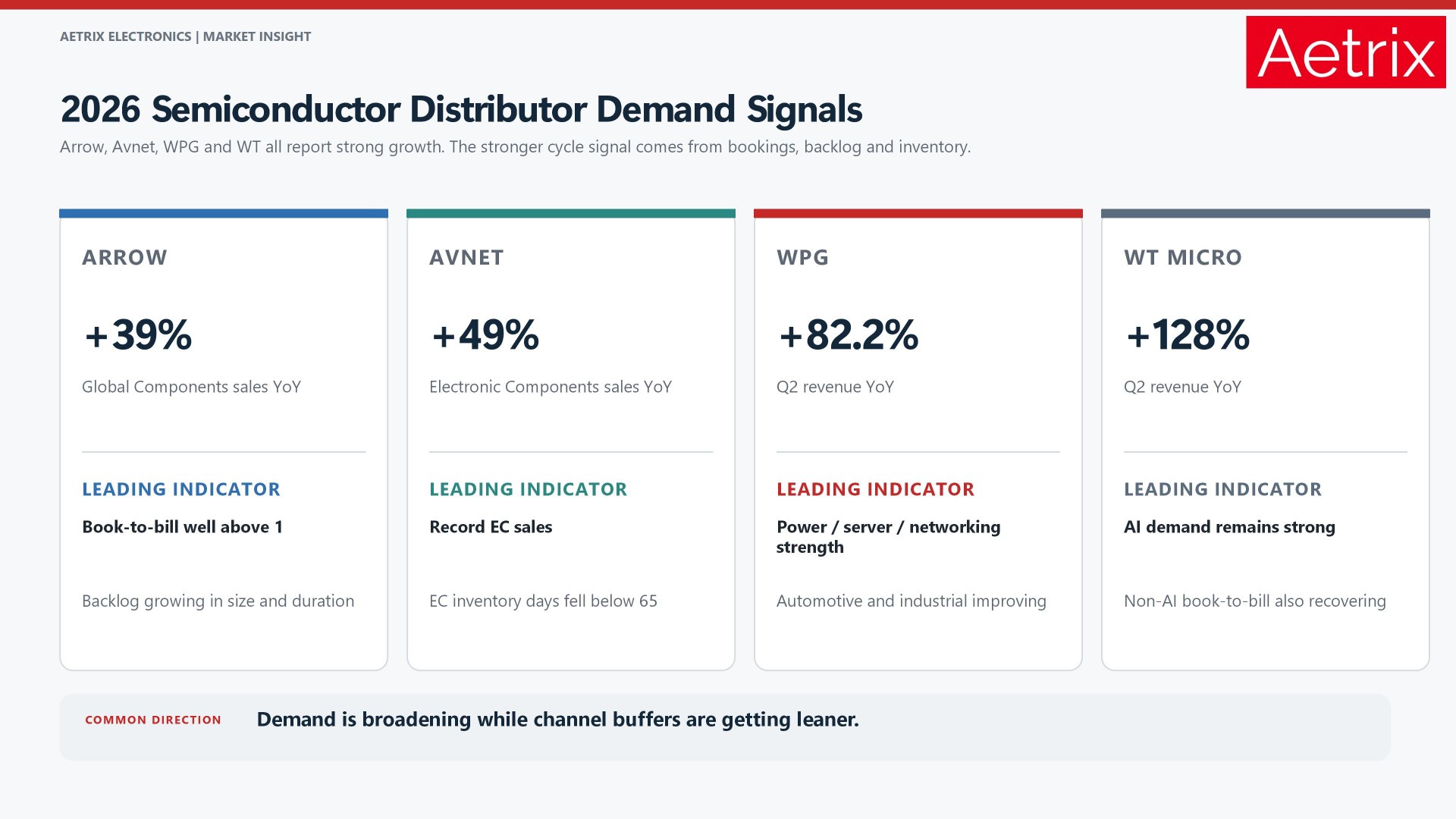
Four major semiconductor distributors are reporting the same change from different parts of the global electronics market. Arrow Electronics' component sales increased 39% year over year in the second quarter of 2026. Avnet's Electronic Components business reached record quarterly sales of nearly $7.8 billion, up 49%. WPG Holdings reported an 82.2% increase in quarterly revenue, while WT Microelectronics recorded 128% growth.
The growth rates should not be compared directly. Reporting periods, geographic exposure, supplier portfolios, customer mix and business structures differ substantially across the four companies. The useful signal is their direction: demand is rising across North America, Europe and Asia at the same time that distributor inventories are becoming leaner, bookings are strengthening and industrial and automotive markets are recovering alongside AI infrastructure.
That combination changes the semiconductor supply-chain outlook for the rest of 2026. The market is still far from a uniform chip shortage. Many standard components remain readily available. Supply risk is beginning to increase, however, where stronger demand overlaps with low channel inventory, long qualification cycles and manufacturing capacity that cannot be shifted quickly between products.
Market signal: Distributor revenue confirms the recovery that has already reached shipments. Book-to-bill, backlog and inventory data give an earlier view of what may come next. When new orders remain above current shipments while channel inventory falls, selected lead times and pricing can tighten before a broad shortage becomes visible.
Four Distributor Reports Point to a Broader Semiconductor Recovery
Arrow, Avnet, WPG and WT sit between semiconductor manufacturers and tens of thousands of OEM, EMS and design customers. Their financial results capture a wider cross-section of electronics demand than the results of a single chip manufacturer. A supplier such as NVIDIA can show the strength of AI accelerators; a broad distributor can show whether that strength is beginning to spread into power management, industrial control, automotive electronics, connectivity and general-purpose components.
| Distributor | Latest Period | Reported Growth | Most Useful Market Signal |
|---|---|---|---|
| Arrow Electronics | Q2 2026 | Global Components +39% YoY | Book-to-bill well above 1; backlog increasing in size and duration |
| Avnet | Fiscal Q4 2026 | Electronic Components +49% YoY | Record EC sales while EC inventory days fell below 65 |
| WPG Holdings | Q2 2026 | Revenue +82.2% YoY | Power, servers, networking and energy infrastructure remain strong while automotive and industrial improve |
| WT Microelectronics | Q2 2026 | Revenue +128% YoY | AI remains strong while non-AI book-to-bill indicates continued industrial and automotive recovery |
These percentages are affected by each distributor's business mix and should be read as separate company results rather than a ranking of semiconductor demand. The common direction is more useful: all four are reporting strong shipment growth while several leading indicators suggest that customer demand remains ahead of current revenue.
Why Distributor Data Can Reveal the Cycle Before Manufacturer Revenue
Semiconductor manufacturer revenue records products that have already shipped. Distributor revenue is also a shipment measure, but distributors provide additional information about orders waiting to ship, customer inventory behavior and the stock available between factories and end users.
Book-to-bill is especially useful. A ratio above 1 means new bookings during the period exceed current billings. If the ratio remains above 1 for several periods, backlog can grow even while revenue is rising. That usually creates more pressure on future delivery schedules than a revenue increase by itself.
Inventory provides the other half of the picture. Strong sales accompanied by rapidly rising distributor inventory can indicate restocking ahead of real consumption. Strong sales accompanied by lower inventory and higher bookings describe a tighter channel. The second pattern is increasingly visible in the latest results.
Arrow: Book-to-Bill Is Above 1 and Backlog Is Still Building
Arrow Electronics reported second-quarter 2026 Global Components sales of $7.366 billion, up 39% from a year earlier. The growth was unusually broad geographically: Americas Components increased 44%, EMEA Components 36% and Asia-Pacific Components 38%. (Arrow Electronics, Q2 2026 Results)
The order data is stronger than the revenue figure alone. Arrow said book-to-bill ratios remained well above parity and backlog continued to build in both size and duration. That means Arrow was receiving more new business even while component sales were already almost 40% above the prior year.
Backlog duration deserves particular attention. A larger backlog can simply reflect more orders. A backlog that also stretches further into the future indicates that customers are placing demand earlier or that delivery schedules are extending. Neither automatically means shortage, but both reduce the amount of unused supply flexibility available if bookings remain strong.
Arrow's regional numbers also weaken the idea that the current recovery is confined to Asian AI manufacturing. Component sales grew by more than 30% in the Americas, EMEA and Asia-Pacific. Industrial, automotive, communications and general electronics activity across several regions is participating in the recovery.
Avnet: Record Component Sales While Inventory Falls
Avnet provides one of the clearest inventory signals. Electronic Components sales reached $7.795 billion in the fiscal quarter ended June 27, 2026, up 49% year over year and 17% sequentially. The company described the quarter as a record for its Electronic Components business. (Avnet, Fiscal Q4 2026 Results)
Inventory moved in the opposite direction. Avnet's total inventory days declined by six days sequentially to 71, while Electronic Components inventory days fell by another five days to below 65. For the full fiscal year, total inventory days declined 18 days to 81.
This is a healthier demand signal than sales growth supported by distributor restocking. Avnet shipped record component revenue while reducing the number of days represented by inventory. Management also said momentum was building across regions, end markets and customer segments.
The regional data is broad as well. Total company sales increased 55.3% year over year in the Americas, 43.7% in EMEA and 46.3% in Asia during the quarter. The figures include more than Electronic Components, but the geographic direction matches the wider recovery visible in the EC segment.
What to watch: If Avnet's component inventory days continue falling while sales and bookings remain strong, customers will have less distributor stock available to absorb another increase in demand. At that point, factory replenishment dates become more important than current catalogue inventory.
WPG: Power, Servers and Networking Are Driving the High-Growth End of the Market
WPG Holdings reported Q2 2026 revenue of NT$456.211 billion, up 82.2% year over year and 44.1% sequentially. Operating profit reached NT$11.954 billion, increasing 143.7% year over year. The company attributed the performance to strong shipment momentum and an improved product mix. (WPG Holdings, Q2 2026 Investor Update)
WPG's end-market commentary shows where the strongest demand is concentrated. The company has highlighted power-management solutions, servers, networking equipment, energy-storage systems and high-density connectivity components. Automotive electronics and industrial-control demand are also advancing. (WPG Holdings, 2026 Demand Update)
This mix connects AI infrastructure with a much wider component base. An AI server does not only consume GPUs and HBM. It creates demand for DC-DC conversion, hot-swap and protection devices, connectors, networking silicon, optical interfaces, power discretes, sensing, storage and energy infrastructure. Higher AI capital expenditure therefore appears in distributor results through many product categories that never appear in an accelerator shipment forecast.
WPG's industrial and automotive comments are equally useful. Those markets went through a long inventory correction after earlier shortages. Continued improvement suggests that new purchasing is increasingly tied to current production requirements rather than only to inventory reduction.
WT Microelectronics: AI Is Still Strong, but Non-AI Demand Is Recovering Too
WT Microelectronics reported Q2 2026 consolidated revenue of approximately NT$590.7 billion, up 128% year over year and 20% sequentially. Operating profit reached approximately NT$13 billion, rising 179% year over year. WT said the quarter benefited from sustained AI demand alongside simultaneous recovery in industrial, automotive and Future Electronics-related businesses. (WT Microelectronics, Q2 2026 Results)
The forward-looking commentary is more useful than the headline growth rate. WT expects hyperscaler and major AI-company capital expenditure to continue expanding through the second half of 2026 and into 2027. At the same time, the company says demand indicators such as book-to-bill ratios in non-AI areas, including industrial and automotive, point to a steady recovery.
WT had already said earlier in 2026 that inventories across many non-AI markets had returned to healthy-to-low levels and that industrial and automotive book-to-bill indicators in Europe and North America were improving. The Q2 update indicates that this recovery has continued rather than fading after one quarter. (WT Microelectronics, Q1 2026 Results and Outlook)
This is one of the clearest pieces of evidence that the 2026 semiconductor recovery is broadening. AI remains the strongest accelerator in the channel, but it is no longer the only segment producing positive demand signals.
The Common Signal: Semiconductor Recovery Is No Longer AI-Only
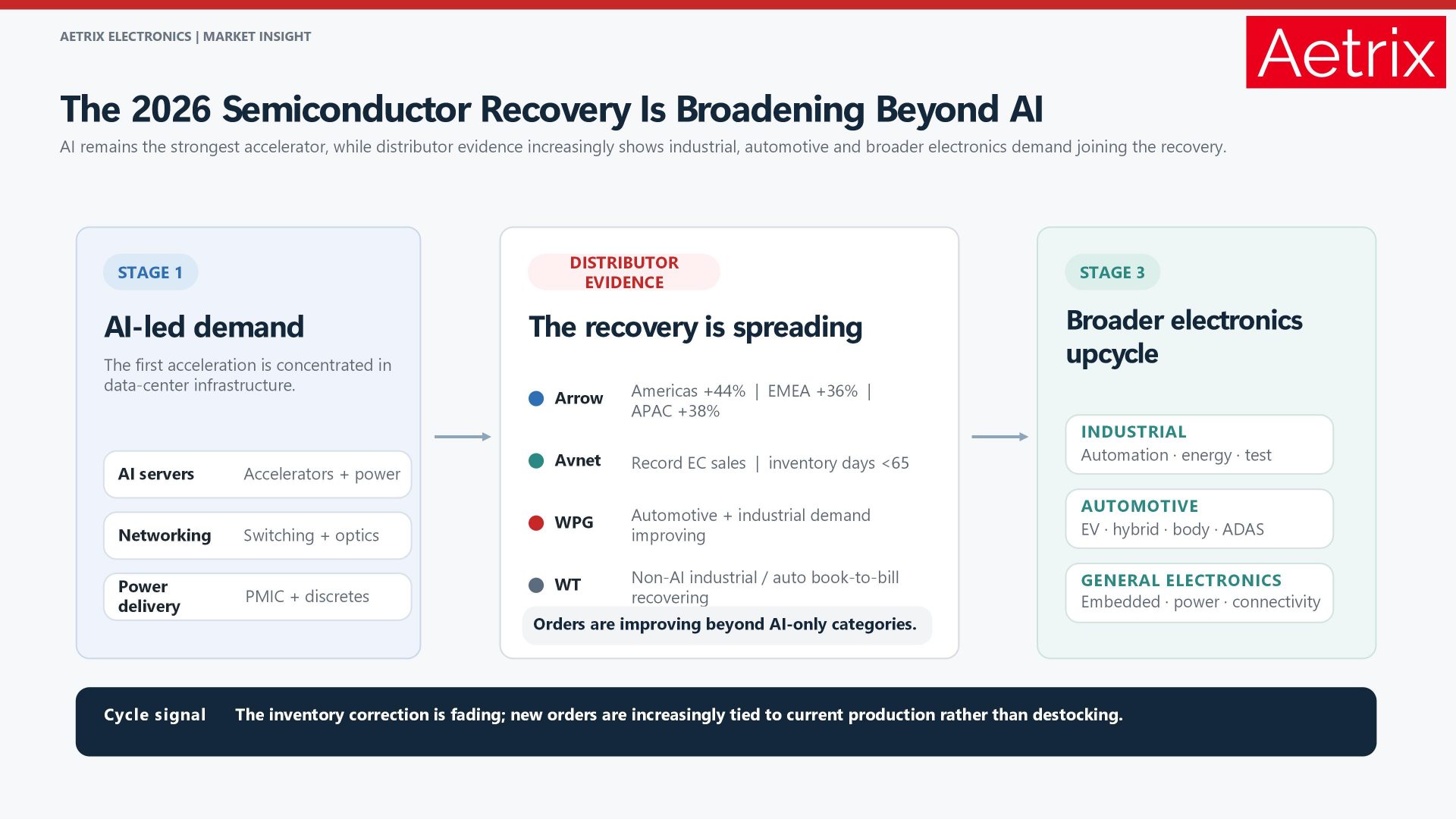
The first stage of the current semiconductor upturn was highly concentrated. AI accelerators, HBM, advanced packaging and data-center networking moved first, while industrial, automotive and general electronics customers were still reducing inventory.
The distributor data now shows a wider pattern. Arrow reports strong component growth across the Americas, Europe and Asia. Avnet says momentum is building across regions and customer segments while component inventory falls. WPG sees continued strength in servers and power infrastructure together with better automotive and industrial demand. WT explicitly identifies a recovery in non-AI book-to-bill.
This does not mean every semiconductor category has entered the same phase. Consumer electronics remain more price-sensitive. Some standard components still carry excess capacity, while products tied to particular mature-node processes, automotive qualifications or specialized packages can tighten much earlier.
The market is therefore moving from a narrow AI-led recovery toward a broader electronics upcycle with substantial differences between product families.
Inventory Down While Bookings Rise Changes the Supply Risk
The most important combination in the four reports is not the revenue growth rate. It is the relationship between inventory, bookings and backlog.
Avnet is reducing inventory days while selling record volumes. Arrow's book-to-bill remains above 1 while backlog is growing. WT reports improving book-to-bill in non-AI end markets where inventory had already returned to healthy or lean levels. These signals indicate that the channel has less excess stock available than it did during the inventory-correction phase.
A lean channel does not immediately create a shortage. It changes how quickly stronger orders reach the factory. When distributors carry large excess inventories, customers can increase consumption for several months without affecting factory schedules. When channel inventory is already lean, additional consumption turns into new replenishment orders sooner.
The sequence can therefore move quickly:
The current data places parts of the market somewhere in the middle of that sequence. It does not support calling the entire semiconductor market constrained. It does justify closer monitoring of product groups where inventory buffers are already small.
Which Component Categories Could Tighten First?
Supply pressure usually appears first where three conditions overlap: demand is recovering quickly, channel inventory is limited and production cannot be moved easily to another qualified manufacturing route.
| Component Area | Current Demand Exposure | Why Supply Can Tighten |
|---|---|---|
| Power-management ICs | AI servers, automotive, industrial, energy storage | Demand overlaps across several recovering markets and multiple process technologies |
| Analog and signal-chain ICs | Industrial, automotive, data center | Long product lives and process-specific manufacturing routes |
| Automotive semiconductors | EV, hybrid, ADAS, body and power systems | Qualification limits the speed of fab, package and alternate-source changes |
| Industrial MCU and embedded devices | Automation, energy, robotics, test equipment | Legacy process platforms and long production cycles can restrict scheduling flexibility |
| MOSFETs and power discretes | Power conversion across server, automotive and industrial systems | Shared wafer, package and test capacity can affect many low-cost MPNs simultaneously |
| Networking and connectivity ICs | AI clusters, storage, switches and data-center networking | High growth and fewer practical substitutes for specialized devices |
Product-level evidence is already appearing in some of these areas. Our review of Diodes Incorporated lead times in 2026 found selected MOSFET, protection, logic and power products carrying factory planning signals of 40 to 52 weeks, with several quantity-specific or historical records reaching further.
The broader mechanism is also visible in our semiconductor lead-time analysis, where automotive, industrial, power-management and networking products show greater exposure when stronger demand overlaps with mature-node or qualification constraints.
Firmer Pricing Can Appear Before a Broad Shortage
Manufacturers do not need to reach full allocation before pricing changes. Improving utilization, stronger order visibility and leaner distributor inventories can reduce the pressure to discount well before customers experience an outright inability to buy components.
That process is already visible in the 2026 pricing cycle. STMicroelectronics, NXP, Texas Instruments, Infineon, Renesas and several other suppliers have introduced product-level price adjustments during the year. The latest actions increasingly vary by MPN, manufacturing route and customer agreement rather than using one percentage for an entire portfolio. Our continuously updated 2026 semiconductor price increase tracker follows those changes.
Texas Instruments provides a useful recent example. Its September 1 customer communication says upcoming adjustments will vary according to materials, technologies and manufacturing processes, with product-specific notifications sent through customer account dashboards. That form of repricing is consistent with a market where supply and cost conditions differ widely between exact MPNs. See our September 2026 TI pricing analysis.
The distributor data does not prove that a broader price increase is imminent. It does make widespread price declines less likely in product groups where bookings are strong, inventories are lean and factory utilization is improving.
Distributor Profitability Is Improving Faster Than Sales
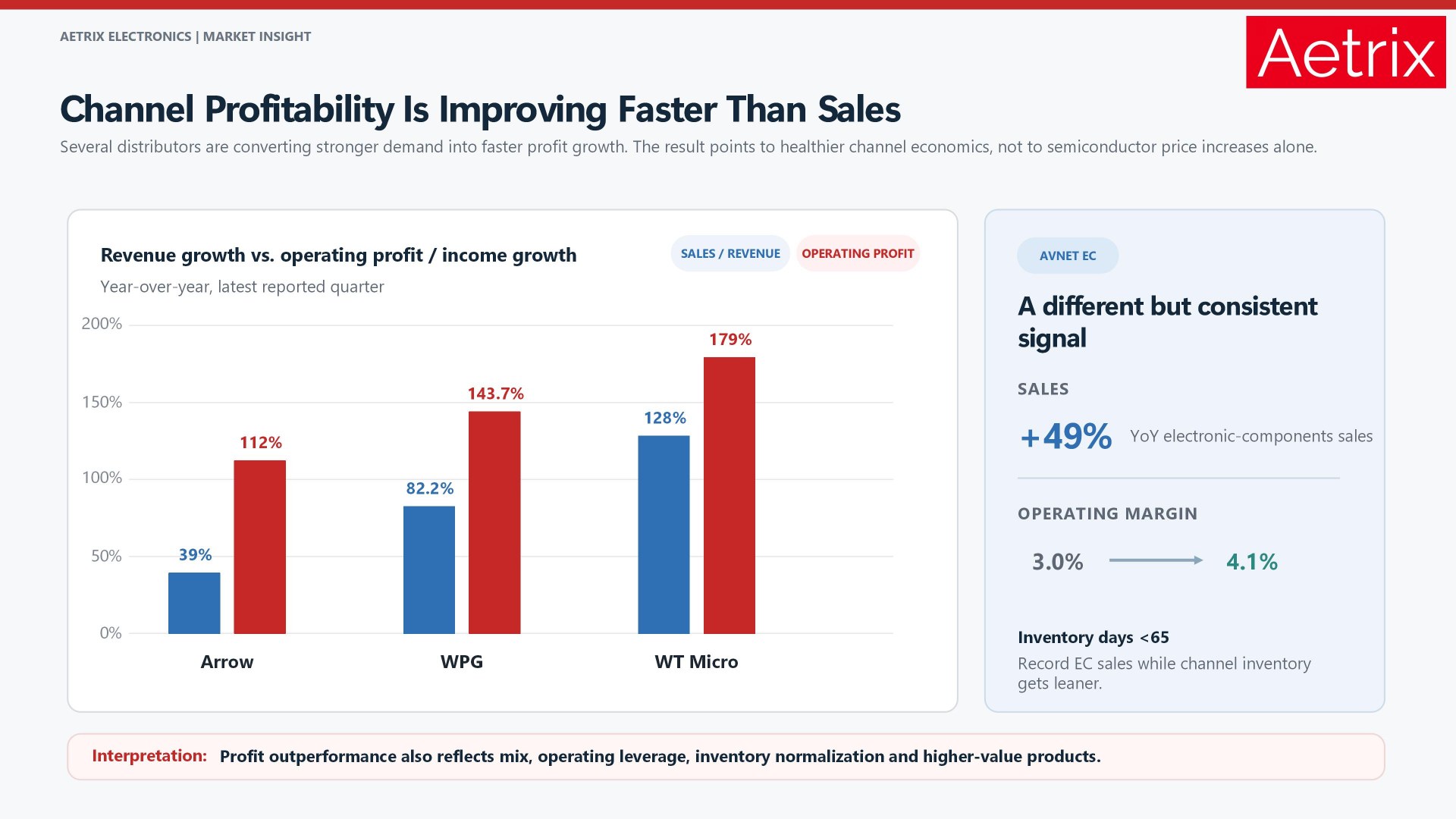
The profit numbers provide another view of channel health. Arrow's Global Components operating income increased 112% year over year while sales rose 39%, taking segment operating margin from roughly 3.5% to 5.4%. Avnet's Electronic Components operating margin increased from 3.0% to 4.1% while EC sales rose 49%.
The same pattern is visible in Asia. WPG's Q2 operating profit increased 143.7% against an 82.2% increase in revenue. WT's operating profit increased 179% while revenue rose 128%.
These figures should not be attributed automatically to higher semiconductor prices. Product mix, higher-value AI content, improved inventory turns, operating leverage, logistics efficiency and lower inventory-adjustment pressure can all change distributor profitability. The common direction still indicates that the channel environment has become economically healthier as demand has recovered.
The Geographic Recovery Is Broader Than an Asia AI Story
Arrow's regional component results are one of the strongest pieces of evidence. Americas Components grew 44%, EMEA 36% and Asia-Pacific 38%. Avnet also reported strong company-wide growth across the Americas, EMEA and Asia.
WT's commentary adds another geographic signal: industrial and automotive book-to-bill indicators in Europe and North America have been improving while non-AI inventory levels have largely normalized. Taken together, the data shows that the electronics recovery is reaching markets that spent much of the previous cycle correcting excess inventory.
Europe is particularly relevant for industrial semiconductors, automotive electronics, energy infrastructure and long-life embedded systems. Stronger EMEA distribution sales do not mean every European end market is expanding at the same rate, but they reduce the likelihood that current growth is simply a shipment effect concentrated in Asian AI-server manufacturing.
What Component Buyers Should Take From Distributor Earnings
Distributor earnings are most useful when converted into procurement signals. Company-wide sales growth is less actionable than knowing whether inventory is falling, backlog is extending and new bookings are outpacing current shipments.
| Channel Signal | What It Means for Buyers |
|---|---|
| Book-to-bill above 1 | Forward orders are running ahead of current shipments |
| Backlog growing in duration | Customers are placing demand further into the future or factory schedules are extending |
| Inventory days falling | Less distributor stock is available to absorb another demand increase |
| Industrial and automotive B2B improving | Demand recovery is spreading into long-life and qualification-sensitive components |
| Supplier pricing becoming more active | Old quotations and annual project prices need closer review |
| Regional growth broadening | Supply planning should not assume weakness outside the AI supply chain |
For Q4 2026 and 2027 programs, buyers should compare immediate stock with confirmed incoming inventory and new factory production dates. A distributor showing inventory today may be shipping material ordered several months earlier. The delivery date for a new high-volume order can be very different.
Forecast coverage deserves another review for power management, industrial analog, automotive components, MOSFETs, protection devices, MCUs and networking products. Exact MPNs with a single approved supplier or one qualified production route should be reviewed before broader market headlines begin reporting a shortage.
Price validity should be tracked separately from availability. A component can remain available while factory pricing is changing, and a long lead time can coexist with distributor inventory purchased at an earlier cost. Current stock, future supply and current factory price are three different procurement variables.
What to Watch Through Q4 2026 and 2027
The next quarter should answer whether the broadening recovery can sustain itself after the initial inventory normalization. Four indicators deserve more attention than headline distributor revenue.
First, book-to-bill needs to remain above 1 in industrial and automotive markets. A ratio that falls back below parity would indicate that the recovery in shipments is beginning to catch up with new orders.
Second, distributor inventory days need to be read together with backlog. Falling inventory is healthy while factories can replenish it. Falling inventory combined with longer backlog and extended factory dates marks a different supply environment.
Third, the geographic recovery should remain broad. Continued growth in EMEA and the Americas would support the view that industrial and automotive electronics have moved beyond inventory correction rather than experiencing a short restocking event.
Fourth, product-level lead times and prices will show whether stronger distributor demand is reaching semiconductor factories. Selective extension in mature-node analog, power, automotive and industrial products would be consistent with the channel signals already visible today.
Is This the Start of a Broader Semiconductor Upcycle?
The four distributor reports do not show a uniform semiconductor shortage. They show that the inventory correction which suppressed much of the electronics market is fading. Shipments are rising, channel inventory is leaner in important areas, bookings remain strong and the recovery is spreading from AI infrastructure into industrial, automotive and broader component demand.
AI still provides the strongest growth engine. WPG and WT make that clear through server, networking, power and data-center demand. Arrow and Avnet provide the other half of the picture: component growth is also strong across regions and broad customer groups that extend well beyond AI systems.
If book-to-bill remains above 1 while distributor inventory continues to decline, the next phase of the cycle is likely to appear first in selected MPNs. Factory lead times may extend, quotation validity may shorten and pricing may become firmer in products where qualification or manufacturing routes limit supply flexibility. A market-wide shortage would require much broader evidence than the distributor results provide today.
For procurement teams, that distinction is useful. The risk is no longer only missing an AI-related component. It is allowing a previously comfortable industrial, automotive or power BOM to remain on an old supply assumption while the channel underneath it is already becoming tighter.
Key Takeaways
- Arrow Global Components sales increased 39% year over year in Q2 2026, with Americas, EMEA and Asia-Pacific Components all growing more than 30%.
- Arrow says book-to-bill remains well above 1 and backlog is increasing in both size and duration.
- Avnet Electronic Components sales reached a record $7.8 billion, up 49%, while EC inventory days fell below 65.
- WPG Q2 revenue increased 82.2%, supported by power management, servers, networking, energy infrastructure and improving automotive and industrial demand.
- WT Microelectronics Q2 revenue increased 128%, with AI demand remaining strong and non-AI industrial and automotive book-to-bill continuing to recover.
- The common signal across the four distributors is a semiconductor recovery that is spreading beyond AI infrastructure.
- Lean inventory combined with stronger bookings gives the channel less buffer if customer demand continues to accelerate.
- Power management, analog, automotive, industrial embedded, MOSFET and networking products deserve closer lead-time monitoring.
- Firmer product-level pricing can appear before a broad semiconductor shortage develops.
- Distributor profitability is improving faster than revenue at several major companies, although product mix and operating leverage are also important drivers.
- Buyers should track exact-MPN inventory, confirmed incoming supply, new factory dates, quotation validity and approved alternate sources as they prepare Q4 2026 and 2027 production plans.