My Inquiry
 My Account


Last updated: September 1, 2026
September 2026 Update: Diodes Incorporated's August results provide new evidence that the lead-time pressure identified in July has not simply disappeared. Second-quarter revenue reached $445.5 million, up 22% year over year and 10% sequentially, while global point-of-sale revenue reached a record level. Management also said channel inventory had fallen below its normal 11- to 14-week range and that previously discussed supply disruption continues. The company increased raw-material and work-in-process inventory partly to support longer wafer manufacturing lead times. For Q3, Diodes expects revenue of approximately $510 million, which would represent about 30% year-over-year and 14% sequential growth at the midpoint. (Diodes Incorporated, Q2 2026 Financial Results; Diodes Q2 2026 Earnings Call)
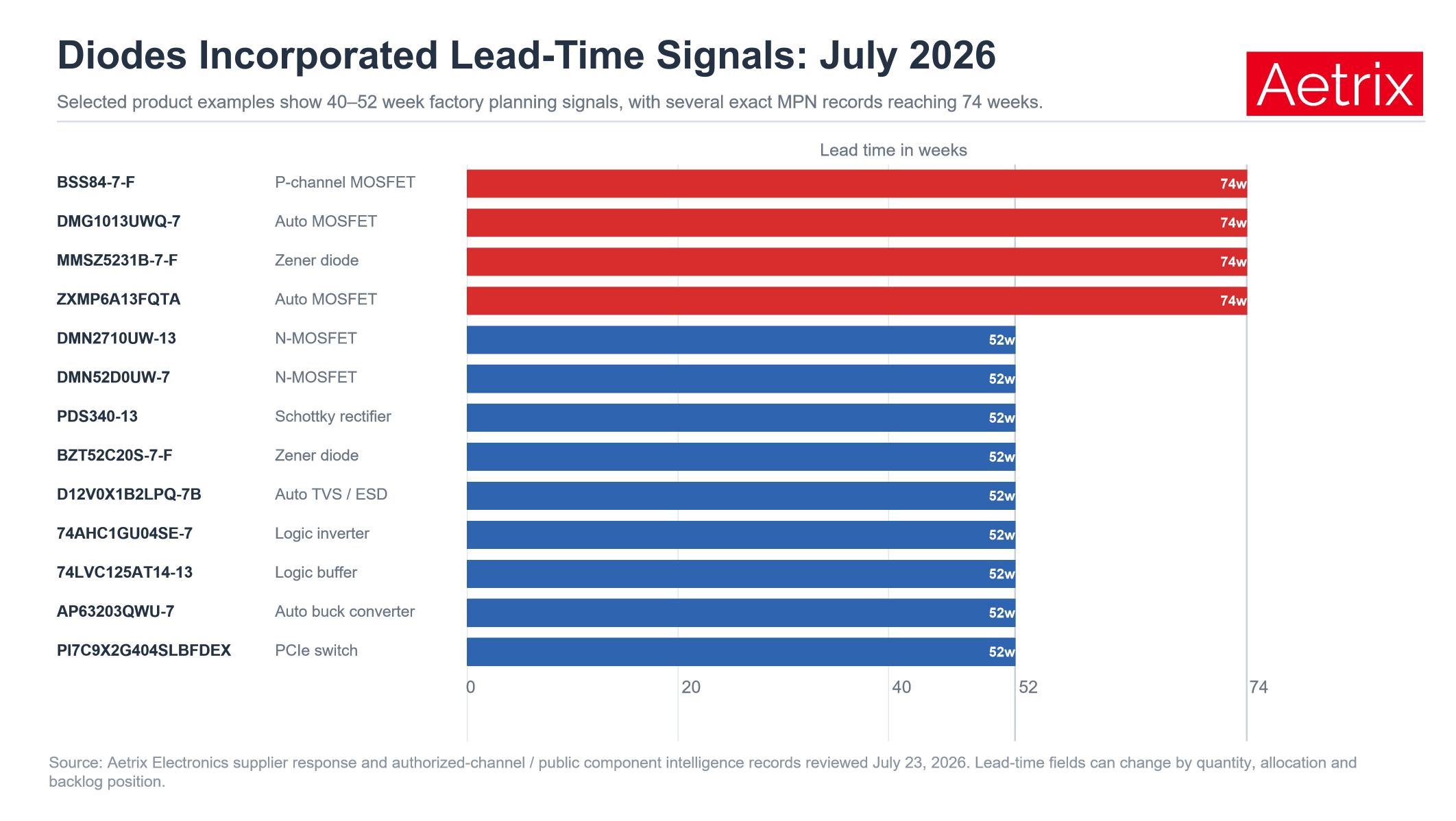
Diodes Incorporated lead times have extended across a wide range of active products in July 2026. Many MOSFETs, Schottky rectifiers, Zener diodes, ESD protection devices, logic ICs and power-management components now carry factory planning signals of approximately 40 to 52 weeks. Selected exact part numbers have also produced 64- to 74-week market records or quantity-specific supplier responses.
BSS84-7-F is one of the clearest examples. Aetrix Electronics received an official 74-week lead-time response for a new order of this widely used P-channel MOSFET. The same part may still appear with limited immediate stock or a shorter standard lead time on an authorized distributor website. Those figures describe separate supply positions: existing inventory, previously scheduled distributor orders and newly placed factory demand.
Other Diodes part numbers have also appeared with 74-week lead-time records in public component intelligence databases, including DMG1013UWQ-7, MMSZ5231B-7-F and ZXMP6A13FQTA. Current authorized-channel planning figures for these products may be shorter, which shows how rapidly lead-time records can change by customer, quantity, package, production route and data source.
The shortage now reaches well beyond specialized high-power semiconductors. A 52-week factory lead time is visible on products as different as the 74AHC1GU04SE-7 inverter, AP63203QWU-7 automotive buck converter, D12V0X1B2LPQ-7B protection diode, PDS340-13 Schottky rectifier and PI7C9X2G404SLBFDEX PCIe packet switch. The common pressure points are wafer scheduling, package availability, final test capacity, customer allocation and the rapid increase in demand from automotive, industrial and AI-server applications.
Diodes Lead-Time Snapshot: July 2026
- BSS84-7-F: 74-week quantity-specific lead time confirmed through an official response received by Aetrix Electronics.
- Additional 74-week market records: DMG1013UWQ-7, MMSZ5231B-7-F and ZXMP6A13FQTA have appeared with 74-week fields in public component intelligence data.
- Common authorized-channel range: approximately 40 to 52 weeks across selected active MOSFETs, diodes, protection devices, logic ICs and power products.
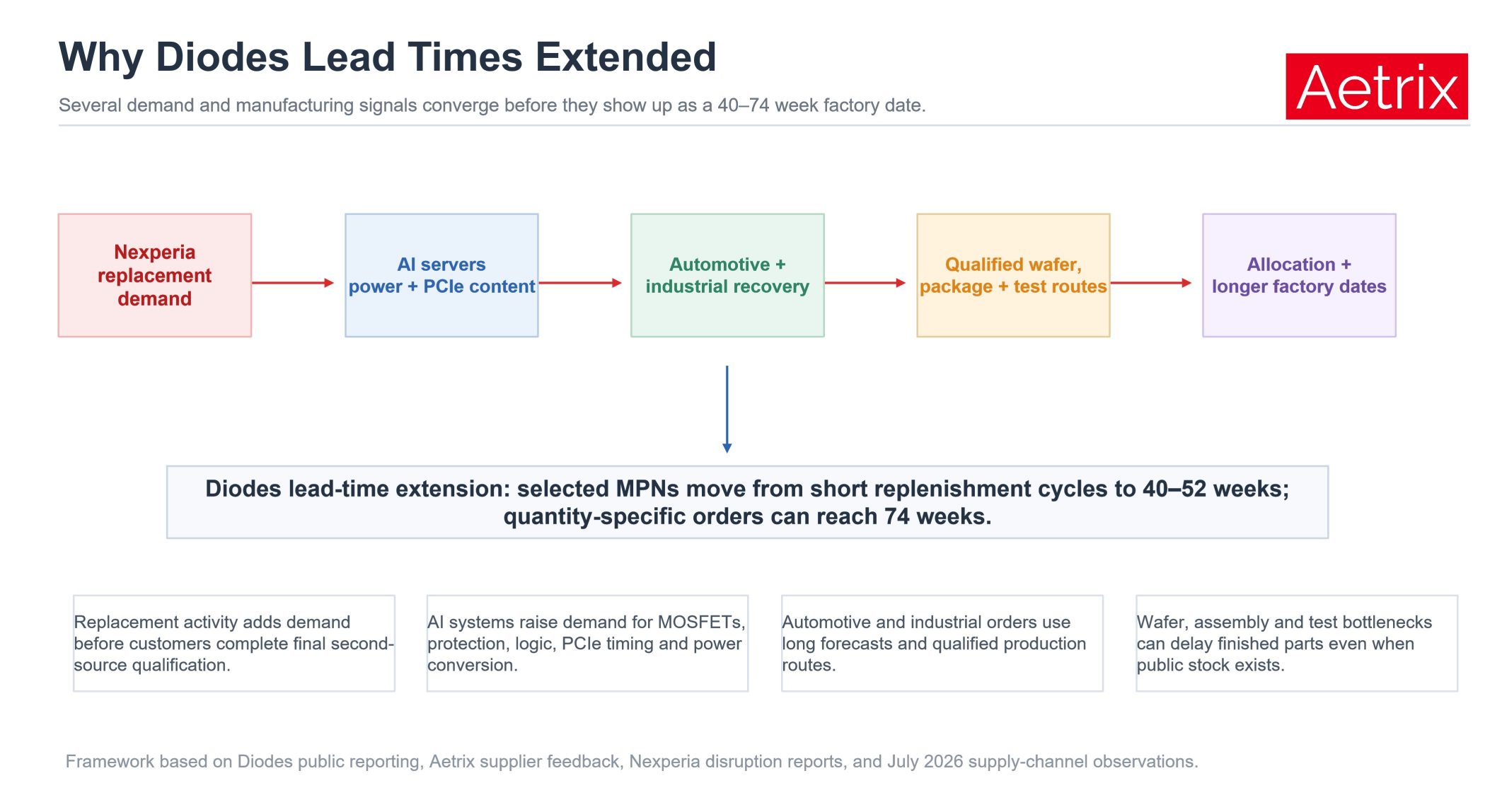
- Main demand drivers: automotive recovery, industrial replenishment, AI-server power and connectivity, and replacement demand following disruption at Nexperia.
- Supply outlook: broad normalization during 2026 appears unlikely, while improvement through 2027 will vary by product and production route.
Diodes Lead Times Reach Up to 74 Weeks
Before the current tightening, many standard Diodes products could be planned around an eight- to ten-week replenishment cycle. That planning assumption no longer fits a large part of the portfolio. Authorized-channel data reviewed in July 2026 shows multiple product groups at 40 or 52 weeks, with scheduled deliveries for some orderable parts extending into 2027.
The highest confirmed lead time in Aetrix Electronics' current sourcing activity is 74 weeks for BSS84-7-F. This is a mature 50V P-channel MOSFET in SOT-23, used for load switching, analog switching and general power-management functions. Its technical simplicity has not protected it from production scheduling pressure.
Public databases have also carried 74-week records for DMG1013UWQ-7, an automotive-qualified 20V P-channel MOSFET; MMSZ5231B-7-F, a 5.1V SOD-123 Zener diode; and ZXMP6A13FQTA, a 60V automotive-qualified P-channel MOSFET. These records support a broader conclusion: extreme lead times can appear on standard discrete components as well as specialized automotive and computing products.
The current authorized-channel position can differ. Several authorized distributors list a 40-week manufacturer standard lead time for BSS84-7-F, DMG1013UWQ-7, MMSZ5231B-7-F and ZXMP6A13FQTA. BSS84-7-F and MMSZ5231B-7-F may still have immediate inventory, while DMG1013UWQ-7 and ZXMP6A13FQTA have recently shown zero stock. A quantity-specific factory quote can move beyond the published standard when the requested volume exceeds available backlog or customer allocation.
Why Public Stock and Factory Quotes Differ
Immediate distributor inventory often originates from purchase orders placed several months earlier. It can support prototypes, maintenance demand or a small production batch, while offering limited protection for a customer requiring hundreds of thousands of pieces over the next year.
Scheduled incoming inventory represents another supply layer. The distributor may already have a confirmed factory order, production slot or allocation position. A customer placing a new order joins a later queue and may receive a substantially longer date.
The required quantity also changes the answer. A source with 5,000 pieces available can support a 1,000-piece order immediately. A 500,000-piece annual requirement depends on new wafer starts, packaging capacity and factory scheduling. This is why BSS84-7-F can show a 40-week standard catalogue lead time while a new volume enquiry receives a 74-week response.
Diodes Parts Showing Extended Lead Times
The following examples cover active or commercially relevant Diodes products showing extended factory planning signals, limited stock or unusually long market lead-time records during the July 2026 review.
| Exact MPN | Product Type | Lead-Time Signal | Supply Position |
|---|---|---|---|
| BSS84-7-F | 50V P-channel MOSFET | 74 weeks | Official quantity-specific response received by Aetrix Electronics; authorized-channel standard lead time currently listed at 40 weeks |
| DMG1013UWQ-7 | 20V automotive P-channel MOSFET | 74-week | Public component database record; current authorized-channel standard lead time around 40 weeks with limited or zero stock at some sources |
| MMSZ5231B-7-F | 5.1V Zener diode | 74-week | Public component database record; current authorized-channel standard lead time around 40 weeks with inventory available at selected sources |
| ZXMP6A13FQTA | 60V automotive P-channel MOSFET | 74-week | Public component database record; current authorized-channel standard lead time around 40 weeks and zero immediate stock observed |
| DMG1012UW-7 | 20V N-channel MOSFET | 40 weeks | Zero immediate stock at the reviewed authorized channel; large scheduled receipts extend into 2027 |
| DMG1013UW-7 | 20V P-channel MOSFET | 40 weeks | Out of stock at the reviewed authorized channel and available for backorder |
| DMN2710UW-13 | N-channel MOSFET | 52 weeks | Extended factory production time reported by an authorized channel |
| DMN52D0UW-7 | N-channel MOSFET | 52 weeks | Current stock may cover limited demand; factory replenishment remains extended |
| DMP3165L-13 | P-channel MOSFET | 52 weeks | Long factory planning signal reported across the reviewed authorized channel |
| PDS340-13 | 3A, 40V Schottky rectifier | 52 weeks | Existing inventory may ship immediately; replenishment carries a one-year planning horizon |
| BZT52C20S-7-F | 20V Zener diode | 52 weeks | Extended factory production time despite availability of some catalogue stock |
| D12V0X1B2LPQ-7B | Automotive ESD / TVS diode | 52 weeks | Non-stocked configuration with factory-order dependence |
| SDA006-7 | ESD protection diode array | 52 weeks | Long replenishment signal reaches compact protection devices |
| 74AHC1GU04SE-7 | Single unbuffered inverter | 52 weeks | Authorized-channel inventory exists, while new factory production remains extended |
| 74HCT14T14-13 | Hex Schmitt-trigger inverter | 52 weeks | Long production lead time affects general-purpose logic |
| 74LVC125AT14-13 | Quad three-state buffer | 52 weeks | Very low immediate stock; scheduled incoming quantities extend into 2027 |
| AP63203QWU-7 | Automotive high-voltage buck converter | 52 weeks | Current stock is available, while production replenishment remains one year |
| PI7C9X2G404SLBFDEX | Four-port PCIe packet switch | 52 weeks | Extended lead time reaches server, storage and embedded connectivity products |
Lead-time and availability checks in this article are based on manufacturer product and lifecycle records, direct manufacturer or supplier responses received by Aetrix Electronics, authorized-channel data and public component intelligence records reviewed on July 23, 2026. A standard factory lead time is a planning indicator. Existing stock, scheduled backlog, allocation and quantity-specific factory quotations can carry different delivery dates.
Public 74-week component records referenced in the table include DMG1013UWQ-7, MMSZ5231B-7-F and ZXMP6A13FQTA. Current authorized-channel data should be checked before each order because lead-time fields can be updated as production and stock conditions change.
Nexperia Disruption Redirects Replacement Demand
The supply dispute involving Nexperia created an additional wave of qualification and replenishment activity from late 2025. Nexperia is a major supplier of automotive logic devices, transistors and diodes. Disruption between its European wafer operations and China-based manufacturing reduced confidence in future deliveries and pushed customers to review alternative suppliers.
Reuters reported that Nexperia stopped supplying wafers to its Dongguan operation during the corporate dispute, while the China unit later secured local wafer sources for 2026 production. Low wafer inventory contributed to shortages affecting automakers and industrial customers. Logic devices, transistors and diodes were among the product groups identified as exposed. (Reuters, Nexperia China secures alternative wafer supplies)
Diodes Incorporated has significant portfolio overlap with Nexperia in small-signal diodes, MOSFETs, rectifiers, protection components and logic. Customers seeking a second source naturally directed part of their demand toward Diodes, onsemi, Vishay, Infineon, STMicroelectronics, Panjit and other suppliers.
Replacement demand often arrives before qualification work is complete. Buyers may order the original component, an established second source and a newly proposed alternative at the same time. This creates temporary double ordering and consumes more supply than the final production requirement.
An increase in orders for common SOT-23, SOD-123, DFN and logic packages can absorb shared assembly and test capacity. The effect then appears in product families that have no direct connection to the original Nexperia shortage.
AI Server Demand Expands Diodes Content
AI servers require far more than processors and memory. Each system contains numerous power-conversion stages, load switches, protection components, voltage references, logic buffers, clock generators, ReDrivers and PCIe switching devices.
Diodes reported first-quarter 2026 revenue of $405.5 million, an increase of 22% from the same quarter in 2025. Management cited demand recovery and momentum in automotive, industrial and AI-server-related applications. Automotive and industrial markets represented 44% of product revenue during the quarter. (Diodes Incorporated, First Quarter 2026 Financial Results)
The AI-server opportunity reaches several Diodes product groups. MOSFETs and rectifiers support auxiliary rails, load switching and power conversion. TVS and ESD devices protect high-speed interfaces and power inputs. Logic products provide enable control, buffering and voltage translation. Timing and PCIe devices support accelerator, storage and network connectivity.
Diodes introduced the PI6CG33A06 PCIe 7.0 clock generator in May 2026 for servers, networking equipment, high-performance computing and AI infrastructure. The product delivers six outputs and less than 30fs RMS jitter for 128GT/s PCIe links. This launch shows that the company's AI exposure spans both power delivery and the high-speed signal chain. (Diodes Incorporated, PCIe 7.0 clock generator for AI infrastructure)
AI demand also changes internal priorities. New data-center designs can provide high volume, long product roadmaps and strategic customer relationships. Engineering support, qualification resources and manufacturing investment increasingly follow these programs. Mature low-cost components may continue in production with fewer opportunities for additional capacity.
Automotive and Industrial Demand Reduce Scheduling Flexibility
Automotive customers require stable production routes, controlled material changes and long-term supply commitments. AEC-qualified MOSFETs, protection devices and power ICs may be tied to specific wafer fabs, assembly plants, test programs and approved material sets.
A product transfer can require a product change notification, PPAP review, reliability data and customer approval. Production cannot be moved freely between wafer or assembly sites when an automotive customer has approved only one route.
Automotive customers also provide multi-year forecasts and scheduled releases. Those commitments give the manufacturer clearer production visibility and often receive stronger allocation support during a constrained period.
Industrial customers create a different type of pressure. Their annual volumes may be lower, yet equipment remains in production or service for many years. Older packages, legacy process platforms and infrequent production runs become more exposed as factory utilization increases.
The combined automotive and industrial recovery leaves less unused capacity for sudden distributor demand. A small customer placing an unexpected order may receive a substantially later delivery date than an established customer with confirmed releases.
Why Diodes' Hybrid Manufacturing Model Still Faces Bottlenecks
Diodes operates a flexible hybrid manufacturing model supported by engineering, wafer manufacturing, assembly, testing and external production resources. This structure gives the company several ways to support a broad portfolio, yet each product remains tied to a specific qualified manufacturing route. (Diodes Incorporated, Corporate Profile)
Wafer Fabrication
MOSFETs, bipolar devices, analog ICs and logic ICs rely on different process platforms. Available capacity on one wafer process cannot be reassigned immediately to another product family.
Supply can tighten around a qualified wafer source, specific process geometry or epitaxial-wafer requirement. High-voltage process modules, mask-set scheduling, yield targets and electrical test limits further restrict the number of usable production slots for an exact MPN.
Additional wafer sources can improve resilience, but the new source must reproduce electrical performance, reliability and process control. Qualification and customer approval can take several months.
Assembly and Packaging
Diodes sells products in SOT-23, SOT-323, SOD-123, DFN, TSSOP, PowerDI and many other packages. Each package uses its own lead frame, mold compound, bonding setup and assembly equipment.
A shortage affecting a particular lead-frame format can delay several unrelated silicon products. Power packages may also require thicker bonding wire, larger die attach areas and longer thermal or electrical test cycles.
Final Test and Qualification
A low-cost discrete device may require a short test sequence, while an automotive protection device, high-voltage power IC or PCIe product uses more complex screening. Temperature testing, high-voltage testing and high-speed signal characterization reduce the number of finished units a test line can process each day.
Finished-part supply can therefore remain constrained even after wafers become available.
Allocation and Customer Priority
When confirmed demand exceeds the available production schedule, allocation usually favors customers with long-term agreements, reliable forecasts and larger committed volumes. Existing backlog, requested delivery dates, product profitability and the strategic value of the end market also influence scheduling.
This can create very different delivery dates for the same part number. A customer receiving scheduled releases under an annual agreement may continue to receive material, while a new order without forecast history enters a later production window.
Why Existing Stock Can Coexist With a Long Lead Time
Many Diodes products with 40- to 52-week factory lead times still show immediate inventory. This is common during a tightening cycle. The available stock may have been ordered before lead times expanded or may represent distributor safety inventory reserved for ordinary demand.
Incoming inventory can also have confirmed production dates based on purchase orders placed months earlier. A buyer looking at those scheduled receipts may assume that supply is improving, even though a new order will enter a later production cycle.
The useful comparison is stock coverage against the customer's actual demand. Ten thousand pieces may appear substantial for a prototype buyer and provide only a few days of coverage for a contract manufacturer.
Buyers should request four separate figures: immediate stock, confirmed incoming stock, unconfirmed expected stock and the production date for a new quantity-specific factory order. Combining these figures into one "availability" number can hide the real exposure.
Which Diodes Product Groups Face the Highest Risk?
MOSFETs
MOSFETs show some of the widest lead-time variation. BSS84-7-F received a 74-week direct response, while DMG1013UWQ-7 and ZXMP6A13FQTA have appeared in public 74-week records. Several other small-signal and power MOSFETs currently carry 40- or 52-week authorized-channel lead times.
Replacement requires more than matching voltage and current. RDS(on) at the actual gate voltage, gate charge, threshold range, capacitance, avalanche behavior, thermal resistance and package pin assignment can affect efficiency and reliability.
Schottky, Zener and Protection Diodes
PDS340-13, BZT52C20S-7-F, D12V0X1B2LPQ-7B and SDA006-7 show that the current pressure reaches rectification, voltage regulation and interface protection.
Alternatives must be checked for forward voltage, reverse leakage, surge capability, capacitance, clamping voltage and package thermal performance. Automotive-qualified products also require matching qualification and traceability.
Logic ICs
The 52-week figures on 74AHC1GU04SE-7, 74HCT14T14-13 and 74LVC125AT14-13 confirm that long lead times extend into general-purpose logic.
Logic-family substitution requires a review of input thresholds, supply range, propagation delay, output drive, Schmitt-trigger behavior and three-state control. A pin-compatible device can still behave differently inside the circuit.
Power-Management ICs
AP63203QWU-7 is an automotive high-voltage buck converter with a current authorized-channel factory lead time of 52 weeks. Products in this category combine power conversion, protection and automotive qualification, which increases the engineering work required for replacement.
PCIe and Connectivity ICs
PI7C9X2G404SLBFDEX and other PCIe devices serve servers, storage, communications and embedded computing. Replacement can involve firmware support, lane configuration, signal-integrity testing and PCB changes. These products usually have fewer practical alternatives than standard discrete components.
Pricing and Commercial Terms
Long factory lead times usually affect commercial terms before a uniform manufacturer price increase becomes visible. Quotation validity can shorten, minimum order quantities can rise and full-reel purchasing may become necessary.
Orders extending 52 or 74 weeks into the future may carry NCNR conditions or limited rescheduling rights. Suppliers can also request annual forecasts, scheduled releases or deposits before confirming production capacity.
Immediate traceable stock attracts a premium when the replenishment date moves beyond one year. The price depends on available quantity, date code, lot consistency, packaging condition and chain of custody.
Spot-market pricing can therefore rise even when the manufacturer has not announced the same percentage increase across every product family.
Alternative Sourcing Options
Diodes products often have potential alternatives from onsemi, Nexperia, Vishay, Infineon, STMicroelectronics, Taiwan Semiconductor, Panjit, MCC and other qualified manufacturers. The appropriate supplier depends on the electrical requirements, package, end market and approval process.
| Product Category | Key Alternate Checks |
|---|---|
| MOSFET | Polarity, VDS, ID, RDS(on), gate-drive voltage, gate charge, capacitance, avalanche rating, pinout and qualification |
| Schottky / Rectifier | Reverse voltage, forward current, VF curve, leakage, surge current, recovery behavior and thermal performance |
| Zener / TVS / ESD | Breakdown voltage, clamping voltage, leakage, capacitance, pulse rating, package and automotive qualification |
| Logic IC | Logic family, input thresholds, supply range, output current, propagation delay, enable behavior and pinout |
| Power-Management IC | Input range, output current, topology, switching frequency, compensation, protection, package, thermal design and qualification |
| PCIe / Timing IC | PCIe generation, lane count, clock format, jitter, protocol support, firmware, package and signal-integrity validation |
General-purpose discrete components can sometimes be qualified within several weeks. Automotive power products, proprietary timing devices and PCIe switches may require months of testing and customer approval.
Buyer Actions for Diodes Long-Lead-Time Parts
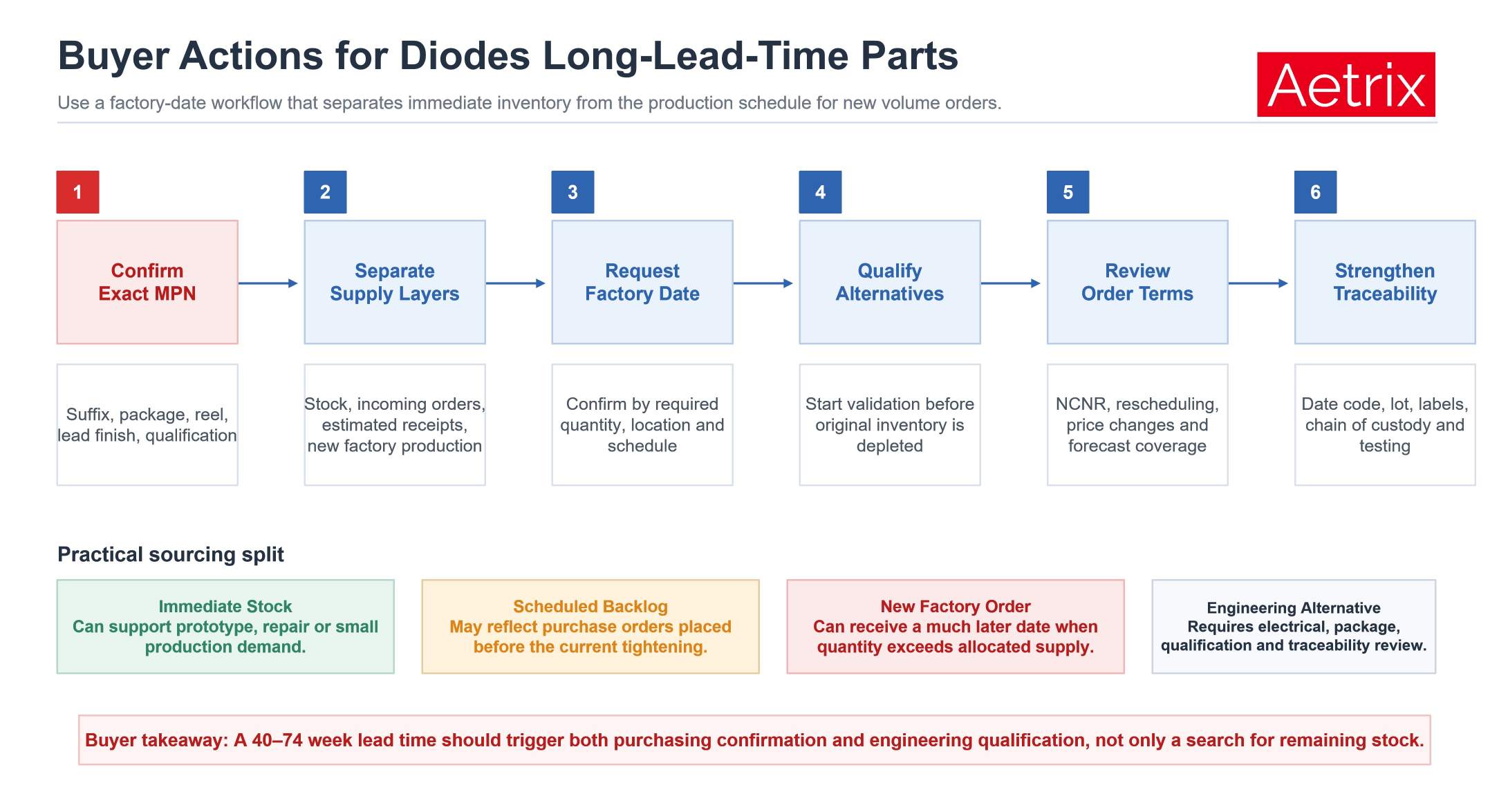
Confirm the Exact MPN
Check the complete suffix, package, reel quantity, lead finish and qualification. A base product can remain available while one tape-and-reel or automotive configuration becomes constrained.
Request a Quantity-Specific Factory Date
Ask the supplier to confirm the date against the actual quantity and delivery schedule. The BSS84-7-F case shows that a direct factory response can extend far beyond a public standard lead-time field.
Separate Stock, Incoming Orders and New Production
Record immediate stock, confirmed incoming quantities, estimated receipts and new factory production separately. This prevents old distributor backlog from being mistaken for current factory availability.
Qualify Alternatives Before Stock Reaches a Critical Level
Engineering work should begin while the original component remains available. The remaining stock can then support validation builds and the transition period.
Extend Forecast Visibility
Monthly or quarterly demand schedules give the manufacturer and authorized distributor a clearer basis for allocation. Forecasts should reflect realistic production requirements and avoid overlapping contingency orders that may later be cancelled.
Review NCNR and Rescheduling Terms
A 74-week order can remain open through several changes in customer demand. Cancellation, price adjustment, rescheduling and excess-inventory responsibilities should be agreed before the order is placed.
Strengthen Traceability for Spot Purchases
Long lead times increase activity in the independent market. Buyers should confirm manufacturer labels, date and lot codes, packaging condition, chain of custody and whether the offered quantity comes from one production lot. Electrical or laboratory testing may be appropriate for high-value or safety-related applications.
September 2026 Update: Stronger Demand Has Not Yet Produced Broad Lead-Time Relief
Diodes Incorporated's second-quarter results add an important official data point to the lead-time conditions reviewed in July. Revenue reached $445.5 million in Q2 2026, increasing 22% from the same period in 2025 and 10% from the previous quarter. Global point-of-sale revenue reached a record level, and the company described the quarter as its sixth consecutive period of double-digit year-over-year growth. Automotive, industrial and AI-server-related applications remain among the company's main focus areas. (Diodes Incorporated, Q2 2026 Financial Results)
The inventory data is particularly relevant to the supply picture. Diodes said channel inventory declined again in both dollars and weeks and had moved below its normal range of 11 to 14 weeks. Management also stated that the supply disruption discussed on previous earnings calls continues. This combination is important because strong sell-through is occurring while channel inventory is relatively lean, reducing the likelihood that the current demand signal is being created simply by excess distributor stock accumulation.
Diodes is also carrying more material earlier in the manufacturing process. Total inventory days declined from approximately 157 days in Q1 to 152 days in Q2, and finished-goods inventory days fell from 55 to 51. At the same time, raw-material inventory increased by $8.7 million and work in process increased by $4.2 million. The company said the increase helps support expected customer growth as well as longer wafer manufacturing lead times. (Diodes Q2 2026 Earnings Call)
| September 2026 Signal | Latest Position | Supply-Chain Meaning |
|---|---|---|
| Q2 2026 revenue | $445.5 million; +22% YoY and +10% QoQ | Demand continued to accelerate after the July lead-time review |
| Global POS | Record level | Stronger end-customer sell-through supports the demand signal |
| Channel inventory | Below Diodes' normal 11- to 14-week range | Less channel buffer is available if customer demand continues to rise |
| Wafer manufacturing | Longer lead times remain a factor in inventory planning | Supply improvement depends on more than finished-goods inventory |
| Q3 revenue guidance | Approximately $510 million ±3%; midpoint +30% YoY and +14% QoQ | Near-term demand is expected to strengthen further rather than reverse |
Part-number-level checks also continue to show long replenishment horizons. As of September 1, BSS84-7-F still carried an approximately 40-week factory lead-time signal at a reviewed authorized source, with scheduled incoming material extending into early 2027. Other active Diodes discrete products continue to show 52-week factory planning fields. These figures should not be interpreted as a universal Diodes lead time, but they confirm that long production schedules remain present in selected product families.
The 74-week figures discussed earlier in this article should therefore remain identified as July quantity-specific or market-record observations rather than a September portfolio-wide benchmark. The more important current conclusion is that selected 40- to 52-week production signals remain visible while Diodes is reporting stronger demand, leaner channel inventory and continued wafer-manufacturing lead-time pressure.
Authorized-channel lead-time and scheduled-inventory fields referenced in this update were reviewed on September 1, 2026. Factory lead-time fields can change by MPN, quantity, region, customer allocation and production schedule.
Diodes Supply Outlook Through 2027
As of September 1, there is still no clear signal of broad normalization back toward the previous eight- to ten-week planning range. The extreme 74-week records discussed earlier were July quantity-specific or market observations and should not be treated as the current lead time for the full Diodes portfolio. However, selected products continue to carry 40- to 52-week factory planning signals, while Diodes' latest results show record global POS, channel inventory below its normal range and longer wafer manufacturing lead times still affecting production planning.
Nexperia supply stabilization could reduce some replacement demand, although customers may retain newly approved second sources after experiencing the disruption. AI-server investment continues to raise demand for power and connectivity products. Automotive and industrial recovery supports factory utilization and long-term backlog.
Diodes can improve supply by adding qualified wafer sources, increasing internal utilization, expanding external manufacturing support and adding package or test capacity. These measures require qualification and production ramp time.
Improvement will appear unevenly. Standard diodes and MOSFETs have a wider alternate-manufacturer base and may normalize earlier. Automotive-qualified devices, specialized packages, logic configurations and PCIe products remain more dependent on exact production routes.
A reduction from 52 or 74 weeks to a more manageable range may begin during 2027 as additional sources complete qualification and customers implement alternatives. A uniform return to short lead times across the full portfolio will take longer.
Key Takeaways
- Diodes Incorporated lead times now extend across MOSFETs, Zener and Schottky diodes, ESD protection, logic ICs, power converters and PCIe products.
- BSS84-7-F received a 74-week quantity-specific official response through an Aetrix Electronics supply check.
- DMG1013UWQ-7, MMSZ5231B-7-F and ZXMP6A13FQTA have also appeared with 74-week fields in public component intelligence records.
- Many active Diodes products currently carry authorized-channel factory planning signals of 40 to 52 weeks.
- Immediate stock and new factory production can have very different delivery schedules.
- Nexperia disruption has increased second-source qualification and replacement demand across logic, transistor and diode categories.
- Diodes reported Q2 2026 revenue of $445.5 million, up 22% year over year and 10% sequentially, while global POS reached a record level and automotive, industrial and AI-server-related applications remained key growth areas.
- Constraints can develop at wafer fabrication, assembly, packaging, final test or customer allocation.
- Exact MPN, requested quantity, qualification and customer forecast history can produce different lead times within the same product family.
- Buyers should confirm quantity-specific factory dates and begin alternate qualification before available stock reaches a critical level.
- As of September 2026, broad normalization is not yet visible: selected Diodes products still show 40- to 52-week factory planning signals while channel inventory remains below its normal range and wafer manufacturing lead times remain extended.
The Diodes supply situation has developed into a broad, product-level shortage covering standard discrete semiconductors and selected integrated circuits. AI-server, automotive and industrial demand is competing for qualified wafer, package and test resources at the same time that customers are qualifying alternatives to Nexperia.
BSS84-7-F demonstrates the practical sourcing risk. A mature SOT-23 MOSFET can receive a 74-week new-order response even while limited inventory remains visible elsewhere in the authorized supply chain.
The strongest purchasing plans will combine traceable current stock, confirmed incoming orders, quantity-specific factory schedules and engineering-approved alternatives. Factory availability should be reviewed at the exact part-number level throughout 2026 and 2027.