My Inquiry
 My Account


Murata is moving another group of multilayer ceramic capacitors toward end-of-life as part of a wider MLCC product-line review. A customer withdrawal notice circulating through the supply chain identifies selected part numbers across nine Murata series: GRM, GRJ, GRT, GXM, GXT, GCM, GCJ, GCG and ZRA.
The withdrawal does not apply to every product in those nine series. The affected scope is at individual MPN level, which is an important distinction for buyers using Murata MLCCs in consumer, industrial and automotive designs.
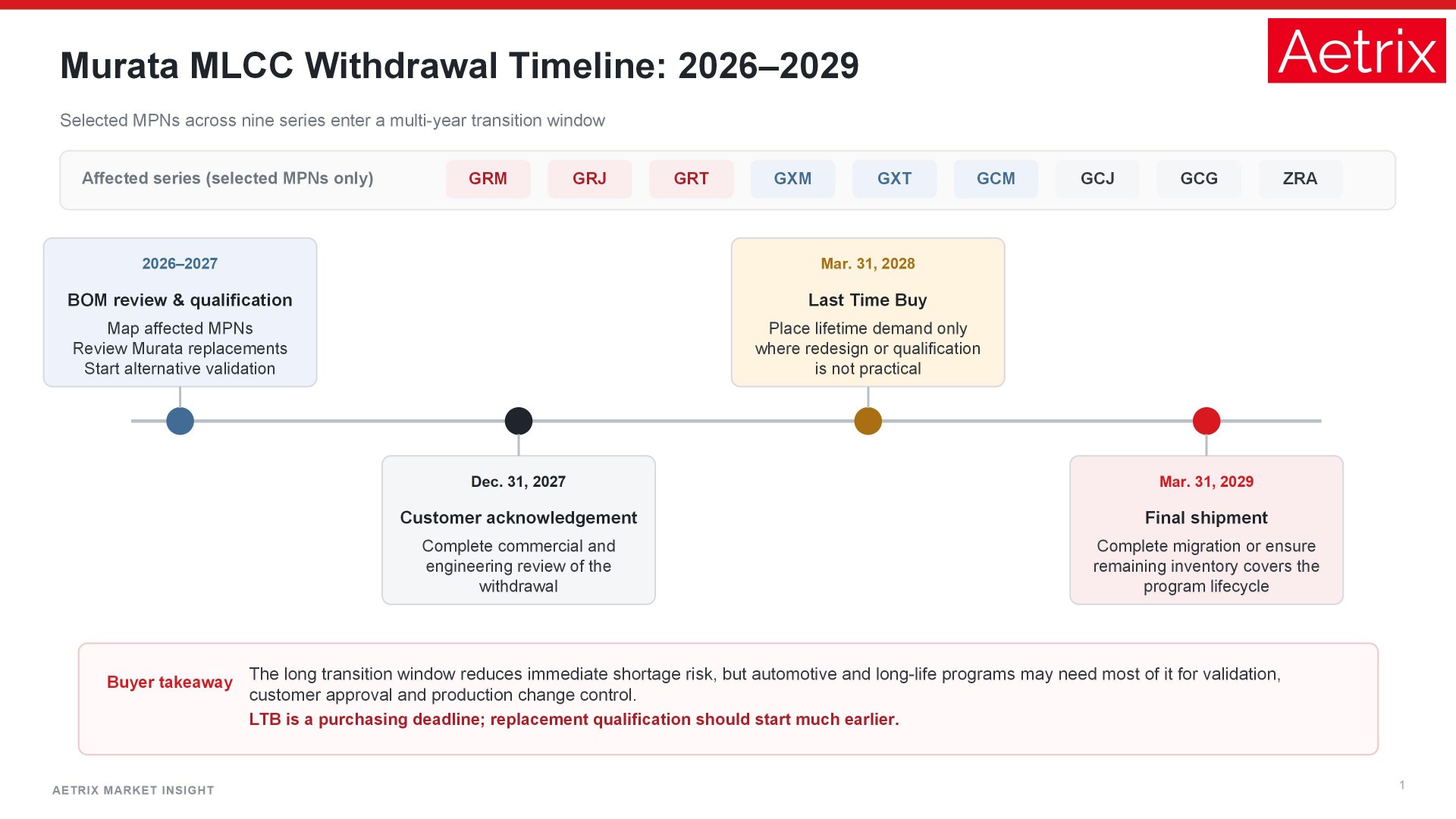
The current schedule gives customers a long transition window. Customer acknowledgement is due by December 31, 2027, the last-time-buy deadline is March 31, 2028, and final shipments are scheduled for March 31, 2029. Murata has also publicly described the adjustment as part of product renewal and portfolio optimization involving older products and selected general-purpose items.
The longer-term significance goes beyond the EOL dates. Murata has been reducing manufacturing complexity in parts of its MLCC portfolio for more than a year, while demand for high-capacitance MLCCs used in AI infrastructure has pushed order backlogs and capacity utilization higher across the industry. The latest withdrawal therefore arrives during a period when every unit of effective MLCC capacity carries a higher opportunity cost.
Key Findings:
- Selected MPNs across nine Murata MLCC series are included in the latest product-line withdrawal.
- The affected families include GRM, GRJ, GRT, GXM, GXT, GCM, GCJ, GCG and ZRA, but the entire series are not being discontinued.
- Customer acknowledgement is scheduled for December 31, 2027, followed by LTB on March 31, 2028 and final shipment on March 31, 2029.
- The move continues an earlier Murata effort to reduce production burden and simplify parts of its MLCC portfolio.
- AI-driven demand for high-capacitance MLCCs is making manufacturing capacity more valuable, even though Murata has not publicly identified AI demand as the direct reason for this specific withdrawal.
- Buyers should manage the change at exact-MPN level and begin replacement qualification well before the LTB date.
Selected MPNs Across Nine Murata MLCC Series Are Affected
The latest withdrawal covers portions of nine established Murata MLCC product families. The series names alone do not determine whether a BOM is affected. Each family contains many capacitance, voltage, dielectric, case-size, termination and qualification combinations, and only selected orderable part numbers are included in the withdrawal.
| Series Included in Notice | Buyer Interpretation |
|---|---|
| GRM / GRJ | Selected MPNs only; do not treat the entire general-purpose or resin-termination portfolio as EOL |
| GRT / GCM | Automotive-qualified families require part-level confirmation and replacement qualification |
| GXM / GXT | Check electrical characteristics, package and application requirements before selecting alternatives |
| GCJ / GCG | Application and reliability requirements can make cross-reference approval more complex |
| ZRA | Specialized mechanical or reliability requirements should be reviewed before substitution |
Murata's own technical guidance illustrates why series-level matching is insufficient. For example, GCM and GRT products are designed around AEC-Q200 requirements, while standard GRM products are not necessarily AEC-Q200 compliant. A replacement that matches capacitance, voltage and package can still fail the qualification requirement of the original design. (Murata, GCM/GRT/GRM Series Comparison)
The 2027–2029 Timeline Is a Qualification Window, Not a Reason to Wait
The current schedule is generous compared with a sudden shortage. Customers have more than a year before the acknowledgement deadline and approximately eighteen months before the March 2028 LTB date.
That does not make the issue low priority. The available time can disappear quickly once engineering qualification, customer approval, sample procurement, reliability testing and production change control are included.
| Milestone | Date | Buyer Action |
|---|---|---|
| Current review period | 2026–2027 | Map affected MPNs and identify preferred replacements |
| Customer acknowledgement | December 31, 2027 | Complete commercial and engineering review of the withdrawal |
| Last Time Buy | March 31, 2028 | Place lifetime demand only where redesign or requalification is not practical |
| Final shipment | March 31, 2029 | Complete migration or ensure remaining inventory covers the supported product lifecycle |
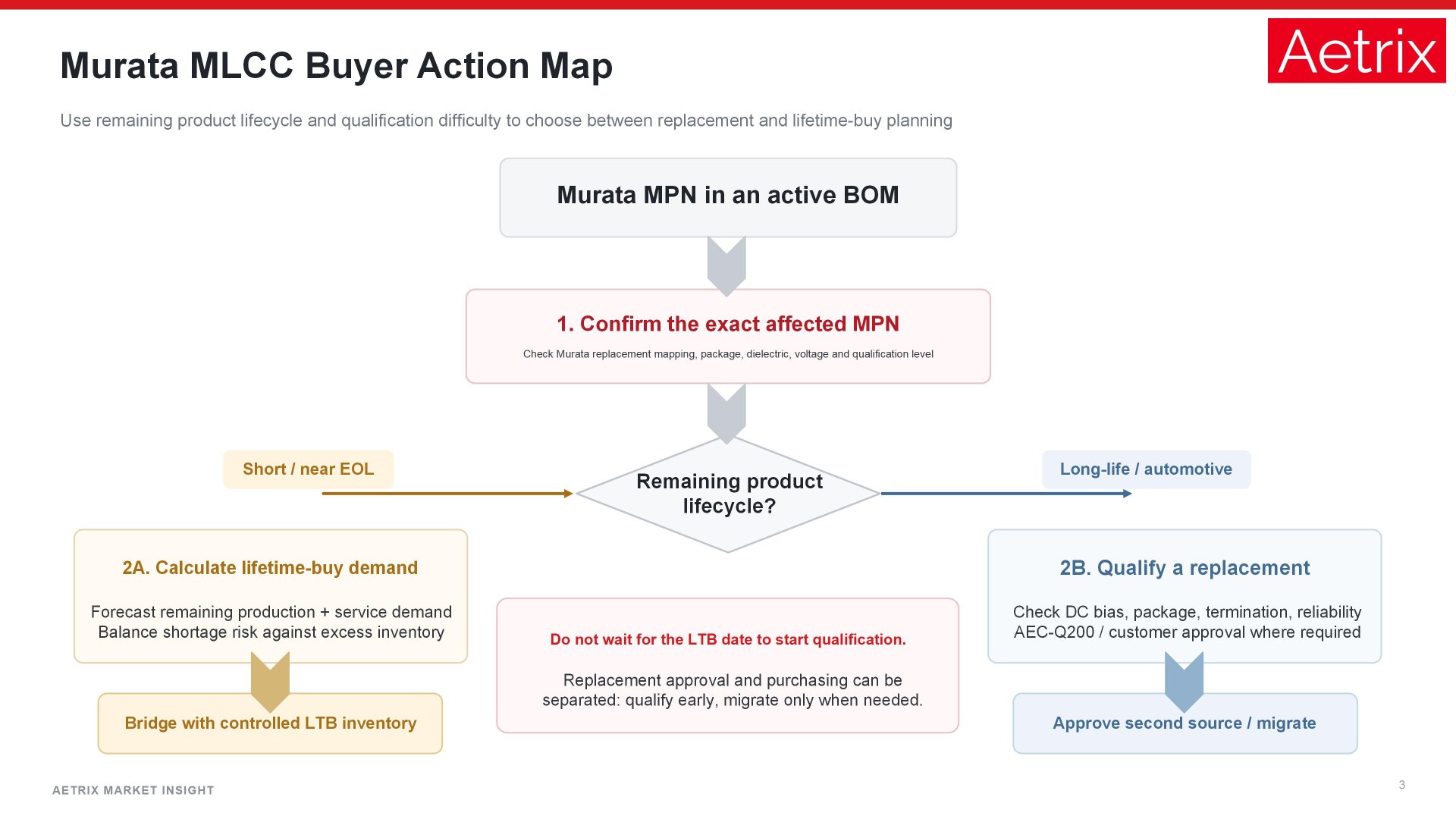
The right response depends on the application. A consumer product approaching its own end-of-life may justify a final purchase. A platform expected to remain in production for another five or ten years usually needs an approved replacement rather than a large lifetime inventory position.
This Is Part of a Longer Murata MLCC Portfolio Rationalization
The latest change is easier to understand when placed beside Murata's earlier withdrawal actions.
In September 2025, Fukui Murata issued a formal withdrawal notice covering selected large-case GRM, GRT and GCM products. The notice explained that large-size products imposed a significant production burden and restricted Murata's ability to increase overall MLCC production capacity. Those products carry an earlier LTB deadline of March 31, 2027 and final shipment date of March 31, 2028. (Murata Withdrawal Notice D08957-A-A2127)
Another withdrawal covered selected GRM, GRT, GJ8 and ZRA products with a September 30, 2026 LTB deadline and September 30, 2027 final shipment. (Murata Withdrawal Notice D09014-A-A2127)
The pattern is more informative than any single EOL list. Murata is repeatedly reviewing individual MPNs that consume manufacturing resources without necessarily justifying continued production in their existing form.
| Withdrawal | Scope | LTB | What It Shows |
|---|---|---|---|
| Earlier portfolio withdrawal | Selected GRM / GRT / GJ8 / ZRA | Sep. 30, 2026 | Ongoing removal of selected mature MPNs |
| Large-case withdrawal | Selected GRM / GRT / GCM | Mar. 31, 2027 | Production burden explicitly linked to overall MLCC capacity |
| Latest product-line review | Selected MPNs across nine series | Mar. 31, 2028 | Portfolio rationalization is continuing rather than ending with one EOL round |
Manufacturing Burden Matters More Than the Number of EOL Part Numbers
MLCC capacity cannot be measured only by the number of pieces a factory can produce. Different products place very different loads on ceramic processing, electrode printing, stacking, firing, termination, testing and yield control.
A product that uses more ceramic volume, more internal layers, tighter dimensional control or a less efficient case format can consume disproportionate production resources. Murata's earlier large-case withdrawal is useful evidence because the company explicitly connected those products with manufacturing burden and constrained capacity expansion.
This explains why portfolio simplification can increase effective output without adding the same amount of new factory floor space. Removing low-volume or inefficient combinations reduces changeovers and allows equipment, materials and engineering resources to be concentrated on a smaller number of strategically important specifications.
The same logic is becoming more relevant as the MLCC market shifts toward high-capacitance products used in AI accelerators, servers, power systems and advanced automotive electronics.
AI Demand Is Raising the Opportunity Cost of MLCC Capacity
Murata has not publicly stated that the latest nine-series withdrawal was initiated specifically to move capacity into AI-server MLCCs. The market context still matters.
A new September 14 report adds stronger evidence that Murata is preparing its manufacturing network for sustained AI-server demand. According to a Nikkei interview with Murata Executive Vice President Masanori Minamide, the company is considering plans to increase production capacity for AI-server MLCCs by about 20% by FY2028 compared with the current level. The options under review include the construction of new large-scale factory buildings in Japan or overseas.
Minamide also indicated that Murata expects MLCC demand from AI applications to continue growing at least through 2028. The expansion plan has not yet been finalized, but it extends the direction already visible in Murata's FY2026 investment program, which includes approximately JPY80 billion in additional capital expenditure primarily for server-use MLCC capacity.
TrendForce reported that Murata's book-to-bill ratio had reached 1.30 by late June 2026, while Samsung Electro-Mechanics reached 1.31 and Taiyo Yuden reached 1.25. Those were the highest levels for the three major Japanese and Korean suppliers since the pandemic-era MLCC cycle. (TrendForce, July 6, 2026)
The pressure is concentrated in specifications that are substantially harder to manufacture than ordinary commodity capacitors. TrendForce reported that certain high-capacitance X6S MLCC lead times moved from around eight weeks to as long as twenty weeks, while new AI accelerator platforms are sharply increasing demand for small-form-factor, high-capacitance parts. Murata's new Izumo capacity is not expected to provide full relief until 2027. (TrendForce, June 17, 2026)
Our earlier analysis of AI server MLCC supply pressure showed why this matters. High-end MLCC demand consumes more manufacturing capability per finished system than simple unit-count comparisons suggest, particularly where higher capacitance and tighter reliability requirements increase layer count and process difficulty.
In that environment, keeping every mature MPN in production carries a larger opportunity cost. A factory slot used for an inefficient legacy combination is capacity that cannot simultaneously support a growing high-value specification.
Murata and SEMCO Are Managing the Same Capacity Problem Differently
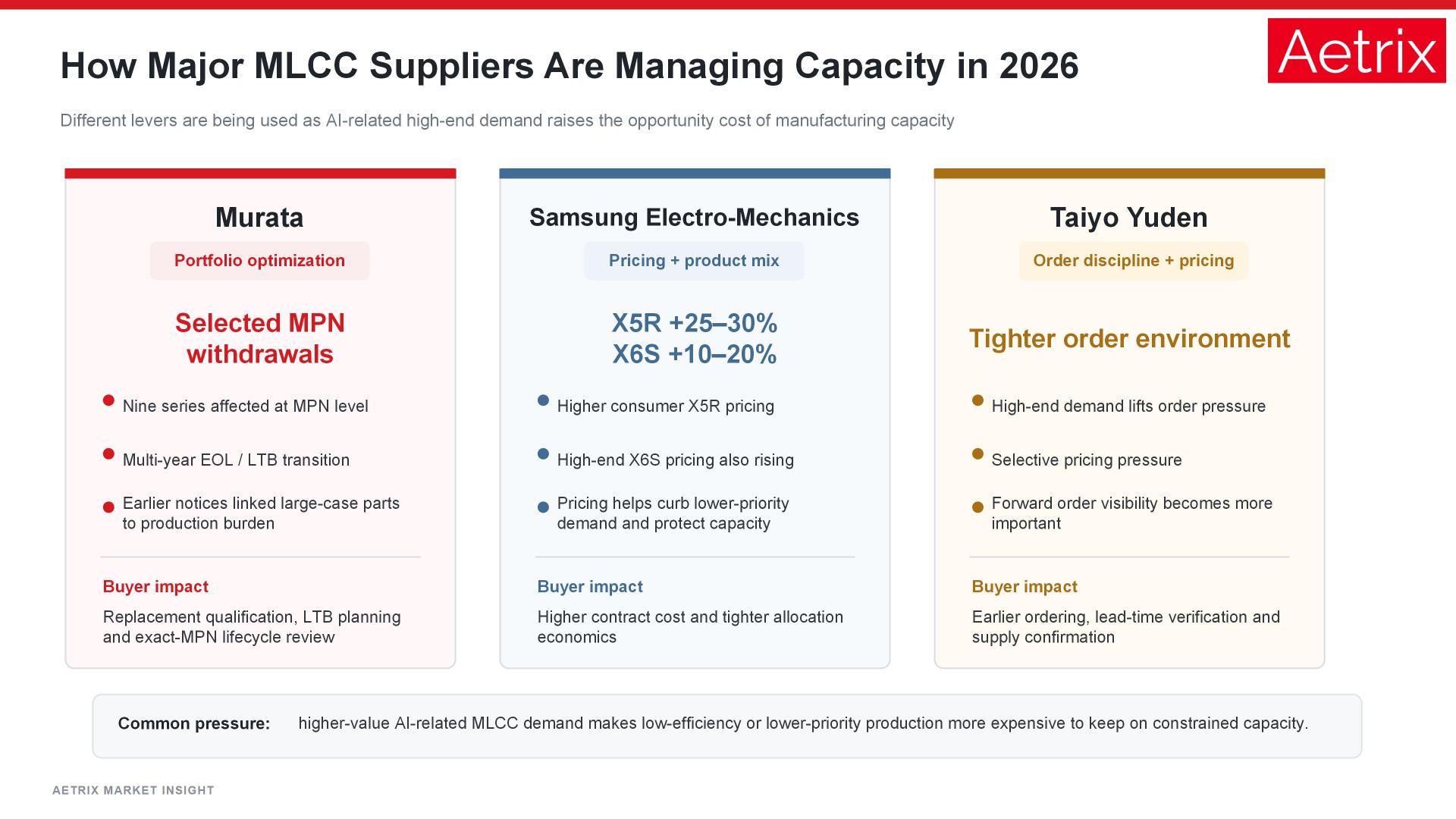
Samsung Electro-Mechanics provides a useful comparison. TrendForce expects SEMCO to raise fourth-quarter pricing for consumer-grade X5R products by an average of 25% to 30% for OEM and ODM customers. High-end X6S products used in AI servers are expected to rise about 10% to 20%, depending on customer negotiations. TrendForce said the larger X5R increase is intended in part to curb demand and free capacity for high-end production. (TrendForce, August 27, 2026)
Murata has not followed SEMCO with the same broad pricing action. Its current product-line adjustment uses a different lever: removing selected MPNs and redirecting manufacturing resources over a multi-year transition.
Those actions should not be treated as identical, but they point toward the same structural issue. High-value MLCC demand is growing faster than effective high-end capacity, forcing suppliers to decide which products deserve manufacturing resources.
| Supplier | 2026 Capacity Response | Buyer Impact |
|---|---|---|
| Murata | Selected MPN withdrawals and product-line optimization | Replacement qualification and LTB planning |
| Samsung Electro-Mechanics | Higher X5R and X6S pricing to manage demand and expand high-end production | Higher contract cost and tighter allocation economics |
| Taiyo Yuden | Tighter order environment and selective pricing pressure as high-end demand rises | Greater need for forward ordering and supply verification |
The pricing side of this shift is covered in our recent analysis of the 2026 MLCC price cycle and Samsung's X5R adjustment.
Replacement Risk Depends on the Application, Not Just the Capacitance Value
MLCC substitution can look simple on a spreadsheet. Two parts may share the same case size, nominal capacitance, voltage rating and dielectric. That does not make them interchangeable in every circuit.
Effective capacitance under DC bias can differ materially. ESR, impedance, temperature behavior, mechanical robustness, flex-crack resistance and termination construction may also affect performance. Automotive programs add qualification and customer-approval requirements that can make a nominally similar replacement unusable until testing is complete.
| Application | Typical Replacement Difficulty | Main Checks |
|---|---|---|
| General consumer electronics | Low to moderate | Capacitance, DC bias, package, voltage, temperature and supply continuity |
| Industrial equipment | Moderate | Long-life support, temperature, mechanical stress and field reliability |
| Automotive infotainment / comfort | Moderate to high | AEC-Q200 status, approved vendor list and customer qualification |
| Automotive powertrain / safety | High | Reliability grade, failure mode, qualification history and system-level approval |
Automotive MLCCs Need an Earlier Replacement Decision
The long phase-out window is particularly valuable for automotive users. A component can be electrically compatible and still require months of internal validation and customer approval before it is released into production.
Automotive buyers should first determine whether the Murata part is used in infotainment and comfort functions or in powertrain and safety-related applications. The qualification path, reliability requirements and acceptable alternatives can differ materially.
A last-time buy can bridge a short program extension, but it creates its own risks. Forecast errors become expensive when several years of demand must be purchased at once, and excess inventory can remain after a product is redesigned or cancelled. For long-running platforms, validating a replacement usually provides better supply flexibility than relying entirely on lifetime stock.
Where Could the Discontinued Volume Move?
Murata's withdrawn volume will not disappear from customer demand. Programs that remain in production will either move to another Murata MPN, qualify another manufacturer, or place a lifetime order before the deadline.
Alternative suppliers in Japan, Korea, Taiwan and mainland China can benefit from that migration, particularly in mainstream MLCC specifications where multiple manufacturers already have comparable products. TrendForce has reported that consumer-grade order spillover is already improving order visibility and utilization among Taiwanese and Chinese suppliers as major Japanese and Korean producers allocate more resources toward higher-end specifications. (TrendForce, July 28, 2026)
The opportunity should not be interpreted as automatic cross-compatibility. Switching from Murata to another MLCC manufacturer still requires a full comparison of electrical behavior, dimensions, qualification level and application conditions.
Alternative MLCC Capacity Is Tightening Too
Moving demand away from Murata does not mean replacement capacity is unlimited.
TrendForce reported in July that mainstream MLCC channel inventories had generally fallen below 30 days while spillover orders were increasing. At the same time, major suppliers were shifting more production from consumer-grade X5R toward X6S and X7R products used in AI applications. (TrendForce, July 28, 2026)
That creates a second risk for programs waiting until late in the Murata phase-out window. An alternative part may still exist in 2028, but its price, lead time or available capacity may be less attractive than it is during the current qualification period.
For long-lifecycle products, replacement approval should therefore be separated from the purchasing decision. Qualifying a second source does not require immediate migration, but it gives procurement more options if Murata availability, alternative lead times or pricing change before the LTB date.
What Murata MLCC Buyers Should Check Now
The first task is an exact-MPN comparison against the official affected-part list once the final PCN package is available. Series names are too broad for BOM-level decisions.
| Check | Why It Matters |
|---|---|
| Exact Murata MPN | Only selected part numbers within the nine series are affected |
| Murata recommended replacement | The manufacturer's migration path is usually the lowest-friction option |
| Capacitance under DC bias | Nominal capacitance alone can hide meaningful circuit-level differences |
| Case size and termination | Mechanical stress, land pattern and flex reliability can affect interchangeability |
| AEC-Q200 / application qualification | Automotive approval cannot be inferred from similar electrical ratings |
| Remaining program demand | Determines whether replacement qualification or LTB inventory is more practical |
| Alternative supplier lead time | Industry-wide capacity pressure can affect replacement availability |
If a Murata MLCC in your BOM may be affected by the latest product-line withdrawal, send Aetrix the MPN, required quantity and delivery schedule for availability, EOL sourcing or alternative-part review.
Murata Is Now Signaling a Broader AI-Server Capacity Expansion
The most useful next document will be the complete official affected-MPN list and replacement mapping. That will show whether the withdrawal is concentrated in large case sizes, older electrical combinations, specific automotive grades or a wider cross-section of the nine series.
The capacity side of the picture is becoming clearer. Murata is now evaluating an increase of about 20% in AI-server MLCC production capacity by FY2028, with new factory construction among the options under consideration. This follows the company's previously announced additional investment of approximately JPY80 billion primarily for server-use MLCC production.
The new information strengthens the evidence that Murata is actively preparing for a multi-year shift in MLCC demand rather than responding to a temporary server build cycle. It also makes future product-line decisions more important for buyers: as higher-capacitance AI-server products consume more manufacturing resources, Murata has a stronger economic incentive to simplify less efficient parts of its mature portfolio.
This still does not establish that the latest nine-series withdrawal was caused directly by AI demand. The two developments should be treated separately: one is a confirmed selected-MPN product withdrawal, while the other is a confirmed plan to evaluate substantial AI-server MLCC capacity expansion. Together, however, they provide a clearer picture of how Murata's MLCC product mix and manufacturing priorities are evolving.
Key Takeaways
- Murata is withdrawing selected MPNs across GRM, GRJ, GRT, GXM, GXT, GCM, GCJ, GCG and ZRA; the nine complete series are not being discontinued.
- The current schedule sets customer acknowledgement for December 31, 2027, LTB for March 31, 2028 and final shipment for March 31, 2029.
- The withdrawal extends a longer Murata effort to review products that create manufacturing burden or no longer fit the preferred product mix.
- Murata has not publicly stated that AI demand directly caused this specific withdrawal.
- The timing coincides with unusually strong high-end MLCC demand, elevated supplier book-to-bill ratios and longer lead times for selected X6S specifications.
- SEMCO is addressing the same tight-capacity environment through substantial X5R and X6S pricing adjustments, while Murata is using portfolio rationalization as another capacity-management tool.
- Automotive and long-lifecycle buyers should begin replacement qualification well before the LTB deadline.
- Alternative suppliers may receive spillover orders, but replacement capacity and qualification should not be assumed to be unlimited.
- Procurement decisions should be made at exact-MPN level using electrical, mechanical, reliability and lifecycle requirements.
- Murata is also evaluating an approximately 20% increase in AI-server MLCC production capacity by FY2028, with new factory construction among the expansion options under consideration.
Checking a Murata MLCC for EOL, LTB, or Supply Risk?
If a Murata part in your BOM may be affected by a product withdrawal or future supply change, send us your MPNs, quantities, and required delivery dates. Aetrix can support availability checks, EOL sourcing, and alternative-part review.