My Inquiry
 My Account


NXP Semiconductors is preparing another price adjustment for September 2026. A customer pricing notice dated September 2 states that select products will increase by approximately 10% effective September 28, although the final increase can vary by part.
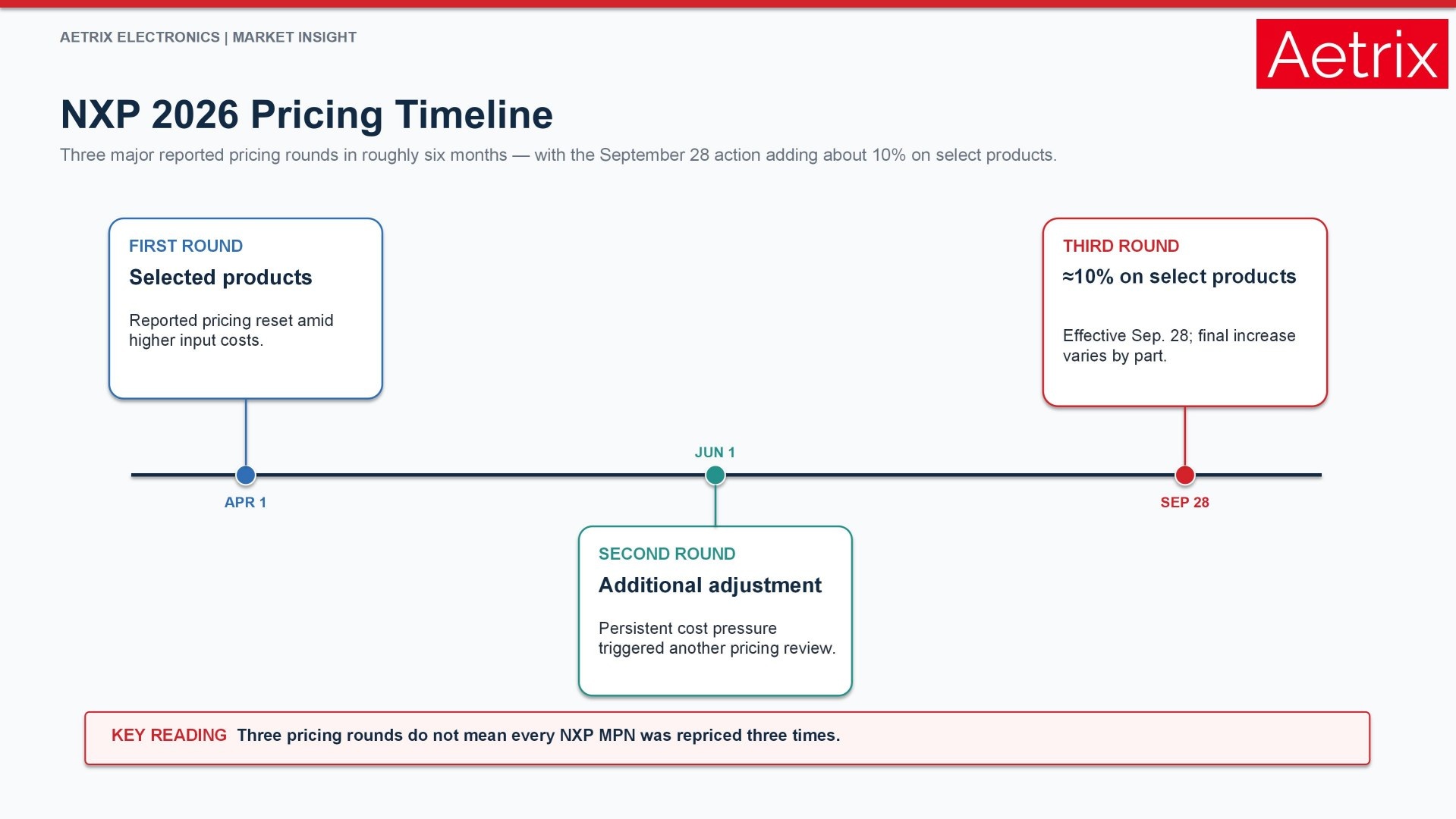
The September action follows reported NXP price changes that took effect in April and June, making it the third major NXP pricing round reported in 2026. The frequency is more significant than the headline percentage. NXP has moved through three pricing actions in roughly six months rather than relying on one annual price reset.
NXP attributes the latest adjustment to continued cost pressure across raw materials, manufacturing, energy, labor, logistics and supplier inputs. The September notice says these factors have continued to affect its cost structure since the earlier pricing action and require further adjustments to support investment, supply continuity and long-term business sustainability.
For buyers, the approximately 10% figure is only the starting point. NXP says the adjustment applies to selected products and varies by part. The notice also specifically addresses Distribution Book Price updates and replacement debits, which means the actual change paid by an OEM or EMS customer can differ substantially from the headline increase.
Market signal: NXP's third reported pricing round in 2026 shows that semiconductor repricing is moving into shorter cycles. For distribution customers, the commercial impact will depend on the exact MPN, revised book price, debit support, project pricing and treatment of existing orders rather than the approximate 10% headline alone.
NXP Announces Its Third Major 2026 Price Adjustment
The September 2 notice gives a relatively clear implementation schedule. NXP will update pricing on selected products from September 28, with an approximate increase of 10%. Individual part numbers may receive different adjustments.
This follows two earlier reported actions. In March, industry reports said NXP would adjust selected product pricing from April 1 as raw-material, energy, labor and logistics costs increased. A second notice reported in May set another adjustment for June 1 and again cited persistent inflationary pressure. (TrendForce, NXP April 2026 Pricing Report) (TrendForce, NXP June 2026 Pricing Report)
| 2026 NXP Pricing Round | Effective Date | Reported Development | Buyer Implication |
|---|---|---|---|
| First | April 1 | Selected products repriced amid higher input costs | First major 2026 price reset |
| Second | June 1 | Additional adjustment as cost pressure persisted | Annual pricing assumptions required another review |
| Third | September 28 | Approximately 10% on select products; varies by part | Distributor book prices and debit support reset again |
Three pricing rounds do not mean every NXP part has increased three times. The product scope can differ between rounds, as can the percentage and customer-specific commercial support. An exact MPN may have been affected once, more than once or not at all.
The cadence still changes procurement planning. A customer that negotiated annual pricing at the beginning of 2026 may now be working through several supplier price revisions before the year is over. That shortens the useful life of old quotations and makes project-price expiration dates more important.
Why NXP Is Raising Prices Again
NXP's September notice lists cost pressure across several parts of the semiconductor supply chain: raw materials, manufacturing, energy, labor, logistics and supplier inputs. More importantly, the letter says these factors continued to affect the company's cost structure after its earlier pricing action.
That wording indicates that the earlier adjustments did not fully close the cost gap NXP says it continues to face. The September increase is therefore presented as another cost reset rather than a one-time reaction to a new event.
This fits a wider semiconductor manufacturing environment in which mature-node economics have also become firmer. TrendForce reported that average 8-inch foundry utilization among major suppliers was expected to approach 90% in 2026, while AI-related power demand and mature-node capacity adjustments were contributing to higher foundry pricing. (TrendForce, Mature-Node Foundry Outlook)
That industry context should not be treated as the direct cause of every NXP increase. NXP's own notice provides the relevant explanation: persistent costs across several manufacturing and supply-chain inputs. Different NXP products use different process technologies, packages and production routes, so the cost exposure can vary substantially by MPN.
Not Every NXP Part Will Rise 10%
The wording of the September notice is important. NXP describes an approximately 10% increase on selected products and states that price-increase levels may vary by part.
That rules out treating 10% as a portfolio-wide multiplier. NXP supplies automotive processors, MCUs, connectivity devices, interface products, analog and mixed-signal ICs, security products and industrial components built on different technologies and manufacturing flows.
The same caution applies to the three-round timeline. A buyer should not assume that an NXP part has risen by 30% simply because three pricing actions occurred during the year. The only reliable calculation is to compare the historical and current price of the exact MPN.
Buyer rule: Track the exact MPN through each pricing round. Supplier-level percentages are useful for market analysis, but they are not a substitute for the customer's actual book price, debit-supported cost or project price.
Why NXP's Distributor Book Price Reset Matters
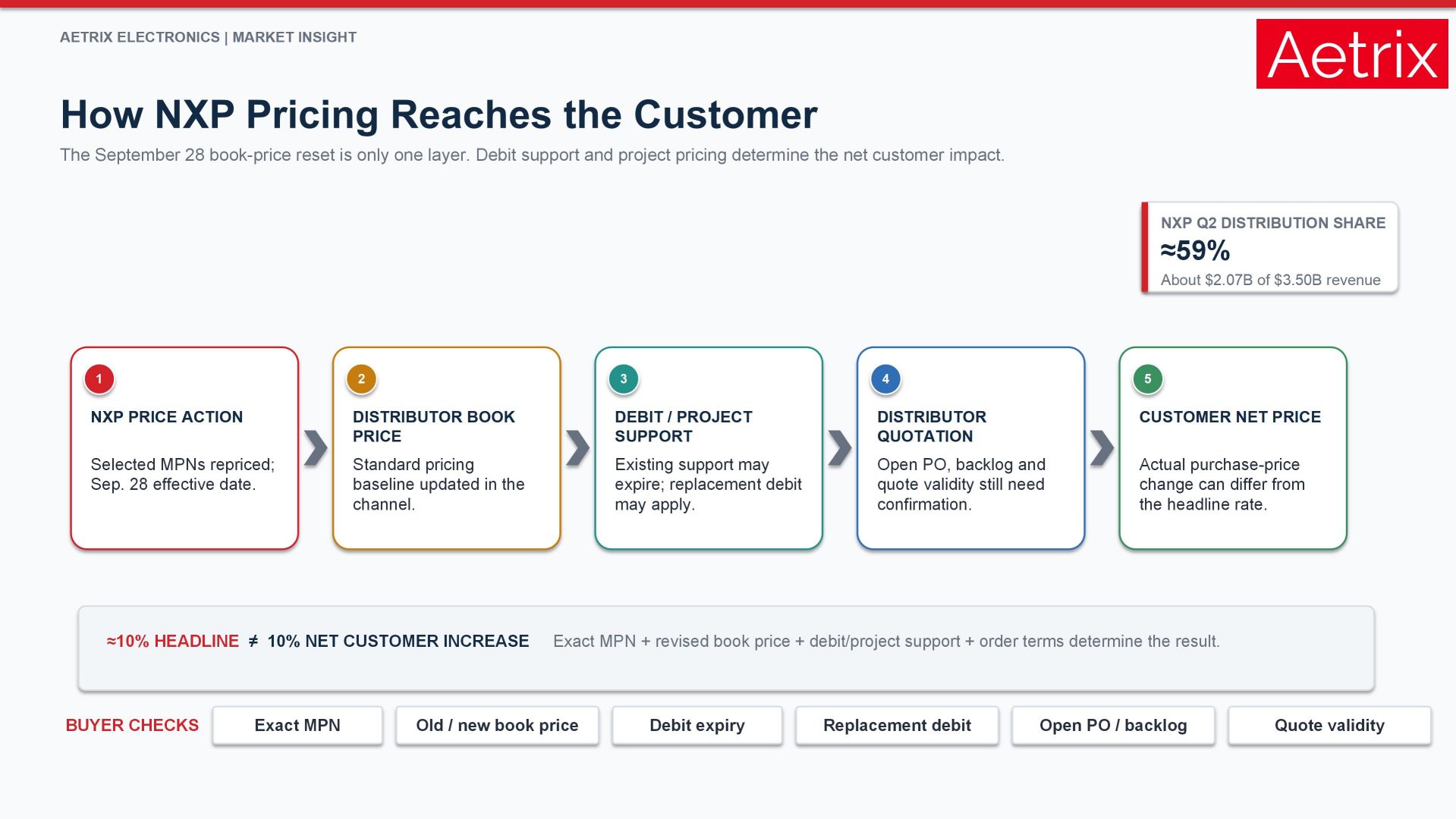
The most commercially important part of the September notice is the treatment of distribution pricing. NXP says updated Distributor Book Prices will take effect September 28 and that new debits will be issued where applicable to replace expiring existing debits.
Book Price and customer purchase price are not necessarily the same number. In authorized semiconductor distribution, a manufacturer can establish a standard distributor book cost while providing approved customer or project pricing through a debit mechanism. The distributor sells the component at the supported customer price and receives the approved adjustment under the supplier's pricing program.
That structure means a 10% book-price increase does not automatically translate into a 10% increase in every customer's purchase price.
| Pricing Layer | What Changes | What the Buyer Needs to Know |
|---|---|---|
| Distributor Book Price | NXP updates the standard distributor pricing baseline | Is this exact MPN affected on September 28? |
| Existing Debit | Existing support may expire under the current structure | When does current support end? |
| Replacement Debit | NXP says new debits will be issued where applicable | What is the new supported net cost? |
| Project / Customer Price | Can remain protected, change or expire depending on the program | Is the agreed customer price still valid after September 28? |
| Final Purchase Price | Depends on book price plus the applicable commercial support | What will actually appear on the new quotation or invoice? |
Repeated price adjustments make debit expiration dates more important. If the book price changes three times during a year while project support is renewed on a different schedule, customers can see very different net-price outcomes even when they buy the same product family.
Distribution Still Represents About 59% of NXP Revenue
The distributor pricing mechanics have unusual importance for NXP because distribution remains its largest sales channel. NXP reported Q2 2026 distributor revenue of $2.072 billion from total revenue of $3.496 billion, equivalent to about 59% of quarterly sales. Direct customers represented approximately 39%. (NXP Semiconductors Q2 2026 Form 10-Q)
Distributor revenue also increased 26.7% year over year, faster than NXP's overall revenue growth of 19.5%. That gives the September book-price update a large transmission path into the market.
This structure differs from Texas Instruments, which has shifted the majority of its business to direct customer relationships and now uses its own account infrastructure for product-specific price notifications. NXP's September notice places more emphasis on Distribution Book Price administration and debit replacement. Our September 2026 Texas Instruments pricing analysis covers that different model.
For buyers, neither model is inherently better or worse. The practical difference is where pricing needs to be monitored. TI customers increasingly need to watch direct account-level notifications. NXP customers using authorized distribution need to reconcile manufacturer pricing changes with distributor quotations, debit validity and project support.
NXP Is Repricing During a Broad Demand Recovery
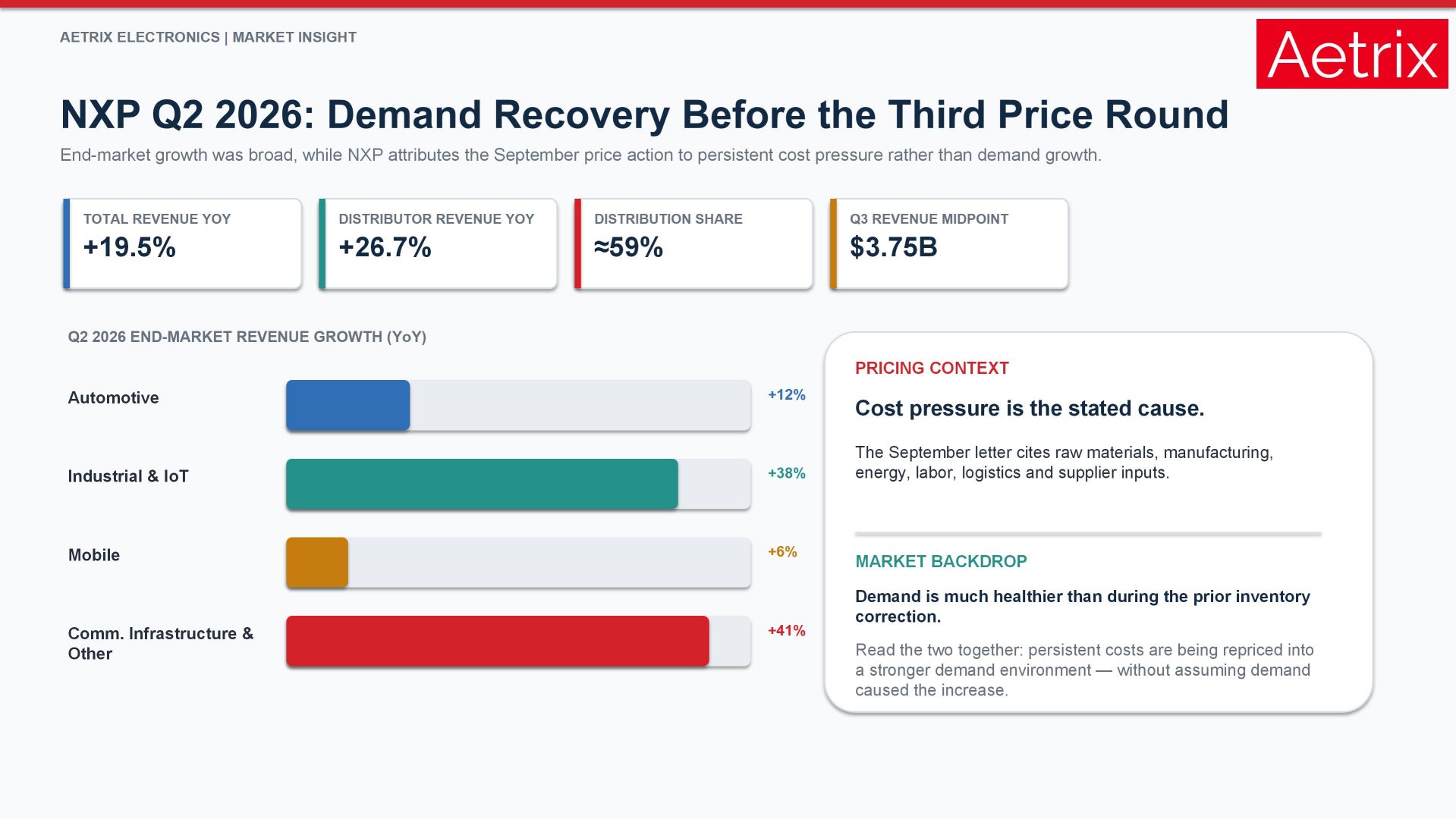
The third pricing round is arriving in a stronger demand environment than the market faced during the previous semiconductor inventory correction. NXP reported Q2 2026 revenue of $3.496 billion, up 19.5% year over year and 9.9% sequentially. The company reported growth across all end markets and all geographic regions. (NXP Semiconductors, Q2 2026 Results)
| NXP End Market | Q2 2026 Revenue | YoY | QoQ |
|---|---|---|---|
| Automotive | $1.938B | +12% | +9% |
| Industrial & IoT | $755M | +38% | +20% |
| Mobile | $351M | +6% | -10% |
| Communication Infrastructure & Other | $452M | +41% | +19% |
Industrial & IoT and Communication Infrastructure & Other showed the fastest year-over-year growth, while Automotive, NXP's largest end market, increased 12%. NXP guided Q3 revenue to $3.65 billion–$3.85 billion, with a midpoint of $3.75 billion representing approximately 18% year-over-year growth. (NXP Semiconductors, Q2 2026 Results)
These figures describe the market environment in which the September adjustment is being implemented. They do not replace NXP's stated explanation for the increase. The pricing notice cites persistent cost pressure, not revenue growth, as the reason for the latest action.
The combination is still relevant. A supplier passing through persistent input costs during a broad demand recovery operates in a different commercial environment from one attempting the same adjustment while customers are cutting inventories and cancelling orders.
Three Price Rounds Signal a Shorter Semiconductor Repricing Cycle
The wider industry signal is the shortening interval between supplier price reviews. A traditional annual price negotiation assumes that product economics remain reasonably stable for most of the year. Three NXP pricing rounds within roughly six months show that assumption is becoming less reliable for at least part of the portfolio.
NXP is not alone. STMicroelectronics, Texas Instruments, Infineon, Renesas and several other semiconductor suppliers have also adjusted pricing during 2026. Our 2026 semiconductor price increase tracker follows that broader pattern.
The channel is also entering this pricing phase with better demand conditions. Recent results from Arrow, Avnet, WPG Holdings and WT Microelectronics show rising semiconductor and component shipments, stronger bookings in several markets and leaner channel inventory in important areas. Our 2026 semiconductor distributor earnings analysis examines those signals.
Together, these developments point to a less deflationary semiconductor market. That does not mean every chip category is moving into shortage or that every supplier has broad pricing power. It does mean that customers can no longer rely on falling channel inventory and weak factory utilization to keep pricing stable across all mature semiconductor categories.
Does NXP's Third Price Increase Mean Supply Is Tight?
The September pricing notice does not establish an NXP semiconductor shortage. It does not announce allocation, lead-time extensions, wafer shortages or capacity restrictions. The document addresses pricing and cost pressure.
NXP also reported 11 weeks of channel inventory at the end of Q2, unchanged sequentially and above the nine weeks reported a year earlier. That does not describe a distribution channel that has already run out of stock. (NXP Semiconductors, Q2 2026 Results)
Price and availability should therefore be monitored separately. A component can remain available while its factory or supported distributor price increases. A different part can hold a stable price while its lead time extends because of a specific wafer, package or qualification constraint.
The supply-chain transmission sequence is rarely simultaneous. Manufacturer cost changes, book-price updates, distributor inventory replacement, customer quotations and factory lead times can move at different times. Our semiconductor supply-chain pressure analysis explains that timing in more detail.
What NXP Buyers Should Confirm Before September 28
The first priority is to identify whether the exact MPN is included in the September adjustment. From there, the commercial review should reconstruct the current net price rather than stopping at the new book-price percentage.
| Buyer Check | What to Confirm |
|---|---|
| Exact MPN | Is the part included in the September 28 adjustment? |
| Previous 2026 adjustments | Was the same MPN already repriced in April or June? |
| Current Book Price | What is the distributor pricing baseline before September 28? |
| New Book Price | What is the actual MPN-level increase? |
| Existing Debit | When does current price support expire? |
| Replacement Debit | Has NXP issued new support and at what level? |
| Project Pricing | Does the existing customer or program price remain protected? |
| Open PO | Will accepted orders retain current pricing? |
| Backlog | Is pricing determined by order date, shipment date or another commercial rule? |
| Quote Validity | Does an existing quotation remain valid after September 28? |
| 2027 Demand | How much does the revised net price change the annual BOM budget? |
| Alternative Source | Is a qualified second source available if pricing or supply becomes unfavorable? |
BOM exposure should be calculated from the new net purchase price, not from the supplier's approximate portfolio increase. High-volume CAN/LIN interface devices, MCUs, power-management ICs, security products or processors can create a material annual cost change even when the percentage adjustment is moderate.
Alternative qualification deserves a separate engineering review. Automotive and industrial NXP products often sit inside long-life designs where software, functional safety requirements, qualification or PCB changes make substitution expensive. A low annual dollar increase may still deserve attention if there is no practical Plan B.
What to Watch After September 28
The first useful data point will be the affected MPN list and the actual distribution book-price changes. That will show whether the approximately 10% headline is tightly clustered or hides a wider range of adjustments.
The second is replacement debit support. If new debits largely preserve established project prices, some strategic customers may experience a smaller net increase than the book-price change suggests. If debit support is reduced at the same time that book prices rise, the increase reaching the customer can be larger.
The third is lead time. The September notice itself provides no evidence of a broad NXP shortage. If selected automotive, industrial or connectivity MPNs later begin showing longer factory schedules while distributor inventory falls, the market would be moving from a pricing issue toward a combined price-and-supply issue.
A fourth pricing round would also be significant. Three reported actions in six months already indicate that NXP is reviewing product economics much more frequently than a traditional annual cycle. Another broad adjustment before year-end would strengthen the evidence that rolling repricing has become part of the 2026 semiconductor market.
Outlook: Repricing Is Moving Closer to the Exact MPN
NXP's September adjustment adds another example of how semiconductor pricing is becoming more product-specific and more frequent in 2026. The company is not announcing a universal 10% increase across its portfolio. It is resetting selected products while also updating distributor book prices and commercial support.
That distinction becomes more important when almost 60% of NXP revenue moves through distribution. The factory announcement is only the first layer of the price change. Distributor book cost, debit support, project pricing, backlog treatment and quotation validity determine how the increase reaches an individual customer.
The timing also deserves attention. NXP is making its third reported pricing adjustment while Q2 revenue is up nearly 20%, distributor revenue is up 26.7% and Industrial & IoT and Communication Infrastructure are growing substantially faster than the company average. NXP attributes the increase to persistent costs, while the demand data shows that those costs are now being repriced into a healthier market than the one seen during the earlier inventory correction.
For procurement teams, the practical response is straightforward: stop treating NXP pricing as an annual static number. Review the exact MPN, the applicable debit and the order-level commercial terms whenever a new pricing notice arrives.
Key Takeaways
- NXP plans an approximately 10% price increase on selected products effective September 28, 2026, with the final increase varying by part.
- The September action follows reported NXP adjustments effective in April and June, making it the third major pricing round reported in 2026.
- Three pricing rounds do not mean every NXP MPN has increased three times.
- NXP cites persistent pressure from raw materials, manufacturing, energy, labor, logistics and supplier inputs.
- Updated Distribution Book Prices will take effect September 28, while new debits will be issued where applicable to replace expiring support.
- A 10% book-price increase does not automatically mean every customer's purchase price rises 10%.
- Distributors accounted for about 59% of NXP Q2 2026 revenue, making distributor pricing mechanics central to the market impact.
- NXP distributor revenue increased 26.7% year over year in Q2.
- Q2 total revenue increased 19.5%, with Automotive up 12%, Industrial & IoT up 38% and Communication Infrastructure & Other up 41%.
- The pricing notice itself does not provide evidence of a broad NXP shortage or lead-time extension.
- Buyers should confirm exact-MPN pricing, previous 2026 adjustments, debit validity, project pricing, backlog treatment and quote validity before September 28.
- The third NXP pricing round adds to a wider 2026 trend toward shorter and more product-specific semiconductor repricing cycles.