My Inquiry
 My Account


Availability pressure is becoming more visible across selected BCD and smart-power integrated circuits. Automotive safety PMICs, intelligent load switches, battery-management ICs, high-voltage regulators and power drivers are showing a mix of low immediate inventory, factory-order dependence and uneven availability between exact orderable part numbers.
AI infrastructure is adding another source of demand to a supply chain already supporting automotive electronics, industrial automation, battery systems and communications equipment. Higher rack power, denser accelerator platforms and more complex protection requirements are increasing demand for power-management functions at every stage between the data-center power feed and the processor.
Infineon raised its fiscal 2026 outlook in May after reporting stronger demand for power-supply solutions used in AI data centers. The company expects revenue from AI data-center applications to reach about EUR1.5 billion in fiscal 2026 and approximately EUR2.5 billion in fiscal 2027. Infineon is also working with Nvidia on high-voltage DC power-delivery architectures for future AI infrastructure. These developments show how quickly AI power has moved from a secondary semiconductor application into a major capacity and product-planning priority. (Reuters, Infineon raises 2026 outlook on AI power demand)
The resulting BCD supply environment remains selective. Some active products are readily available, while closely related automotive, industrial-temperature, reel-packed or high-voltage versions can be much harder to source. Factory status, package, qualification, packing format and production route increasingly determine the real lead time.
Key Findings
- AI servers are increasing demand for PMICs, hot-swap controllers, eFuses, gate drivers, current monitoring and integrated power stages.
- Automotive and industrial customers compete for portions of the same high-voltage analog, smart-power, wafer, package and test infrastructure.
- BCD remains a specialized manufacturing platform even when it uses mature process nodes.
- Current pressure is strongest in selected automotive-grade, high-voltage, safety-related and exact orderable configurations.
- Manufacturer product status and authorized-channel availability can differ between tray, reel, temperature and packaging options within the same base product.
- Infineon, STMicroelectronics, Texas Instruments and Renesas face different exposure depending on product mix, internal manufacturing and customer allocation.
- 300mm production can improve the economics of high-volume BCD products, while legacy and low-volume devices may remain on older production routes.
- GaN and SiC adoption increases demand for BCD-based control, sensing, protection and gate-driving functions.
BCD Supply Pressure Is Becoming More Visible
The present BCD market does not resemble a uniform industry-wide allocation cycle. Supply pressure appears first at the product and configuration level. Buyers may find a base product active on the manufacturer website while the required automotive suffix, industrial-temperature option or tape-and-reel configuration remains unavailable for immediate shipment.
This pattern is common in power-management ICs. One silicon design may be sold through several orderable part numbers that differ by temperature range, packing method, qualification, assembly site or commercial program. Each option can carry a separate inventory position and replenishment schedule.
Several market signals are now appearing together:
- Active high-voltage and automotive power ICs with no immediate manufacturer stock
- Reel configurations unavailable while tray versions remain available
- Authorized-channel inventory concentrated at only a small number of sources
- Factory-order positions replacing ordinary catalogue availability
- New product generations receiving stronger supply support than older platforms
- Automotive and safety products requiring longer production and qualification planning
These signals support a view of selective BCD tightening. The affected products often sit in systems where redesign is expensive: vehicle power distribution, MCU safety supplies, battery packs, industrial drives and high-power computing platforms.
What BCD Technology Integrates
BCD stands for Bipolar-CMOS-DMOS. The process places three different device technologies on one silicon die:
- Bipolar devices support precise analog functions, references, sensing and high-gain circuits.
- CMOS devices provide digital control, logic, interfaces, diagnostics and protection sequencing.
- DMOS devices handle higher voltages and currents for power switching and load control.
STMicroelectronics pioneered the first commercial BCD process in the mid-1980s. Its early L6202 device combined analog, digital and power functions and controlled loads up to 60V and 5A. ST now offers high-density, high-voltage and silicon-on-insulator BCD platforms covering applications from low-voltage power management to high-voltage industrial control. (STMicroelectronics, BCD technology overview)
The integration reduces the number of external components and allows monitoring, protection and power switching to operate within one coordinated device. Typical BCD and closely related smart-power products include:
- Automotive and processor PMICs
- System basis chips
- High-side and low-side smart switches
- Motor and actuator drivers
- Gate-driver ICs
- Battery chargers and battery-management front ends
- Hot-swap controllers and eFuses
- LED and display drivers
- High-voltage DC-DC converters
- Integrated power stages
Ordinary discrete MOSFETs, IGBTs and bipolar transistors should be assessed separately. A standalone transistor does not contain the analog, CMOS and power-device integration that defines a BCD IC.
Why AI Power Systems Are Increasing BCD Demand
Higher Current Density
AI accelerators operate at low core voltages and very high current. Load changes can occur rapidly as compute activity moves between idle and full utilization. The power-delivery network must respond without excessive voltage droop, overshoot or thermal stress.
This increases semiconductor content around the processor:
- Multiphase PWM controllers
- Integrated driver-MOSFET power stages
- Current-sense amplifiers and monitors
- Voltage supervisors
- Load switches
- Fault-management ICs
- Telemetry and digital power interfaces
Many of these products use BCD or related high-voltage mixed-signal processes. The platform allows precise control logic to sit beside power devices and protection functions.
More Power-Conversion Stages
Power passes through several conversion and protection stages before reaching an AI accelerator. The chain may include facility-level conversion, rack distribution, intermediate bus conversion, board-level conversion and point-of-load regulation.
Future data-center architectures are also moving toward higher-voltage DC distribution. Infineon and Nvidia have discussed centralized high-voltage DC delivery as a route to lower conversion losses in high-density AI systems. Each architecture still requires local control, gate driving, monitoring, isolation and fault protection. (Reuters, Infineon and Nvidia work on AI data-center power delivery)
Protection Content Rises With System Value
The value of an AI server board and its installed accelerators raises the cost of a power fault. Designers are adding more:
- Overcurrent protection
- Overvoltage and undervoltage monitoring
- Thermal warning and shutdown
- Soft-start and inrush-current control
- Hot-plug protection
- Redundant power-path control
- Digital fault reporting
This expands the addressable market for integrated power ICs even when the main switching devices use GaN, SiC or discrete silicon MOSFETs.
Competition With Automotive and Industrial Demand
AI, automotive and industrial customers rarely purchase the same complete part number. Their products can still share parts of the manufacturing infrastructure:
- High-voltage analog process modules
- 200mm wafer equipment
- Power-device isolation structures
- High-current metal layers
- QFN, power-SO and automotive packages
- High-voltage final test
- Burn-in and automotive screening
Capacity decisions at wafer, package and test level can therefore affect several end markets. A strong AI program may receive priority for new investment, while automotive customers retain leverage through long-term contracts and qualification commitments. Industrial customers often carry the greatest exposure when volumes are smaller and product lifecycles are longer.
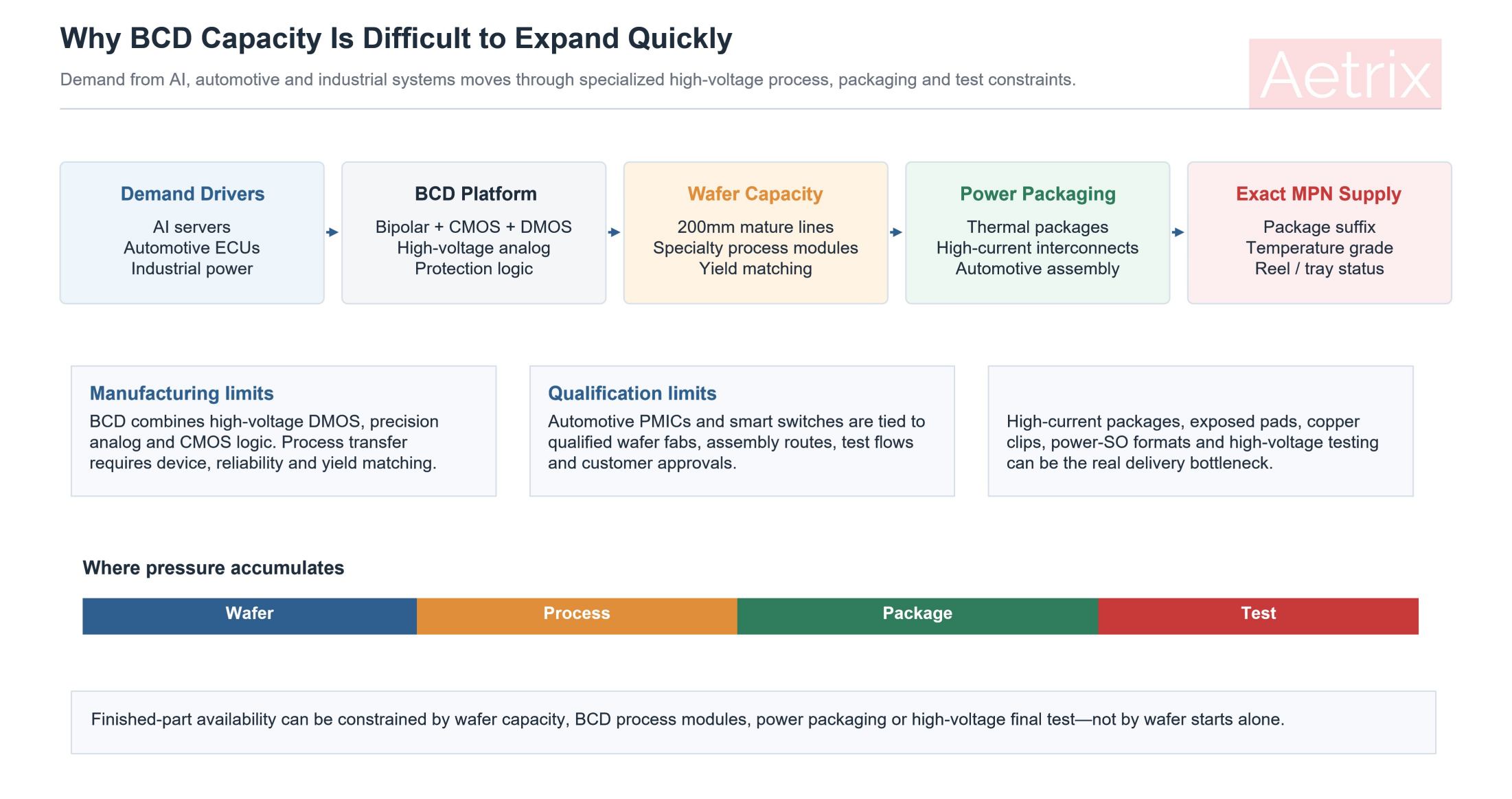
Why BCD Capacity Is Difficult to Expand Quickly
Mature-Node Does Not Mean Simple Manufacturing
BCD products frequently use process geometries that appear mature compared with advanced digital logic. The manufacturing flow remains highly specialized. Bipolar, CMOS and DMOS devices need different implants, wells, isolation structures, oxide thicknesses and metal requirements.
High-voltage products can also require:
- Deep wells and junction isolation
- Thick gate oxides
- High-voltage lateral or vertical DMOS structures
- Additional masking and implant steps
- Thicker top metal for current handling
- Specialized ESD and latch-up protection
Adding wafer capacity requires a qualified process match, compatible equipment and stable yield. Moving a product between fabs involves more work than transferring a basic CMOS design.
200mm Capacity Remains Strategically Important
Many analog, power, MEMS and BCD products continue to use 200mm wafer lines. These fabs offer attractive economics for established high-voltage processes, but their expansion options can be limited by equipment availability and the age of installed tools.
A new 200mm tool set can be expensive relative to the selling price of mature products. Used equipment is limited, and process matching across old and new tools requires engineering work. Manufacturers therefore concentrate new investment on platforms with predictable volume and strong margins.
Automotive Qualification Limits Production Flexibility
Automotive PMICs and smart switches are tied to qualified wafer fabs, assembly locations, test flows and material sets. Moving production can trigger:
- Product change notifications
- Customer approval
- PPAP updates
- Reliability testing
- Functional-safety documentation review
- EMC and system revalidation
These requirements reduce the manufacturer's ability to redirect a product between lines at short notice.
Back-End Capacity Can Be the Actual Constraint
BCD wafers can be available while the finished IC remains constrained. Smart-power devices often require packages and tests designed for high current, high voltage and thermal performance.
Potential back-end constraints include:
- Exposed-pad QFN assembly
- Power-SO packages
- Copper-clip or heavy-wire bonding
- Automotive-grade mold compounds
- High-voltage production test
- Temperature screening and burn-in
The finished part lead time must therefore be separated from the wafer lead time.
Which BCD Product Categories Are Tightening First
Automotive PMICs and System Basis Chips
Automotive PMICs supply MCUs, transceivers, sensors and safety circuits. They can include multiple regulators, watchdogs, voltage monitors, fail-safe outputs and diagnostic interfaces.
Their replacement cycle is long. A new PMIC may require changes to startup sequencing, watchdog timing, safety analysis, software and PCB layout. The limited number of qualified alternatives increases supply sensitivity.
Smart High-Side and Low-Side Switches
Smart switches combine a power MOSFET with control, protection and diagnostic functions. Automotive applications include lighting, valves, heaters, pumps, motors and electronic control-unit power distribution.
Two products with similar current ratings can differ in diagnostic behavior, clamp energy, current-sense accuracy, fault reporting and package thermal resistance. Direct substitution is therefore uncommon.
Gate Drivers and Motor Drivers
Industrial automation, robotics, home appliances, vehicle actuators and server power supplies all use gate-driver and motor-driver ICs. Demand spans low-voltage half bridges, three-phase drivers, isolated drivers and high-voltage level-shift devices.
The adoption of GaN and SiC increases demand for more specialized gate-drive performance, including higher common-mode immunity, controlled switching speed, negative-bias support and advanced fault detection.
Battery Chargers and Battery-Management ICs
Battery products combine precision analog measurement, digital control and power FET driving. Portable computing, robotics, power tools, energy storage and electric mobility are expanding the range of required cell counts and power levels.
Packing variants can become a practical supply issue. Renesas currently lists the RAA489220 battery manager as active, with the tray version in stock and two reel configurations out of stock on its direct purchasing portal. Its ISL9241 battery-charger family shows a similar difference between available tray options and an out-of-stock industrial-temperature reel version. (Renesas RAA489220 product and ordering page; Renesas ISL9241 product and ordering page)
High-Voltage DC-DC and Integrated Power Stages
High-voltage buck regulators and integrated power stages serve automotive, industrial, communications and computing systems. Their supply risk often concentrates in specific current ratings, packages and automotive versions.
New high-volume designs can also compete with existing products for test and package capacity. Buyers should track the exact orderable code instead of relying on the product-family status.
Manufacturer Exposure: Infineon, ST, TI and Renesas
Infineon
Infineon has broad exposure across automotive PMICs, intelligent high-side switches, gate drivers, power stages, MOSFETs, GaN and SiC. Its AI data-center business is expanding rapidly, giving the company a direct role in both upstream conversion and board-level power delivery.
The OPTIREG portfolio supports automotive MCUs and safety systems, while PROFET devices serve protected load switching. These products use long qualification cycles and application-specific diagnostics. Capacity planning must balance automotive commitments with faster-growing AI and data-center power programs.
The TLF35585QVS01 safety PMIC illustrates the importance of checking the exact orderable code. Infineon lists the current recommended OPN as TLF35585QVS01XUMA2, with active and preferred status and planned availability through at least 2039. Buyers still using an earlier ordering suffix may encounter a different supply position. (Infineon TLF35585QVS01 product page)
STMicroelectronics
ST has the longest commercial history in BCD technology and maintains a broad roadmap covering high-density, automotive, SOI and high-voltage platforms. Its current roadmap includes established 0.32µm, 0.16µm and 0.11µm processes, along with 90nm and future 40nm generations.
ST's L99 automotive devices integrate regulators, communication interfaces, motor control and protected outputs. VIPower products combine control and protection with power switching for vehicle and industrial loads.
The L99DZ200G remains active and in volume production. It integrates power management, LIN, CAN, regulators and numerous protected outputs in one automotive device. Products with this level of integration can become difficult to replace when immediate channel inventory tightens. (STMicroelectronics L99DZ200G product page)
Texas Instruments
TI has one of the industry's largest analog and power-management portfolios. It supplies high-voltage DC-DC converters, automotive PMICs, smart switches, eFuses, battery ICs and integrated power stages.
The size of the portfolio creates a wide range of supply conditions. New automotive PMICs and strategic high-volume products may receive strong production support, while older packages and lower-volume configurations can move toward factory-order supply.
TI lists TPS65222-Q1 as an active automotive PMIC with four buck converters, three LDOs and functional-safety support for ADAS processors. Such devices concentrate several rails and safety functions in one package, increasing redesign work if availability changes. (Texas Instruments TPS65222-Q1 product page)
Renesas
Renesas has strong exposure to battery charging, processor power, battery management and industrial mixed-signal devices through its Intersil and Dialog portfolios.
The company's direct product pages provide clear examples of orderable-part differentiation. ISL9241IRTZ-T is active and available for sampling, while the reel configuration was listed out of stock on July 16, 2026. The corresponding tray version remained in stock. RAA489220 showed the same pattern, with one tray OPN in stock and two reel OPNs out of stock.
This type of divergence can appear before a broad product-family shortage. It affects customers whose assembly line requires a specific packing method or temperature grade.
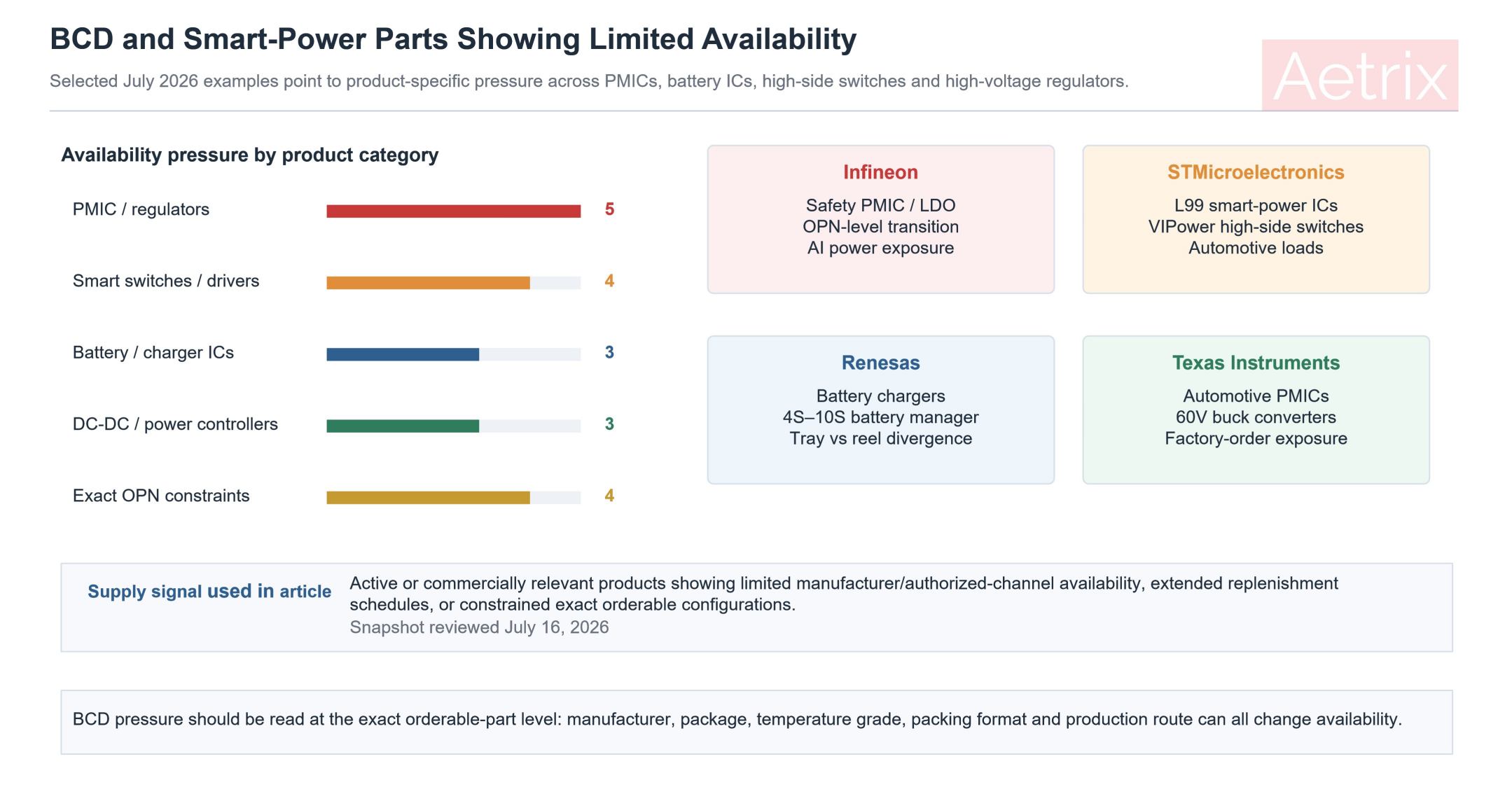
BCD and Smart-Power Parts Showing Limited Availability
The following examples cover BCD and closely related integrated smart-power products. Some manufacturers disclose the underlying BCD platform, while others describe only the product function and electrical architecture. The table focuses on active or commercially relevant products showing limited immediate stock, factory-order dependence or uneven availability between exact orderable configurations.
| Manufacturer | Exact MPN | Product Type | Main Application | Availability Signal |
|---|---|---|---|---|
| Infineon | IFX25001MEV25HTSA1 | 2.5V, 400mA LDO | Automotive and industrial supply rails | In short supply; factory-order dependence |
| Infineon | TLF35585QVS01XUMA1 | Automotive safety PMIC | AURIX MCU, sensor and safety supply | Limited availability for the earlier XUMA1 OPN; current recommended OPN is XUMA2 |
| STMicroelectronics | L99DZ200GTR | Automotive door-zone and power IC | Door modules, motor and load control | Immediate inventory concentrated across a limited number of authorized sources |
| STMicroelectronics | L99UDL01TR | Automotive universal door-lock driver | Door locks and vehicle body control | Limited immediate authorized-channel stock; replenishment-dependent supply |
| STMicroelectronics | L99VR01JTR | Automotive multi-output regulator | Vehicle MCU and peripheral supplies | Factory-order position or limited regional inventory observed |
| STMicroelectronics | VN9D30Q100FTR | Multi-channel smart high-side driver | Automotive power distribution | Limited immediate stock across reviewed channels |
| STMicroelectronics | VNQ7050AJTR | Quad smart high-side switch | Automotive loads, lighting and actuators | Uneven regional supply and concentrated channel inventory |
| Renesas | ISL9241IRTZ-T | Buck-boost battery charger | Notebook, portable and industrial battery systems | Active and available; reel OPN listed out of stock by manufacturer |
| Renesas | RAA489220AGNP#HA5 | 4S to 10S battery manager | Power tools, robotics and mobility | Active and available; reel OPN listed out of stock by manufacturer |
| Renesas | RAA489220AGNP#MA5 | 4S to 10S battery manager | Industrial battery packs | Active and available; alternate reel configuration listed out of stock |
| Renesas | ISL8845AABZ | PWM power controller | Flyback, boost and industrial power supplies | In short supply |
| Texas Instruments | TPS65222-Q1 | Automotive multi-rail PMIC | ADAS and processor power | Limited immediate channel inventory; factory-order dependence observed |
| Texas Instruments | LM5008MMX/NOPB | High-voltage buck regulator | Industrial and communications power | Limited immediate stock and replenishment-led availability |
| Texas Instruments | TPS54360DDAR | 60V, 3.5A buck converter | Industrial, automotive and telecom systems | Uneven authorized-channel inventory and factory-order exposure |
| Texas Instruments | LM76005QRNPRQ1 | 60V, 5A automotive buck converter | Automotive and industrial power conversion | Limited immediate stock for the exact automotive reel configuration |
Availability checks in this article are based on manufacturer lifecycle records, manufacturer purchasing portals and authorized-channel data reviewed on July 16, 2026. The examples focus on active products showing limited availability across manufacturer and authorized supply channels, extended replenishment schedules or constrained exact orderable configurations.
Why Current Shortages Are Product-Specific
BCD availability should be evaluated at the exact orderable-part level. A manufacturer can have sufficient wafer output for the base die while one package or qualification route remains constrained.
Packing Format
Tray and tape-and-reel products can follow separate packing and inventory flows. Automated high-volume production normally requires reel packaging, so a tray version does not always solve the customer's immediate requirement.
Temperature and Qualification
Commercial, industrial and automotive versions may use the same base architecture but require different test limits, screening and documentation. The industrial-temperature ISL9241 reel option shows how one grade can become constrained while other members of the family remain available.
Package and Assembly Site
A package change can affect thermal performance, current handling, pinout and board layout. An alternate assembly site may require a PCN and customer approval.
Product Revision and Ordering Suffix
Manufacturers periodically update ordering codes for packing, material or production reasons. Buyers working from an old approved-vendor list may continue requesting a constrained OPN even when a newer supported code exists.
Customer Allocation
Catalogue inventory represents only part of the market. Automotive OEMs, major data-center customers and contract manufacturers may receive supply through forecasts, direct agreements and scheduled releases. Public inventory can remain low while committed production continues to ship.
How BCD Tightness Could Spread to Other Power Products
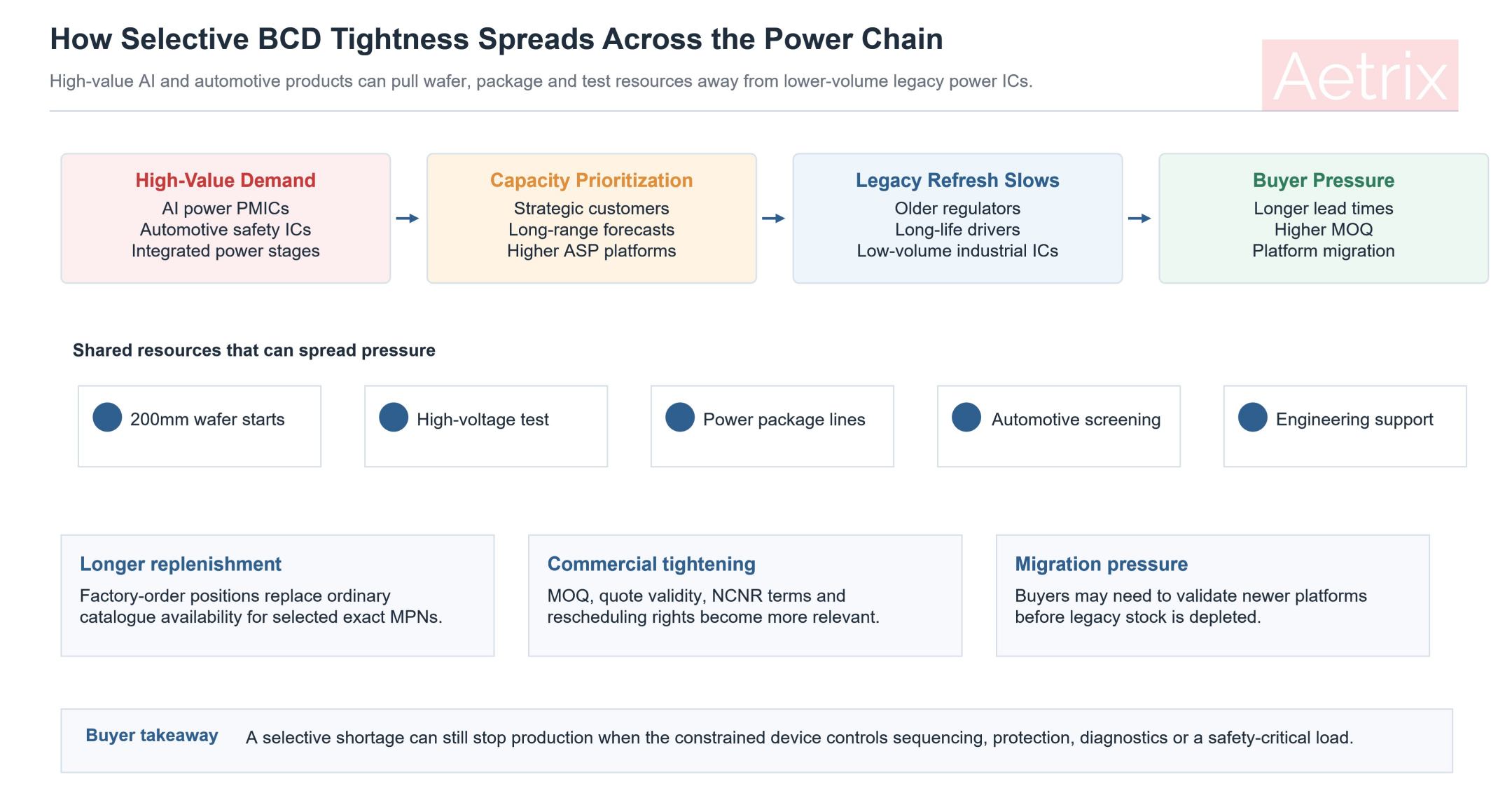
Capacity Prioritization
Manufacturers are likely to prioritize products with strong volume visibility, strategic customers and attractive margins. These can include:
- AI server power-management ICs
- Automotive safety PMICs
- Integrated smart-power switches
- High-current power stages
- New GaN and SiC driver platforms
Products with stable but smaller demand may receive less incremental capacity. Existing production can continue, yet replenishment becomes slower when demand rises unexpectedly.
Legacy Product Pressure
Long-life industrial and automotive programs frequently depend on old regulators, drivers and switches. These products can face:
- Reduced build frequency
- Larger minimum order quantities
- Longer factory lead times
- Shorter quotation validity
- Requests for annual forecasts
- Migration toward a newer product platform
An older product can become difficult to source even when the wider BCD platform remains healthy.
Shared Foundry and Back-End Resources
BCD products can share equipment and back-end capacity with analog ICs, motor drivers, LED drivers and other high-voltage mixed-signal products. Tightness in one high-volume area may reduce scheduling flexibility elsewhere.
The spillover effect is usually strongest where products share:
- The same wafer fab and process family
- The same high-current package
- The same high-voltage test platform
- The same automotive screening route
Could 300mm BCD Relieve the Supply Constraint?
Moving selected BCD products to 300mm wafers can increase die output per wafer and improve automation economics. This route is most attractive for products with high and predictable volume.
The transition carries several limits:
- High-voltage device structures must be redesigned and requalified for the new process.
- Analog performance and DMOS behavior must remain stable across the larger wafer.
- Existing masks, design rules and IP may need substantial changes.
- Automotive customers may require a complete change-approval process.
- Low-volume legacy products may not justify the transfer cost.
300mm BCD can improve the supply outlook for new high-volume PMICs, automotive platforms and computing power ICs. It will not quickly replace every established 200mm product.
The market may therefore divide into two supply structures:
- New strategic BCD products manufactured on highly automated, higher-volume platforms
- Legacy and specialized products remaining on mature 200mm lines with less frequent production cycles
How GaN and SiC Change the Role of BCD
GaN and SiC increase the efficiency and switching capability of power converters. They still require silicon control ICs around them.
A wide-bandgap power stage typically needs:
- Gate-drive control
- Level shifting or isolation
- Current and voltage sensing
- Short-circuit and overtemperature protection
- Dead-time management
- Digital communication and diagnostics
- Auxiliary bias power
BCD and SOI BCD technologies are well suited to many of these functions. Higher GaN and SiC adoption can therefore increase demand for integrated drivers and protection ICs.
Infineon, ST, TI, onsemi and Power Integrations are moving toward more complete power platforms that combine control, gate driving, protection and power switching. Some solutions integrate these functions inside a module or system-in-package. Others use separate ICs qualified as one reference design.
This trend can shift value away from ordinary standalone control parts toward highly integrated and application-specific solutions.
What BCD Tightness Means for Automotive Buyers
Automotive customers face the highest replacement barriers. A low-cost power IC can control a critical ECU function and hold up delivery of a much more valuable assembly.
PMICs Can Be Tied to the MCU Platform
Safety PMICs often provide:
- Specific voltage rails
- Startup and shutdown sequencing
- Watchdog protocols
- Reset timing
- Safety-state outputs
- Diagnostic communication
A replacement may require changes to software, safety analysis and hardware.
Smart-Switch Replacements Require Electrical Review
Current rating alone provides an incomplete comparison. Engineers must check:
- On-resistance
- Current-limit profile
- Inductive clamp energy
- Diagnostic thresholds
- Open-load detection
- Thermal shutdown behavior
- Package thermal impedance
- Pin compatibility
Forecast Accuracy Affects Allocation
Manufacturers allocate automotive production against long-term customer schedules. Inaccurate forecasts can leave a buyer exposed even when annual factory capacity appears sufficient.
OEMs and Tier 1 suppliers should align engineering changes, annual forecasts and purchase-order coverage before constrained products reach critical inventory levels.
What It Means for Industrial and AI-System Buyers
Industrial Buyers
Industrial equipment often remains in production or service for ten years or longer. Annual volume may be modest, and the approved component can use an old package or process.
Key risks include:
- Infrequent factory production runs
- High MOQ requirements
- Limited alternate qualification budgets
- Dependence on a single package
- EOL risk appearing alongside temporary supply tightness
- Small demand receiving lower scheduling priority
Industrial buyers should begin alternate reviews while the original part remains available. Waiting until public inventory reaches zero can make the engineering schedule longer than the remaining stock coverage.
AI and Data-Center Buyers
AI customers usually purchase through direct supply agreements, contract manufacturers or platform suppliers. Their challenge is less about catalogue stock and more about confirmed production allocation.
They should track:
- Power-stage qualification
- Package and thermal capacity
- 48V and high-voltage DC architecture changes
- Second-source readiness
- Controller and telemetry compatibility
- Volume-ramp timing
A change in accelerator architecture can alter demand for dozens of supporting power ICs. Suppliers serving a new platform may experience rapid order growth before distributor inventory reflects the demand change.
Buyer Actions During a Selective BCD Shortage
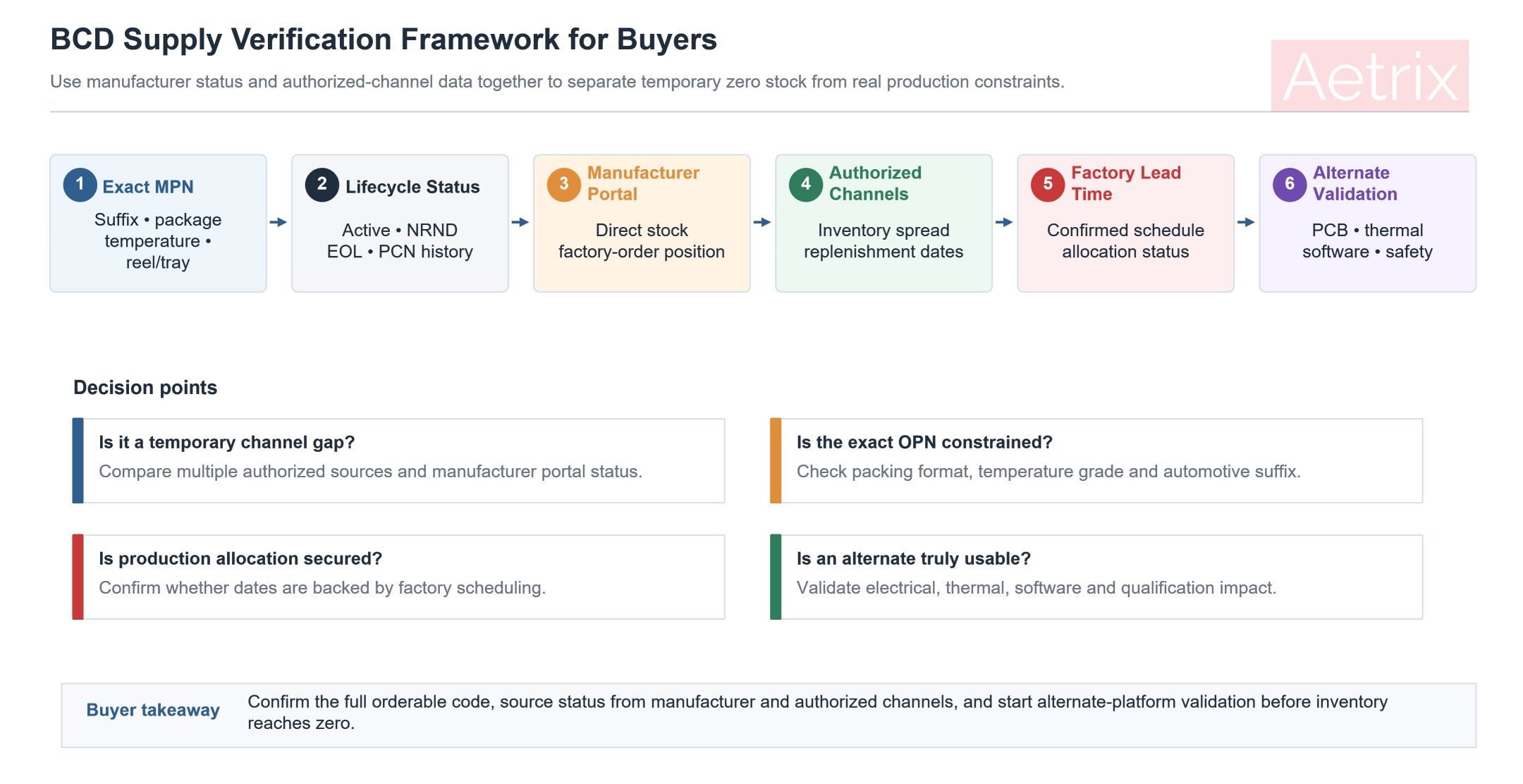
Confirm Exact MPN Availability
Check the full part number, including:
- Package suffix
- Temperature grade
- Automotive qualification
- Packing format
- Product revision
- Lead finish
Base-product availability does not guarantee supply for every exact configuration.
Separate Factory Lead Time From Channel Replenishment
An authorized distributor's expected delivery date can reflect an existing purchase order, allocation estimate or internal replenishment plan. Ask whether the date is supported by confirmed factory scheduling.
Review Platform-Level Alternatives Early
BCD and smart-power IC alternatives may require:
- PCB changes
- Software updates
- Thermal validation
- EMC testing
- Safety review
- New production qualification
An electrically similar product can still require several months of validation.
Confirm Lifecycle Status and PCN History
Distinguish among:
- Temporary zero stock
- Factory-order supply
- Not recommended for new designs
- Packaging-code transition
- End-of-life status
Each condition requires a different purchasing response.
Separate Firm Demand From Forecast Coverage
Longer order coverage can improve supply visibility, but some orders carry NCNR terms, limited rescheduling rights or price-adjustment clauses. Buyers should separate confirmed production demand from contingency volume before placing extended orders.
What to Watch Through 2027
AI Power Revenue and Design Wins
Infineon's expected AI data-center revenue growth provides a direct indicator of how fast power-semiconductor demand is shifting. Similar disclosures from TI, ST, Renesas and onsemi will show whether demand is spreading across the wider analog and smart-power market.
Automotive PMIC and Smart-Switch Lead Times
Watch exact orderable configurations rather than family-level status. A rise in factory-order positions across multiple active automotive products would indicate broader pressure.
200mm Utilization and New Investment
New equipment orders, fab utilization and process transfers will determine how much supply flexibility remains for established BCD platforms.
300mm BCD Ramp
High-volume PMIC and smart-power product transfers to 300mm could improve output. The benefit will arrive gradually and will initially favor newer designs.
Packaging and Test Capacity
Power QFN, Power-SO, automotive assembly and high-voltage test capacity can become separate bottlenecks. Buyers should watch PCNs that add new assembly or test sites, as these notices often signal an attempt to increase supply resilience.
China BCD Qualification Progress
Chinese foundries and analog IC companies are expanding BCD and high-voltage mixed-signal offerings. Industrial adoption can move faster than automotive adoption, where qualification, reliability history and functional-safety support remain significant barriers.
Key Takeaways
- AI, automotive and industrial demand are increasing the strategic value of BCD and smart-power manufacturing platforms.
- AI data-center power is creating new demand for PMICs, drivers, protection ICs, current monitoring and integrated power stages.
- Current BCD supply pressure is concentrated in selected automotive, high-voltage, safety-related and exact orderable configurations.
- BCD production remains specialized despite its use of mature process nodes.
- 200mm wafer capacity, automotive qualification, power packaging and high-voltage test all influence finished-part availability.
- Infineon's expanding AI power business could increase competition for engineering and manufacturing resources across its wider power portfolio.
- ST's BCD and smart-power range gives it broad exposure to automotive and industrial demand, while highly integrated products can be difficult to replace.
- TI's large power-management portfolio will continue to show product-level differences by package, qualification and production priority.
- Renesas product data already shows clear availability differences between tray and reel configurations within the same active family.
- GaN and SiC growth will increase demand for BCD-based control, sensing, protection and gate-driver ICs.
- Buyers should confirm exact MPN availability, factory scheduling, lifecycle status and alternate qualification time before extending order coverage.
The BCD market is entering a period of higher strategic demand. AI infrastructure is expanding the power-semiconductor opportunity at the same time that automotive and industrial systems require long-term access to qualified high-voltage and smart-power products.
The near-term supply risk will remain uneven. High-volume new platforms may receive additional capacity, while automotive variants, specialized packaging and long-life legacy products can remain constrained. Manufacturer-level availability provides only the first layer of the analysis. Exact orderable configurations and confirmed production schedules will determine whether a customer can receive the required component on time.
For component buyers, the most effective response is earlier supply mapping and earlier engineering validation. A selective BCD shortage can still stop an entire system when the constrained device controls power sequencing, protection, communication or a safety-critical load.