My Inquiry
 My Account


Last updated: September 3, 2026
September 2026 Update: TI's September 1 customer pricing letter provides a new example of how the direct-sales infrastructure discussed in this article is being used beyond order fulfillment. TI says upcoming price adjustments will vary by product according to materials, technologies and manufacturing processes, while automated product-specific price-change notifications will be delivered through customer account dashboards. The change gives TI a direct channel for communicating MPN-level pricing to customers and reinforces the role of its account infrastructure in commercial management. See our latest analysis: Texas Instruments Price Increase September 2026: What It Signals for TI Demand, Margins and the Semiconductor Cycle.
Texas Instruments reported second-quarter 2026 revenue of $5.463 billion, up 23% from a year earlier and 13% from the previous quarter. Net income increased 53% to $1.98 billion, while earnings per share rose 52% to $2.14.
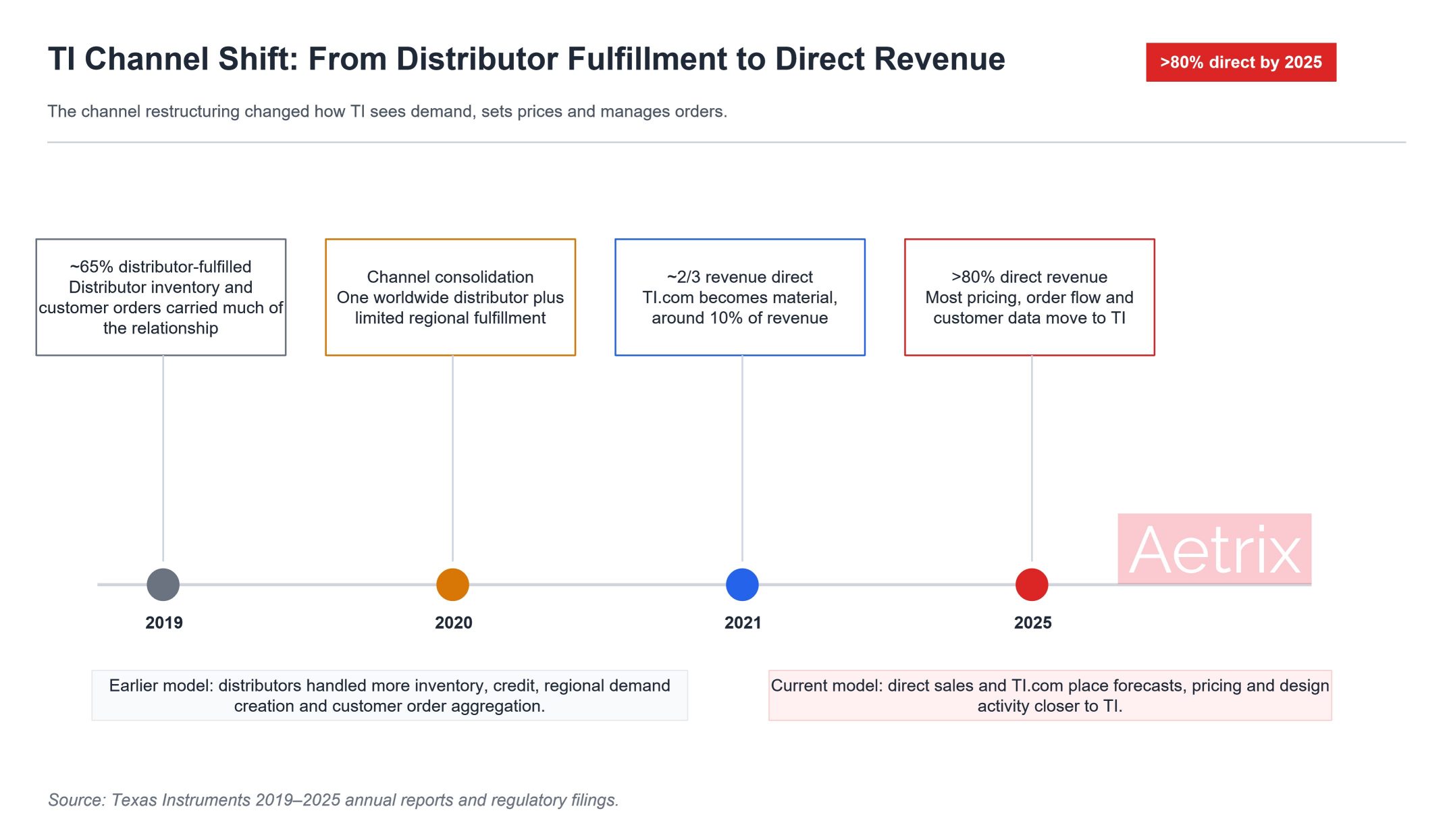
The strength was spread across industrial, data-center and automotive markets. Analog revenue increased 26% to $4.365 billion, Embedded Processing revenue rose 16% to $788 million, and gross margin recovered to approximately 61.4%.
Demand recovery and higher factory utilization produced the quarter's growth. TI's channel strategy determined how efficiently that demand moved through inventory, pricing and production planning.
In 2019, approximately 65% of TI sales were fulfilled through distributors. By 2025, more than 80% of revenue was direct, including TI.com. That change gave TI direct access to most customer forecasts, design projects and commercial negotiations just as industrial, automotive and AI infrastructure demand began recovering together.
The result is visible in several parts of the latest financial report: revenue rose sharply, inventory declined, backlog increased and gross margin recovered faster than sales. Channel reform did not create the end-market demand. It gave TI a more controlled way to convert that demand into shipments and profit.
TI Q2 2026 Financial Snapshot
| Metric | Q2 2026 | Change |
|---|---|---|
| Total revenue | $5.463 billion | +23% YoY, +13% QoQ |
| Analog revenue | $4.365 billion | +26% YoY |
| Embedded Processing revenue | $788 million | +16% YoY |
| Net income | $1.98 billion | +53% YoY |
| Gross margin | Approximately 61.4% | About +340 bps QoQ |
| Inventory | $4.605 billion | Down $90 million QoQ |
| Q3 revenue guidance | $5.65–$6.15 billion | Further sequential growth possible |
Financial figures are based on Texas Instruments' second-quarter 2026 earnings release. Gross margin is calculated from reported revenue and gross profit. (Texas Instruments, Second Quarter 2026 Financial Results)
TI's Recovery Spreads Across Three Major Markets
TI entered 2026 with industrial and data-center demand already improving. Automotive became a stronger contributor during the second quarter, giving the company a broader recovery than it had at the beginning of the year.
Data-center revenue doubled from a year earlier and increased approximately 20% sequentially. AI infrastructure is driving demand for power-management ICs, isolation devices, current sensors, signal-chain products, timing devices and embedded controllers. These components sit around processors, accelerators, memory, networking equipment and power-conversion systems.
Industrial revenue increased approximately 30% year over year and around 10% sequentially. The improvement covered multiple applications rather than one large automation program. Factory equipment, energy infrastructure, robotics, test systems and other industrial markets had spent several quarters reducing excess semiconductor inventory. Higher shipments now indicate that customers are purchasing for current production again.
Automotive revenue returned to mid-teens year-over-year growth and increased by an upper-single-digit percentage from the first quarter. Demand strengthened during the quarter, with China's electric and hybrid vehicle markets providing an important contribution.
The pattern is stronger than a recovery led by one product category. Industrial, data center and automotive have different investment cycles and customer bases. Their simultaneous growth reduces TI's dependence on one short-term replenishment event. (Texas Instruments, Q2 2026 Earnings Conference Call)
How TI Changed Its Sales Channel
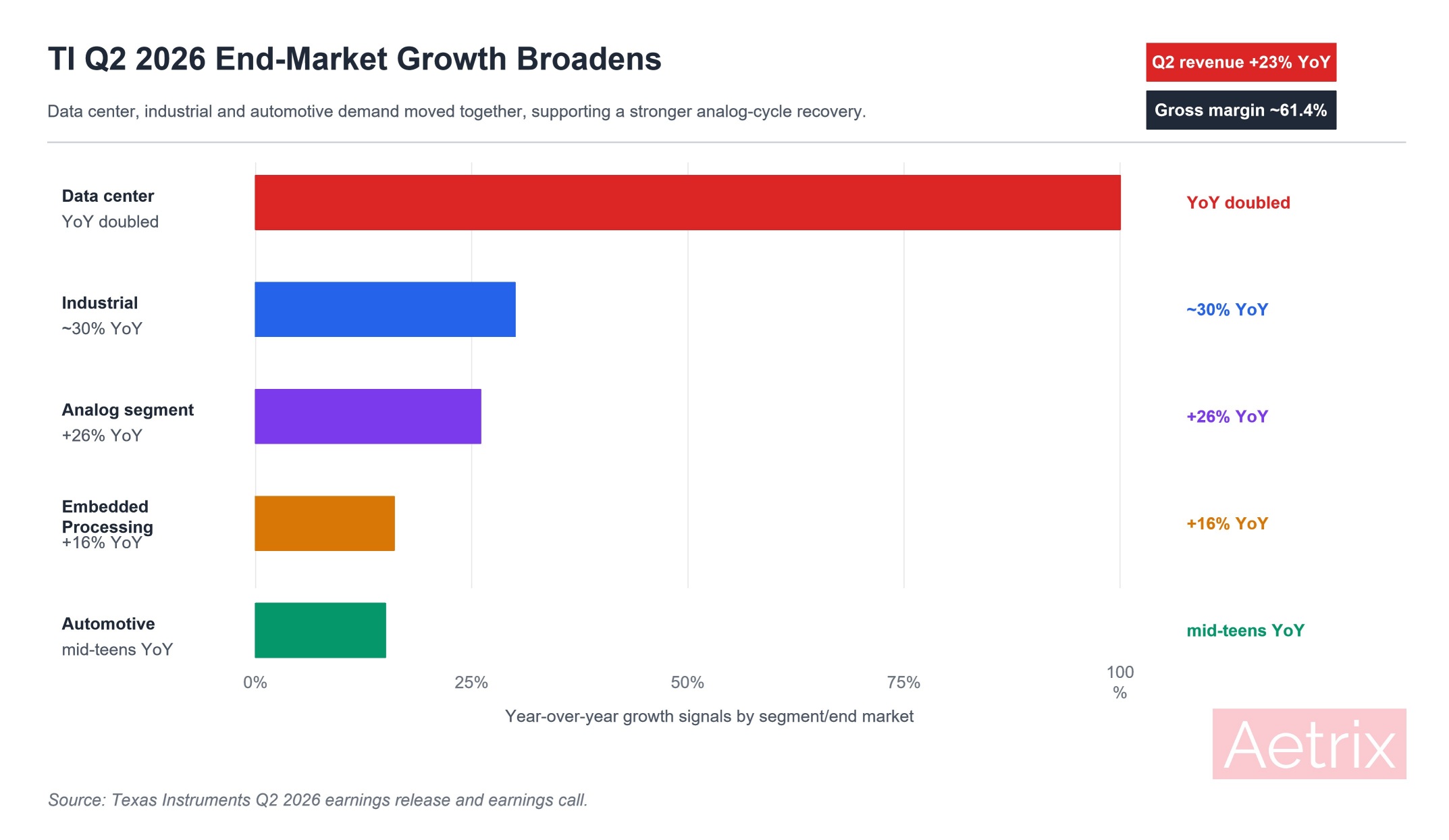
TI previously relied on distributors to fulfill most customer orders. In 2019, approximately 65% of sales moved through distribution. Distributors carried inventory, provided local credit, supported customer designs and combined TI products with components from other manufacturers.
During 2019 and 2020, TI ended several broadline distribution relationships and moved more customers into its own sales organization, inventory programs and online purchasing platform. By the end of 2020, the company had consolidated the network around one worldwide distributor and a limited number of regional distributors used mainly for order fulfillment. (Texas Instruments 2020 Form 10-K)
The transition continued after 2020. About two-thirds of revenue was direct in 2021, and TI.com represented approximately 10% of revenue. Direct sales reached about 80% in 2024 and exceeded 80% in 2025.
| Year | Reported Channel Position | Operational Change |
|---|---|---|
| 2019 | About 65% of sales fulfilled through distributors | Distributors owned much of the order flow and customer inventory layer |
| 2020 | One worldwide distributor plus limited regional channels | Customer management and demand creation moved closer to TI |
| 2021 | About two-thirds of revenue direct; TI.com about 10% | Online direct purchasing became a material sales channel |
| 2025 | More than 80% of revenue direct | TI controlled most customer data, pricing and order visibility |
TI describes closer customer relationships as a way to access more design projects, sell more products into each design and gain better knowledge of customer requirements. Those benefits are now relevant to a much larger share of company revenue. (Texas Instruments 2025 Form 10-K)
The Q2 Numbers Show Why Direct Demand Data Matters
Under a distributor-led model, the manufacturer often receives one consolidated order covering multiple end customers. That order may reflect factory demand, distributor safety stock, expected price changes or an attempt to secure extra supply. The original manufacturer cannot always separate those motives immediately.
Direct business provides more detail. TI can see the customer, product, delivery schedule and project behind a larger share of its orders.
Consider an automotive customer requesting 500,000 power-management ICs. Direct engagement allows TI to determine whether the quantity supports confirmed vehicle production, a new platform launch or a temporary safety-stock increase. Each situation leads to a different wafer-start, inventory and pricing decision.
The second-quarter inventory data shows how that visibility can be used. TI's revenue increased 13% sequentially, while inventory declined by $90 million to $4.605 billion. Inventory days fell from 209 to 196.
TI shipped more product without adding another large layer of stock. Backlog also increased during the quarter, indicating that customer orders were arriving faster than all demand could be shipped.
Backlog can still change through cancellations, rescheduling and customer forecast revisions. A direct order base gives TI more information for judging the quality of those orders than it had when most demand was aggregated through distributors.
The inventory balance remains high in absolute terms. TI intentionally carries broad product inventory to support a portfolio with long life cycles and more than 100,000 customers. During the current recovery, that stock has become a sales advantage: customers can obtain many TI products while competing suppliers are already reporting substantially longer lead times on selected components.
Direct Pricing Changes How TI Manages the Upturn
TI does not need one uniform channel price increase to improve price realization. Most large customers negotiate directly with the company, allowing adjustments to vary by product family, annual volume, contract timing and supply commitment.
Management indicated that pricing remained generally stable during the first half of 2026. Selective increases had begun, although the expected third-quarter revenue contribution remained small. Shipment volume was still expected to provide most of the near-term growth.
The commercial effect may become more visible during fourth-quarter contract negotiations. Automotive, industrial and data-center customers renewing annual agreements can receive different adjustments even when TI issues no single portfolio-wide channel notice.
This gives buyers less certainty from general market announcements. One customer may retain existing pricing through a long-term agreement, while another sees an increase on the same product family when renewing a shorter contract.
The direct model also reduces price conflict between distributors holding inventory acquired at different costs. TI has clearer control over the price offered to a strategic volume account, a small TI.com purchaser and a customer using an authorized fulfillment channel.
TI has not disclosed how many gross-margin points come from channel restructuring. The financial benefit cannot be separated cleanly from product mix, manufacturing cost and utilization. Direct pricing remains a structural support rather than a complete explanation for the quarterly margin increase.
September 2026 Update: TI's Direct Model Is Now Visible in Price Management
TI's September 1 customer pricing letter provides a practical example of how the company's direct customer infrastructure can be used for more than demand visibility and order management. TI says upcoming price adjustments will vary by product according to materials, technologies and manufacturing processes, and that automated product-specific price-change notifications will be delivered through customer account dashboards.
This is a different pricing workflow from a manufacturer sending one revised price book through a broad distributor network. TI can communicate changes directly to the customer account and tie the notification to the individual product. The final commercial outcome can still depend on volume, project pricing, backlog and account terms, but the communication layer now sits much closer to TI and the end customer.
| Direct-Sales Capability | Earlier Role | September 2026 Evidence |
|---|---|---|
| Customer visibility | Direct access to customer orders, designs and forecasts | Individual accounts can receive product-specific pricing information |
| Pricing control | Account-level negotiation and selective adjustments | Adjustments can vary by MPN according to product economics |
| Communication | Sales teams, TI.com and fulfillment channels | Automated price-change notifications through TI account dashboards |
| Buyer requirement | Monitor quotes and annual negotiations | Monitor exact MPN, dashboard notice, effective date and backlog treatment |
The September letter does not prove that direct sales automatically produce higher margins or stronger pricing power. TI cites market dynamics and rising costs throughout the supply chain as reasons for the upcoming adjustments, so some repricing may offset higher costs rather than create additional profit. Customer resistance and competitive alternatives can also limit how much of an adjustment remains in place over time.
The strategic value is greater visibility and control. TI can observe a larger share of customer demand directly, communicate product-level changes through its own account system and manage commercial terms without relying entirely on a distributor to transmit pricing information. That becomes more useful as demand recovers and pricing differs increasingly by MPN rather than by broad product category.
The September communication does not provide a new universal effective date and should not yet be classified as a confirmed fourth independent TI price increase in 2026. For the full analysis of the letter, including the relationship with the October 1 adjustment, TI's 300mm manufacturing economics and the implications for its operating cycle, see Texas Instruments Price Increase September 2026: What It Signals for TI Demand, Margins and the Semiconductor Cycle.
Why Gross Margin Returned Above 61%
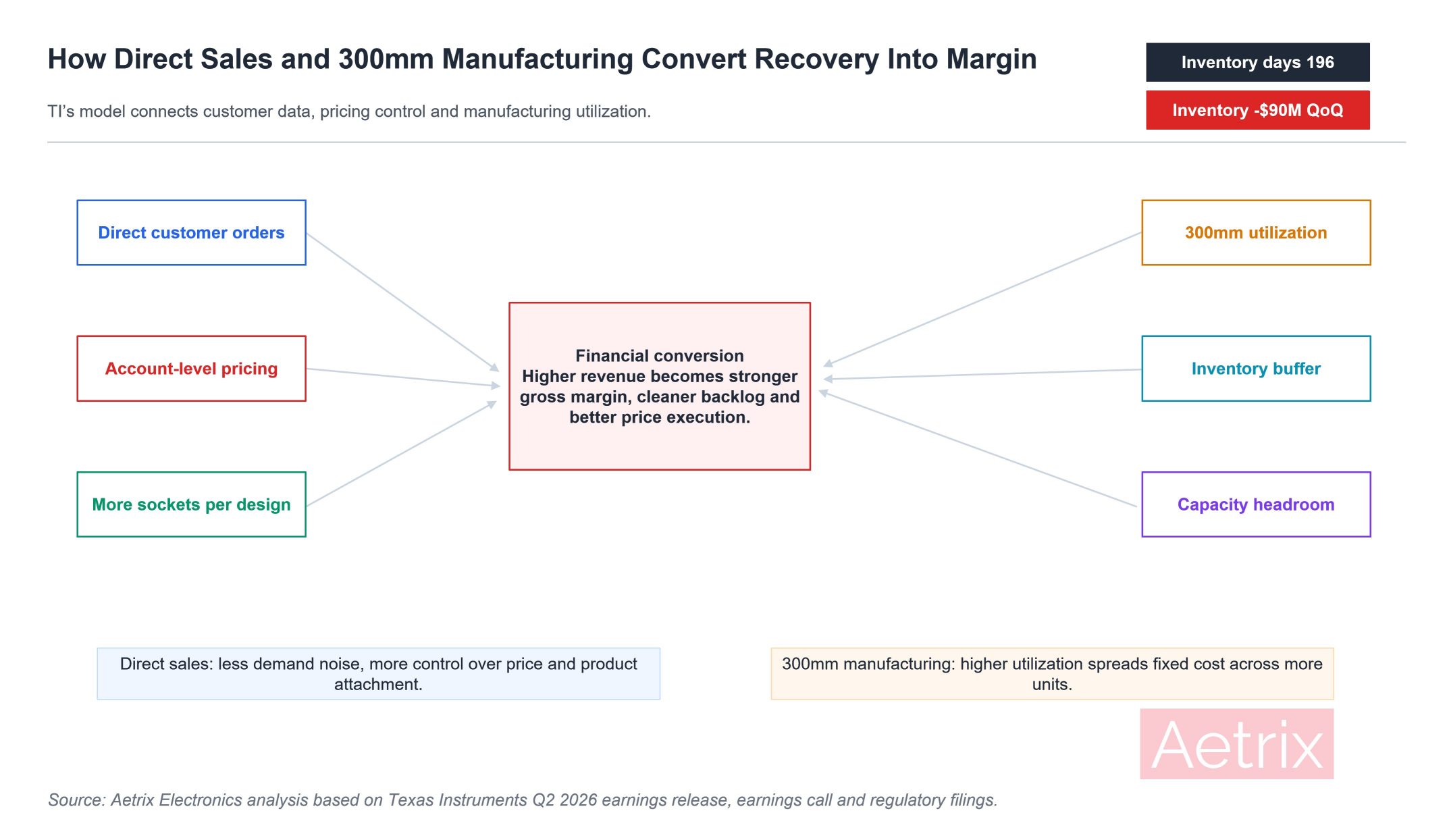
TI's gross margin rose by roughly 340 basis points sequentially to approximately 61.4%. Higher factory utilization was the largest immediate driver.
Semiconductor factories carry substantial fixed costs. When sales decline, depreciation, staffing and facility costs are spread across fewer shipped units. A 13% sequential revenue increase reverses part of that pressure quickly.
The revenue mix also improved. Analog grew faster than the company average, while industrial, automotive and data-center applications provided more of the quarter's growth. These markets use large numbers of power, signal-chain, isolation and embedded products with long production lives.
TI's 300mm factories add another layer of operating leverage. A 300mm wafer provides more usable die than a 200mm wafer, reducing manufacturing cost per chip once utilization and yield reach effective levels.
Direct sales support the commercial side of this manufacturing model. TI can direct existing inventory and new wafer starts toward customers with confirmed demand, negotiate pricing at account level and introduce additional TI products into active designs.
Factory utilization produced the rapid margin recovery. The channel model helped TI retain more control over the revenue and product mix generated by that higher output.
Large and Small Customers Experience Different Results
TI's channel model has produced a clear customer split.
Large automotive, industrial and data-center customers fit the direct structure well. They can provide annual forecasts, negotiate scheduled deliveries and involve TI engineers early in the design cycle. TI gains visibility into future production, while the customer gains a direct path to product, pricing and supply decisions.
A large customer may also use more TI content over time. A power-management design win can lead to additional isolation, sensing, interface or embedded-control sockets in the same system. TI's broad portfolio makes this cross-selling economically significant.
Smaller OEMs and design houses have different requirements. Many previously relied on regional distributors for credit terms, local FAE support, flexible quantities and one purchase order covering several semiconductor brands.
TI.com provides product information, samples, inventory visibility and online ordering, but it does not reproduce every local service. A small industrial customer may prefer a distributor that can supply the complete BOM, provide payment terms and send an engineer to the customer's facility.
| Customer Group | Main Benefit | Main Limitation |
|---|---|---|
| Large automotive and industrial accounts | Direct forecasts, annual pricing, product support and supply planning | Greater dependence on TI's account-level commercial terms |
| Data-center and infrastructure customers | Early design engagement and access to multiple TI product categories | Fast platform cycles require close forecast coordination |
| Small OEMs and design houses | Direct access to TI.com inventory, samples and documentation | Less access to local credit, dedicated FAE support and multi-brand purchasing |
| Regional distributors | Continued opportunity in fulfillment, logistics and local customer support | Reduced control over pricing and strategic customer relationships |
The long-tail service gap creates an opening for regional analog suppliers. Chinese manufacturers such as SGMICRO, Novosense and other local vendors can combine competitive products with local engineering, flexible commercial terms and faster support.
A small design win does not immediately affect TI's financial performance. Repeated wins across industrial controllers, power modules and automotive subsystems can build a meaningful competitive position over several product generations.
The Distributor Role Is Narrower but Still Relevant
Authorized distributors no longer control most TI customer demand. Their role has shifted toward order fulfillment, available inventory, small-quantity purchasing, logistics and selected regional support.
That role remains valuable. Many customers do not want separate purchasing systems for every semiconductor manufacturer. A distributor can combine multiple brands, manage local import procedures and provide one commercial account for a complete BOM.
Independent distributors occupy another part of the market. They support urgent shortages, legacy products and customers that cannot obtain the required quantity through normal channels. Their opportunity grows when the exact TI part is constrained, although traceability and quality risk must be managed carefully.
The channel reform has reduced the amount of inventory and customer information controlled by intermediaries. It has not removed the need for local logistics, credit, technical service and multi-brand procurement.
What TI's Results Mean for Component Buyers
Industrial and Automotive Demand Needs Earlier Planning
The recovery is now broad enough to affect purchasing behavior. Customers should review power-management ICs, isolation devices, gate drivers, amplifiers, data converters and embedded processors used in industrial and automotive programs.
TI still has substantial inventory and manufacturing capacity, so a portfolio-wide shortage is not the base case. Exact MPNs can tighten earlier when they depend on a specific package, test flow or qualified production route.
Annual Price Negotiations May Show More Pressure
Pricing pressure is now becoming more visible ahead of fourth-quarter contract renewals and 2027 negotiations. TI's September 1 letter gives advance notice of upcoming product-level adjustments and says the final changes will vary according to materials, technologies and manufacturing processes.
Buyers should review TI account-dashboard notifications alongside quotation validity, scheduled releases, open backlog and forecast commitments. The relevant question is no longer whether TI pricing is generally stable; it is which exact MPNs are changing, when the new price becomes effective and whether existing project or backlog pricing remains protected.
AI-Related Products Need BOM-Level Monitoring
Data-center growth affects more than specialized AI processors. Power converters, isolation devices, current-sensing amplifiers, interface products and embedded controllers can experience faster demand growth as server and power architectures scale.
Procurement teams should identify TI components connected to data-center power, cooling, networking and storage programs and confirm whether forecast coverage matches the customer's platform ramp.
Alternative Sources Remain Important
TI's current supply position is stronger than many smaller analog suppliers, but its direct model gives the company tighter control over commercial terms and allocation.
Engineering teams should retain qualified alternatives for high-volume and long-life products. Alternative planning gives buyers leverage during annual price negotiations and reduces dependence on one manufacturer's customer-priority system.
The Costs and Risks of TI's Direct Model
Direct sales transfer more responsibility to TI. The company must operate customer-service systems, e-commerce infrastructure, global logistics, inventory programs and a large sales and applications organization.
Inventory risk also sits more visibly on TI's balance sheet. Distributors previously owned part of the supply buffer. TI now carries more inventory itself so products can be delivered directly or through consignment programs.
The $4.605 billion inventory balance supported higher second-quarter shipments. It would become more burdensome if automotive, industrial or data-center demand weakened suddenly.
Channel concentration creates another exposure. Relying on one worldwide fulfillment distributor and a limited group of regional partners leaves fewer alternate routes during a regulatory, geographic or operational disruption.
Customer coverage remains the longer-term strategic risk. TI can serve major accounts efficiently through direct teams and TI.com. Regional competitors may provide more personal support to smaller customers that need local engineering, payment terms and multi-brand purchasing.
TI Outlook Through 2027
TI expects third-quarter revenue between $5.65 billion and $6.15 billion and earnings per share between $2.23 and $2.57. The range supports continued recovery during the second half of 2026.
Industrial demand appears to be moving beyond inventory correction. Automotive has begun contributing more strongly, and data-center demand continues to grow from AI infrastructure investment.
Higher factory utilization should continue supporting gross margin, particularly as more products move through TI's 300mm manufacturing network. Selective price adjustments could add another benefit as annual customer agreements are renewed.
The channel strategy gives TI direct access to the customers generating most of that demand. It also places inventory, logistics and service costs more fully inside the company.
The model is likely to perform well while industrial, automotive and data-center demand remain aligned. Its next test will come when one of those markets slows and TI must balance high internal capacity, a large inventory position and direct responsibility for customer coverage.
Key Takeaways
- TI's second-quarter 2026 revenue increased 23% year over year to $5.463 billion, with industrial, data-center and automotive markets all contributing.
- Analog revenue increased 26%, while gross margin recovered to approximately 61.4%.
- TI moved from approximately 65% distributor-fulfilled sales in 2019 to more than 80% direct revenue in 2025.
- Revenue increased 13% sequentially while inventory declined by $90 million, showing how TI used its inventory buffer during the recovery.
- Direct customer data helps TI distinguish confirmed production demand from safety-stock or speculative orders.
- Account-level pricing gives TI more control over selective increases, and the September 1 customer letter now shows product-specific price-change notifications being delivered through TI account dashboards.
- Higher factory utilization and 300mm production were the main drivers of the rapid gross-margin recovery.
- Large automotive, industrial and data-center customers receive the greatest benefit from direct forecasting and supply coordination.
- Smaller customers may still need distributors for credit, local FAE support, flexible quantities and multi-brand purchasing.
- The long-tail service gap gives regional analog suppliers and local distributors room to win new design opportunities.
- Buyers preparing 2027 procurement plans should monitor TI account-dashboard pricing notices, exact-MPN effective dates, backlog treatment, quotation validity and AI-related analog demand.