My Inquiry
 My Account


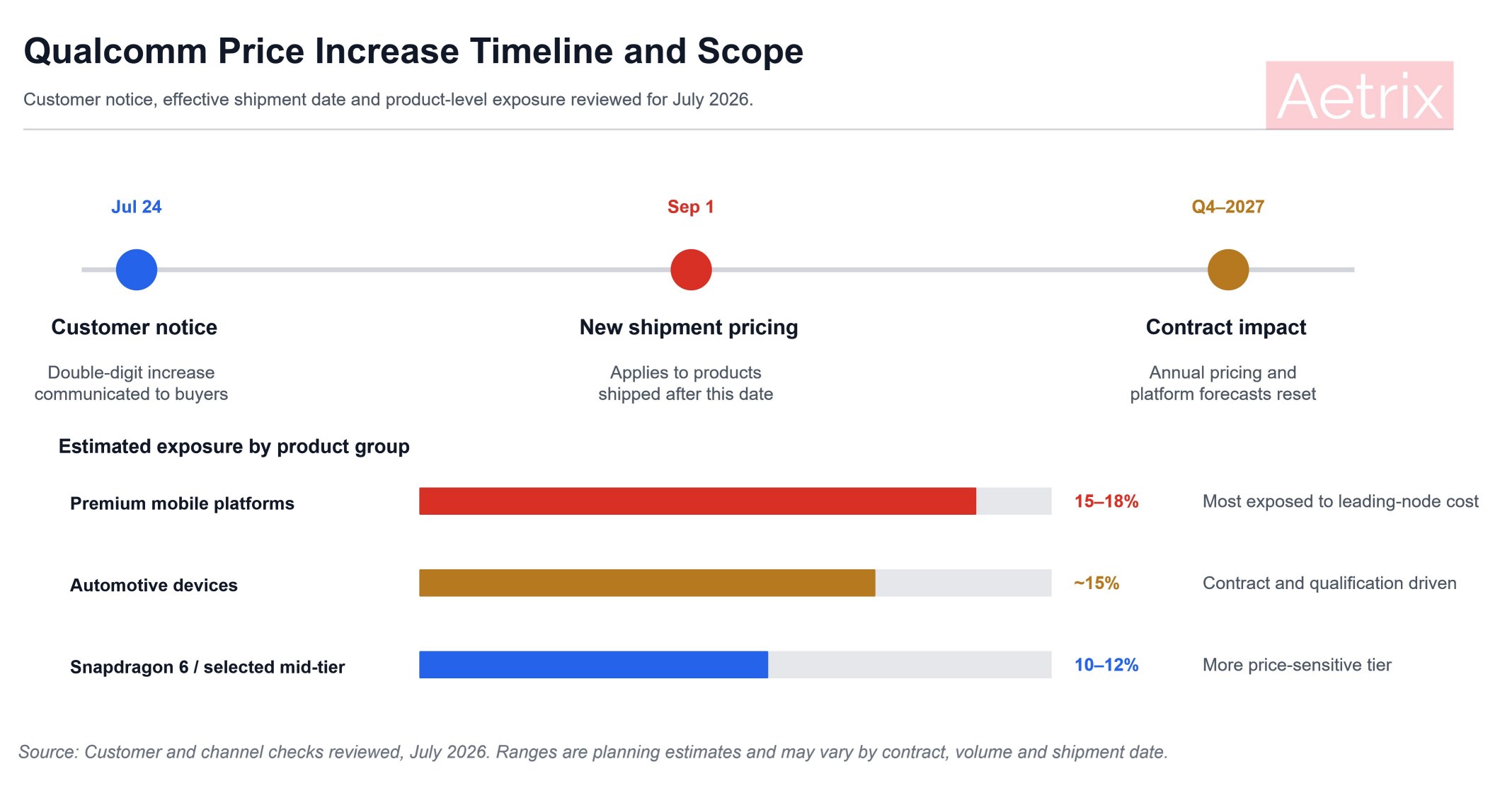
Qualcomm informed customers on July 24, 2026 that it will implement double-digit percentage price increases on products shipped after September 1, 2026. The notice states that rising supplier costs can no longer be absorbed internally and that efforts to qualify alternative component sources have not been sufficient to offset the increase. The adjustment is tied to shipment timing, which means open orders scheduled for delivery after September 1 may also be affected.
Customer communications and channel checks indicate that the increase will be implemented by product line, account and contract rather than through one uniform public price list. Premium mobile platforms, automotive devices and advanced-computing products are expected to face the greatest pressure, while the final adjustment will depend on purchase volume, price-protection terms, backlog status and confirmed shipment date. Buyers should therefore verify pricing against the exact MPN and delivery schedule instead of relying on a general percentage range.
The adjustment arrives as advanced-node manufacturing costs rise, memory inflation disrupts smartphone production and AI infrastructure absorbs a growing share of the semiconductor industry's investment. Qualcomm is also committing more resources to automotive computing, PCs, edge AI and data-center processors while its handset-chip business faces weaker unit shipments.
The price increase therefore has several dimensions. It transfers supplier costs to customers, protects the economics of increasingly complex Snapdragon platforms and tests how much pricing power Qualcomm retains across premium Android, mid-range smartphones, automotive systems and emerging AI devices.
Qualcomm Price-Increase Snapshot
| Item | Current Information |
|---|---|
| Customer notice date | July 24, 2026 |
| Effective date | Products shipped after September 1, 2026 |
| Headline adjustment | Double-digit percentage increase |
| Reported explanation | Rising supplier costs that Qualcomm can no longer fully absorb |
| Highest exposure | Premium mobile, automotive and advanced-computing platforms |
| Immediate buyer action | Confirm shipment-based pricing, backlog protection and contract terms |
The Increase Will Vary by Product, Customer and Contract
A double-digit adjustment does not mean every Qualcomm device will increase by the same percentage. Customer volume, platform generation, manufacturing node, annual contract timing and supply commitments can all change the final price.
Channel and supply-chain estimates reviewed in July 2026 indicate increases of approximately 10% to 12% for selected Snapdragon 6 products, 15% to 18% for next-generation flagship platforms and around 15% for certain automotive devices. These ranges have not been published by Qualcomm as an official product-level price schedule.
A large smartphone manufacturer operating under a long-term agreement may receive different treatment from a smaller customer purchasing through a regional supply channel. Existing backlog may retain previous pricing when a contract includes protection, while open orders without fixed-price terms can be repriced according to shipment date.
The September 1 wording is particularly important. A purchase order accepted in August does not automatically secure the old price if the material ships in September or later. Buyers need written confirmation covering the exact MPN, quantity, scheduled shipment and price-validity terms.
Advanced-Node Economics Are Raising Flagship SoC Costs
Qualcomm's leading smartphone processors have become substantially more expensive to design and manufacture. Each new generation combines custom CPU cores, a larger GPU, an increasingly capable NPU, image-processing engines, security functions, memory controllers and high-speed connectivity inside one platform.
Industry estimates place an early 2nm wafer at approximately $30,000, around 10% to 20% above comparable 3nm production. This is an indicative foundry estimate rather than a public TSMC price quotation. The usable cost per chip also depends on die size, defect density, yield and the number of functional dies obtained from each wafer.
Initial production on a new node usually carries lower yields than a mature process. A larger or more complex die loses more value when a manufacturing defect makes it unusable. Yield improvement can reduce unit cost over time, but early flagship launches bear more of the initial ramp expense.
Manufacturing represents only one part of the cost increase. A leading-edge SoC requires more expensive masks, design tools, verification, third-party IP, validation equipment and engineering labor. Packaging and final testing also become more demanding as power density, memory speed and interface complexity increase.
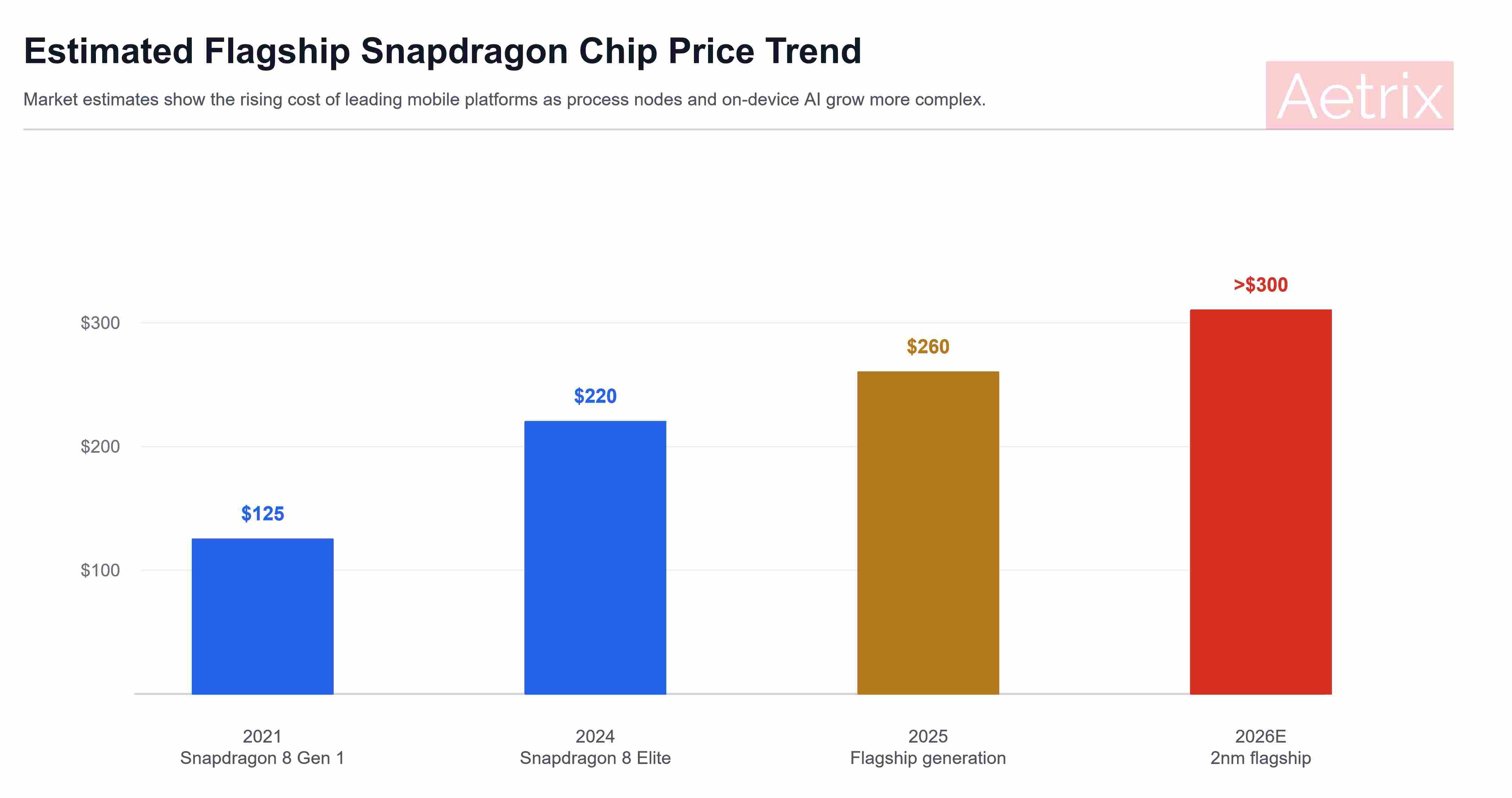
| Platform Generation | Estimated Chip Price | Market Context |
|---|---|---|
| Snapdragon 8 Gen 1, 2021 | About $120–$130 | Early 4nm flagship generation |
| Snapdragon 8 Elite, 2024 | About $220 | Custom CPU and higher AI performance increased platform value |
| 2025 flagship generation | About $240–$280 | Industry and channel estimate, varying by customer and configuration |
| Next-generation 2nm flagship platform | Potentially above $300 | Forward industry estimate, not a confirmed Qualcomm quotation |
The historical figures are market estimates rather than uniform selling prices. They still show the direction of travel: the application processor is consuming a larger share of a premium smartphone's bill of materials.
A 15% increase on a $250 platform would add $37.50 before the phone manufacturer accounts for logistics, tariffs, financing, warranty and retail margin. The final device-price impact can therefore exceed the direct semiconductor cost.
AI Is Reallocating Semiconductor Resources
AI infrastructure is changing investment priorities across foundries, memory suppliers, packaging companies and substrate manufacturers. The highest-value capacity is increasingly directed toward accelerators, custom ASICs, high-bandwidth memory and data-center networking.
Mobile SoCs do not generally use the same CoWoS configuration as large AI accelerators. They still compete within a broader manufacturing ecosystem for advanced lithography equipment, engineering resources, packaging development, high-performance substrates and supplier capital.
When an upstream manufacturer can direct investment toward a high-margin AI product or a consumer platform, the opportunity cost of serving the consumer market rises. Suppliers then seek higher prices, firmer forecasts or longer commitments from mobile customers.
Qualcomm is also becoming a larger participant in the data-center market. Its Dragonfly roadmap includes the C1000 CPU, AI200, AI250 and AI300 accelerators, custom silicon and High Bandwidth Compute technology. Commercial sampling of AI250 with first-generation HBC is expected in 2027, while AI300 is planned for 2028. (Qualcomm, Dragonfly data-center roadmap)
This expansion increases Qualcomm's own need for advanced design teams, high-speed connectivity IP, packaging expertise and supply-chain commitments. Protecting the economics of its established handset platforms becomes more important as the company funds several new computing businesses at the same time.
Why Memory Prices Affect Qualcomm Indirectly
Smartphone DRAM and NAND are generally purchased by the handset manufacturer rather than supplied as part of Qualcomm's mobile processor. Memory inflation therefore does not flow directly into every Snapdragon chip's manufacturing cost.
It affects Qualcomm through the customer's total device budget. When LPDDR and NAND prices rise sharply, a phone manufacturer has less room to absorb a more expensive application processor, display, camera or power system.
| Cost Area | Main Buyer | Effect on Qualcomm |
|---|---|---|
| SoC wafer fabrication | Qualcomm and its manufacturing supply chain | Direct product-cost pressure |
| SoC package, substrate and final test | Qualcomm and its manufacturing partners | Direct product-cost pressure |
| LPDDR and NAND | Smartphone OEM | Higher device BOM, weaker production forecasts and greater resistance to SoC price increases |
| Display, camera and passive components | Smartphone OEM | Competes with the processor for the OEM's available cost budget |
Qualcomm's fiscal second-quarter filing provides a practical example. Handset-chip revenue fell 13% year over year to $6.024 billion as certain major customers reduced build plans and inventory in response to memory constraints and related price increases. Automotive revenue rose 38% to $1.326 billion, while IoT revenue increased 9% to $1.726 billion. (Qualcomm fiscal Q2 2026 Form 10-Q)
Counterpoint Research estimated that global smartphone SoC shipments declined 8% year over year in the first quarter of 2026. Its research also found that premium devices were more capable of passing costs to consumers, while entry-level manufacturers increasingly adopted older or lower-cost chipsets. (Counterpoint Research, Q1 2026 smartphone SoC market)
This creates a difficult pricing environment. Qualcomm faces higher direct manufacturing costs while its customers are already absorbing a large increase elsewhere in the device BOM.
How Qualcomm's Increase Differs From the Wider 2026 Semiconductor Price Cycle
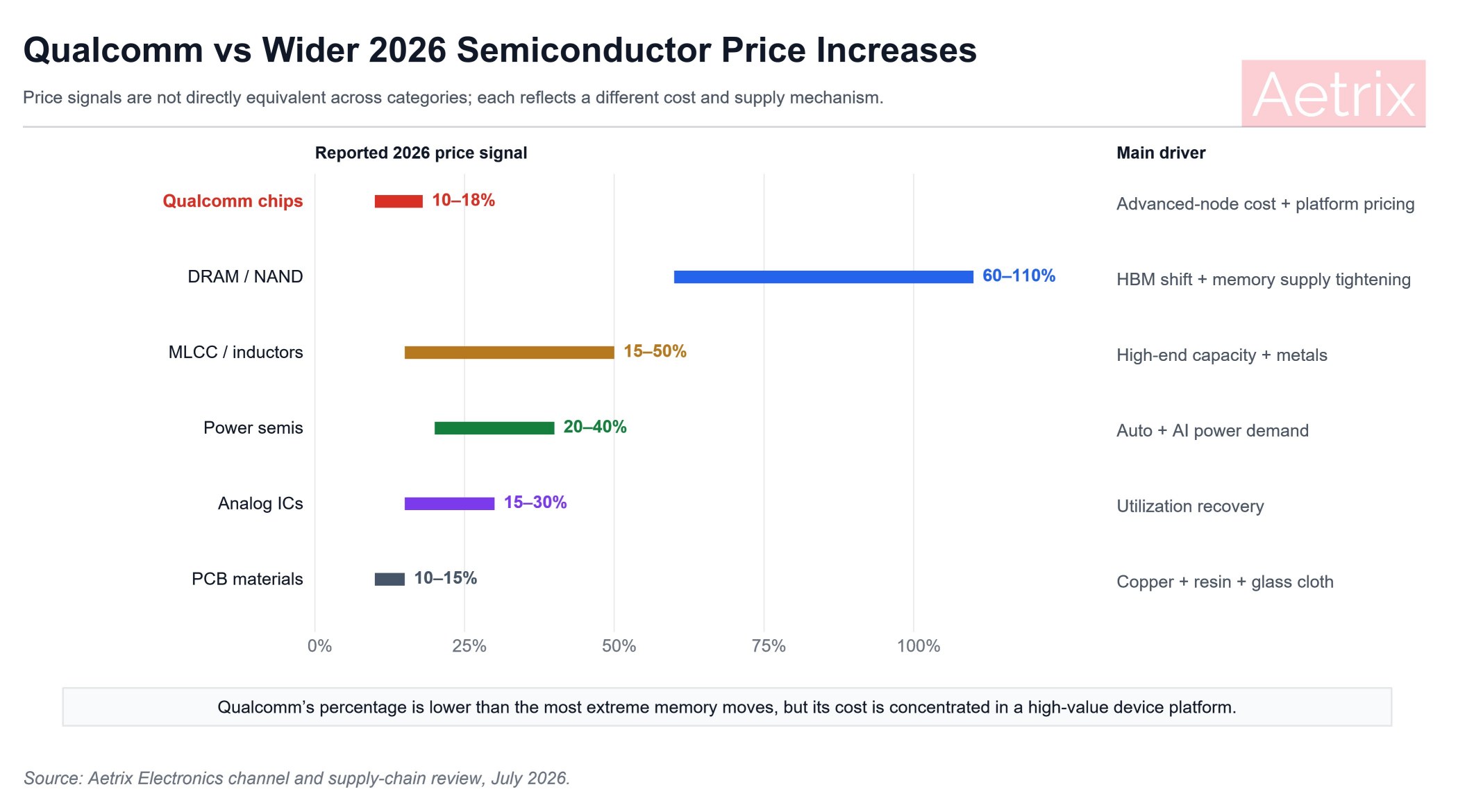
Qualcomm is joining a broader semiconductor and electronic-component price cycle. The mechanism differs across product categories, and the percentage ranges should not be treated as directly equivalent.
Memory figures may refer to spot-market movements, quarterly contract resets or particular capacities. Passive-component increases often affect only high-performance specifications. Qualcomm's adjustment is a supplier-level commercial action with a stated effective date and customer-specific implementation.
| Category | Reported 2026 Price Signal | Main Driver | Pricing Pattern |
|---|---|---|---|
| Qualcomm chips | About 10%–18% | Advanced-node cost, supplier inflation and platform positioning | Defined effective date with customer- and product-level implementation |
| DRAM and NAND | About 60% to above 100% for selected products | HBM capacity shift and memory supply tightening | Contract and spot prices reset periodically |
| MLCC and inductors | About 15%–50%+, depending on specification | High-end capacity, metals and long expansion cycles | Highly product-specific |
| Power semiconductors | About 20%–40% for selected products | Automotive demand, AI power systems and mature-node constraints | Allocation and product-level adjustments |
| Analog ICs | About 15%–30% for selected products | Utilization recovery and manufacturing costs | Customer- and product-specific negotiation |
| PCB materials | About 10%–15% | Copper, resin, glass cloth and energy costs | Staged upstream increases |
The ranges above combine manufacturer notices, market reports and Aetrix Electronics' channel review as of July 2026.
Qualcomm's reported percentage is lower than the most extreme memory and passive-component movements. Its effect is concentrated in one of the highest-value components inside a premium Android device.
Replacement is also difficult once a smartphone platform has entered development. Changing the application processor can affect the PCB, RF design, thermal system, camera tuning, software, certification and launch schedule. The switching cost gives Qualcomm meaningful negotiating leverage on high-end projects.
Qualcomm's Pricing Power Varies by Smartphone Tier
Qualcomm remains highly influential in premium Android smartphones, where OEMs require top CPU and GPU performance, advanced camera support, global modem capability and mature software integration. The number of practical substitutes becomes limited after a flagship design is underway.
Its position across the full smartphone market is more competitive. Counterpoint Research reported that MediaTek held 32% of global smartphone AP-SoC shipments in the first quarter of 2026, compared with 23% for Qualcomm. Apple represented 19%, UNISOC 14% and Samsung 7%. (Counterpoint Research, global smartphone AP-SoC market share)
| Market Tier | Qualcomm Pricing Position | Likely OEM Response |
|---|---|---|
| Premium Android | Strongest leverage due to performance, modem and ecosystem requirements | Accept part of the increase, raise retail pricing or reduce other BOM costs |
| Upper mid-range | Moderate leverage with more competition from MediaTek and older flagship platforms | Use a standard rather than Pro platform or extend the previous generation |
| Entry-level smartphones | Limited room for double-digit increases | Shift volume toward MediaTek, UNISOC or older chipsets |
| Vertically integrated OEMs | Reduced leverage where the OEM has an internal processor option | Increase internal silicon use in later product cycles |
The current increase will test demand elasticity. Premium Android brands may preserve Snapdragon adoption to protect performance and product positioning. Mid-range and entry-level manufacturers have more freedom to change platforms, reuse older processors or reduce order volume.
Handset Margins Remain Important to Qualcomm's Expansion
Qualcomm is diversifying rapidly, but handset products remain the largest source of QCT revenue. In fiscal Q2 2026, handsets generated $6.024 billion, compared with $1.326 billion from automotive and $1.726 billion from IoT.
| QCT Revenue Stream | Fiscal Q2 2026 Revenue | Year-over-Year Change |
|---|---|---|
| Handsets | $6.024 billion | -13% |
| Automotive | $1.326 billion | +38% |
| IoT | $1.726 billion | +9% |
Automotive, IoT, PCs and data-center computing provide the company with important long-term growth opportunities. These areas also require sustained engineering, software, acquisition and manufacturing investment.
Maintaining handset-chip margins becomes more important as Qualcomm increases spending across those new markets. The price increase can protect the value of flagship platforms without requiring the company to depend entirely on smartphone unit growth.
This strategy has limits. Raising mobile-platform prices too aggressively can encourage Samsung to increase Exynos adoption, strengthen MediaTek in upper-tier Android devices and improve the business case for internal silicon development at other OEMs.
Lead Times Are Extending, but the Pressure Is Product-Specific
The reported price increase does not mean every Qualcomm product is experiencing a severe shortage. Supply-chain lead-time signals vary considerably by platform.
| Product Category | Supply-Chain Lead-Time Signal | Primary Exposure |
|---|---|---|
| Premium mobile platforms | About 20–24 weeks | Advanced-node production and initial product ramp |
| Selected constrained flagship versions | Up to about 28 weeks | Exact configuration, allocation and early capacity |
| Snapdragon 6 and 7 series | About 8–12 weeks | Generally stable, with variation by generation and customer |
| Selected IoT and wearable chips | About 14–16 weeks | Mature-node scheduling and lower-volume production runs |
| Automotive platforms | About 20–22 weeks | Qualification, long-term allocation and package requirements |
| Custom AI and data-center products | Up to about 36 weeks | Advanced packaging, platform ramp and customer-specific production |
These figures represent channel and supply-chain planning signals reviewed in July 2026.
The current pattern is concentrated around advanced mobile, automotive and AI products. Mid-range platforms remain closer to conventional lead times. Pricing can therefore rise before the entire portfolio enters allocation.
How Smartphone Manufacturers Are Likely to Respond
Phone manufacturers have several ways to absorb a more expensive Qualcomm platform. The choice depends on brand position, launch timing and the amount of cost already added by memory and other components.
Higher Retail Prices
Premium and Ultra models have the greatest ability to pass semiconductor costs to consumers. Some Chinese flagship devices could move further into the RMB 6,000 to RMB 7,000 range, although a price above RMB 6,999 should be treated as a product-level scenario rather than a market-wide forecast.
Standard and Pro Platform Segmentation
OEMs can reserve the highest-performance processor for Ultra models and use a standard platform in lower-priced flagships. This preserves a premium performance tier while reducing the average chip cost across the product family.
Extending Previous-Generation Platforms
A previous flagship processor can remain competitive in gaming phones, upper-mid-range models and regional devices. Longer platform life reduces dependence on the newest and most expensive node.
Reducing Other BOM Costs
A phone can retain its launch price while reducing memory capacity, camera hardware, display specifications, bundled accessories or promotional subsidies. Consumers may see fewer configuration upgrades even when the advertised retail price remains unchanged.
Lower Initial Production Commitments
Smaller brands may reduce launch inventory or delay projects rather than accept a high component cost before demand is confirmed. This response would limit Qualcomm's shipment volume even if the selling price per chip rises.
Automotive, PCs, Wearables and AI Glasses Face Different Pressures
Automotive platforms are difficult to replace after qualification. A vehicle program may depend on a specific cockpit, connectivity or ADAS architecture for several years. Existing programs are more likely to absorb the change through contract negotiations, while future vehicle platforms may reconsider supplier mix and price-protection terms.
PC manufacturers have more platform flexibility. Qualcomm must compete with Intel and AMD across performance, software compatibility, battery life and price. A large price increase can make it harder to expand Snapdragon PC adoption outside premium thin-and-light systems.
Wearables and AI glasses operate with smaller physical designs and lower total selling prices. The main processor can represent a significant share of the BOM. Price sensitivity may cause some experimental products to use older platforms or remain at lower production volumes.
These differences make a uniform pricing strategy difficult. Qualcomm can exercise stronger leverage in an automotive program already in production than in a new wearable project still testing consumer demand.
What Buyers and Distributors Should Confirm Before September 1
| Commercial Issue | Required Check | Procurement Risk |
|---|---|---|
| Effective date | Confirm whether pricing is determined by PO, order acceptance, shipment or invoice date | An August order may receive the new price when shipped after September 1 |
| Existing backlog | Obtain written confirmation that open orders retain the agreed price | Unprotected backlog may be repriced |
| Annual contracts | Review price-adjustment, indexation and supplier-cost clauses | Contract language may override the general notice |
| Available inventory | Separate existing stock cost from replacement cost | Channel prices may rise before old inventory is exhausted |
| Forecast coverage | Verify 2026 and 2027 requirements by exact platform and delivery month | Unplanned orders may face both higher prices and longer delivery |
| Contingency orders | Remove duplicate demand placed through multiple channels | Artificial demand can lead to excess inventory after supply improves |
Inventory decisions should be separated by product line. Premium mobile and automotive platforms require earlier capacity and price confirmation. Mid-range products with stable lead times do not automatically justify speculative stocking.
Distributors also need to distinguish gross-margin expansion from inventory revaluation. Material purchased at the old cost may temporarily generate a higher margin, but the next replenishment order will carry the increased replacement cost.
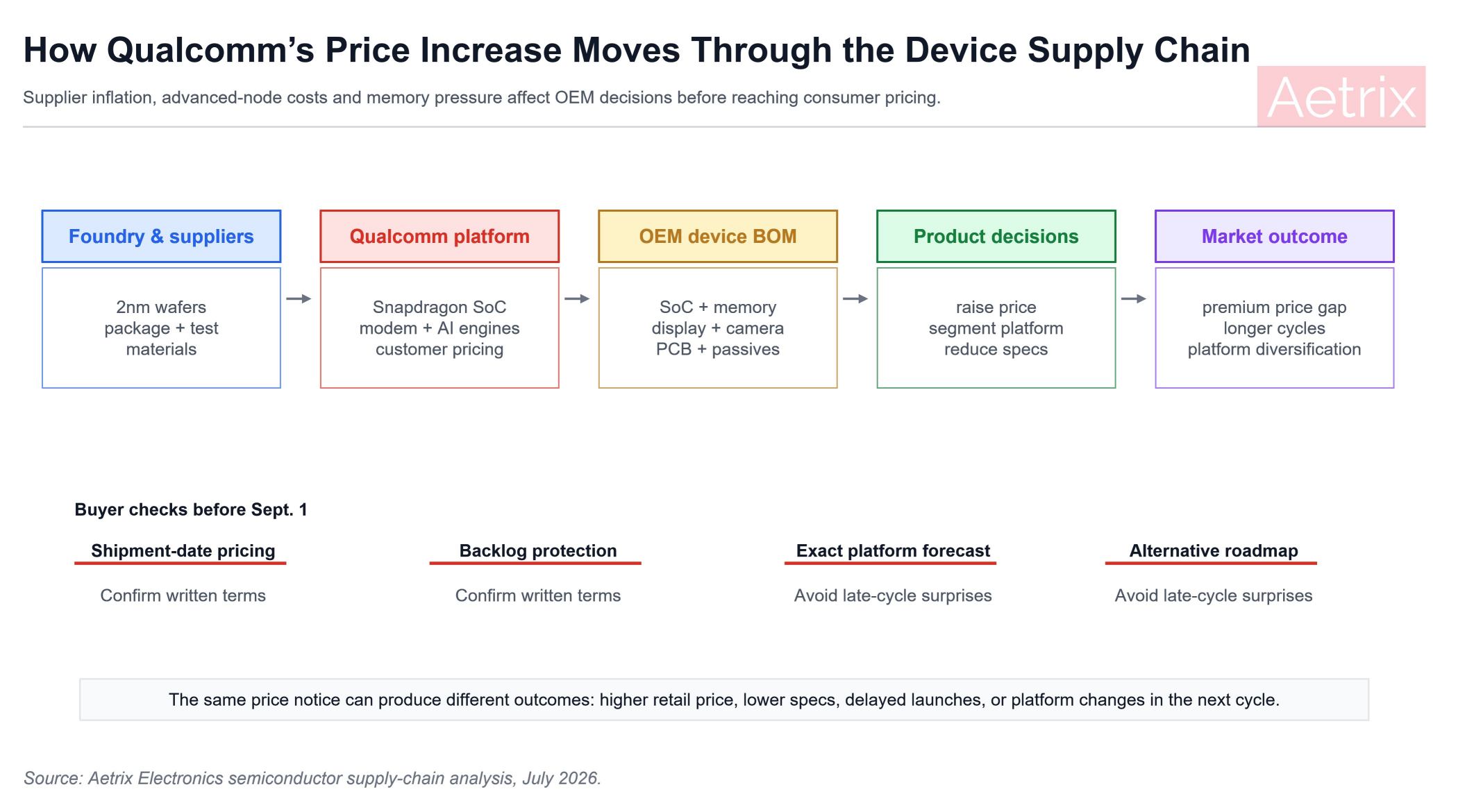
Higher Prices Could Accelerate Platform Diversification
The immediate effect of the adjustment is higher procurement cost. Platform changes take longer.
A smartphone design already scheduled for launch cannot switch processors without substantial engineering and certification work. The impact on supplier share will appear mainly in later product generations.
MediaTek is positioned to compete for more upper-mid-range and selected premium programs. UNISOC can benefit where entry-level manufacturers need to protect low retail prices. Samsung has an incentive to increase Exynos use where internal performance and yield targets are met.
Automotive and IoT customers may also increase dual-platform planning. Chinese suppliers can gain evaluation opportunities by combining lower cost with local engineering, customization and supply-chain support.
Qualcomm retains substantial advantages in premium performance, modem technology, software support and global certification. Price increases are therefore more likely to encourage gradual diversification than an immediate large-scale exit from Snapdragon.
Qualcomm Pricing Outlook Through 2027
Advanced-node chip costs are unlikely to return to earlier levels. Future pricing will depend on 2nm yield improvement, foundry capacity, package and substrate agreements, memory-market conditions and smartphone demand.
If yields improve quickly and handset production remains weak, Qualcomm may gain more room to negotiate on volume. Continued AI investment and tight supplier conditions would keep the cost base elevated.
Premium Android manufacturers are likely to accept more of the increase than entry-level brands. The market will continue to split between high-performance devices able to pass costs to consumers and price-sensitive models relying on older or competing platforms.
Qualcomm must balance revenue per device against platform share. Higher flagship prices can protect margins and support investment in automotive and data-center computing. They also improve the economics of competing and internally developed processors.
The broader signal extends beyond Qualcomm. AI investment is raising the value of advanced manufacturing resources throughout the semiconductor supply chain. Consumer-electronics companies are beginning to pay a higher price for access to those resources.
Key Takeaways
- Qualcomm reportedly plans a double-digit price increase for products shipped after September 1, 2026.
- The customer letter cited rising supplier costs that the company could no longer fully absorb, although Qualcomm has not publicly confirmed the notice.
- Actual adjustments are expected to differ by product, customer volume, contract and shipment schedule.
- Industry estimates place selected increases at approximately 10% to 18%, with next-generation flagship and automotive platforms carrying greater exposure.
- Advanced-node wafers, early yield, design complexity, packaging and testing are raising the cost of high-end mobile SoCs.
- Memory inflation affects Qualcomm mainly by increasing the smartphone OEM's total BOM and reducing handset production forecasts.
- Qualcomm's increase is smaller than extreme movements in selected memory and passive products, but the cost is concentrated in a high-value device platform.
- Qualcomm has its strongest pricing leverage in premium Android smartphones and less room in mid-range and entry-level devices.
- Lead-time pressure is concentrated in premium mobile, automotive and AI products rather than across the entire Qualcomm portfolio.
- Phone manufacturers can respond through higher retail prices, platform segmentation, older processors, reduced specifications or lower production.
- Buyers should confirm shipment-date pricing, backlog protection and annual contract terms before September 1.
- The longer-term result may be wider use of MediaTek, UNISOC, Exynos and internally developed silicon in future product cycles.