My Inquiry
 My Account


A magnitude 7.1 earthquake struck the Kumamoto region of Japan at 4:27 p.m. on July 28, 2026, forcing semiconductor factories across Kyushu to stop production, evacuate employees and inspect precision manufacturing equipment.
The Japan Meteorological Agency recorded a maximum seismic intensity of 7 in Uki City and Hikawa Town. Its updated assessment placed the hypocenter at a provisional depth of 16 kilometers, revised from the initial estimate of approximately 10 kilometers. By 8 p.m. on July 28, the agency had recorded 61 aftershocks with an intensity of 1 or higher and warned that another earthquake producing intensity 7 shaking could occur during the following week, particularly within the first two to three days. (Japan Meteorological Agency, 2026 Kumamoto Earthquake Update)
The semiconductor concern extends beyond the earthquake's magnitude. Kumamoto is the center of Kyushu's semiconductor cluster, often called Japan's "Silicon Island." The region now combines wafer fabrication, image-sensor production, automotive microcontrollers, power semiconductors, packaging, materials, manufacturing equipment and local maintenance services.
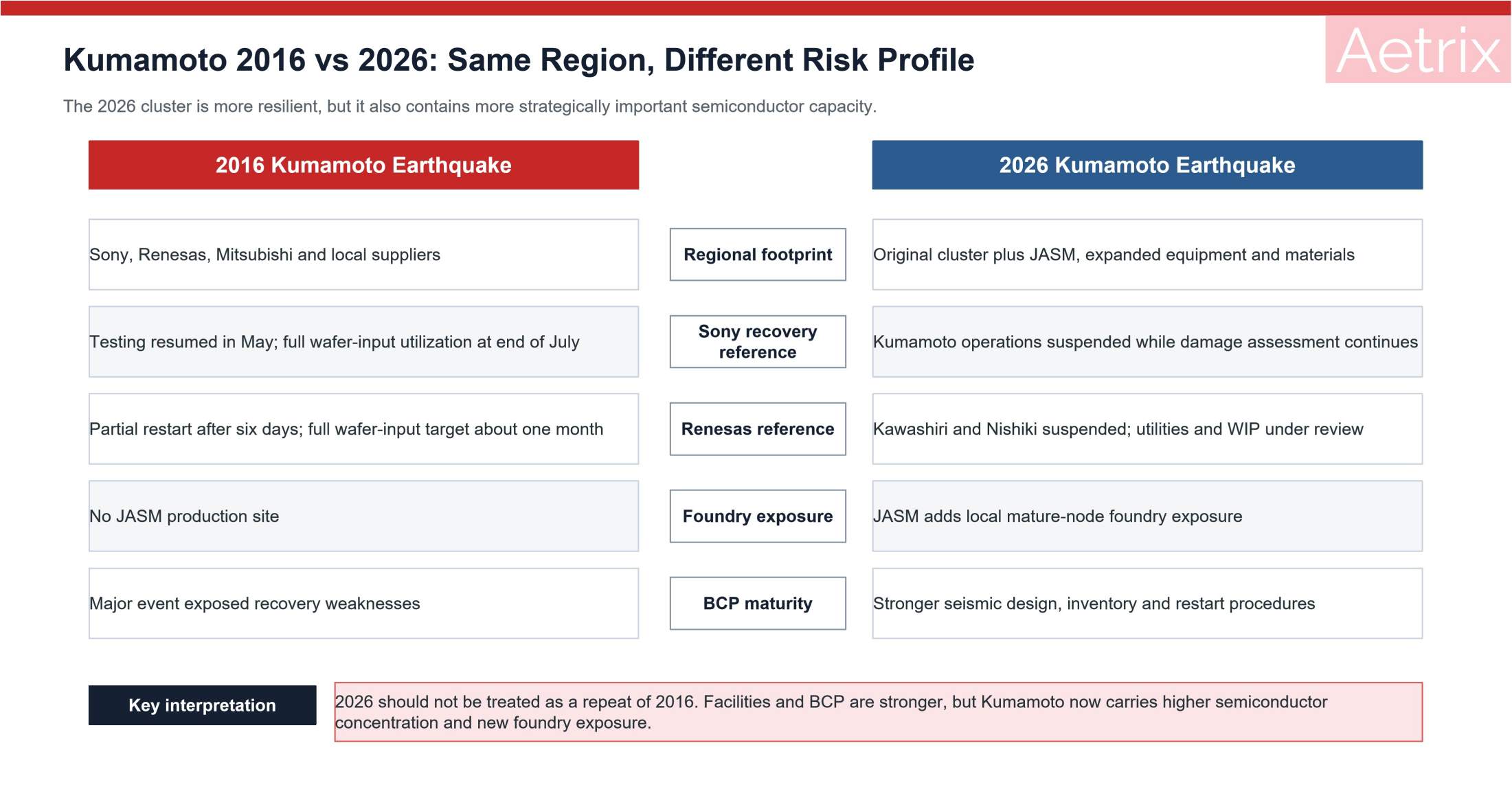
The direct historical comparison is the 2016 Kumamoto earthquake. That event shut Sony and Renesas production for weeks, damaged manufacturing equipment and interrupted semiconductor output long after buildings had been declared structurally safe. The 2026 event has hit a larger semiconductor cluster, but one that has also spent a decade improving seismic protection, business-continuity planning and inventory resilience.
The key question is therefore not whether factories stopped. Most semiconductor plants automatically stop after strong shaking. The supply-chain outcome will depend on whether inspections uncover equipment displacement, utility damage, work-in-process losses or repeated aftershock interruptions that keep individual production lines offline for weeks rather than days.
2026 Kumamoto Earthquake Semiconductor Snapshot
| Item | Status as of July 29, 2026 |
|---|---|
| Magnitude | 7.1, provisional |
| Hypocenter depth | 16 km, revised from the initial estimate of about 10 km |
| Maximum seismic intensity | 7 on the Japanese scale |
| JASM | Building safety confirmed; operations gradually resuming while detailed inspections continue |
| Sony Kumamoto | Operations remain suspended; buildings and manufacturing lines under evaluation |
| Renesas | Kawashiri and Nishiki factories suspended; equipment and work-in-process impact under investigation |
| Primary short-term risks | Equipment calibration, pure-water systems, work-in-process loss, logistics and aftershocks |
Why Kumamoto Matters to the Chip Supply Chain
Kumamoto is no longer only a regional Japanese manufacturing center. It has become an interconnected semiconductor ecosystem serving automotive, industrial, consumer and computing markets.
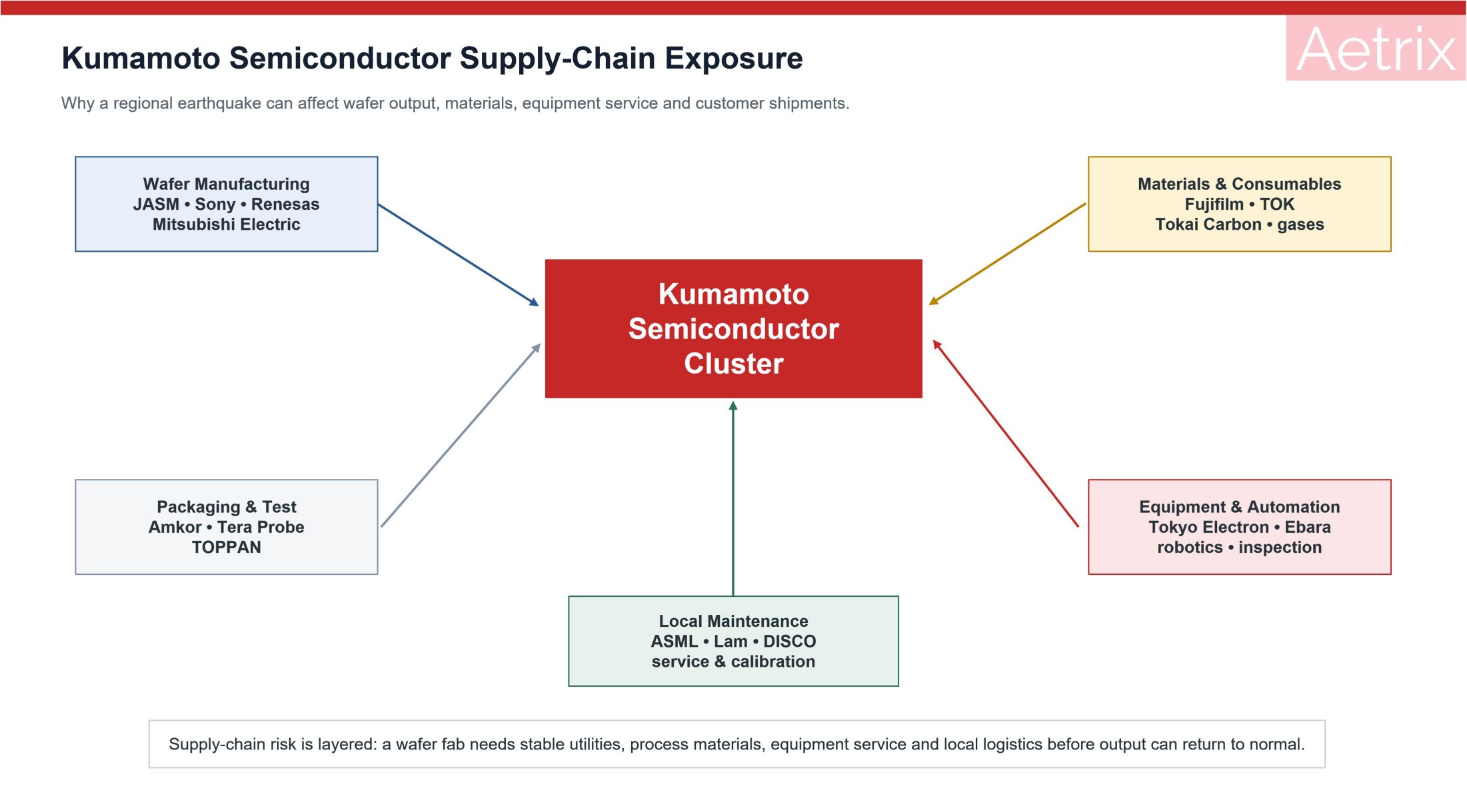
The manufacturing layer includes Japan Advanced Semiconductor Manufacturing, Sony Semiconductor Manufacturing, Renesas Electronics, Mitsubishi Electric, Amkor, Tera Probe and other wafer-processing, packaging and test operations.
The supporting network includes Tokyo Electron, Ebara, Fujifilm, Tokyo Ohka Kogyo, Toppan, Tokai Carbon, specialty-gas suppliers, quartz-product manufacturers, probe-card companies, automation providers and local service operations connected to ASML, Lam Research, SCREEN and DISCO.
| Supply-Chain Layer | Representative Kumamoto Operations | Potential Disruption |
|---|---|---|
| Wafer manufacturing | JASM, Sony, Renesas, Mitsubishi Electric | Logic, image sensors, automotive MCUs and power devices |
| Packaging and test | Amkor, Tera Probe, Toppan and regional subcontractors | Delayed final test, assembly, substrates and shipment release |
| Manufacturing equipment | Tokyo Electron, Ebara and automation suppliers | Equipment deliveries, spare parts, field service and calibration |
| Materials and consumables | Fujifilm, Tokyo Ohka Kogyo, Tokai Carbon and gas suppliers | CMP materials, photoresist, carbon components and process gases |
| Maintenance and local services | Equipment service, precision cleaning and utility contractors | Slower equipment restart even when the factory itself is undamaged |
This concentration creates two opposing effects. Local technical expertise can accelerate recovery because equipment vendors, contractors and suppliers are located nearby. The same concentration also allows one regional disaster to interrupt several linked production stages at the same time.
A wafer fab cannot return to stable output using only an undamaged building. It needs electricity, pure water, process gases, chemicals, spare parts, cleanroom control, transportation and qualified technicians. A delay at any one of those layers can hold back the wider recovery.
Current Status of Semiconductor Factories
JASM Is Gradually Resuming Operations
TSMC evacuated employees from its JASM facility after the earthquake. Structural checks confirmed the safety of the buildings, and personnel began returning while the company continued detailed inspections and impact assessment. Construction of the second fab did not suffer reported damage, although some work was suspended as a precaution against further aftershocks. (Reuters, TSMC JASM Operations Update)
JASM's first Kumamoto fab was designed for 12/16nm FinFET and 22/28nm process technologies, with planned monthly capacity of 55,000 12-inch wafers. TSMC's two-fab plan would raise total Kumamoto capacity above 100,000 wafers per month and add 40nm and 6/7nm technologies for automotive, industrial, consumer and high-performance computing applications. (TSMC, JASM First-Fab Capacity) (TSMC, JASM Kumamoto Expansion)
A short JASM stoppage would have limited impact on TSMC's global capacity. The customer-level impact could be more meaningful where a product has been qualified specifically on JASM's process, manufacturing route or automotive control plan.
Moving an order to another TSMC fab is not always immediate. The receiving factory must have compatible equipment, process capacity, mask support, customer approval and available production slots. Automotive customers may also require additional documentation before accepting a manufacturing-site change.
Sony Kumamoto Remains Suspended
Sony Semiconductor Manufacturing stopped operations at its Kumamoto Technology Center after the earthquake. As of July 29, the company said operations remained suspended while it evaluated buildings and manufacturing lines.
Sony reported no significant building or equipment damage at its Nagasaki, Oita and Kagoshima technology centers. No employee casualties were reported across the affected semiconductor sites. (Sony Semiconductor Solutions, July 2026 Earthquake Status)
The existence of multiple Kyushu manufacturing centers provides some production resilience. It does not mean that all Kumamoto products can be transferred immediately. Image sensors are closely linked to wafer process, pixel architecture, customer qualification, package configuration and downstream image tuning.
The length of the Kumamoto shutdown is currently one of the most important indicators for the smartphone, security-camera and automotive imaging markets.
Renesas Is Investigating Equipment and Work in Process
Renesas suspended operations at the Kawashiri Factory in Kumamoto City and the Nishiki Factory in Kuma District.
At Nishiki, ceiling panels fell and cracks were identified in walls. Air conditioning, electricity and the cleanroom environment remained available. At Kawashiri, wall cracks and water leakage caused a temporary suspension of pure-water supply, although air conditioning, electricity and cleanroom conditions were maintained.
Renesas said the impact on manufacturing equipment and work in process remained under investigation. (Renesas, Impact of the 2026 Kumamoto Earthquake)
The pure-water interruption at Kawashiri deserves close attention. Semiconductor wafer processing depends on highly controlled water purity for cleaning and rinsing. Restoring supply is only the first step; the system must be tested before production can resume without contamination risk.
The condition of work in process is equally important. Wafers may be moving through lithography, deposition, etching or thermal stages when a fab shuts down. Some lots can be recovered after inspection. Others may need to be scrapped, restarted or held for extended reliability analysis.
Other Equipment, Material and Power-Semiconductor Sites
Tokyo Electron, Ebara, Mitsubishi Electric, Fujifilm, Toppan and Tokai Carbon were among the semiconductor-related companies that temporarily halted operations, evacuated employees or initiated inspections in the region. Available reports did not initially indicate widespread major structural damage at these sites. (Reuters, Kyushu Manufacturing and Semiconductor Disruptions)
Short inspection shutdowns at equipment and material suppliers do not immediately remove chip output from the market. Their impact becomes more serious when a factory cannot deliver a critical spare part, process material or service engineer required by another plant's restart.
The Critical Comparison: Kumamoto 2026 vs 2016
The 2016 Kumamoto earthquake is the most useful benchmark because it affected many of the same locations and companies without the nationwide tsunami, nuclear and infrastructure damage seen in 2011.
| Comparison | 2016 Kumamoto Earthquake | 2026 Kumamoto Earthquake |
|---|---|---|
| Regional semiconductor footprint | Sony, Renesas, Mitsubishi and regional suppliers | Original cluster plus JASM and expanded equipment, material and service capacity |
| Sony initial condition | Physical damage and extended suspension at Kumamoto Technology Center | Kumamoto operations suspended; damage evaluation still in progress |
| Renesas initial condition | Equipment damage at Kawashiri; partial restart after six days | Wall cracks, leakage and pure-water interruption; cleanroom environment maintained |
| Foundry exposure | No JASM production site | JASM adds local automotive, industrial and consumer foundry exposure |
| Business-continuity maturity | Major recovery event that exposed weaknesses | Facilities, restart procedures and inventory policies improved after repeated earthquakes |
| Regional concentration | High | Higher due to new fabs and expanded supporting infrastructure |
| Current risk conclusion | Confirmed multi-week manufacturing disruption | Still dependent on equipment, utility and work-in-process inspections |
The comparison does not support an automatic conclusion that the 2026 disruption will be smaller. Modern factories are better prepared, but the economic importance and semiconductor density of Kumamoto are substantially greater.
JASM did not exist in 2016. Its presence strengthens Japan's domestic semiconductor manufacturing base during normal operations while increasing the amount of strategically important capacity exposed to a Kumamoto-area disaster.
The 2026 outcome will depend on whether stronger buildings and improved business-continuity systems offset the region's increased production concentration.
What the 2016 Recovery Timelines Tell Us
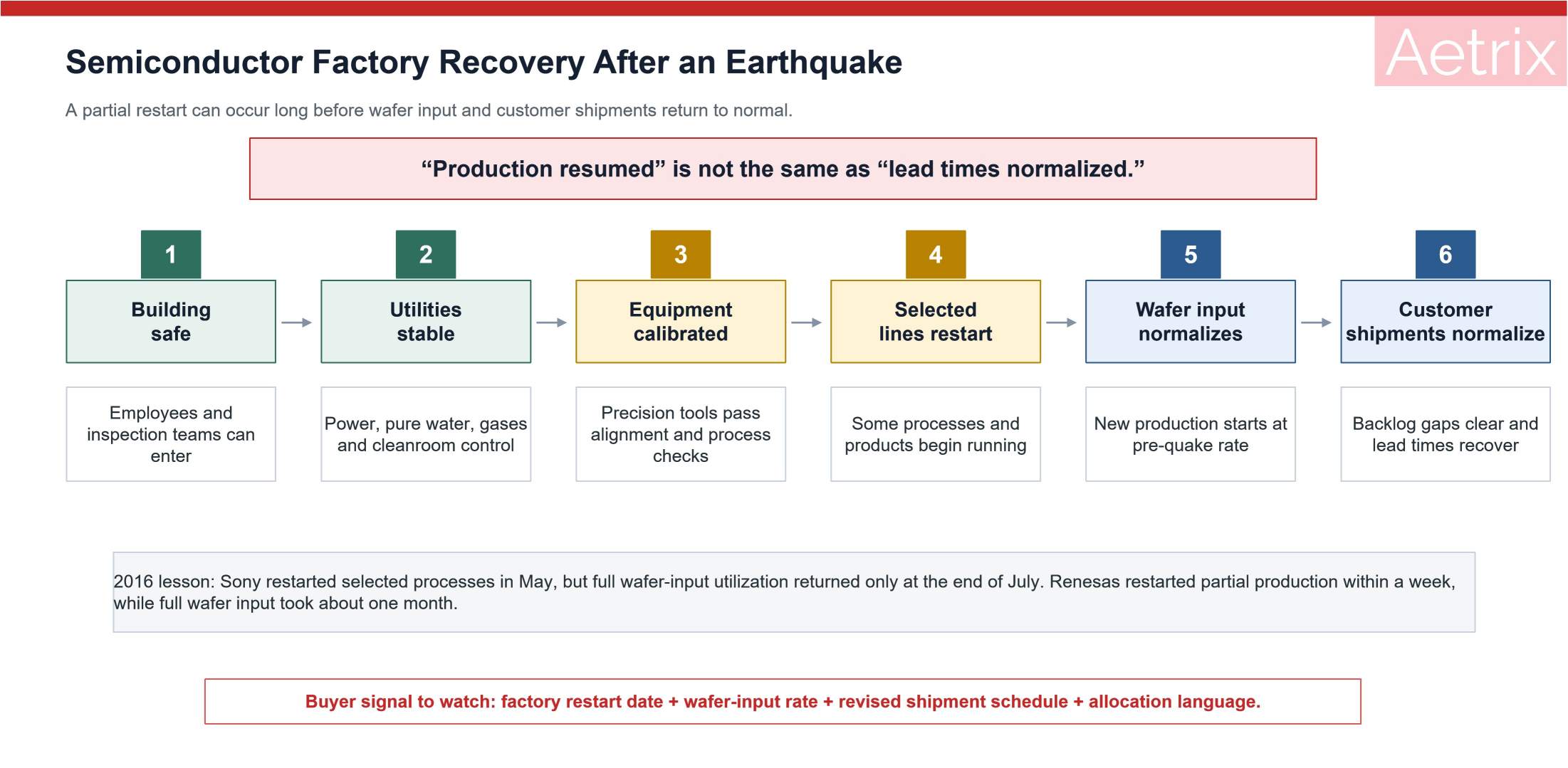
The phrase "production resumed" can create a misleading impression. Semiconductor recovery occurs in stages, and each stage has a different effect on customer deliveries.
Sony: Early Processes Restarted in May, Full Utilization Arrived in July
Sony's Kumamoto Technology Center suspended production after the April 2016 earthquakes. Testing operations resumed on May 9. Other back-end processes, including assembly, were scheduled to restart sequentially from May 17, while front-end wafer processing was scheduled to restart from May 21. (Sony, May 2016 Kumamoto Recovery Update)
Sony later reported that the facility did not return to full utilization on a wafer-input basis until the end of July 2016. (Sony, Full Kumamoto Wafer-Input Recovery)
This sequence shows why the first restart announcement is not the end of the supply disruption. A plant may restart testing or selected production lines while front-end capacity, output mix and customer shipments remain below normal for several additional weeks.
Sony later estimated the 2016 earthquake's negative impact on semiconductor operating income at approximately ¥39.5 billion, including physical damage, recovery expenses and lost production opportunities. The final financial effect demonstrated that a factory can recover faster than initially expected and still experience a material business interruption.
Renesas: Partial Production Returned Quickly, Full Wafer Input Took About a Month
Renesas stopped production at the Kawashiri Factory after the April 16, 2016 main quake. It restarted part of the manufacturing process on April 22 and targeted restoration of full pre-earthquake wafer-input capacity by May 22. (Renesas, 2016 Kumamoto Recovery Update)
The one-week partial restart reduced the likelihood of a prolonged shutdown, but the complete production recovery still required approximately one month. Customers also had to account for interrupted work in process, supplier schedules and the time required for new wafers to move through the manufacturing cycle.
| Recovery Stage | Factory Meaning | Customer Meaning |
|---|---|---|
| Building declared safe | Employees and inspection teams can enter | No confirmation of production availability yet |
| Utilities restored | Power, water, gases and cleanroom control become available | Production remains dependent on equipment qualification |
| Selected lines restarted | Some processes can run | Only certain products or production stages may be available |
| Wafer input returns to normal | New production starts at the previous rate | Delivery recovery still follows the remaining manufacturing cycle |
| Customer shipments normalize | Backlog and work-in-process gaps are cleared | Standard lead times begin to return |
Why 2011 Is a Worst-Case Boundary, Not a Direct Comparison
The Great East Japan Earthquake in 2011 remains the extreme supply-chain reference point, but its conditions were fundamentally different from the current Kumamoto event.
The 2011 disruption combined a magnitude 9 earthquake, tsunami, nuclear emergency, extensive power restrictions, damaged ports and roads, and simultaneous production interruptions across multiple regions. Automotive, electronics and semiconductor supply chains were affected by both direct factory damage and the loss of specialized materials and components from lower-tier suppliers.
Japan's Ministry of Economy, Trade and Industry documented how the earthquake's effect spread beyond the disaster area through interconnected industrial supply chains. The event demonstrated that small, highly specialized suppliers could stop international production even when the final manufacturer was located outside Japan. (METI, Global Supply-Chain Effects of the 2011 Earthquake)
The 2026 Kumamoto earthquake is currently a regional cluster interruption. There is no evidence of a comparable nationwide power, port or nuclear-system failure.
The 2011 experience remains relevant as an upper-risk boundary. A regional factory event becomes a global semiconductor crisis when it coincides with prolonged utility failure, transport disruption and loss of unique material suppliers.
What the 2022 Earthquake Shows About Modern BCP
The March 2022 Fukushima earthquake provides a more recent example of faster factory recovery.
Four Renesas fabrication lines at three factories temporarily stopped because of power interruptions and related issues. All lines had restarted and returned to their pre-earthquake production capacity by March 26, approximately ten days after the March 16 earthquake. (Renesas, 2022 Earthquake Production Recovery)
The shorter recovery reflected limited structural damage and more mature restart processes. It does not guarantee that every modern fab can recover within ten days. It shows what is possible when utilities return quickly, equipment remains aligned and work-in-process losses are manageable.
The 2026 Kumamoto event currently sits between the 2016 and 2022 patterns. JASM's gradual restart resembles an inspection-led disruption. Sony's continued suspension and Renesas' utility and building issues require more evidence before the recovery path can be classified.
BCP Has Improved, but Regional Concentration Has Increased
Japanese semiconductor manufacturers have strengthened business-continuity systems after repeated earthquakes, fires, power outages and supply interruptions.
Common improvements include seismic reinforcement, equipment anchoring, automatic shutdown systems, emergency generators, redundant utilities, documented restart sequences, digital equipment records and closer coordination with suppliers.
Inventory strategy has also changed. Semiconductor and automotive companies now map more lower-tier suppliers, maintain additional buffer stock for selected critical products and qualify secondary production paths where technical and commercial conditions allow.
These improvements reduce the probability that an undamaged factory will remain idle because no recovery plan exists. They cannot remove several structural semiconductor risks:
- Precision tools must be inspected and recalibrated after strong shaking.
- Work-in-process wafers can be lost even when the building is intact.
- Pure-water, gas and chemical systems require contamination checks.
- Automotive and specialized devices cannot always move to another site without approval.
- Repeated aftershocks can interrupt inspections and restart attempts.
Kumamoto's expansion also creates a concentration trade-off. Local clustering improves normal production efficiency and access to skilled labor. During a natural disaster, the same clustering exposes manufacturing, equipment, materials and maintenance operations to one regional event.
Supply Risk by Product Category
| Product Category | Current Risk Level | Main Risk Driver | Key Indicator |
|---|---|---|---|
| Sony image sensors | Elevated | Kumamoto operations remain suspended and product transfer is qualification-intensive | Date of wafer-processing restart |
| Renesas automotive and industrial ICs | Elevated | Equipment, pure-water and work-in-process assessment continues | Factory-specific restart and shipment notice |
| Mitsubishi power semiconductors | Moderate to elevated | Front-end production concentration and customer qualification | Confirmation of affected lines and product families |
| JASM foundry output | Moderate | Operations are restarting, but detailed equipment and wafer impact is not yet complete | Return to normal wafer input and customer delivery schedule |
| Equipment and materials | Low to moderate | Temporary inspections become material only if they delay fab recovery or global deliveries | Factory restart, shipment and field-service availability |
| Unrelated general components | Low | No confirmed exposure to affected Kumamoto production | Exact manufacturing-site confirmation |
Risk levels are assessment as of July 29, 2026. They describe supply-chain exposure rather than confirmed shortages.
Image Sensors
Sony image sensors require close monitoring because the Kumamoto shutdown is confirmed and the 2016 recovery took several months to reach full wafer-input utilization.
Customer exposure will differ by sensor. Smartphone, automotive, security and industrial image sensors use different wafer processes, packages and qualification routes. A general statement that all Sony image sensors will become scarce would be inaccurate.
The highest-risk products are those tied to Kumamoto production with limited finished-goods coverage and no qualified alternate manufacturing route.
Automotive MCUs and Industrial ICs
Renesas components deserve early review because automotive and industrial designs often remain in production for many years. The exact factory source may not be obvious from the public part number.
Even when another Renesas fab can manufacture a similar device, moving an existing automotive product can require process matching, quality documentation, customer approval and production scheduling.
Short factory downtime may be covered by finished-goods and channel inventory. A multi-week wafer interruption would create a delayed effect because shortages may appear only after existing inventory is consumed.
Power Semiconductors
Mitsubishi Electric's Kumamoto operations expose power semiconductor supply used in industrial drives, automotive systems, power conversion and other high-reliability applications.
The market impact depends on the exact wafer lines, device technologies and packages affected. Standard MOSFETs with broad alternative supply carry less risk than qualified automotive modules, proprietary IGBT products or application-specific power devices.
JASM Foundry Products
JASM's process portfolio supports specialty logic used in automotive, industrial and consumer applications. The factory's planned capacity is significant within Japan, though small relative to TSMC's global network.
Global foundry pricing is unlikely to change because of a short JASM inspection shutdown. Selected customers could face schedule changes if their exact products are tied to JASM and cannot be moved quickly.
Equipment and Materials Are a Second-Order Risk
The temporary shutdown of a semiconductor equipment factory does not immediately stop chips already being produced elsewhere.
The effect appears through equipment deliveries, service visits, replacement parts and local support. A fab waiting for a Tokyo Electron process tool, Ebara CMP component or specialized field engineer may experience a delayed installation or restart.
Material suppliers create a similar risk. Semiconductor plants qualify exact chemical formulations, gases, quartz parts and process consumables. A single-site interruption can matter when the product is technically difficult to substitute and customers hold limited inventory.
The current equipment and material stoppages appear primarily precautionary. Their global significance would rise if operations remained suspended for several weeks or if inspections identified damage to specialized production lines.
Three Supply Scenarios for the Next Four Weeks
Scenario 1: Inspection-Led Recovery
In the lower-impact scenario, buildings remain safe, utilities stabilize, precision equipment passes inspection and work-in-process losses are limited.
Factories would restart selected operations within three to seven days and recover most production within two to three weeks. Customer lead-time changes would be limited, while initial channel price increases would largely reflect precautionary buying rather than a physical shortage.
Scenario 2: Local Equipment and Work-in-Process Loss
In the middle scenario, some tools require repair or extended calibration, pure-water systems need work, and a portion of in-process wafers cannot be recovered.
Individual production stages could remain constrained for two to four weeks. Selected image sensors, automotive ICs and power products would receive revised delivery schedules. Channel inventory could tighten before factory production returns to normal.
The current evidence for Sony and Renesas leaves this scenario possible. Neither company had completed its full manufacturing-equipment and work-in-process assessment at the time of publication.
Scenario 3: Prolonged Regional Disruption
The high-impact scenario would require significant equipment or utility damage, repeated aftershocks, transportation problems and delayed recovery among local suppliers.
Production would remain materially constrained for more than one month. OEMs could receive allocation notices, push out production plans or begin urgent qualification of alternative devices.
Available evidence does not yet support this scenario as the base case. It cannot be excluded until Sony, Renesas and other manufacturers complete their inspections.
| Scenario | Factory Condition | Possible Lead-Time Effect | Market Behavior |
|---|---|---|---|
| Inspection-led recovery | Limited physical and work-in-process damage | Minimal to several weeks for selected orders | Short-lived precautionary buying |
| Local equipment or WIP loss | Some tools, utilities or wafer lots affected | Several weeks to selected product families | MPN-level tightening and higher spot quotations |
| Prolonged regional disruption | Major repairs and slow supplier recovery | One quarter or longer for constrained products | Allocation, duplicate ordering and broader price pressure |
How Price and Lead-Time Pressure Usually Develops
The first market response to a major semiconductor-region earthquake is often faster than the physical supply impact.
Distributors and end customers may request additional inventory before manufacturers have completed inspections. Independent-market quotations can rise based on expected shortages, even when authorized-channel delivery dates have not changed.
This behavior can create false demand. The same customer may place contingency orders with multiple suppliers and cancel them later when production resumes.
A genuine supply disruption becomes clearer through several signals:
- The manufacturer extends the standard lead time for an exact MPN.
- Confirmed customer orders receive revised shipment dates.
- The manufacturer introduces allocation or limits new orders.
- Authorized distributors lose visibility beyond current inventory.
- The affected factory remains offline after the initial inspection period.
- The manufacturer confirms equipment damage or work-in-process loss.
A channel price increase without these signals may reflect precautionary inventory positioning rather than a sustained shortage.
The 2016 experience also shows that price pressure can fade before every factory has fully recovered. Finished-goods inventory, production at other sites and weaker end demand can offset part of the lost output.
What Buyers Should Monitor Before Increasing Inventory
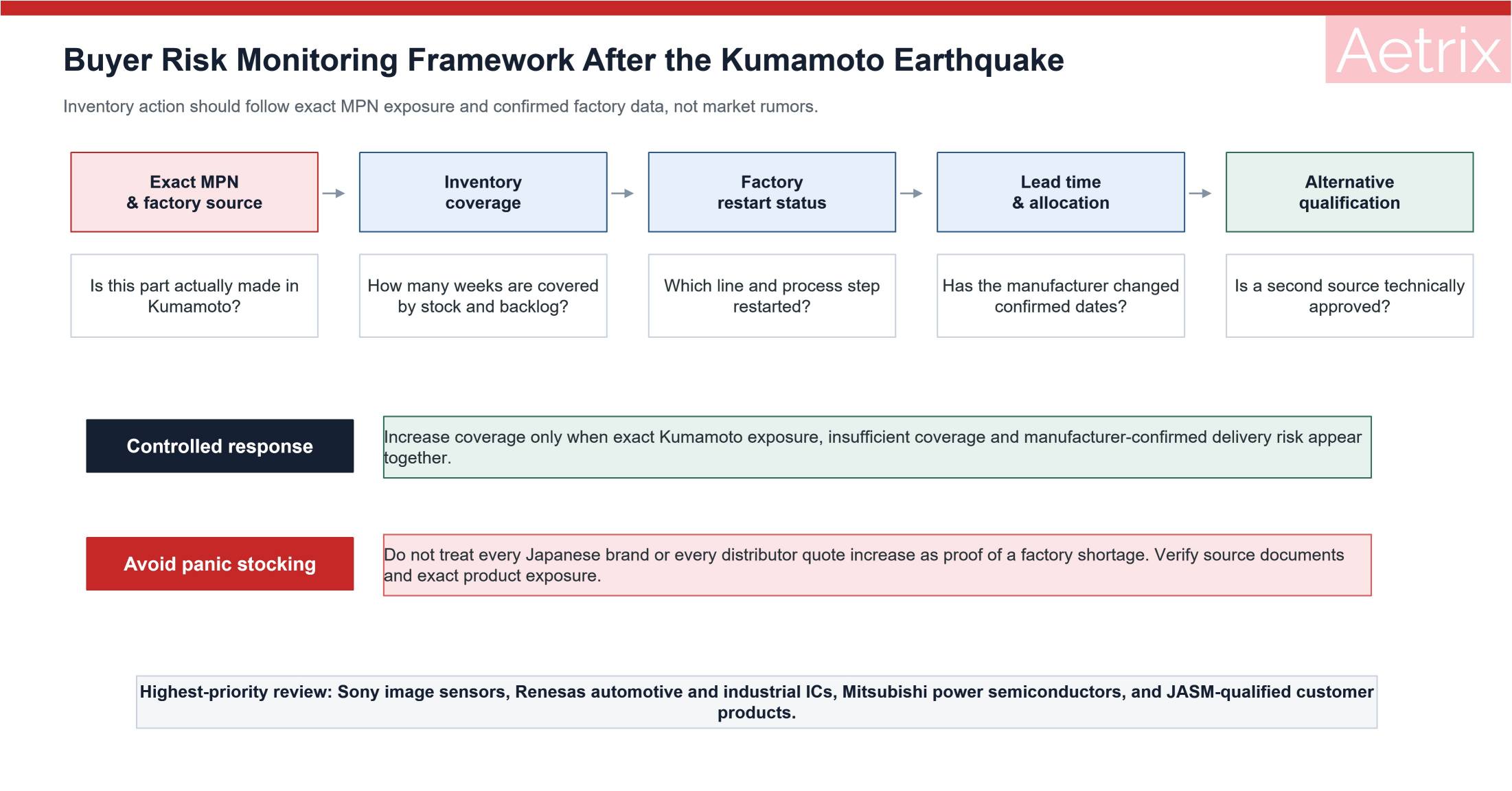
| Required Check | Why It Matters |
|---|---|
| Exact manufacturing site | A Japanese brand does not mean the product is manufactured in Kumamoto |
| Current authorized-channel inventory | Existing stock may cover a short factory interruption |
| Confirmed backlog coverage | Open orders may already be supported by finished goods or pre-earthquake production |
| Factory-specific restart date | A corporate-level restart statement may not cover every line or product |
| New standard lead time | Separates physical supply pressure from market speculation |
| Alternative approval status | Automotive and industrial alternatives may require months of testing |
| Source of any disruption notice | Unofficial letters and altered screenshots often circulate after supply shocks |
Buyer Actions Without Panic Stocking
1. Identify Real Kumamoto Exposure
Review Sony image sensors, Renesas automotive and industrial ICs, Mitsubishi power products and JASM-manufactured devices by exact MPN. Do not apply the same risk assumption to an entire manufacturer.
2. Calculate Current Coverage
Combine on-hand inventory, contract-manufacturer stock, confirmed distributor inventory and open factory orders. Coverage should be measured against actual weekly consumption rather than annual forecast alone.
3. Prioritize Single-Source Qualified Parts
Automotive, medical, industrial and imaging products with no approved second source deserve the earliest attention. A common commercial component with several qualified suppliers does not require the same response.
4. Confirm Existing Orders Before Duplicating Demand
Ask the supplier whether confirmed backlog remains valid before placing emergency orders through multiple channels. Duplicate ordering can create excess inventory and reduce the accuracy of industry demand signals.
5. Start Alternative Review Before a Shortage Is Confirmed
Engineering teams can begin a paper comparison of alternatives without immediately changing the BOM. Early work should cover electrical performance, package, software impact, qualification and manufacturing-site diversity.
6. Separate Factory Data From Market Rumors
Use original manufacturer announcements, authorized-channel updates and confirmed customer communications. A higher independent-market quote is not proof that the factory has reduced allocation.
Outlook
The 2026 Kumamoto earthquake has struck a semiconductor cluster that is larger and more strategically important than the one affected in 2016.
JASM has added Japanese foundry capacity for automotive, industrial and consumer devices. Sony remains a major image-sensor supplier. Renesas and Mitsubishi support long-life automotive, industrial and power-electronics systems. Equipment and material companies in the same region help supply and maintain semiconductor factories inside and outside Japan.
The cluster is also more resilient. Facilities have stronger seismic protection, companies have practiced restart procedures, and customers are more aware of lower-tier supply risks.
The next several days will determine which side of that balance dominates.
If inspections confirm limited equipment and work-in-process damage, the event is likely to produce temporary schedule adjustments and selective channel volatility rather than a broad chip shortage.
If Sony or Renesas remains materially constrained for several weeks, pressure will become more visible in exact image-sensor, automotive MCU and industrial product lines. The effect would emerge through revised shipment dates and lower inventory coverage before it appears as an industry-wide shortage.
The most defensible conclusion at this stage is that supply risk is real but product-specific. The earthquake does not justify indiscriminate semiconductor stockpiling. It does justify immediate factory-source verification, backlog review and contingency planning for difficult-to-replace products.
Key Takeaways
- A magnitude 7.1 earthquake struck Kumamoto on July 28, 2026, reaching the highest level on Japan's seismic-intensity scale.
- JASM is gradually resuming operations, while detailed equipment and production-impact inspections continue.
- Sony's Kumamoto Technology Center remains suspended, making image sensors one of the main product categories to monitor.
- Renesas suspended the Kawashiri and Nishiki factories and is investigating equipment and work-in-process impact.
- The 2016 Kumamoto earthquake is the most relevant historical comparison because it affected many of the same companies and locations.
- In 2016, Sony restarted selected processes in May but did not return to full wafer-input utilization until the end of July.
- Renesas restarted part of Kawashiri production within one week in 2016 and targeted full wafer-input recovery approximately one month after the earthquake.
- The 2011 earthquake represents a much more severe scenario involving tsunami, nuclear, utility and national logistics disruption.
- Modern business-continuity systems can shorten recovery, as shown by Renesas' approximately ten-day recovery after the 2022 Fukushima earthquake.
- Kumamoto's semiconductor capacity is more resilient than in 2016, but regional concentration has also increased.
- The main technical risks are equipment calibration, pure-water systems, work-in-process losses and repeated aftershocks.
- Buyers should identify exact Kumamoto-manufactured MPNs, verify inventory coverage and avoid broad panic stocking.