My Inquiry
 My Account


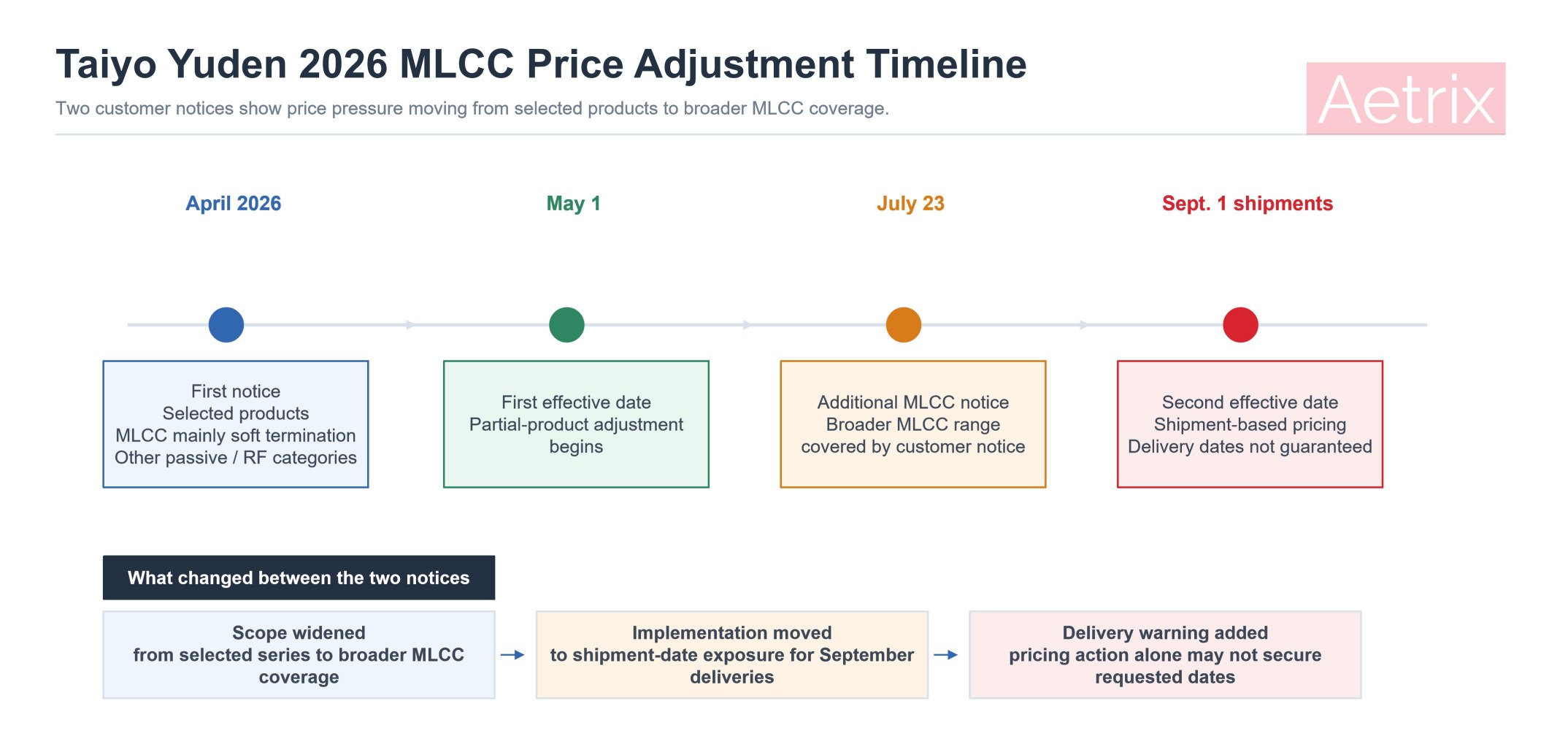
Taiyo Yuden has issued a second price-adjustment notice covering multilayer ceramic capacitors in 2026, expanding the scope from selected series in May to the broader MLCC portfolio covered by a new customer notice effective for shipments from September 1.
The first notice, issued in April, applied from May 1 and covered selected products across several component categories. Its MLCC scope focused mainly on soft-termination series, alongside selected inductors, ferrite-bead inductors, ceramic RF devices, FBAR and SAW components, and aluminum electrolytic capacitors.
The second notice, dated July 23, is narrower by product category but broader within MLCCs. It requests an additional adjustment across the MLCC range covered by the communication and states that Taiyo Yuden's current supply capability is insufficient to meet all requested delivery schedules. The company also warns that the price adjustment itself will not guarantee on-time delivery.
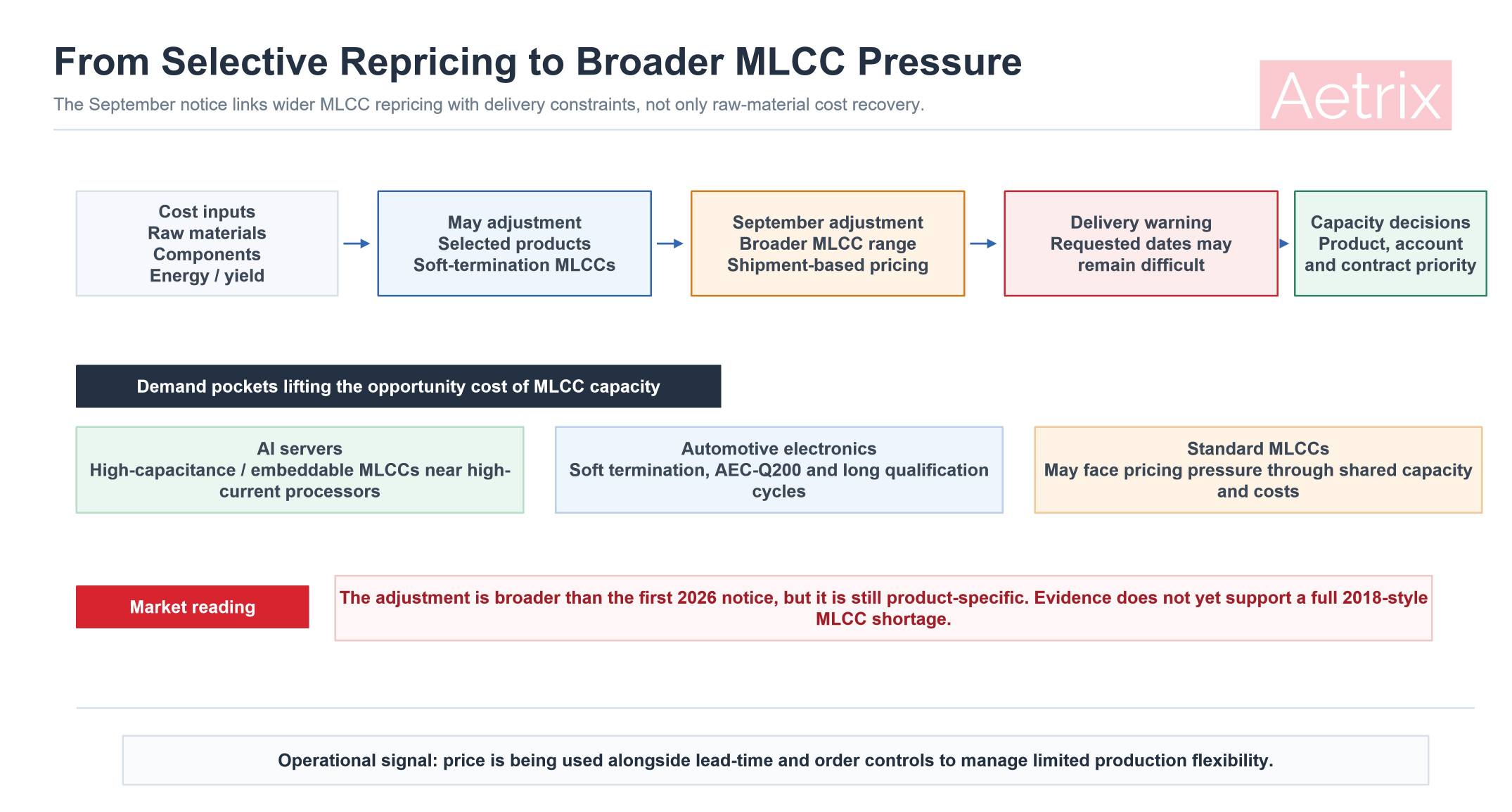
These two notices show a progression from selective cost recovery to broader MLCC repricing accompanied by a delivery-capacity warning. The change deserves attention, although current market conditions remain materially less severe than the 2018 MLCC shortage. Demand is more concentrated, alternatives are more developed, and there is no clear evidence of the widespread component scarcity, aggressive double ordering or cross-industry production disruption seen eight years ago.
Taiyo Yuden 2026 Price-Adjustment Snapshot
| Item | May Adjustment | September Adjustment |
|---|---|---|
| Notice timing | April 2026 | July 23, 2026 |
| Effective date | May 1, 2026 | Products shipped from September 1, 2026 |
| MLCC scope | Selected series, mainly soft-termination products | Broader MLCC range covered by the customer notice |
| Other products | Selected inductors, ferrite beads, RF devices, FBAR/SAW products and aluminum electrolytic capacitors | MLCC-focused communication |
| Primary explanation | Rising raw-material and component costs | Material-cost pressure and insufficient supply capability |
| Delivery language | Pricing required to maintain stable and reliable supply | Requested delivery dates may remain difficult even after repricing |
| Published uniform increase | Not disclosed in the notice | Not disclosed in the notice |
From Selective Repricing to a Broader MLCC Adjustment
The April notice began with a limited set of products rather than a uniform adjustment across Taiyo Yuden's entire catalog.
Within MLCCs, the notice identified selected series, mainly soft-termination products. These capacitors include a conductive-resin layer in the external termination to absorb mechanical stress from PCB bending, vibration and thermal expansion. They are widely used in automotive electronics, industrial equipment and other applications where ceramic cracking would create a reliability risk.
Soft-termination MLCCs usually carry higher manufacturing and qualification requirements than standard commercial products. They therefore represent a logical starting point when material, processing and quality-control costs can no longer be absorbed through internal productivity improvements.
The September notice expands pricing action to the broader MLCC range included in the communication. That change indicates that the pressure has spread beyond a limited group of high-reliability series.
It does not prove that every MLCC part number faces the same increase or the same supply condition. Final pricing may differ by series, manufacturing region, customer agreement, purchase volume, delivery schedule and existing price-protection terms. Taiyo Yuden states that the details will be explained through its sales representatives.
Why the Additional Price Adjustment Matters
A second adjustment only four months after the first effective date shows that the April action did not fully resolve Taiyo Yuden's cost and supply concerns.
The July notice describes the September change as an additional adjustment. Buyers should therefore confirm whether the new price replaces the May price or is applied on top of it for products already included in the first notice.
That distinction can materially affect annual component spending. A product covered by both communications may face two separate revisions during the same fiscal year, while a standard MLCC excluded from the first notice may receive its first adjustment in September.
The short interval between the two effective dates also reduces the value of older annual price assumptions. Procurement budgets negotiated at the start of 2026 may no longer reflect actual second-half costs.
Customers should avoid using one general percentage across an entire Taiyo Yuden MLCC bill of materials. The notices do not publish a standard global increase, and the commercial effect needs to be checked at the exact MPN and account level.
Shipment-Based Pricing Creates Backlog Risk
The September notice states that the adjustment applies to products shipped by Taiyo Yuden from September 1. This wording creates a different commercial exposure from an increase based only on new order dates.
An order placed before September may still be affected when the confirmed factory shipment occurs after the effective date. The notice therefore has immediate implications for open backlog, long-term purchase orders and scheduled releases.
| Order Condition | Potential Exposure | Required Confirmation |
|---|---|---|
| Order placed and shipped before September 1 | Generally lower exposure to the September adjustment | Confirm actual factory shipment date |
| Order placed before September but shipped afterward | May be repriced under shipment-based implementation | Review price protection and written order acceptance |
| Blanket order with scheduled releases | Different releases may receive different prices | Request a shipment-by-shipment price schedule |
| Distributor stock purchased before the increase | Existing inventory may temporarily retain the old cost basis | Check inventory ownership, replenishment cost and quote validity |
| New order after September 1 | Expected to use revised pricing | Obtain an MPN-level quotation and confirmed delivery date |
Buyers should also distinguish the manufacturer's shipment date from the date a distributor delivers the product to the customer. Those dates may differ by several days or weeks, particularly for international shipments.
Price and Delivery Pressure Are Appearing Together
The strongest signal in the July notice is the statement that Taiyo Yuden may remain unable to meet requested delivery dates even after the price adjustment.
A conventional cost-recovery letter usually focuses on raw materials, labor, logistics or energy and then presents a new price. This notice adds a direct warning about supply capability.
The language suggests that Taiyo Yuden is managing two related problems:
- Manufacturing costs have exceeded the level that can be absorbed internally.
- Available production capacity cannot satisfy every customer's preferred delivery schedule.
A price increase does not immediately create additional equipment, trained staff, qualified material supply or production yield. It can improve the economics of manufacturing lower-margin parts, but additional physical output still requires stable processes and available capacity.
Aetrix Electronics' assessment is that the September action also functions as a capacity-management signal. Broader repricing may help Taiyo Yuden control low-margin demand, reduce uneconomic orders and prioritize products that make better use of constrained production resources. Taiyo Yuden has not publicly identified those objectives as the specific purpose of the adjustment, so this interpretation should be treated as supply-chain analysis rather than company guidance.
Raw-Material Pressure Extends Across Product Categories
Taiyo Yuden's April notice cited continuing increases in gold, silver, other raw materials and component costs. The scope included MLCCs, inductors, ferrite components, radio-frequency products and aluminum electrolytic capacitors.
The reference to gold and silver applies to a mixed component portfolio and should not be interpreted as a complete explanation of MLCC manufacturing cost.
MLCC production depends on ceramic dielectric materials, internal electrodes, termination materials, plating, process chemicals, high-temperature firing, precision printing and lamination, inspection, packaging and energy. Cost pressure can enter at several stages even when the nominal bill of materials for one capacitor appears small.
MLCC economics are also affected by yield. High-capacitance, miniature and high-reliability products require more demanding layer thickness, electrode alignment and process control. A small change in yield can alter the effective cost per sellable unit.
Taiyo Yuden produces products from material development through precision printing and lamination, making raw-material control and manufacturing efficiency central to its MLCC competitiveness. The company describes this integrated process as one of the foundations of its small, high-capacitance and high-reliability product portfolio. (Taiyo Yuden, Multilayer Ceramic Capacitor Technologies and Product Strategy)
AI Servers Are Raising the Opportunity Cost of MLCC Capacity
AI server demand helps explain why production capacity has become more commercially valuable, although the customer notices do not identify AI as the sole cause of the price adjustments.
High-performance processors and accelerators draw large, rapidly changing currents. Their power-distribution networks require large amounts of capacitance close to the semiconductor package to stabilize voltage and reduce power loss.
Taiyo Yuden commercialized 1005-size 22µF and 2012-size 100µF embeddable MLCCs for AI server applications in 2025. The components can be embedded within multilayer circuit boards, shortening the distance between capacitance and high-current semiconductor power rails while preserving surface mounting area. (Taiyo Yuden, High-Capacitance Embeddable MLCCs for AI Servers)
The company's Integrated Report 2025 states that demand for MLCCs above 100µF increased rapidly with the emergence of high-performance AI server chips. It also identifies large high-capacitance MLCCs for AI servers and high-reliability automotive products as high-value areas where Taiyo Yuden intends to strengthen profitability and competitive advantage. (Taiyo Yuden, Integrated Report 2025)
This strategy affects the rest of the portfolio even when standard MLCC demand remains moderate. Equipment time, engineering support, process development and capital spending directed toward high-capacitance products cannot simultaneously support every lower-value legacy or general-purpose series.
The resulting pressure may appear through pricing before it appears as a physical shortage. Standard products can remain available while their economics are adjusted to reflect the higher value of the production resources they consume.
Automotive Electronics Provide a Second Structural Driver
The first 2026 adjustment focused mainly on soft-termination MLCCs, connecting the price cycle closely with automotive and high-reliability applications.
Automotive MLCC demand is increasing as advanced driver-assistance systems, domain controllers, vehicle networks, digital cockpits and software-defined vehicle architectures require more processing and more local power-supply capacitance.
In May 2026, Taiyo Yuden began mass production of a 220µF, 4V automotive MLCC in a 3225 package. The AEC-Q200 product provides more than twice the capacitance of its previous 100µF device in the same case size and is intended for engine control units, ABS, ADAS and instrument-cluster applications. (Taiyo Yuden, 220µF Automotive MLCC in 3225 Size)
Products of this type carry high capacitance, reliability and qualification requirements. They also tend to remain tied to approved automotive platforms for long periods.
Automotive customers cannot treat every electrically similar capacitor as an immediate substitute. A replacement may require AEC-Q200 documentation, production-part approval, reliability testing, customer notification and validation of DC-bias behavior, temperature performance and mechanical strength.
That qualification barrier gives automotive-oriented MLCC production greater pricing resilience than common consumer products. It also makes supply disruption more difficult to resolve through short-term supplier switching.
Why Standard MLCCs Are Now Included
The July communication extends the price adjustment beyond the selected high-reliability series addressed in April.
This wider scope does not mean that standard MLCC demand has suddenly reached the same level as AI server or automotive demand. It indicates that the cost and capacity environment is influencing the economics of the complete product portfolio.
Standard products can be affected through several mechanisms:
- Shared manufacturing equipment is prioritized for higher-value products.
- Common raw materials, plating processes and energy costs increase.
- Lower-margin legacy pricing becomes difficult to maintain.
- Small and irregular orders create disproportionate scheduling and handling costs.
- Customers increase forecasts in response to supply concerns, reducing available scheduling flexibility.
The practical result may vary widely. A high-volume standard part with stable production and multiple factories may only receive a price adjustment. A lower-volume MPN sharing constrained equipment with automotive or high-capacitance products may face both a higher price and a less reliable delivery schedule.
Why 2026 Remains Different From the 2018 MLCC Shortage
The second Taiyo Yuden adjustment raises a reasonable question: is the MLCC market returning to the conditions seen in 2018?
The current evidence does not support that conclusion.
The 2018 shortage developed after years of product discontinuations, reduced support for older large-case products and strong demand across smartphones, automotive electronics, industrial systems and consumer equipment. Customers struggled to obtain suitable replacement products, while low inventory and duplicate ordering amplified the physical supply gap.
Industry analysis from the period described shortages beginning in 2017 and intensifying during 2018 as customers fell below acceptable inventory levels or reduced production because they could not obtain the required MLCC specifications. Product exits by several major manufacturers also removed capacity from difficult-to-replace case sizes and voltage classes.
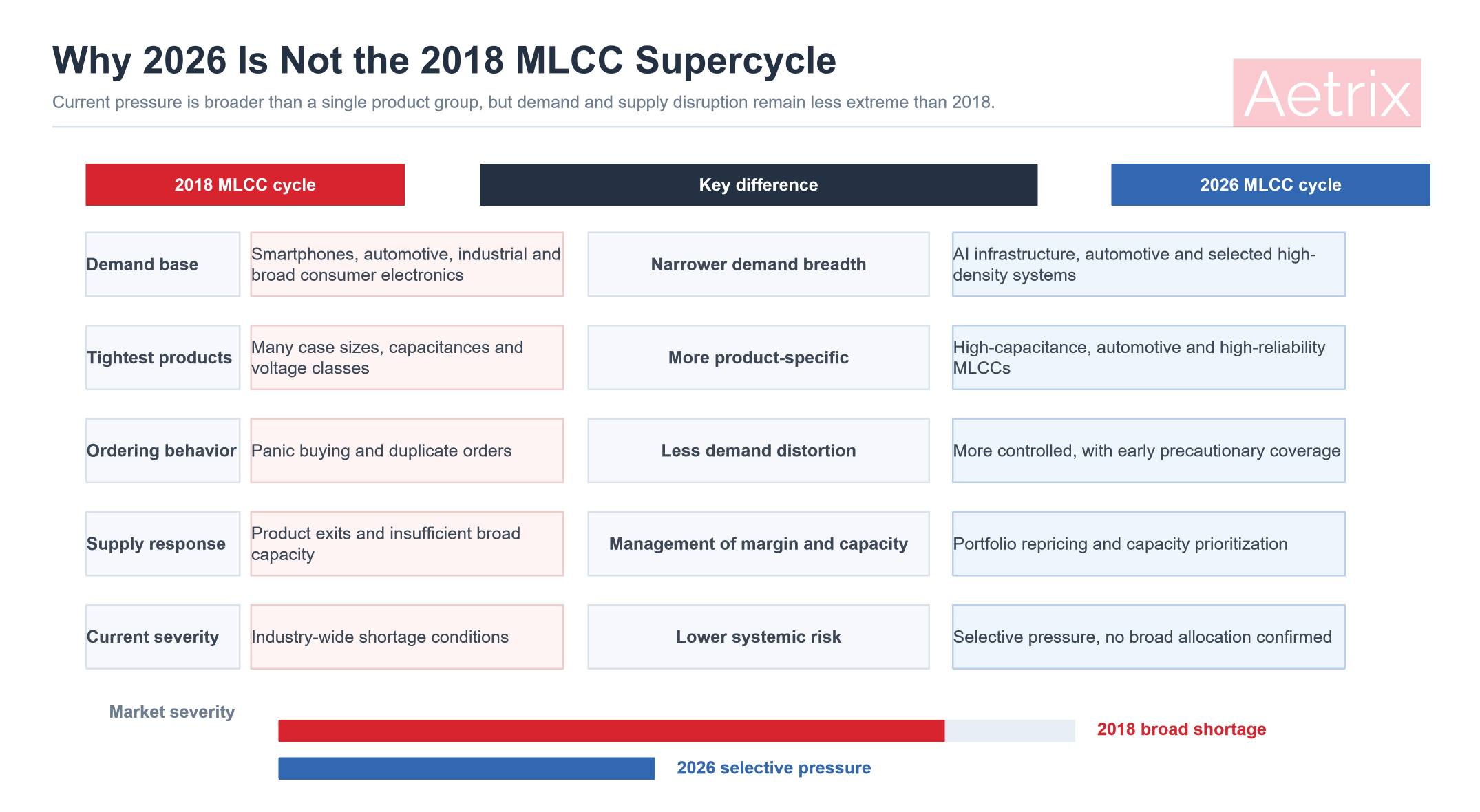
The 2026 market is narrower. Demand strength is concentrated in AI infrastructure, automotive electronics and selected high-capacitance or high-reliability products. Smartphones, PCs and general consumer electronics are not creating the same broad incremental demand that contributed to the previous cycle.
Supply-chain conditions are also less severe. More manufacturers offer standard MLCCs, customers have improved second-source planning, and the market has not yet shown widespread factory allocation or long production stoppages across the full range of case sizes.
| Dimension | 2018 MLCC Cycle | 2026 MLCC Cycle |
|---|---|---|
| Demand base | Smartphones, automotive, industrial and broad consumer electronics | AI infrastructure, automotive and selected high-density systems |
| Supply problem | Product discontinuations, insufficient capacity and difficult replacements | Cost inflation and selective capacity pressure spreading into broader repricing |
| Product exposure | Shortages across many case sizes, capacitances and voltage classes | Highest pressure in high-capacitance, automotive and high-reliability products |
| Ordering behavior | Strong panic buying and duplicate orders | More controlled procurement, with early signs of precautionary coverage |
| Alternative supply | Limited for several legacy and high-voltage products | Broader for standard products, still limited for qualified high-end MPNs |
| Price pattern | Broad increases reinforced by physical shortages | Selective increases followed by wider portfolio repricing |
| Current severity | Industry-wide disruption | Product-specific pressure without a broad market shortage |
Aetrix Electronics expects the 2026 cycle to remain more selective than 2018 unless three additional conditions emerge: broad lead-time extensions across multiple manufacturers, rapid growth in duplicate ordering, and widespread allocation of standard MLCC products.
MLCC Risk by Product Category
The customer notices should not be used to assign the same supply risk to every Taiyo Yuden capacitor.
| Product Category | Relative Risk | Primary Reason |
|---|---|---|
| AI server high-capacitance or embeddable MLCCs | Higher | Rapid demand growth, specialized construction and limited qualified supply |
| Automotive soft-termination products | Higher | Included early in the price cycle and difficult to replace after qualification |
| Automotive high-capacitance MLCCs | Higher | Advanced manufacturing, reliability requirements and long approval cycles |
| Telecom and industrial high-reliability products | Moderate to higher | Long project life and limited flexibility to change approved components |
| Small-size, high-capacitance commercial MLCCs | Moderate | Shared technology and capacity with higher-growth applications |
| Common standard MLCCs with multiple approved suppliers | Lower to moderate | Broader alternative supply and less complex qualification |
Three MLCC Supply Scenarios Through the End of 2026
Scenario 1: Cost Repricing Without Material Supply Disruption
In the lower-impact scenario, Taiyo Yuden implements revised pricing while maintaining most existing production schedules.
High-demand products remain subject to longer planning windows, but standard MLCC availability stays stable. Other major manufacturers do not introduce broad allocation, and customers avoid excessive precautionary ordering.
The market effect would consist mainly of higher contract and replenishment prices rather than a physical component shortage.
Scenario 2: Selective Capacity Tightness
In the middle scenario, AI server, automotive and high-reliability MLCC demand absorbs more production resources than expected.
Lead times extend for selected MPNs, quote validity shortens and distributors hold less forward visibility. Standard products using the same equipment may receive lower production priority or less flexible delivery commitments.
The July notice is consistent with movement toward this scenario. The company has already warned that requested delivery dates cannot always be met, although there is no evidence of broad allocation across the entire catalog.
Scenario 3: Broad Replenishment and Duplicate Ordering
A more severe cycle would require customers across consumer, industrial, automotive and computing markets to increase orders simultaneously.
Repeated orders placed through several suppliers would distort demand visibility, standard-product lead times would extend across multiple manufacturers, and spot prices would rise rapidly.
Current market conditions do not support this as the base case. End-market demand is not broad enough, and supply conditions are not yet comparable with 2018.
| Scenario | Pricing | Delivery | Buyer Response |
|---|---|---|---|
| Cost repricing | Broader price adjustments | Mostly stable outside selected products | Update budgets and confirm backlog pricing |
| Selective capacity tightness | Higher prices for constrained and strategic MPNs | Longer or less predictable for high-end products | Extend coverage for confirmed high-risk parts |
| Broad replenishment cycle | Rapid industry-wide increases | Broad lead-time extension and allocation | Activate multi-supplier continuity plans |
What Buyers Should Confirm Before September 1
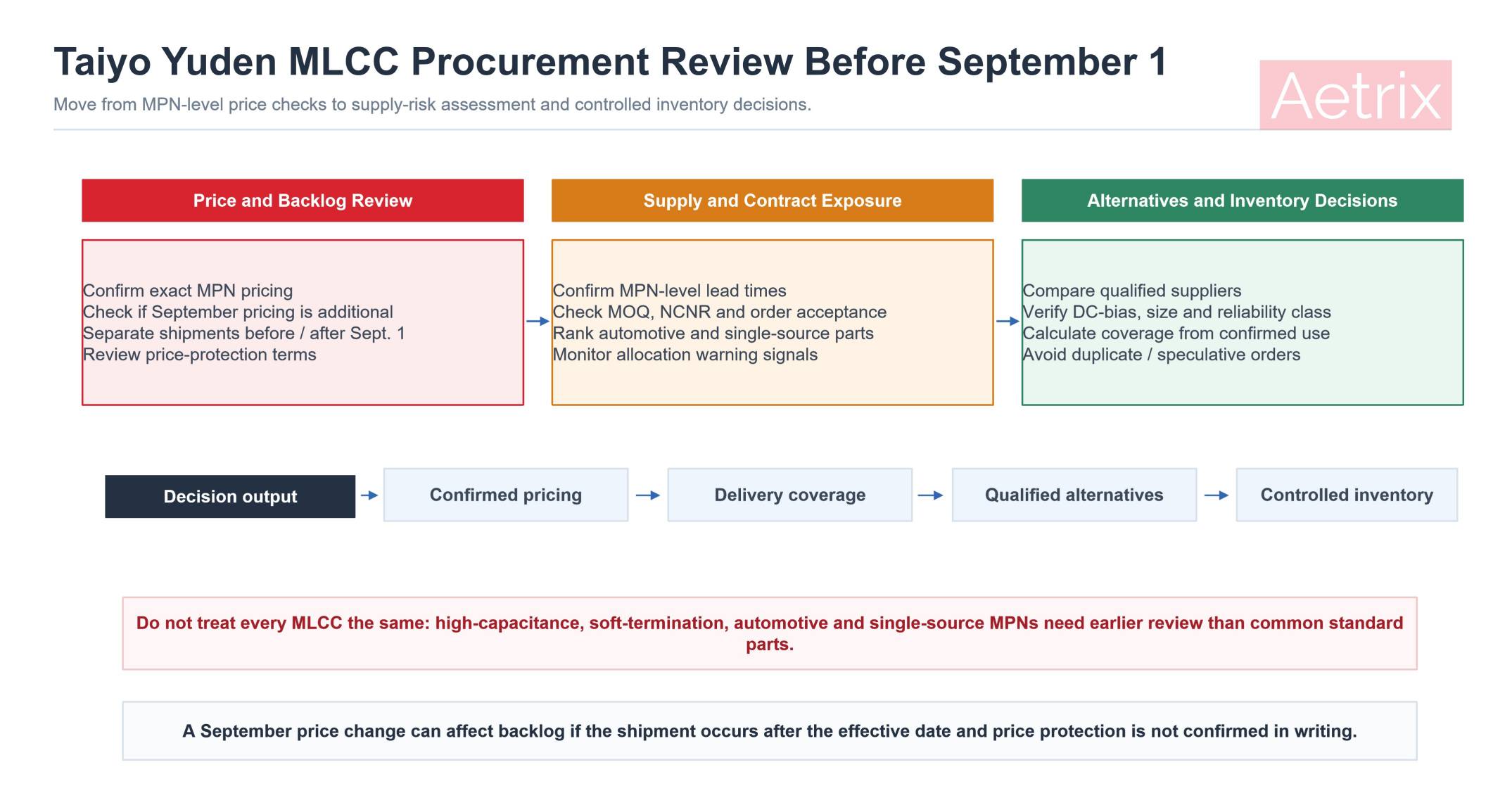
The immediate task is to determine how the September adjustment applies to existing orders. Buyers should request revised pricing at the exact MPN level and confirm whether products already affected in May will receive a second increase or move to a newly calculated price. Open orders should be reviewed by factory shipment date, since material released after September 1 may be priced differently even when the purchase order was placed earlier.
Price-protection terms also need to be checked across annual agreements, blanket orders, distributor contracts and accepted purchase orders. For scheduled releases, procurement teams should obtain written confirmation of both price and delivery date for each shipment period rather than relying on the original order acknowledgment.
The delivery warning in Taiyo Yuden's notice requires a separate supply review. Current lead times should be confirmed by product family and MPN, together with any changes to MOQ, NCNR conditions, forecast flexibility or order acceptance. These commercial controls may tighten before a supplier formally announces allocation.
Risk should be ranked by application and replaceability. Automotive, high-capacitance, soft-termination and single-source MLCCs deserve earlier attention because qualification and manufacturing-site changes can take time. Standard parts with several approved sources generally require less inventory protection.
Alternative reviews should begin before delivery schedules deteriorate. Murata, TDK, Samsung Electro-Mechanics, Yageo, Walsin and other suppliers may offer technically similar products, but nominal capacitance and case size are not sufficient for approval. Engineers should compare effective capacitance under DC bias, temperature characteristics, dimensions, termination structure, reliability class and approved manufacturing location.
Additional purchases should be tied to confirmed consumption and backlog coverage. Placing the same requirement with several suppliers can distort demand, weaken market visibility and leave buyers with excess inventory if delivery conditions stabilize.
Outlook
Taiyo Yuden's two 2026 notices confirm that MLCC pricing pressure has broadened during the year.
The first adjustment concentrated on selected, higher-reliability products and several other passive and RF component categories. The second expands the MLCC scope and introduces a clearer warning about delivery capability.
The current cycle remains smaller and less disruptive than 2018. Demand is concentrated in AI infrastructure, automotive electronics and high-performance power systems. Standard consumer and industrial products have more alternative supply, while broad factory allocation has not been confirmed.
The September adjustment still deserves immediate attention. Shipment-based implementation may affect orders already in backlog, and the inability to guarantee requested delivery dates creates risk for customers using qualified or single-source components.
The next stage of the market will be determined by product-level lead times rather than price letters alone. A sustained shortage would require wider delivery extensions, reduced distributor visibility and similar capacity warnings from other major MLCC manufacturers.
Until those signals appear, the appropriate response is selective coverage and contract review. Broad panic buying would increase costs and could recreate the demand distortion that made the 2018 shortage more severe.
Key Takeaways
- Taiyo Yuden issued two customer price-adjustment notices in 2026, with effective dates of May 1 and September 1.
- The May adjustment covered selected products, including MLCC series focused mainly on soft termination.
- The September notice expands the adjustment across the broader MLCC range covered by the communication.
- Neither customer notice publishes one uniform price-increase percentage.
- The September adjustment is based on shipment timing, creating potential exposure for existing backlog shipped after September 1.
- Taiyo Yuden states that requested delivery dates may remain difficult even after pricing is revised.
- Raw-material inflation affects several component categories, while MLCC economics also depend on yield, energy, precision processing and production allocation.
- AI servers are increasing demand for high-capacitance and embeddable MLCCs near high-current processors.
- Automotive electronics support demand for high-capacitance, soft-termination and high-reliability MLCCs with long qualification cycles.
- The 2026 market remains less severe than 2018 because demand is narrower, alternative supply is stronger and widespread allocation has not been confirmed.
- The highest risk lies in qualified automotive, AI server, high-capacitance and single-source products.
- Buyers should confirm exact MPN pricing, shipment dates, price protection, lead time, MOQ, NCNR and alternative approval before increasing inventory.