My Inquiry
 My Account


PCB material pricing has entered another adjustment phase in late August 2026. Nan Ya Plastics is raising CCL and prepreg prices by 20%–25% from September 1 based on shipment date, while Kingboard Laminates issued a new notice on August 28 raising all FR-4 thicknesses by 10%, prepreg using 7628 and thicker glass by 10%, and thinner-glass prepreg by 20%.
The size of the increases is important, but the product split is more revealing. Nan Ya describes the shortage of glass fabric as exceptionally severe and says the supply gap has continued to widen month by month. Kingboard also points to tightening supply and sharply higher prices for core upstream materials including glass fabric and copper foil. Its decision to raise thin-glass prepreg twice as much as standard FR-4 and thicker prepreg shows that the material cycle is becoming increasingly dependent on glass style and PCB stack-up.
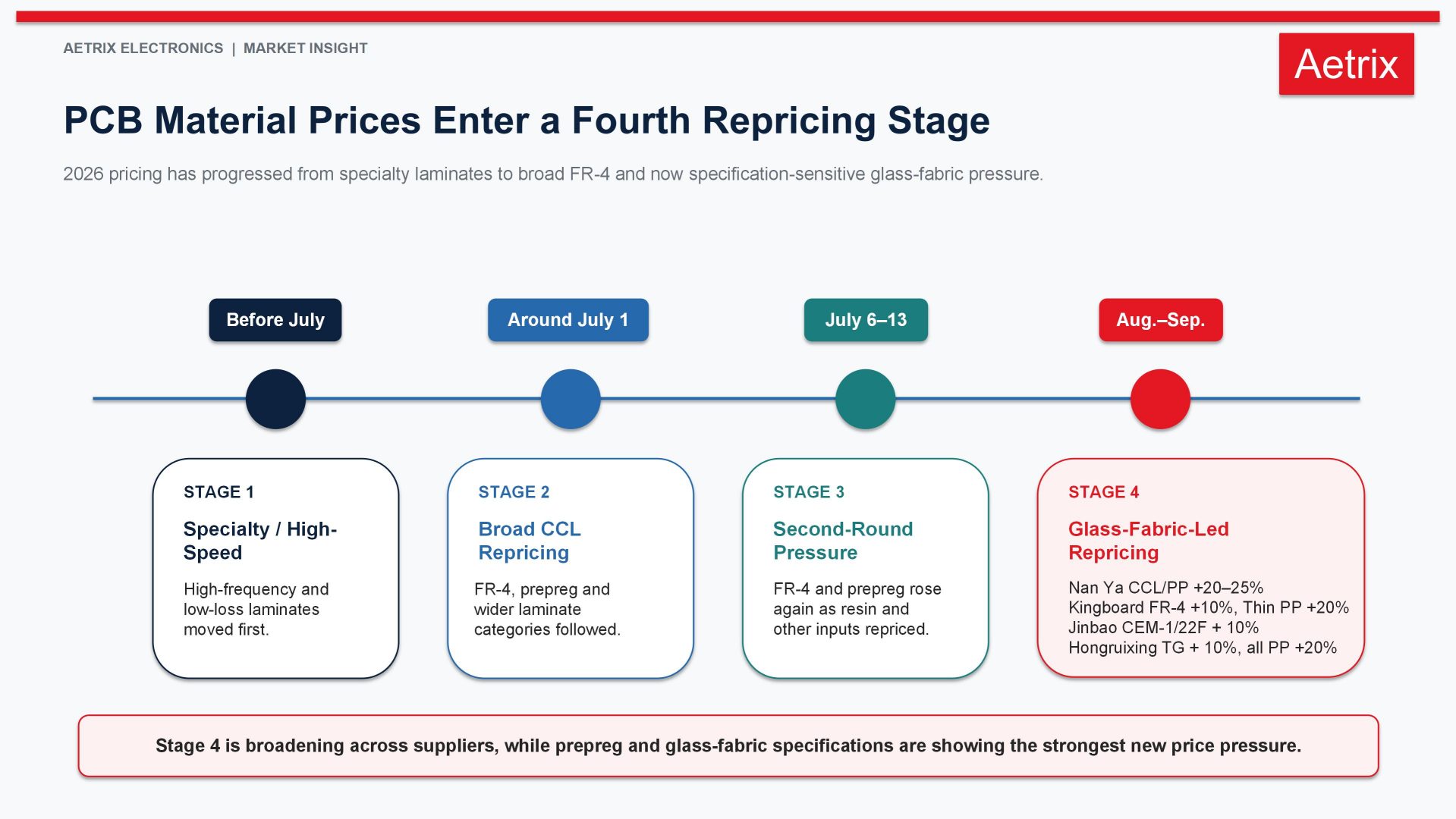
This extends the market pattern covered in our July analysis, PCB Material Price Hikes Enter New Phase as CCL, FR-4 and Resin Costs Rise. At that point, pricing had already moved from specialty laminates into broader FR-4, prepreg and resin. The latest notices add a fourth stage: glass-fabric availability is now becoming a more visible constraint inside the laminate supply chain.
PCB Material Prices Enter a Fourth Repricing Stage
The 2026 PCB material cycle did not begin with ordinary FR-4. Specialty and low-loss laminates moved first, followed by broader CCL repricing around July 1 and another Kingboard adjustment on July 6. Resin prices also moved higher during July. By late August, another set of price actions has arrived from major laminate suppliers.
Why Nan Ya and Kingboard Matter to the PCB Supply Chain
Nan Ya Plastics and Kingboard Laminates are not niche material suppliers. Both are major producers of copper-clad laminate and prepreg, placing their pricing decisions close to the center of the global PCB material supply chain.
Kingboard Laminates is one of the world's largest rigid CCL suppliers, with extensive production of FR-4, prepreg and related electronic materials across Asia. Industry data for 2025 places Kingboard at roughly 14% of the global rigid laminate market, making it one of the three largest suppliers by revenue. Nan Ya Plastics, part of Taiwan's Formosa Plastics Group, is also a major vertically integrated electronic-materials producer supplying CCL, prepreg, glass fabric, copper foil and resin-related materials. Recent industry estimates place Nan Ya at roughly 8% of the global rigid laminate market. Market-share figures vary by reporting scope, particularly depending on whether specialty laminates, mass laminates or prepreg are included. (Prismark, Rigid CCL Market June 2026 Update)
Their combined significance explains why the latest notices deserve attention beyond their direct customers. A price change from either supplier can affect a large number of PCB fabricators, while simultaneous increases from both provide a stronger signal that the pressure is originating upstream in laminate and reinforcement materials rather than from an isolated PCB manufacturer.
The August 28 pricing signal has since broadened beyond Nan Ya and Kingboard. Shandong Jinbao Electronics announced a 10% increase for CEM-1/22F, while Jiangxi Hongruixing raised normal-TG HX135, middle-TG HP-150LF and high-TG HP-170LF laminates by 10% and all prepreg series by 20%. With several laminate producers adjusting prices on the same date, the market signal is no longer limited to the largest CCL suppliers. It is becoming a broader industry repricing event across FR-4, TG laminates, prepreg and composite board materials.
| Stage | Timing | Market Development | Buyer Meaning |
|---|---|---|---|
| Stage 1 | Before July | Specialty and high-speed laminate prices moved higher | AI server and networking materials showed pressure first |
| Stage 2 | Around July 1 | Broader CCL repricing reached FR-4, PP and high-speed laminates | Material inflation spread beyond specialty boards |
| Stage 3 | July 6–13 | Kingboard raised FR-4 and PP again; specialty resin costs also increased | Multiple upstream cost layers were repricing simultaneously |
| Stage 4 | August 28–September 1 | Nan Ya raises CCL/PP 20%–25%; Kingboard raises FR-4 and PP again; Jinbao raises CEM-1/22F 10%; Hongruixing raises multiple TG laminates 10% and all PP 20% | Repricing is spreading across multiple laminate suppliers, while glass style, material grade and shipment timing become larger procurement variables |
Nan Ya Raises CCL and Prepreg Prices 20%–25%
Nan Ya Plastics' Electronic Materials Division has set a 20%–25% increase for CCL and prepreg, effective September 1, 2026. The notice specifies that the adjustment is based on shipment date rather than simply the date a new order is placed. Public reports on the notice confirm the same pricing range and September 1 shipping rule. (Nan Ya CCL and Prepreg Price Increase Report)
The explanation is unusually specific for a laminate price letter. Nan Ya describes a severe imbalance in the electronic-materials market, broad increases in core raw-material costs and an exceptionally severe glass-fabric shortage. It also says the glass-fabric supply gap has been widening month by month and that current production costs can no longer be absorbed internally.
The shipment-date rule creates an immediate question for orders already in backlog. A PCB fabricator may have placed laminate orders before September, yet deliveries scheduled after September 1 can still fall under the new price structure. That can affect PCB quotes that were issued before the upstream cost was finalized.
PCB buyers with September and Q4 builds should therefore distinguish between a quoted board price and actual material price protection. The two are not necessarily the same. Open purchase orders, partial shipments and long production schedules may require separate confirmation.
Kingboard Raises FR-4 Again, With Thin Prepreg Up 20%
Kingboard's August 28 notice applies to new orders received from the notice date. FR-4 across all thicknesses rises 10%. Prepreg using 7628 and thicker glass also rises 10%, while prepreg using glass styles below 7628 rises 20%. The same notice also adds RMB 10 (approx. US$1.49) to CEM-1/22F and RMB 5 (approx. US$0.74) to VO materials. Public reporting describes the August adjustment as another round in Kingboard's repeated 2026 repricing cycle. (Kingboard August 28 Price Increase Report)
| Kingboard Product | Increase | Procurement Signal |
|---|---|---|
| FR-4, all thicknesses | +10% | Mainstream laminate remains exposed to upstream material inflation |
| PP using 7628 and thicker glass | +10% | Standard multilayer material cost continues to rise |
| PP using glass styles below 7628 | +20% | Thin-glass availability is carrying a stronger price signal |
| CEM-1 / 22F | RMB 10 (approx. US$1.49) | Price pressure is also reaching lower-cost composite laminate categories |
| VO | RMB 5 (approx. US$0.74) | The adjustment extends beyond FR-4 and multilayer prepreg into additional laminate products |
The difference between the 10% and 20% adjustments is more informative than the headline FR-4 increase. It shows that material pressure is not uniform across every PCB stack-up.
More CCL Suppliers Join the August 28 Price Increase
Kingboard was not the only laminate producer to adjust pricing on August 28. Shandong Jinbao Electronics announced a 10% increase for CEM-1/22F, citing continued shortages and rising prices for upstream materials including glass fabric and electronic copper foil.
Jiangxi Hongruixing issued a separate adjustment covering several laminate grades. Normal-TG HX135, middle-TG HP-150LF and high-TG HP-170LF increase 10%, while the company's entire prepreg series increases 20%. Hongruixing attributes the move to simultaneous shortages and sharp price increases across glass fabric, copper foil and resin.
| Supplier | Product | Adjustment | Market Signal |
|---|---|---|---|
| Shandong Jinbao Electronics | CEM-1 / 22F | +10% | Composite laminate pricing is also moving higher |
| Jiangxi Hongruixing | HX135 normal-TG | +10% | Standard TG laminate cost pressure is broadening |
| Jiangxi Hongruixing | HP-150LF middle-TG | +10% | Mid-TG products are participating in the same repricing cycle |
| Jiangxi Hongruixing | HP-170LF high-TG | +10% | Higher-TG material is also exposed to the upstream shortage |
| Jiangxi Hongruixing | All PP series | +20% | Prepreg is showing stronger inflation than laminate in this notice |
The timing matters. Multiple laminate manufacturers issuing increases on the same date makes the August 28 move more significant than a single-supplier adjustment. Kingboard's 20% increase for thinner-glass prepreg and Hongruixing's 20% increase across all PP series also provide separate evidence that prepreg is carrying particularly strong cost pressure.
Thin Glass Cloth Is Sending the Strongest Supply Signal
7628 is a widely used electronic glass-fabric style associated with relatively thick dielectric construction. Many multilayer and HDI designs also use thinner styles such as 2116 and 1080 to build thinner dielectric layers, control impedance and achieve higher layer density.
Kingboard's new pricing separates thicker and thinner prepreg instead of applying one uniform PP increase. The 20% adjustment below 7628 suggests that customers using thinner glass constructions should expect more pressure than buyers using standard thick-glass material.
That changes the sourcing conversation. Asking whether "FR-4 is available" is no longer enough for a multilayer board. The actual risk can depend on the laminate series, prepreg construction, glass style, resin content, finished dielectric thickness and approved stack-up.
A fabricator may have access to one FR-4 family while still facing difficulty securing the exact prepreg construction needed for an approved impedance stack-up. Changing glass style can alter dielectric thickness, resin content, impedance, copper-to-copper spacing, CAF performance and process behavior. For controlled-impedance, automotive or high-reliability boards, substitutions may require customer approval or electrical revalidation.
Glass Fabric Has Become a Major PCB Material Bottleneck
TrendForce has identified persistent shortages in high-end fiberglass cloth used in AI chips, servers and high-speed switching equipment. Its June research points to technical barriers, equipment bottlenecks and yield limitations that slow the release of additional capacity. Next-generation AI systems also require larger substrates and more layers, increasing consumption of specialty glass cloth. (TrendForce, Key AI Components – Fiberglass Cloth)
The supply problem is difficult to solve quickly because electronic glass cloth is not expanded by adding generic textile capacity. High-performance materials require qualified yarn, specialized weaving, controlled finishing and stable electrical properties. Advanced low-Dk and low-CTE glass products carry even tighter process requirements.
TrendForce has also reported that Nittobo controls a large share of the high-end T-glass and NER-glass market and that meaningful new capacity is not expected until around mid-2027 at the earliest. That analysis applies primarily to high-end glass rather than every standard FR-4 fabric style, but it helps explain why PCB material capacity remains difficult to rebalance quickly. (TrendForce, Glass Fiber Cloth Shortage in AI Infrastructure)
Why AI Demand Can Raise the Cost of Ordinary FR-4
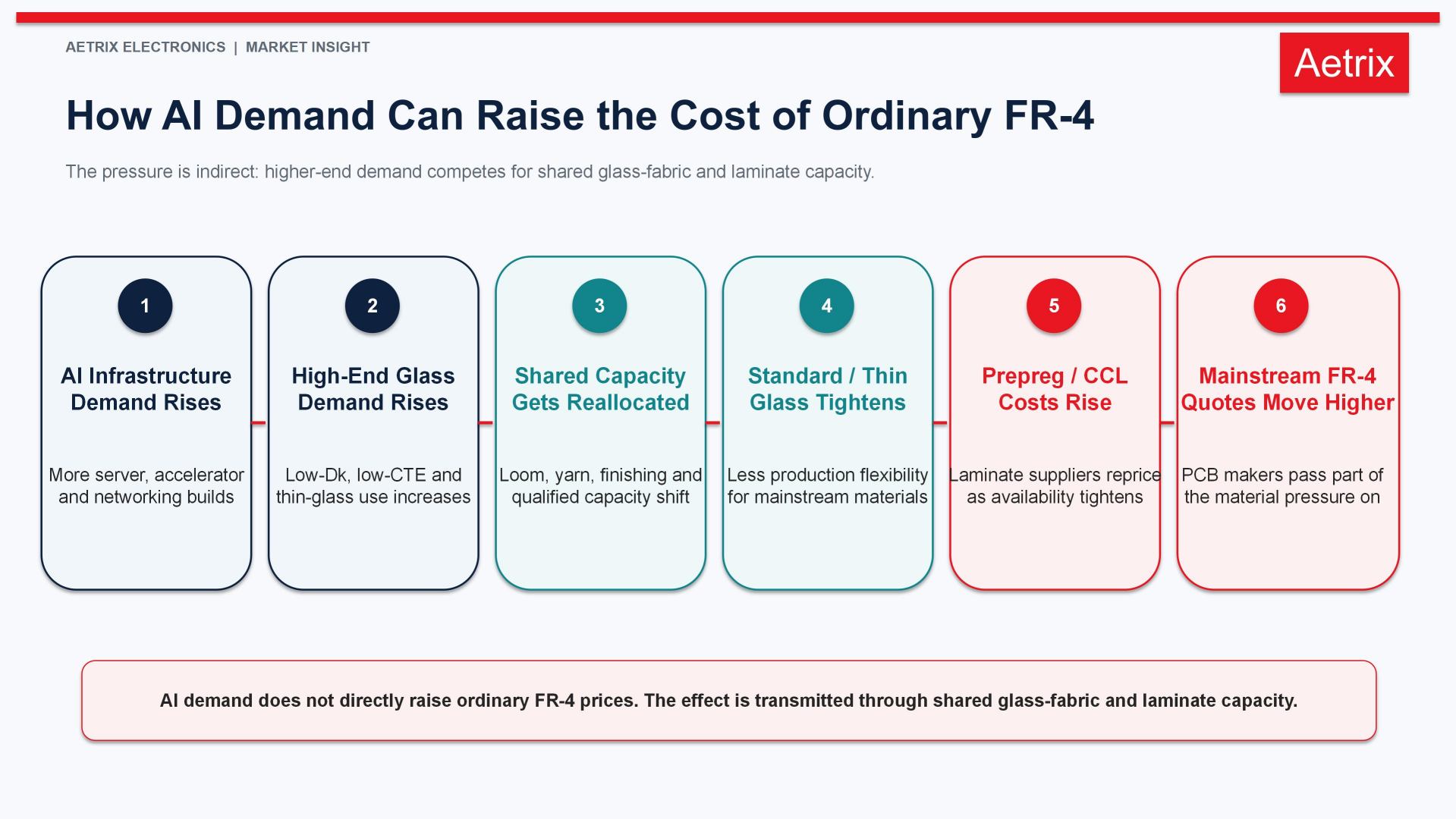
AI infrastructure does not consume ordinary FR-4 in exactly the same way as a conventional industrial control board. High-performance servers, accelerator cards and high-speed switches rely more heavily on low-loss laminates, advanced glass systems, dense multilayer structures and tighter signal-integrity specifications.
The effect on mainstream FR-4 is indirect. High-end and standard materials share parts of the wider production ecosystem: glass yarn, weaving equipment, finishing resources, resin systems, laminate lines and qualified manufacturing capacity. When suppliers prioritize scarce resources toward higher-value AI and networking materials, flexibility available to other glass and laminate products can decline.
TrendForce has described AI competition as a broader supply-chain capacity race extending beyond wafers and advanced packaging into T-glass, substrates and PCBs. (TrendForce, AI Supply Chain Capacity Competition)
The latest Kingboard notice gives a practical downstream signal. Even though the tightest demand starts in more advanced material categories, ordinary FR-4 is still receiving another 10% increase. Thin-glass prepreg is moving faster at 20%.
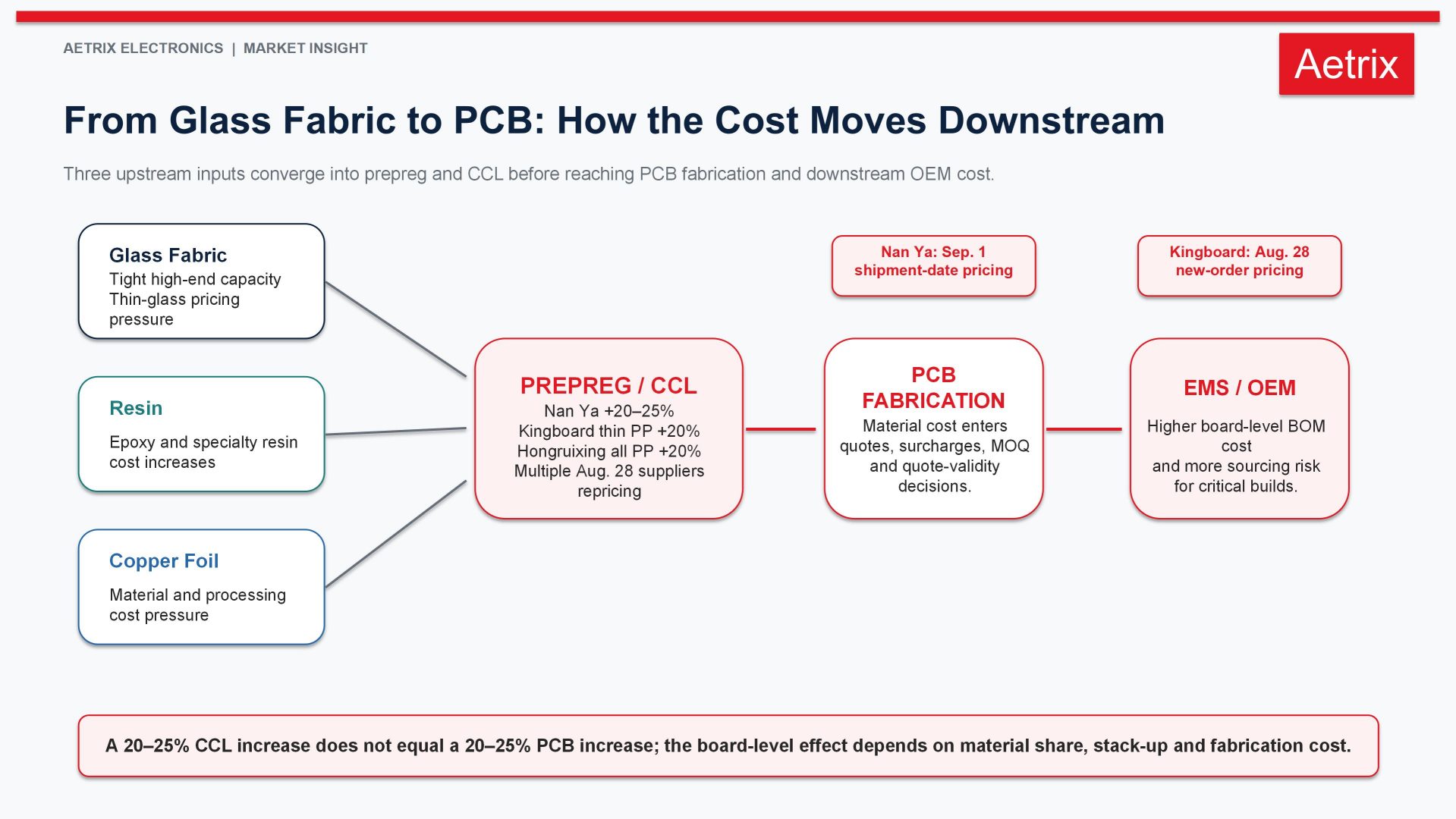
From Glass Fabric to PCB: How the Cost Moves Downstream
A PCB fabricator does not buy glass cloth in isolation. Glass fabric is impregnated with resin to form prepreg, while cured laminate is combined with copper foil to produce CCL. The board manufacturer then adds drilling, plating, imaging, solder mask, surface finish, electrical testing and other processes.
The current cost pressure therefore moves through several commercial layers:
| Supply-Chain Layer | Current Pressure | Possible Buyer Effect |
|---|---|---|
| Glass yarn / glass fabric | Tight high-end capacity and stronger thin-glass pricing | Specific stack-ups become harder to secure |
| Resin | Higher epoxy and specialty resin costs | Prepreg and laminate formulation costs rise |
| Copper foil | Higher material and processing costs | CCL and heavy-copper board cost increases |
| Prepreg / CCL | Nan Ya +20%–25%; Kingboard FR-4 +10% and thin-glass PP +20%; Hongruixing TG laminates +10% and all PP +20%; Jinbao CEM-1/22F +10% | PCB material cost, quote validity and material-specific allocation pressure increase |
| PCB fabrication | Fabricators absorb less of the upstream increase | Board prices, surcharges or commercial terms can change |
| EMS / OEM | Higher board-level BOM cost | Product margin and customer quotation pressure |
Evidence of this downstream repricing is already visible. Jinlu Electronics reported that CCL and prepreg procurement prices rose sharply and supply tightened during the first half of 2026. The average price of orders accepted during the first half increased 29.03% year over year, while the Q2 average order price increased 21.77% from Q1. The company expects pricing changes to become more fully reflected during the second half. Those figures describe Jinlu's order mix and pricing rather than a universal PCB market increase, but they confirm that upstream material pressure is already reaching finished-board pricing. (Jinlu Electronics 2026 Interim Report)
Shipment-Based Pricing Creates Backlog Risk
Nan Ya's September 1 rule deserves separate attention because it is tied to shipment date. An order entered before September may still require review if the laminate ships after the new pricing becomes effective.
That becomes important for PCB programs with material reservations, split deliveries or long manufacturing schedules. A fabricator may have quoted a board based on an older CCL cost while its laminate supplier ultimately ships part of the requirement under September pricing.
Before relying on an existing PCB quotation, buyers should confirm whether the quoted price includes material protection through the planned build date. Open PO status alone does not establish that protection.
The same check should cover partial deliveries. A blanket PO covering several monthly releases can have different cost exposure from a fully allocated material purchase already held by the PCB supplier.
A 20%–25% CCL Increase Does Not Mean PCB Prices Rise 20%–25%
Nan Ya's adjustment should not be applied directly to finished PCB prices. CCL and prepreg are major PCB inputs, but the final board price also includes copper processing, drilling, plating, imaging, solder mask, surface finish, testing, labor, depreciation, yield loss and logistics.
Material weight also varies widely by board type. A simple two-layer board with standard dimensions has a different cost structure from an 18-layer server board using multiple prepreg constructions, heavy copper and tightly controlled dielectric thickness.
The board-level effect therefore depends on how much laminate is consumed, which glass styles are specified, whether high-speed material is required and how much of the upstream increase the PCB fabricator passes through.
Buyers should watch actual PCB quotations rather than multiplying an upstream percentage by the finished-board price. Shorter quote validity, explicit laminate surcharges, material substitutions and revised MOQ or NCNR terms can reveal the impact before a broad PCB price increase appears.
Which PCB Types Face Higher Material Risk?
The latest notices do not affect every PCB category equally. The following ranking is an Aetrix assessment based on material intensity, glass-fabric dependence, qualification difficulty and current AI-related demand.
| PCB Type | Current Material Risk | Main Exposure |
|---|---|---|
| AI server / high-speed networking PCB | Very High | Low-loss laminate, advanced glass and high layer count |
| High-layer-count PCB | High | Large prepreg consumption and multiple controlled dielectric layers |
| HDI | High | Thin dielectric construction and tighter material qualification |
| Thin-dielectric multilayer PCB | High | Greater sensitivity to thin glass styles below 7628 |
| Automotive multilayer PCB | Moderate–High | Long qualification cycle and restricted material substitutions |
| Industrial multilayer FR-4 | Moderate–High | Broad FR-4 repricing and long product lifecycles |
| Standard 2/4-layer FR-4 | Moderate | FR-4 cost increases, with more substitution flexibility |
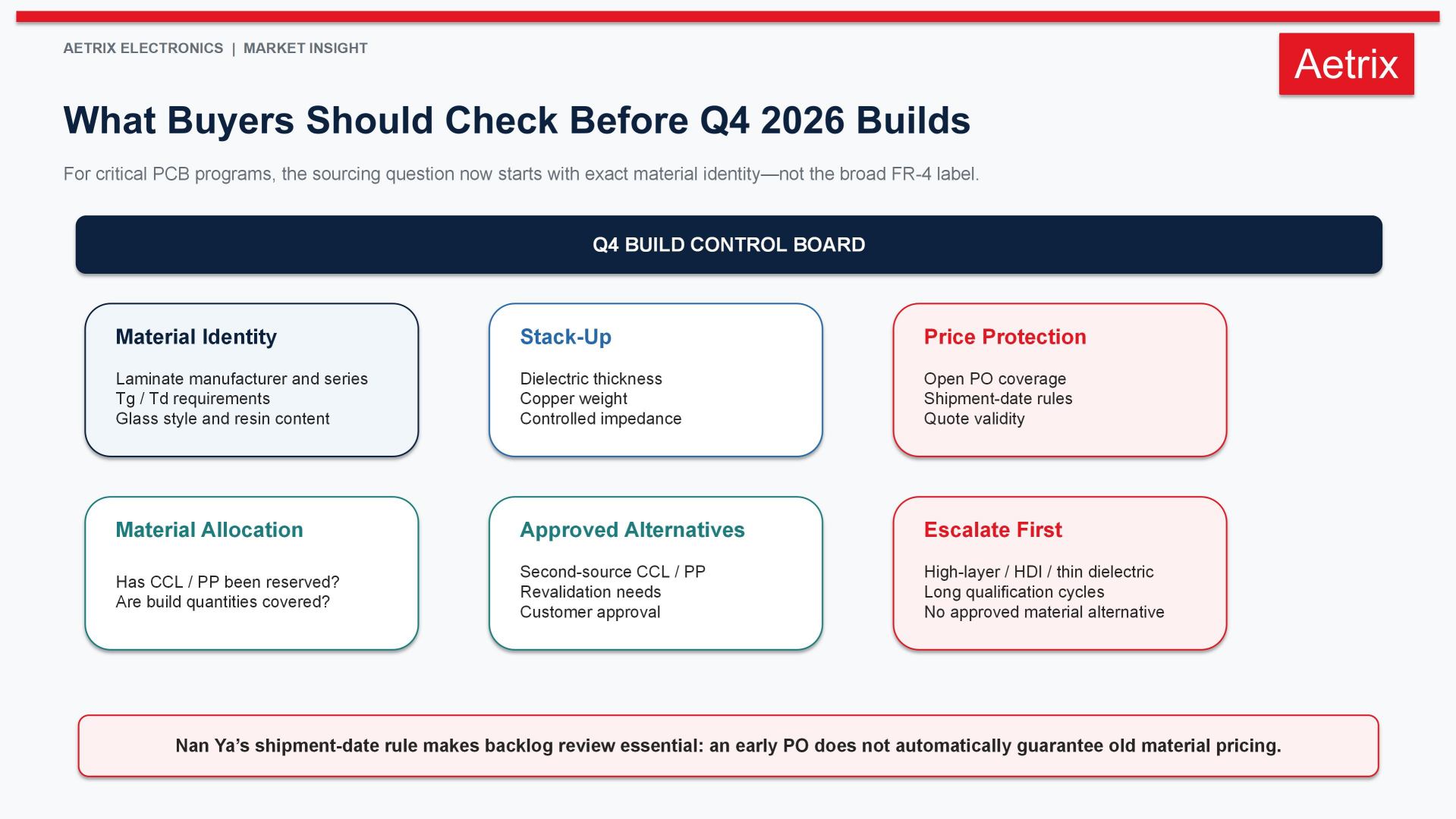
What Buyers Should Check Before Q4 2026 Builds
Material identification should go deeper than the words "FR-4." Buyers with critical PCB programs should know the approved laminate manufacturer and series, Tg requirement, copper weight, prepreg construction, glass style and final stack-up.
That information determines whether an alternate laminate can actually be used when the preferred material is constrained. Two materials sold as FR-4 can differ in Tg, Td, CTE, dielectric properties, CAF performance, resin content and processing behavior.
| Review Area | What to Confirm |
|---|---|
| Material code | Laminate manufacturer, series, Tg, PP construction and glass style |
| Stack-up | Dielectric thickness, copper weight and controlled-impedance requirements |
| Second-source material | Whether alternate CCL and prepreg are already approved |
| Open PO protection | Whether current board pricing is protected through actual material shipment |
| Material allocation | Whether laminate and PP have been physically reserved for the build |
| Quote validity | How long the PCB supplier will hold material and board pricing |
| Substitution validation | Whether impedance, reliability or customer approval must be repeated after a material change |
Could PCB Material Prices Rise Again in Q4?
Another industry-wide increase has not been confirmed. The upstream conditions behind the August and September adjustments, however, have not normalized.
Nan Ya says the glass-fabric supply gap has been widening month by month. Kingboard has issued another increase only weeks after its July adjustments, while Jinbao and Hongruixing also released new pricing on August 28. The simultaneous moves across several laminate suppliers show that the latest repricing is broader than a single-company action. TrendForce continues to describe high-end glass-fabric capacity as structurally tight, with expansion slowed by equipment, qualification and yield constraints.
The next signals to watch are additional glass-fabric allocation, shorter laminate quote validity, more shipment-based pricing, PCB material surcharges and requests to substitute approved laminate or prepreg constructions.
If these become more common during Q4, the PCB market will be moving beyond a simple material-inflation cycle. Procurement risk would then depend on three variables at the same time: price, material availability and allocation.
Outlook
The late-August notices show that PCB material pricing remains active after the July repricing cycle. Nan Ya's 20%–25% CCL and prepreg adjustment is large enough to force downstream cost reviews, while August 28 increases from Kingboard, Jinbao and Hongruixing show that repricing is spreading across FR-4, TG laminates, prepreg and composite materials rather than remaining concentrated in one supplier.
The stronger 20% increase for thinner-glass prepreg gives the market a more precise signal. Availability is becoming more dependent on glass style, stack-up and product mix. High-layer-count, HDI and high-speed boards therefore carry greater sourcing exposure than a simple FR-4 market headline suggests.
AI infrastructure remains an important upstream demand driver, particularly for high-end glass and low-loss laminate systems. The transmission into ordinary boards occurs through shared material and manufacturing capacity, which can leave mainstream PCB buyers paying more even when their own end markets are not growing at AI-server rates.
For Q4 procurement, the practical priority is to confirm the exact material behind each critical board, determine whether that material has already been reserved, and understand how supplier pricing applies to backlog and shipment dates. Those details will determine the real effect of the current PCB material shortage more accurately than any single CCL price-increase percentage.
Key Takeaways
- Nan Ya Plastics is raising CCL and prepreg prices by 20%–25% from September 1, 2026, based on shipment date.
- Nan Ya identifies glass-fabric shortage as an exceptionally severe constraint and says the supply gap is widening month by month.
- Kingboard's August 28 notice raises all FR-4 thicknesses by 10%, PP using 7628 and thicker glass by 10%, and thinner-glass PP by 20%.
- Shandong Jinbao Electronics also raised CEM-1/22F by 10% on August 28, citing tight glass-fabric and electronic copper-foil supply.
- Jiangxi Hongruixing raised normal-TG, middle-TG and high-TG laminate products by 10% and all prepreg series by 20%, adding another independent signal that the late-August repricing is spreading across the CCL market.
- The larger thin-glass increase indicates that PCB material risk is becoming more dependent on glass style and stack-up.
- AI server and high-speed networking demand is increasing consumption of advanced glass and laminate materials while reducing flexibility across shared production resources.
- A 20%–25% CCL increase does not translate directly into a 20%–25% finished PCB increase.
- PCB manufacturers are already passing part of the upstream cost pressure into finished-board pricing.
- High-layer-count, HDI, thin-dielectric and high-speed PCBs currently carry greater material risk than standard low-layer FR-4 boards.
- Buyers should confirm laminate series, glass style, stack-up, open-order protection, material allocation and approved alternatives before Q4 builds.