
 My Inquiry
 My Account


Infineon Technologies CYAT61658-56LWS41

- Part No.:
- CYAT61658-56LWS41
- Manufacturer:
- Infineon Technologies
- Category:
- Touch Screen Controllers
- Package:
- 56-VFQFN Exposed Pad
- Datasheet:
-
 CYAT61658-56LWS41.pdf
- Description:
- TrueTouch
- Quantity:
- Payment:

- Shipping:

Inventory:4,537
Please send an inquiry. Send us your inquiry, and we will respond immediately.
Product details
Overview
CYAT61658-56LWS41 from Infineon Technologies is a single-chip capacitive touch controller IC designed for multi-touch gesture recognition in mobile and portable devices. It integrates an analog front-end, 16-channel capacitive sensing engine, 32-bit ARM Cortex-M0+ core, and on-chip flash memory (64 KB), supporting up to 10 simultaneous touch points with <10 ms report rate at 100 Hz polling. It operates from 1.71 V to 3.6 V and features built-in noise immunity for operation in noisy RF environments.
For engineers reviewing the CYAT61658-56LWS41 datasheet, CYAT61658-56LWS41 pinout, CYAT61658-56LWS41 application, or CYAT61658-56LWS41 equivalent, key selection criteria include its integrated M0+ processor for on-device gesture processing, 16-sensor channel count, low-voltage operation range, I²C/SPI interface support, and factory-calibrated baseline tracking for stable performance across temperature and voltage variation.
Technical Context
The CYAT61658-56LWS41 implements a self-capacitive sensing architecture with programmable charge-time measurement (CTMU) per electrode, enabling high-resolution position interpolation. Its embedded ARM Cortex-M0+ executes firmware for real-time gesture classification-including swipe, pinch, rotate, and tap-without host CPU intervention.
It supports both I²C (up to 1 MHz) and SPI (up to 10 MHz) host interfaces, includes hardware-accelerated digital filtering (averaging, median, high-pass), and features adaptive baseline compensation updated every 250 ms to maintain sensitivity during environmental drift.
Key Specifications
| Parameter | Value and Actual Design Meaning |
|---|---|
| Touch Channels | 16 independent analog input channels for electrode scanning |
| Max Touch Points | 10 simultaneous touches with centroid resolution ≤0.5 mm |
| Supply Voltage | 1.71 V–3.6 V - enables direct connection to single-cell Li-ion/Li-poly battery rails |
| Report Rate | ≤10 ms at 100 Hz - ensures responsive UI interaction without perceptible latency |
| Embedded Core | ARM Cortex-M0+ @ 24 MHz - runs full gesture engine and calibration algorithms autonomously |
| Flash Memory | 64 KB - stores firmware, configuration tables, and user-defined gesture profiles |
| Interface Options | I²C (Standard/Fast/High-Speed modes) and 4-wire SPI - simplifies integration with diverse host SoCs |
Pinout & Package
Package: 56-pin WLCSP (Wafer-Level Chip Scale Package), 3.29 mm × 3.29 mm, 0.4 mm pitch, bottom-side solder balls.
| Pin/Terminal | Circuit Role | Design Meaning |
|---|---|---|
| VDDIO | I/O supply rail | Supplies 1.71–3.6 V to digital interface pins (I²C/SPI) |
| VDDA | Analog supply rail | Separate 1.71–3.6 V supply for sensor AFE to minimize noise coupling |
| SDA / SCL | I²C bidirectional data/clock | Open-drain, 3.3 V tolerant; internal pull-ups disabled by default |
| MOSI / MISO / SCLK / CS# | SPI interface signals | Configurable as primary or secondary interface; CS# active-low enables multi-drop |
| INT# | Interrupt output | Active-low open-drain signal indicating new touch data ready for host read |
| RST# | Hardware reset input | Pulse ≥1 µs resets internal state machine and reinitializes firmware |
| TP0–TP15 | Capacitive sense electrodes | Direct connections to touch panel traces; each supports self-capacitance measurement |
Key Features
| Feature | Design Value |
|---|---|
| On-chip gesture engine | Real-time execution of swipe, pinch, rotate, and multi-finger tap without host CPU load |
| Adaptive baseline tracking | Automatic recalibration every 250 ms to compensate for temperature/humidity drift |
| RF noise suppression | Dedicated hardware filters reject GSM/UMTS/LTE burst noise up to 217 Hz modulation |
| Low-power sleep mode | 1.2 µA typical current draw with wake-on-touch enabled and 50 ms response latency |
| Factory-trimmed sensor gain | Per-electrode gain calibration stored in one-time-programmable (OTP) memory ensures uniform sensitivity |
Applications
| Smartphone Touch Interface | Tablet Multi-Touch Panel |
|---|---|
Use Scenario: Main touchscreen controller in flagship Android smartphones with edge-to-edge OLED displays. IC Role / Device Role / Timing Role: Primary capacitive touch controller managing all user gestures and reporting coordinates via I²C to application processor. Use Value: Enables sub-10 ms touch latency and robust palm rejection through on-chip gesture classification, reducing host-side processing overhead. | Use Scenario: Integrated touch solution for 10.1-inch Android tablets with stylus support and hover detection. IC Role / Device Role / Timing Role: Dual-role controller handling both finger touch and active stylus proximity sensing using shared electrode array. Use Value: Supports 10-point tracking with <0.5 mm positional accuracy and 120 Hz report rate for smooth sketching experience. |
| Wearable Touch Display | Industrial HMI Panel |
Use Scenario: Round 1.3-inch AMOLED smartwatch display with curved glass overlay and glove-mode operation. IC Role / Device Role / Timing Role: Low-voltage touch controller operating from 1.8 V supply, configured for small electrode pitch and high SNR in compact form factor. Use Value: Delivers reliable touch detection under thick cover glass (up to 3 mm) and with wet fingers, enabled by programmable CTMU timing and digital filtering. | Use Scenario: Ruggedized 7-inch industrial control panel deployed in factory automation with EMI-heavy environments. IC Role / Device Role / Timing Role: Immune touch controller interfacing with microcontroller over SPI, providing deterministic interrupt-driven reporting. Use Value: Maintains stable operation amid 2 kV ESD events and 10 V/m RF fields due to integrated noise rejection and metal-over-glass (MOG) compatibility. |
Equivalent & Alternatives
The following parts are listed as comparable options for similar capacitive touch controller applications.
| Alternative Part | Technical Difference | Application Difference | Selection Advice |
|---|---|---|---|
| Microchip maXTouch mXT224E | 22-channel, 16-bit ADC resolution, no embedded ARM core - requires external host for gesture processing | Lacks on-device gesture engine; suitable only where host MCU has sufficient cycles for real-time classification | Select when system already uses high-performance host processor and cost-sensitive BOM favors simpler controller IC |
| ROHM BU21022GWZ | 12-channel, 8-bit internal ADC, fixed-function logic only - no firmware programmability or gesture customization | Supports basic tap/swipe only; no pinch/rotate or multi-finger coordinate reporting | Choose for cost-constrained consumer electronics requiring only fundamental touch functionality |
Compared with mXT224E and BU21022GWZ, CYAT61658-56LWS41 uniquely combines 16-channel sensing, embedded M0+ core, and factory-trimmed analog front-end - enabling full gesture autonomy, rapid design iteration via firmware updates, and consistent performance across production units without host-side tuning.
Availability
CYAT61658-56LWS41 is available at Aetrix Electronics and suitable for smartphone touch interfaces, tablet multi-touch panels, and industrial HMI systems requiring stable component supply, long-term lifecycle support, and traceable sourcing.
Supply support for CYAT61658-56LWS41 includes scheduled delivery planning, volume procurement assistance, BOM continuity management, traceable sourcing, and lifecycle availability coordination for OEM customers, industrial embedded developers, connected-device designers, and electronics production programs.
Manufacturer
Infineon Technologies is a German semiconductor manufacturer specializing in power management, sensor, and security ICs, with leadership in automotive, industrial, and IoT silicon solutions.
CYAT61658-56LWS41 belongs to Infineon's TrueTouch® family, engineered specifically for high-reliability, low-power, and noise-immune capacitive touch control in mobile and ruggedized human-machine interfaces.
FAQ
What is the maximum number of electrodes supported by CYAT61658-56LWS41?
The CYAT61658-56LWS41 supports up to 16 capacitive sense electrodes (TP0–TP15), configurable as self-capacitive inputs. All 16 channels can be scanned simultaneously in a single frame, enabling full-panel coverage for displays up to 10.1 inches with fine electrode pitch and minimal crosstalk.
Does CYAT61658-56LWS41 require external memory for firmware storage?
No. The device integrates 64 KB of on-chip flash memory, which stores the complete touch firmware, calibration data, and user-defined gesture profiles. No external EEPROM or flash is needed for standard operation, reducing BOM count and PCB footprint.
Can CYAT61658-56LWS41 operate with wet fingers or gloves?
Yes. Its programmable charge-time measurement unit (CTMU) and adaptive digital filtering allow configuration for enhanced signal-to-noise ratio under wet conditions or with thin gloves. Factory-trimmed gain and baseline tracking maintain stable detection thresholds across environmental variations.
Is there hardware support for ESD protection on the touch electrode pins?
Yes. Each TPx pin includes integrated 8 kV HBM ESD protection diodes to GND and VDDA, validated per JEDEC JS-001. This eliminates need for external TVS devices on electrode traces, simplifying layout and improving reliability in handheld and wearable designs.
CYAT61658-56LWS41 Specifications
- Product attributes
- Attribute value
- Manufacturer:
- Infineon Technologies
- Package/Case:
- 56-VFQFN Exposed Pad
- Touchscreen:
- 2 Wire Capacitive
- Resolution (Bits):
- 32 b
- Interface:
- I2C, SPI
- Voltage Reference:
- -
- Voltage - Supply:
- 1.71V ~ 1.95V, 3V ~ 5.5V
- Current - Supply:
- -
- Operating Temperature:
- -40°C ~ 105°C (TA)
- Mounting Type:
- Surface Mount
- Grade:
- Automotive
- Qualification:
- AEC-Q100
- Supplier Device Package:
- 56-QFN (8x8)
CYAT61658-56LWS41 FAQ
1.How can I place an order for CYAT61658-56LWS41 through Aetrix?
Please submit a Request for Quotation (RFQ) for CYAT61658-56LWS41 on Aetrix. Our sales agent will provide a competitive quotation and guide you through the order confirmation once you accept the terms.
2.Are the price and stock information for CYAT61658-56LWS41 reliable?
The price and inventory of CYAT61658-56LWS41 are updated periodically and may fluctuate due to market conditions. Stock and pricing data are typically refreshed every 24 hours. Quotation validity for CYAT61658-56LWS41 is usually 5 days.
3.What payment methods are accepted for CYAT61658-56LWS41?
We accept Wire Transfer, PayPal, Credit Card, Western Union, MoneyGram, and Escrow for CYAT61658-56LWS41 transactions.
Note: Certain payment methods may incur a processing fee.
4.How is shipping managed for CYAT61658-56LWS41?
CYAT61658-56LWS41 orders can be shipped via leading logistics carriers, including DHL, UPS, FedEx, TNT, or Registered Mail.
Once your CYAT61658-56LWS41 order is processed, you will receive an email with the shipment details and tracking number.
Note: Tracking information may take up to 24 hours to appear. Express delivery typically takes 3–5 business days.
5.How can I obtain technical support or documentation for CYAT61658-56LWS41?
For technical support, including CYAT61658-56LWS41 datasheets, pinout diagrams, or application guidance, please contact our engineering support team. They can provide detailed documentation and assistance for your CYAT61658-56LWS41 requirements.
6.How does Aetrix verify that CYAT61658-56LWS41 is sourced from the original manufacturer or authorized distributors?
All CYAT61658-56LWS41 products on Aetrix are procured from qualified distributors and authorized channels. Our dedicated quality assurance team conducts strict verification, including traceability checks and, if necessary, third-party testing. This ensures that CYAT61658-56LWS41 meets industry standards.
7.What is the process for return or replacement of CYAT61658-56LWS41?
All CYAT61658-56LWS41 units undergo pre-shipment inspection (PSI). If there is an issue with CYAT61658-56LWS41, returns or replacements are accepted under the following conditions:
1.Quantity discrepancies, incorrect items, or visible external defects (such as breakage or corrosion), acknowledged by Aetrix.
2.The issue is reported within 90 days of delivery.
3.The CYAT61658-56LWS41 part is unused and in its original packaging.
Return procedure for CYAT61658-56LWS41:
1.Submit a request within 90 days.
2.Obtain a Return Material Authorization (RMA) from Aetrix.
CYAT61658-56LWS41 Tags
-
TSC2046IPWR
Texas Instruments
-
TSC2007IPWR
Texas Instruments
-
TSC2046EIPWR
Texas Instruments
-
AR1021-I/SS
Microchip Technology
-
AR1020-I/SS
Microchip Technology
-
AR1100-I/MQ
Microchip Technology
-
AR1021T-I/ML
Microchip Technology
-
AR1100T-I/SS
Microchip Technology
-
TSC2003IPWR
Texas Instruments
-
TSC2004IRTJR
Texas Instruments
-
AR1100BRD
Microchip Technology
.jpg)
-
TSC2046IRGVR
Texas Instruments
Tech Hub

18650 battery guide covering lithium-ion cell basics, 3.6V/3.7V voltage, 4.2V charging, mAh and Wh capacity, protected cells, chargers, BMS, series-parallel packs, holders, welding and sourcing checks.…

Hall effect sensor guide covering working principle, linear and digital sensors, Arduino circuits, current sensing, speed detection, automotive applications, A3144 examples, signal filtering and datash…

Product Change Notification guide for electronic components, covering PCN meaning, PCN vs PDN/EOL, common change types, risk levels, form-fit-function review, engineering validation, BOM control, LTB/L…

A practical guide to blend door actuators, covering HVAC function, symptoms, location, AC and heater issues, reset and calibration, replacement cost, electrical diagnosis, compatibility checks, and rep…

Engineering guide to Raspberry Pi alternatives, covering chip-level differences, Orange Pi, ROCK, Jetson, Banana Pi, NanoPi, Compute Module, Pico, GPIO, camera, HAT compatibility, and replacement risks…
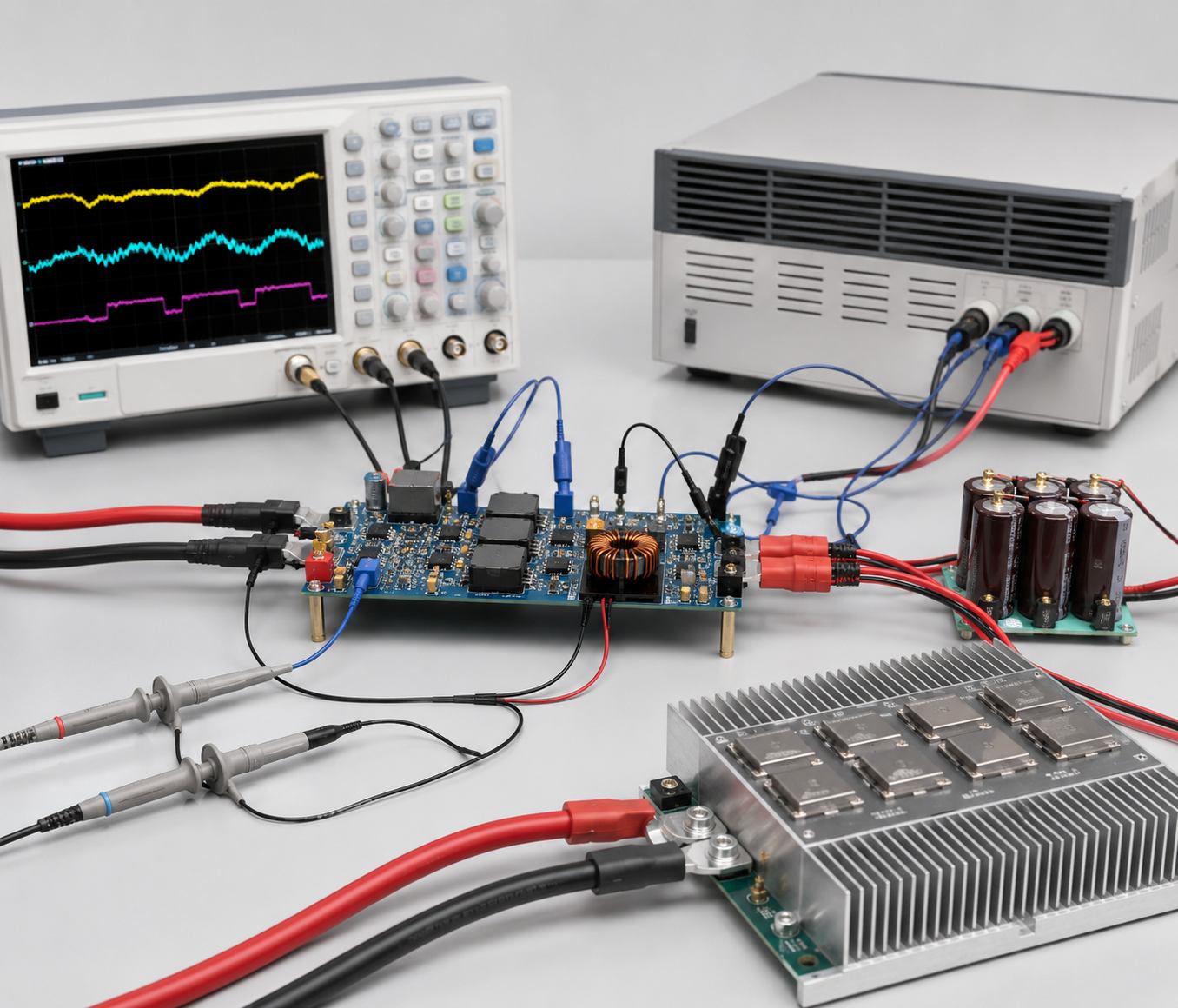
Engineering guide to dynamic load response testing for high-current buck converters, covering load step setup, slew rate, Vcore undershoot, overshoot, recovery time, probe location, output capacitors a…
Engineering guide to output capacitor selection for ASIC Vcore rails, covering bulk capacitors, polymer capacitors, MLCC decoupling, DC bias, ESR, ESL, placement, transient response and substitution ri…
Engineering guide to high-current ASIC Vcore rails, covering 12-phase buck architecture, PMBus control, dynamic load testing, output capacitor networks, smart power stage selection, thermal design and …
Voltage regulator guide covering linear, LDO, 7805, Zener, adjustable, buck, VRM and alternator regulators, with design checks, testing methods, troubleshooting and datasheet-based selection.
Amplifier guide covering voltage, current and power amplification, gain, feedback, amplifier classes, audio and RF applications, op-amp circuits, transimpedance amplifiers, datasheet selection and trou…


