
 My Inquiry
 My Account


Infineon Technologies CYB06445LQI-S3D42

- Part No.:
- CYB06445LQI-S3D42
- Manufacturer:
- Infineon Technologies
- Category:
- Microcontrollers
- Package:
- 68-VFQFN Exposed Pad
- Datasheet:
-
 CYB06445LQI-S3D42.pdf
- Description:
- IC MCU 32BIT 512KB FLASH 68QFN
- Quantity:
- Payment:

- Shipping:

Inventory:1,850
Please send an inquiry. Send us your inquiry, and we will respond immediately.
Product details
Overview
CYB06445LQI-S3D42 from Infineon Technologies (formerly Cypress) is a PSoC 64 "Secure Boot" MCU featuring dual Arm Cortex-M4F (150 MHz) and Cortex-M0+ (100 MHz) CPUs, 384 KB application flash, 176 KB SRAM, hardware-based root-of-trust, and immutable secure boot with ECC signature validation. It targets IoT edge nodes requiring TLS authentication, secured firmware updates, and attested device identity.
For engineers reviewing the CYB06445LQI-S3D42 datasheet, CYB06445LQI-S3D42 pinout, CYB06445LQI-S3D42 application, or CYB06445LQI-S3D42 equivalent, key selection criteria include its pre-provisioned RoT architecture, dual-voltage core operation (0.9 V / 1.1 V), QSPI XIP with on-the-fly encryption, CAN FD interface, and 68-QFN package with 53 GPIOs including Smart I/O and OVT pins.
Technical Context
The device implements a hardened security subsystem where the Cortex-M0+ executes only immutable boot ROM and trusted services, isolating the application-running Cortex-M4F from provisioning logic and cryptographic key management. Secure boot enforces chain-of-trust via SHA-256 hash verification and ECDSA-P256 signature validation of signed images stored in flash.
Its power architecture supports six low-power modes with sub-µA quiescent current in Deep Sleep, enabled by an on-chip DC-DC buck converter and backup domain with RTC and 64-byte memory. Clocking includes IMO (8 MHz ±2%), ILO (32 kHz), PLL/FLL, and crystal oscillators (16–35 MHz & 32 kHz).
Key Specifications
| Parameter | Value and Actual Design Meaning |
|---|---|
| CPU Cores | Dual-core: 150-MHz Cortex-M4F + 100-MHz Cortex-M0+, with separate 8-KB caches and MPUs |
| Memory | 384-KB application flash (RWW), 176-KB SRAM with retention control, 1-Kb OTP eFuse array |
| Security | Immutable RoT with public-key attestation, device-unique ID/secret, HSM-provisioned debug policies |
| Peripherals | 7 SCBs (6 configurable as SPI/I²C/UART, 1 Deep Sleep-capable), USB FS, CAN FD, SD/eMMC, 12 TCPWMs |
| Analog | 12-bit 2-Msps SAR ADC with 16-channel sequencer, 2 low-power comparators, integrated temperature sensor |
| Power | 1.7–3.6-V operation; active current slope: 40 µA/MHz (M4 @ 1.1 V), 15 µA/MHz (M0+ @ 0.9 V) |
| Package | 68-pin QFN (9 × 9 mm, 0.5-mm pitch), 53 GPIOs including 2 overvoltage-tolerant pins and 2 Smart I/O ports |
Pinout & Package
68-pin QFN package (9 mm × 9 mm, 0.5 mm pitch) with exposed thermal pad; RoHS-compliant, moisture sensitivity level 3.
| Pin/Terminal | Circuit Role | Design Meaning |
|---|---|---|
| VDDIO0–VDDIO3 | I/O power supply rails | Independent 1.7–3.6-V domains per group for mixed-voltage interfacing |
| VDDD/VDDA | Digital/analog core supplies | Supports 0.9 V or 1.1 V core operation; enables ultra-low-power active mode scaling |
| XRES | External reset input | Asynchronous active-low reset with internal pull-up; triggers full system reset including security state |
| SWDIO/SWCLK | ARM Serial Wire Debug interface | Two-pin debug port; permanently disableable during provisioning to prevent unauthorized access |
| QSPI[0:3]/SCK/SS | Quad-SPI bus signals | Support XIP with 4-KB cache and on-the-fly AES-128 encryption/decryption of external flash content |
Key Features
| Feature | Design Value |
|---|---|
| Immutable Secure Boot | Enforces ECDSA-P256 signature validation of all boot images; prevents unsigned or tampered firmware execution |
| Hardware Crypto Accelerator | Offloads AES-128/256, SHA-256, RSA-2048, ECC-P256, and TRNG generation from CPU, reducing latency and power |
| Smart I/O™ Logic | Two 8-pin programmable logic blocks execute Boolean operations in Deep Sleep without waking CPU |
| CapSense® CSD | Sigma-delta capacitive sensing engine with >100:1 SNR, liquid tolerance, and auto-tuning (SmartSense™) |
| Flexible Clock System | Multiple independent clock sources (IMO, ILO, WCO, ECO, PLL, FLL) with fractional dividers for precise peripheral timing |
Applications
| Smart Home Hub | Industrial Sensor Node |
|---|---|
Use Scenario: Central gateway aggregating BLE/Zigbee/Wi-Fi sensors while managing local policy enforcement and OTA updates. IC Role / Device Role / Timing Role: Secure application host with TLS stack acceleration, encrypted QSPI XIP for firmware storage, and CAN FD for wired fieldbus bridging. Use Value: Enables zero-touch provisioning via attested device identity and prevents rollback attacks using immutable boot image validation. | Use Scenario: Battery-powered environmental monitor deployed in remote locations with 10+ year lifespan requirements. IC Role / Device Role / Timing Role: Ultra-low-power sensor fusion controller with Deep Sleep wake-on-comparator, RTC-triggered sampling, and Smart I/O event preprocessing. Use Value: Achieves 15 µA/MHz M0+ active current at 0.9 V and sub-µA quiescent DC-DC operation, extending battery life beyond 12 years. |
| Medical Wearable | Automotive Access Module |
Use Scenario: FDA-classified wearable collecting biometric data with HIPAA-compliant local encryption and audit logging. IC Role / Device Role / Timing Role: Cryptographic co-processor for AES-128 encryption of sensor data and ECDSA signing of log entries before transmission. Use Value: Hardware TRNG and isolated key storage prevent side-channel leakage; eFuse-based debug lockdown satisfies regulatory audit requirements. | Use Scenario: Keyless entry module authenticating fobs via secure challenge-response and managing door lock actuation. IC Role / Device Role / Timing Role: Root-of-trust anchor validating signed firmware and performing mutual authentication with vehicle ECU over CAN FD. Use Value: Pre-provisioned OEM trust anchor and immutable boot ensure no unauthorized code execution, meeting ISO/SAE 21434 cybersecurity requirements. |
Equivalent & Alternatives
The following parts are listed as comparable options for similar secure MCU applications.
| Alternative Part | Technical Difference | Application Difference | Selection Advice |
|---|---|---|---|
| STM32H563VI | Single-core Cortex-M33 (250 MHz), TrustZone-based security, 2 MB flash, no dedicated RoT provisioning infrastructure | Lacks factory-provisioned device identity and HSM-backed attestation; requires external secure element for comparable RoT depth | Choose when higher CPU performance and larger memory are prioritized over out-of-box secure provisioning |
| NXP LPC55S69 | Dual-core Cortex-M33 (150 MHz), EdgeLock SE050 companion secure element required for full RoT, 640 KB flash | RoT functionality distributed across MCU + external SE; increases BOM count and PCB area vs. monolithic PSoC 64 | Choose when leveraging NXP's EdgeLock ecosystem and existing SE integration workflows is preferred |
Compared with STM32H563VI and LPC55S69, CYB06445LQI-S3D42 delivers integrated, factory-provisioned root-of-trust with no external components, deterministic secure boot latency under 100 ms, and lower active power per MHz at sub-1V operation-critical for constrained IoT endpoints.
Availability
CYB06445LQI-S3D42 is available at Aetrix Electronics and suitable for smart home hubs, industrial sensor nodes, medical wearables, and automotive access modules requiring stable component supply, long-term lifecycle support, and certified secure boot capability.
Supply support for CYB06445LQI-S3D42 includes scheduled delivery planning, volume procurement assistance, BOM continuity management, traceable sourcing, and lifecycle availability coordination for OEM customers, industrial embedded developers, connected-device designers, and electronics production programs.
Manufacturer
Infineon Technologies is a global semiconductor leader headquartered in Munich, Germany, specializing in power systems, sensors, and secure microcontrollers for industrial, automotive, and IoT markets.
The PSoC 64 product line was developed to deliver production-ready, pre-provisioned security for resource-constrained IoT endpoints-eliminating the need for third-party HSMs or custom secure boot development.
FAQ
What debug interfaces are available on CYB06445LQI-S3D42, and can they be disabled?
CYB06445LQI-S3D42 provides three debug ports: one for Cortex-M4F, one for Cortex-M0+, and a system-level SWJ interface. All are accessible via SWDIO/SWCLK pins and can be permanently disabled during final production provisioning using eFuse bits. Once locked, no debug access-including flash readout or breakpoint injection-is possible, satisfying high-assurance security requirements.
Does CYB06445LQI-S3D42 support external memory execution with encryption?
Yes. The device supports Execute-In-Place (XIP) from external quad-SPI flash with on-the-fly AES-128 decryption. A dedicated 4-KB instruction cache optimizes XIP performance while minimizing active power. Encryption keys are derived from device-unique secrets and never exposed to software, ensuring confidentiality even if external flash is physically extracted.
How is the root-of-trust implemented in hardware, and what provisioning steps are required?
The root-of-trust is implemented via immutable boot ROM, a factory-programmed public key, and a hardware SHA-256/ECC accelerator. Provisioning occurs in a certified HSM environment where OEM keys are injected into the device's secure enclave. This process generates a unique device ID and secret key, both stored in protected memory and used for attestation-no customer-side key generation or management is needed.
Can the Cortex-M0+ core be used for application code, or is it strictly reserved for security functions?
The Cortex-M0+ core is strictly reserved for system-level security services-including secure boot, cryptographic offloading, and debug policy enforcement-and is not accessible to user applications. The PSoC 64 architecture enforces this separation via hardware-enforced memory protection units (MPUs) and inter-processor communication (IPC) channels, ensuring application code running on the Cortex-M4F cannot interfere with or inspect secure services.
CYB06445LQI-S3D42 Specifications
- Product attributes
- Attribute value
- Manufacturer:
- Infineon Technologies
- Package/Case:
- 68-VFQFN Exposed Pad
- Series:
- PSOC™ 6
- Packaging:
- Tray
- Product Status:
- Active
- Programmable:
- Not Verified
- Core Processor:
- ARM® Cortex®-M0+, ARM® Cortex®-M4F
- Core Size:
- 32-Bit Dual-Core
- Speed:
- 100MHz, 150MHz
- Connectivity:
- CANbus, eMMC/SD/SDIO, FIFO, I2C, IrDA, LINbus, Microwire, QSPI, SmartCard, SPI, SSP, UART/USART, USB
- Peripherals:
- Brown-out Detect/Reset, CapSense, Crypto - AES, DMA, LCD, LVD, PMC, POR, PWM, RSA, SHA, Temp Sensor, TRNG, WDT
- Number of I/O:
- 53
- Program Memory Size:
- 512KB (512K x 8)
- Program Memory Type:
- FLASH
- EEPROM Size:
- -
- RAM Size:
- 256K x 8
- Voltage - Supply (Vcc/Vdd):
- 1.7V ~ 3.6V
- Data Converters:
- A/D 16x10b SAR, 16x12b Sigma-Delta; D/A 2x7/8b
- Oscillator Type:
- External, Internal
- Operating Temperature:
- -40°C ~ 85°C (TA)
- Grade:
- -
- Qualification:
- -
- Mounting Type:
- Surface Mount
- Supplier Device Package:
CYB06445LQI-S3D42 FAQ
1.How can I place an order for CYB06445LQI-S3D42 through Aetrix?
Please submit a Request for Quotation (RFQ) for CYB06445LQI-S3D42 on Aetrix. Our sales agent will provide a competitive quotation and guide you through the order confirmation once you accept the terms.
2.Are the price and stock information for CYB06445LQI-S3D42 reliable?
The price and inventory of CYB06445LQI-S3D42 are updated periodically and may fluctuate due to market conditions. Stock and pricing data are typically refreshed every 24 hours. Quotation validity for CYB06445LQI-S3D42 is usually 5 days.
3.What payment methods are accepted for CYB06445LQI-S3D42?
We accept Wire Transfer, PayPal, Credit Card, Western Union, MoneyGram, and Escrow for CYB06445LQI-S3D42 transactions.
Note: Certain payment methods may incur a processing fee.
4.How is shipping managed for CYB06445LQI-S3D42?
CYB06445LQI-S3D42 orders can be shipped via leading logistics carriers, including DHL, UPS, FedEx, TNT, or Registered Mail.
Once your CYB06445LQI-S3D42 order is processed, you will receive an email with the shipment details and tracking number.
Note: Tracking information may take up to 24 hours to appear. Express delivery typically takes 3–5 business days.
5.How can I obtain technical support or documentation for CYB06445LQI-S3D42?
For technical support, including CYB06445LQI-S3D42 datasheets, pinout diagrams, or application guidance, please contact our engineering support team. They can provide detailed documentation and assistance for your CYB06445LQI-S3D42 requirements.
6.How does Aetrix verify that CYB06445LQI-S3D42 is sourced from the original manufacturer or authorized distributors?
All CYB06445LQI-S3D42 products on Aetrix are procured from qualified distributors and authorized channels. Our dedicated quality assurance team conducts strict verification, including traceability checks and, if necessary, third-party testing. This ensures that CYB06445LQI-S3D42 meets industry standards.
7.What is the process for return or replacement of CYB06445LQI-S3D42?
All CYB06445LQI-S3D42 units undergo pre-shipment inspection (PSI). If there is an issue with CYB06445LQI-S3D42, returns or replacements are accepted under the following conditions:
1.Quantity discrepancies, incorrect items, or visible external defects (such as breakage or corrosion), acknowledged by Aetrix.
2.The issue is reported within 90 days of delivery.
3.The CYB06445LQI-S3D42 part is unused and in its original packaging.
Return procedure for CYB06445LQI-S3D42:
1.Submit a request within 90 days.
2.Obtain a Return Material Authorization (RMA) from Aetrix.
CYB06445LQI-S3D42 Tags

-
ATTINY4-TSHR
Microchip Technology
-
ATTINY10-TSHR
Microchip Technology
-
ATTINY10-TS8R
Microchip Technology

-
ATTINY202-SSNR
Microchip Technology
-
ATTINY202-SSFR
Microchip Technology
-
ATTINY402-SSNR
Microchip Technology
-
PIC16F15213T-I/MF
Microchip Technology
-
PIC16F15213-E/MF
Microchip Technology

-
PIC10F200T-I/OT
Microchip Technology
-
ATTINY412-SSNR
Microchip Technology
-
PIC10F202T-I/OT
Microchip Technology
-
ATTINY404-SSNR
Microchip Technology
Tech Hub

18650 battery guide covering lithium-ion cell basics, 3.6V/3.7V voltage, 4.2V charging, mAh and Wh capacity, protected cells, chargers, BMS, series-parallel packs, holders, welding and sourcing checks.…

Hall effect sensor guide covering working principle, linear and digital sensors, Arduino circuits, current sensing, speed detection, automotive applications, A3144 examples, signal filtering and datash…

Product Change Notification guide for electronic components, covering PCN meaning, PCN vs PDN/EOL, common change types, risk levels, form-fit-function review, engineering validation, BOM control, LTB/L…

A practical guide to blend door actuators, covering HVAC function, symptoms, location, AC and heater issues, reset and calibration, replacement cost, electrical diagnosis, compatibility checks, and rep…

Engineering guide to Raspberry Pi alternatives, covering chip-level differences, Orange Pi, ROCK, Jetson, Banana Pi, NanoPi, Compute Module, Pico, GPIO, camera, HAT compatibility, and replacement risks…
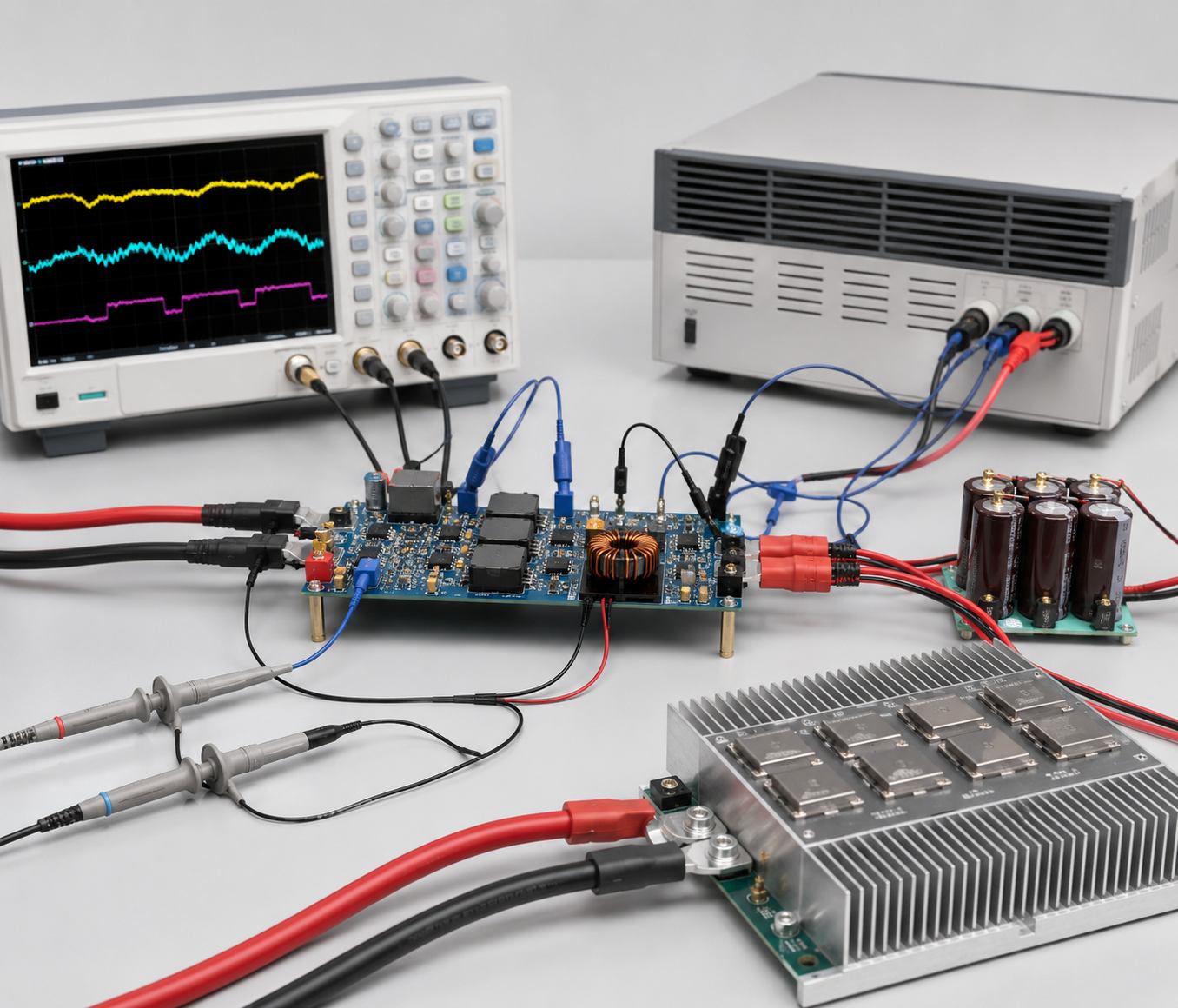
Engineering guide to dynamic load response testing for high-current buck converters, covering load step setup, slew rate, Vcore undershoot, overshoot, recovery time, probe location, output capacitors a…
Engineering guide to output capacitor selection for ASIC Vcore rails, covering bulk capacitors, polymer capacitors, MLCC decoupling, DC bias, ESR, ESL, placement, transient response and substitution ri…
Engineering guide to high-current ASIC Vcore rails, covering 12-phase buck architecture, PMBus control, dynamic load testing, output capacitor networks, smart power stage selection, thermal design and …
Voltage regulator guide covering linear, LDO, 7805, Zener, adjustable, buck, VRM and alternator regulators, with design checks, testing methods, troubleshooting and datasheet-based selection.
Amplifier guide covering voltage, current and power amplification, gain, feedback, amplifier classes, audio and RF applications, op-amp circuits, transimpedance amplifiers, datasheet selection and trou…


