
 My Inquiry
 My Account


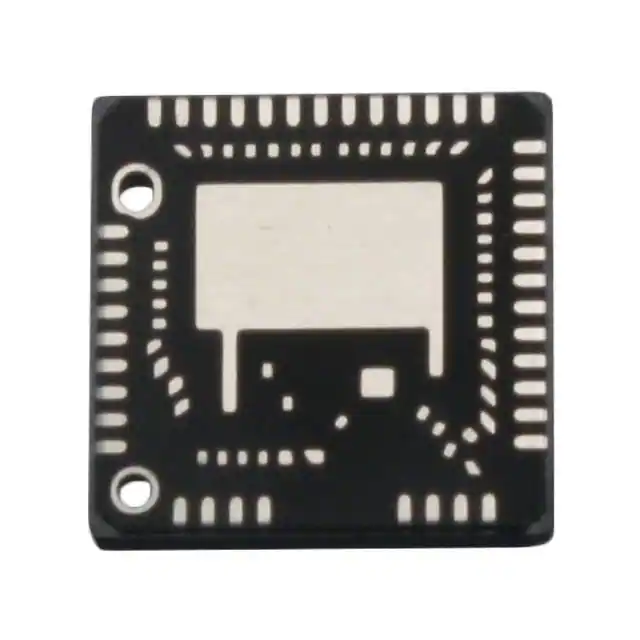
Infineon Technologies CYONS2100-LBXC
- Part No.:
- CYONS2100-LBXC
- Manufacturer:
- Infineon Technologies
- Category:
- Ambient Light, IR, UV Sensors
- Package:
- 42-BQFN Module
- Datasheet:
-
 CYONS2100-LBXC.pdf
- Description:
- SENSOR OPT 42 BQFN MODULE
- Quantity:
- Payment:

- Shipping:

Inventory:3,713
Please send an inquiry. Send us your inquiry, and we will respond immediately.
Product details
Overview
CYONS2100-LBXC from Cypress Semiconductor is a programmable System-on-Chip (SoC) laser navigation engine for high-performance wired gaming mice, integrating an 8-bit M8C MCU, 32 KB Flash, 2 KB SRAM, full-speed USB 2.0 interface, and an on-die 850 nm VCSEL. It delivers continuously variable optical resolution from 400 to 3200 cpi, tracking speeds up to 75 in/s and acceleration up to 30G, with self-aligning snap-on lens support and Class 1 eye-safety compliance.
For engineers reviewing the CYONS2100-LBXC datasheet, CYONS2100-LBXC pinout, CYONS2100-LBXC application, or CYONS2100-LBXC equivalent, this SoC enables rapid customization of motion tracking firmware, eliminates laser calibration in manufacturing, and supports real-time resolution switching, USB HID report generation, and low-power idle modes for competitive gaming peripherals.
Technical Context
The CYONS2100-LBXC implements a tightly coupled OptiCheck™ laser navigation engine controlled via an internal system bus by a PSoC-based M8C MCU running at up to 24 MHz. Its navigation subsystem handles laser power regulation, resolution scaling, lift detection, and motion-to-USB report translation without host intervention.
Power management integrates dual regulators (3.3 V analog, 1.8 V digital), supports operation from 5 V USB or 2.7–3.6 V external supply, and includes self-adjusting sleep modes triggered by zero-motion detection. The device uses no external crystal-its ±5% IMO and 32 kHz ILO provide all required clocks, with 0.25% USB timing accuracy achieved internally.
Key Specifications
| Parameter | Value and Actual Design Meaning |
|---|---|
| Resolution Range | 400–3200 cpi, continuously variable and software-selectable per motion event |
| Max Tracking Speed | 75 in/s - enables responsive cursor movement during aggressive swipes in FPS games |
| Max Acceleration | 30G - maintains tracking fidelity during rapid directional changes |
| USB Interface | Full-speed USB 2.0 (12 Mbps), 8 unidirectional + 1 bidirectional endpoint, integrated 512-byte buffer |
| Memory | 32 KB Flash (50k erase/write cycles), 2 KB SRAM - sufficient for multi-profile firmware and runtime calibration tables |
| Laser Source | Integrated 850 nm VCSEL (840–870 nm), Class 1 IEC 60825 compliant, no external alignment needed |
| Supply Voltage | 5 V USB (4.25–5.25 V) or 2.7–3.6 V external - supports dual-power-path designs |
Pinout & Package
The CYONS2100-LBXC is housed in a 42-pin QFN package (7 mm × 7 mm, 0.5 mm pitch) with exposed thermal pad. All digital and analog supplies are segregated, and the center pad (CP) must be connected to DVSS for thermal and electrical integrity.
| Pin/Terminal | Circuit Role | Design Meaning |
|---|---|---|
| XRES | Active-high reset input | External hard reset with internal pull-down; not high-Z at power-on |
| D+ / D− | USB differential data pair | Full-speed USB 2.0 physical layer; requires 27 Ω series termination per line |
| VDD5V | 5 V USB power input | Primary power source for USB PHY and internal regulators; bypassed externally |
| P1[5]–P1[1] | SPI master interface | Configurable as SPI MISO/CLK/SS/MOSI; also supports ISSP programming and GPIO |
| P0[0]–P0[7], P1[0]–P1[7], P2[0]–P2[7], P3[1], P3[3], P3[5], P3[7] | General-purpose I/O | Up to 28 GPIOs total; support CMOS drive, 25 mA sink, configurable pull-up/HZ/open-drain |
Key Features
| Feature | Design Value |
|---|---|
| On-die VCSEL + OptiCheck™ engine | Eliminates external laser diode, collimator, and alignment fixtures - reduces BOM count and assembly steps |
| Programmable PSoC MCU (M8C) | Enables firmware-level customization of DPI switching logic, button mapping, RGB lighting control, and motion smoothing algorithms |
| Self-calibrating zero-motion detection | Automatically enters low-power sleep mode when stationary; resumes instantly on motion - extends USB bus power efficiency |
| Integrated USB HID stack | Generates standard mouse reports (X/Y/delta, buttons, wheel) without host driver modification - plug-and-play compatibility |
| Single-supply flexibility | Operates natively from 5 V USB or 2.7–3.6 V battery rail - supports hybrid wired/wireless upgrade paths |
Applications
| Gaming Mouse Motion Engine | Professional Graphic Design Mouse |
|---|---|
|
Use Scenario: High-DPI, low-latency cursor control during fast-paced first-person shooter gameplay with rapid flick shots and micro-adjustments. IC Role / Device Role / Timing Role: Primary motion sensing and USB report generation SoC - translates optical displacement into 125 Hz or higher HID reports with sub-1 ms latency. Use Value: 3200 cpi resolution and 75 in/s speed ensure pixel-precise targeting without interpolation artifacts; firmware-tunable polling rate avoids host-side bottlenecks. |
Use Scenario: Precision panning, zooming, and brush stroke control in Adobe Photoshop or CAD applications requiring stable low-speed tracking. IC Role / Device Role / Timing Role: High-fidelity optical navigation engine with adaptive smoothing and jitter suppression - outputs clean delta vectors even at <1 in/s. Use Value: Continuously variable 400–3200 cpi range allows users to switch between fine-grained editing and broad canvas navigation without hardware change. |
| USB-Cabled Presentation Remote | Industrial Human Interface Device |
|
Use Scenario: Wireless presenter with wired fallback mode using USB-C cable for guaranteed latency-free pointer control during live keynotes. IC Role / Device Role / Timing Role: Dual-mode navigation controller - operates as USB mouse when cabled, and as SPI master to RF transceiver when wireless. Use Value: Shared firmware base across modes; same PCB layout supports both configurations - reduces NRE and inventory complexity. |
Use Scenario: Ruggedized medical or test equipment mouse requiring ESD-hardened motion sensing (2 kV HBM) and Class 1 laser safety certification. IC Role / Device Role / Timing Role: Certified optical navigation subsystem - provides traceable eye safety compliance and robust operation in EMI-noisy environments. Use Value: Integrated VCSEL drive circuitry meets IEC 60825-1:2014 Class 1 requirements without external fault monitoring - simplifies regulatory submission. |
Equivalent & Alternatives
The following parts are listed as comparable options for similar laser navigation SoC applications.
| Alternative Part | Technical Difference | Application Difference | Selection Advice |
|---|---|---|---|
| CYONS2101-LBXC | Same core, but lacks full-speed USB; relies on external USB bridge IC | Used in cost-sensitive wired mice where USB PHY is offloaded to companion chip | Select when reducing die size or enabling custom USB descriptor handling via external controller |
| CYONS2000-LBXC | Lower performance: max 30 in/s speed, 20G acceleration, fixed 400/800/1600 cpi steps | Targeted at mainstream desktop mice, not gaming-grade motion fidelity | Select only for non-gaming applications where 75 in/s and continuous cpi scaling are unnecessary |
Compared with CYONS2101-LBXC, the CYONS2100-LBXC eliminates external USB components and simplifies layout; compared with CYONS2000-LBXC, it delivers 2.5× higher speed and true continuous resolution-critical for competitive gaming responsiveness and professional design precision.
Availability
CYONS2100-LBXC is available at Aetrix Electronics and suitable for high-performance gaming peripherals, professional graphic design input devices, and industrial human interface applications requiring stable component supply, long-term lifecycle support, and certified Class 1 laser safety.
Supply support for CYONS2100-LBXC includes scheduled delivery planning, volume procurement assistance, BOM continuity management, traceable sourcing, and lifecycle availability coordination for OEM customers, industrial embedded developers, connected-device designers, and electronics production programs.
Manufacturer
Cypress Semiconductor (now part of Infineon Technologies) is a fabless semiconductor company specializing in programmable mixed-signal ICs, USB controllers, and embedded solutions for consumer, industrial, and automotive markets.
The CYONS2100-LBXC belongs to the OvationONS™ II family of laser navigation SoCs, designed specifically to integrate optical sensing, MCU processing, and USB connectivity into a single chip for next-generation wired and wireless pointing devices.
FAQ
Does CYONS2100-LBXC require an external crystal for USB operation?
No. The device uses its internal ±5% 24 MHz main oscillator (IMO) combined with digital clock conditioning to achieve 0.25% USB timing accuracy-fully compliant with USB 2.0 full-speed requirements without any external crystal or resonator.
Can the onboard VCSEL be disabled or replaced with an external laser diode?
No. The 850 nm VCSEL is monolithically integrated and electrically isolated within the die; it cannot be disabled or substituted. The laser drive circuitry is hardened for Class 1 safety and calibrated at wafer test-external lasers are neither supported nor safe to interface.
How many GPIOs are available for customer-defined functions like RGB LED control or button debouncing?
Up to 28 GPIOs are available across Ports 0–3, all configurable as digital inputs/outputs with 25 mA sink capability, programmable pull-up, open-drain, or CMOS drive. Port 1 supports regulated 3.0 V sourcing (20 mA total) ideal for driving LEDs directly.
Is PSoC Designer™ software still supported for CYONS2100-LBXC firmware development?
Yes. Cypress provides legacy support for PSoC Designer™ v5.4 (last official release) including device libraries, code examples, and debug tools. Infineon maintains archived documentation and known-good build environments for continued maintenance of existing CYONS2100-LBXC designs.
CYONS2100-LBXC Specifications
- Product attributes
- Attribute value
- Manufacturer:
- Infineon Technologies
- Series:
- -
- Package/Case:
- 42-BQFN Module
- Packaging:
- Tray
- Product Status:
- Obsolete
- Type:
- -
- Wavelength:
- -
- Proximity Detection:
- -
- Output Type:
- -
- Voltage - Supply:
- -
- Operating Temperature:
- -
- Grade:
- -
- Qualification:
- -
- Mounting Type:
- Surface Mount
- Supplier Device Package:
- 42-PQFN (8.3x8.3)
CYONS2100-LBXC FAQ
1.How can I place an order for CYONS2100-LBXC through Aetrix?
Please submit a Request for Quotation (RFQ) for CYONS2100-LBXC on Aetrix. Our sales agent will provide a competitive quotation and guide you through the order confirmation once you accept the terms.
2.Are the price and stock information for CYONS2100-LBXC reliable?
The price and inventory of CYONS2100-LBXC are updated periodically and may fluctuate due to market conditions. Stock and pricing data are typically refreshed every 24 hours. Quotation validity for CYONS2100-LBXC is usually 5 days.
3.What payment methods are accepted for CYONS2100-LBXC?
We accept Wire Transfer, PayPal, Credit Card, Western Union, MoneyGram, and Escrow for CYONS2100-LBXC transactions.
Note: Certain payment methods may incur a processing fee.
4.How is shipping managed for CYONS2100-LBXC?
CYONS2100-LBXC orders can be shipped via leading logistics carriers, including DHL, UPS, FedEx, TNT, or Registered Mail.
Once your CYONS2100-LBXC order is processed, you will receive an email with the shipment details and tracking number.
Note: Tracking information may take up to 24 hours to appear. Express delivery typically takes 3–5 business days.
5.How can I obtain technical support or documentation for CYONS2100-LBXC?
For technical support, including CYONS2100-LBXC datasheets, pinout diagrams, or application guidance, please contact our engineering support team. They can provide detailed documentation and assistance for your CYONS2100-LBXC requirements.
6.How does Aetrix verify that CYONS2100-LBXC is sourced from the original manufacturer or authorized distributors?
All CYONS2100-LBXC products on Aetrix are procured from qualified distributors and authorized channels. Our dedicated quality assurance team conducts strict verification, including traceability checks and, if necessary, third-party testing. This ensures that CYONS2100-LBXC meets industry standards.
7.What is the process for return or replacement of CYONS2100-LBXC?
All CYONS2100-LBXC units undergo pre-shipment inspection (PSI). If there is an issue with CYONS2100-LBXC, returns or replacements are accepted under the following conditions:
1.Quantity discrepancies, incorrect items, or visible external defects (such as breakage or corrosion), acknowledged by Aetrix.
2.The issue is reported within 90 days of delivery.
3.The CYONS2100-LBXC part is unused and in its original packaging.
Return procedure for CYONS2100-LBXC:
1.Submit a request within 90 days.
2.Obtain a Return Material Authorization (RMA) from Aetrix.
CYONS2100-LBXC Tags
-
IN-S63DTLS
Inolux
-
LTR-329ALS-01
Lite-On Inc.
.jpg)
-
LTR-303ALS-01
Lite-On Inc.
-
APDS-9008-020
Broadcom Limited
-
BH1603FVC-TR
Rohm Semiconductor
-
APDS-9306-065
Broadcom Limited
-
APDS-9006-020
Broadcom Limited
-
OPT3004DNPR
Texas Instruments
-
VEML7700-TR
Vishay Semiconductor Opto Division
-
VEML7700-TT
Vishay Semiconductor Opto Division

-
TCS34103M OLGA6 LF T&RDP
ams-OSRAM USA INC.
-
OPT3001DNPRQ1
Texas Instruments
Tech Hub

18650 battery guide covering lithium-ion cell basics, 3.6V/3.7V voltage, 4.2V charging, mAh and Wh capacity, protected cells, chargers, BMS, series-parallel packs, holders, welding and sourcing checks.…

Hall effect sensor guide covering working principle, linear and digital sensors, Arduino circuits, current sensing, speed detection, automotive applications, A3144 examples, signal filtering and datash…

Product Change Notification guide for electronic components, covering PCN meaning, PCN vs PDN/EOL, common change types, risk levels, form-fit-function review, engineering validation, BOM control, LTB/L…

A practical guide to blend door actuators, covering HVAC function, symptoms, location, AC and heater issues, reset and calibration, replacement cost, electrical diagnosis, compatibility checks, and rep…

Engineering guide to Raspberry Pi alternatives, covering chip-level differences, Orange Pi, ROCK, Jetson, Banana Pi, NanoPi, Compute Module, Pico, GPIO, camera, HAT compatibility, and replacement risks…

Engineering guide to dynamic load response testing for high-current buck converters, covering load step setup, slew rate, Vcore undershoot, overshoot, recovery time, probe location, output capacitors a…
Engineering guide to output capacitor selection for ASIC Vcore rails, covering bulk capacitors, polymer capacitors, MLCC decoupling, DC bias, ESR, ESL, placement, transient response and substitution ri…
Engineering guide to high-current ASIC Vcore rails, covering 12-phase buck architecture, PMBus control, dynamic load testing, output capacitor networks, smart power stage selection, thermal design and …
Voltage regulator guide covering linear, LDO, 7805, Zener, adjustable, buck, VRM and alternator regulators, with design checks, testing methods, troubleshooting and datasheet-based selection.
Amplifier guide covering voltage, current and power amplification, gain, feedback, amplifier classes, audio and RF applications, op-amp circuits, transimpedance amplifiers, datasheet selection and trou…


