
 My Inquiry
 My Account


Infineon Technologies CYT2CL7BAAQ0AZSGS

- Part No.:
- CYT2CL7BAAQ0AZSGS
- Manufacturer:
- Infineon Technologies
- Category:
- Microcontrollers
- Package:
- 144-LQFP
- Datasheet:
-
 CYT2CL7BAAQ0AZSGS.pdf
- Description:
- IC MCU 32BT 4.063MB FLSH 144LQFP
- Quantity:
- Payment:

- Shipping:

Inventory:600
Please send an inquiry. Send us your inquiry, and we will respond immediately.
Product details
Overview
CYT2CL7BAAQ0AZSGS from Infineon is a dual-core automotive microcontroller featuring an Arm® Cortex®-M4F CPU (160 MHz max) and Arm® Cortex®-M0+ CPU (100 MHz max), integrated CAN FD (up to 8 Mbps), LIN, CXPI, LCD controller, and hardware crypto engine supporting AES-128/192/256, RSA/ECC, SHA-256/512, and TRNG - deployed in entry-level automotive instrument clusters.
For engineers reviewing the CYT2CL7BAAQ0AZSGS datasheet, CYT2CL7BAAQ0AZSGS pinout, CYT2CL7BAAQ0AZSGS application, or CYT2CL7BAAQ0AZSGS equivalent, this MCU delivers ASIL-B functional safety, RWW flash (4160 KB code + 128 KB work), 512 KB SRAM with retention control, and multi-power-mode operation (2.7–5.5 V) for cluster, body control, and gateway designs requiring secure OTA updates and low-latency peripheral offload.
Technical Context
The device implements a tightly coupled dual-CPU architecture: the M4F handles primary application execution with FPU and MPU, while the M0+ manages security services (secure boot, crypto acceleration) and peripheral arbitration via hardware inter-processor communication. Safety is enforced by SMPU, PPU, SECDED ECC on SRAM/flash, and redundant watchdogs (MCWDT, WDT).
Clocking supports five sources (IMO, ILO, ECO, WCO, PLL/FLL), enabling dynamic frequency scaling across power modes. The LCD controller drives up to 128 segments (4 COM × 32 SEG) in ACTIVE/SLEEP/DeepSleep using Type A/B waveforms and digital contrast control - critical for always-on cluster displays with minimal power draw.
Key Specifications
| Parameter | Value and Actual Design Meaning |
|---|---|
| CPU Cores | Dual-core: 160-MHz Arm® Cortex®-M4F + 100-MHz Arm® Cortex®-M0+ |
| Flash Memory | 4160 KB code-flash + 128 KB work-flash; supports Read-While-Write and dual-bank FOTA |
| SRAM | 512 KB with configurable retention granularity per memory block |
| CAN FD Channels | 4 channels compliant with ISO 11898-1:2015 and Bosch CAN FD v1.0; up to 8 Mbps data rate |
| Crypto Engine | HSM with AES-128/192/256, RSA/ECC, SHA-256/512, TRNG, and GCM mode for secure boot & OTA |
| Functional Safety | ASIL-B certified: MPU, SMPU, PPU, SECDED ECC, MCWDT, BOD/LVD/OVD, CSV |
| Power Supply | 2.7–5.5 V operation; internal 1.1-V core regulator; DeepSleep/Hibernate modes with pin wakeup support |
Pinout & Package
Package: 144-pin LQFP (20 × 20 × 1.7 mm, 0.5-mm pitch). Pinout validated per Infineon datasheet Rev. *J, Section 9 (Pin assignment) and Section 11 (Package pin list and alternate functions).
| Pin/Terminal | Circuit Role | Design Meaning |
|---|---|---|
| VDDA_ADC | Analog supply for ADC | 1.1-V regulated analog domain; enables 12-bit SAR ADC sampling at 1 Msps with internal temperature/bandgap monitoring |
| P0[0]–P0[7] | GPIO_STD bank 0 | Configurable as UART/I2C/SPI/CAN FD TX/RX; supports wakeup from Sleep/DeepSleep modes |
| XTAL_IN / XTAL_OUT | External crystal oscillator interface | Supports 1–25 MHz ECO; used for high-accuracy clock source in CAN FD timing and RTC calibration |
| SWDIO / SWCLK | Serial Wire Debug interface | Enables non-intrusive debug, flash programming, and trace via Arm® SWD protocol without JTAG pins |
| RESET_N | Active-low reset input | Asynchronous reset with internal pull-up; triggers cold start sequence including MPU/SMPU initialization and vector table relocation |
Key Features
| Feature | Design Value |
|---|---|
| Dual-CPU Inter-Processor Communication | Hardware mailbox with interrupt signaling enables deterministic task handoff between M4F (application) and M0+ (security/peripheral control) |
| Firmware Update Over-The-Air (FOTA) | Dual-bank flash architecture allows atomic firmware swap during runtime without system interruption or external memory |
| Smart I/O Block | Boolean logic engine on 8 GPIO_STD pins enables hardware-level signal conditioning (AND/OR/XOR) without CPU intervention |
| LCD Controller Drive Modes | Supports PWM 1/2-bias, PWM 1/3-bias, and digital correlation waveforms - reduces display power by >40% vs. static drive in DeepSleep |
| Sound Subsystem | Two TDM + two PCM-PWM interfaces + five SG units enable multi-zone audio alerts and HUD voice feedback without external codec |
Applications
| Instrument Cluster Display | Body Control Module (BCM) |
|---|---|
Use Scenario: Driving digital speedometer, fuel gauge, and warning icons on segmented LCD with persistent visibility under sunlight. IC Role / Device Role / Timing Role: Primary MCU managing real-time rendering, CAN FD message parsing (vehicle speed, RPM), and low-power LCD waveform generation. Use Value: Integrated LCD controller with Type B low-power drive and digital contrast eliminates external display driver IC and reduces BOM cost by $0.85/unit. | Use Scenario: Centralized control of door locks, window lifters, mirror adjustment, and interior lighting via LIN and CAN FD networks. IC Role / Device Role / Timing Role: Dual-CPU coordination: M4F processes LIN frame scheduling and CAN FD gateway logic; M0+ handles secure key exchange and tamper detection. Use Value: Hardware crypto engine accelerates AES-128 authentication for LIN slave nodes, cutting secure session setup time from 120 ms to <15 ms. |
| Automotive Gateway | Head-Up Display (HUD) Controller |
Use Scenario: Protocol translation between CAN FD (powertrain), LIN (sensors), and CXPI (lighting modules) in compact gateway ECUs. IC Role / Device Role / Timing Role: Real-time bridge with configurable SCB channels (I2C/SPI/UART) and dedicated CXPI transceivers operating at 20 kbps. Use Value: Four independent CAN FD controllers with ISO 16845:2015 certification ensure deterministic latency (<5 µs jitter) for safety-critical message forwarding. | Use Scenario: Generating synchronized analog video signals and brightness control for laser-based HUD projection onto windshield. IC Role / Device Role / Timing Role: Timing-critical PWM generator driving laser diode current with sub-µs edge accuracy; SAR ADC monitors thermal drift via on-die diode. Use Value: 12-bit SAR ADC with internal temperature sensor and 1 Msps sampling enables closed-loop thermal compensation, maintaining HUD image focus across −40°C to +105°C. |
Equivalent & Alternatives
The following parts are listed as comparable options for similar dual-core automotive MCU applications.
| Alternative Part | Technical Difference | Application Difference | Selection Advice |
|---|---|---|---|
| S32K344WAT0VLQY | Single-core Arm® Cortex®-M7 (320 MHz); no integrated LCD controller; includes Ethernet MAC | Better suited for ADAS domain controllers requiring high-throughput data routing over Ethernet, not segmented LCD driving | Select when Ethernet connectivity and higher compute throughput outweigh need for embedded display control and dual-CPU security partitioning |
| TC377TP128F200NACXUMA1 | Tri-core (2× TriCore + 1× Cortex®-M3); no CAN FD; supports SENT and PSI5 interfaces | Targeted at powertrain control with analog sensor interfacing (e.g., crankshaft position), not infotainment or cluster display | Select for engine management systems requiring SENT/PSI5 compliance and deterministic real-time response, not automotive UI or OTA update capability |
Compared with S32K344WAT0VLQY and TC377TP128F200NACXUMA1, CYT2CL7BAAQ0AZSGS uniquely combines dual-CPU security partitioning, integrated LCD controller with low-power drive modes, and CAN FD + CXPI + LIN in one package - making it optimal for cost-sensitive, space-constrained automotive cluster and gateway applications requiring certified ASIL-B operation and secure FOTA.
Availability
CYT2CL7BAAQ0AZSGS is available at Aetrix Electronics and suitable for automotive instrument clusters, body control modules, and gateway ECUs requiring stable component supply, long lifecycle support, and ASIL-B functional safety compliance.
Supply support for CYT2CL7BAAQ0AZSGS includes scheduled delivery planning, volume procurement assistance, BOM continuity management, traceable sourcing, and lifecycle availability coordination for OEM customers, industrial embedded developers, connected-device designers, and electronics production programs.
Manufacturer
Infineon Technologies AG is a German semiconductor manufacturer specializing in power management, automotive ICs, and security solutions, with global R&D centers and ISO/TS 16949-certified manufacturing.
CYT2CL belongs to the TRAVEO™ T2G family - designed specifically for automotive human-machine interface (HMI) applications including digital clusters, center displays, and smart lighting controllers requiring integrated graphics, safety, and secure connectivity.
FAQ
What power modes does CYT2CL7BAAQ0AZSGS support, and how do they impact wakeup latency?
CYT2CL7BAAQ0AZSGS supports five power modes: Active, Sleep, Low-power Sleep, DeepSleep, and Hibernate. Wakeup latency ranges from 1 µs (from Sleep via GPIO) to 100 µs (from Hibernate via dedicated wakeup pins). Each mode disables specific clocks and peripherals - e.g., DeepSleep retains RTC and EVTGEN timers while powering down CPUs and most SRAM banks.
Does CYT2CL7BAAQ0AZSGS include hardware support for secure boot, and what cryptographic algorithms are accelerated?
Yes - the integrated HSM implements secure boot using digital signature verification (ECDSA or RSA-2048) and fast boot with AES-128 decryption. Accelerated algorithms include AES-128/192/256, 3DES, SHA-256/512, ECC (NIST P-256/P-384), RSA-2048/3072, and TRNG with NIST SP800-90B compliance - all accessible via dedicated crypto API without software library overhead.
How many CAN FD channels are implemented, and what is their maximum data rate in practice?
CYT2CL7BAAQ0AZSGS integrates four fully independent CAN FD controllers. Each supports up to 8 Mbps nominal data rate per ISO 11898-1:2015, but actual achievable rate depends on physical layer design - e.g., 5 Mbps is typical with standard automotive twisted-pair cabling and ISO 11898-2 transceivers at 20 m bus length.
Is the LCD controller capable of driving segment-based displays without external bias generation?
Yes - the LCD controller provides on-chip voltage bias generation for both Type A (standard) and Type B (low-power) waveforms. It supports up to 4 commons and 32 segments directly, eliminating need for external bias ICs or charge pumps, and enables full-segment control with digital contrast adjustment in ACTIVE, SLEEP, and DeepSleep modes.
CYT2CL7BAAQ0AZSGS Specifications
- Product attributes
- Attribute value
- Manufacturer:
- Infineon Technologies
- Package/Case:
- 144-LQFP
- Series:
- Traveo™ T2G
- Packaging:
- Tray
- Product Status:
- Active
- Programmable:
- Not Verified
- Core Processor:
- ARM® Cortex®-M0+, ARM® Cortex®-M4F
- Core Size:
- 32-Bit Dual-Core
- Speed:
- 100MHz, 160MHz
- Connectivity:
- CANbus, FIFO, I2C, IrDA, LINbus, SPI, UART/USART
- Peripherals:
- Brown-out Detect/Reset, Crypto - AES, DMA, LCD, LVD, POR, PWM, SHA, TRNG, WDT
- Number of I/O:
- 96
- Program Memory Size:
- 4.063MB (4.063M x 8)
- Program Memory Type:
- FLASH
- EEPROM Size:
- 128K x 8
- RAM Size:
- 512K x 8
- Voltage - Supply (Vcc/Vdd):
- 2.7V ~ 5.5V
- Data Converters:
- A/D 48x12b SAR
- Oscillator Type:
- External, Internal
- Operating Temperature:
- -40°C ~ 105°C (TA)
- Grade:
- -
- Qualification:
- -
- Mounting Type:
- Surface Mount
- Supplier Device Package:
CYT2CL7BAAQ0AZSGS FAQ
1.How can I place an order for CYT2CL7BAAQ0AZSGS through Aetrix?
Please submit a Request for Quotation (RFQ) for CYT2CL7BAAQ0AZSGS on Aetrix. Our sales agent will provide a competitive quotation and guide you through the order confirmation once you accept the terms.
2.Are the price and stock information for CYT2CL7BAAQ0AZSGS reliable?
The price and inventory of CYT2CL7BAAQ0AZSGS are updated periodically and may fluctuate due to market conditions. Stock and pricing data are typically refreshed every 24 hours. Quotation validity for CYT2CL7BAAQ0AZSGS is usually 5 days.
3.What payment methods are accepted for CYT2CL7BAAQ0AZSGS?
We accept Wire Transfer, PayPal, Credit Card, Western Union, MoneyGram, and Escrow for CYT2CL7BAAQ0AZSGS transactions.
Note: Certain payment methods may incur a processing fee.
4.How is shipping managed for CYT2CL7BAAQ0AZSGS?
CYT2CL7BAAQ0AZSGS orders can be shipped via leading logistics carriers, including DHL, UPS, FedEx, TNT, or Registered Mail.
Once your CYT2CL7BAAQ0AZSGS order is processed, you will receive an email with the shipment details and tracking number.
Note: Tracking information may take up to 24 hours to appear. Express delivery typically takes 3–5 business days.
5.How can I obtain technical support or documentation for CYT2CL7BAAQ0AZSGS?
For technical support, including CYT2CL7BAAQ0AZSGS datasheets, pinout diagrams, or application guidance, please contact our engineering support team. They can provide detailed documentation and assistance for your CYT2CL7BAAQ0AZSGS requirements.
6.How does Aetrix verify that CYT2CL7BAAQ0AZSGS is sourced from the original manufacturer or authorized distributors?
All CYT2CL7BAAQ0AZSGS products on Aetrix are procured from qualified distributors and authorized channels. Our dedicated quality assurance team conducts strict verification, including traceability checks and, if necessary, third-party testing. This ensures that CYT2CL7BAAQ0AZSGS meets industry standards.
7.What is the process for return or replacement of CYT2CL7BAAQ0AZSGS?
All CYT2CL7BAAQ0AZSGS units undergo pre-shipment inspection (PSI). If there is an issue with CYT2CL7BAAQ0AZSGS, returns or replacements are accepted under the following conditions:
1.Quantity discrepancies, incorrect items, or visible external defects (such as breakage or corrosion), acknowledged by Aetrix.
2.The issue is reported within 90 days of delivery.
3.The CYT2CL7BAAQ0AZSGS part is unused and in its original packaging.
Return procedure for CYT2CL7BAAQ0AZSGS:
1.Submit a request within 90 days.
2.Obtain a Return Material Authorization (RMA) from Aetrix.
CYT2CL7BAAQ0AZSGS Tags

-
ATTINY4-TSHR
Microchip Technology
-
ATTINY10-TSHR
Microchip Technology
-
ATTINY10-TS8R
Microchip Technology

-
ATTINY202-SSNR
Microchip Technology
-
ATTINY202-SSFR
Microchip Technology
-
ATTINY402-SSNR
Microchip Technology
-
PIC16F15213T-I/MF
Microchip Technology
-
PIC16F15213-E/MF
Microchip Technology

-
PIC10F200T-I/OT
Microchip Technology
-
ATTINY412-SSNR
Microchip Technology
-
PIC10F202T-I/OT
Microchip Technology
-
ATTINY404-SSNR
Microchip Technology
Tech Hub

18650 battery guide covering lithium-ion cell basics, 3.6V/3.7V voltage, 4.2V charging, mAh and Wh capacity, protected cells, chargers, BMS, series-parallel packs, holders, welding and sourcing checks.…

Hall effect sensor guide covering working principle, linear and digital sensors, Arduino circuits, current sensing, speed detection, automotive applications, A3144 examples, signal filtering and datash…

Product Change Notification guide for electronic components, covering PCN meaning, PCN vs PDN/EOL, common change types, risk levels, form-fit-function review, engineering validation, BOM control, LTB/L…

A practical guide to blend door actuators, covering HVAC function, symptoms, location, AC and heater issues, reset and calibration, replacement cost, electrical diagnosis, compatibility checks, and rep…

Engineering guide to Raspberry Pi alternatives, covering chip-level differences, Orange Pi, ROCK, Jetson, Banana Pi, NanoPi, Compute Module, Pico, GPIO, camera, HAT compatibility, and replacement risks…
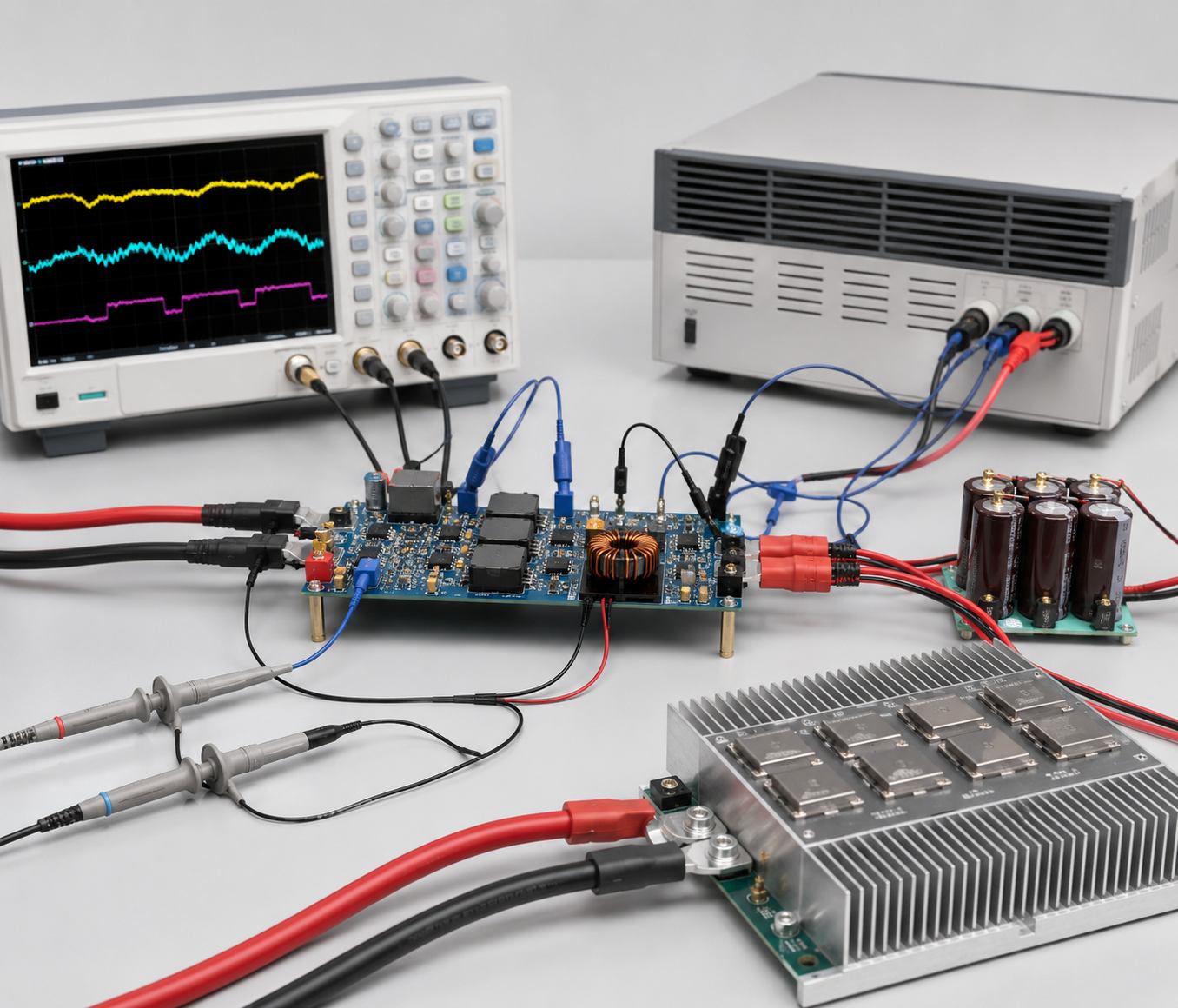
Engineering guide to dynamic load response testing for high-current buck converters, covering load step setup, slew rate, Vcore undershoot, overshoot, recovery time, probe location, output capacitors a…
Engineering guide to output capacitor selection for ASIC Vcore rails, covering bulk capacitors, polymer capacitors, MLCC decoupling, DC bias, ESR, ESL, placement, transient response and substitution ri…
Engineering guide to high-current ASIC Vcore rails, covering 12-phase buck architecture, PMBus control, dynamic load testing, output capacitor networks, smart power stage selection, thermal design and …
Voltage regulator guide covering linear, LDO, 7805, Zener, adjustable, buck, VRM and alternator regulators, with design checks, testing methods, troubleshooting and datasheet-based selection.
Amplifier guide covering voltage, current and power amplification, gain, feedback, amplifier classes, audio and RF applications, op-amp circuits, transimpedance amplifiers, datasheet selection and trou…


